Our readers keep the lights on and my smoothie glass nicely filled. As an Amazon Associate, I earn from qualifying purchases.
Stacking a pile of receipts, contracts, or tax documents onto a flatbed scanner is a slow-motion exercise in patience. An auto feed document scanner transforms that chore into a hands-free workflow, pulling each page through a feeder and digitizing both sides in seconds. The right model turns a cluttered desk into a paperless operation, but the wrong one jams, skips pages, or produces muddy scans.
I’m Mohammad Maruf — the founder and writer behind WellFizz. I have spent hundreds of hours analyzing the hardware specifications, feeder mechanisms, and real-world reliability data on dedicated document scanners to separate the workhorses from the paper-eaters.
After parsing performance benchmarks across nine models, these are the hard specs and real feedback that define the best auto feed document scanner for every office scenario and budget tier.
How To Choose The Best Auto Feed Document Scanner
Not all auto feed scanners handle the same workload. A home user scanning a few receipts each week has different needs than an office processing hundreds of invoices daily. The three specs that define a scanner’s real-world performance are its ADF capacity, duplex speed, and sensor type. Ignore the marketing language and focus on these measurable attributes.
ADF Capacity and Paper Path Design
The Automatic Document Feeder (ADF) capacity tells you how many pages you can load at once. A 50-sheet tray is fine for personal use, but a 100-sheet tray becomes necessary for batch processing of contracts or medical records. The paper path design — straight-through versus U-turn — also matters. Straight paths handle thicker items like business cards and laminated IDs far more reliably.
Duplex Speed and Imaging Sensor
Duplex speed, measured in images per minute (ipm), is the real productivity metric because it captures both sides in a single pass. A scanner rated at 30 ppm / 60 ipm effectively doubles throughput. The imaging sensor choice between CIS and CCD determines the depth of field. CCD sensors produce sharper scans from slightly curled or wrinkled pages, while CIS sensors are thinner, use less power, and suit flat originals.
Quick Comparison
On smaller screens, swipe sideways to see the full table.
| Model | Category | Best For | Key Spec | Amazon |
|---|---|---|---|---|
| ScanSnap iX2400 | Premium | High-volume duplex batch scanning | 45 ppm / 90 ipm, 100-sheet ADF | Amazon |
| Epson RapidReceipt RR-620W | Premium | Receipt & invoice data extraction | 45 ppm / 90 ipm, 100-sheet ADF, AI-ready | Amazon |
| Epson ES-500W II | Premium | Wireless office scanning with CCD sensor | 35 ppm / 70 ipm, 50-sheet ADF, CCD | Amazon |
| Canon imageFORMULA R40 | Premium | QuickBooks & accounting workflow | 40 ppm / 80 ipm, 50-sheet ADF | Amazon |
| ScanSnap iX1300 | Mid-Range | Space-saving duplex scanner with Wi-Fi | 30 ppm / 60 ipm, 50-sheet ADF | Amazon |
| RICOH SP-1130Ne | Mid-Range | Network scanning with TWAIN driver | 30 ppm / 60 ipm, 50-sheet ADF, Ethernet | Amazon |
| Doxie Pro | Mid-Range | Portable duplex scanning with smart software | 20-sheet ADF, duplex, collapsible feeder | Amazon |
| CZUR Aura Pro | Mid-Range | Book & bound-document scanning | 2 sec/page, A3 capture, book flattening | Amazon |
| HP HPPS100 | Budget | Lightweight simplex portable scanning | 15 ppm, simplex, 10-sheet ADF | Amazon |
In‑Depth Reviews
1. ScanSnap iX2400
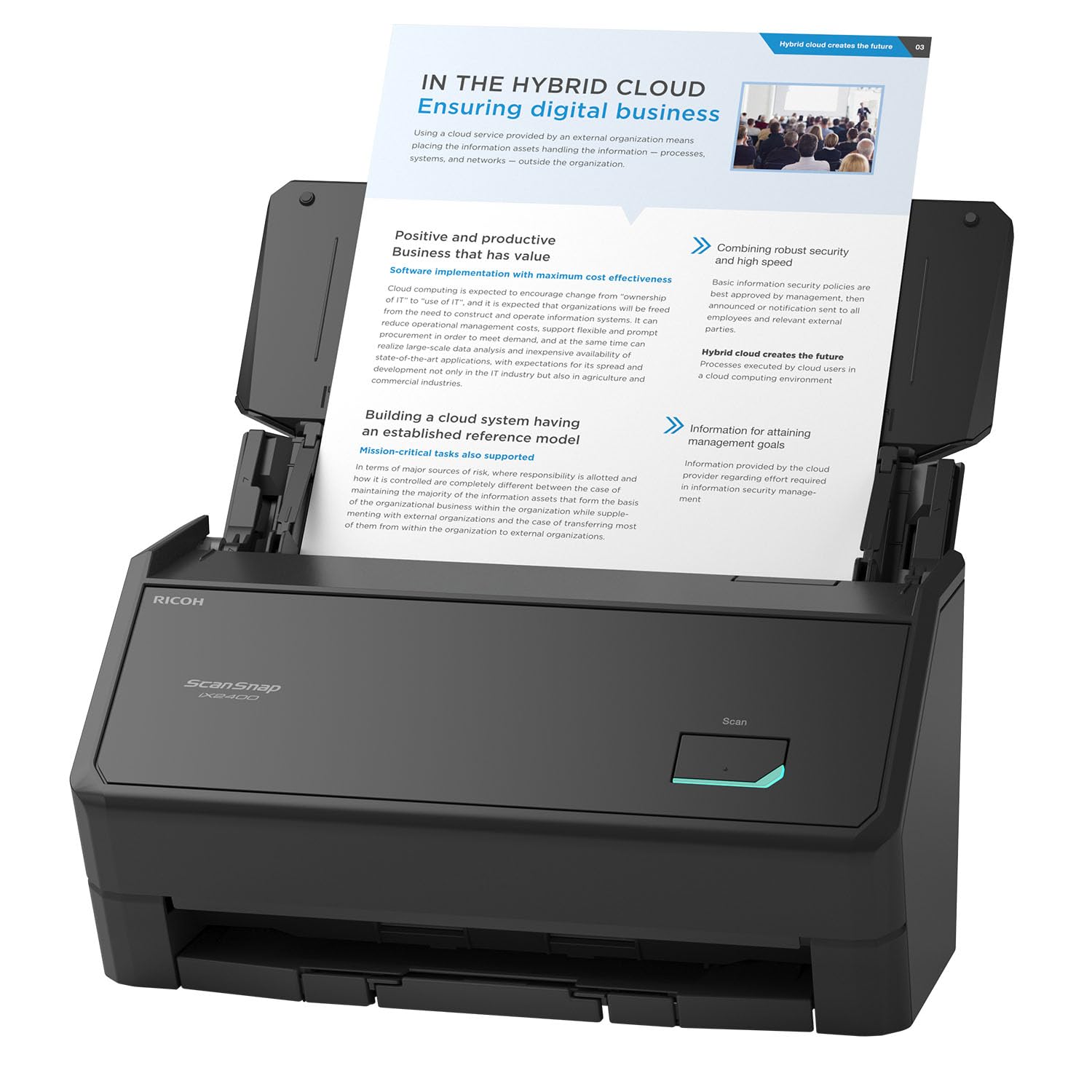
The iX2400 is the closest thing to a conveyor belt for paper in the sub- bracket. Its 100-sheet ADF and 45 ppm / 90 ipm duplex speed mean you can drop a 500-page stack and walk away for eleven minutes. The single-button operation and automatic de-skew, blank page removal, and color detection eliminate the need to babysit each batch.
The CIS sensor delivers 600 dpi optical resolution with consistent sharpness on standard office paper. ScanSnap Home software organizes scans into searchable PDFs with minimal manual tagging. The wired USB connection ensures zero latency, making it a reliable choice for fixed workstation deployments where Wi-Fi dropouts would be disruptive.
Customer feedback highlights the seamless handling of mixed document types — business cards, envelopes, and receipts pass through without jamming. The trade-off is the lack of a TWAIN driver, which limits integration with some third-party document management systems, and the absence of Wi-Fi for mobile scenarios.
Why it’s great
- 100-sheet ADF is best-in-class for this tier
- Duplex speed allows digitizing large volumes in minutes
- Proven reliability over years of use
Good to know
- No Wi-Fi or TWAIN driver support
- Software interface has a slight learning curve
2. Epson RapidReceipt RR-620W
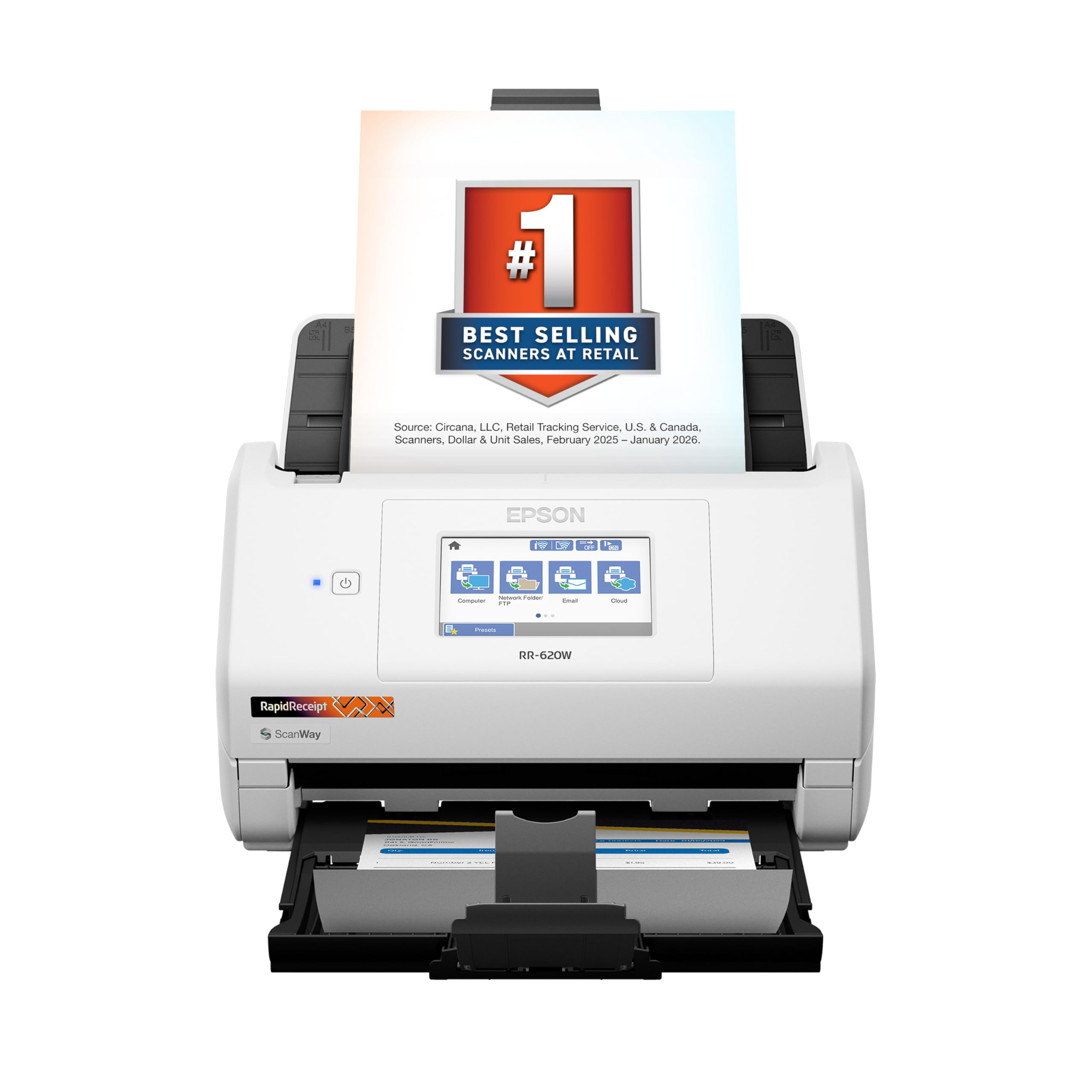
The RR-620W is engineered specifically for receipt and invoice workflows. Its 100-sheet ADF and 45 ppm / 90 ipm duplex speed match the iX2400, but the differentiating feature is the 4.3-inch color touchscreen that enables computer-free scanning directly to email, cloud storage, or a USB flash drive. The ScanWay software processes scans on-device, making it ideal for small business owners who want to avoid leaving a PC running.
Epson’s ScanSmart AI PRO technology extracts payee, amount, date, and category from receipts and exports the data to QuickBooks, TurboTax, and Excel. The CCD-equivalent imaging handles crumpled thermal paper better than CIS-based scanners, reducing the need to flatten every receipt before feeding.
Real users praise the drastic reduction in manual data entry — one reviewer estimated an 80% time savings on expense categorization. The main drawback is the bundled third-party PDF software, which some found non-functional; sticking with the native Epson ScanSmart software avoids the headache entirely.
Why it’s great
- Standalone scanning via touchscreen, no computer needed
- AI data extraction syncs directly with accounting software
- CCD sensor handles crumpled receipts well
Good to know
- Setup can require patience with bundled software
- Not ideal for scanning fragile photos
3. Epson ES-500W II
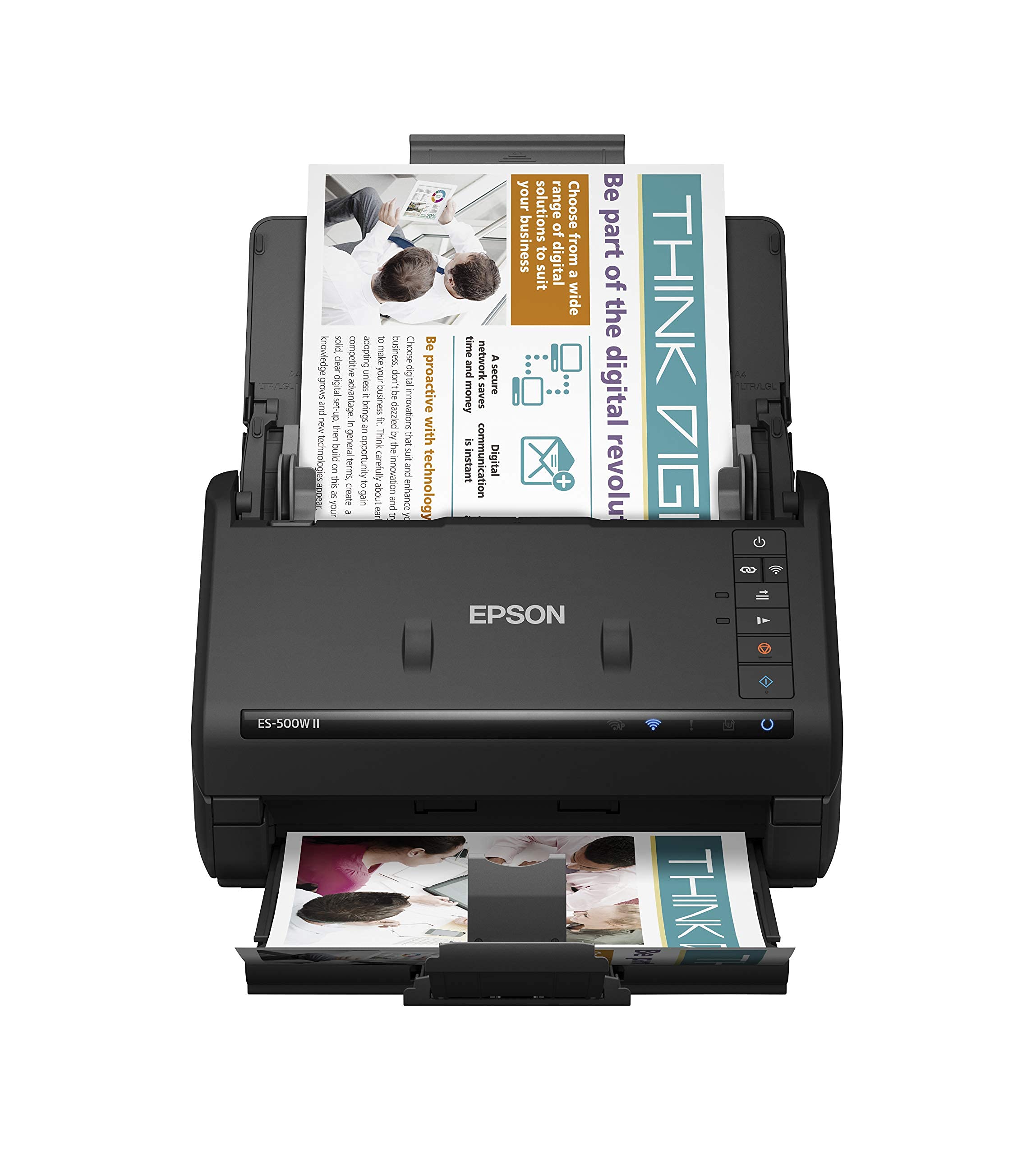
The ES-500W II is a true CCD scanner, which gives it a clear advantage when scanning documents that are not perfectly flat — folded letters, stapled pages, or wrinkled originals. The CCD sensor captures edge-to-edge sharpness with better depth of field than CIS alternatives, and the ultrasonic double-feed detection prevents missed pages and damage from hidden staples.
Wireless connectivity through the Epson Smart Panel app allows scanning from a smartphone or tablet, making it a flexible tool for teams. The 35 ppm / 70 ipm duplex speed may not match the 45 ppm competition, but the combination of CCD quality, 50-sheet ADF, and TWAIN driver support makes it the preferred choice for accounting firms and legal offices that need software-agnostic integration.
Users note that the initial wireless setup can be finicky, and switching between Wi-Fi and USB requires a full driver reinstall. Once running, the scanner is dependable and fast, handling mixed media including business cards and extra-long pages up to 240 inches.
Why it’s great
- CCD sensor delivers superior image quality on imperfect originals
- TWAIN driver ensures compatibility with most document management software
- Ultrasonic double-feed detection prevents page loss
Good to know
- Wireless setup can be tricky initially
- 50-sheet ADF is smaller than the 100-sheet competition
4. Canon imageFORMULA R40 Receipt Edition

Canon’s R40 Receipt Edition is purpose-built for the accounting workflow, bundling a CaptureOnTouch plugin that extracts data from receipts and invoices and pushes it directly to QuickBooks Online. The 40 ppm / 80 ipm duplex speed and 50-sheet ADF handle a typical month’s worth of receipts in a single session. The CIS sensor at 600 dpi captures clean, legible text on standard thermal receipt paper.
The one-button operation reduces the friction of daily scanning — load the paper, press the button, and the software processes the batch. The compact footprint (slightly larger than a shoebox) fits an office desk without dominating the surface. Users who need to scan a mix of receipt sizes benefit from the auto-size detection that crops each scan to the correct dimensions.
Mac users should be aware that the bundled software has received criticism for being bloated and incompatible with macOS 15. The hardware is solid, but the software experience can sour the setup for Apple-centric offices. A third-party solution like VueScan resolves compatibility issues, but it adds to the total investment.
Why it’s great
- Native QuickBooks integration streamlines expense management
- Reliable ADF handles receipts without jamming
- Fast duplex scanning for batch processing
Good to know
- Bundled software has compatibility issues on macOS
- USB 2.0 interface may feel outdated for large transfers
5. ScanSnap iX1300

The iX1300 shrinks the footprint of a full-featured duplex scanner without sacrificing wireless capability. Its 30 ppm / 60 ipm duplex speed and 50-sheet ADF handle moderate office volumes, and the space-saving design folds the output tray under the scanner when not in use. The CIS sensor at 600 dpi produces clean scans of standard documents, and the Quick Menu software allows one-click scanning to email, folders, or cloud services.
Wi-Fi and USB connectivity mean the iX1300 can sit on a shared desk and serve multiple workstations. The automatic feed arm and return tray keep the workflow tidy. The ScanSnap Home software organizes documents into searchable PDFs with minimal setup, making it approachable for users who do not want to dive into driver configurations.
One recurring complaint involves paper jams — some users report jams every four to five pages with the paper pulling at an angle and wrinkling sheets. Others scanned thousands of pages without a single jam, suggesting batch-to-batch variance or sensitivity to paper quality. Edge-case trimming of content (missing 0.5–1 inch of the page edge) has also been flagged.
Why it’s great
- Compact design with folding output tray saves desk space
- Wireless scanning via Wi-Fi for multi-user setups
- Intuitive Quick Menu software for fast workflow
Good to know
- Some units experience frequent paper jams
- Inconsistent auto-sizing can cut off page edges
6. RICOH SP-1130Ne

The RICOH SP-1130Ne is the entry-level networkable scanner that brings TWAIN driver support to a price bracket where it is often missing. The 30 ppm / 60 ipm duplex speed and 50-sheet ADF are standard mid-range specs, but the Ethernet connectivity makes it possible to place the scanner on a shared network and scan from any workstation without a dedicated PC host.
RICOH’s PaperStream ClickScan software provides a straightforward interface with one-push scanning to email, local folders, or cloud destinations. The compact chassis dimensions (11.2 x 5.3 x 5.2 inches) let it sit on a credenza or side table without dominating the space. The CIS sensor at 600 dpi delivers acceptable image quality for text-based documents and standard letter-size paper.
The Ethernet port only supports one active network user at a time — other workstations must wait until the connection is released. Most offices will treat this as a single-user scanner connected via USB, which defeats the network advantage. That said, buyers looking for an affordable TWAIN-compatible duplex scanner have few other options at this level.
Why it’s great
- TWAIN driver for broad software compatibility
- Ethernet connectivity for network placement
- Affordable entry into duplex scanning
Good to know
- Only one user can connect over Ethernet at a time
- Minor learning curve with PaperStream software
7. Doxie Pro

The Doxie Pro stands out for its software-first approach. The companion app automatically imports scans to Dropbox, Evernote, OneNote, and iCloud without needing to manually locate files on a drive. The duplex ADF handles two-sided scanning in a single pass, and the collapsible feeder makes the unit more portable than fixed-chassis models. The 20-sheet ADF capacity is modest, but the direct-feed slot handles thick or delicate items like glossy photos and folded maps.
The hardware measures 12 x 4 x 3 inches and weighs just over 3 pounds, making it the most transportable duplex option on this list. Setup requires no complex drivers — the scanner is recognized immediately by modern operating systems. Image quality at 600 dpi is crisp, with automatic cropping, straightening, and contrast enhancement applied in real-time.
Real-world users report a jam rate of roughly 1 in 300 pages, which is excellent for a portable feeder. The lack of an SD card slot and external battery limits untethered operation, and there is no dedicated Chromebook app. For a home office or mobile professional who values software integration over raw ADF capacity, the Doxie Pro is a refined choice.
Why it’s great
- Excellent software integration with cloud services
- Portable design with collapsible feeder
- Very low jam rate in real-world use
Good to know
- 20-sheet ADF limits batch capacity
- No SD card slot or external battery option
8. CZUR Aura Pro

The CZUR Aura Pro is not a traditional sheet-fed scanner — it is a book scanner that captures two pages at once with an overhead camera. The AI-powered curve flattening technology uses laser lines to model the page curvature and digitally flatten it, producing images that look as if the pages were separated. This makes it the only scanner on this list capable of handling bound documents, magazines, or fragile archival material without damaging the spine.
The 32 LED lights and two supplemental sidelights eliminate shadows and glare, while the foot pedal (sold separately) enables hands-free page turning. The software produces searchable PDFs with OCR support for 180+ languages. The output formats include JPG, Word, PDF, and searchable PDF, covering most archiving needs.
The learning curve is real — users need to practice proper hand positioning to avoid capturing fingers in the frame. The finger cots included in the box help, but the process is slower than a dedicated ADF scanner for single sheets. It excels at its specific use case: digitizing thick textbooks or old photo albums where traditional feeders would cause damage.
Why it’s great
- Captures A3-size pages and bound books without damage
- AI flattening produces flat, readable page images
- Integrated LED lighting eliminates shadows
Good to know
- Steep learning curve for hand positioning
- Slower than ADF scanners for single-sheet batches
9. HP HPPS100

The HP HPPS100 is the lightest scanner in this roundup at 3 ounces, designed for the mobile professional who needs to digitize a handful of pages while traveling. The 10-sheet ADF and 15 ppm simplex speed are entry-level specs, but the USB bus-powered operation means no charging brick or wall outlet is needed — just plug into any laptop and scan.
At 1200 dpi resolution, the image quality is surprisingly good for its size. The scanner accepts sheets from 2 x 2.9 inches up to 8.5 x 14 inches, covering business cards, receipts, invoices, and legal documents. HP WorkScan software for Windows and macOS provides basic editing tools like cropping, background removal, and image optimization.
The software lock at 300 dpi in the bundled app is a known limitation, but using third-party scanning software bypasses this restriction. The simplex-only scanning means double-sided documents require manual flipping, which becomes tedious beyond a few pages. For its intended use case — occasional scanning on a plane, in a coffee shop, or at a client site — it is the most portable option available.
Why it’s great
- Ultra-light at 3 oz, perfect for travel
- USB bus-powered, no external power supply needed
- Decent 1200 dpi resolution for its size
Good to know
- Simplex only — manual flipping for double-sided pages
- Bundled software locks resolution at 300 dpi
FAQ
Can an auto feed scanner handle stapled or folded paper?
Why does my scanner keep jamming on thermal receipt paper?
What is the difference between ppm and ipm in scanner ratings?
Do all auto feed scanners support scanning to cloud services like Dropbox or Google Drive?
Final Thoughts: The Verdict
For most users, the best auto feed document scanner winner is the ScanSnap iX2400 because its 100-sheet ADF and 90 ipm duplex speed deliver high-volume throughput with proven reliability across years of use. If you need AI-powered receipt data extraction for accounting workflows, grab the Epson RapidReceipt RR-620W. And for mobile professionals who need a pocket-friendly simplex scanner, nothing beats the HP HPPS100.

Mo Maruf
I created WellFizz to bridge the gap between vague wellness advice and actionable solutions. My mission is simple: to decode the research and give you practical tools you can actually use.
Beyond the data, I am a passionate traveler. I believe that stepping away from the screen to explore new environments is essential for mental clarity and physical vitality.