Our readers keep the lights on and my smoothie glass nicely filled. As an Amazon Associate, I earn from qualifying purchases.
Stepping into a true 7.1 surround sound system means leaving the thin soundstage of a soundbar behind for a full hemisphere of audio—bullets whizz past your ear, rain falls from above, and the low-end rumble of an explosion presses against your chest. The jump from virtual processing to dedicated physical channels is dramatic, but choosing the right receiver and speaker combination requires parsing specs like HDMI 2.1 bandwidth, amplifier wattage per channel, and codec support (Dolby Atmos, DTS:X, Auro-3D) that determines whether your setup is truly future-proof or stuck in the past.
I’m Mohammad Maruf — the founder and writer behind WellFizz. I’ve spent years analyzing home theater hardware specifications, amplifier topologies, and room-correction algorithms to separate marketing fluff from measurable performance.
Whether you’re building a dedicated theater room or upgrading your living room, this guide to the best 7.1 surround sound system breaks down eleven top-tier options across receivers, speaker bundles, and soundbars to match your space and budget.
How To Choose The Best 7.1 Surround Sound System
A 7.1 system consists of seven speakers (left, center, right, two side surrounds, two rear surrounds) and one subwoofer. The receiver is the brain, decoding audio formats and powering each channel. The biggest mistake is matching a high-end receiver with budget speakers or vice versa—balance is everything.
Receiver Power and Channel Configuration
Look for receivers that list power per channel driven (typically 75-110W into 8 ohms). A 7.2 channel receiver allows two subwoofers for smoother bass response, while a 9.2 channel unit adds front-height or rear-height channels for Atmos without sacrificing your 7.1 bed layer. THX certification (Select, Ultra) guarantees a minimum level of performance for larger rooms.
HDMI 2.1 and Gaming Features
For 4K/120Hz and 8K/60Hz passthrough, the receiver must have HDMI 2.1 inputs with 40Gbps bandwidth. Features like VRR (Variable Refresh Rate) and ALLM (Auto Low Latency Mode) eliminate screen tearing and input lag for PS5 and Xbox Series X. If gaming isn’t a priority, HDMI 2.0 with eARC is sufficient for streaming and Blu-ray.
Room Calibration and Speaker Matching
Automatic room correction (Audyssey MultEQ, YPAO R.S.C., Dirac Live) measures speaker distances and EQ to compensate for room acoustics. Timbre-matched speaker packages ensure seamless panning between channels—mixing brands can create tonal shifts as sound moves across the soundstage.
Quick Comparison
On smaller screens, swipe sideways to see the full table.
| Model | Category | Best For | Key Spec | Amazon |
|---|---|---|---|---|
| Denon AVR-S770H | AV Receiver | Best Overall Balance | 75W x 7, 8K, Audyssey | Amazon |
| Onkyo TX-NR6100 | AV Receiver | Gaming & THX | 210W/Ch Dynamic, THX Select | Amazon |
| Yamaha RX-A2A | AV Receiver | MusicCast & Versatility | 100W x 7, YPAO R.S.C. | Amazon |
| Sony STR-AN1000 | AV Receiver | 360 Spatial Sound Mapping | 165W (6 ohms), DCAC IX | Amazon |
| Yamaha RX-A4A | AV Receiver | Surround:AI & Auro-3D | 110W x 7, YPAO 3D | Amazon |
| Fluance Elite SX71BR | Speaker System | Full 7.1 Speaker Package | 3-Way Towers, 10″ Sub | Amazon |
| Klipsch Cinema + Onkyo RZ30 | Bundle | 5.1.4 Atmos Ready | Tractrix Horn, 170W RZ30 | Amazon |
| Klipsch 5.2+ Yamaha A2AB | Bundle | Dual Sub Bass Headroom | Dual 12″ Subs, Floorstanders | Amazon |
| LG S90TR | Soundbar | Apartment/LG TV Owners | 7.1.3 Channels, Wow Orchestra | Amazon |
| TCL Q85H | Soundbar | Plug-and-Play Value | 7.1.4 Channels, 860W | Amazon |
| ULTIMEA Skywave X70 | Soundbar | Deep Bass Enthusiast | 10″ Sub, 20Hz, GaN Amp | Amazon |
In‑Depth Reviews
1. Denon AVR-S770H 7.2 Ch Home Theater Receiver

The Denon AVR-S770H strikes a compelling balance for the mid-range buyer: 75 watts per channel into 7 channels is sufficient for most bookshelf and tower speakers in rooms up to 400 square feet, while the built-in Audyssey MultEQ calibration tames room modes and time-aligns each driver in under ten minutes. Its 6 HDMI 2.1 inputs (all 40Gbps) handle 4K/120Hz passthrough from a PS5 or Xbox Series X without dropping a frame, and Dolby Height Virtualization can fake overhead effects if you’re not ready to mount ceiling speakers.
The HEOS multi-room platform lets you group this receiver with other Denon units or wireless speakers for whole-home audio, and voice control works via Alexa, Google Assistant, and Siri. A handful of users report firmware glitches causing random volume drops, but a factory reset and update from a USB drive typically resolves the issue. For the price, the S770H delivers more clean power and modern gaming features than comparably priced Sony or Yamaha entries, making it the anchor of a reliable 7.1 setup.
Pair it with a timbre-matched speaker package like the Fluance Elite series or Klipsch Reference for a cohesive soundstage. The receiver lacks pre-outs for external amplification and only supports 5.1.2 Atmos (not 7.1.2), but those are compromises most buyers in this tier can live with.
Why it’s great
- Full HDMI 2.1 bandwidth for 4K/120 and 8K/60
- Audyssey MultEQ provides reliable room correction
- HEOS multi-room streaming supports major music services
Good to know
- Occasional firmware bugs require manual update
- No pre-outs for separate power amps
- Limited to 5.1.2 Atmos, not 7.1.2
2. Onkyo TX-NR6100 7.2 Channel THX Certified AV Receiver
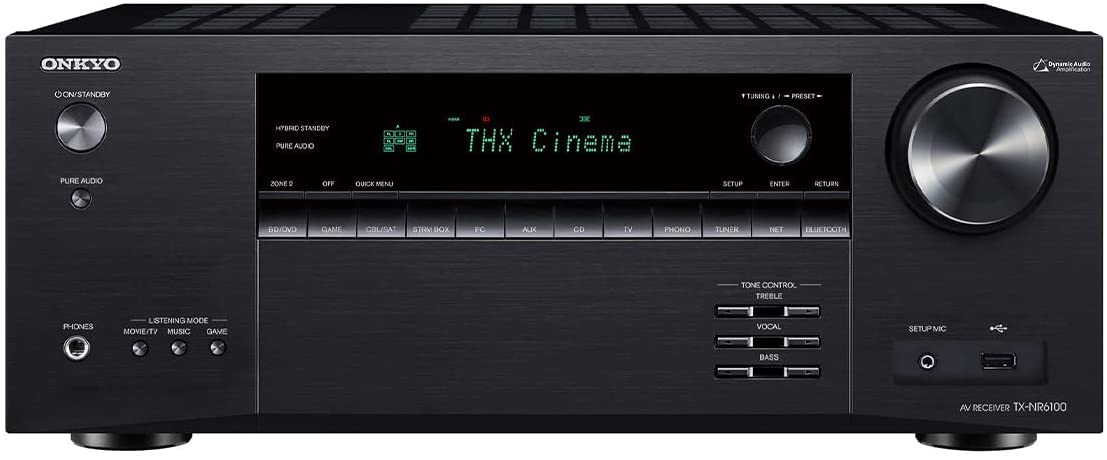
The Onkyo TX-NR6100 brings THX Select Certification to the table, meaning it has passed a suite of tests for reference-level sound in rooms where the screen-to-seat distance is roughly 3-4 meters. Its dynamic power rating of 210W per channel (2-ch driven, 6 ohms) translates to headroom that keeps transients clean during explosive action sequences, and the 5.2.2-channel layout supports Dolby Atmos and DTS:X with dedicated height channels.
Three HDMI 2.1 inputs handle 4K/120Hz and 8K/60Hz signals with full HDCP 2.3 compliance, and the discrete Zone 2 audio/video output lets you send a separate source to a second room. Onkyo’s AccuEQ room calibration is less sophisticated than Audyssey or YPAO—it primarily handles distance and level without parametric EQ—so you may need to manually tweak the subwoofer crossover. Some long-term owners report HDMI board failures after two years, though Onkyo’s warranty support has improved under new ownership.
The non-backlit remote feels cheap for a receiver in this class, and the Bi-Amp mode rears its head: using two channels to bi-amp front speakers drops you to 5.1 surround. Stick to standard 7.1 or 5.1.2 and you’ll get THX-certified dynamics that can drive a Klipsch Reference setup to reference levels without strain.
Why it’s great
- THX Select guarantees a minimum performance standard
- High dynamic headroom for clean transients
- Full HDMI 2.1 gaming support
Good to know
- AccuEQ lacks parametric EQ for deep room correction
- Reports of HDMI board failure after extended use
- Bi-Amp mode reduces surround channels
3. Yamaha RX-A2A AVENTAGE 7.2-Channel AV Receiver

The Yamaha RX-A2A sits in the AVENTAGE line—Yamaha’s top-tier series—which means a thicker chassis, an extra internal foot for vibration damping, and higher-grade internal components compared to the standard RX-V series. Its 7-channel amplification (100W per channel into 8 ohms) pairs with Yamaha’s YPAO R.S.C. (Reflected Sound Control) room correction, which measures multipoint reflections and applies precision EQ to tame early reflections that smear stereo imaging.
The Surround:AI feature analyzes each scene in real-time—dialogue, ambient, effects, and bass—and adjusts the sound field parameters accordingly. In practice, it pushes dialogue clarity during quiet passages and widens the soundstage during action scenes, all automatically. Three of the seven HDMI inputs support 8K60/4K120 at 40Gbps with ALLM and VRR, making this a solid pick for mixed-use living rooms that serve both movie nights and gaming sessions.
MusicCast wireless multi-room is among the most stable ecosystems tested, and the receiver is Roon Tested for high-res audio enthusiasts. A minority of users experience an intermittent no-signal handshake with Sony TVs, typically fixed by swapping HDMI cables or disabling CEC. Overall, the RX-A2A offers a step up in build quality over the Denon S770H with better streaming features, though its room correction doesn’t dig as deep as Dirac Live on pricier units.
Why it’s great
- Surround:AI dynamically optimizes sound in real-time
- YPAO R.S.C. multipoint room correction
- MusicCast multi-room is reliable and feature-rich
Good to know
- HDMI handshake issues with certain Sony TVs
- No analog video inputs on this model
- MSRP is high; best purchased on sale
4. Sony STR-AN1000 7.2 CH Surround Sound Home Theater 8K A/V Receiver

Sony’s STR-AN1000 leverages 360 Spatial Sound Mapping, an algorithm that creates up to six phantom speakers by processing the phase and delay of the physical channels. The result is a wider, more enveloping soundfield than the raw seven channels would suggest—especially impressive for object-based soundtracks where helicopters pan smoothly from front to rear. The Digital Cinema Auto Calibration IX (DCAC IX) measures each speaker’s frequency response and distance with a supplied microphone, then applies correction filters that Sony’s cinema division helped develop.
Six HDMI inputs support 8K and 4K/120 with VRR and ALLM, and the receiver integrates with Sonos systems via Works with Sonos certification—handy if you already own Sonos speakers for other rooms. The S-Center sync feature uses a compatible Sony TV’s speakers as a dedicated center channel, which can improve dialogue clarity without buying a third speaker. The front display is too small to read across a room, and the on-screen menu for audio settings is clunky.
A known issue with Apple TV 4K Dolby Vision passthrough requires connecting the Apple TV directly to the TV and using eARC for sound. Users report that the subwoofer distance measurement from the calibration mic is occasionally wrong by 10 feet, requiring manual correction. Despite these quirks, the STR-AN1000 produces a crisp, detailed soundstage that competes with receivers costing more, especially when paired with Sony’s wireless subwoofers.
Why it’s great
- 360 Spatial Sound Mapping creates phantom height channels
- Works with Sonos for multi-room integration
- S-Center sync uses TV speakers for dialogue
Good to know
- Dolby Vision passthrough with Apple TV 4K is glitchy
- Small front display hard to read from a distance
- Calibration mic can mis-measure subwoofer distance
5. Yamaha RX-A4A AVENTAGE 7.2-Channel AV Receiver

The Yamaha RX-A4A is a step up from the A2A, adding Auro-3D decoding and a more robust YPAO R.S.C. with 3D multipoint measurement and Precision EQ. Auro-3D introduces a third layer (height) to the soundfield, creating a “snow dome” effect that is distinct from Atmos’s object-based approach—support for both means you can play any immersive format without compromise. The seven HDMI inputs all support 8K60/4K120 at 40Gbps, and the pre-outs for front left/right channels allow you to add an external power amplifier for demanding tower speakers.
Surround:AI on the A4A processes audio in 60-millisecond bursts, analyzing scene elements (dialogue, ambient, effects) against a database of sound signatures to apply real-time EQ. It’s more refined than the A2A’s implementation, with less aggressive center-channel steering during old stereo content. The MusicCast app is among the best in class for stability, and the phono input is a welcome inclusion for vinyl listeners.
The major drawback is the firmware update process—it requires a USB flash drive rather than an over-the-air option, and the initial setup menu is dense with options that can overwhelm new users. Once dialed in via YPAO, the A4A delivers a clean, neutral sound that reveals the character of your speakers without adding coloration. For buyers who plan to expand to a 5.1.2 or 7.1.4 system later, the A4A’s surround back and height pre-outs make it the most future-proof Yamaha in this lineup.
Why it’s great
- Supports Dolby Atmos, DTS:X, and Auro-3D
- Front L/R pre-outs for external amplification
- Surround:AI is refined and unobtrusive
Good to know
- Firmware updates require a USB flash drive
- Setup menu is dense for beginners
- No front HDMI input for quick connections
6. Fluance Elite High Definition Surround Sound Home Theater 7.1 Speaker System SX71BR

The Fluance Elite SX71BR is a complete 7.1 speaker package that includes two 3-way floorstanding towers, a center channel, two bookshelf speakers, two surround speakers, and a 10-inch powered subwoofer—all timbre-matched so the sonic signature is consistent as sounds pan across the room. The towers use a 1-inch silk dome tweeter, a 5-inch midrange, and dual 8-inch woofers in a precision-ported MDF cabinet, producing a frequency response that extends down to 35Hz before the subwoofer takes over.
The DB10 subwoofer uses a 10-inch long-throw driver in a front-ported enclosure, delivering 150 watts RMS of bass down to 30Hz. It is clean and punchy for music but may lack the deep extension (sub-25Hz) that home theater purists want for LFE effects. The cabinets are finished in a woodgrain vinyl that looks convincing from a few feet away, and the magnetic grilles give a clean aesthetic. Customers praise the customer support team’s responsiveness when replacing damaged units in transit.
The main limitation is the connectivity—this is a passive speaker system that requires a separate AV receiver to power it. The surround speakers are larger than typical dipole designs, so wall-mounting them may require sturdy brackets. For buyers who want a complete, matched 7.1 speaker set without mixing brands, the Fluance Elite package offers excellent coherence at a competitive price point.
Why it’s great
- Timber-matched across all seven channels for seamless panning
- 3-way floorstanding towers with dedicated midrange drivers
- Lifetime parts and labor warranty on speakers
Good to know
- Requires a separate AV receiver to power
- Surround speakers are large for wall-mounting
- Subwoofer doesn’t dig below 30Hz for deep LFE
7. Klipsch Reference Cinema System with Onkyo TX-RZ30 9.2-Channel 8K AV Receiver

This bundle pairs the Klipsch Reference Cinema System 5.1.4—featuring four satellite speakers with integrated Dolby Atmos up-firing drivers and a 10-inch powered subwoofer—with the Onkyo TX-RZ30, a 170W per channel 9.2-channel THX-certified receiver that supports Dirac Live room correction. The Klipsch Tractrix horn-loaded tweeters deliver the brand’s characteristic high sensitivity (96dB), meaning the receiver doesn’t need to work hard to achieve reference levels, and the aluminum LTS tweeters keep distortion low during high-frequency transients.
The 5.1.4 configuration uses the four Dolby Atmos satellites as front and rear height channels, creating overhead effects without cutting holes in your ceiling. The 10-inch subwoofer offers adjustable gain and a low-pass crossover, though some users replace it with dual 12-inch subs for deeper extension. The Onkyo RZ30 has seven HDMI 2.1 inputs (all 40Gbps), Dirac Live with optional Bass Control upgrade, and bi-amping capability for the front channels.
The receiver’s warranty handling has been inconsistent—one report of a unit failing twice within weeks suggests potential quality control issues. The bundle does not include speaker wire, and the speaker terminals require banana plugs for a clean connection. For buyers who want the Klipsch horn sound combined with a receiver that supports advanced room correction and future expansion to a 7.1.4 or 9.2.4 system, this is a comprehensive starting point.
Why it’s great
- Klipsch horn-loaded tweeters deliver high sensitivity and dynamics
- Onkyo RZ30 supports Dirac Live room correction
- 5.1.4 Atmos configuration with dedicated up-firing speakers
Good to know
- Receiver quality control has been inconsistent
- No speaker wire included in the box
- Limited to 5 base channels, not a true 7.1 bed
8. Klipsch Reference 5.2 Home Theater System with Yamaha RX-A2AB 7.2-Channel AV Receiver
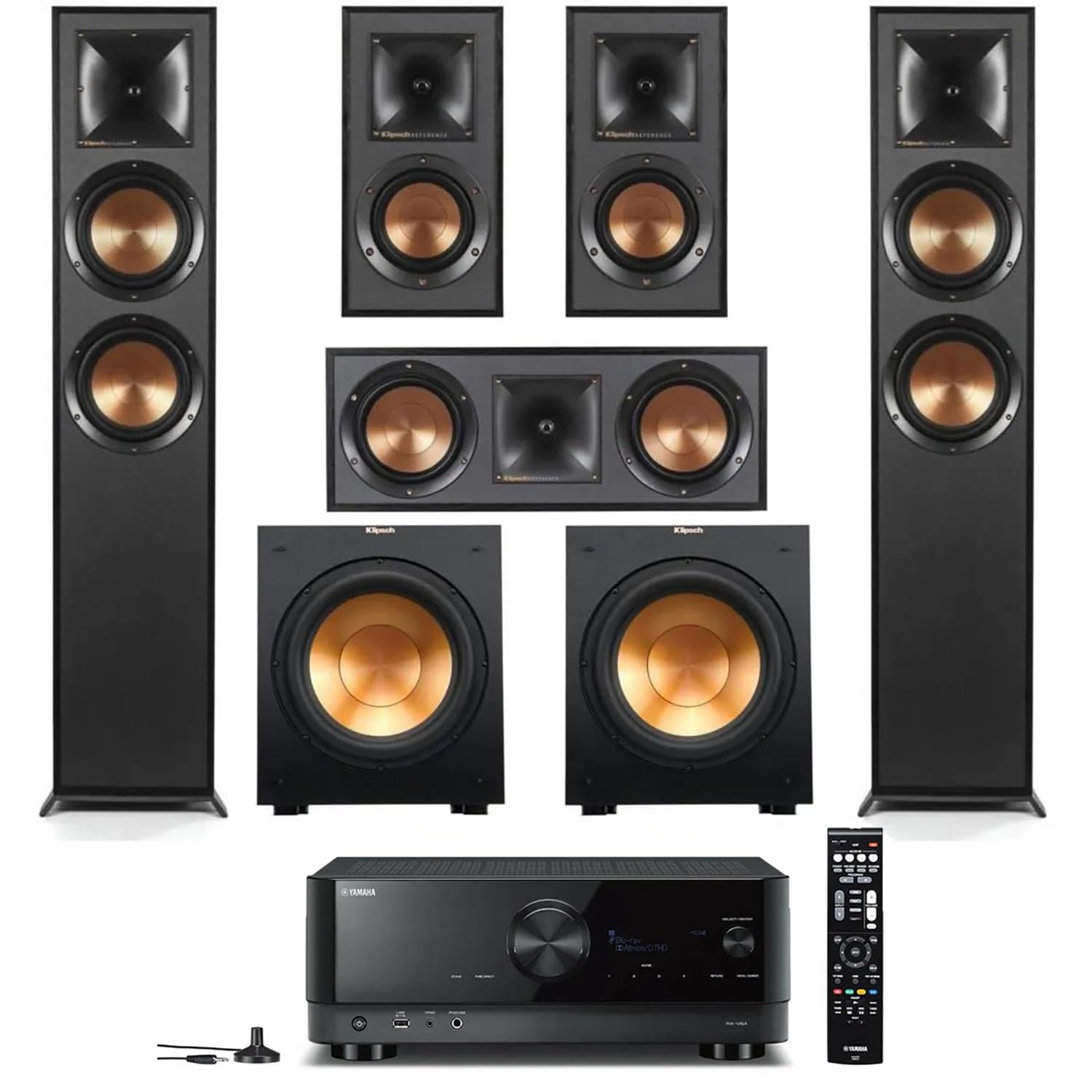
This bundle combines two Klipsch R-625FA floorstanding towers with built-in Dolby Atmos up-firing speakers, two R-12SW 12-inch subwoofers, an R-52C center channel, R-41M bookshelf speakers, and the Yamaha RX-A2AB 7.2-channel receiver. The dual 12-inch subs deliver a combined output that can pressurize medium-to-large rooms (up to 500 cubic feet) down to 29Hz, and the Atmos towers fire sound upward to bounce off your ceiling, creating a convincing overhead layer without cutting holes.
The R-625FA towers integrate the Atmos driver into the top of the cabinet—no separate modules needed—and their 6.5-inch IMG woofers handle mid-bass efficiently. The Yamaha RX-A2AB (a variant of the RX-A2A) provides 100W per channel into 8 ohms, YPAO R.S.C. room correction, and MusicCast multi-room streaming. Users report the system fills a 20×15-foot room with vaulted ceilings to reference levels without distortion, and the copper-spun woofers match Klipsch’s distinctive aesthetic.
The Yamaha receiver needs a USB firmware update out of the box to enable some HDMI 2.1 features, and the bookshelf speakers may be slightly too large for ideal side surround placement in tight spaces. The system is 5.2 not 7.1, but the Atmos height channels add the missing dimension for object-based audio. For buyers seeking a high-output Klipsch setup with dual subwoofers for even bass response, this bundle brings premium components at a package discount.
Why it’s great
- Dual 12-inch subwoofers for chest-thumping bass
- Floorstanding towers with integrated Atmos up-firing drivers
- Klipsch horn tweeters deliver clean, dynamic highs
Good to know
- Yamaha receiver requires USB firmware update initially
- System is 5.2, not a full 7.1 configuration
- Bookshelf speakers may be too large for close side placement
9. LG S90TR 7.1.3-Channel Soundbar with Rear Speakers and Wireless Subwoofer

The LG S90TR is a 7.1.3-channel soundbar system that includes a wireless subwoofer and wireless rear speakers with both front- and up-firing drivers. The “3” in 7.1.3 refers to three up-firing channels: left, right, and a dedicated center up-firing driver focused on dialogue clarity. Combined with LG’s Wow Orchestra feature (synchronized audio between the soundbar and compatible LG TV speakers), the system creates a wide soundstage that extends beyond the physical width of the bar.
WOWCAST built-in allows wireless Dolby Atmos transmission from a compatible LG TV without an HDMI cable, reducing clutter. Advanced Room Calibration uses the soundbar’s built-in microphone to measure the room’s dimensions and adjust the EQ accordingly. The system supports VRR and ALLM pass-through (up to 120Hz), making it viable for gaming, and voice control works with Google Assistant and Alexa.
One limitation is that the rear speakers need power outlets, so you can’t run them on batteries. The bass is impressive for a wireless sub—some users report it has more punch than a previous JBL 10-inch bar system. This isn’t a true 7.1 receiver-based setup, but for LG TV owners who want a clean, wireless Atmos installation without a separate AV receiver, the S90TR delivers a 3D soundfield that outperforms most soundbars in its class.
Why it’s great
- Center up-firing driver enhances dialogue clarity with Atmos
- WOWCAST offers wireless Dolby Atmos from LG TVs
- Advanced Room Calibration optimizes for room acoustics
Good to know
- Rear speakers require power outlets—not fully wireless
- Limited to LG TV ecosystem for some features
- Not a true 7.1 channel separate system
10. TCL Q85H 7.1.4 Surround Sound Bar with Wireless Subwoofer

The TCL Q85H is a 7.1.4-channel soundbar system with wireless rear speakers that include both front-firing and up-firing drivers, delivering a full 7.1.4 Atmos layout without a separate receiver. The included 6.5-inch wireless subwoofer produces 860W peak output, and the AI Sonic optimization feature uses the TCL app to measure your seating position and adjust the sound field for balanced immersion. Setup is genuinely plug-and-play—HDMI eARC pairs the sub and rears automatically within seconds.
The metal grille enclosure feels solid, and the 42-inch soundbar is wide enough to match a 55-inch or larger TV visually. Dialogue in non-Atmos content can be quieter than ideal—there is no dedicated rear-channel volume adjustment, which makes balancing the surround level somewhat dependent on the source material. The system handles 4K HDR passthrough at 60Hz (not 120Hz), so hardcore gamers need to connect their console directly to the TV.
For buyers transitioning from TV speakers or a basic 2.1 soundbar, the Q85H provides a true discrete surround experience with minimal complexity. The bass is loud and room-filling, though it can overpower smaller spaces. At its price point, the Q85H offers the most channel counts and the easiest setup in the soundbar category, making it a compelling entry point into immersive audio.
Why it’s great
- Genuine 7.1.4 channel layout with wireless rears
- AI Sonic optimization adjusts sound to your seating position
- Plug-and-play setup via HDMI eARC
Good to know
- No individual rear channel volume adjustment
- 4K passthrough limited to 60Hz (no 120Hz)
- Dialogue can sound recessed with non-Atmos content
11. ULTIMEA Skywave X70 7.1.4ch Professional Wireless Surround Sound System
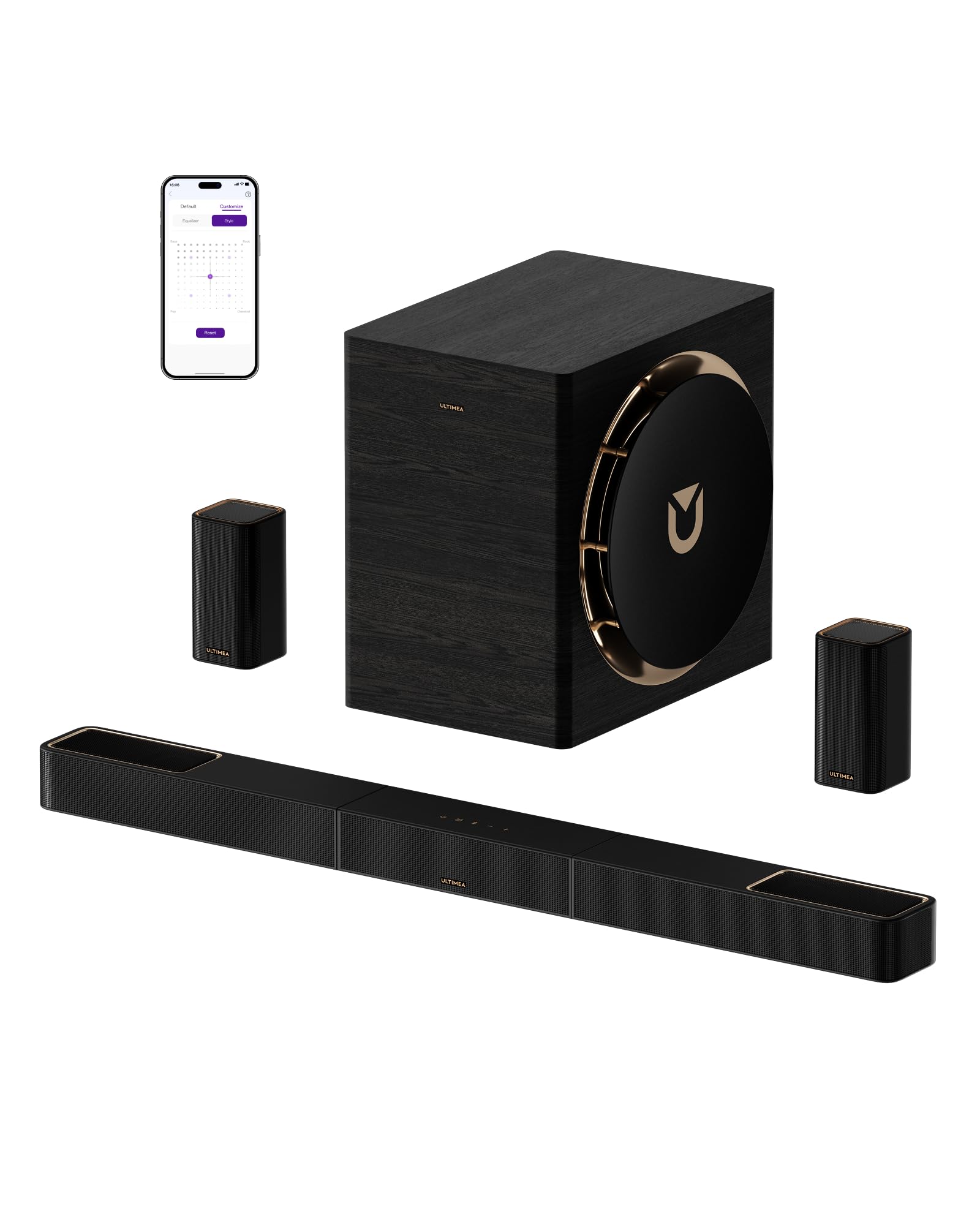
The ULTIMEA Skywave X70 is a 7.1.4-channel wireless soundbar system built around a 10-inch wireless subwoofer that uses a Gravus Ultra-Linear driver to reach 20Hz—deep enough to reproduce the lowest organ notes and LFE effects from modern action movies. The soundbar uses a Gallium Nitride (GaN) amplifier rated at 98% efficiency, which produces 980W peak output with minimal heat—a significant engineering shift from traditional Class-D silicon amps that typically run hotter at high volume.
The NEURACORE multi-channel audio engine uses a triple-core DSP and dual-core MCU to process 24-bit/192kHz audio with <0.5% total harmonic distortion, and it supports up to 17 virtual channels for object-based positioning. The wireless rear speakers connect via dual 5GHz RF bands, which minimizes interference from Wi-Fi networks. The subwoofer enclosure uses wood-crafted panels with a metal grille soundbar that includes rose gold accents—a design that stands out from typical black plastic soundbars.
The system lacks automatic room calibration, so you need to manually adjust the rear speaker levels and distance via the app or remote. The auto-power-off timeout can be disruptive during long listening sessions. For buyers who prioritize deep, tactile bass—the kind you feel in your chest during an explosion—the X70 delivers sub-25Hz extension that typically requires a much larger, dedicated subwoofer. It’s the best choice in this list for bass-heads who want a simple wireless installation.
Why it’s great
- 10-inch subwoofer reaches down to 20Hz for true deep bass
- GaN amplifier runs cooler and more efficiently than silicon designs
- NEURACORE DSP provides low distortion and wide soundstage
Good to know
- No automatic room calibration—manual placement needed
- Auto power-off timer can be inconvenient
- Speaker wire for rears feels somewhat stiff and plasticky
FAQ
Can I use my old wired rear speakers with a new 7.1 receiver?
Is 7.1 still relevant for modern Dolby Atmos soundtracks?
What size room is ideal for a 7.1 system?
How far should rear surround speakers be from the listening position?
Can I mix different brands of speakers in a 7.1 system?
Final Thoughts: The Verdict
For most users, the best 7.1 surround sound system winner is the Denon AVR-S770H because it combines robust 75W x 7 amplification with Audyssey room correction and full HDMI 2.1 gaming support at a price that leaves budget for quality speakers. If you want the most powerful receiver for future expansion with Auro-3D and pre-outs, grab the Yamaha RX-A4A. And for the simplest plug-and-play experience with deep, room-shaking bass, nothing beats the ULTIMEA Skywave X70 soundbar.

Mo Maruf
I created WellFizz to bridge the gap between vague wellness advice and actionable solutions. My mission is simple: to decode the research and give you practical tools you can actually use.
Beyond the data, I am a passionate traveler. I believe that stepping away from the screen to explore new environments is essential for mental clarity and physical vitality.