Our readers keep the lights on and my smoothie glass nicely filled. As an Amazon Associate, I earn from qualifying purchases.
Choosing an amplifier for your passive speakers is the single most consequential decision in building a hi-fi system. A mismatch in power, impedance, or connectivity can leave your speakers sounding thin, strained, or — worse — damaged. The market is flooded with options ranging from pocket-sized class-D modules to full-sized class-A/B behemoths, each promising clean power at different price tiers. The real challenge isn’t finding an amp; it’s identifying the one that actually matches your speakers’ sensitivity and your listening habits.
I’m Mohammad Maruf — the founder and writer behind WellFizz. I’ve spent hundreds of hours analyzing amplifier specifications, cross-referencing power ratings with real-world speaker loads, and filtering through customer feedback to separate marketing claims from measurable performance.
After scouring the market, I’ve narrowed the field down to the nine amplifiers that genuinely deliver on their promises. Whether you need a compact desktop solution or a high-current monster for floor-standing towers, this guide to the best amplifier for speakers will help you match the right power stage to your setup without wasting money on overrated specs.
How To Choose The Best Amplifier For Speakers
An amplifier isn’t just a power source — it’s the engine that dictates your system’s dynamics, clarity, and longevity. Choosing blindly based on wattage alone is a common pitfall. Below are the critical factors you need to evaluate before making a purchase.
Power Matching: RMS vs. Peak Wattage
Ignore the flashy peak power numbers printed on the box — they represent milliseconds of output before distortion sets in. What matters is continuous RMS power per channel into your speaker’s nominal impedance (usually 8 or 4 ohms). A speaker with 86dB sensitivity at 1 watt will need roughly double the power to sound as loud as a 89dB sensitive speaker. As a rule of thumb, target an amp that delivers 1.5 to 2 times your speaker’s rated RMS handling for clean headroom without clipping.
Topology: Class-D, Class-A/B, or Tube
Class-D amplifiers (like those using TPA3255 chips) are compact, efficient, and run cool — ideal for desktop or bookshelf setups. Class-A/B designs (like the Denon PMA-900HNE) run hotter but are often praised for their musicality and current delivery into difficult loads. Tube amplifiers add even-order harmonic distortion that some listeners find euphonic, but they require higher sensitivity speakers and more maintenance. Your choice should align with your speaker’s impedance curve and your tolerance for heat and size.
Connectivity and System Integration
Modern amplifiers blur the line between source components and amplification. A built-in DAC with USB, optical, and coaxial inputs eliminates the need for a separate streamer. Subwoofer pre-outs (or line-level outputs) are essential for 2.1 setups. If you’re building a multi-room system, look for networked options with HEOS, WiiM, or AirPlay 2. Balanced XLR inputs are a bonus for long cable runs in studio environments, but RCA is sufficient for most home setups.
Quick Comparison
On smaller screens, swipe sideways to see the full table.
| Model | Category | Best For | Key Spec | Amazon |
|---|---|---|---|---|
| Cambridge Audio CXA81 MkII | Class A/B Integrated | Audiophile stereo systems | 80W/ch (8Ω) Class A/B | Amazon |
| Denon PMA-900HNE | Class A/B Integrated | Multi-room streaming systems | 85W/ch (8Ω) with HEOS | Amazon |
| Marantz MM7025 | Stereo Power Amp | Home theater and high-power setups | 140W/ch (8Ω) Class A/B | Amazon |
| WiiM Amp Ultra | Streaming Integrated | Modern all-in-one wireless systems | 100W/ch (8Ω) Wi-Fi 6 | Amazon |
| AIYIMA A80 | Class-D DAC Amp | Desktop and small-room hi-fi | 120W/ch (4Ω) TPA3255 | Amazon |
| Rockville RPA9 | Pro DJ Power Amp | Large venues and live sound | 800W RMS 2-channel | Amazon |
| Fosi Audio V3 | Mini Class-D | Budget desktop and garage systems | 150W/ch (4Ω) 48V PSU | Amazon |
| Douk Audio ST-01 PRO | Hybrid Tube/Class-D | Vintage-styled budget hi-fi | 100W/ch (4Ω) tube pre | Amazon |
| JBL 305P MkII (Pair) | Powered Studio Monitor | Nearfield music production | 41W/ch Class-D each | Amazon |
In‑Depth Reviews
1. Cambridge Audio CXA81 MkII

The CXA81 MkII is the benchmark for integrated stereo amplifiers in its class. Its 80 watts per channel into 8 ohms, delivered through a toroidal transformer and genuine class-A/B output stage, provides authoritative drive even for demanding speakers like the KEF LS50 Meta or Monitor Audio Silver 500. The built-in ESS ES9018K2M Sabre DAC handles up to 24-bit/192kHz via USB, TOSLINK, and coaxial inputs, making it a true one-box solution.
Reviewers consistently praise its soundstage depth and instrument separation — piano transients are described as “incredibly realistic,” with a warm-neutral tonality that avoids fatigue during long listening sessions. It supports aptX HD Bluetooth for wireless streaming and includes balanced XLR inputs for premium source connections. The CXA81 MkII is Roon Tested certified, ensuring seamless integration with PC-based libraries.
The minor compromises are worth noting: Bluetooth is version 4.2, which can cause occasional dropouts in congested 2.4GHz environments, and the included remote cannot control a matching Cambridge CD player. But for pure sonic performance per dollar, this amp punches well above its price weight. Pair it with speakers rated at 87dB sensitivity or higher for the best dynamic range.
Why it’s great
- Exceptional soundstage depth and instrument separation
- Toroidal transformer provides stable, low-noise power delivery
- Full suite of digital inputs with quality ESS DAC
Good to know
- Bluetooth 4.2 can be unreliable with some computers
- No built-in phono stage for turntable users
2. Denon PMA-900HNE

The PMA-900HNE bridges the gap between traditional hi-fi separates and modern multi-room streaming. Its Advanced High Current (AHC) single push-pull circuit delivers 85 watts per channel into 8 ohms, with a robust toroidal transformer that provides clean current delivery. The built-in HEOS platform allows wireless streaming from Spotify, TIDAL, and Pandora, as well as AirPlay 2 for Apple users, making it a central hub for whole-home audio.
Vinyl enthusiasts will appreciate the built-in phono equalizer that supports both MM and MC cartridges — a rare feature at this tier. The ESS 9018K2M DAC handles high-resolution formats up to DSD and FLAC HD via USB or network. Reviewers note its smooth, recessed highs and tight bass presentation, with a fixed 100Hz subwoofer crossover that integrates well with powered subs. The build quality is solid, with a metal front panel and an OLED display for source and volume info.
It also runs notably warm during extended use. But for a single-box integrated amp that handles streaming, phono, and multi-room audio, the PMA-900HNE delivers exceptional flexibility without sacrificing Denon’s signature class-A/B warmth.
Why it’s great
- Built-in HEOS for seamless multi-room streaming
- MM/MC phono stage for vinyl without extra gear
- Smooth, non-fatiguing class-A/B sound signature
Good to know
- HEOS app interface is not as polished as competitors
- Fixed 100Hz subwoofer crossover limits flexibility
3. Marantz MM7025

The MM7025 is a dedicated stereo power amplifier designed for users who already have a preamp or AV processor. Its 140 watts per channel into 8 ohms provide massive headroom for demanding speakers like the Bowers & Wilkins 700 series or Klipsch R-820F towers. The amplifier runs in class-A/B and includes both single-ended RCA and balanced XLR inputs, offering flexibility for pro and consumer systems alike.
One of the most praised features is its noiseless fan cooling system. Even under heavy load, the fan spins silently, keeping the chassis temperature low without introducing any audible hum or whir into the listening environment. Users report a “warm, musical” presentation that is fuller than Rotel alternatives but slightly less detailed than McIntosh — a fair trade-off at roughly half the price. The 23.8-pound chassis is built to last, with a low-profile 14-inch depth that fits easily into standard AV racks.
The MM7025 is not an integrated amp, so you will need a separate preamplifier or AVR to control volume and source selection. It also lacks a built-in DAC or streaming module, making it a pure power stage for purists. For home theater enthusiasts wanting to offload front-channel duties to a dedicated high-current amp, this Marantz is a solid, proven performer.
Why it’s great
- True 140W/ch with substantial current delivery
- Noiseless fan cooling system prevents thermal throttling
- Balanced XLR inputs for pro integration
Good to know
- Requires separate preamplifier — not an integrated solution
- No built-in DAC or streaming capabilities
4. WiiM Amp Ultra
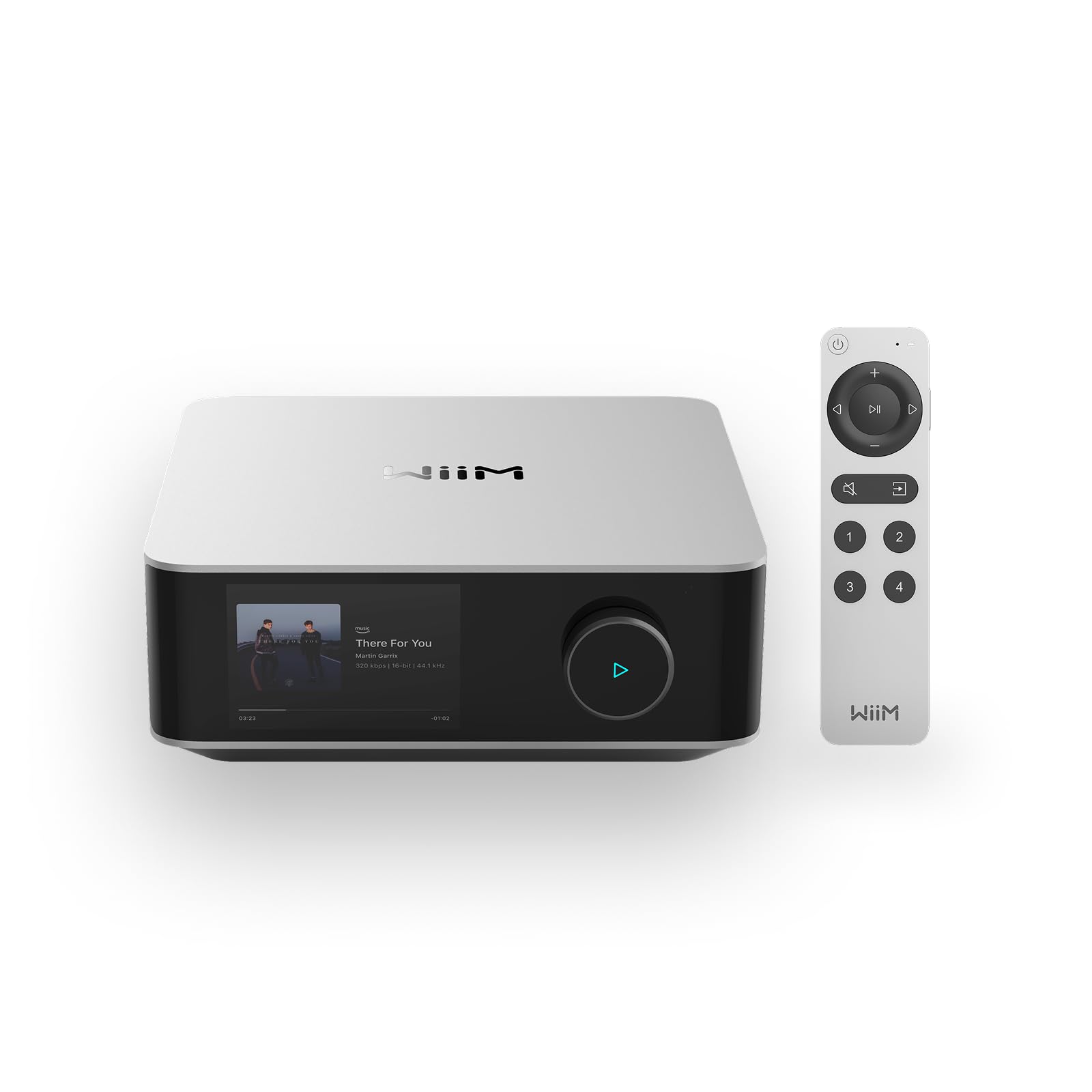
The WiiM Amp Ultra is the most forward-thinking amplifier on this list. It combines a dual TPA3255 class-D amp (100W per channel into 8 ohms) with an ESS ES9039Q2M Sabre DAC, Wi-Fi 6 streaming, and a 3.5-inch glass-covered touchscreen display. The built-in RoomFit automatic room correction calibrates the sound based on your room acoustics, compensating for boundary gain and reflection issues that plague untreated rooms.
Connectivity is comprehensive: HDMI ARC for TV integration, optical and RCA inputs, and a subwoofer pre-out. The WiiM Home app gives granular control over parametric EQ, source presets, volume limits, and multi-room synchronization with other WiiM speakers. Reviewers describe the sound as “cleaner and more detailed” than the previous Amp Pro model, with excellent bass management and tactile subwoofer control. The unibody aluminum case feels premium, and the touchscreen displays album art and system settings.
There are two notable absences: it lacks a coaxial digital input and does not support AirPlay. The Bluetooth source can introduce a 5-second delay when switching inputs, though this can be mitigated by disabling Bluetooth as a selectable source. For users building a modern, app-driven system with automatic room correction, the WiiM Amp Ultra delivers premium DSP features that no passive amp in this price range can match.
Why it’s great
- Room correction EQ optimizes sound for any room
- Wi-Fi 6 and HDMI ARC for modern system integration
- Touchscreen interface with album art display
Good to know
- No coaxial input or AirPlay support
- Bluetooth switching can introduce input delay
5. AIYIMA A80
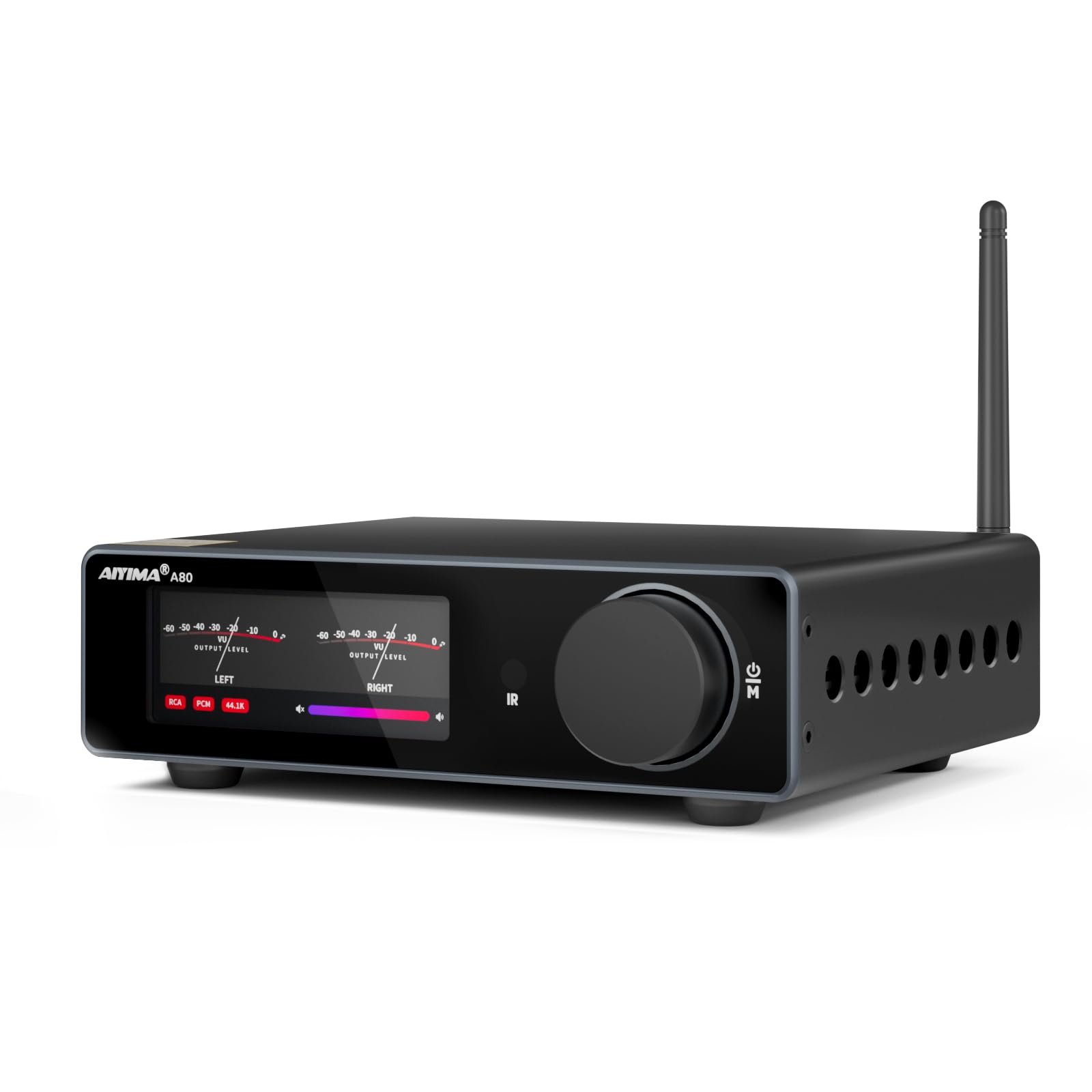
The AIYIMA A80 is a compact all-in-one that packs serious component quality into a chassis barely larger than a paperback. It uses the ES9038Q2M DAC chip paired with the TPA3255 class-D amplifier, supporting DSD512 and PCM up to high-resolution formats. With PFFB (Post Filter Feedback) circuitry, total harmonic distortion is measured at just 0.006% with a SINAD of 109dB — genuinely impressive numbers for a unit at this price tier.
Input selection is generous: Bluetooth 5.0, USB, optical, coaxial, and TRS balanced inputs cover almost every modern source. The electronic VU meter display offers multiple modes, including a spectrum analyzer that adds visual flair to desktop setups. The included 48V 5A GaN power supply runs cool, and the amplifier drives speakers up to 4 ohms with confidence. Reviewers have successfully paired it with Sony SSCS5 bookshelves and Martin Logan Motion 15i towers, noting crisp highs and tight bass.
It also runs moderately warm during extended high-volume sessions, and some users report that the remote feels slightly cheap. Still, for a desktop system needing optical input, Bluetooth, and a quality DAC, the A80 punches far above its size.
Why it’s great
- Premium ESS DAC with DSD512 support
- Balanced TRS inputs for studio connectivity
- Stylish digital VU meter and spectrum display
Good to know
- Continuous power lower than peak rating
- Runs warm at higher output levels
6. Rockville RPA9

The Rockville RPA9 is built for a different world than the audiophile integrated amps above — this is a pro-audio power amplifier designed for DJs, live bands, and large venue setups. Its claimed 800W RMS output into 4 ohms (bridged) drives passive PA speakers like Mach2 160W cabinets with authority, maintaining clarity even at high sound pressure levels. The front-panel LED indicators and individual channel volume controls are designed for quick stage adjustments in low-light conditions.
The amplifier includes XLR, 1/4-inch, and RCA inputs, plus SpeakON and banana binding post outputs, ensuring compatibility with virtually any professional speaker system. Dual fan cooling with a rear heatsink prevents thermal shutdown during long gig sets, though the fans are audible in quiet room environments. Build quality is solid for the price with a rack-mountable metal chassis, and the low-profile depth fits standard 2U racks without protruding cables.
Be realistic about the power rating: multiple independent measurements suggest the continuous RMS output is closer to 200W per channel into 8 ohms — still plenty for small-to-medium venues but not the 800W continuous rating advertised. The fans can also be intrusive for quiet listening at home. But for live sound reinforcement where raw SPL and ruggedness matter more than noise floor, the RPA9 is a reliable budget workhorse.
Why it’s great
- Pro connectivity with XLR, SpeakON, and RCA
- Rugged metal chassis suitable for touring
- Dual fan cooling prevents thermal shutdown
Good to know
- Continuous power is lower than advertised peak rating
- Fans are audible in quiet listening environments
7. Fosi Audio V3

The Fosi Audio V3 is a compact class-D amplifier that has become a cult favorite among budget-conscious audiophiles. Its TPA3255 chip, combined with Japanese NCC, ELNA, and German WIMA capacitors, achieves a SINAD rating of 88dB and a signal-to-noise ratio of 110dB — impressive for a mini amp under many dollars. With the 48V/5A power supply, it delivers roughly 150 watts per channel into 4 ohms, enough to drive moderately efficient bookshelf speakers like the Polk Atrium 6 or ELAC Debut B6.
The V3’s heat dissipation design is genuinely innovative for its class: vents on the top and bottom panels, combined with a full-body heatsink, keep the chassis cool even during extended listening sessions. The pre-out functionality is volume-controlled, allowing you to add a powered subwoofer without needing an extra preamp. A nice bonus is the socketed NE5532 op-amps — users can swap in Sparkos SS3602 or MUSES02 chips to tweak the sound signature.
The main limitation is the lack of digital inputs; there is no optical, coaxial, or USB input, so you will need an external DAC if your source isn’t analog. The bass response is also leaner than high-current class-A/B designs, particularly with speakers below 87dB sensitivity. But as a tiny, affordable power stage for a desktop PC setup or secondary system, the V3 offers remarkable transparency per cubic inch.
Why it’s great
- Very low distortion for a compact class-D amplifier
- Interchangeable op-amps for sound customization
- Effective heat dissipation design prevents overheating
Good to know
- No digital inputs — requires external DAC for digital sources
- Bass output is lean with low-sensitivity speakers
8. Douk Audio ST-01 PRO

For enthusiasts who want the warm glow and analog feel of vacuum tubes without the cost and complexity of a full tube amp, the Douk Audio ST-01 PRO is a clever hybrid. A vacuum tube preamp stage (using GE JAN 5725W mil-spec tubes in many units) feeds a TI class-D power amplifier that delivers 100 watts per channel into 4 ohms. The result is a sound that leans warm and sweet, with tube softening that reduces digital harshness from sources like a TV or computer.
The unit’s aesthetic is undeniably charming: a real analog VU meter dances in warm backlighting, and the three gold rings around the tubes and meter add a vintage flair. Input options are surprisingly comprehensive for the price, including USB, coaxial, optical, stereo RCA, and Bluetooth 5.0. A 3.5mm AUX output lets you daisy-chain a second amplifier or active subwoofer to build a 2.1 system without splitting cables.
There are usability quirks: the amplifier enters standby after a few seconds of silence, which can be jarring during quiet passages, and the volume steps in audible notches (the lowest setting may still be too loud for late-night listening on efficient speakers). The built-in DAC is functional but not exceptional — external DACs like a FiiO Taishan can improve clarity. But for the price, the combination of tube warmth, VU meter nostalgia, and solid power is hard to beat.
Why it’s great
- Analogue VU meter with retro tube glow aesthetic
- Hybrid design offers tube warmth with class-D efficiency
- AUX output for easy subwoofer or second amp integration
Good to know
- Auto-standby can interrupt quiet listening passages
- Built-in DAC is decent but outclassed by external units
9. JBL 305P MkII (Pair)

The JBL 305P MkII is not a traditional passive amplifier — it is a pair of active powered studio monitors, each containing its own dual 41-watt class-D amplifier module. This is an entirely different category designed for nearfield monitoring in music production, podcasting, and critical listening. The built-in amplifiers are perfectly matched to the 5-inch woofer and 1-inch tweeter, with patented Image Control Waveguide technology providing a remarkably wide and stable sweet spot.
The Boundary EQ and HF Trim controls allow you to compensate for room placement — whether the monitors are flush against a wall or positioned on desk stands. Users upgrading from budget monitors like the PreSonus E3.5 report an immediate improvement in width, depth, and low-mid fullness, with clean bass extension down to about 50Hz. The sound signature is balanced and uncolored, making it suitable for critical mix decisions without ear fatigue. XLR and 1/4-inch TRS inputs ensure compatibility with audio interfaces, and the MDF enclosure minimizes cabinet resonance.
The primary drawback is that these are not standalone speakers for casual listening — they require an audio interface or preamp with balanced outputs, and there is no remote control, Bluetooth, or volume knob on the front. Also, they are active speakers, so you cannot use them with an external power amplifier. But for anyone building a desktop production setup or wanting reference-grade accuracy nearfield, the 305P MkII pair is an industry standard for good reason.
Why it’s great
- Wide, stable sweet spot from Image Control Waveguide
- Boundary EQ and HF trim adapt to room placement
- Neutral, uncolored sound ideal for critical listening
Good to know
- Requires audio interface with balanced outputs
- Not compatible with passive amplifiers — active design only
FAQ
What amplifier power rating do I need for 89dB sensitivity speakers?
Should I choose a class-D or class-A/B amplifier for home listening?
Can I use a Bluetooth amplifier for a turntable setup?
Final Thoughts: The Verdict
For most users, the best amplifier for speakers is the Cambridge Audio CXA81 MkII because it delivers genuine 80W/ch class-A/B performance with an excellent ESS DAC in a single cleanly designed component. If you want built-in multi-room streaming and a phono stage, grab the Denon PMA-900HNE. And for a compact desktop system with premium DAC performance, nothing beats the AIYIMA A80 for its value per cubic inch.

Mo Maruf
I created WellFizz to bridge the gap between vague wellness advice and actionable solutions. My mission is simple: to decode the research and give you practical tools you can actually use.
Beyond the data, I am a passionate traveler. I believe that stepping away from the screen to explore new environments is essential for mental clarity and physical vitality.