Our readers keep the lights on and my smoothie glass nicely filled. As an Amazon Associate, I earn from qualifying purchases.
A nutrient-rich water reservoir is useless if your root zone is gasping for oxygen. Without a steady supply of dissolved oxygen, your plants can’t uptake nutrients efficiently, leading to stunted growth and root rot. The right air pump for your hydroponic system is a silent workhorse that keeps your water column saturated with bubbles, driving oxygenation directly to the root mass.
I’m Mohammad Maruf — the founder and writer behind WellFizz. My research focuses on comparing hardware specifications like flow rates, pressure ratings, and decibel levels to find the commercial-grade and consumer-friendly pumps that actually deliver consistent performance for deep-water culture and ebb-and-flow setups.
Whether you are running a single bucket or a multi-site system, selecting the wrong unit can mean noisy nights, weak output, or premature failure. I’ve broken down the key specs and real-world performance data to help you find the best air pump for hydroponics that matches your grow space and budget.
How To Choose The Best Air Pump For Hydroponics
Picking the right pump for your setup means understanding your reservoir depth, total water volume, and how many airstones you plan to run. A mismatch between pump pressure and water depth is the most common cause of weak bubbling.
Match pressure to reservoir depth
Every foot of water depth adds roughly 0.43 PSI of back pressure. Most consumer pumps are rated for tanks under 2 feet. For deep-water culture systems with 3-5 foot columns, you need a unit that delivers at least 20 kPa (0.02 MPa) of maximum pressure. Units below 15 kPa will struggle to push air effectively at depth.
Calculate total airflow needed
A general rule is 1 liter per minute for every 4 gallons of nutrient solution. A 20-gallon reservoir needs around 5 LPM of airflow. Splitting a single high-output pump across multiple airstones with a manifold works well, but each splitter and length of tubing introduces pressure drop, so overspec by 20 to 30 percent.
Noise and vibration isolation
Diaphragm pumps vibrate. Look for units with rubber feet, foam padding, or double-shell construction. Placing the pump on a soft foam pad or hanging it with bungee cords dramatically reduces transmitted noise. If the pump will sit in a living area, aim for user-reported quiet models rather than relying on a single decibel number from the spec sheet.
Outlet count vs. individual control
Multiple outlets let you aerate several buckets or tanks with one pump. However, if the pump lacks individual flow control valves on each port, you can’t fine-tune air distribution. For multi-site systems, a pump with a manifold that has per-outlet adjusters is far more practical than a simple splitter arrangement.
Quick Comparison
On smaller screens, swipe sideways to see the full table.
| Model | Category | Best For | Key Spec | Amazon |
|---|---|---|---|---|
| AquaMiracle NP30A | Premium | Deep reservoirs & multi-site systems | 475 GPH / 30 LPM | Amazon |
| VIVOSUN 25W | Commercial | High-output commercial and fish farms | 634 GPH / 40 LPM | Amazon |
| AquaMiracle Pond Kit | All-in-One | Outdoor ponds and large water gardens | 192 GPH / 0.42 CFM | Amazon |
| hygger 4W | Compact | Small tanks and silent corner setups | 95 GPH / 360 L/H | Amazon |
| hygger Stainless Steel | Mid-Range | Medium tanks up to 120 gallons | 95 GPH per outlet | Amazon |
| HITOP 10W | Value | Multi-tank setups on a budget | 320 GPH / 20 LPM | Amazon |
| AQUANEAT 300GPH | Entry-Level | Beginners with single reservoirs | 300 GPH / 5 GPM | Amazon |
In‑Depth Reviews
1. AquaMiracle NP30A (475 GPH)

The AquaMiracle NP30A sits at the sweet spot of power and quiet operation for serious hydroponic growers. With a 16W motor pushing 30 LPM at 0.03 MPa of pressure, this unit can aerate deep reservoirs up to 7 feet without losing bubble intensity. The aluminum alloy housing dissipates heat efficiently, making it suitable for 24/7 operation in enclosed spaces.
What sets this pump apart is the 6-outlet metal manifold with individual flow adjusters on each port. You can fine-tune air distribution across multiple buckets or a single large airstone without sacrificing pressure. Users consistently report it runs quieter than comparable commercial pumps, with the thick metal housing and rubber feet damping vibration effectively even at full output.
The included accessories — airline tubing, check valves, and a diaphragm rebuild kit — extend the usable life significantly. Some users note the stock tubing can arrive kinked, but replacing it with higher-grade vinyl is a simple fix. For growers running multi-site deep-water culture or large aerated compost tea brewers, this is the most balanced option available.
Why it’s great
- High 30 LPM output with 0.03 MPa pressure handles deep reservoirs
- Aluminum housing stays cool and dampens noise effectively
- Each manifold outlet has its own flow adjuster for precise control
- Includes diaphragm rebuild kit for long-term maintenance
Good to know
- Stock airline tubing can arrive with kinks that restrict flow
- Not fully silent — better for a grow room than a bedroom
2. VIVOSUN 25W Commercial Air Pump

The VIVOSUN 25W is a piston-driven workhorse designed for applications that demand raw air volume. At 40 LPM through 6 outlets, it can oxygenate multiple large reservoirs, fish tanks, or small ponds simultaneously. The electromagnetic motor and steel piston are engineered for continuous 24/7 duty, and the aluminum alloy heat-radiating plates prevent overheating during extended runs.
This is not a subtle pump. At full throttle it generates noticeable sound, described by users as a low hum that is best isolated in a garage or utility room. The oil-free lubrication reduces maintenance, but the vibration is significant enough that placing it on a soft pad or hanging it is strongly recommended. The manifold accepts 1/4-inch airline tubing and includes individual control valves for each outlet.
Where this pump shines is raw pressure output — 0.03 MPa means it can push air to the bottom of deep reservoirs without losing steam. Some users have reported that it runs hot, and adding a small external fan improves longevity. For commercial setups where noise is secondary to sheer oxygenation capacity, this is the pump to beat.
Why it’s great
- Highest airflow in this lineup at 40 LPM
- Aluminum heat sinks for reliable 24/7 operation
- Steel piston and oil-free design reduce long-term wear
Good to know
- Very loud — not suitable for living spaces without isolation
- Runs hot; supplemental cooling may be needed for continuous use in enclosed cabinets
3. HITOP 10W (320 GPH)

The HITOP 10W delivers an impressive 20 LPM of airflow across 4 independent outlets at a price that undercuts most competitors. The double-layer shell design does an admirable job containing motor noise, and the included rubber feet absorb enough vibration to make it tolerable in a living area. Users consistently report that after adjusting hoses to prevent direct contact with the housing, the pump runs much quieter than expected.
Each of the 4 outlets can be individually adjusted using the included regulating valves, giving you granular control over air distribution. The kit comes with 5-foot tubes, airstones, check valves, and replacement filter cotton for the intake, making it a true plug-and-play package. The maximum pressure of 22 kPa is sufficient for reservoirs up to about 3 feet deep.
Some users have noted concerns about long-term flow consistency after several months of continuous use. The pump is physically larger than comparable single-outlet units — roughly the size of a toaster — so plan your placement accordingly. For a multi-bucket system where budget is a primary constraint, this offers the best performance-to-price ratio.
Why it’s great
- 20 LPM output through 4 independently adjustable outlets
- Comes with all accessories for immediate setup
- Double-layer shell keeps noise reasonable for the output level
Good to know
- Physically large — requires dedicated shelf or floor space
- Some users report flow reduction after extended use
4. hygger 4W Dual Outlet

The hygger 4W is engineered specifically for noise-sensitive environments. The double-layer ABS shell and four shockproof rubber pads bring operation down to around 35 dB, which is barely audible in a quiet room. It delivers 360 L/H (95 GPH) through two stainless steel outlets, enough for a single medium reservoir or paired airstones in a 120-gallon tank.
The airflow is fully adjustable via a single knob, but note that unused outlets must be capped or they will push out a noticeable stream of air. The pump is compact at 4 inches cubed, making it easy to tuck away. The included check valves and airstones are basic but functional for initial setup.
One trade-off is that the 4W motor lacks the pressure headroom for deep reservoirs. At depths beyond 2 feet, the bubble output noticeably weakens. For shallow tray systems, small DWC buckets, or seed-starter setups, this pump delivers silent and reliable oxygenation without waking the household.
Why it’s great
- Extremely quiet operation at roughly 35 dB
- Compact form factor fits into tight spaces
- Adjustable airflow gives fine control over bubble output
Good to know
- Low pressure limits effectiveness in deep reservoirs
- Unused outlet must be capped to prevent air leakage noise
5. hygger Strong Stainless Steel (4W)
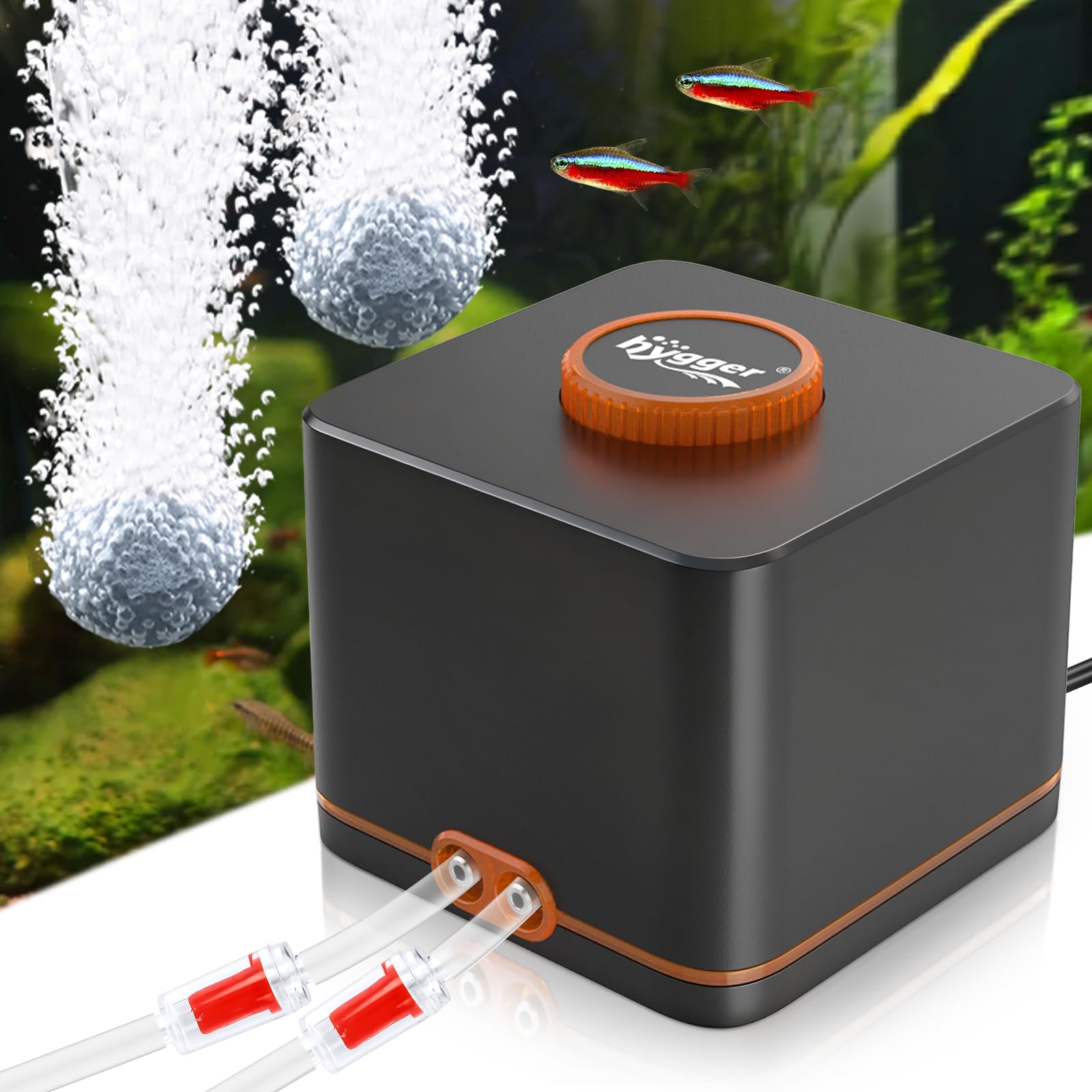
This hygger variant uses a bearingless magnetic motor that reduces friction and noise compared to traditional diaphragm pumps. The stainless steel dual outlets resist corrosion, which is critical for hydroponic environments where humidity and nutrient splashes are constant. The unit delivers 95 GPH per outlet with a maximum pressure of 20 kPa, suitable for tanks up to 5 feet deep.
The pump can be installed above or below the water line, but a check valve is mandatory for below-water setups. Users consistently praise the quiet operation, with many calling it the most silent pump they have used. The 4 suction cups hold it firmly in place and prevent vibration transmission to shelves or tank rims.
The primary limitation is the single-knob control that adjusts both outlets simultaneously — you cannot dial down one side independently. For a single-reservoir system or two identical tanks, this is not an issue, but for mixed-depth setups it requires external valves. Overall, it is a well-engineered pump that prioritizes durability and silence.
Why it’s great
- Bearingless magnetic motor reduces friction and noise dramatically
- Stainless steel outlets resist corrosion from humidity and nutrients
- Very quiet operation reported consistently by users
Good to know
- Single knob controls both outlets without independent adjustment
- Provided tubing and airstones are basic quality
6. AquaMiracle Pond Aerator Kit
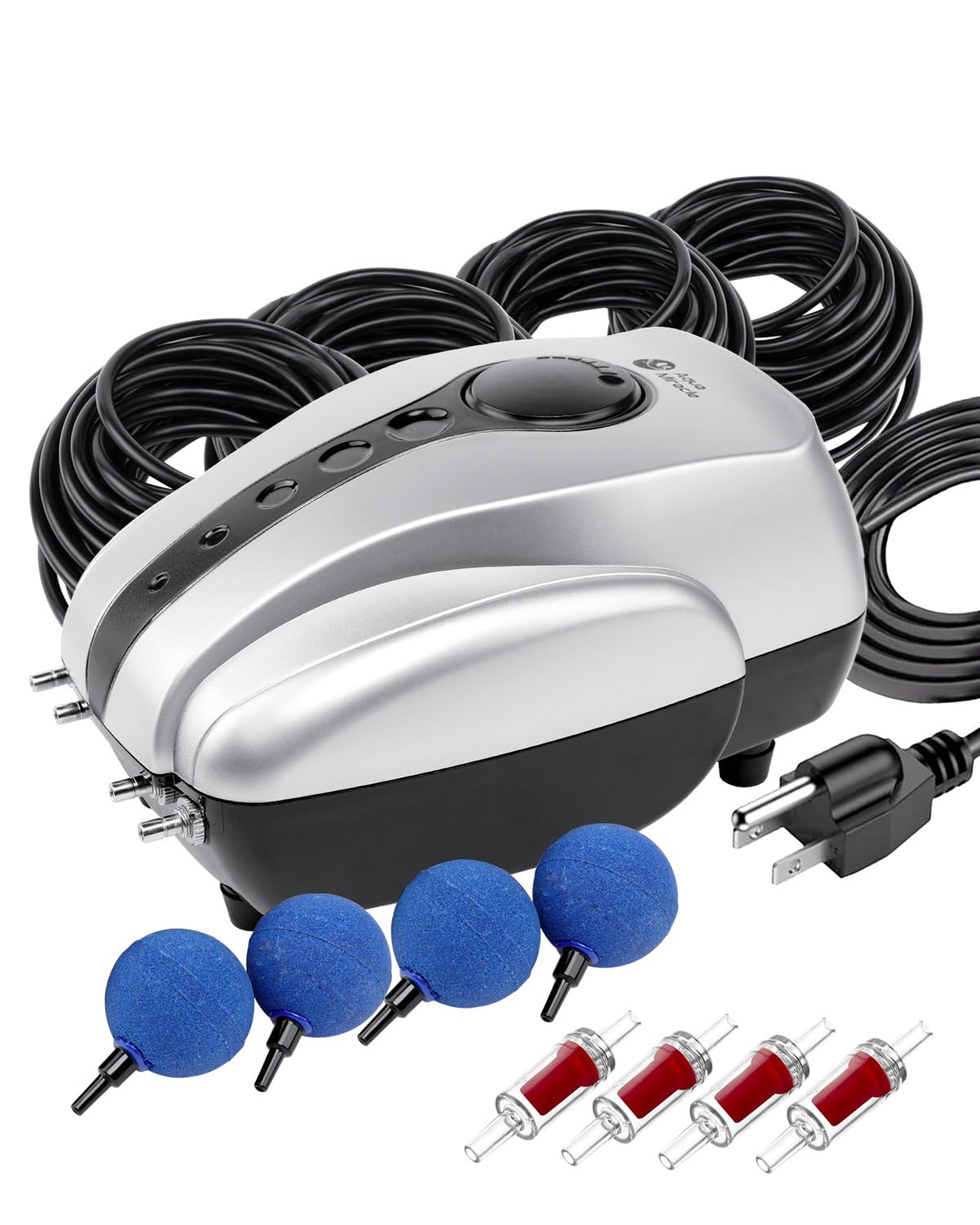
This all-in-one kit targets outdoor pond owners but works equally well for large hydroponic reservoirs or outdoor nutrient tanks. The 8W motor pushes 192 GPH at 0.018 MPa through 4 outlets, each supplied with 30 feet of vinyl airline tubing. The sulfurized diaphragm is engineered for durability, and the chrome-plated air outlets resist corrosion in wet environments.
Noise levels are notably low for a pump of this capacity, thanks to the straight airflow path and textured internal housing that dampens vibration. Users report it is quiet enough for garden settings without being intrusive. The package includes 4 large airstones and check valves, so you can set up a full aeration system out of the box.
Some users have experienced pressure loss after about a month of continuous use, though customer service has been responsive with replacements. The 0.018 MPa pressure is adequate for shallow ponds and reservoirs under 3 feet, but it lacks the headroom for deep column systems. If you need to oxygenate a large, shallow water volume quietly, this kit delivers solid value.
Why it’s great
- Complete kit with long 30-foot airline tubing per outlet
- Very quiet operation suitable for garden or greenhouse
- Sulfurized diaphragm and chrome-plated outlets resist wear
Good to know
- Pressure rating limits use to shallower reservoirs
- Some units have reported pressure loss after extended use
7. AQUANEAT 300GPH 4-Outlet

The AQUANEAT 300GPH is the most accessible entry point for first-time hydroponic growers. The 4-outlet design provides 5 GPM of total airflow, enough to run multiple sponge filters or airstones in a single reservoir. The control knob allows you to dial the flow back when running smaller systems, and the four rubber feet reduce vibration transmission to surfaces.
The kit is comprehensive, including 16 feet of airline tubing, four airstones, check valves, suction cups, and T-connectors. This makes it extremely easy to get started without additional purchases. The maximum pressure is low at 0.01 MPa, so this pump works best in shallow reservoirs under 2 feet deep.
Noise is the most common criticism — it is noticeably louder than the hygger or AquaMiracle pumps. Some users find the hum acceptable as white noise, while others consider it too loud for indoor living spaces. Placing it on a foam pad helps significantly. For a budget-conscious grower with a shallow system, this pump provides enough oxygen at the lowest possible cost.
Why it’s great
- Very low cost for a 4-outlet pump with full accessory kit
- Adjustable airflow knob gives flexibility for different system sizes
- 16 feet of tubing provides plenty of reach for multi-tank setups
Good to know
- Loud operation compared to mid-range and premium options
- Low pressure limits use to shallow reservoirs under 2 feet
FAQ
Can I use a fish tank air pump for hydroponics?
How many airstones can I run from one pump?
Should I leave my air pump running 24 hours a day?
Why is my air pump getting hot?
Final Thoughts: The Verdict
For most users, the best air pump for hydroponics winner is the AquaMiracle NP30A because it combines high 30 LPM output, pressure capable of 7-foot depths, and per-outlet adjustability in a quiet aluminum housing. If you need the absolute highest airflow for a commercial setup, grab the VIVOSUN 25W. And for a silent, compact system in a small grow tent, nothing beats the hygger 4W.

Mo Maruf
I created WellFizz to bridge the gap between vague wellness advice and actionable solutions. My mission is simple: to decode the research and give you practical tools you can actually use.
Beyond the data, I am a passionate traveler. I believe that stepping away from the screen to explore new environments is essential for mental clarity and physical vitality.