Our readers keep the lights on and my smoothie glass nicely filled. As an Amazon Associate, I earn from qualifying purchases.
Every ounce counts when you’re carrying your kitchen on your back, and the wrong cooking pot turns a simple meal into a frustrating fuel-wasting chore. The difference between a great backcountry meal and a lukewarm disappointment often comes down to the metal between your stove and your food — material thickness, diameter-to-height ratio, and heat-transfer efficiency dictate how fast your water boils and how much fuel you burn getting there.
I’m Mohammad Maruf — the founder and writer behind WellFizz. I’ve spent years analyzing backpacking cookware specifications, from titanium gauge thickness to heat-exchanger fin geometry, to identify which pots deliver the best boil speed and packability without the marketing fluff.
After parsing hundreds of verified user experiences across seven of the most popular models on the trail, this guide cuts through the noise to reveal the best backpacking pots that balance weight, durability, and real-world cooking performance for solo and duo hikers alike.
How To Choose The Best Backpacking Pots
Choosing a backpacking pot is a tradeoff between weight, boil speed, and durability. The right choice depends on your cooking style — whether you primarily boil water for dehydrated meals or simmer actual food — and how many grams you’re willing to carry for that capability.
Material Matters: Titanium vs. Aluminum vs. Stainless Steel
Titanium is the lightest option at roughly 60–125g for a 650–900ml pot, but it distributes heat unevenly — you’ll get hot spots that scorch food if you don’t stir constantly. Aluminum conducts heat much better and often comes with heat-exchanger fins that cut boil time significantly, but it’s heavier and the coating can wear. Stainless steel is durable and conducts heat evenly, but at 7.8 oz for a 900ml pot, it’s the heaviest choice, best reserved for car campers or those pairing with a twig stove.
Capacity: Solo Sipping vs. Duo Dining
A 600–650ml pot is perfect for a single dehydrated meal or boiling water for one coffee, but you can’t cook actual food in it without crowding. The 750–900ml range is the sweet spot for backpacking — enough to rehydrate a double serving or cook a ramen pack with room to spare, yet still light enough for a solo hiker. If you regularly cook for two, look for 900ml or a nested two-pot system.
Handle Design and Lid Lock
A folding bail handle lets you hang the pot over a campfire, while fixed side handles are better for stability on a canister stove. Some pots have handles that get hot — check whether the material is insulated or if you’ll need a bandana. Lid fit matters: a lid that locks in place prevents spills in your pack and lets you strain water, while a loose lid doubles as a boil indicator when it rattles.
Quick Comparison
On smaller screens, swipe sideways to see the full table.
| Model | Category | Best For | Key Spec | Amazon |
|---|---|---|---|---|
| TOAKS LIGHT 650ml | Titanium | Ultralight solo hikers | 2.8 oz with lid | Amazon |
| TOAKS Titanium 900ml | Titanium | Versatile solo/duo | 4.4 oz with lid, 900ml | Amazon |
| Valtcan 900ml | Titanium | Campfire & stove cooking | 144g, bail handle | Amazon |
| Solo Stove Solo Pot 900 | Stainless Steel | Twig stove pairing | 7.8 oz, pour spout | Amazon |
| Fire-Maple Petrel 600ml | Aluminum | Fuel-efficient solo boils | Heat exchanger, 162g | Amazon |
| Odoland Mess Kit | Aluminum | Budget two-person set | Pot + pan, 0.45kg | Amazon |
| SNOW ROCK Titanium Set | Titanium | Nesting two-cup system | 750ml + 450ml stack | Amazon |
In‑Depth Reviews
1. TOAKS LIGHT Titanium 650ml Pot

The TOAKS 650ml pot is the gold standard for ultralight soloists who want the lightest possible vessel without sacrificing durability. At just 2.8 ounces including the lid, this pure titanium pot shaves critical grams compared to aluminum alternatives, and the 95mm diameter fits perfectly around a 100g fuel canister for compact storage. The uncoated surface is non-reactive, meaning no metallic taste in your morning coffee, and it cleans easily with hot water and a gentle scrub — even after three days of oatmeal residue.
Boil speed is respectable for titanium, reaching a rolling boil in roughly the same time as other pure-ti pots, but you won’t get the heat-distribution benefits of aluminum. The 650ml capacity is ideal for a single dehydrated meal or boiling water for one coffee, though it’s too tight for cooking actual food like ramen or rice. The lid fits snugly enough to prevent splashing but can be a bit loose when lifting the pot by the lid loop alone — a minor quirk that most users work around with a quick grip check.
What makes this pot stand out is the ecosystem: it nests inside TOAKS’ own 900ml pot for a modular kitchen system, and the compact form factor leaves room in your pack for a stove, lighter, and small fuel canister. For the solo hiker who prioritizes gram savings above all else, this pot delivers the lightest possible cooking solution without feeling flimsy. The tradeoff is pure titanium’s tendency to develop hot spots — stirring is mandatory if you’re cooking anything beyond boiling water.
Why it’s great
- Incredibly lightweight at 80g with lid — barely noticeable in any pack
- Fits standard 100g fuel canister and small stove inside for a nested kit
- Uncoated grade 1 titanium is non-reactive and cleans easily without seasoning
Good to know
- Too small for actual cooking — best reserved for boiling water for dehydrated meals
- Not tall enough to store a stove inside the pot itself
- Lid fit can be slightly loose; not ideal for lifting the pot by the lid loop
2. TOAKS Titanium 900ml Pot with 115mm Diameter

The TOAKS 900ml pot is widely considered the benchmark for lightweight backpacking cookware, offering the perfect capacity for a solo hiker who wants to boil water for a meal plus a hot drink, or for a duo sharing dehydrated meals. The 115mm diameter is noticeably wider than the 650ml version, which creates a lower profile that’s more stable on most stoves and reduces the chance of tipping. At 4.4 ounces with the lid, it’s lighter than the equivalent Snow Peak 750ml pot, making it a savvy upgrade for weight-conscious hikers.
One of the best features is the internal volume markings in both milliliters and ounces, which let you precisely measure water for freeze-dried meals without carrying a separate cup. The included orange mesh sack is overbuilt but protective, and the pot fits a standard 220g screw-top gas canister inside with the lid still closing — a rare convenience. The lid fits loosely by design, which doubles as a boil indicator (listen for the rattle) but means you can’t lift the full pot by the lid handle.
The 900ml capacity handles two ramen packs comfortably, and the wide mouth makes it easy to eat directly from the pot if you want to minimize cleanup. Purists note that the loose lid could be improved with a locking tab, but for the weight savings and durability, this pot remains a staple recommendation across the long-distance hiking community. If you need one pot that does everything from rehydrating meals to brewing coffee for two, this is the one.
Why it’s great
- Sweet-spot 900ml capacity handles solo meals plus a hot drink in one boil
- Fits a 220g gas canister inside the pot for space-saving storage
- Internal ml and oz markings eliminate the need for a separate measuring cup
Good to know
- Lid is loose and doesn’t lock; not ideal for lifting the pot by the lid handle
- Wide 115mm diameter may not fit some ultralight stoves with small burner heads
- Titanium’s heat distribution still requires stirring to avoid scorching
3. Valtcan 900ml Titanium Pot

The Valtcan 900ml pot stands out from the titanium crowd with its redesigned foldable bail handle — a feature rare at this price point that lets you hang the pot directly over a campfire without needing a separate hanging system. The grade 1 titanium construction is thicker than entry-level pots, giving it a reassuringly solid feel without the weight penalty, tipping the scales at just 144g including the lid. The bail handle folds flat when not in use, and the side handles are angled so you can drink directly from the rim — a clever detail for coffee drinkers.
Real-world performance is impressive: the pot boils water quickly for freeze-dried meals, and the bail handle makes it easy to suspend over a twig fire or adjust the height over flames. The lid doesn’t snap on — it sits loosely on top — which some users find inconvenient for packing, but the included mesh bag keeps everything contained. One subtle design win is the lack of a pour-spout notch; the smooth rim actually pours cleanly without dripping down the side, so you don’t lose precious boiled water down the outside of the pot.
The 900ml capacity is ample for solo hikers and adequate for two coffee drinkers, and the pot nests with the Valtcan 450ml cup for a modular system. The bail handle hinges are improved over earlier versions and don’t flop around, making it a reliable choice for mixed-mode cooking — stove, campfire, or even as a large mug at home. If you want the versatility to cook over an open flame and still enjoy ultralight titanium weight, this pot delivers that rare combination.
Why it’s great
- Foldable bail handle enables campfire hanging without extra gear
- Thicker grade 1 titanium feels more durable than ultralight competition
- Clean rim pours without spilling or dripping down the pot wall
Good to know
- Lid sits loosely and doesn’t clip or lock into place
- No internal volume markings — you’ll need to know your fill level by eye
- Slightly taller profile may not fit in smaller pack side pockets
4. Solo Stove Solo Pot 900

The Solo Stove Solo Pot 900 is a purpose-built companion for the Solo Stove Lite twig burner, but it works equally well on any standard backpacking stove. The 304 stainless steel construction is heavier than titanium or aluminum at 7.8 ounces, but it conducts heat more evenly and doesn’t develop the hot spots that plague pure-ti pots. The polished interior is remarkably easy to clean — even scorched-on food wipes out with minimal scrubbing, a major convenience on multi-day trips.
This pot is packed with smart details: internal volume markings in both ounces and milliliters for precise water measurement, a folding lid handle with a rubberized tab that stays cool to the touch, and a pour spout that directs water without spilling. The folding side handles also stay relatively cool during cooking, though some users report they can still get hot enough to require a pot holder or bandana. The tight-fitting lid has a lockable lift tab that lets you strain pasta or rice without losing the lid mid-pour.
The 900ml capacity is generous for a solo hiker, easily handling a double serving of dehydrated food plus a hot drink from the same boil. The pot is designed to nest the Solo Stove Lite stove inside, along with a small fuel canister, creating a compact all-in-one cooking system. For hikers who already own or are considering the Solo Stove ecosystem, this pot is a no-brainer — it’s the most feature-rich option in its class, even if the stainless steel weight keeps it out of ultralight territory.
Why it’s great
- Pour spout and integrated strainer function for controlled pouring
- Internal volume markings in oz and ml for precise water measurement
- Cool-touch lid tab and folding handles for safe handling
Good to know
- Heaviest pot in this guide at 7.8 oz — not for gram-counters
- Side handles can still get hot with prolonged cooking
- Best performance is achieved when paired with the Solo Stove Lite
5. Fire-Maple Petrel Ultralight Pot 600ml

The Fire-Maple Petrel 600ml pot brings Jetboil-style heat-exchanger efficiency to a standalone pot at a fraction of the cost. The hard-anodized aluminum body features a finned heat-exchanger base that captures and channels hot exhaust gases across more surface area, boiling 500ml of water in about two minutes — nearly as fast as an integrated canister system. At 162g, it’s heavier than a pure-titanium pot of similar capacity, but the fuel savings over a week-long trip easily offset the extra grams.
The heat-absorbing base isn’t just about speed; it also protects the pot from direct flame contact, reducing the likelihood of scorching. The foldable plastic handle stays cool during cooking thanks to thermally insulated plastic, though it’s not as robust as a metal bail handle. The 600ml capacity is tight for any cooking beyond boiling water for a single dehydrated meal, but the included lid with a ventilation hole lets you control steam for soups. The pot also fits a small 100g fuel canister and a stove inside for a compact nested kit.
One notable quirk: the Petrel is not compatible with the Fire-Maple Greenpeak2 stove due to fit issues, but it works perfectly with the Greenpeak1 and most other canister stoves. The three recesses on the bottom are designed to align with specific stove burner heads for stability, though not every stove will mate perfectly. For the solo hiker who cooks primarily by boiling water and wants to stretch a fuel canister across a long trip, this pot’s heat-exchanger technology delivers measurable real-world savings.
Why it’s great
- Heat-exchanger fins boil water as fast as integrated Jetboil systems
- Fuel-efficient design extends canister life by up to 40% compared to flat-bottom pots
- Folds down compact enough to stow stove and fuel inside the pot
Good to know
- Heavier than titanium at 162g for only 600ml capacity
- Not compatible with Fire-Maple Greenpeak2 stove
- Small capacity limits use to boiling water and single dehydrated meals
6. Odoland Camping Cookware Mess Kit

The Odoland Camping Cookware Mess Kit offers the most gear for the least weight in this guide: a 1900ml pot, a 860ml fry pan, and a lid with a heat-resistant handle and drain holes — all for 1 lb (0.45kg). The hard-anodized aluminum construction conducts heat quickly and evenly, and the locking stainless steel handles fold away when not in use, making the entire set compact enough for a solo or duo backpacker who wants the option to actually fry food, not just boil water.
Real-world performance has some caveats. The locking handles are heavy, which creates an off-center balance when the pot is full of water on a standard backpacking stove — it can tip if not carefully centered. Several users reported that the fry pan warped slightly when cooking burgers on low flame, and the non-stick interior showed discoloration after cooking rice-a-roni. These aren’t deal-breakers for occasional use, but they indicate the aluminum gauge is on the thinner side, which affects durability over time.
The set includes a mesh bag with drawstring closure for storage, and all items fit inside for easy packing. For the price-conscious hiker who wants a two-piece cook system for car camping or short backpacking trips where weight isn’t critical, this kit delivers solid functionality. It’s best for those who plan to cook actual food — not just boil water — and don’t mind the extra grams for the versatility a fry pan provides. If your primary cooking is boiling water for dehydrated meals, a single titanium pot would serve you better and lighter.
Why it’s great
- Includes both a 1900ml pot and an 860ml fry pan for real cooking capability
- Locking stainless steel handles provide a secure, stable grip during use
- Drain holes in the lid allow easy straining of pasta or vegetables
Good to know
- Heavy locking handles create off-center balance on backpacking stoves
- Fry pan reported to warp under direct low flame
- Non-stick interior may discolor with use over time
7. SNOW ROCK Ultralight Titanium Camping Cookware Set (750ml + 450ml)
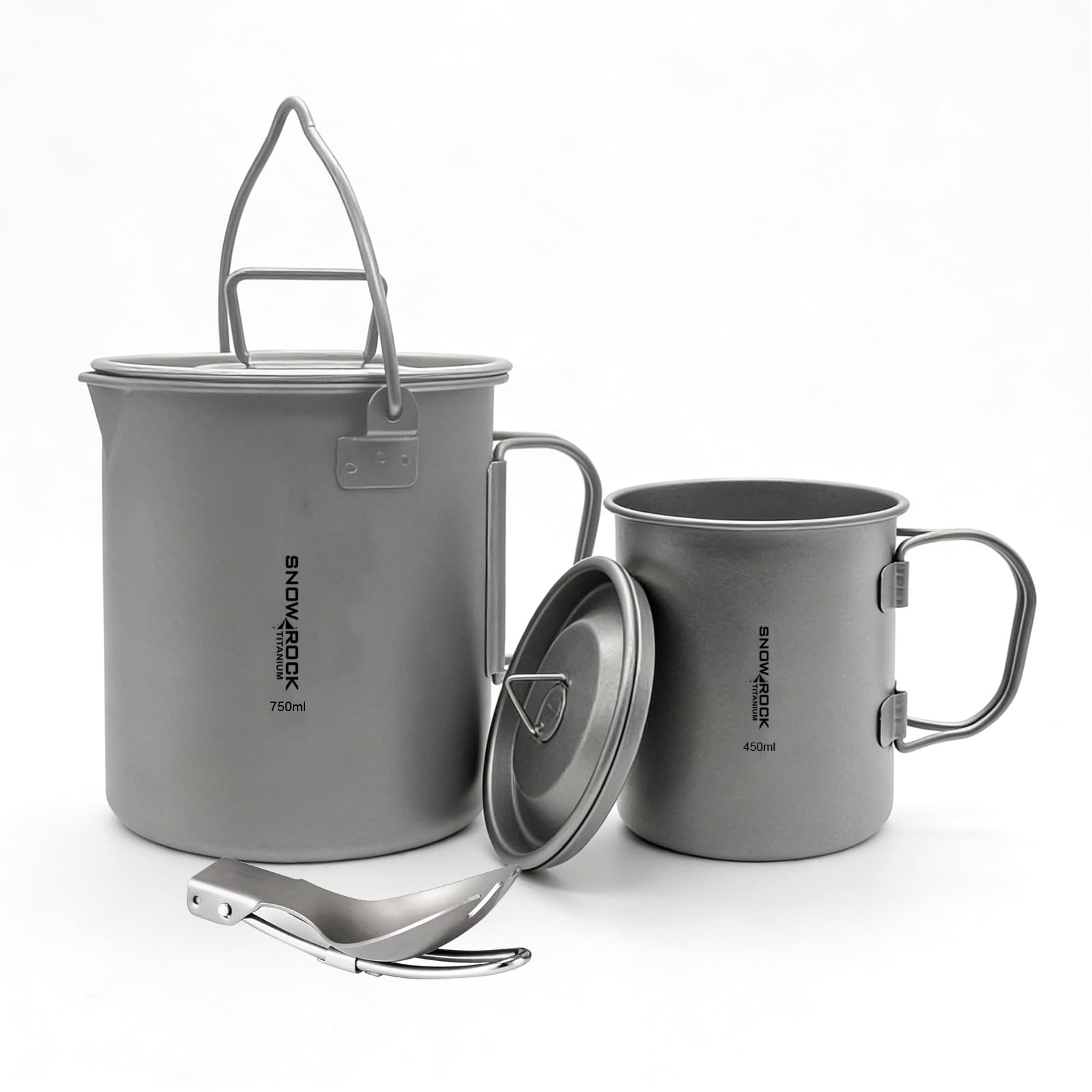
The SNOW ROCK Titanium Cookware Set bundles two titanium cups — a 750ml and a 450ml — that nest together for a compact, two-person cooking system. The integrated folding handles tuck away neatly for storage and lock securely in place for a comfortable, stable grip during use. Both cups are made from grade 1 titanium, which means they’re non-reactive, lightweight, and free from the coating wear issues that affect aluminum pots over time.
The 750ml cup is the primary cooking vessel, large enough to boil water for two dehydrated meals or a generous serving of soup, while the 450ml cup works well as a coffee mug or a secondary bowl. The lids fit securely enough to prevent spills in your pack, though they don’t lock — similar to many titanium pots in this class. The European stackable design allows the cups to nest efficiently with other cookware, and the whole set weighs less than most single aluminum pots of similar capacity.
One of the best aspects is the value: you get two titanium cups for roughly the same price as a single premium titanium pot from more established brands. The build quality matches pricier competitors, with clean welding and consistent wall thickness. The main tradeoff is that neither cup has a pour spout or internal volume markings, so you’ll need to learn fill levels by eye. For a duo or someone who wants a dedicated drinking cup plus a cooking pot without carrying extra weight, this is a clever, affordable system.
Why it’s great
- Two nested titanium cups provide a complete cooking + drinking system
- Locking folding handles are stable during use and compact for storage
- Exceptional value for the weight and build quality at this price point
Good to know
- No internal volume markings on either cup
- Lids don’t lock in place — pack carefully to avoid spills
- No pour spout; straining pasta requires a separate tool or careful tilting
FAQ
Can I cook actual food in a titanium backpacking pot?
How do heat-exchanger pots perform with alcohol stoves?
What is the ideal capacity for a solo backpacking pot?
Final Thoughts: The Verdict
For most users, the best backpacking pots winner is the TOAKS LIGHT Titanium 650ml Pot because it delivers the lightest possible cooking solution at a reasonable cost without feeling flimsy. If you want the versatility of a larger capacity and the durability of titanium, grab the TOAKS Titanium 900ml Pot. And for campfire cooking with a bail handle, nothing beats the Valtcan 900ml Titanium Pot.

Mo Maruf
I created WellFizz to bridge the gap between vague wellness advice and actionable solutions. My mission is simple: to decode the research and give you practical tools you can actually use.
Beyond the data, I am a passionate traveler. I believe that stepping away from the screen to explore new environments is essential for mental clarity and physical vitality.