Our readers keep the lights on and my smoothie glass nicely filled. As an Amazon Associate, I earn from qualifying purchases.
Lifting veneer edges, bubbling surfaces, and delaminating corners are the hallmarks of a failed adhesive. The wrong glue softens the wood fiber, seeps through the paper-thin veneer, or simply lacks the tensile strength to hold a curved surface over time. Choosing a dedicated adhesive for veneer means understanding open time, reversibility, and whether the bond needs to survive a hot press or a cold clamp.
I’m Mohammad Maruf — the founder and writer behind WellFizz. I’ve spent years analyzing woodworking adhesives, cross-referencing spec sheets against real-world use cases like marquetry, curved lamination, and antique restoration to find the formulations that actually work.
Whether you’re regluing a Chippendale chair or laying down a fresh sheet of paper-backed walnut, this guide will help you navigate the best options. The best adhesive for veneer depends on your project type, but one recommendation stands out above the rest for its flexibility, reversibility, and time-tested performance.
How To Choose The Right Adhesive For Veneer
Matching the adhesive to the substrate and the working environment is critical. Paper-backed veneers, wood-backed veneers, and phenolic backers all react differently to moisture, heat, and clamping pressure.
Open Time and Assembly Window
Open time is the period during which the adhesive remains workable after application. For large panels or complex veneer marquetry, a long open time (30 minutes or more) gives you the freedom to position and reposition the sheet. Fast-setting CA glues, on the other hand, excel for small repairs where clamping is impractical, but they set in seconds — leaving zero room for error.
Reversibility for Restoration Work
Old furniture often has hide glue residue in the joints. If you plan to repair an antique, an adhesive that can be reactivated with heat and moisture is non-negotiable. Modern PVA or polyurethane glues form irreversible bonds that damage the wood fiber during removal. Hide glue, by contrast, softens with heat and hot water, allowing future restoration without compromising the original material.
Gap-Filling vs. Thin-Film Bonding
Thin cyanoacrylate glues wick into hairline cracks and micro-gaps, making them ideal for stabilizing blistered veneer without lifting the surrounding area. Thicker formulations — like honey-like CA glues or medium-viscosity liquid hide glue — fill deeper voids and provide structural support for missing patches or loose inlays.
Quick Comparison
On smaller screens, swipe sideways to see the full table.
| Model | Category | Best For | Key Spec | Amazon |
|---|---|---|---|---|
| Old Brown Glue Liquid Hide Glue | Hide Glue | Antique restoration, curved lamination | 30-minute open time | Amazon |
| 3M Hi-Strength 94 ET Spray | Spray Contact | Large surface laminations, foam-backed veneer | 60-minute bonding range | Amazon |
| Starbond Thick CA Glue Bundle | Cyanoacrylate | Gap-filling, mitre joints, crack repair | Thick honey-like viscosity | Amazon |
| Titebond Instant Wood Adhesive | Cyanoacrylate | Quick repairs, clamp-free bonding | 5-second cure time | Amazon |
| FastCap 2P-10 Thin Wood Adhesive | Cyanoacrylate | Micro-crack filling, invisible glue lines | Water-thin viscosity | Amazon |
In‑Depth Reviews
1. Old Brown Glue Liquid Hide Glue
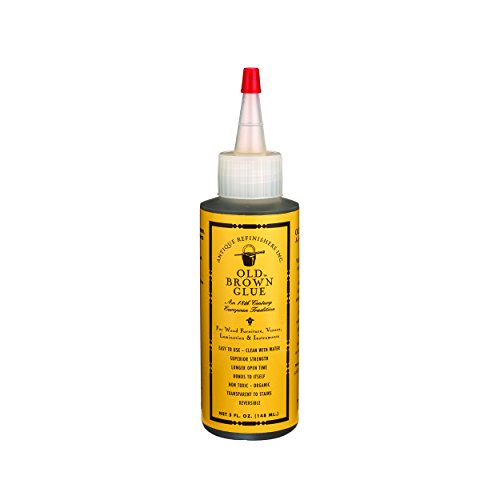
Old Brown Glue is the undisputed choice for any veneer work that demands reversibility and a forgiving assembly window. Made from hydrolyzed collagen and urea, it delivers a bond that remains flexible after curing — critical for curved panels where rigid glues cause delamination as wood expands and contracts seasonally.
The 30-minute open time is a lifesaver when you’re laying a large sheet of book-matched veneer. You can spread the warmed glue, position the veneer, and adjust alignment without watching the clock. After 24 hours, the bond reaches full strength, but the real advantage is that you can reactivate the glue with heat — so future repairs don’t require stripping the entire surface.
This product does require heating to 120–140°F before use, which adds a step compared to room-temperature glues. But for fine furniture restoration, instrument building, or any project where the original hide glue residue remains in the joints, the self-bonding chemistry makes it irreplaceable.
Why it’s great
- Reversible with heat and moisture — perfect for antiques
- Self-bonding; reactivates original hide glue residue
- 30-minute open time for complex positioning
Good to know
- Requires warming to 120–140°F before application
- 24-month shelf life; store refrigerated for longer
2. 3M Hi-Strength 94 ET Spray Adhesive
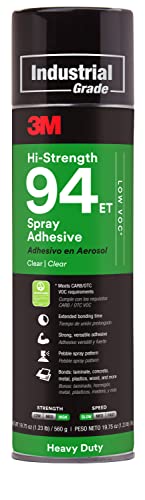
When you need to bond a full sheet of veneer to a large substrate — like a tabletop or cabinet panel — a spray adhesive offers uniform coverage that a brush-on glue can’t match. The 3M Hi-Strength 94 ET delivers an aggressive tack with a remarkably long open time; you can apply it to both surfaces and still have up to 60 minutes to position the veneer before the bond sets.
The formula is a low-VOC, GREENGUARD-certified contact cement, so it works by bonding to itself: spray both sides, let them dry to the touch (about 30 minutes), then press them together. The initial grab is immediate and strong, reducing the need for heavy clamping. It bonds wood, metal, rubber, carpet, and flooring, making it versatile beyond veneer alone.
The main trade-off is ventilation. This is a solvent-based spray with a strong odor, so you’ll need a well-ventilated workspace and a respirator mask. It’s not designed for small repairs — the overspray and cleanup make it better suited for full-panel lamination where speed and consistency matter more than precision.
Why it’s great
- 60-minute bonding range allows precise alignment
- Uniform coverage eliminates brush marks and bubbles
- GREENGUARD-certified, low VOC
Good to know
- Strong solvent odor requires ventilation and a mask
- Not ideal for small or detailed veneer repairs
3. Starbond Thick CA Glue with Activator Bundle
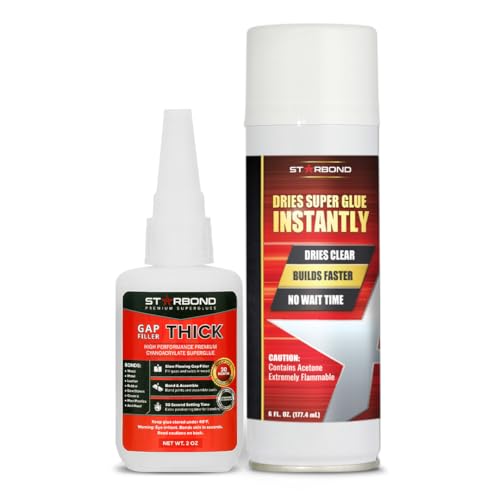
The Starbond Thick CA Glue bundle is the go-to for any veneer job that needs gap-filling strength without the wait. Its honey-like viscosity stays where you put it, making it ideal for filling cracks inside a woodturning blank or bridging a slight gap between a veneer patch and the substrate. The included aerosol accelerator cures the glue in seconds, so you can sand and move on immediately.
This formulation is particularly useful for mitre joint bonding on trim and MDF where clamping is awkward. The thick body prevents the glue from wicking into the end grain and starving the joint — a common failure with thin CA glues. After curing, it sands cleanly and accepts stain, which is essential for visible veneer repairs.
The accelerator does have a low-odor formula, but you’ll still want to use it in a ventilated area. The two-ounce bottle is compact, but the activator can runs out faster than the glue if you’re heavy-handed. For small, precision-intensive work — like reattaching a loose inlay or stabilizing a blistered patch — this bundle offers unmatched speed.
Why it’s great
- Thick viscosity fills gaps without running
- Activator cures in seconds for instant sanding
- Sands clean and accepts stain for invisible repairs
Good to know
- Activator can dries faster than the glue
- Not reversible — once cured, the bond is permanent
4. Titebond Instant Wood Adhesive

Titebond’s Instant Wood Adhesive is a medium-viscosity CA glue that eliminates clamping altogether — a huge advantage when you’re working on a veneer edge that’s lifting in the middle of a panel. The bond reaches handling strength in about 5 seconds and ultimate strength that exceeds the wood itself. For quick repairs and small patches, this is the most efficient option on the list.
The medium viscosity strikes a balance between the water-thin consistency that wicks into cracks and the thick gel that fills gaps. It’s dependable for bonding wood, MDF, acrylic, and even PVC, so it works as a general-purpose adhesive around the shop, not just for veneer. The pin-point applicator tip helps you place the glue precisely without overspill.
The trade-off is speed itself. With a 5-second cure, you have zero time to reposition the veneer once the pieces touch. For beginners or large panels, this can lead to misalignment and wasted material. It’s also irreversible, so any mistake requires sanding or cutting away the bond rather than softening it.
Why it’s great
- Eliminates clamps entirely for small repairs
- Bonds stronger than the surrounding wood
- Medium viscosity suits most general woodworking tasks
Good to know
- Zero repositioning time — alignment must be perfect
- Not reversible; bond is permanent once cured
5. FastCap 2P-10 Thin Wood Adhesive
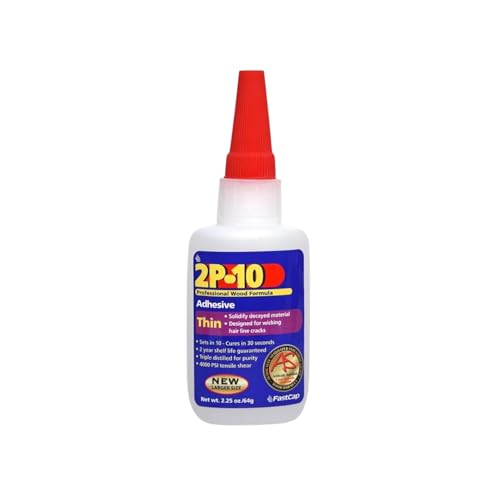
FastCap 2P-10 is the thinnest glue in this lineup, with a water-like viscosity designed to wick into microscopic cracks and tight-fitting joints. For veneer work, this is invaluable when you need to stabilize a blister without lifting the surface — simply apply a drop at the edge and watch the capillary action pull it under the veneer.
The transparency after curing is another major asset. Unlike some CA glues that leave a white bloom around the repair area, FastCap dries crystal-clear, so glue lines disappear against wood grain. It fills micro and medium cracks effectively, and you can sand it within 60 seconds, making it the fastest turnaround for a visible surface repair.
The thin viscosity is a double-edged sword: it’s hard to control if you’re not precise. A heavy hand causes the glue to run across the surface or drip through open joints. It works best with the FastCap activator spray for instant cure, but even alone, the bond strength is impressive — one reviewer reported pulling plastic off a 3D print rather than breaking the glue joint.
Why it’s great
- Wicks into micro-cracks without lifting veneer
- Cures crystal-clear with no visible glue lines
- Sands within 60 seconds for fast finishing
Good to know
- Extremely thin; requires precise application to avoid runs
- Not suitable for gap-filling — designed for tight joints only
FAQ
Can I use regular wood glue for veneer?
What does reversible mean for a veneer adhesive?
Why does hide glue need to be heated before use?
Final Thoughts: The Verdict
For most users, the best adhesive for veneer winner is the Old Brown Glue Liquid Hide Glue because it combines a forgiving 30-minute open time, a strong yet flexible bond, and full reversibility — making it suitable for both modern lamination and antique restoration. If you need to bond a full panel quickly and evenly, grab the 3M Hi-Strength 94 ET Spray. And for quick, gap-filling repairs where clamping is impossible, nothing beats the Starbond Thick CA Glue Bundle.

Mo Maruf
I created WellFizz to bridge the gap between vague wellness advice and actionable solutions. My mission is simple: to decode the research and give you practical tools you can actually use.
Beyond the data, I am a passionate traveler. I believe that stepping away from the screen to explore new environments is essential for mental clarity and physical vitality.