Our readers keep the lights on and my smoothie glass nicely filled. As an Amazon Associate, I earn from qualifying purchases.
An indoor bike that shakes across the floor or drowns out your podcast is a purchase you will regret within the first week. The real test of an at-home workout bike is not the brand name printed on the frame but the specific combination of resistance type, frame rigidity, and drivetrain noise that determines whether that bike gathers dust or gets used daily. A poorly chosen unit turns cardio into a chore; a properly specced one pulls you back to the saddle every single day.
I’m Mohammad Maruf — the founder and writer behind WellFizz. My research focuses on cross-referencing warranty terms, customer longevity reports, and measurable performance specs like decibel ratings and weight capacities to separate durable home fitness machines from disposable ones.
This guide breaks down nine models side by side so you can confidently choose the best at home workout bikes for your space, fitness level, and daily routine without falling for marketing fluff.
How To Choose The Best At Home Workout Bikes
Every home bike buyer faces the same core tension: you want a machine that feels solid under load but doesn’t dominate your living space visually or acoustically. The right choice depends on understanding three key variables that most product pages obscure behind heroic marketing language.
Resistance Type — Magnetic vs. Felt Pad vs. Air
Magnetic resistance uses opposing magnets to create drag without physical contact. This produces the lowest noise floor — typically under 25 decibels — and requires zero friction pad replacements. Felt pad resistance is cheaper to manufacture but wears down over months, creating a grinding sound and inconsistent tension. Air resistance (fan bikes) increases drag proportionally to your effort, which delivers a natural road feel but generates noticeable wind noise. For apartment dwellers or shared-wall homes, magnetic is the clear winner. If you want the hardest possible sprint session and don’t mind the whoosh, air resistance offers an unmatched intensity curve.
Drivetrain — Belt vs. Chain
A belt drive uses a reinforced rubber belt connecting the pedals to the flywheel. It is nearly silent, requires no lubrication, and stays clean — no greasy chain residue near your carpet. A chain drive is more durable under extreme torque but demands periodic oiling and runs audibly louder. Most residential bikes now ship with belt drives for exactly this reason. The exception is the Wahoo KICKR CORE 2 and Garmin Tacx NEO 2T, which are direct-drive smart trainers that use your actual bike’s drivetrain — these are chain-based by necessity but operate at a different noise profile due to their enclosed design.
Frame Stability and Weight Capacity
A bike that flexes or wobbles during a climb simulation will undermine your confidence and your workout quality. Look for a steel triangular frame with a weight capacity at least 30 pounds above your body weight — this ensures the frame has reserve stiffness. The Wenoker and Yesoul S3 both hit 350-pound capacities with reinforced alloy steel, while the Kawnina recumbent and pooboo W216 push past 400 pounds for heavier users. Check the base footprint too: a wider stance (especially with front stabilizer extensions) resists lateral rocking during out-of-saddle sprints.
Quick Comparison
On smaller screens, swipe sideways to see the full table.
| Model | Category | Best For | Key Spec | Amazon |
|---|---|---|---|---|
| MERACH S19 | Recumbent | Knee rehab & ergonomic comfort | 330 lb capacity, dual-belt drive | Amazon |
| Wahoo KICKR CORE 2 | Smart Trainer | Serious Zwift training at home | WiFi connectivity, virtual shifting | Amazon |
| Garmin Tacx NEO 2T | Smart Trainer | Realistic road feel & silent operation | 32 neodymium magnets, 2200W load | Amazon |
| pooboo Air Bike | Air Resistance | Full-body HIIT & CrossFit | Dual-action handlebars, 350 lb cap | Amazon |
| Yesoul S3 | Upright | App-guided spin classes | 100 resistance levels, 350 lb cap | Amazon |
| Merach S26 | Upright | Zwift-compatible value | <25 dB noise, 300 lb cap | Amazon |
| pooboo W216 Recumbent | Recumbent | Low-impact full-body with arm exerciser | 400 lb cap, 20 dB, arm cranks | Amazon |
| Kawnina Recumbent | Recumbent | Senior-friendly high-capacity rides | 420 lb cap, 16 resistance levels | Amazon |
| Wenoker Magnetic | Upright | Budget-friendly quiet apartment use | 350 lb cap, Bluetooth app sync | Amazon |
In‑Depth Reviews
1. MERACH S19 Recumbent Exercise Bike
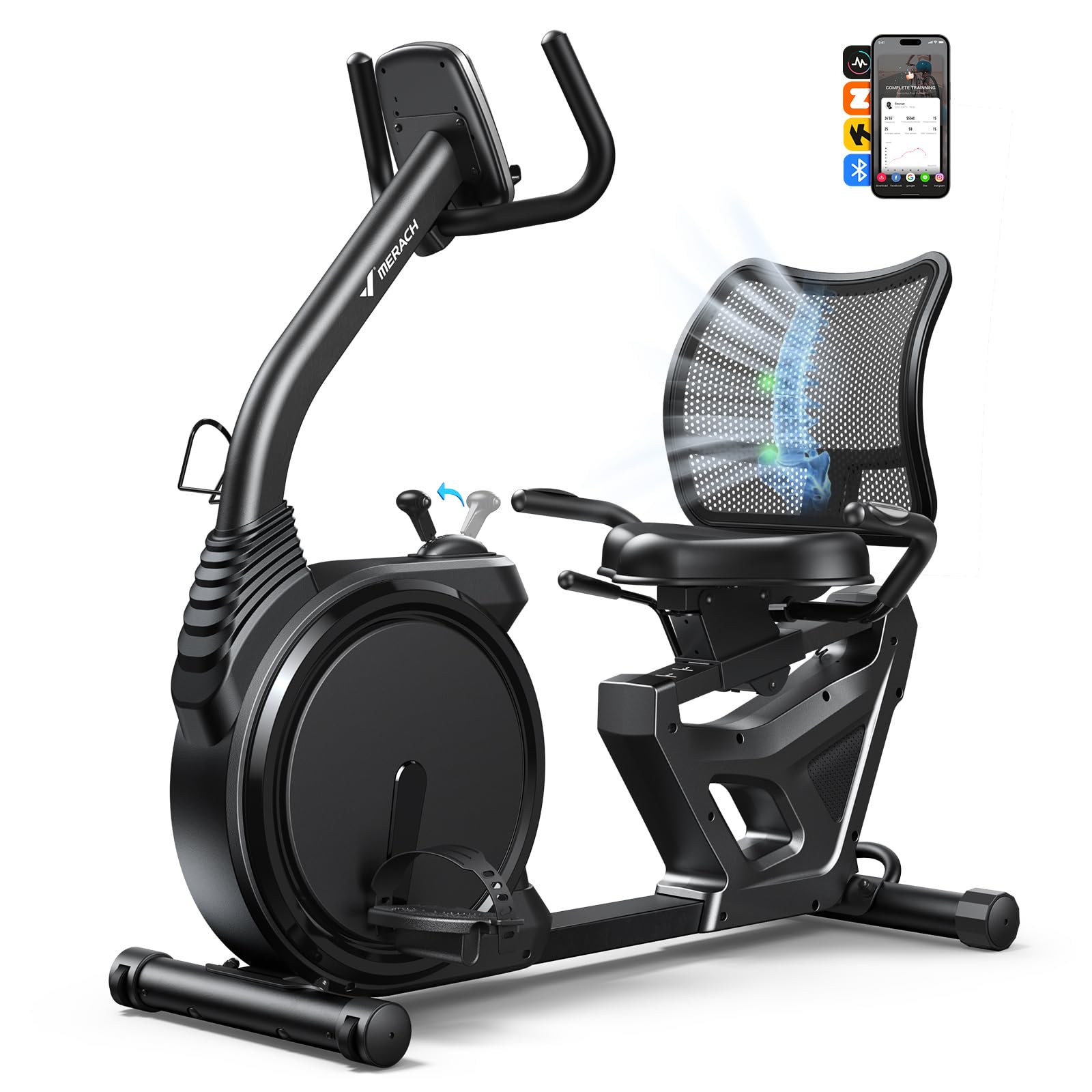
The MERACH S19 hits the sweet spot between commercial-grade stability and home-friendly footprint. Its dual-belt drive system paired with a perimeter-weighted 6.6-pound flywheel delivers a whisper-quiet ride that stays under 85 pounds total weight — light enough to move via transport wheels but planted enough that 330-pound users report zero frame flex. The car-style lever resistance adjustment is a thoughtful touch: rather than fumbling with a tiny knob mid-ride, you shift through eight levels with a single mechanical click that you can feel through the handlebar.
Ergonomically, this recumbent shines for anyone recovering from knee surgery or dealing with lower back sensitivity. The breathable mesh backrest follows the natural curve of the spine, and the eight-position seat slider accommodates inseams up to roughly 35 inches. Customer reviews consistently mention that 5-foot-9 riders find the leg extension full without overreaching, though taller users above 6 feet may find the top end tight. The frosted handlebars resist sweat buildup — a detail absent from cheaper plastic-wrapped grips that turn slick within weeks.
The MERACH self-developed app syncs basic metrics and gamifies the experience through FantomFite, but the real value here is the hardware. The heart rate handle sensors are more responsive than chest straps in the same price tier, and the LCD backlit display is readable in low-light garages. If you want a recumbent that prioritizes joint-friendly motion and quiet operation without forcing you into a subscription ecosystem, the S19 is the pick.
Why it’s great
- Car-style lever resistance is intuitive and durable compared to cable-actuated knobs
- Breathable mesh backrest provides continuous lumbar airflow during 45-minute sessions
- Near-silent belt drive at conversation-level volume — tested under 30 dB in home settings
- Easy 30-minute assembly with 80% pre-built frame and clear video instructions
Good to know
- Recommended rider height maxes out around 5-foot-10 due to seat rail length
- Resistance curve is mild in the lower half; serious athletes may want a unit with more granular top-end steps
- Calorie counter on the LCD is optimistic — use a chest strap or power meter for accurate energy expenditure
2. Wahoo Fitness KICKR CORE 2 Zwift Cog and Click
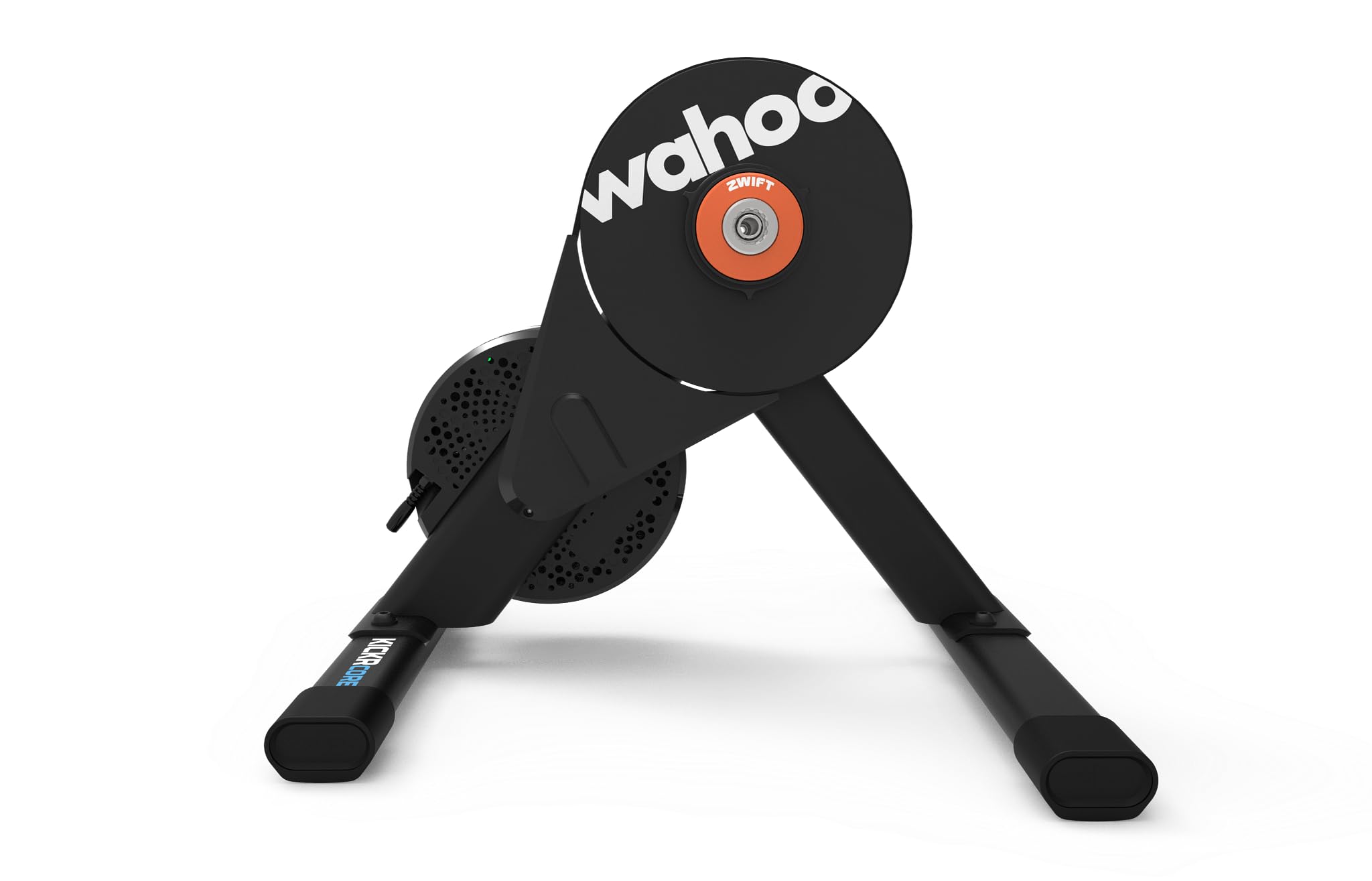
The KICKR CORE 2 is a direct-drive smart trainer — you attach your own road or mountain bike to its cassette and pedal against a computer-controlled electromagnetic resistance unit. This is not a standalone exercise bike; it is a training platform for cyclists who already own a bike and want to simulate climbs, intervals, and structured workouts inside platforms like Zwift or Rouvy. The third-generation Zwift Cog and Click bundle includes Wahoo’s virtual shifting system, which lets you change gears without a physical derailleur.
Setup is dramatically simpler than the original KICKR: integrated WiFi handles firmware updates and ANT+/Bluetooth pairing without a dongle. The ride feel is smooth and responsive — the electromagnetic resistance adjusts in under a second to match gradient changes in Zwift. The included Zwift Cog replaces your rear cassette with a single cog and uses the Click remote to simulate gear changes virtually. Some early adopters reported pairing hiccups with the Click, but after firmware updates the shifting response is reliable for most riders.
Crucially, the KICKR CORE 2 is quiet enough that users report hearing only their own breathing and drivetrain noise. The steel frame folds for storage, and the 220-pound load capacity handles sprints up to 1800 watts without slipping. This unit requires a Zwift subscription to unlock most features — factor that recurring cost into your decision. If you are a cyclist who wants structured indoor training with minimal floor footprint, this is the most versatile option on the list.
Why it’s great
- Integrated WiFi eliminates the need for a separate ANT+ dongle or bridge
- Virtual shifting with Zwift Cog removes the need for a traditional cassette and derailleur setup
- Foldable legs reduce storage height to under 19 inches when not in use
- Power accuracy within 1% for structured training plans
Good to know
- Requires a Zwift subscription (approximately /month) to use the Click virtual shifting feature
- You must supply your own bike — not a standalone unit for non-cyclists
- Some users report a slight vibration hum at high wattages; placing on a rubber mat helps
3. Garmin Tacx NEO 2T Smart Trainer

The Tacx NEO 2T is the quietest direct-drive trainer on the market — period. Its 32 neodymium magnets generate resistance without any mechanical contact, so there is zero belt, chain, or gear noise. During a structured workout, the only sound you hear is your own breathing and the subtle hum of the flywheel. The unit simulates road texture through a feature called Road Feel, which vibrates the frame slightly when you ride over cobblestones or gravel in virtual environments.
Setup is genuinely plug-and-play: no calibration required because the NEO 2T measures power directly from the magnetic field rather than inferring it from belt tension. The unit folds relatively flat for storage and includes both 130mm and 148mm thru-axle adapters for modern disc-brake road and mountain bikes. The included one-month Tacx Premium subscription unlocks video-based routes, but the trainer works seamlessly with Zwift, TrainerRoad, and Rouvy without any subscription lock-in.
The catch is price — this is the most expensive unit in this guide — and the fact that you need to supply your own bike. The 2200-watt maximum load means even elite sprinters cannot overwhelm the resistance unit. For serious cyclists who train year-round and want the most realistic indoor experience possible, the NEO 2T justifies its position at the top of the hierarchy. If you are a casual rider looking for a standalone bike, this is not the model for you.
Why it’s great
- Absolutely silent operation — no moving contact surfaces means zero mechanical noise
- Road Feel technology vibrates the frame to simulate real-world surfaces in Zwift and Tacx apps
- No calibration needed; power is measured directly from the magnetic field
- Foldable design reduces storage footprint to 10 inches tall
Good to know
- Premium price point — entry-level cyclists may find the investment hard to justify
- Requires your own bicycle; not a standalone exercise bike for non-cyclists
- Included Tacx Premium subscription is only one month; renewal costs extra
- Setup with older Macs may need a direct HDMI connection rather than Bluetooth-only pairing
4. pooboo Air Resistance Fan Bike

The pooboo Air Bike is the polar opposite of a magnetic quiet bike — and that is by design. Air resistance means the faster you pedal, the more drag you feel, creating an intensity curve that is unmatched for high-intensity interval training. The dual-action handlebars move independently, so you can push and pull with your arms while your legs spin, engaging your entire posterior chain and core simultaneously. The fan itself generates a cooling breeze, which is welcome during all-out 30-second sprints.
The construction is heavy — 90 pounds of carbon steel — and the belt-and-chain hybrid drivetrain delivers smooth power transfer without the maintenance headache of a full chain. The Bluetooth performance monitor tracks time, speed, distance, odometer, and calories, and it connects to third-party apps for structured interval programs. Customer feedback consistently praises the solid frame that does not wobble even during aggressive out-of-saddle efforts, and users up to 6-foot-4 report comfortable fit after adjusting the four-way seat and handlebars.
The trade-off is noise. Air resistance bikes produce a pronounced whoosh that fills the room — expect to hear it through walls if you live in an apartment. The pooboo is also not designed for casual pedaling; its resistance floor starts at moderate and climbs sharply. This is a performance tool for CrossFit athletes, HIIT enthusiasts, and anyone who wants maximum metabolic demand in minimal time. For gentle recovery rides or TV-watching cardio, look at a magnetic recumbent instead.
Why it’s great
- Progressive air resistance provides unlimited intensity — the harder you push, the harder it gets
- Dual-action handlebars enable simultaneous upper and lower body engagement for full-body conditioning
- 90-pound steel frame eliminates wobble during max-effort sprints
- Fan cooling keeps you from overheating during high-intensity intervals
Good to know
- Air resistance produces noticeable whoosh noise — not suitable for shared-wall apartments during late hours
- Seat adjustment can loosen over time; periodic tightening of the clamp bolt is needed
- Not designed for slow, steady-state pedaling; resistance floor is moderate even at low RPM
5. Yesoul S3 Exercise Bike

The Yesoul S3 is designed for people who love Peloton-style spin classes but do not want to pay the monthly premium for a branded tablet. It pairs via Bluetooth to the Yesoul Fitness app, which offers hundreds of instructor-led classes with real-time metrics including cadence, resistance level, and heart rate. The magnetic resistance knob adjusts smoothly across 100 levels, and the app automatically matches the class instructor’s cue changes when you connect.
The frame is carbon steel with a 350-pound weight capacity and a belt drive that keeps noise near silent. At 68 pounds total, the S3 is lighter than many competitors — easy to reposition with its transport wheels, but some users report minor lateral flex during max-effort standing climbs. The SPD-compatible pedals accept both cleat-in cycling shoes and standard sneakers via the included toe cages, which is a rare convenience at this price point.
Where the S3 compromises is adjustability. The handlebars adjust vertically but not horizontally, which can force taller riders into a stretched-out position. Several reviews note that riders above 5-foot-10 find the cockpit cramped; the seat also has a reputation for causing discomfort during rides longer than 30 minutes. The Yesoul app subscription is about half the cost of Peloton’s, but if you skip the subscription the bike functions as a manual-resistance unit with a basic LCD — still usable, but you lose the guided class experience that defines this model.
Why it’s great
- 100 levels of magnetic resistance provide granular tension control from warm-up to max climb
- SPD dual-sided pedals accept cleats or sneakers without swapping hardware
- Yesoul app delivers hundreds of instructor-led classes at roughly half the Peloton subscription cost
- Whisper-quiet belt drive won’t disturb household members during early morning rides
Good to know
- Handlebars lack horizontal adjustment; taller riders may experience reach discomfort
- Stock seat is firm and narrow — most users replace it within the first month
- App subscription is optional but the bike loses its core value proposition without it
- Transport wheels are small and can flex under load when moving across carpet
6. Merach S26 Exercise Bike
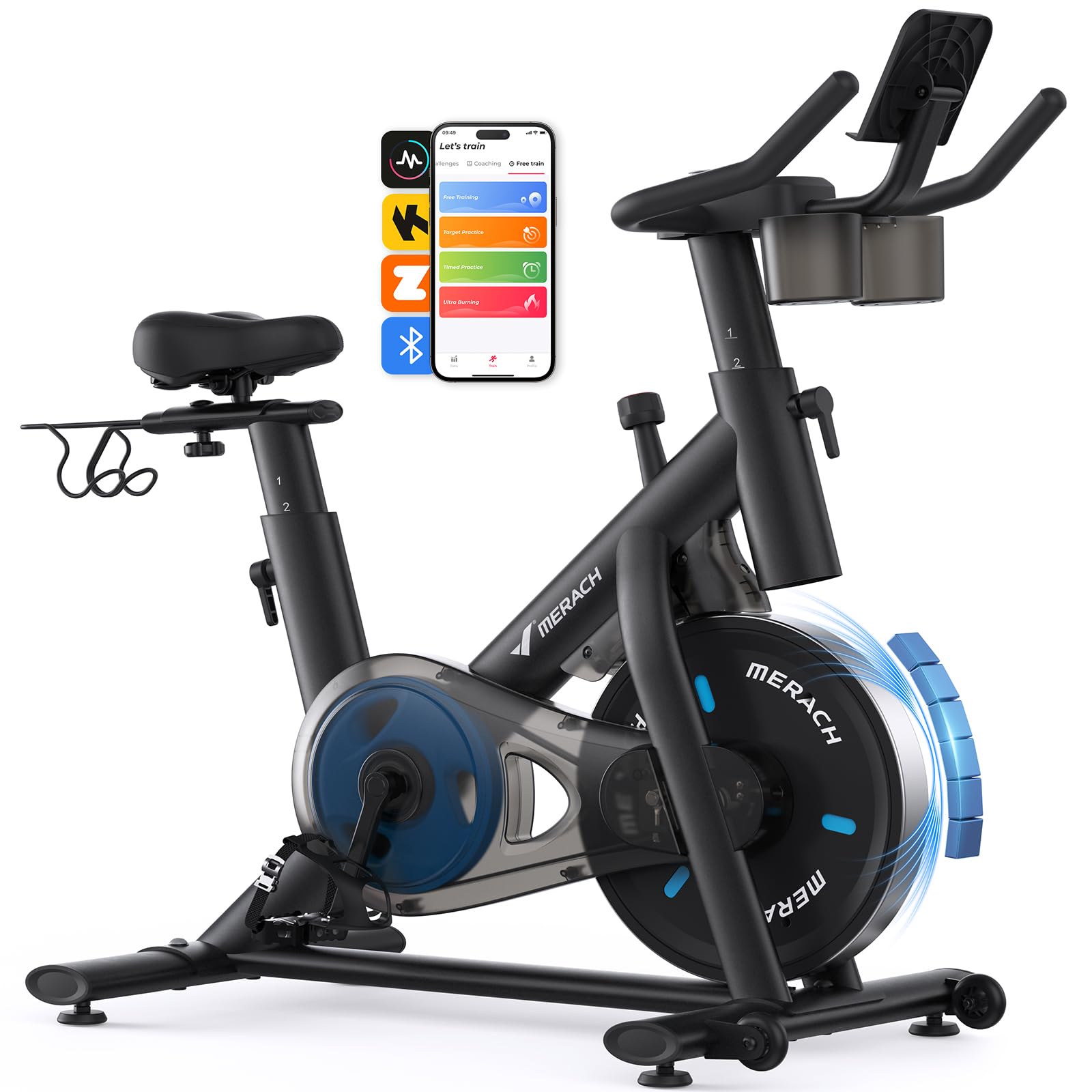
The Merach S26 is the upright magnetic bike for buyers who want Zwift compatibility on a mid-range budget. The self-developed Merach app syncs with KINOMAP and Zwift, and users report power data accuracy within 10% of a Wahoo KICKR — impressive for a bike that costs a fraction of a smart trainer. The magnetic resistance system uses industrial-grade bearings and ABS pulleys to keep noise under 25 decibels, making it one of the quietest upright models in this roundup.
The reinforced inverted triangle frame uses 2.00mm steel in high-stress zones and keeps weld points to five or fewer, reducing the risk of frame flex over years of use. The inseam range accommodates riders from 4-foot-8 to 6-foot-2, and the four-way seat adjustment plus two-way handlebar tilt let you dial in a comfortable riding position. The included dumbbell rack is a unique bonus — you can keep light weights within reach for combined cardio-and-strength circuits.
Assembly is the biggest friction point. Multiple customer reviews note that even experienced builders need close to two hours to complete assembly, and the instructions can be unclear on certain steps like the brake pad alignment. The pedal straps are also thinner than ideal and may wear out faster than the rest of the bike. Despite these quibbles, the S26’s combination of app connectivity, whisper-quiet drivetrain, and solid 62-pound build makes it a strong value play for Zwift-curious riders who are not ready to invest in a dedicated smart trainer.
Why it’s great
- Zwift-compatible power data within 10% of dedicated smart trainers — rare at this price tier
- Wide inseam range (56–74 inches) fits riders from 4-foot-8 to 6-foot-2
- Ultra-quiet magnetic drive at under 25 dB is suitable for shared-wall apartments
- Built-in dumbbell rack supports combined cardio-and-strength workout circuits
Good to know
- Assembly takes roughly 2 hours even for mechanically inclined users
- Pedal straps are thin and may need replacement within the first year
- No freewheeling mechanism — pedals stop immediately when you stop, which takes adjustment
- Basic LCD display does not show resistance level; app required for full data visibility
7. pooboo W216 Recumbent Exercise Bike
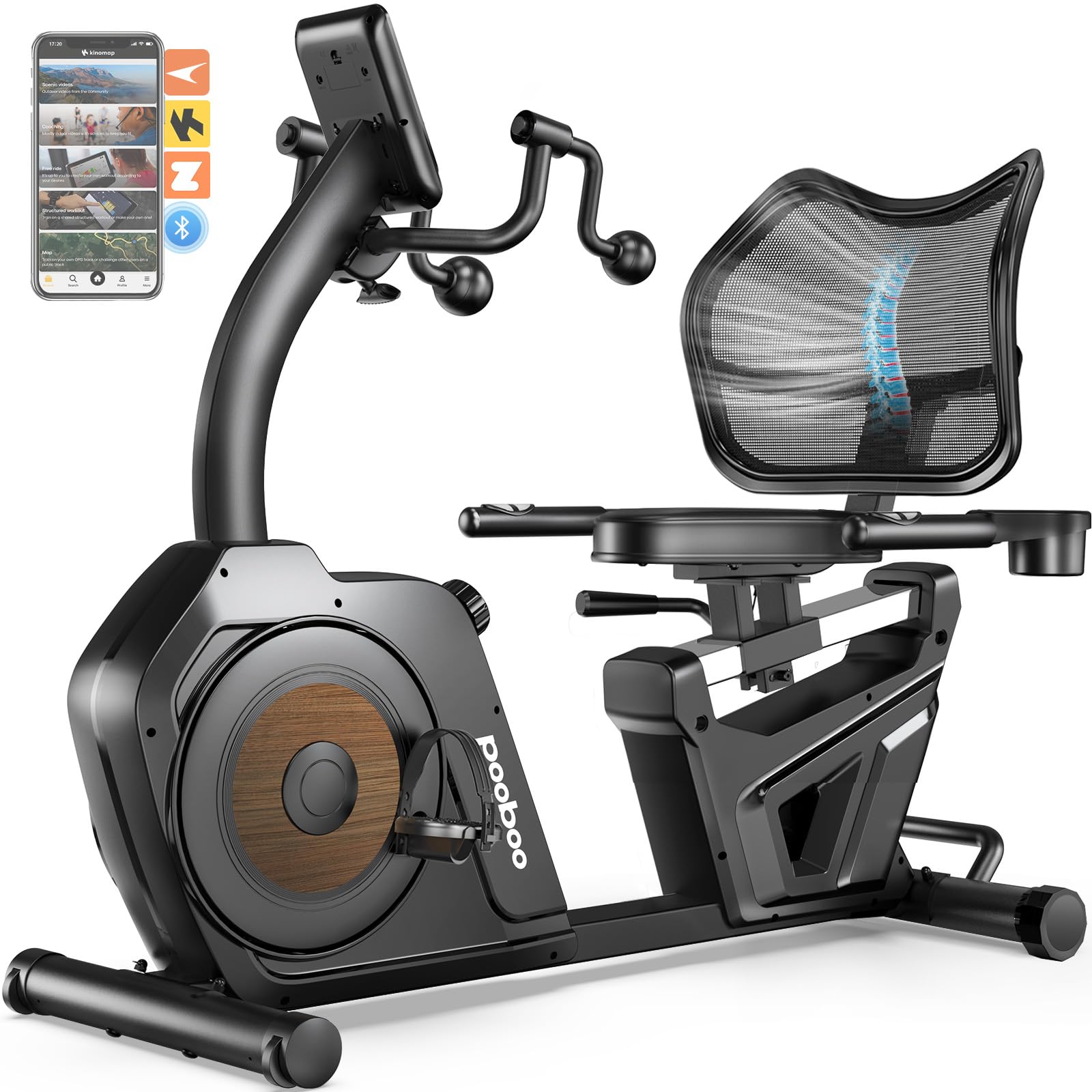
The pooboo W216 is a recumbent bike with an integrated arm exerciser — the handlebars move independently to work your shoulders, biceps, and triceps while your legs pedal. This dual-motion design is valuable for physical therapy, stroke recovery, or anyone who wants to increase upper-body blood flow during a cardio session. The 15-pound flywheel and belt drive keep operation at a claimed 20 decibels, which is impressively low for a recumbent.
The seat rail adjusts up to 18.5 inches, accommodating riders up to 6-foot-3. The breathable mesh backrest follows the natural curve of the spine and provides continuous lumbar support — critical for users with chronic back pain who cannot tolerate upright posture on a standard spin bike. The eight-level resistance knob is simple to turn mid-ride, though the steps are wide enough that you may feel a noticeable jump between levels 4 and 5. The LCD monitor tracks speed, distance, time, calories, and pulse, but it lacks a backlight, making it hard to read in dim lighting.
At 80 pounds, the W216 is heavier than most recumbents in its class, which contributes to its stability. Users report zero wobble even with 400-pound riders pedaling at moderate cadence. The included transport wheels make relocation possible, though the 80-pound weight is still a lift for a single person. Several reviews flagged a broken monitor on arrival, but pooboo’s customer service responded quickly with replacements. If upper-body engagement during cardio is your priority, this is the most purpose-built option available.
Why it’s great
- Dual-action arm exerciser engages upper body independently or simultaneously with legs
- 400-pound weight capacity with stable steel frame accommodates a wide range of users
- Breathable mesh backrest provides continuous lumbar airflow and support during long sessions
- Near-silent 20 dB belt drive is among the quietest recumbents tested
Good to know
- Arm handlebars offer no adjustable resistance — they move freely with pedaling cadence
- LCD monitor is not backlit; requires ambient light for readability
- 8 resistance levels provide wide steps; fine-tuning between levels is limited
- Some units ship with cosmetic or monitor damage; customer service is responsive but inconsistency exists
8. Kawnina Recumbent Exercise Bike
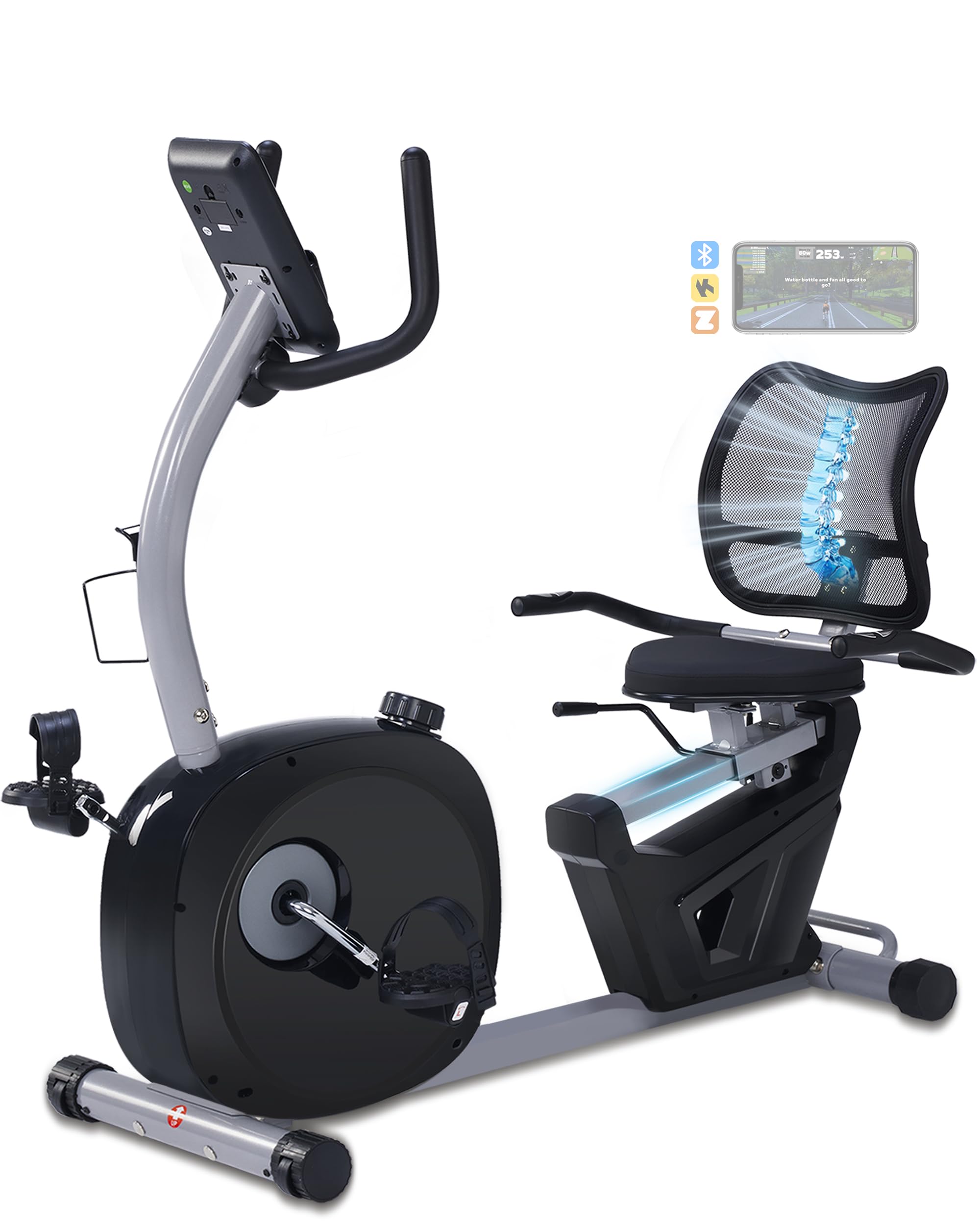
The Kawnina recumbent targets the senior market directly, and its design decisions reflect that focus. The step-through frame means you do not have to lift your leg over a top tube — you simply sit down and swing your feet onto the pedals. The 420-pound weight capacity is the highest in this guide, supported by a one-piece alloy steel frame that shows no flex under load. The seat adjusts infinitely along a rail, with a breathable mesh backrest that prioritizes lumbar comfort for users with degenerative disc issues or arthritis.
The magnetic resistance system offers 16 levels, which is double the granularity of most budget recumbents. For physical therapy applications, this is meaningful — you can start at level 1 for gentle range-of-motion work and progress in small increments as strength returns. The backlit LCD display shows time, distance, speed, calories, and heart rate from the handlebar pulse sensors, and it is readable even in dark rooms. Bluetooth connectivity pairs with Kinomap and Zwift for virtual ride variety, though the bike functions perfectly as a standalone unit without any app.
Some users note that the seat cushion could be plusher for long sessions, and the 62-pound weight makes it less portable than lighter recumbents despite the built-in wheels. The pulse sensors on the handlebars are more primitive than optical or chest-strap alternatives — expect approximate readings rather than clinical accuracy. For its primary audience — seniors, rehabilitation patients, and anyone prioritizing easy access and high weight capacity — the Kawnina delivers exactly what it promises without gimmicks.
Why it’s great
- Step-through frame design eliminates leg-over-top-tube entry — ideal for limited mobility
- 420-pound weight capacity is the highest in this roundup with zero reported frame flex
- 16 resistance levels allow gradual tension progression suitable for physical therapy protocols
- Backlit LCD is readable in low-light basement or garage environments
Good to know
- Seat cushion is firm; users who prefer plush padding may need an aftermarket gel cover
- Handlebar pulse sensors provide approximate heart rate data only — not clinical grade
- 62-pound weight is manageable but not compact; the bike requires dedicated floor space
- Maximum user height around 6 feet; very tall riders may feel the leg extension is limited
9. Wenoker Magnetic Exercise Bike
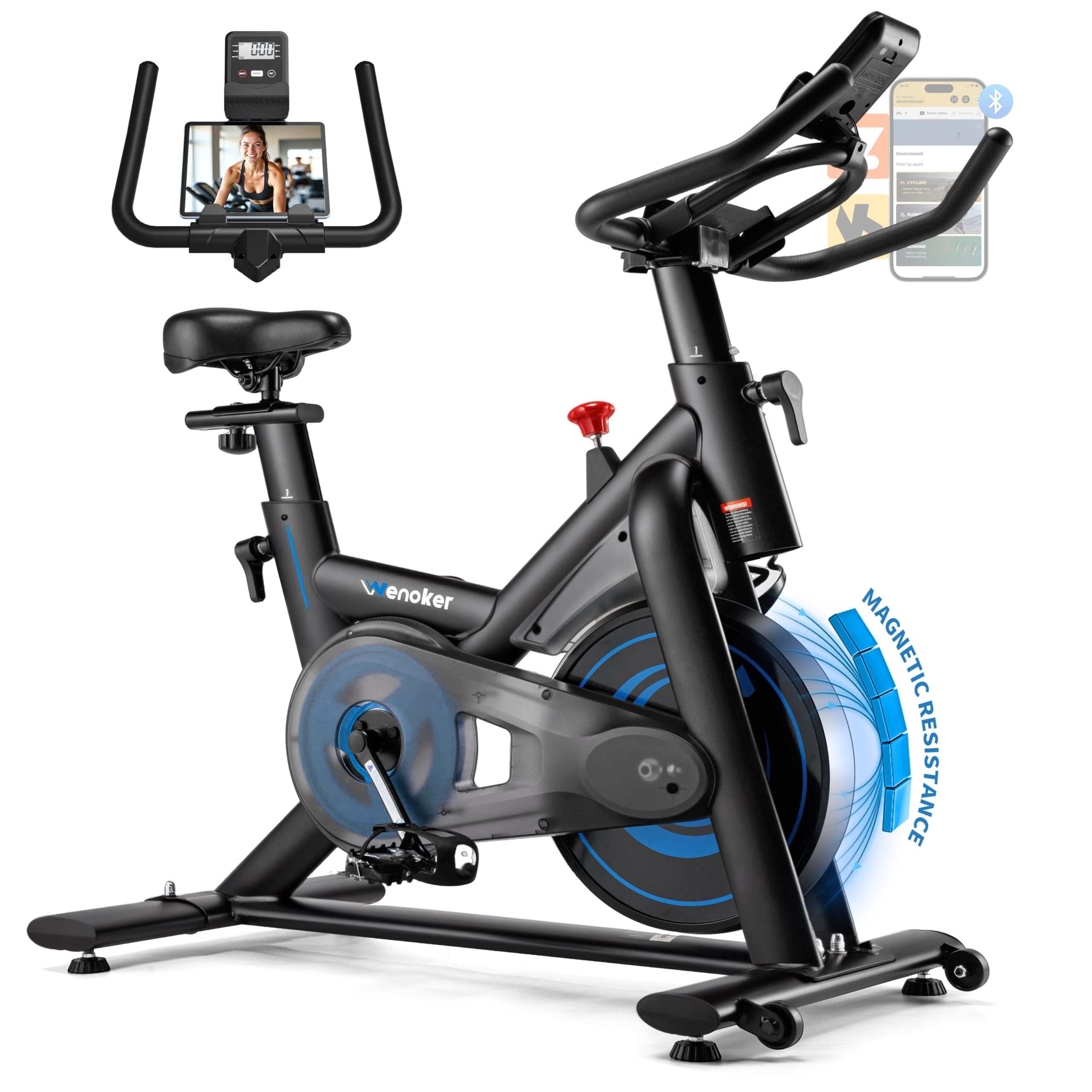
The Wenoker magnetic upright bike punches above its price tier on two crucial specs: a 350-pound weight capacity and Bluetooth app connectivity. The reinforced triangular steel frame does not wobble during steady-state rides, and the belt-driven magnetic resistance is genuinely quiet — you can hold a conversation at normal volume while pedaling at moderate cadence. The LCD display tracks time, speed, distance, and calories, though it lacks any heart rate capability.
Assembly is straightforward — the bike arrives mostly pre-assembled, and most users report setup completion within 30 minutes. The seat and handlebars adjust vertically, but the fore-aft range is limited. Several reviews note that when the seat is raised to accommodate taller riders, the handlebars cannot be raised high enough to maintain a comfortable upright posture, potentially causing lower back strain for users over 5-foot-10. The included tablet holder and water bottle cage are standard inclusions at this price, but they feel flimsy compared to the bike’s otherwise sturdy frame.
The seat itself is a common complaint — multiple reviewers describe it as small and firm, which can become uncomfortable during rides exceeding 30 minutes. A gel seat cover or padded cycling shorts solves this issue for under . The Bluetooth app integration is basic and does not offer guided classes or structured workouts like the Yesoul app, but it does sync basic metrics to your phone for progress tracking. If you need a quiet, stable, and affordable entry into indoor cycling and you are under 5-foot-10, the Wenoker delivers the core experience without breaking your budget.
Why it’s great
- 350-pound capacity in a bike at this price point is rare — the steel frame is genuinely sturdy
- Magnetic belt drive operates near-silently, perfect for apartment or early-morning use
- Quick 30-minute assembly with clear video instructions reduces setup frustration
- Bluetooth app sync provides basic metric tracking without any subscription cost
Good to know
- Handlebar height range does not match seat height range — tall riders may experience back strain
- Stock seat is small and firm; a gel cover or padded shorts is almost mandatory for rides over 30 minutes
- Bluetooth app is basic with limited features — no guided classes or structured workouts
- Tablet holder and water bottle cage feel less durable than the rest of the frame
FAQ
Can I use a standard upright bike for Zwift without buying a smart trainer?
What maintenance does a magnetic resistance bike require compared to a felt pad bike?
Why do recumbent bikes have lower weight capacities than upright bikes on paper but feel more stable?
Is an air resistance bike suitable for someone recovering from knee surgery?
How important is an SPD pedal system for casual home riders?
Final Thoughts: The Verdict
For most users, the best at home workout bikes winner is the MERACH S19 because it combines recumbent ergonomics with near-silent belt drive and a weight capacity practical for the entire family — all without forcing you into a subscription app. If you want a smart trainer that transforms your existing bike into a Zwift powerhouse, grab the Wahoo KICKR CORE 2. And for full-body HIIT that leaves nothing on the table, nothing beats the pooboo Air Bike.

Mo Maruf
I created WellFizz to bridge the gap between vague wellness advice and actionable solutions. My mission is simple: to decode the research and give you practical tools you can actually use.
Beyond the data, I am a passionate traveler. I believe that stepping away from the screen to explore new environments is essential for mental clarity and physical vitality.