Our readers keep the lights on and my smoothie glass nicely filled. As an Amazon Associate, I earn from qualifying purchases.
A 7.1 sound bar promises to wrap you in audio from every direction—front, sides, and rear—without the clutter of a full receiver-based theater. The challenge is separating true channel separation from virtual processing that merely widens the stereo field, all while keeping the system manageable for a living room.
I’m Mohammad Maruf — the founder and writer behind WellFizz. Over the past three years, I’ve evaluated dozens of home theater audio systems, focusing on the specific engineering trade-offs (driver arrays, DSP algorithms, wireless latency, and subwoofer integration) that separate immersive 7.1 setups from glorified two-channel bars with rear speakers tacked on.
Whether you’re upgrading from TV speakers or replacing a dated 5.1 receiver, understanding how each bar handles surround decoding, up-firing vs. wired rears, and dialogue clarity is the difference between a cinematic upgrade and a costly disappointment. This guide cuts through the marketing to reveal the best 7.1 sound bar for your specific room size, content habits, and tolerance for wires.
How To Choose The Best 7.1 Sound Bar
The term “7.1” on a sound bar can mean very different things depending on whether the system uses four physical surround speakers, virtual psychoacoustic processing, or a hybrid of both. Start by understanding your room’s layout and where you can place rear speakers without tripping over cables.
True Channel Count vs. Virtual Surround
A true 7.1 sound bar includes a left, center, right soundstage up front, plus four discrete surround channels (two side, two rear) and a subwoofer. Virtual 7.1 uses digital signal processing to simulate rear channels from a single bar. The first approach delivers precise object placement for action films; the second is less intrusive but rarely convinces critical listeners. Check whether the bar ships with four physical surround speakers or relies solely on up-firing drivers and room reflection.
Subwoofer Size and Room Fit
The subwoofer driver diameter—typically 6.5 inches at the budget end to 10 inches in premium models—directly affects how low the system can dig. An 8-inch or 10-inch wireless subwoofer provides chest-thumping impact for explosions and movie scores in medium to large living rooms, while a 6.5-inch driver suits apartments where you need controlled bass that won’t shake the whole building. Also verify whether the subwoofer connects wirelessly with minimal latency or requires a wired link.
Dialogue Clarity and Voice Modes
Many 7.1 sound bars include dedicated center channel drivers or proprietary dialogue enhancement (such as JBL’s PureVoice 2.0 or A.I. Dialogue Mode from Bose) that raises vocal frequencies without making the rest of the mix sound tinny. If you frequently watch dramas, sports, or news, prioritize a system with a specific voice or dialogue mode over one that requires you to manually boost the center channel via an app equalizer.
Quick Comparison
On smaller screens, swipe sideways to see the full table.
| Model | Category | Best For | Key Spec | Amazon |
|---|---|---|---|---|
| JBL Bar 1000MK2 | Premium 7.1.4 | True Atmos with detachable rears | 10″ sub, 480W RMS, 4 up-firing drivers | Amazon |
| Polk Audio MagniFi Max AX SR | Premium 7.1.2 | Wired surrounds with VoiceAdjust | 10″ sub, 7.1.2 channels, SDA 3D audio | Amazon |
| TCL Q85H 7.1.4 | Premium 7.1.4 | Large-room Atmos and DTS:X | 860W peak, up-firing rears, AI Sonic tune | Amazon |
| Bose Smart Ultra | Premium Virtual | Compact 3D immersion without rear speakers | 5 transducers, TrueSpace upmixing, A.I. dialogue | Amazon |
| JBL Bar 700MK2 | Mid-Range 7.1 | Detachable rears for flexible placement | 10″ sub, 780W peak, MultiBeam 3.0 | Amazon |
| Denon DHT-S218 | Entry 2.1 Virtual | Small room with built-in subs | 2 built-in down-firing subs, Dialog Enhancer | Amazon |
| ULTIMEA Poseidon D80 | Mid-Range 7.1 | Budget Dolby Atmos with wired surrounds | 6.5″ sub, 460W peak, SurroundX System | Amazon |
| ULTIMEA Poseidon D70 | Budget 7.1 | Entry-level wired surround with app EQ | 6.5″ sub, 410W peak, 121 EQ presets | Amazon |
| Bose Smart Dolby Atmos (All-in-One) | Premium Single | Minimalist setup with Alexa integration | 5 transducers, A.I. Dialogue Mode, AirPlay 2 | Amazon |
In‑Depth Reviews
1. JBL Bar 1000MK2 – 7.1.4 Channel

The JBL Bar 1000MK2 delivers a true 7.1.4 configuration with four up-firing drivers—two in the main bar and two in the detachable surround speakers—giving you genuine overhead effects for Dolby Atmos and DTS:X content. The 10-inch wireless subwoofer provides deep, chest-thumping bass without needing a wired connection, and the detachable rears recharge on the bar when not in use, eliminating the need for power outlets near your seating area.
Setup is remarkably simple: lift the surround speakers off the bar, place them behind your couch, and the system auto-calibrates using MultiBeam 3.0 to map your room’s acoustics. The JBL ONE app offers a precise equalizer and access to streaming services, while PureVoice 2.0 automatically adjusts dialogue clarity based on ambient noise levels during quiet scenes.
With 480W RMS (880W peak), this bar fills large living rooms effortlessly. The Night Listening mode mutes the sub and main bar, routing audio exclusively through the detachable speakers for late-night viewing without disturbing others. HDMI eARC supports 4K Dolby Vision passthrough, making it a clean hub for gaming consoles and streaming devices.
Why it’s great
- True 7.1.4 with four up-firing drivers for genuine overhead sound
- Detachable wireless rears with long battery life and no power outlet needed
- 10-inch wireless subwoofer delivers powerful, room-shaking bass
- Comprehensive calibration and app-based EQ control
Good to know
- Premium tier places it above budget-friendly options
- Detachable rears require nightly recharging to maintain battery health
2. Polk Audio MagniFi Max AX SR 7.1.2

The Polk MagniFi Max AX SR bundle pairs Polk’s flagship sound bar with dedicated SR2 wireless surround speakers, creating a 7.1.2 arrangement with two up-firing drivers for height effects. Polk’s patented SDA 3D technology processes the audio to deliver a wide, enveloping soundstage, while the integrated center channel pairs with VoiceAdjust to boost vocal frequencies without muddying the rest of the mix.
The 10-inch wireless subwoofer connects instantly on power-up and delivers controlled, deep bass that can handle blockbuster soundtracks without distortion. Three HDMI inputs with eARC support allow you to connect multiple sources—gaming console, Blu-ray player, streaming stick—and switch between them automatically, a feature rare at this level.
Setup requires no app to get started, though the Polk Connect app adds room calibration and streaming options. The All Stereo mode upmixes two-channel content for sports and music, while Movie mode engages the full 7.1.2 array for Dolby Atmos and DTS:X soundtracks. VoiceAdjust works well across all modes, making it a top choice for dialogue-heavy content.
Why it’s great
- VoiceAdjust technology enhances dialogue without sacrificing surround effects
- Three HDMI inputs with auto-switching for multi-device setups
- 10-inch wireless subwoofer provides balanced, deep bass
- SDA 3D audio creates a wide, immersive soundstage
Good to know
- Up-firing speakers’ height effect is subtle and depends on ceiling height
- Surround speakers connect via power supply, not rechargeable
3. TCL Q85H 7.1.4 Surround Sound Bar

The TCL Q85H packs a punch with 860W peak power spread across a full 7.1.4 channel array, including dedicated up-firing drivers in both the main bar and the rear surround speakers. This system is built for large living spaces where a 6.5-inch subwoofer might feel underpowered—here, the 6.5-inch driver is supplemented by the sheer power ceiling to create room-filling sound without distortion at high volumes.
AI Sonic Optimization uses the TCL app to analyze your room’s dimensions and your seating position, then adjusts the equalizer and delay settings so you hear balanced audio even when sitting off-center. Dolby Atmos and DTS:X decoding are both supported, and the rear speakers include front-firing and up-firing drivers to place effects precisely around and above you.
Metal enclosure construction gives the bar a premium feel, and the included wall-mount kit simplifies installation. Note that the surrounds require access to power outlets (they are not battery-powered), and HDMI passthrough caps at 4K/60Hz rather than 120Hz, which may matter for high-refresh-rate gaming. For pure cinema volume in a big room, few systems compete at this level.
Why it’s great
- 860W peak power supports large rooms without distortion
- AI Sonic Optimization fine-tunes audio to your specific seating position
- Full 7.1.4 with up-firing drivers in rear speakers
- Supports both Dolby Atmos and DTS:X decoding
Good to know
- HDMI passthrough supports 4K/60Hz, not 120Hz for high-refresh gaming
- Rear speakers require power outlets—no rechargeable option
4. Bose Smart Ultra Dolby Atmos Soundbar

The Bose Smart Ultra is a single-bar 7.1 virtual system that uses five transducers—two of which are custom upward-firing dipole drivers—and Bose’s TrueSpace technology to upmix stereo and 5.1 content into a convincing three-dimensional sound field. It does not ship with rear speakers, making it ideal for spaces where running cables or placing satellite speakers isn’t practical.
Setup uses the Bose Music app and requires creating an account, but once configured, HDMI eARC or optical connection works seamlessly with your TV remote. A.I. Dialogue Mode analyzes the soundtrack in real time and balances vocal frequencies against background effects, producing crisp speech without requiring manual equalizer adjustments. The built-in Amazon Alexa and Google Assistant let you control music, smart home devices, and TV functions hands-free.
For those seeking true discrete rear channels, the Bose Ultra can be expanded with Bose Surround Speakers 700 or Bose Ultra Open Earbuds. Without them, the virtual surround is impressive but lacks the precision of physical rear drivers for pinpoint object placement. At this level, the Bose delivers a remarkably wide soundstage from a single, elegant unit.
Why it’s great
- Single-bar design fits neatly under most TVs without satellite clutter
- TrueSpace upmixing creates convincing 3D audio from non-Atmos content
- A.I. Dialogue Mode automatically balances voices for clear speech
- Built-in Alexa and Google Assistant for hands-free control
Good to know
- Virtual surround cannot match physical rear speakers for directional precision
- Initial setup requires phone, Bluetooth, and Bose account creation
5. JBL Bar 700MK2 – 7.1 Channel

The JBL Bar 700MK2 brings the detachable surround speaker concept from JBL’s flagship down to a more accessible price point. The two wireless surround speakers lift off the bar with one hand and can be placed anywhere behind your seating area, delivering true 7.1 channel separation without needing power outlets nearby. The 10-inch wireless subwoofer pumps out 780W peak power, providing thunderous bass that fills medium to large rooms.
MultiBeam 3.0 technology projects sound beams across the room to create a wide soundstage, and PureVoice 2.0 ensures dialogue remains clear even during chaotic action sequences. The JBL ONE app offers multi-band EQ and firmware updates, while Spotify Connect, AirPlay, and Chromecast built-in cover all major streaming platforms.
Battery life on the detachable speakers lasts for a full movie marathon (up to 10 hours), and they recharge when docked to the bar. Night Listening mode mutes the bar and sub, sending audio exclusively to the detachable speakers for private listening. On sale, this system represents one of the best values for true wireless surround without the complexity of a full receiver setup.
Why it’s great
- Detachable wireless rears provide true surround without power outlets
- 10-inch wireless subwoofer delivers powerful, room-filling bass
- MultiBeam 3.0 creates a wide soundstage from the main bar
- PureVoice 2.0 automatically enhances dialogue clarity
Good to know
- Battery life requires nightly docking for continuous use
- Lower mid-bass response may need app EQ adjustment for some listeners
6. Denon DHT-S218 2.1 Channel Sound Bar

The Denon DHT-S218 takes a different approach to the 7.1 category: instead of multiple satellite speakers, it uses a 2.1 channel design with two built-in down-firing subwoofers and dual midrange drivers and tweeters. Dolby Atmos decoding is supported, and Denon’s Dialog Enhancer sharpens vocal clarity without requiring separate rear speakers or an external subwoofer.
Pure mode bypasses all surround processing for a direct stereo listening experience, while Movie, Music, and Night modes tailor the frequency response. Bluetooth Low Energy Audio allows multi-pairing and multi-point connectivity, meaning you can switch between smartphone, tablet, and laptop without re-pairing. HDMI eARC carries 4K video and Dolby Atmos sound through a single cable, and the bar supports automatic control from your TV remote.
This bar is best suited for small to medium rooms where a full 7.1 speaker array would be overkill. The built-in subwoofers provide enough low-end punch for movies and music without rattling the walls, and the compact footprint makes it easy to place on a media console or mount under a 50-inch TV. For those prioritizing simplicity and dialogue clarity over discrete surround channels, the Denon delivers excellent value.
Why it’s great
- Two built-in down-firing subwoofers eliminate the need for a separate sub
- Dialog Enhancer makes voices crisp without manual EQ
- Bluetooth multi-pairing allows quick device switching
- Pure mode offers clean, unprocessed stereo for music
Good to know
- 2.1 channel design cannot produce discrete rear surround effects
- Built-in subs lack the depth of a separate 10-inch wireless subwoofer
7. ULTIMEA Poseidon D80 7.1 with Dolby Atmos
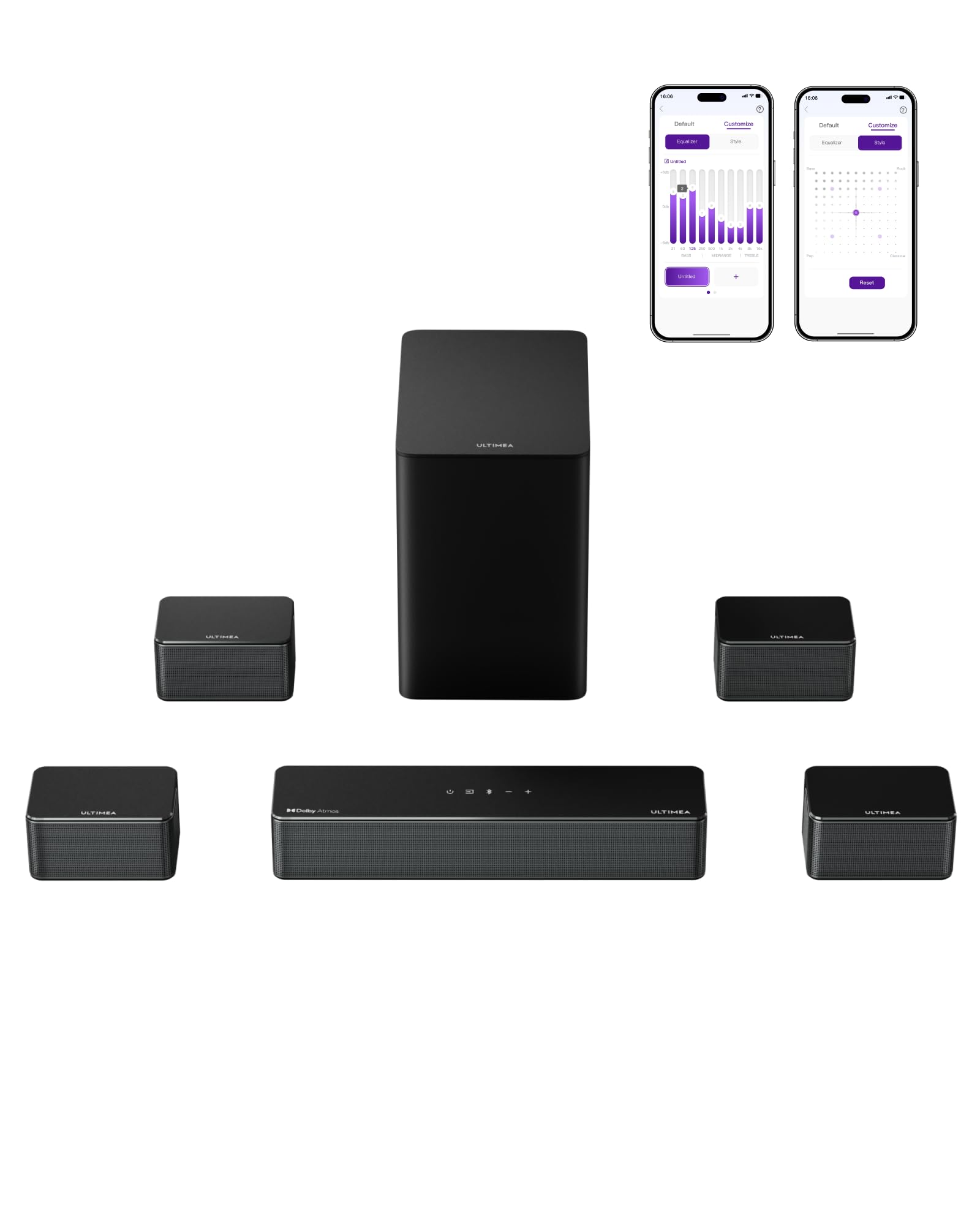
The ULTIMEA Poseidon D80 is a 7.1 channel system that supports Dolby Atmos, a rare feature at its price point. It ships with four wired surround speakers (two front, two rear) that connect to the subwoofer using included cables, and the main bar houses eight drivers including a powerful 6.5-inch wireless subwoofer for 460W peak output.
SurroundX System and 360° Aural Spatial Localization Technology use custom-designed waveguides to project sound precisely around the room, creating a convincing three-dimensional bubble. The ULTIMEA Smart App provides 121 preset EQ matrices and a 10-band custom equalizer, plus six tailored modes (Movie, Music, Voice, Sport, Game, Night) for fine-tuning. HDMI eARC with 4K passthrough simplifies the connection chain.
While the D80 supports Dolby Atmos decoding, it does not include up-firing drivers, so height effects rely on virtual processing rather than physical driver placement. The wired surround speakers allow precise positioning but require running cables to the rear of the room. For buyers on a budget who want genuine 7.1 channel separation with Atmos metadata support, the D80 is hard to beat.
Why it’s great
- Dolby Atmos decoding at a mid-range price point
- Four physical wired surround speakers for true 7.1 channel separation
- 121 EQ presets and 10-band custom equalizer via the ULTIMEA app
- HDMI eARC supports 4K passthrough
Good to know
- Height effects are virtual, lacking up-firing drivers for overhead sound
- Wired surround speakers require running cables to the rear of the room
8. ULTIMEA Poseidon D70 7.1ch

The ULTIMEA Poseidon D70 is an entry-level 7.1 system that prioritizes channel count over premium audio codecs. It upgrades from the 5.1 Poseidon D50 by adding two front surround speakers, bringing the total to four wired surrounds plus a 6.5-inch wireless subwoofer. Peak power is rated at 410W, sufficient for small to medium rooms.
The ULTIMEA Smart App unlocks 121 preset equalizer matrices across four styles (Bass, Pop, Classical, Rock) plus a 10-band equalizer with six dedicated modes. Thirteen adjustable surround levels let you dial in the amount of rear channel presence, which is useful when seating positions vary. Connection options include HDMI (non-eARC), optical, AUX, and Bluetooth 5.0 for music streaming.
Audio is encoded via PCM 2.0 stereo, meaning the D70 does not natively decode Dolby Digital or DTS signals. Setting your TV to PCM output is required for proper audio synchronization. The wired surround speakers connect via 20-foot cables, giving flexibility for placement but adding cable management to the setup process. For budget-conscious buyers who absolutely want four physical surround channels, the D70 delivers the basic architecture.
Why it’s great
- Four wired surround speakers provide true 7.1 channel separation
- 121 EQ presets and 10-band custom equalizer offer extensive tuning
- 13 adjustable surround levels for customized rear channel presence
- Voice prompts and color-coded wiring simplify installation
Good to know
- Does not support Dolby Digital or DTS decoding—requires PCM output from TV
- Subwoofer performance is modest compared to larger driver systems
9. Bose Smart Dolby Atmos Soundbar

The Bose Smart Dolby Atmos Soundbar packs five transducers—including two upward-firing drivers—into a compact chassis, using TrueSpace technology to upmix stereo and 5.1 content into a convincing 3D sound field. A.I. Dialogue Mode automatically analyzes the audio mix and adjusts vocal clarity without the need for manual EQ adjustments, making it particularly strong for TV dramas, news, and dialogue-heavy content.
Built-in Amazon Alexa and Bose Voice4Video let you control the soundbar, TV, and connected devices with voice commands. Streaming support covers Bluetooth, Apple AirPlay 2, Spotify Connect, and Chromecast built-in, giving you broad compatibility with music services. The bar also supports pairing with Bose Ultra Open Earbuds for personal surround sound—a unique feature for solo late-night viewing without loudspeakers.
As a single-bar system, it cannot produce discrete rear channel effects without adding optional Bose Surround Speakers or the earbuds. The virtual surround processing is effective for creating a wide soundstage, but purists will notice the absence of physical rear drivers. The included remote and app control work well, though initial setup requires a Bose account. This is the choice for those who prioritize minimalist aesthetics, smart integration, and clear dialogue over multi-speaker sprawl.
Why it’s great
- Compact design fits easily on most media consoles
- A.I. Dialogue Mode delivers crystal-clear speech without extra speakers
- TrueSpace upmixing creates immersive 3D audio from standard content
- Extensive streaming support including AirPlay 2 and Chromecast built-in
Good to know
- Virtual surround sound cannot replicate physical rear channel precision
- App-dependent setup requires Bose account and firmware update
FAQ
What is the real difference between a 7.1 virtual sound bar and a true 7.1 sound bar with surround speakers?
Does a 7.1 sound bar need Dolby Atmos or DTS:X to sound good?
How much space do I need behind my seating area for rear surround speakers?
Final Thoughts: The Verdict
For most users, the best 7.1 sound bar winner is the JBL Bar 1000MK2 because its detachable wireless surround speakers deliver true 7.1.4 channel separation with genuine Dolby Atmos height effects, combined with a powerful 10-inch subwoofer and advanced room calibration. If you want clear dialogue without sacrificing surround impact, grab the Polk Audio MagniFi Max AX SR. And for a minimalist single-bar setup with impressive virtual 3D audio and A.I. Dialogue Mode, nothing beats the Bose Smart Ultra Soundbar.

Mo Maruf
I created WellFizz to bridge the gap between vague wellness advice and actionable solutions. My mission is simple: to decode the research and give you practical tools you can actually use.
Beyond the data, I am a passionate traveler. I believe that stepping away from the screen to explore new environments is essential for mental clarity and physical vitality.