Our readers keep the lights on and my smoothie glass nicely filled. As an Amazon Associate, I earn from qualifying purchases.
The familiar orange-flavored chewable tablet often labeled “high-dose vitamin C” is likely derived from GMO corn starch treated with acetone in a lab. The actual whole-food source of C, the Indian gooseberry or amla, delivers bioflavonoids, tannins, and phytonutrients no synthetic ascorbic acid can replicate. This isn’t about getting 1,000 mg of isolated ascorbic acid; it is about absorbing a matrix of cofactors that help your body actually use the nutrient.
I’m Mohammad Maruf — the founder and writer behind WellFizz. My research process involves combing through third-party lab reports, evaluating extraction technologies like water-and-CO2 methods versus simple drying, and cross-referencing customer feedback on bioavailability and purity for each batch.
After analyzing purity, form (powder vs. capsule), certification level, and sourcing claims across the current market, I’ve identified the five standouts that represent the genuine best amla supplement choices for immune support, liver health, and whole-food nutrition.
How To Choose The Best Amla Supplement
The amla market splits into two distinct camps: whole-fruit powders and concentrated capsule extracts. Your choice depends on whether you prioritize dosage flexibility or capsule convenience, but every label should pass three quality filters before you buy.
Form: Powder vs. Capsule
Powders allow you to start with a half-teaspoon and ramp up, making them ideal for smoothie users and DIY hair care. Capsules eliminate the famously sour taste and provide a consistent milligram dose per serving. Neither is inherently superior, but capsule-only users should verify the capsule itself contains no magnesium stearate or silicon dioxide binders.
Certification & Sourcing
Because amla trees grow wild across India, “organic” claims vary widely. The USDA Organic seal is the gold standard — it requires annual third-party audits of the soil and harvesting methods. “Wildcrafted” without organic certification may still expose you to pesticide runoff from neighboring farms.
Extraction Integrity
Some brands use solvent extraction (hexane or ethanol) to concentrate active compounds. Water-and-CO2 extraction, often called “Natural Fusion” technology, preserves the full phytochemical profile without chemical residue. If the label mentions an extract ratio (e.g., 10:1), check whether a third party tested for residual solvents.
Quick Comparison
On smaller screens, swipe sideways to see the full table.
| Model | Category | Best For | Key Spec | Amazon |
|---|---|---|---|---|
| True Veda Organic Amla Powder Capsules | Premium Capsules | Zero-filler whole-food C | Water-CO2 extraction | Amazon |
| Grenera Organic Amla Powder | Premium Powder | Bulk value for smoothies | 2.2 lb resealable pouch | Amazon |
| ORGANIC INDIA Amla Powder | Mid-Range Powder | Wildcrafted forest sourcing | 1 lb bag | Amazon |
| Himalaya HeartCare | Blend Capsules | Cardiovascular + amla combo | 720 mg, 120 caps | Amazon |
| Organic Bhumi Amla Powder | Budget Powder | Liver-focused Ayurveda | 100 g airtight pouch | Amazon |
In‑Depth Reviews
1. True Veda Organic Amla Powder Capsules

True Veda stands alone in this lineup for using a patented water-and-CO2 extraction method that skips chemical solvents entirely. Each plant-based capsule contains organic amla fruit concentrate with no magnesium stearate, no silicon dioxide, and no preservatives. The resulting powder inside the capsule retains the holistic bioflavonoid profile — not just ascorbic acid — which explains why users report hair regrowth and immune resilience rather than the transient energy spike of synthetic C.
This is an award-winning brand (Healthcare & Pharmaceutical Awards 2022) with GMP certification and independent multi-stage testing. The bottle gives a gentle 40 mg of vitamin C per capsule, which is far below the synthetic 500 mg tablets but far more absorbable due to the whole-food matrix. Type 2 diabetics in particular have noted stable blood sugar after switching from high-dose ascorbic acid.
The only friction point is the modest vitamin C milligram count per capsule — if you are accustomed to seeing 1,000 mg on a label, this may look underwhelming. But the real measure is serum saturation, not label bravado. For anyone wanting a truly clean, binder-free capsule that delivers amla’s full phytochemical spectrum, this is the benchmark.
Why it’s great
- Solvent-free Water-CO2 extraction preserves whole-fruit synergy
- Certified USDA Organic with zero fillers or binders
- Easy-to-swallow capsules with no bitter aftertaste
Good to know
- Vitamin C per capsule is modest (40 mg) compared to synthetic tabs
- Premium price per bottle relative to powder form
2. Grenera Organic Amla Powder
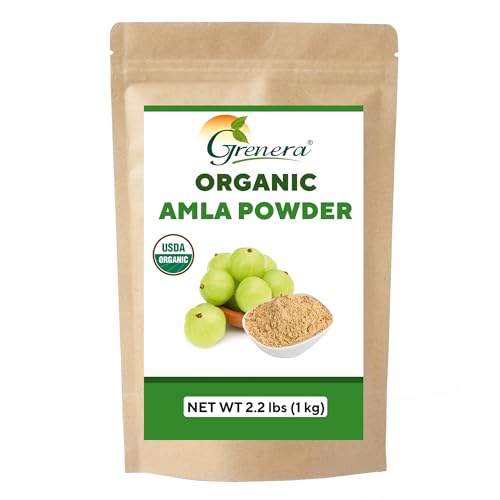
The fine-milled texture dissolves well in smoothies, yogurt, and juices, with multiple customer reports confirming it mixes cleanly without clumping. Each batch is third-party lab tested for purity and consistency, which matters when buying in bulk quantities that sit in your pantry for months.
The single-ingredient profile (100% dried Indian gooseberry fruit) is straightforward and versatile — users add it to soups and roasted dishes in addition to drinks, and some use it in DIY face masks for its antioxidant content. The resealable zip-lock pouch is practical for frequent scooping, though storing it in a cool, dark cabinet is essential to preserve the phytonutrients over the long usage period.
The obvious tradeoff is the sour taste: amla powder in this quantity means you will taste it daily. Users who dislike the flavor often mask it with creamer, honey, or strong fruit juices. If you are committed to a daily smoothie routine and want the most economical route to whole-food amla, this pouch is the clear pick.
Why it’s great
- Massive 2.2 lb bag offers lowest cost per serving in the lineup
- Third-party lab tested for purity and consistency
- Fine texture blends easily into smoothies and recipes
Good to know
- Strong sour taste requires mixing with flavored liquids
- Resealable pouch is less protective than a jar with desiccant
3. ORGANIC INDIA Amla Powder

ORGANIC INDIA sources its amla from forests designated as organic environments by the government of India, a wildcrafting protocol that protects the trees from overharvesting while ensuring the fruit grows without synthetic inputs. The result is a 1-pound bag of single-ingredient powder with a phytonutrient density that customers consistently describe as noticeably potent — several reviewers switched from capsule forms specifically because they felt more effect from the powder.
The Kosher certification and vegan-friendly label broaden its appeal, and the brand’s adaptogenic positioning (earthing the amla under “Holy Basil” category on their website) reinforces that this is not merely a vitamin C supplement but a traditional Ayurvedic rejuvenative. Users with digestive inflammation and gallbladder sensitivity have reported reduced discomfort after meals, which aligns with amla’s traditional use for liver and stomach support.
Be prepared for the taste. Multiple reviews emphasize that the flavor is strong and not easily masked by honey alone; creamer or citrus juice works better. For buyers who prioritize ethical wildcrafting and forest conservation over raw volume, this is a compelling choice.
Why it’s great
- Wildcrafted from protected organic Indian forests
- Kosher, vegan, and Non-GMO certified
- Potent phytonutrient profile noted by long-time users
Good to know
- Strong sour/bitter taste is difficult to mask
- Powder form less convenient than capsules for travel
4. Himalaya HeartCare

Himalaya HeartCare distinguishes itself as a multi-herb formulation rather than a standalone amla product. Alongside amla, it contains ashwagandha, arjuna, and holy basil (tulsi), all dosed at 720 mg per capsule. The stated goal is cardiovascular support — blood pressure and cholesterol levels already within normal range — and the customer evidence is unusually concrete: one reviewer’s resting heart rate dropped from 84 bpm to 72 bpm over three months, and another saw micro-albumin levels move from abnormal to near normal in 13 days.
The product is vegan, non-GMO, and gluten-free, with no fillers, dairy, soy, or corn. Himalaya’s 90-year family history in herbal medicine lends credibility to the sourcing, and the capsule form masks the herbal blend’s taste effectively. Users consistently report slow, steady results rather than a quick fix, which aligns with the Ayurvedic principle of gradual tissue nourishment.
The main caveat is that amla is not the hero ingredient here — it’s one of four primary herbs. If you specifically want high-dose standalone amla, this blend spreads the focus across multiple targets. However, if your goal is cardiovascular resilience with amla as part of a synergistic stack, this formula delivers clinical-style outcomes that single-ingredient products rarely match.
Why it’s great
- Clinically reported improvements in heart rate and BP markers
- Synergistic Ayurvedic blend (amla, ashwagandha, arjuna, tulsi)
- Clean label with no fillers, dairy, soy, or corn
Good to know
- Amla is one ingredient, not the primary focus
- Capsules appear half-full due to natural herb density variation
5. Organic Bhumi Amla Powder

Organic Bhumi Amla enters from a slightly different botanical angle — Phyllanthus niruri (Bhumi Amla) rather than Emblica officinalis (standard amla). This distinction matters because Bhumi Amla carries a stronger traditional reputation for liver support and digestive health. The 100-gram pouch is small, roughly 3.5 ounces, which makes it an accessible trial size for anyone curious about amla’s effects without committing to a pound of powder.
The product is manufactured in a GMP-certified facility and tested for quality and purity, with no artificial colors, flavors, or preservatives. Customer reviews specifically highlight reduced gallbladder pain and noticeable liver support, with one user describing it as “for the liver cleansing” and accepting the bitter taste as a necessary tradeoff. Mixing instructions recommend 1 teaspoon (3-5 grams) with lukewarm water or buttermilk.
The biggest drawbacks are the small pouch size and the very difficult taste. Reviewers explicitly warn that honey does not mask the bitterness; creamer is the most reliable mask. The per-gram cost is also higher than the larger bulk options due to the smaller package. For buyers specifically targeting liver function or wanting to test Bhumi Amla before buying in bulk, this is the right entry point.
Why it’s great
- Targeted liver and gallbladder support via Bhumi Amla species
- GMP certified with third-party purity testing
- Small pouch ideal for first-time amla users
Good to know
- Extremely bitter taste that honey cannot fully mask
- Higher per-gram cost than larger bulk powder options
FAQ
Is amla powder better than amla capsules for vitamin C absorption?
Can amla supplements replace synthetic vitamin C tablets?
Why do some amla capsules look half-empty in the bottle?
Final Thoughts: The Verdict
For most users, the best amla supplement winner is the True Veda Organic Amla Powder Capsules because it combines solvent-free water-CO2 extraction with zero binders in a capsule format that avoids the notorious sour taste. If you want to buy in bulk for daily smoothies, grab the Grenera Organic Amla Powder. And for targeted cardiovascular support with a synergistic herbal blend, nothing beats the Himalaya HeartCare.

Mo Maruf
I created WellFizz to bridge the gap between vague wellness advice and actionable solutions. My mission is simple: to decode the research and give you practical tools you can actually use.
Beyond the data, I am a passionate traveler. I believe that stepping away from the screen to explore new environments is essential for mental clarity and physical vitality.