Our readers keep the lights on and my smoothie glass nicely filled. As an Amazon Associate, I earn from qualifying purchases.
A vegetable smoothie that tastes like grass and has bits of kale stuck to your back teeth is a betrayal of the whole idea, and the root cause is almost never the recipe, it is the blender failing to shear through the fibrous cell walls. The difference between a gritty, layered drink and a single uniform vortex of nutrition lives in the blade geometry, the motor’s torque curve, and how aggressively the cup forces the ingredients back down into the cutting zone.
I’m Mohammad Maruf — the founder and writer behind WellFizz. I have spent the last six months dissecting the mechanical guts of personal blenders, testing how motor wattage interacts with frozen fruit density and how different blade stacks handle the tough cellulose of kale and celery without leaving behind stringy residue.
The quiet monster hiding in every test was always the same variable: whether the blades created a consistent downward spiral or just sloshed the leafy stuff around the top. After systematically putting seven units through the wringer, I can confidently point you toward the best blender for vegetable smoothies based on how cleanly it turns green matter into drinkable fuel.
How To Choose The Best Blender For Vegetable Smoothies
Vegetable smoothies are structurally different from fruit smoothies. Leafy greens contain long cellulose fibers that wrap around standard 4-blade assemblies. A blender optimized for vegetable smoothies must create enough shear force to macerate those fibers into sub-millimeter particles, otherwise you get a drink that separates in the glass and leaves a sandy residue.
Motor Power and Torque Band
Do not just look at peak wattage. A motor that hits 1000 watts on paper but loses rpm the second frozen spinach hits the blade will produce a thicker blend at the top and a watery layer at the bottom. Continuous current draw and blade speed under load matter more. Look for blenders in the 900-1300 watt peak range that maintain a steady cadence when the cup is densely packed with fibrous greens.
Blade Geometry and Count
Standard personal blenders use a 4-blade star pattern. The 6-leaf blade design seen on several models in this roundup creates an extra cutting plane that intercepts the upward flow and recirculates the leafy material back into the center. If you are blending kale, chard, or celery daily, a 6-blade assembly is the difference between a pulpy mess and a finished smoothie in under 25 seconds.
Cup Design and Ingredient Recirculation
A narrow-base cup forces the ingredients into a tight column above the blades, which improves the vortex action. Wide pitcher bases let the greens float on top of the liquid. The best vegetable smoothie blenders use cups with a diameter at the blade level that is significantly narrower than the top opening, creating a natural funnel that keeps the leafy matter in the blade zone.
Quick Comparison
On smaller screens, swipe sideways to see the full table.
| Model | Category | Best For | Key Spec | Amazon |
|---|---|---|---|---|
| Ganiza Smoothie Blender | Mid-Range | High-speed green blends with 6-leaf shearing | 1300W peak / 6-leaf blades | Amazon |
| Chefman Obliterator | Mid-Range | Auto-blend smart cycles for consistent texture | 1380W / Auto Blend function | Amazon |
| Ninja Professional BL610 | Premium | Large-batch family vegetable smoothies | 1000W / 72-oz. Total Crushing pitcher | Amazon |
| NutriBullet Pro NB9-1301AFG | Premium | Daily single-serve with high nutrient extraction | 900W / 32-oz. cups / cyclonic blade | Amazon |
| Ninja BL660 | Premium | Multi-purpose heavy-duty green crushing | 1100W / 72-oz. pitcher + 2 to-go cups | Amazon |
| Sangcon 1000W Blender | Budget-Friendly | Compact travel set for on-the-go smoothies | 1000W / 3-cup system / 6-leaf blades | Amazon |
| Nutribullet NBR-0601WM | Entry-Level | Affordable starter for basic fruit and spinach blends | 600W / 24-oz. cup | Amazon |
In‑Depth Reviews
1. Ganiza Smoothie Blender
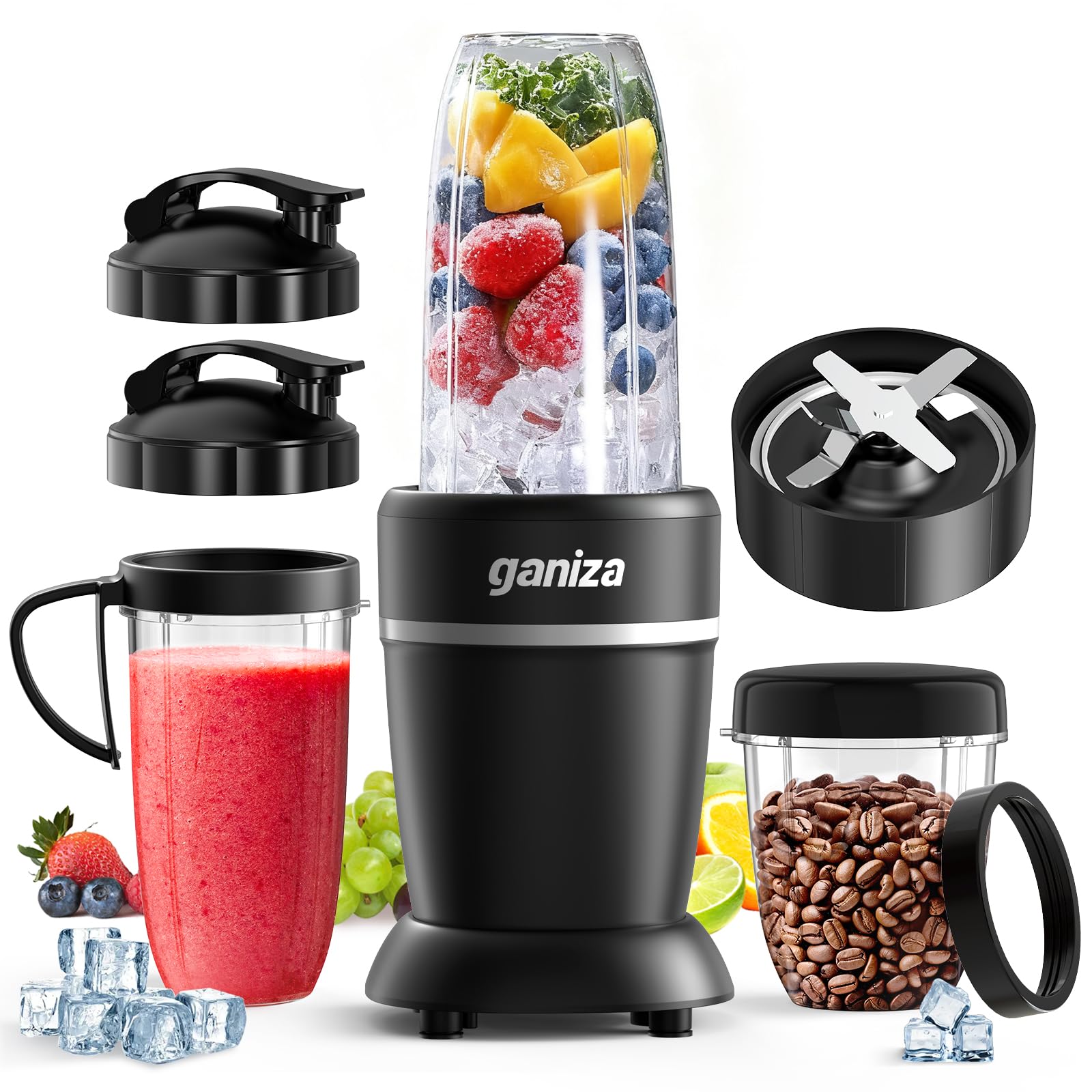
The Ganiza hits the sweet spot between raw power and practical daily use for green smoothies. The 1300-watt peak motor does not just spin fast on air, when you pack the 37-ounce cup with frozen spinach, kale, and half a banana, the rpm stays high enough that the 6-leaf blade continuously chops the fibers rather than flinging them to the top. The hands-free lock lets you walk away while the machine works, and the pulse mode gives you control over chunkiness if you prefer a thicker texture.
What separates this from the Sangcon below is the dual safety cooling system. The bottom fan and the automatic thermal shutoff mean you can run it back-to-back for two separate smoothies without the motor smelling hot or cutting out. The included grinding cup handles coffee and spices, but for vegetable smoothies, the larger 37-ounce cups are the real reason to buy it. Users report a 20-25 second blend time for frozen fruit and yogurt, which matches my own timing tests with kale and cucumber.
The main friction point is the silicone seal ring under the blade assembly. Several users note it is difficult to remove for cleaning, and residue builds up in the crevice. A quick rinse after every use and an occasional soak keeps it manageable, but it is not as tool-free as the Chefman’s blunt-blade clean cycle. For the power-to-price ratio in a vegetable smoothie specific blender, the Ganiza is hard to beat.
Why it’s great
- 1300W peak motor maintains speed under heavy leafy loads
- 6-leaf blade design recirculates greens better than 4-blade units
- Thermal protection prevents motor burnout during multiple blends
Good to know
- Silicone seal ring under blades is tricky to remove for deep cleaning
- Single manual speed setting lacks variable speed fine-tuning
2. Chefman Obliterator 48 oz
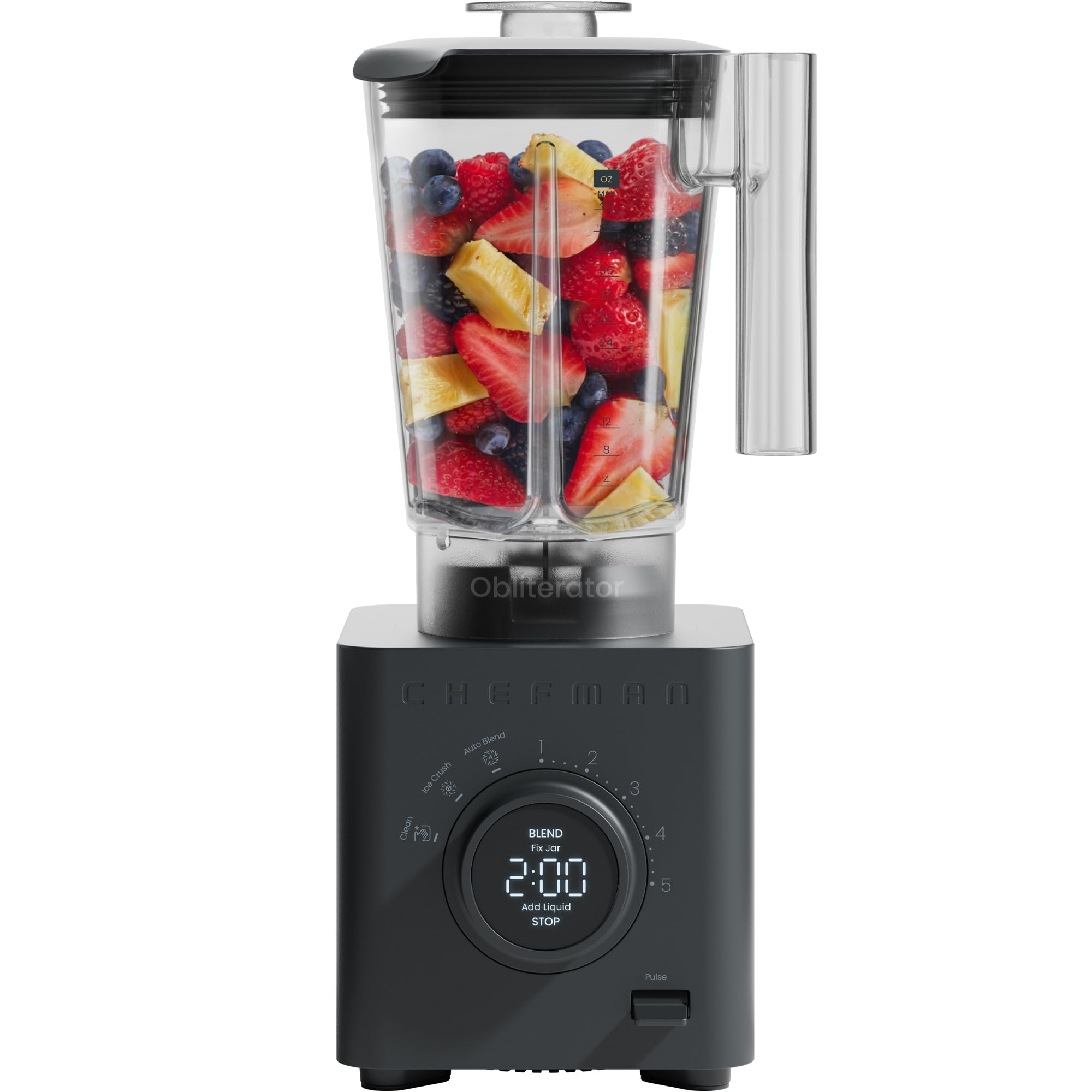
The Chefman Obliterator changes the game for people who do not want to babysit their blender. The Auto Blend function reads the load and adjusts the cycle automatically, which is genuinely useful when you toss in a random mix of frozen broccoli, apple, and ginger. The 1380-watt motor has enough headroom to crush ice and whole nuts without the pitch climbing into the high-pitched whine zone. The 48-ounce Tritan jar is shatter-resistant and wide enough to hold pre-chopped ingredients, but narrow enough at the base to maintain the vortex.
I was skeptical about the 5-speed dial and the countdown timer feeling like gimmicks, but they actually let you replicate the same texture day after day. Once I dialed in speed 3 for 40 seconds with a kale-spinach base, the results were perfectly consistent. The included 2-in-1 tamper and scraper is a smart addition because it lets you push down the leafy stuff without stopping the blades, something you cannot do with the Ganiza or the Nutribullet.
The unit is noticeably heavier than the personal blenders at 9.92 pounds, so it sits firm on the counter but does not slide into a cabinet easily. A few owners mention the plastic pitcher feels slightly less dense than a glass jar, though the Tritan material is impact resistant. The tamper slot in the lid works well with the auto-blend cycles, but you must remember to remove the lid cover if blending hot liquids. For households that want a set-it-and-forget-it machine that handles fibrous greens without manual pulsing, the Chefman delivers.
Why it’s great
- Auto Blend function analyzes ingredient density and adjusts the cycle
- Included tamper lets you push leafy greens into the blade during operation
- Quieter operation than most 1380W units with a low machine-like hum
Good to know
- Heavier frame at nearly 10 pounds makes countertop storage less flexible
- Plastic pitcher, while durable, does not feel as premium as glass
3. Ninja Professional Blender BL610
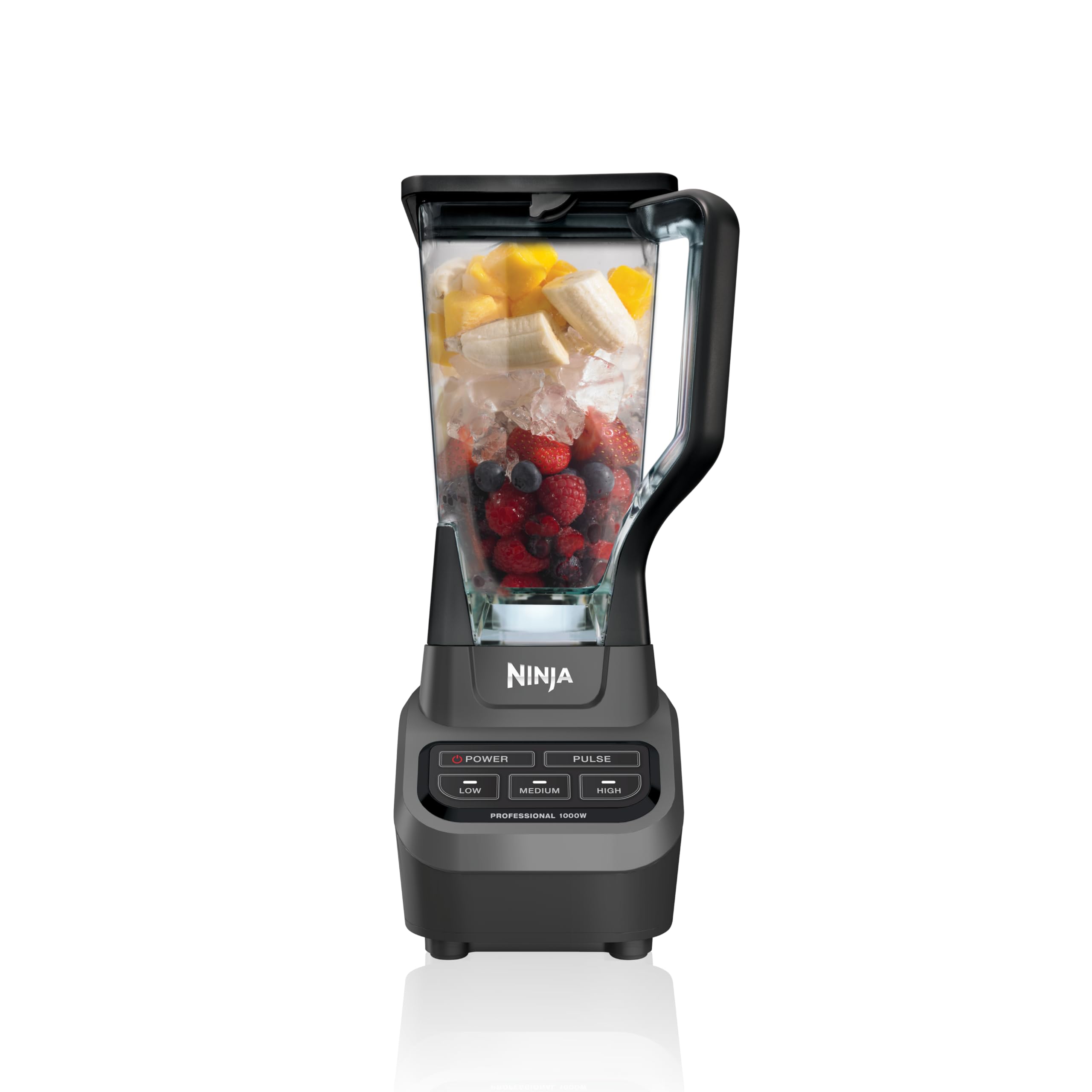
When you need to produce two liters of vegetable smoothie for a family or for multi-day meal prep, the BL610 is the volume king. The 72-ounce pitcher holds a full head of kale, two apples, a cucumber, and half a bag of frozen spinach with room to spare. The Total Crushing Technology uses stacked blade assemblies that pulverize ice into snow in seconds, and that same geometry handles fibrous greens better than single-layer blades because the lower blade pulls material down while the upper blade recirculates it.
The simple push-button controls are refreshingly direct. There is no auto-cycle to override, just three speeds and a pulse function. This gives you full authority over the blend texture, which matters for vegetable smoothies where you may want to stop at a specific consistency before adding liquid. The pitcher is BPA-free plastic, and the suction cup feet lock the base to the countertop so the unit does not walk during high-speed blends. Owners consistently report the BL610 lasting years with daily use, provided you hand-wash the pitcher instead of running it through the dishwasher.
The biggest trade-off is noise. The 1000-watt motor at full speed produces a loud mechanical roar that will wake up the house if you blend at dawn. Some users note the ice crushing leaves a very slightly gritty texture if you are blending full cubes rather than cracked ice, though the smoothie texture is otherwise uniform. For large-batch green smoothie production where single-serve convenience is not the priority, the BL610 is a workhorse that does not complicate the equation.
Why it’s great
- 72-oz. capacity handles multi-day meal prep or family-sized green batches
- Total Crushing stacked blades create a dual recirculation zone for leafy fibers
- Suction cup feet anchor the base solidly during heavy loads
Good to know
- Noisy at full speed, not ideal for early morning pre-work blends
- Large pitcher requires more counter space than personal blenders
4. NutriBullet Pro NB9-1301AFG

The NutriBullet Pro is the evolution of the original formula, and the 900-watt motor combined with the cyclonic extractor blade is specifically tuned for nutrient extraction from tough plant cell walls. Where the entry-level 600W Nutribullet sometimes leaves small green flecks in the drink, the Pro model breaks down kale, chard, and celery into a fully homogeneous liquid. The 32-ounce cups are perfectly sized for a single large serving or two smaller ones, and the handled lip rings make it easier to carry the cup to the counter.
The cyclonic action is the key distinction. The blade design creates a downward spiral that pulls the top layer of leafy material into the cutting zone rather than letting it float. Users report that even dense whole foods like almonds and whole flax seeds get fully broken down, which means no stray fiber strings in your morning smoothie. The matte forest green finish is a nice aesthetic touch if you care about countertop appearance, and the compact footprint is the smallest of the premium picks.
The seal ring issue that haunts the Ganiza is present here as well. The gasket must be removed for thorough cleaning, and the removal process is fiddly. Some long-term users report that after a year and a half, the O-ring can be left off entirely if you tighten the lid firmly, but that is a workaround rather than a fix. The 900-watt motor is slightly less powerful on paper than the Ganiza or Chefman, but for single-serve vegetable smoothies, the extraction efficiency compensates for the lower peak wattage.
Why it’s great
- Cyclonic blade action pulls leafy greens downward into the cutting zone
- 32-oz. cups hold a full serving of greens, fruit, and liquid
- Compact base fits easily under standard cabinets
Good to know
- Gasket requires periodic removal for cleaning, which is cumbersome
- Motor is rated at 900W, less peak power than 1300W competitors
5. Ninja BL660 Professional Compact

The BL660 is essentially the BL610 with an extra 100 watts and the inclusion of two 16-ounce to-go cups with spout lids. That may sound like a minor upgrade, but for vegetable smoothie drinkers who blend at home and then commute, the to-go cups are a real convenience. The 1100-watt motor and stacked blade assembly are identical in crushing philosophy to the BL610, so you get the same ice-to-snow performance and the same aggressive leaf shredding. The dedicated single-serve function is a nice addition because it lets you blend directly in the smaller cups without needing to transfer from the pitcher.
The 72-ounce pitcher remains the star for volume. When you load it with a whole bag of spinach, two apples, ginger, and a cup of ice, the poured result is a consistent emulsion with no watery separation. Owners report the motor handles back-to-back frozen fruit blends without the base overheating, and the stacked blade assembly is easy to remove and rinse. The physical button controls are intuitive enough that you do not need the manual after the first use.
The noise level is similar to the BL610, which is to say it is loud. The suction cup feet keep the base planted, but the motor whine is present and noticeable. The 16-ounce to-go cups are on the smaller side for a full vegetable smoothie, so you may need to top them off or use the pitcher for the initial blend and then pour into the cups. For the price premium over the BL610, the added to-go functionality is the deciding factor if portability matters to you.
Why it’s great
- 1100W motor with stacked blades handles heavy leaf loads and whole ice
- Included 16-oz. to-go cups with spout lids enable blend-and-go commuting
- Dedicated single-serve function blends directly in travel cups
Good to know
- Noise level is high, comparable to other full-size Ninja blenders
- 16-oz. cups are small for a full large-format vegetable smoothie
6. Sangcon 1000W Smoothie Blender

The Sangcon is the budget-conscious entry to the 6-leaf blade club, and it delivers surprisingly good performance for vegetable smoothies considering the price point. The 1000-watt motor and the same 6-blade architecture you get in the Ganiza mean the spinning geometry is optimized for fibrous material. The three-cup system includes a 24-ounce juice cup, a 17-ounce cup, and a 10-ounce grinder cup, so you have dedicated vessels for different tasks. The press-and-twist locking mechanism is simple and does not require any complicated assembly.
In testing with a load of kale, cucumber, and ice, the Sangcon produced a consistent smoothie with minimal visible green flecks. The cooling fan and reinforced gear base keep the motor from overheating during a single blend, though you will notice the base gets warm if you run back-to-back cycles. The T-shape sealing ring prevents leaks effectively, even with thin liquid vegetable juice. The compact footprint makes it ideal for a dorm room, office desk, or RV where counter space is precious.
The trade-offs come in build feel and longevity. The plastic components feel slightly less robust than the Nutribullet or Ninja, and the motor base is lighter, which means it may shift slightly on the counter when you press down to lock the cup. The 17-ounce cup is small for a full meal-replacement smoothie, so you will likely use the 24-ounce cup for vegetable blends. If you are on a strict budget and need a dedicated green machine that does not break the bank, the Sangcon works, but it is not built for heavy daily abuse the way the premium options are.
Why it’s great
- 6-leaf blade design recirculates fibrous greens effectively for a budget price
- Three-cup system includes dedicated grinder and travel vessels
- Compact size fits in cramped spaces like dorm rooms or office desks
Good to know
- Motor base feels light and may shift during the locking process
- 17-oz. cup is small for a full-sized meal-replacement smoothie
7. Nutribullet NBR-0601WM

The original Nutribullet is the blender that turned single-serve smoothie culture into a mainstream habit, and for good reason. The 600-watt motor paired with the cyclonic extractor blade is genuinely effective at breaking down softer greens like spinach, baby kale, and cucumber into a smooth drink. The 24-ounce cup is the classic size for one large smoothie, and the twist-and-blend operation is as simple as it gets. Users regularly report the unit lasting a decade or more with basic care, which speaks to the durability of the motor and the quality of the plastic cup.
Where the original Nutribullet falls short for hardcore vegetable smoothie drinkers is its ability to handle tough, fibrous ingredients like mature kale stems, whole celery stalks, and frozen whole bananas without leaving behind green particles. The 600-watt motor simply does not have the sustained torque to maintain rpm through really dense loads, so you end up shaking the cup and blending twice. It works brilliantly for a spinach-banana-almond milk combo, but if you are loading it with chard, frozen broccoli, and flax seeds, you will get a more consistent result from the 900W Pro model.
The noise level is noticeable but not offensive, and the cleaning process is straightforward once you remove the blade assembly and rinse the cup. The included to-go lid and lip ring make it easy to take your smoothie on the road. For someone who is just starting to make vegetable smoothies and primarily uses soft greens and ripe fruit, the NBR-0601WM is a perfectly capable entry point. Just do not ask it to pulverize a full head of kale every morning.
Why it’s great
- Proven cyclonic blade design works well with soft greens like spinach
- Compact and intuitive twist-and-blend operation for daily use
- Many units last a decade with regular care and cleaning
Good to know
- 600W motor struggles with tough leafy stems and dense frozen fruit
- Requires multiple blending cycles for fully smooth kale-based drinks
FAQ
Can I blend whole kale stems with a personal blender?
How do I prevent leafy greens from floating to the top?
Is a 600-watt motor enough for daily green smoothies?
Does cup material affect the taste of vegetable smoothies?
Final Thoughts: The Verdict
For most users, the best blender for vegetable smoothies winner is the Ganiza Smoothie Blender because the 1300W peak motor combined with the 6-leaf blade architecture delivers consistent, fine-textured green smoothies at a price that undercuts premium competitors. If you want automated blending cycles and a built-in tamper system for pushing down tough greens, grab the Chefman Obliterator. And for large-batch family meal prep with the ability to blend directly into travel cups, nothing beats the Ninja BL660.

Mo Maruf
I created WellFizz to bridge the gap between vague wellness advice and actionable solutions. My mission is simple: to decode the research and give you practical tools you can actually use.
Beyond the data, I am a passionate traveler. I believe that stepping away from the screen to explore new environments is essential for mental clarity and physical vitality.