Our readers keep the lights on and my smoothie glass nicely filled. As an Amazon Associate, I earn from qualifying purchases.
The promise of an all-in-one soundbar is simple: dramatically better TV audio without a separate subwoofer cluttering your floor or a second box to hide. In reality, the category is a battlefield of acoustic compromises, where the internal driver layout, amplifier wattage, and digital signal processing determine whether you get genuine cinematic weight or just a slightly louder version of your TV’s tinny speakers. Choosing the wrong one means living with hollow bass or a bloated cabinet that overpowers your room.
I’m Mohammad Maruf — the founder and writer behind WellFizz. I’ve spent months analyzing consumer audio hardware, from driver topology and DSP architecture to real-world listening conditions, so you don’t have to guess which integrated soundbar actually delivers on its promise.
This guide separates genuine engineering from marketing fluff, ranking the top options to help you find the best all in one soundbar that fits your space, ears, and expectations without wasting money on features you’ll never use.
How To Choose The Best All In One Soundbar
An all-in-one soundbar must balance acoustic physics against cabinet size, meaning every design choice — from driver diameter to internal amplifier class — directly impacts what you hear. Here are the three non-negotiable factors to evaluate before buying.
Driver Configuration and Channel Count
Specs like “2.1” or “3.1” aren’t marketing jargon; they tell you exactly how many separate audio channels the soundbar can produce. A 2.1 channel bar has left and right drivers plus a built-in subwoofer, while a 3.1 adds a dedicated center channel specifically for dialogue. For an all-in-one system that has to simulate surround sound without physical rear speakers, look for models with at least a 3.1 layout and up-firing drivers if you want convincing Dolby Atmos height effects.
Digital Signal Processing and Virtual Surround
Without rear satellites, an all-in-one soundbar relies entirely on its DSP algorithms to create the illusion of sound coming from behind you. Dolby Atmos and DTS Virtual:X are the two dominant processing formats, but not all implementations are equal. The quality of the psychoacoustic processing — how well it widens the soundstage and places audio objects in space — separates a genuinely immersive bar from one that just sounds loud. Check reviews specifically mentioning soundstage width and overhead effects, not just bass punch.
Connectivity and HDMI eARC
For the best audio quality, especially with Dolby Atmos, your soundbar needs HDMI eARC (enhanced Audio Return Channel). This single cable carries uncompressed, object-based audio from your TV to the bar without the compression that optical or AUX connections force. If you plan to connect a 4K gaming console or Blu-ray player through the soundbar, also verify HDMI 2.1 passthrough for 4K 120Hz support. Bluetooth is fine for casual music streaming, but HDMI eARC is the backbone of a modern home theater setup.
Quick Comparison
On smaller screens, swipe sideways to see the full table.
| Model | Category | Best For | Key Spec | Amazon |
|---|---|---|---|---|
| TCL S55H | 2.1 ch + Sub | Small rooms / value seekers | AI Sonic room calibration | Amazon |
| JBL Bar 2.0 All-in-one (MK2) | 2.0 ch | Minimalist setups / ultra-compact | Built-in deep bass drivers | Amazon |
| Samsung B-Series HW-B550F | 2.1 ch + Sub | Entry-level with subwoofer | Adaptive Sound auto-optimization | Amazon |
| LG S70TY | 3.1.1 ch + Sub | LG TV owners / dialogue clarity | Up-firing center channel | Amazon |
| Amazon Fire TV Soundbar Plus | 3.1 ch + Sub | Fire TV ecosystem users | Dedicated center dialogue channel | Amazon |
| ULTIMEA Skywave X50 | 5.1.4 ch + 2x Rear | Full wireless surround | GaN amplifier / 8″ subwoofer | Amazon |
| Polk Audio MagniFi Max AX | 5.1.2 ch + Sub | Large rooms / movie immersion | 10″ wireless subwoofer | Amazon |
| Sonos Arc Ultra | 9.1.4 ch | High-end eco-system / multi-room | Sound Motion spatial audio | Amazon |
| Samsung Q990D | 11.1.4 ch + Rear | Ultimate cinema experience | Wireless Dolby Atmos | Amazon |
In‑Depth Reviews
1. Samsung Q990D 11.1.4ch Soundbar

The Samsung Q990D is the current benchmark for integrated soundbar systems. Its 11.1.4 channel configuration — featuring 11 front-facing drivers, a dedicated subwoofer, and four up-firing channels — creates a genuinely immersive bubble of sound that rivals traditional wired surround setups. Real-world reviews consistently praise its ability to make dialogue crystal clear even during chaotic action scenes, thanks to Q-Symphony which syncs the bar with compatible Samsung TVs for a unified spatial audio field.
Setup is remarkably simple for such a complex system: the included rear speakers and subwoofer connect wirelessly, and the SpaceFit Sound Pro calibration adjusts the sound profile to your specific room dimensions automatically. The built-in Alexa, Chromecast, and AirPlay 2 support make it a smart hub as well as a home theater centerpiece.
At this price point, the only meaningful competition is the Sonos Arc Ultra, and the Q990D edges ahead because it includes real rear speakers and a dedicated subwoofer in the box — no incremental purchases needed. The trade-off is a larger physical footprint and a remote that feels less premium than the Sonos app experience.
Why it’s great
- Full 11.1.4 channel array with wireless rears included
- Q-Symphony integration improves dialogue clarity dramatically
- SpaceFit Sound Pro tunes audio to your specific room layout
Good to know
- Bulky rear speakers require dedicated shelf or stand space
- App experience is less polished than competitors
- Some users report needing a manual lip-sync delay adjustment
2. Sonos Arc Ultra Soundbar

The Sonos Arc Ultra redefines what an all-in-one soundbar can achieve without a separate subwoofer. Sonos’s proprietary Sound Motion technology uses a radically different acoustic architecture — a single, large driver paired with precisely tuned waveguides — to produce deep, physical bass that would typically require a separate box. The 9.1.4 channel layout, combined with Dolby Atmos, delivers spatial audio that feels genuinely three-dimensional, with AI-powered Speech Enhancement that keeps dialogue intelligible at any volume.
Setup is the gold standard for audio products: plug in the HDMI eARC cable, launch the Sonos app, and Trueplay automatically measures your room’s acoustics using your iPhone’s microphone to fine-tune the sound. The bar supports WiFi, Bluetooth, Apple AirPlay 2, and Spotify Connect, and integrates seamlessly into a multi-room Sonos ecosystem.
The main limitation is that the Arc Ultra is technically a single-bar system — to get rear surround speakers and a dedicated subwoofer, you need to purchase the Era 300 and Sonos Sub separately, significantly increasing the total investment. For buyers committed to the Sonos ecosystem, the Arc Ultra is unmatched in refinement; for those wanting a complete system out of the box, the Samsung Q990D offers more channels for the same starting price.
Why it’s great
- Sound Motion technology produces real subwoofer-level bass from a single bar
- Trueplay room calibration is best-in-class for accuracy
- Seamless multi-room audio integration with other Sonos speakers
Good to know
- Rear speakers and subwoofer sold separately at high additional cost
- Heavy reliance on the app for full functionality
- No HDMI passthrough — uses eARC only
3. Polk Audio MagniFi Max AX

Polk Audio’s MagniFi Max AX is a purpose-built home theater bar designed to fill large family rooms and open-concept living spaces. The 11-driver array includes two up-firing drivers for Dolby Atmos and DTS:X height effects combined with an oversized 10-inch wireless subwoofer that delivers tactile, room-shaking bass without distortion. Polk’s patented VoiceAdjust technology works independently from the main soundtrack, letting you boost dialogue levels without affecting the surrounding audio mix.
Connectivity is generous — three HDMI inputs plus eARC, WiFi, Bluetooth, Apple AirPlay 2, Chromecast, and Spotify Connect — making it easy to connect multiple sources directly through the bar. The included remote has a clear backlit display, and the system can be expanded with optional SR2 wireless rear speakers for true 7.1.2 surround.
Where the Max AX truly shines is in its raw power and clarity at high volumes. Reviewers consistently note that it remains clean and composed even in rooms with vaulted ceilings or awkward geometry, where many soundbars would sound muddy or shrill. The 10-inch subwoofer is physically large, so plan for placement space, but the bass output is proportionally authoritative.
Why it’s great
- 10-inch subwoofer delivers deep, clean bass for large rooms
- VoiceAdjust allows independent dialogue level control
- Three HDMI inputs and robust streaming protocol support
Good to know
- Subwoofer is large and heavy — requires significant floor space
- Up-firing Atmos effects are subtle in rooms with standard 8-foot ceilings
- Rear speakers are optional but add substantial cost
4. ULTIMEA Skywave X50
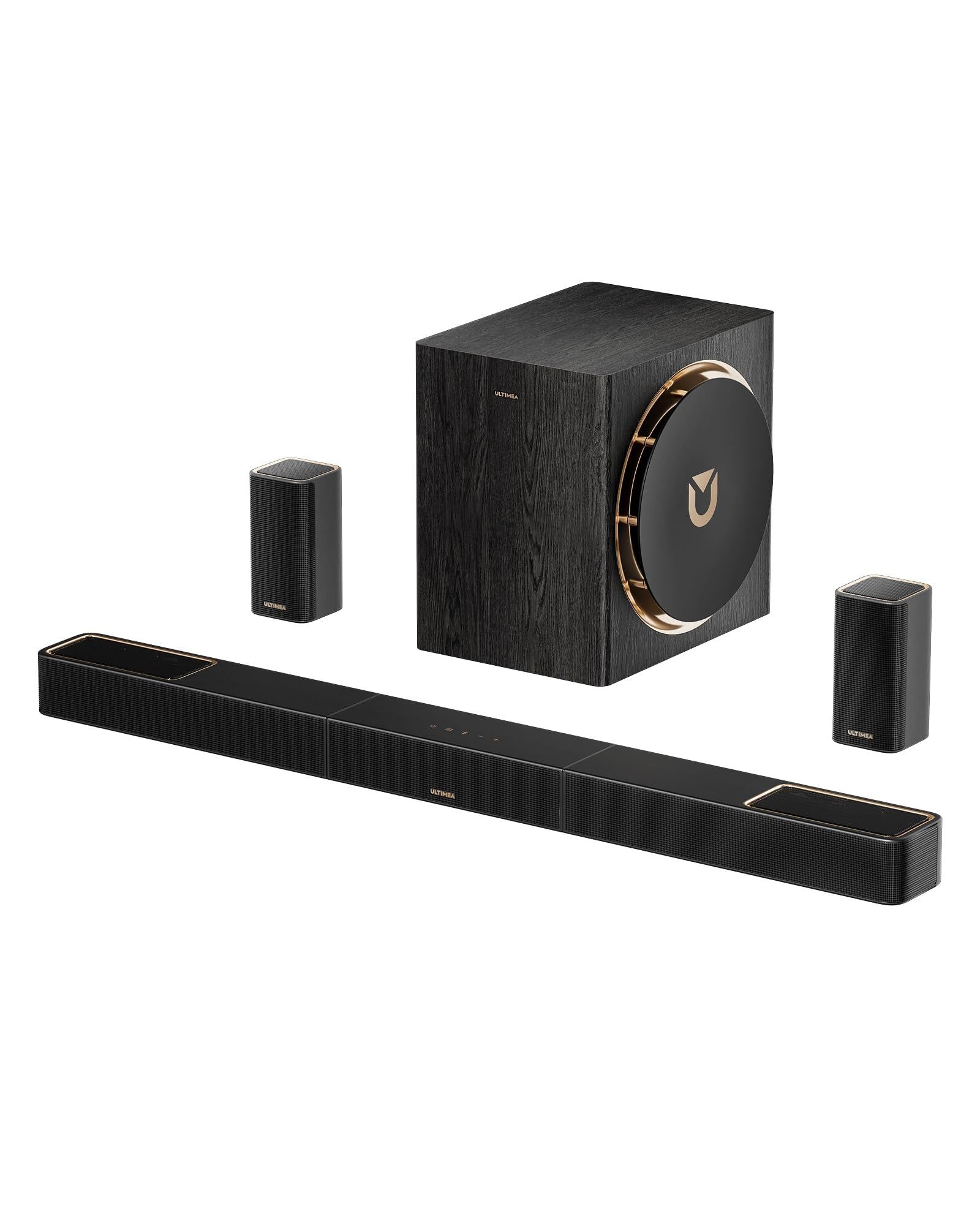
The ULTIMEA Skywave X50 is a surprising heavyweight in the mid-range market. Its 5.1.4 channel configuration includes two wireless rear surround speakers and an 8-inch subwoofer — a genuine five-speaker system delivered at a price where competitors typically offer only a soundbar and subwoofer pair. The star of the show is the GaN (Gallium Nitride) amplifier, which provides 98% efficiency and significantly less heat generation than traditional silicon amplifiers, enabling cleaner, higher power output without distortion.
Setup is refreshingly plug-and-play: the rear speakers and subwoofer sync automatically with the bar via dual 5GHz wireless channels, eliminating the pairing frustrations common in budget systems. The ULTIMEA app provides granular individual speaker level control, allowing you to balance the sound field precisely. The bar supports HDMI eARC, optical, Bluetooth, and USB connections, with 4K HDR passthrough for seamless source integration.
Build quality stands out at this tier, with a metal grille, rose gold accents, and a wood-crafted subwoofer cabinet that looks more expensive than the price suggests. The NEURACORE audio engine delivers under 0.5% total harmonic distortion even at high volumes. The only compromise is that the up-firing Atmos height effects are less convincing than dedicated top-tier systems like the Samsung Q990D, but for the price, the soundstage width and bass authority are exceptional.
Why it’s great
- True 5.1.4 channel system with wireless rear speakers included
- GaN amplifier delivers high power with low heat and distortion
- Premium wood and metal construction at a mid-range price
Good to know
- Atmos height effects are less convincing than flagship competitors
- App can occasionally be slow to connect
- Rear speakers require their own power outlets
5. LG S70TY 3.1.1ch Soundbar
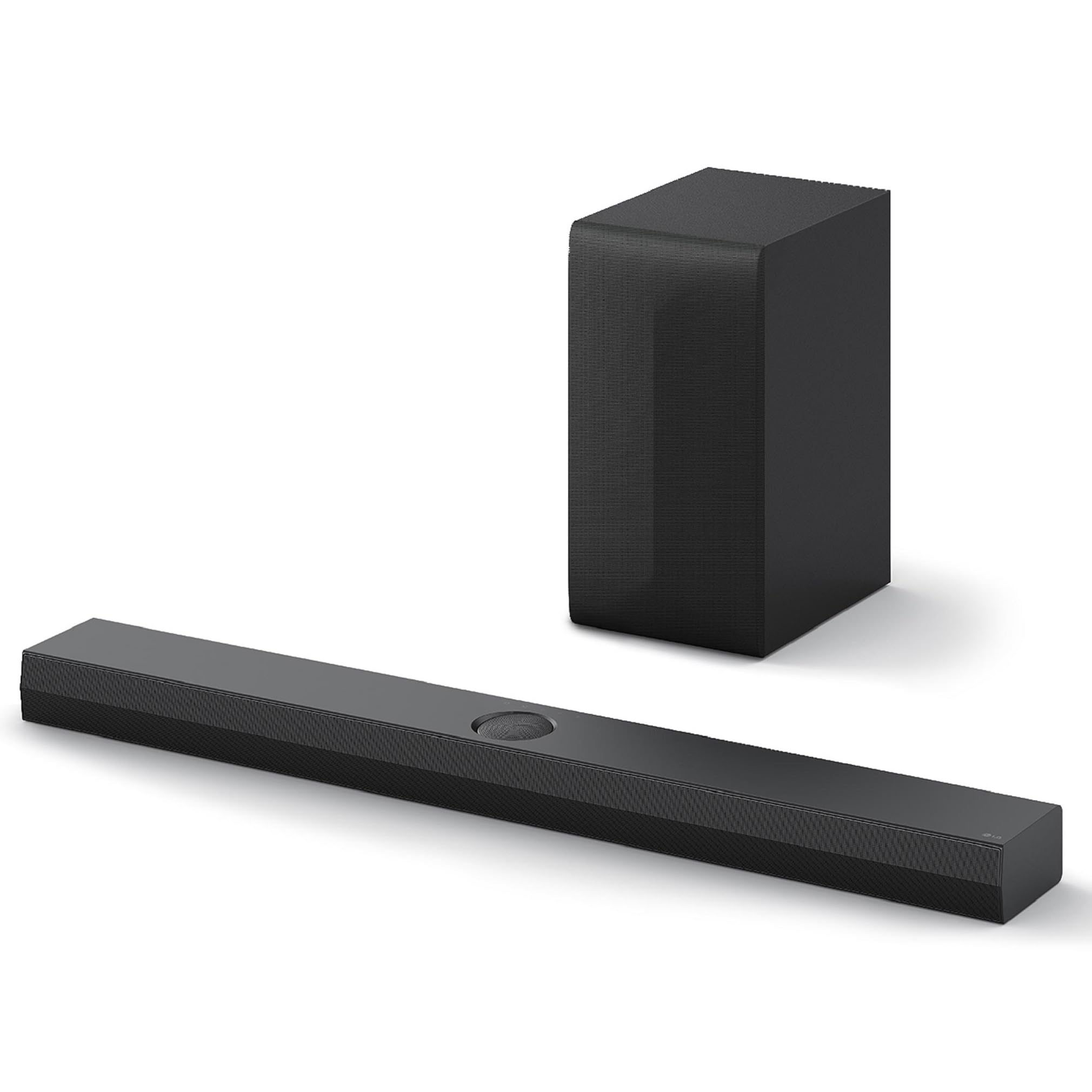
The LG S70TY is built around a unique acoustic architecture: an up-firing center channel driver that projects dialogue directly upward, then reflects off your TV screen or wall to land at ear level with exceptional clarity. This industry-exclusive design means voices sound like they’re coming from the screen itself, not from below it, solving the common problem of dialogue sounding muffled in action-heavy content. The 3.1.1 channel layout includes a dedicated wireless subwoofer that adds richness without dominating the soundstage.
Integration with LG TVs is the primary selling point: WOW Orchestra lets you use the TV’s own speakers and the soundbar simultaneously for a wider soundstage, and WOW Interface allows full control of the bar through the TV remote and on-screen menus. The metal grill also serves a practical purpose, keeping dust out of the drivers over time.
While the S70TY sounds excellent for dialogue-heavy content like news, drama, and sports, its bass output is polite rather than aggressive — the subwoofer adds warmth but won’t rattle floors during action movies. The optional rear speakers (SPT8-S) are difficult to find in the US, limiting expandability. For LG QNED TV owners who prioritize crystal-clear voices, this is the best-matched soundbar on the market.
Why it’s great
- Up-firing center channel delivers best-in-class dialogue clarity
- WOW Orchestra integration with LG TVs for wider soundstage
- Sleek metal grill design exactly matches LG QNED aesthetics
Good to know
- Bass output is subtle compared to larger subwoofer options
- Optional rear speakers are unavailable in many markets
- No Wi-Fi or Ethernet — app control limited to Bluetooth
6. Amazon Fire TV Soundbar Plus
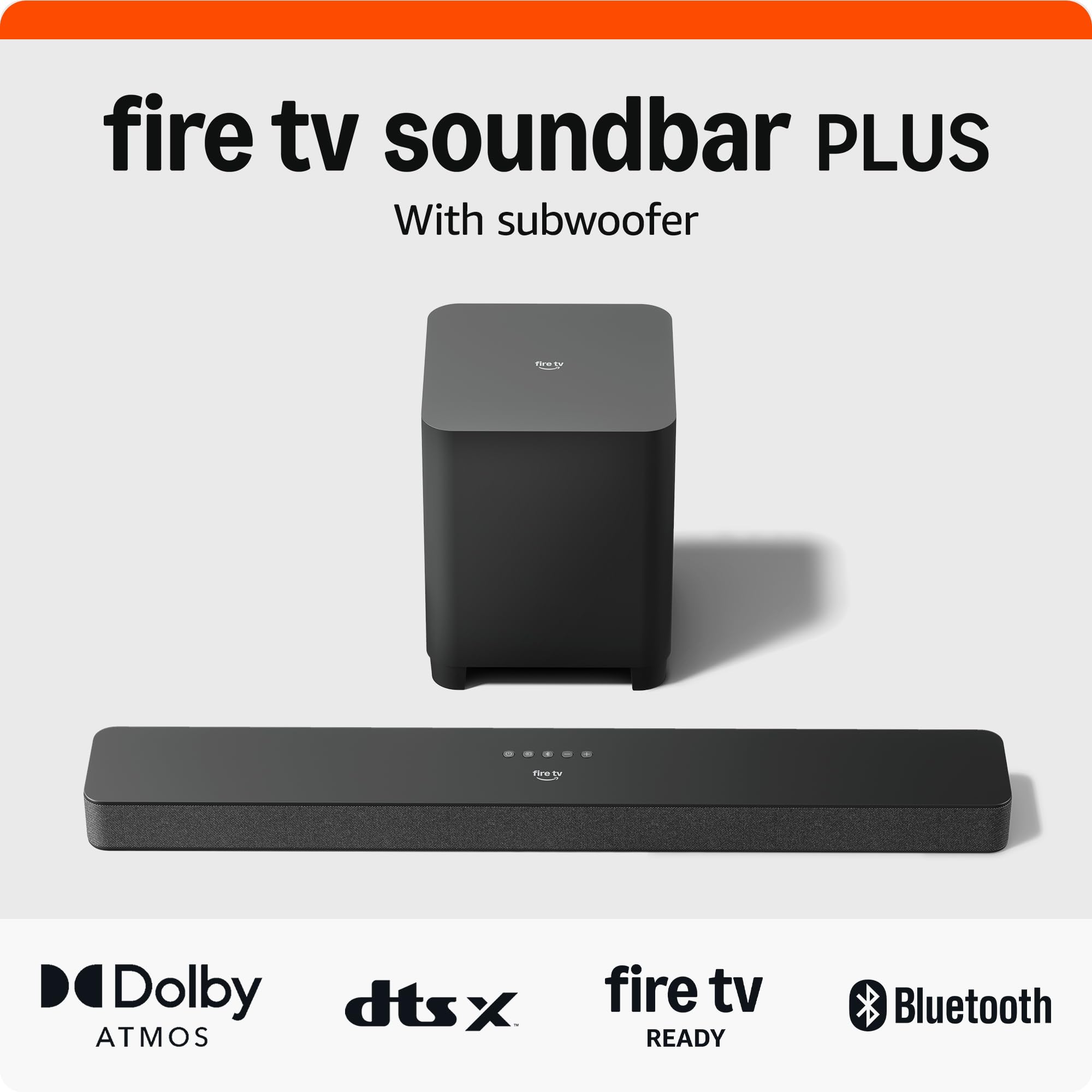
The Amazon Fire TV Soundbar Plus is a 3.1 channel system designed for seamless integration with the Fire TV ecosystem. Its dedicated center channel dialogue sharpens conversations, while the included wireless subwoofer adds bass presence that you can feel during action scenes. Dolby Atmos and DTS:X provide multi-dimensional audio that expands the soundfield beyond the physical width of the bar.
What sets this bar apart is the Fire TV integration: the same remote controls both TV and soundbar, and audio settings appear directly in the Fire TV menu. Reviewers have noted that it uses real 2-way channels with separate amplification per driver — a design choice that results in clearer mids and highs compared to single-driver competitors at the same tier.
The main drawback is that the subwoofer offers limited fine-tuning. There’s no app-based EQ for adjusting the crossover frequency or bass level independently, so you’re locked into the factory tuning. For Fire TV users who want a simple, direct upgrade over TV speakers, this is the most convenient option available.
Why it’s great
- Seamless Fire TV remote and menu integration
- Real 2-way channels with separate driver amplification
- Dolby Atmos and DTS:X virtual surround processing
Good to know
- Subwoofer lacks independent EQ or crossover fine-tuning
- No HDMI input passthrough — only eARC output
- Best feature set is locked to Fire TV devices
7. Samsung B-Series HW-B550F

The Samsung HW-B550F delivers a 2.1 channel layout with DTS Virtual:X processing and a dedicated wireless subwoofer, offering a noticeable upgrade over standard TV speakers without demanding a large investment. Adaptive Sound analyzes whatever you’re watching in real time and automatically adjusts the EQ to prioritize dialogue, music, or effects depending on the scene. Voice Enhance Mode further amplifies vocal frequencies, making this a strong option for viewers who struggle with muddy dialogue on standard TV audio.
Setup is straightforward with HDMI ARC or optical input, and the subwoofer pairs wirelessly out of the box. The Bass Boost feature adds an extra layer of low-end punch for action scenes and music, while the optional rear speaker kit (sold separately) allows for true surround sound expansion later. Reviewers consistently describe the sound as “movie theater quality” for the price, particularly praising the subwoofer’s ability to produce deep, tactile bass.
The B-Series is best suited for smaller to medium rooms. The subwoofer provides solid impact for its size, but it doesn’t match the output of larger drivers found in the ULTIMEA or Polk systems. For a balanced entry into quality soundbar audio with the option to grow, this is a well-engineered starting point.
Why it’s great
- Adaptive Sound automatically optimizes EQ per content type
- Voice Enhance Mode improves dialogue audibility significantly
- Wireless subwoofer pairs instantly and delivers solid bass
Good to know
- Only 2.1 channels — no dedicated center for dialogue
- Rear speakers are optional and add to the total cost
- Maximum volume output is moderate for larger rooms
8. TCL S55H 2.1 Soundbar

The TCL S55H punches well above its weight class by including Dolby Atmos and DTS Virtual:X processing in a 2.1 channel configuration with a wireless subwoofer. The standout feature is AI Sonic Auto Room Calibration — a technology typically reserved for premium systems — which uses the built-in microphone to analyze your room’s acoustics and automatically adjust the EQ for balanced sound at your specific listening position. This one-time calibration, done through the TCL app, dramatically improves soundstage coherence in rooms with irregular shapes or hard surfaces.
The soundbar itself delivers 220W peak power, with clear mids and crisp highs that handle dialogue and music well. The included wall-mount kit and HDMI cable make installation straightforward, and the compact form factor (32 inches wide) fits easily under TVs up to 55 inches. The subwoofer adds appreciable bass presence, though reviewers note it’s subtle rather than overwhelming — suitable for apartments and bedrooms where you want depth without disturbing neighbors.
TCL’s combination of room calibration, Dolby Atmos processing, and wireless subwoofer at this price point is unique. The trade-off is that the subwoofer lacks the physical punch of larger drivers, and the app interface, while functional, is basic. For budget-conscious buyers who still want advanced calibration, the S55H is the smartest value in the category.
Why it’s great
- AI Sonic room calibration is a rare feature at this price tier
- Dolby Atmos and DTS Virtual:X virtual surround processing
- Compact 32-inch design fits easily under smaller TVs
Good to know
- Subwoofer output is modest — not for bass-heavy listeners
- App interface feels basic compared to competitors
- Limited to 2.1 channels with no expandability path
9. JBL Bar 2.0 All-in-one (MK2)

The JBL Bar 2.0 All-in-One MK2 is the purest expression of the all-in-one concept: a single, compact bar with no subwoofer box and no rear speakers. JBL’s proprietary driver design uses large-diameter woofers inside the bar to produce deep bass that genuinely mimics the presence of a separate subwoofer — not as tactile as a physical sub, but far beyond what any other single-bar system achieves at this width. JBL Surround Sound processing widens the stereo image effectively, creating a sense of space that belies the bar’s physical footprint.
The low-profile design (just over 2 inches tall) means it fits seamlessly under virtually any TV without blocking the screen or IR sensor. Setup is as simple as connecting via HDMI ARC or optical, and Bluetooth streaming from your phone makes it easy to play music when the TV is off. Built-in Dolby Digital decoding ensures proper audio sync with streaming services and Blu-rays.
The JBL Bar 2.0 is best for minimalist setups where a separate subwoofer is physically or aesthetically unacceptable. It won’t shake the room like systems with dedicated subs, but for bedrooms, apartments, or offices where space is at a premium, it delivers remarkable performance from a single box. Some reviewers note that at higher volumes, the bass can become slightly strained, and the lack of any EQ adjustments via remote is a minor inconvenience.
Why it’s great
- True single-box design with no additional speakers needed
- JBL’s deep bass driver design is best-in-class for integrated bars
- Ultra-compact profile fits under any TV without blocking
Good to know
- No dedicated subwoofer limits bass impact at high volumes
- Lacks any EQ or sound mode adjustments
- 3.5mm auxiliary input is not included
FAQ
Can a single soundbar really replace a system with a separate subwoofer?
Is Dolby Atmos worth it on an all-in-one soundbar without rear speakers?
HDMI eARC vs. optical — which connection should I use for the best sound?
How important is room calibration in an all-in-one soundbar?
Final Thoughts: The Verdict
For most users, the best all in one soundbar winner is the Samsung Q990D because it delivers a complete 11.1.4 channel system with wireless rear speakers included, unmatched dialogue clarity through Q-Symphony, and automatic room calibration that works in nearly any space. If you want the highest single-bar refinement with deep, physical bass and a seamless multi-room ecosystem, grab the Sonos Arc Ultra. And for the best value that still delivers true 5.1.4 surround with a GaN amplifier and premium build, nothing beats the ULTIMEA Skywave X50.

Mo Maruf
I created WellFizz to bridge the gap between vague wellness advice and actionable solutions. My mission is simple: to decode the research and give you practical tools you can actually use.
Beyond the data, I am a passionate traveler. I believe that stepping away from the screen to explore new environments is essential for mental clarity and physical vitality.