Our readers keep the lights on and my smoothie glass nicely filled. As an Amazon Associate, I earn from qualifying purchases.
The common budget wood planer on the market makes a lot of noise, but often fails to deliver a flat, chatter-free surface across a board’s full length. Buyers chasing the lowest ticket price frequently end up fighting snipe, fiddling with misaligned fences, and replacing dull blades within weeks — turning a “bargain” into a recurring expense of time and materials. The real challenge isn’t finding a cheap unit; it’s finding a unit that delivers repeatable accuracy without demanding a second mortgage.
I’m Mohammad Maruf — the founder and writer behind WellFizz. I’ve spent years analyzing power tool specifications, studying motor amperage curves, cutterhead geometries, and feed-rate tolerances to separate durable value from disposable frustration in this specific price tier.
After evaluating dozens of models across multiple price bands, these reviews focus on the nine machines that genuinely deliver for the money — helping you confidently choose a best budget wood planer that won’t leave you sanding out tear-out before you’ve even finished your project.
How To Choose The Best Budget Wood Planer
Choosing a planer on a budget means prioritizing the specs that directly affect surface finish and longevity — not the color of the housing or the number of included accessories. Focus on motor power, cutterhead design, and how the machine handles snipe before you consider anything else.
Motor Amperage and Cuts Per Minute
A 6.5-amp motor spinning at 16,500 to 17,000 RPM is the baseline for a hand planer that can handle hardwoods without bogging down. For benchtop thickness planers, look for at least 15 amps and a feed rate around 26 feet per minute. Higher cuts-per-minute (CPM) numbers generally translate to a smoother finish in a single pass — but lower CPM with a spiral cutterhead can outperform a higher CPM straight-blade machine on tear-out reduction.
Cutterhead Type: Straight Blades vs. Spiral Inserts
Straight-blade cutterheads (two knives, standard HSS or carbide) are the most common in the budget tier. They’re easy to sharpen or replace and cost less upfront. Spiral cutterheads with individually mounted tungsten carbide inserts cost more but run quieter, produce a finer finish, and each insert can be rotated for a fresh edge without replacing the whole set. If you plane figured woods or exotic species regularly, the spiral upgrade pays for itself in reduced sanding time.
Snipe Control and Table Alignment
Snipe — the deeper cut at the leading and trailing edges of a board — is the single most common complaint about budget planers. Look for models with four lead screws (rather than two) on the table adjustment, a dedicated snipe minimizer mechanism, or built-in board return rollers. On hand planers, verify that the front and rear shoes are precision-machined as a matched set after assembly — this ensures the sole is perfectly flat and parallel, preventing step-shaped cuts.
Quick Comparison
On smaller screens, swipe sideways to see the full table.
| Model | Category | Best For | Key Spec | Amazon |
|---|---|---|---|---|
| Bosch PL2632K | Hand Planer Kit | All-around accuracy in a portable kit | 6.5A / 16,500 RPM | Amazon |
| Makita KP0800K | Hand Planer Kit | Smooth finish and easy blade setting | 6.5A / 17,000 RPM | Amazon |
| DEWALT D26677K | Hand Planer Kit | Fast removal with dual carbide blades | 5.5A / 34,000 CPM | Amazon |
| Cutech 40700H | Thickness Planer | Quiet operation with minimal snipe | 12.5″ spiral cutterhead | Amazon |
| WEN PL1252 | Thickness Planer | Wide capacity at a budget-friendly price | 15A / 12.5″ width | Amazon |
| Bosch PL1632 | Hand Planer | Lightweight single-blade efficiency | 6.5A / 6.3 lbs | Amazon |
| WEN JT3062 | Benchtop Jointer | Edge jointing for small projects | 10A / 22,000 CPM | Amazon |
| CRAFTSMAN CMEW020 | Benchtop Jointer | Variable speed for hard and soft woods | 10A / 6,000-11,000 RPM | Amazon |
| VEVOR Planer Stand | Tool Stand | Stable platform for benchtop planers | 100 lb capacity | Amazon |
In‑Depth Reviews
1. Bosch PL2632K 3-1/4 In. Planer Kit

The PL2632K is the gold standard for the mid-range hand planer segment. Its 6.5-amp motor spins at 16,500 RPM and the dual-blade system accepts either reversible micrograin carbide or optional high-speed steel blades. The ratcheting depth knob adjusts in 1/64-inch increments within a full revolution, eliminating the need to re-zero the tool between passes — a time saver when you’re working through multiple thicknesses.
Precision-machined aluminum front and rear shoes are assembled together before final machining, guaranteeing that the sole is flat and the depth remains parallel across the entire cut width. Users consistently report smooth cuts on dense woods like red oak and hard maple straight out of the box, with the only recurring complaint being the flimsy dust bag — a non-issue if you connect a shop vac to the ejection port.
The kit includes a hard plastic carrying case, a dual-mount guide fence, a blade-changing wrench, and the dust bag. The ambidextrous lock-off button and lock-on feature make extended trimming sessions less fatiguing, and the ball-joint cord swivel keeps the power cable out of your way during corner work.
Why it’s great
- Dual-blade system with reversible carbide inserts for long edge life
- Ratchet depth knob with 1/64-inch detents for repeatable adjustments
- Included hard case protects the tool and accessories
Good to know
- Dust bag is low-quality — plan to use a vac hose instead
- No dedicated vacuum adapter included for the dust port
2. Makita KP0800K 3-1/4″ Planer, with Tool Case

The Makita KP0800K delivers 6.5 amps and 17,000 RPM from a two-blade cutterhead that planes up to 3-1/4 inches wide and 3/32 inch deep in a single pass. Its easy blade-setting system uses a gauge to index the knives — users report that setup takes minutes and the cutterhead maintains balance even after blade changes, avoiding the vibration found on lesser planers.
Spring-loaded stand elevates the base when the tool is at rest, protecting both the blades and your workpiece. The aluminum shoes are precision-machined, and the 4.6-kilogram weight (about 10 pounds) keeps the tool planted without being unwieldy for overhead door-trim work. A common point among buyers who switched from other brands is that the Makita produces fewer scratch marks on softwoods and shows less tear-out on cross-grain passes.
The kit comes with a blade gauge assembly, guide rule, wrench, and a hard-sided tool case. Note that it does not include a dust bag or a hose adapter — you’ll need to source a bag separately or adapt a standard shop vac hose with tape or a reducer.
Why it’s great
- Excellent blade-setting gauge for fast, repeatable knife changes
- Quiet, vibration-free operation even on thick hardwoods
- Sturdy tool case included for transport and storage
Good to know
- No dust bag or shop vac adapter included
- Power cable tends to take a set in the box over time
3. DEWALT Hand Planer Kit, 5.5-Amp, 3-1/4-Inch (D26677K)

The D26677K generates 34,000 cuts per minute from a 5.5-amp motor — a higher CPM than most competitors — which translates to a finer surface finish in a single pass. The two-blade system accepts both reversible carbide inserts and industry-standard high-speed steel blades, giving you flexibility depending on whether you prioritize edge life or easy sharpening.
Calibrated depth adjustment knob goes to 1/16-inch maximum depth, and the precision-machined front and rear aluminum shoes ensure the cut remains parallel across the full 3-1/4-inch width. A precision groove in the front shoe allows for edge chamfering without needing a separate tool. The kit includes a rabbeting fence, blade depth setting gauge, dust adapter, and socket wrench, all packed in a durable kit box.
Users note that the planer is noticeably louder than some older DEWALT models, and the air intake port is smaller — keeping it clear of sawdust is essential to prevent overheating. The power cord is also a trip hazard if not managed, so a cord retractor or overhead routing is recommended for production work.
Why it’s great
- High 34,000 CPM for a smooth finish on hardwoods
- Dual-blade system accepts carbide or HSS blades
- Includes dust adapter and rabbeting fence
Good to know
- Louder operation than comparable models
- Smaller air intake requires regular cleaning to avoid motor strain
4. Cutech 40700H 12½-Inch Spiral Cutterhead Benchtop Planer
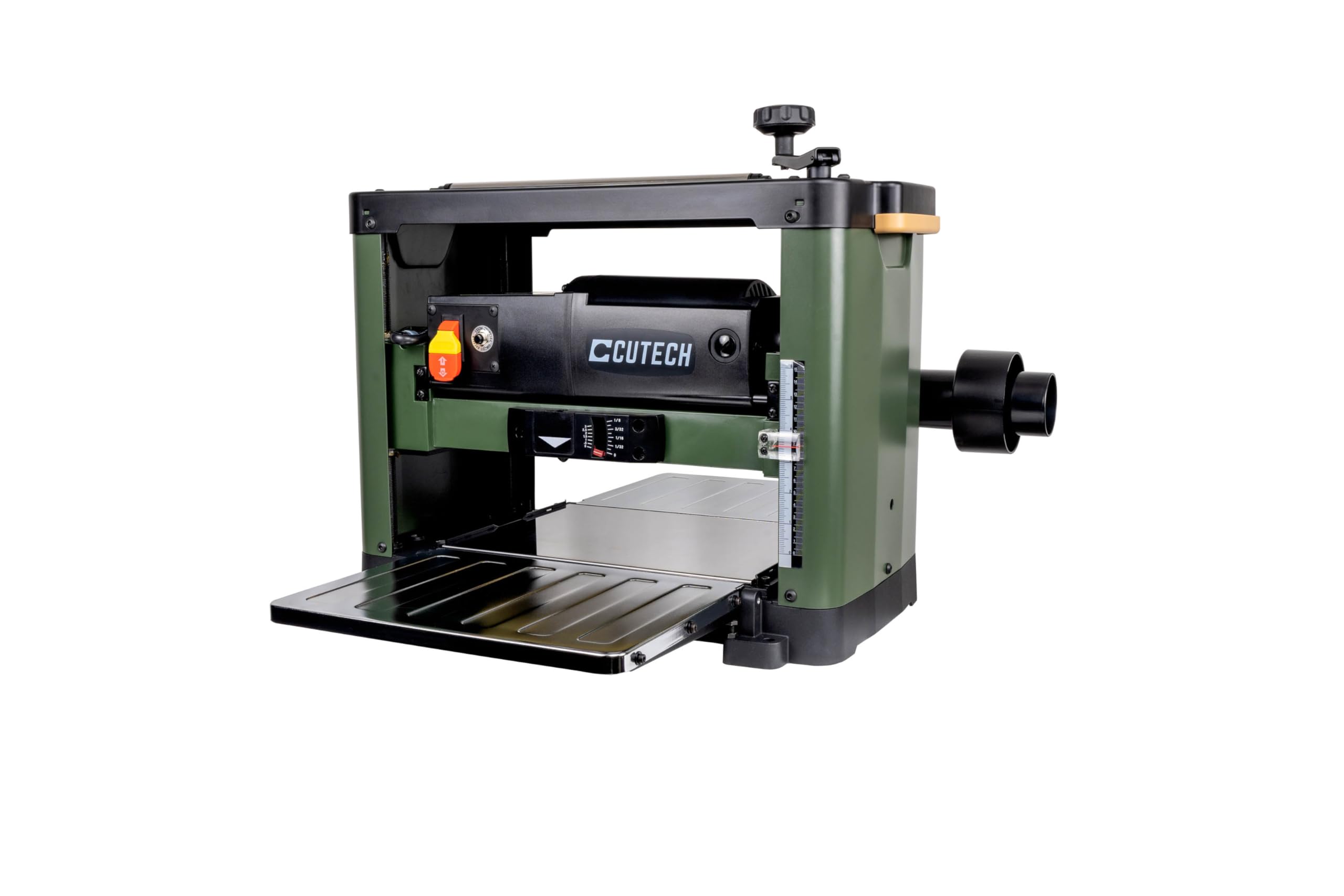
The 40700H is a benchtop thickness planer that uses a spiral cutterhead with six rows of staggered tungsten carbide inserts. This design significantly reduces noise compared to straight-blade machines and produces a much finer surface — often eliminating the need for sanding between coats on figured woods. Each insert is two-sided; when one edge dulls, you rotate it for a fresh cutting surface.
Patented snipe minimizer uses four lead screws and a coupling design to keep the cutterhead parallel to the table during entry and exit, dramatically reducing the deeper cut at the board ends. Board return rollers on top send material back to the front for the next pass without you walking around the machine. The depth-of-cut indicator on the front panel shows exactly how much material you’re removing.
Cast iron and aluminum construction keeps the 12.5-inch-wide planer stable at 10,000 RPM cutterhead speed. Users praise the smooth finish on reclaimed lumber and the minimal snipe straight out of the box. The only downside is that the color (black or rifle green) is shipped at random, which may matter to workshop aesthetic purists.
Why it’s great
- Spiral cutterhead delivers a smooth, quiet cut with less tear-out
- Patented snipe minimizer reduces board-end waste
- Two-sided inserts double edge life per piece
Good to know
- Color is randomly shipped (black or rifle green)
- Not ideal for very narrow strips under 1/2 inch wide
5. WEN PL1252 15-Amp 12.5-Inch Two-Blade Benchtop Thickness Planer

The PL1252 offers the widest capacity in the budget-friendly benchtop category — planing boards up to 12.5 inches wide and 6 inches thick. The 15-amp motor generates 20,000 cuts per minute at a 26-feet-per-minute feed rate, and the two reversible SK5 carbide blades (model BP122K) are easy to swap without removing the cutterhead.
Depth adjustment ranges from 0 to 1/8 inch per pass, and the cast-iron base keeps vibration low even during aggressive cuts. Users report that the planer works well right out of the box, with most setup completed in under 30 minutes. A common workaround for the 2-inch snipe at both infeed and outfeed is to hot-glue sacrificial 1/4-inch runners that extend 2.5 inches beyond the material — a simple fix that restores full-length flatness.
The machine is loud (as most benchtop planers are), but it draws boards in smoothly and leaves a finish that requires only light sanding. At 64 pounds, it’s heavy enough to stay put but still portable for moving around a small shop.
Why it’s great
- Planes boards up to 12.5 inches wide
- 15-amp motor provides steady power through hardwoods
- Low learning curve — set up and planing in under 30 minutes
Good to know
- Noticeable snipe on infeed and outfeed without sacrificial runners
- Loud operation — hearing protection is mandatory
6. Bosch PL1632 3-1/4 In. Planer
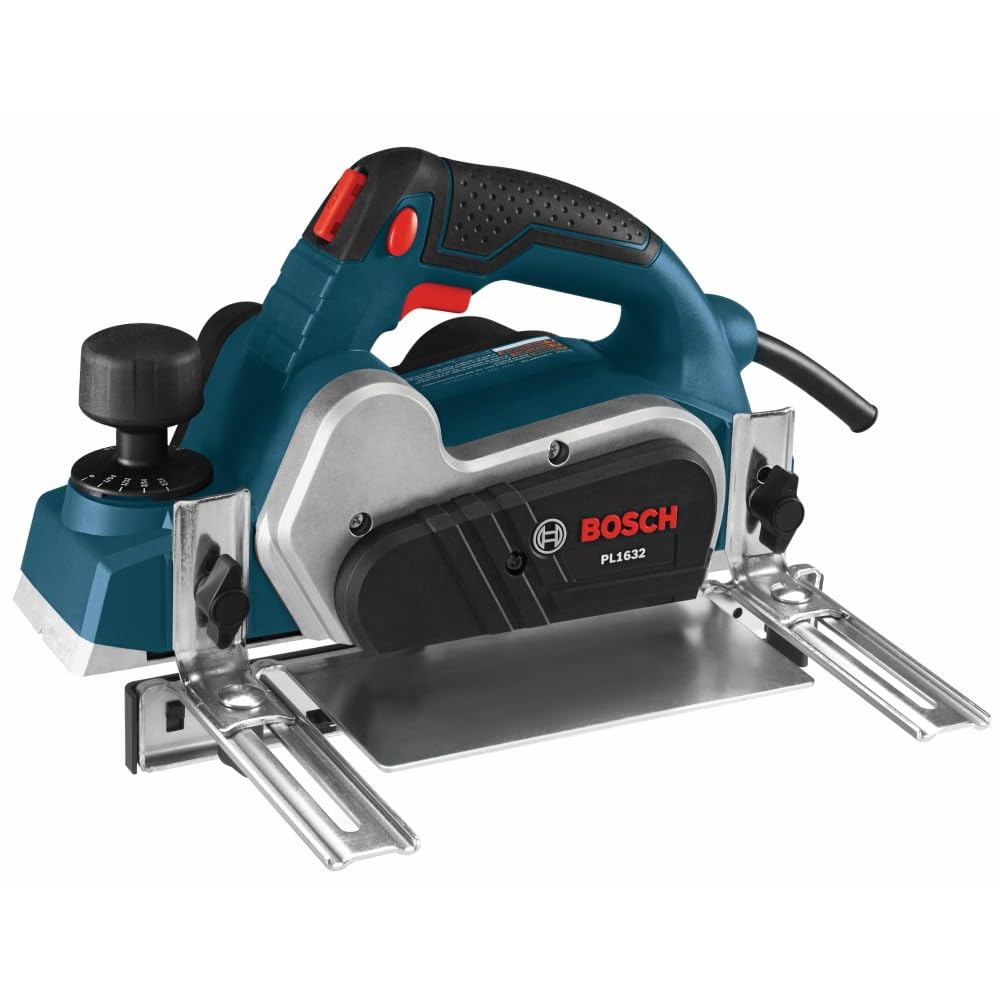
The PL1632 is the single-blade sibling of the PL2632K, sharing the same 6.5-amp motor and 16,500 RPM output but in a lighter chassis (6.3 pounds). The electronically counterbalanced single-blade design reduces drag and positions the carbide insert at the ideal cutting angle automatically — a good option if you prefer simplicity over the dual-blade flexibility of the kit version.
The ratcheting depth knob adjusts from 0 to 1/16 inch within one revolution, and separate inch and metric depth scales eliminate guesswork. Dual-mount guide fence can attach to either side, and the ball-joint cord swivel keeps the cable from interfering with your cut line. The spring-loaded stand lifts the tool when resting, protecting the blade and the workbench surface.
Several users note that the guide bar may not be perfectly square to the shoe out of the box — a quick check with a machinist square and a gentle adjustment typically resolves the issue. Compared to the PL2632K, this model lacks the hard case and the second blade slot, but for light-duty trimming and door fitting, the weight savings are noticeable.
Why it’s great
- Lightweight design reduces fatigue during overhead or extended use
- Counterbalanced single-blade system for reduced drag
- Separate inch and metric depth scales for versatility
Good to know
- Guide fence may need initial adjustment to achieve 90°
- No hard case included — a soft bag or storage is needed
7. WEN JT3062 10-Amp 6-Inch 2-Blade Benchtop Jointer

The JT3062 is a benchtop jointer, not a planer, but it deserves a spot in this guide because a budget wood planer workflow is incomplete without a way to flatten the face and edge of rough lumber before thicknessing. Its 10-amp motor delivers 22,000 cuts per minute, and the 6-inch-wide, 30-inch-long table handles boards up to 4-1/4 inches thick.
The adjustable fence bevels up to 45 degrees, and the two-blade cutterhead with jackscrew knife leveling makes blade swaps straightforward. Onboard depth scale shows your cut setting from 0 to 1/8 inch. Two push blocks and a 2-1/2-inch dust port are included. Users consistently report that it joints hard and soft woods with minimal tear-out, and the cast-iron build keeps vibration low enough for accurate work.
The main challenge is getting the infeed and outfeed tables perfectly coplanar — a process that requires patience and a straight edge. Once dialed in, the JT3062 produces glue-ready edges on cutting boards and drawer fronts without breaking the bank.
Why it’s great
- 6-inch width handles most common stock sizes
- 22,000 CPM leaves a smooth surface with low tear-out
- Fence bevels to 45° for chamfers and beveled edges
Good to know
- Table alignment requires careful setup to achieve coplanar infeed/outfeed
- Plastic adjustment knobs feel less durable than the metal base
8. CRAFTSMAN Benchtop Jointer, 10 Amp, Corded (CMEW020)

The CMEW020 stands out because of its variable speed range — 6,000 to 11,000 RPM — letting you match cutterhead speed to the material hardness and size. The 10-amp motor drives a two-knife cutterhead with jackscrew knife leveling for precise blade height adjustment. The center-mounted fence spans 4-1/4 inches and provides support throughout the cut for accurate edge jointing.
The benchtop design weighs 40 pounds, making it easier to move than stationary jointers but still stable enough for consistent cuts. Setup involves aligning the fence with a machinist square — a step many users report takes about an hour on first assembly. The short infeed and outfeed tables limit practical jointing to boards under 4 to 5 feet long; longer stock will require additional roller support.
Dust collection works best with a dedicated vacuum attached — the chute clogs quickly without suction. A small stick can clear the chamber during operation, but a shop vac is the better long-term solution. Despite these quirks, once the fence and tables are dialed in, the CMEW020 delivers reliable, repeatable edge jointing at a mid-range price.
Why it’s great
- Variable speed allows tuning for different wood species
- Jackscrew knife leveling simplifies blade changes
- Lightweight enough for benchtop storage and transport
Good to know
- Short tables limit jointing length to about 4-5 feet
- Dust chute clogs without a shop vac attached
9. VEVOR Thickness Planer Stand, 100 lbs capacity

A planer is only as accurate as the surface it sits on, and the VEVOR stand provides a stable, mobile platform for benchtop machines up to 100 pounds. The metal top measures 27.7 by 24 inches and includes pre-drilled holes for quick mounting. Three height settings (30.5, 33.5, and 35.4 inches) let you match the feed height to your workbench or assembly table.
Four swivel casters with two additional straight casters and foot-action locks keep the stand stationary during operation and mobile when you need to clear shop floor space. A middle storage platform accommodates additional tools and accessories, reducing clutter around the workstation. The alloy steel frame feels solid, and users report that assembly takes about an hour with basic tools, despite the manual having some inaccuracies.
Some units arrive with oily hardware and the included bolts for mounting the planer may be too short — drilling new holes in the stand top is a common workaround. The casters roll smoothly on concrete and the locks hold firm during aggressive planing passes.
Why it’s great
- Three height settings for ergonomic feed position
- Six casters with locks provide mobility and stability
- Storage shelf reduces benchtop clutter
Good to know
- Hardware may arrive oily — plan to wipe before assembly
- Mounting bolts may be too short for some planer base plates
FAQ
How much snipe is normal on a budget benchtop planer?
Can I use a cordless planer instead of a corded model for budget projects?
What’s the difference between a planer and a jointer in a budget shop?
How often should I replace or rotate the blades on a budget planer?
Final Thoughts: The Verdict
For most users, the best budget wood planer winner is the Bosch PL2632K because it combines a dual-blade system, a ratcheting depth knob with 1/64-inch increments, and precision-machined aluminum shoes in a package that includes a hard case — all at a mid-range price that outperforms many more expensive models. If you want a spiral cutterhead with minimal snipe and quieter operation, grab the Cutech 40700H. And for those needing the widest capacity on a tight budget, nothing beats the WEN PL1252 for planing 12.5-inch-wide lumber without breaking the bank.

Mo Maruf
I created WellFizz to bridge the gap between vague wellness advice and actionable solutions. My mission is simple: to decode the research and give you practical tools you can actually use.
Beyond the data, I am a passionate traveler. I believe that stepping away from the screen to explore new environments is essential for mental clarity and physical vitality.