Our readers keep the lights on and my smoothie glass nicely filled. As an Amazon Associate, I earn from qualifying purchases.
Finding a capable home theater hub under a strict budget often feels like auditioning a dozen black boxes that all promise the same thing but deliver wildly different results. Between HDMI board revisions, room correction algorithms, and power ratings that rarely match real-world output, the wrong pick can leave you fighting lip-sync issues and muddled dialogue for years.
I’m Mohammad Maruf — the founder and writer behind WellFizz. I’ve spent countless hours cross-referencing amplifier schematics, HDMI 2.1 chipset compatibility, and real owner feedback to separate receivers that deliver genuine value from those that rely on marketing specs alone.
Whether you need a basic 5.1 hub for a first setup or a future-proofed 7.2 unit with 4K/120Hz passthrough for next-gen consoles, this guide covers the top contenders to help you confidently select the right budget av receiver.
How To Choose The Best Budget AV Receiver
Selecting the right entry-level to mid-range receiver requires understanding a few non-negotiable specs that directly affect your listening and viewing experience. Prioritize these three areas before comparing extra features.
Channel Count and Real Power Output
The number of channels determines your speaker layout. A 5.1 receiver handles front left/right, center, and two surrounds; a 7.2 adds rear surrounds or overhead Atmos speakers. Pay attention to the power rating measured with two channels driven — all channels driven specs are often far lower and reveal the true muscle of the amplifier.
HDMI 2.1 Features for Modern Gaming
If you own a PlayStation 5 or Xbox Series X, look for a receiver that passes 4K/120Hz and supports Variable Refresh Rate (VRR) and Auto Low Latency Mode (ALLM). Some budget receivers advertise 8K compatibility but use older 24Gbps HDMI chips that cannot handle the full 40Gbps bandwidth demanded by next-gen consoles.
Room Calibration and Usability
Auto-calibration systems like Audyssey, YPAO, or Sony’s Digital Cinema Auto Calibration IX measure your room acoustics and adjust speaker distances, levels, and EQ. A receiver with solid room correction can make budget speakers sound far more cohesive than a more powerful unit without proper calibration.
Quick Comparison
On smaller screens, swipe sideways to see the full table.
| Model | Category | Best For | Key Spec | Amazon |
|---|---|---|---|---|
| Denon AVR-S970H | Mid-Range | 7.2 Music & Movies | 90W x 7 Channels | Amazon |
| Yamaha RX-A2A | Premium | Build Quality & Room Calibration | YPAO R.S.C. with Multipoint | Amazon |
| Sony STR-AN1000 | Premium | Immersive Sound & 360 Mapping | 360 Spatial Sound Mapping | Amazon |
| Onkyo TX-NR6100 | Mid-Range | THX Certified Performance | 210W/Ch Dynamic Power | Amazon |
| Yamaha RX-V6A | Mid-Range | MusicCast Multi-Room | 7 HDMI Inputs (3x 8K) | Amazon |
| Onkyo TX-NR6050 | Mid-Range | Gaming Features at a Value | 4K/120Hz & VRR Pass-Through | Amazon |
| Pioneer VSX-935 | Mid-Range | Surround from Fewer Speakers | Dolby Atmos Height Virtualization | Amazon |
| Denon AVR-S670H | Budget | Simple 5.1 with Phono Input | 75W x 5 Channels | Amazon |
| Sony STRAZ1000ES | Premium | Ultimate Custom Integration | 100W + 100W (8 ohms) | Amazon |
In‑Depth Reviews
1. Denon AVR-S970H 7.2 Channel Receiver

The Denon AVR-S970H strikes a strong balance between channel count, power, and convenience features for a medium-sized room. With 90 watts per channel across seven channels, it provides enough headroom to drive bookshelf speakers like KEF Q150s without strain, and its 8K/60Hz passthrough with VRR and ALLM keeps you ready for current-gen gaming consoles. The onscreen setup assistant and Audyssey MultEQ room correction make initial configuration straightforward, even for first-time owners.
HEOS built-in lets you stream from Spotify, TIDAL, and Pandora across the house, and the phono input adds flexibility for vinyl listeners. The unit runs noticeably cooler than competing Onkyo models according to owner feedback, which matters for long-term reliability in an enclosed cabinet. The front-panel layout is clean, with a large volume knob and dedicated input buttons that reduce menu-diving for daily use.
All seven HDMI inputs (including three 8K-capable) support eARC, so a single cable from the TV handles return audio. Zone 2 powered output does drop the main zone to 5.1, which limits some configurations, but for most home theater and casual listening needs this Denon delivers dependable performance without pushing the budget too far.
Why it’s great
- Audyssey MultEQ provides excellent room calibration for the price
- Phono input and HEOS streaming cover vinyl and digital sources
- Cooler operating temperature compared to rivals in the same bracket
Good to know
- Powered Zone 2 reduces main setup to 5 channels
- HEOS app can lag; wired Ethernet offers more stability
2. Yamaha RX-A2A AVENTAGE 7.2-Channel Receiver

The AVENTAGE line represents Yamaha’s top-tier engineering focus on vibration damping and rigid chassis design, and the RX-A2A brings that philosophy to a more accessible price point. It features a fifth foot for added stability, a thick bottom chassis plate, and premium internal components that reduce mechanical noise. With 7.2 channels, Dolby Atmos, and DTS:X, it handles immersive audio formats while YPAO R.S.C. with multipoint measurement fine-tunes the sound to your room’s specific reflections.
Three of the seven HDMI inputs support 8K60B and 4K120AB, making this receiver a strong candidate for gamers who want future-proof bandwidth. MusicCast multi-room lets you sync with Yamaha wireless speakers, and the unit works with Sonos via a separate Port. The Surround:AI feature analyzes audio scenes in real-time and adjusts dialogue clarity and surround effects without manual intervention.
Owners consistently praise the clean, natural Yamaha sound signature and the intuitive MusicCast app. The remote is straightforward and backlit, and the front display provides clear feedback without being overwhelming. It lacks analog video inputs and the MSRP often feels high, but when found on sale it competes directly with Denon’s 7.2 offerings while offering superior build dampening.
Why it’s great
- AVENTAGE chassis construction reduces vibrational distortion
- YPAO R.S.C. with multipoint delivers precise room correction
- Surround:AI adapts sound in real-time for impactful movie moments
Good to know
- No analog video inputs for legacy devices
- Full MSRP is high; best value when purchased on promotion
3. Sony STR-AN1000 7.2 CH Surround Receiver

Sony’s STR-AN1000 leverages the company’s cinema heritage with Digital Cinema Auto Calibration IX and 360 Spatial Sound Mapping, which creates phantom surround channels from a smaller physical speaker layout. In a 5.1.2 configuration, the receiver can simulate a 7.1.4 experience by intelligently processing sound objects. The 165W per channel rating (6 ohms, 1kHz, 1ch driven) provides ample power for most bookshelf and tower speakers.
Connectivity includes six HDMI inputs with two outputs, all supporting 8K/4K120 pass-through, eARC, VRR, and ALLM. Chromecast built-in, Apple AirPlay 2, and Spotify Connect cover streaming, and the “Works with Sonos” integration allows seamless multi-room with Sonos speakers. The graphical setup interface walks you through each step on your TV, which simplifies the calibration process for less technical users.
The S-Center sync feature uses a compatible Sony TV’s speaker as a center channel to anchor dialogue to the screen. Owners report that the auto-calibration is accurate but sometimes over-corrects subwoofer distance, requiring manual fine-tuning. The unit lacks a phono input, but for buyers focused on immersive cinema sound and Dolby Atmos virtualization, the AN1000 is a compelling package.
Why it’s great
- 360 Spatial Sound Mapping expands the soundstage without extra speakers
- Clear, onscreen walkthrough for calibration and setup
- D.C.A.C. IX automates room correction effectively
Good to know
- No phono input for turntable users
- Subwoofer calibration distance often needs manual override
4. Onkyo TX-NR6100 7.2 Channel THX Certified Receiver
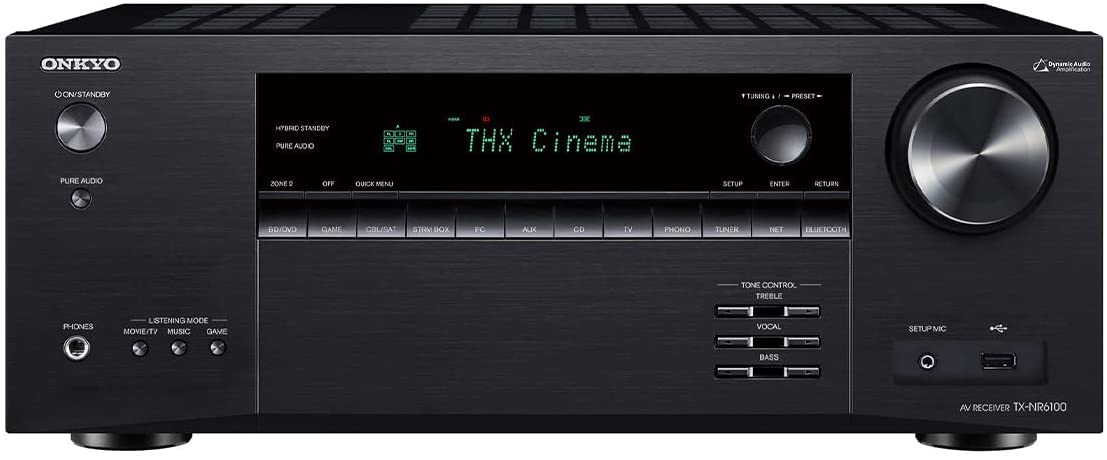
THX Select certification means the TX-NR6100 has passed rigorous testing for distortion, frequency response, and output capability in rooms where the screen is about 3 meters away. The receiver delivers 210W per channel dynamic power and supports 5.2.2 Dolby Atmos and DTS:X playback. Three of its HDMI inputs handle 40Gbps 8K signals, making it fully compatible with the highest bandwidth HDMI 2.1 devices.
The Onkyo Control app allows you to adjust settings, switch inputs, and browse streaming services from your phone. Owners report that the unit pairs exceptionally well with Klipsch speakers, producing clear channel definition with plenty of headroom for dynamic movie peaks. Eight HDMI ports provide abundant connectivity for multiple consoles, a Blu-ray player, and a streaming box without needing an external switch.
Music lovers will appreciate the AccuEQ room calibration and the ability to save custom sound modes per input. Some long-term owners have reported fan noise becoming audible over time and occasional HDMI switching delays. The unit also runs warmer than some competitors, so ventilation space is important. For buyers seeking THX-certified performance and broad connectivity, this Onkyo remains a strong contender.
Why it’s great
- THX Select certification guarantees reliable performance standards
- 8 HDMI ports accommodate complex home theater setups
- Dynamic power rating provides ample headroom for demanding scenes
Good to know
- Fan noise can become noticeable over extended ownership
- Runs hot; ensure adequate ventilation in your cabinet
5. Yamaha RX-V6A 7.2-Channel AV Receiver with MusicCast

The RX-V6A sits in Yamaha’s more accessible line but inherits many features from the AVENTAGE series, including YPAO multipoint room correction and MusicCast multi-room streaming. It offers 7.2 channels with Dolby Atmos and DTS:X, and its three 8K60 HDMI inputs handle 4K120AB passthrough for gaming. The onboard DAC and high slew rate amplifier produce a sound that owners describe as clearer and more dynamic than previous Yamaha entry-level receivers.
MusicCast allows you to group compatible Yamaha speakers throughout the house and stream from Spotify, TIDAL, Pandora, and Amazon Music HD directly without a separate device. Voice control via Alexa and Google Assistant is integrated, and Apple AirPlay 2 adds flexibility for iOS households. The unit powers 4 ohm speakers without issue, which is rare at this price tier and opens up more speaker choices.
The menu interface feels dated compared to competitors, and the setup process requires connecting to the network for firmware updates before you can fully configure the unit. Owners note that the receiver does not auto-turn on with the TV, requiring a manual press of the power button. For users who prioritize multi-room streaming and robust power delivery in a Yamaha ecosystem, the RX-V6A is a reliable workhorse.
Why it’s great
- MusicCast enables seamless multi-room audio streaming
- Capable of driving 4 ohm speakers without stability issues
- Clear, dynamic sound with high slew rate amplifier design
Good to know
- Menu interface is dated and less intuitive than competitors
- Requires firmware update before full configuration is possible
6. Onkyo TX-NR6050 7.2-Channel Network Receiver

The TX-NR6050 was positioned as one of the more affordable receivers to offer full HDMI 2.1 support with 4K/120Hz, VRR, ALLM, and QFT — making it a favorite among console gamers who wanted to avoid the black-screen issues that plagued some early Denon units. The built-in streaming services include Spotify, TIDAL, Deezer, Pandora, and TuneIn, accessible through the Onkyo Control app or directly via the receiver’s network connection.
Sound quality is a strong point, with owners reporting clear dialogue, deep bass, and immersive surround sound after the basic calibration. The unit works well with older speakers, so you can upgrade the receiver without immediately replacing your entire speaker set. The included setup microphone and onscreen guide help you get the system running relatively quickly for a novice.
Problems reported by users include flickering video and casting issues that sometimes require swapping to a certified 8K HDMI cable, and the receiver runs hot under operation. Several owners encountered HDMI handshake problems and found themselves troubleshooting extensively before the system stabilized. For someone willing to invest time in cable selection and firmware updates, the TX-NR6050 offers gaming features at an aggressive price point.
Why it’s great
- Full HDMI 2.1 gaming feature set at a very competitive price
- Punchy bass and clear dialogue from a simple setup
- Works well with older speakers for gradual system upgrades
Good to know
- HDMI handshake issues may require certified cables and troubleshooting
- Unit runs hot; adequate ventilation is essential
7. Pioneer VSX-935 7.2 Channel Network Receiver
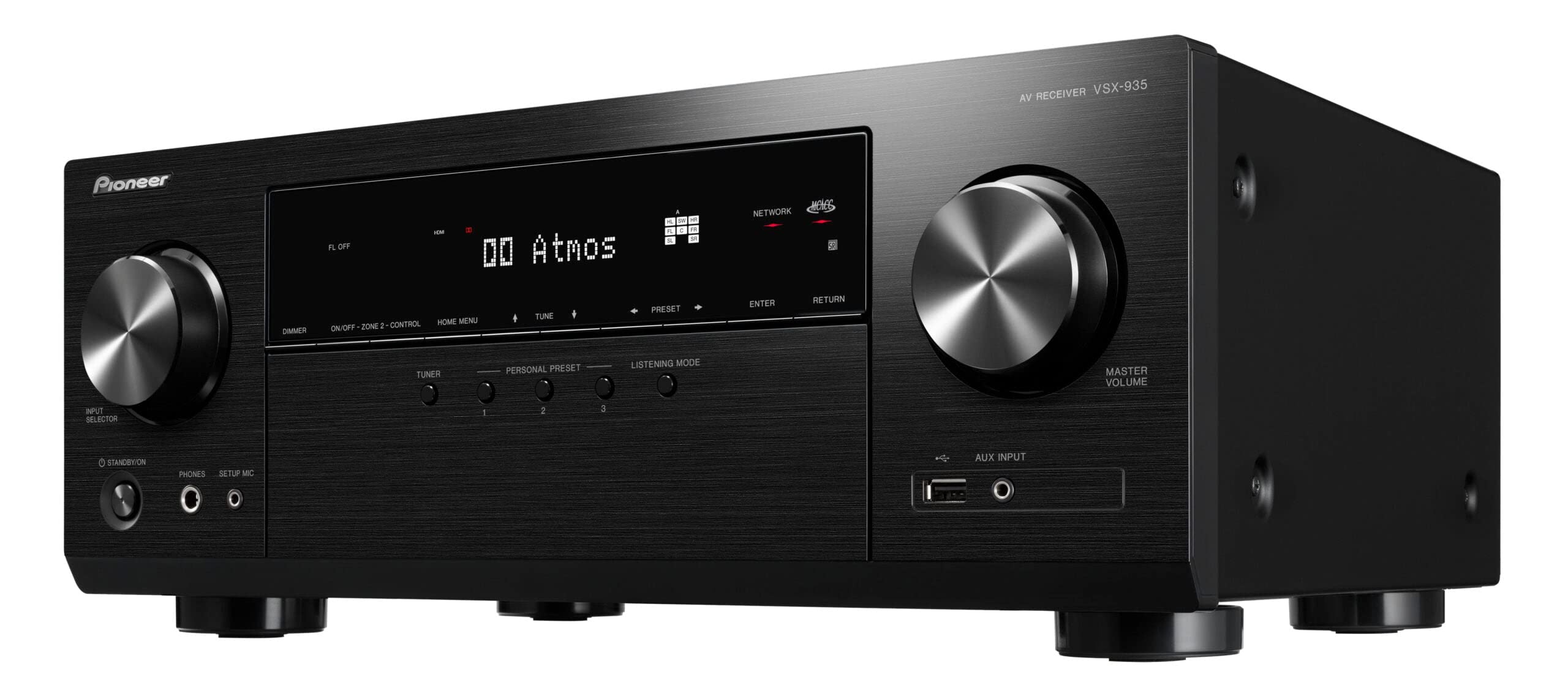
Pioneer’s VSX-935 stands out for its Dolby Atmos Height Virtualization, which creates a convincing overhead effect from a traditional 5.1 or 7.2 speaker layout without requiring ceiling-mounted or up-firing modules. This is particularly useful for renters or anyone who cannot install in-ceiling speakers. The receiver also supports 8K/60Hz and 4K/120Hz with enhanced gaming features, making it relevant for next-gen consoles.
Owners praise the crisp, clear sound quality and the gradual volume ramp that prevents sudden loud jumps. The RF remote works through cabinets and the dual-zone output allows a second set of speakers in another room. The display is bright with a dimmer for dark rooms, and all speakers play in music mode without special configuration, which simplifies listening across multiple sources.
Some users have reported HDMI video issues including snow on streaming sites and intermittent black screens, along with USB-only firmware updates that can be error-prone. The manual calibration process is described as better than the auto setup, so expect to spend some time dialing in speaker distances and levels. For buyers who want the Atmos height virtualization trick and have patience for occasional troubleshooting, the VSX-935 is a unique option.
Why it’s great
- Dolby Atmos Height Virtualization works without physical height speakers
- RF remote operates through cabinets and walls
- Gradual volume control prevents audio surprises
Good to know
- Some HDMI video issues reported by owners
- Firmware updates only available via USB and can fail
8. Denon AVR-S670H 5.2 Ch Home Theater Receiver

The AVR-S670H is Denon’s entry-level 5.2 channel receiver aimed at first-time home theater builders or those replacing a very old unit. Its 75 watts per channel into five channels is sufficient for a modest living room setup with efficient speakers. It includes a phono input for turntables, which is rare at this price level and a major draw for vinyl enthusiasts who want a single hub for both movies and records.
HEOS built-in provides wireless streaming for Spotify, TIDAL, and Pandora, and the HDMI inputs support 8K/60Hz passthrough along with HDR10+, Dolby Vision, and HLG. The Audyssey calibration works through the supplied microphone and provides a solid baseline EQ for the room. Owners consistently praise the easy setup — the receiver can be configured without an internet connection, and the one remote often controls both the TV and the receiver seamlessly.
The five-channel limitation means you cannot add Atmos height speakers or surround backs, so this receiver is best for a straightforward 5.1 layout. The HEOS app has been reported as occasionally unreliable for wireless streaming, but wired performance is excellent. For someone who just wants a clean 5.1 system with a phono input and future-proof HDMI, this is the honest entry point.
Why it’s great
- Phono input is a standout feature at this price level
- Very easy setup that works without an internet connection
- Audyssey calibration provides good baseline room correction
Good to know
- Limited to 5 channels; no Atmos or rear surround expansion
- HEOS wireless streaming can have intermittent lag
9. Sony STRAZ1000ES Premium ES 7.2 CH Receiver

The STRAZ1000ES represents Sony’s premium ES series, built for custom integration and high-performance home theater. It delivers 100 watts per channel into 8 ohms with two channels driven, and its 360 Spatial Sound Mapping creates a remarkably wide and immersive soundstage from a 5.1.2 configuration that rivals setups with more physical speakers. The receiver includes Digital Cinema Auto Calibration IX for precise speaker measurement in complex rooms.
IP control and RS-232 compatibility allow seamless integration with third-party control systems like Crestron and Control4, making this a favorite for dedicated theater rooms and professional installations. Six HDMI inputs support 8K/4K120 with VRR and ALLM, and both Dolby Atmos and DTS:X are supported. The front-panel cover plate provides a clean look when the receiver is visible in a rack or cabinet.
Owners describe the sound quality as exceptional, with clear dialogue, powerful dynamics, and a DAC that makes good speakers sound significantly better. The unit runs very hot during operation, and an external fan like the AC Infinity Aircom T10 is often recommended for enclosed spaces. It also lacks HDR10+ support, which may matter for some Samsung TV owners. For buyers seeking a high-end Sony receiver with expandability and professional calibration, this ES model delivers.
Why it’s great
- 360 Spatial Sound Mapping creates a huge soundstage from fewer speakers
- IP control and RS-232 for professional custom installations
- DAC quality improves the performance of capable speakers
Good to know
- Runs very hot; external cooling fan is advisable
- No HDR10+ support for Samsung TV owners
FAQ
Does a budget AV receiver support Dolby Atmos effectively?
What does room calibration actually do for sound quality?
Can I use a budget receiver with 4 ohm speakers?
Final Thoughts: The Verdict
For most users, the budget av receiver winner is the Denon AVR-S970H because it delivers 90W across seven channels with reliable Audyssey room correction, a phono input, and HEOS streaming at a price that doesn’t force major trade-offs. If you want the most immersive sound virtualization for smaller speaker setups, grab the Sony STR-AN1000. And for a no-compromise gaming receiver with full HDMI 2.1 bandwidth and THX certification, the Onkyo TX-NR6100 remains the strongest specialist pick.

Mo Maruf
I created WellFizz to bridge the gap between vague wellness advice and actionable solutions. My mission is simple: to decode the research and give you practical tools you can actually use.
Beyond the data, I am a passionate traveler. I believe that stepping away from the screen to explore new environments is essential for mental clarity and physical vitality.