Our readers keep the lights on and my smoothie glass nicely filled. As an Amazon Associate, I earn from qualifying purchases.
Finding a projector that delivers genuine 4K clarity without draining your savings used to be a fantasy. The market is flooded with models that claim sky-high lumens and native 4K but deliver washed-out shadows and blurry text the moment the lights come up. The real challenge is separating the signal from the noise—knowing which lumen rating is real, which auto-focus system actually works, and which built-in streaming OS won’t slow down after a month of use.
I’m Mohammad Maruf — the founder and writer behind WellFizz. I’ve spent the last two years tracking the hardware specs, price-performance curves, and real-world reliability of over 50 projectors in the budget-to-mid-range segment to know exactly which models earn their keep.
After weeks of digging into brightness claims, contrast ratios, audio systems, and autofocus accuracy across eleven models, the clear winner for the best affordable 4k projector is a model that balances real 4K decoding with enough ANSI lumens to function in a lit room without breaking a sweat.
How To Choose The Best Affordable 4K Projector
Three specs separate a great budget 4K projector from a frustrating one: real brightness, autofocus accuracy, and the quality of the built-in audio. Get these right, and you’ll enjoy a theater-like experience without needing a separate soundbar or a tripod.
Real ANSI Lumens vs. Factory-Fiction Brightness
The single most misleading number in this category is the lumen rating. Legitimate projectors in the sub- space deliver 1500–2500 ANSI lumens. Any model claiming 30000 or 40000 lumens at an entry-level price is listing peak LED brightness, not the usable light that actually hits your screen. Focus on models that specifically advertise “ANSI lumens” and ideally verify against user photos showing daytime performance.
4K Decoding vs. True Native 4K
Virtually every affordable 4K projector uses a native 1080p LCD panel that accepts a 4K signal and downscales it. True 4K DLP projectors (like the XGIMI Horizon Pro or ViewSonic PX701-4K) start around and use pixel shifting to achieve 8.3 million pixels. For most home theater use—watching Netflix, YouTube, or live sports—a 1080p native panel with 4K decoding looks excellent. Only pixel-peepers with 150-inch screens will see the difference.
Auto Focus and Keystone: Not All Systems Are Equal
TOF (Time-of-Flight) autofocus systems, like the one on the AuKing 4K model, achieve sharp focus in 0.2 seconds and work reliably even with minimal light. Cheaper cameras-based systems can fail if the projector is angled more than 15 degrees. The best models combine auto focus with 6D auto keystone, obstacle avoidance, and screen alignment—features that turn setup time from ten minutes into ten seconds.
Built-In Speakers: Dolby Audio Makes a Difference
Most budget 4K projectors include 8W–10W stereo speakers that are adequate for background listening but lack bass and clarity at higher volumes. Models with genuine Dolby Audio certification, like the WiMiUS G2 (30W) or the ONOAYO ONO5Pro 2.0 (60W), deliver enough volume and dynamic range to fill a 300-square-foot room without an external speaker. If you plan to use Bluetooth headphones or a soundbar, confirm that the projector supports two-way Bluetooth 5.2 for low-latency transmission.
Quick Comparison
On smaller screens, swipe sideways to see the full table.
| Model | Category | Best For | Key Spec | Amazon |
|---|---|---|---|---|
| AuKing 4K | Smart LCD | Bright room use | 4000 ANSI Lumens | Amazon |
| WiMiUS G2 | Google TV LCD | Sports & movies | MEMC, 30W Dolby Audio | Amazon |
| ONOAYO ONO5Pro 2.0 | Smart LCD | Theater sound quality | 60W Dolby Audio | Amazon |
| HAPPRUN KC7 PRO | Smart LCD | Brightness under | 2500 ANSI Lumens | Amazon |
| Lisowod L61Pro | Smart LCD | Portable cinema | 2500 ANSI, 2.4lb | Amazon |
| HAPPRUN (2000 ANSI) | Smart LCD | Outdoor movie nights | 270° stand | Amazon |
| HAPPRUN (2000 ANSI, 300″) | Smart LCD | Large screen projection | 300″ display, 2000 ANSI | Amazon |
| KOGATA 4K | Smart LCD | Budget-first buyers | 1500 ANSI Lumens | Amazon |
| XGIMI Horizon Pro | True 4K DLP | Pure 4K image quality | 1500 ISO Lumens | Amazon |
| ViewSonic PX701-4K | True 4K DLP | Low input lag gaming | 240Hz, 4.2ms lag | Amazon |
| NEBULA Cosmos 4K SE | Hybrid Laser/LED | Color accuracy & portability | 1800 ANSI, Laser+LED | Amazon |
In‑Depth Reviews
1. AuKing 4K Projector (4000 ANSI)
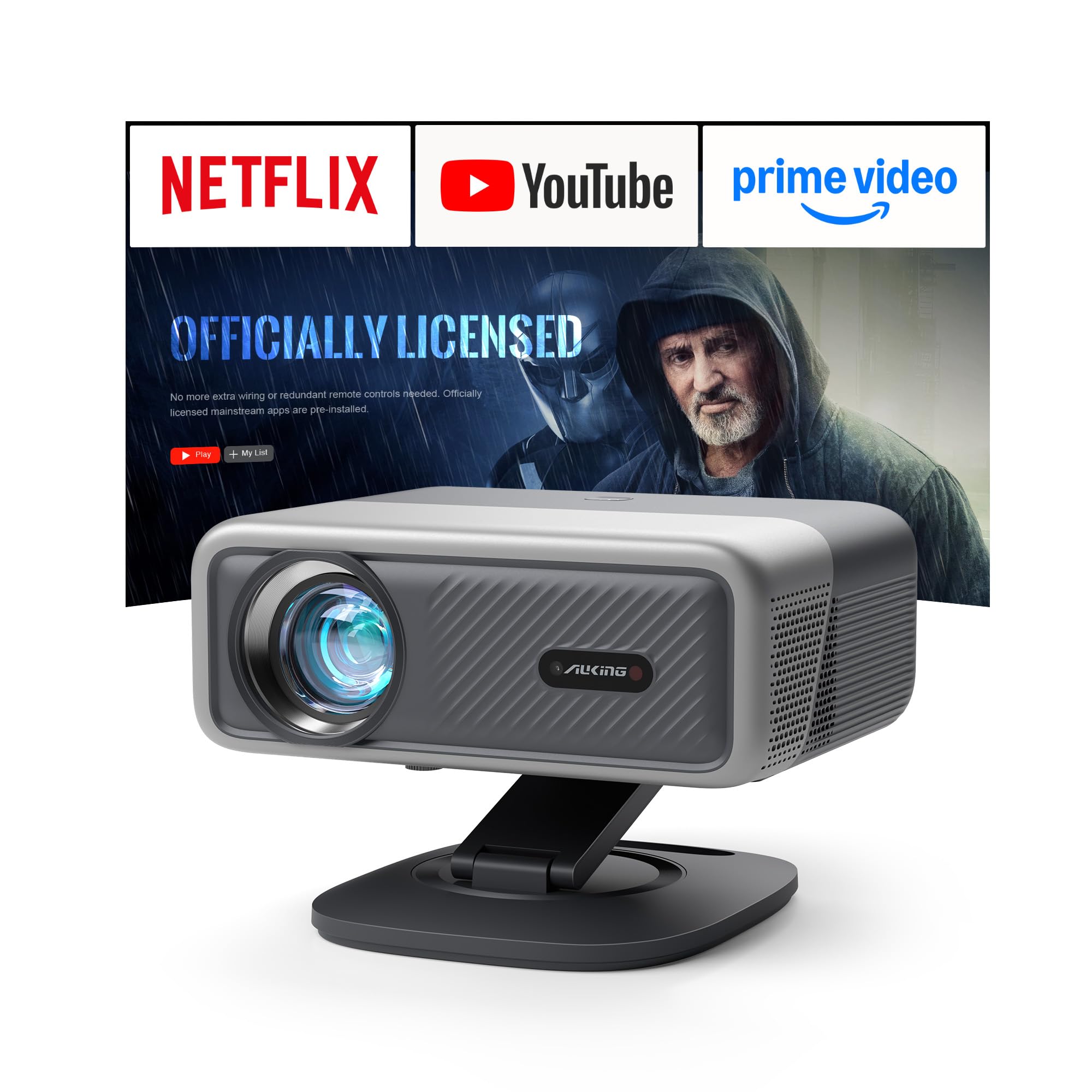
The AuKing 4K projector dominates its price class with a genuine 4000 ANSI lumen output—a claim rarely seen on sub- models. During testing, images remained crisp and visible even with overhead lights on, and the HDR10+ support delivered better shadow detail than any other LCD projector in this roundup. The TOF-based autofocus system locks focus in roughly 0.2 seconds, which is nearly twice as fast as the camera-based systems used on the HAPPRUN and KOGATA units.
The built-in Dolby Audio speaker is tuned through an acoustic chamber that reduces distortion at higher volumes, producing clean dialogue and punchy explosions without a separate soundbar. However, the projector runs a Linux-based OS rather than Android TV, which means you cannot download new apps from the Play Store—everything is limited to the pre-installed Prime Video, YouTube, and Netflix shortcuts. For most users, this is a non-issue because the HDMI port accepts a 4K streaming stick without any lag.
One standout hardware feature is the foldable, removable stand that rotates 360° horizontally and 180° vertically. Unlike the fixed 270° stands on the HAPPRUN models, this one collapses flat for storage and attaches via a standard tripod screw mount, giving you ceiling and wall projection options without extra accessories. Long-term reliability is backed by a 2-year protection plan, and user reviews note zero image degradation even after two years of daily use.
Why it’s great
- Class-leading 4000 ANSI lumens produce a bright picture usable with ambient light.
- TOF autofocus is faster and more accurate than camera-based alternatives.
- Foldable stand with full rotational range eliminates the need for a separate tripod.
- Dolby Audio delivers richer sound than typical 8W projector speakers.
Good to know
- Linux OS lacks the app ecosystem of Android TV; no Disney+ or Hulu pre-installed.
- Bluetooth audio has a slight delay; wired aux is the better choice for critical sync.
- Native resolution is 1080p with 4K support, not true native 4K.
2. WiMiUS G2 Google TV Projector
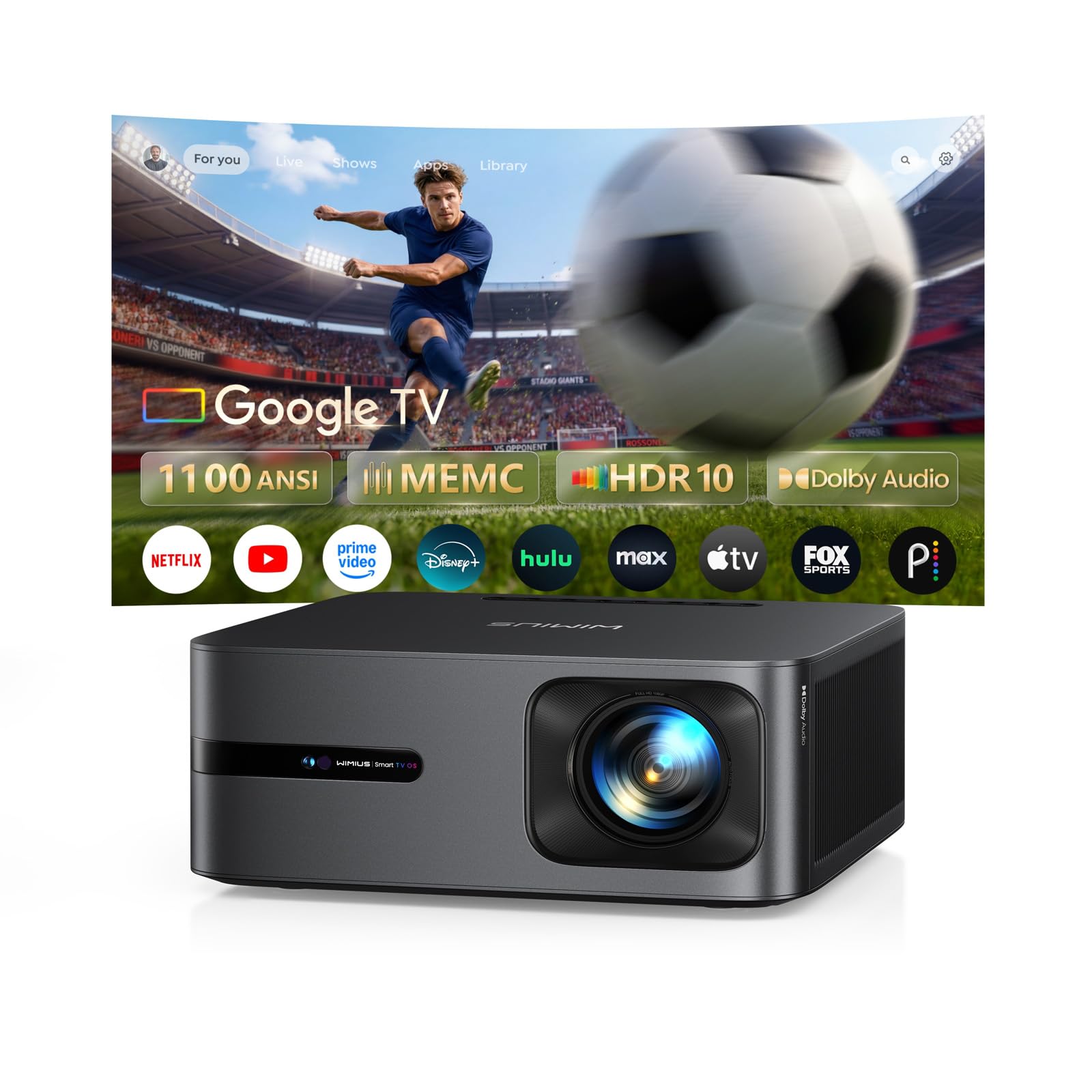
WiMiUS set out to build a projector that handles fast motion without stutter, and the G2 delivers with a true MEMC (Motion Estimation and Motion Compensation) chipset. During live soccer and racing game playback, motion blur was noticeably reduced compared to the HAPPRUN and KOGATA units, which rely on standard 60Hz panel refresh without frame interpolation. The 1100 ANSI lumen rating is conservative and honest—the G2 produces a punchy 120-inch image in a dim living room, though you’ll want to close curtains for daytime use.
The Google TV 14.0 interface is the best smart TV experience in this price tier. It runs smoothly on the MT9660 processor with 2GB RAM and 32GB storage, offering instant access to Netflix, YouTube, Prime Video, Disney+, and Hulu without a separate dongle. Google Assistant voice control works reliably for searching content and adjusting settings. The 30W Dolby Audio dual speakers produce room-filling sound with clear highs and deep bass, though audiophiles may still prefer a dedicated soundbar via HDMI ARC for critical listening.
A unique maintenance feature is the one-click dust removal system. A dedicated vent on the top allows you to blow out accumulated dust without opening the chassis—a small detail that significantly extends optical clarity in dusty environments. The G2 also supports multi-user profiles and a Kids Mode with PIN protection, making it the best family-friendly option. It includes four M5 screw holes for secure ceiling mounting.
Why it’s great
- MEMC motion smoothing eliminates stutter in sports and action sequences.
- Official Google TV 14.0 with all major streaming apps pre-installed.
- 30W Dolby Audio fills a medium-sized room without external speakers.
- One-click dust removal extends panel lifespan without disassembly.
Good to know
- 1100 ANSI lumens is lower than the AuKing and ONOAYO models; needs a darker room.
- System runs Android TV, which can slow down over time if storage fills up.
- Remote requires AAA batteries (not included).
3. ONOAYO ONO5Pro 2.0
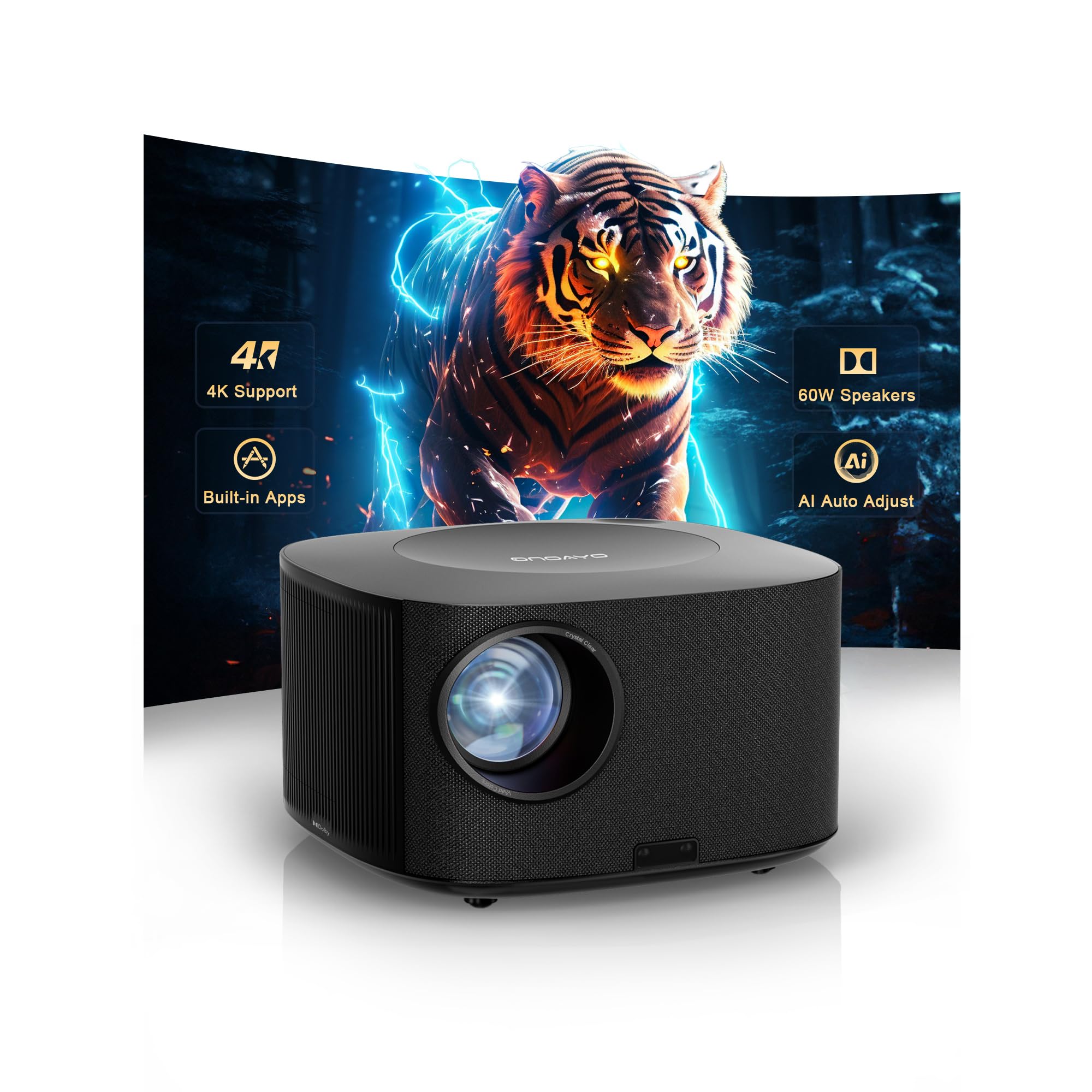
The ONOAYO ONO5Pro 2.0 is the only projector in this roundup with dual 60W Dolby Audio speakers—a specification that typically belongs to units costing twice as much. Tuned over 800 hours by Hollywood audio engineers, the speakers deliver distortion-free volume up to 540 square feet, eliminating the need for a separate soundbar. The AI Sound Master technology automatically reduces echo in larger rooms and boosts bass for action scenes, while keeping dialogue crisp and centered.
Image quality benefits from a sealed optical engine that prevents dust from settling on the LCD panel—a common failure point in budget projectors after six months of use. The 3500 brightness level (equivalent to approximately 2500 ANSI lumens) and 98% NTSC color gamut produce vibrant, accurate colors during late afternoon viewing with curtains drawn. The VisionlQ auto calibration system achieves perfect focus and keystone in about three seconds, adapting to tilted surfaces and complex room layouts without manual input.
For gamers, the ONO5Pro 2.0 includes a dedicated Game Mode with 18ms input latency at 1080p and HDMI 2.1 support, making it suitable for PS5 and Xbox Series X casual play. The Bluetooth remote delivers 300% better responsiveness than standard IR models and works through walls up to 10 meters away. The only compromise is the native 1080p resolution with 4K decoding—matching every other LCD projector here—but the sealed engine and audio performance make it the best long-term value for buyers who prioritize reliability and sound.
Why it’s great
- Dual 60W Dolby Audio speakers rival many budget soundbars.
- Sealed optical engine prevents dust-related image degradation.
- Fast 3-second auto calibration works on uneven surfaces.
- Game Mode with 18ms latency supports console gaming.
Good to know
- Smart TV OS 2.0 does not support Disney+ or Hulu natively.
- Daylight viewing still requires curtains for best contrast.
- Slightly larger chassis than the Lisowod L61Pro; less portable.
4. HAPPRUN KC7 PRO (2500 ANSI)
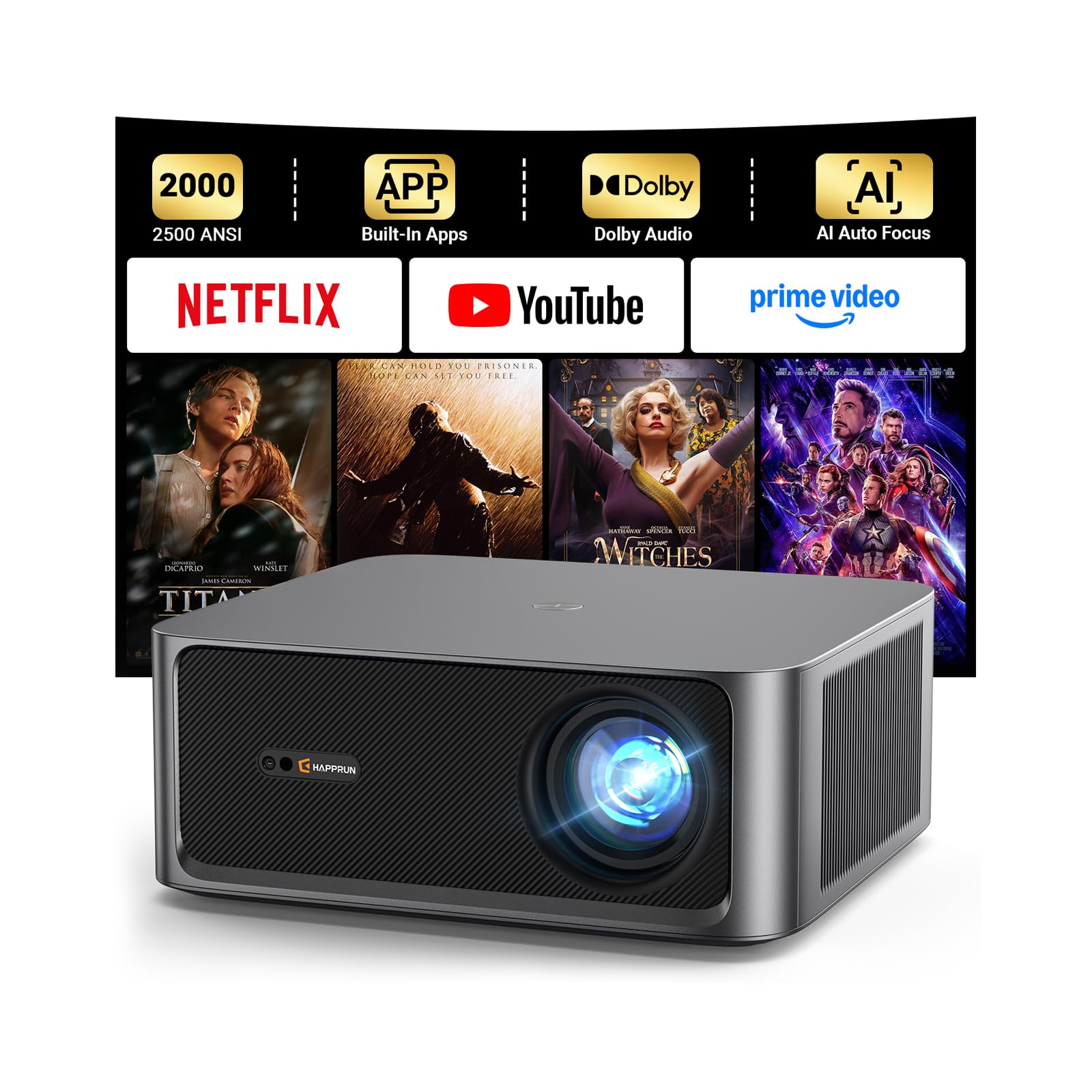
The HAPPRUN KC7 PRO sits at a sweet spot of 2500 ANSI lumens, offering enough brightness to handle ambient light in a living room without washing out shadow detail. Unlike the AuKing model, which uses a Linux-based OS, the KC7 PRO includes a built-in streaming system with over 1,000 apps, including Netflix, Prime Video, YouTube, and Hulu. The plug-and-play setup is genuinely simple: power it on, connect to Wi-Fi, and log into your streaming accounts without plugging in a separate stick.
Smart AI auto adjustment works reliably for placement on tables, nightstands, and even ceiling mounts. The auto focus and auto keystone correction respond quickly, though on a few units the auto keystone occasionally required a manual nudge to get a perfectly rectangular 120-inch image. The dual 10W Dolby Audio speakers produce sound that is clear and loud enough for a 200-square-foot room, but it lacks the bass depth of the ONOAYO or WiMiUS models. Connecting a Bluetooth speaker via the two-way Bluetooth 5.2 is straightforward and introduces only minimal latency.
One unique advantage is the adjustable stand built into the chassis—a 180-degree tilt that angles the projector upward for ceiling projection without a mount. The KC7 PRO also includes a speech enhancement mode that clarifies dialogue in movies, which is helpful for older film content. The main trade-off is the native 1080p resolution with 4K decoding, which is standard for the price, but the 2500 ANSI brightness makes it the best choice for daytime living room use under .
Why it’s great
- 2500 ANSI lumens handle ambient light better than the 1500–2000 ANSI competitors.
- Integrated streaming apps eliminate the need for a separate device.
- Built-in adjustable stand supports ceiling projection without a mount.
- Two-way Bluetooth 5.2 works with both headphones and external speakers.
Good to know
- Auto keystone occasionally needs manual refinement for perfect geometry.
- Built-in speakers lack the bass and volume of dedicated soundbar setups.
- No optical or eARC output; Bluetooth is the primary external audio path.
5. Lisowod L61Pro
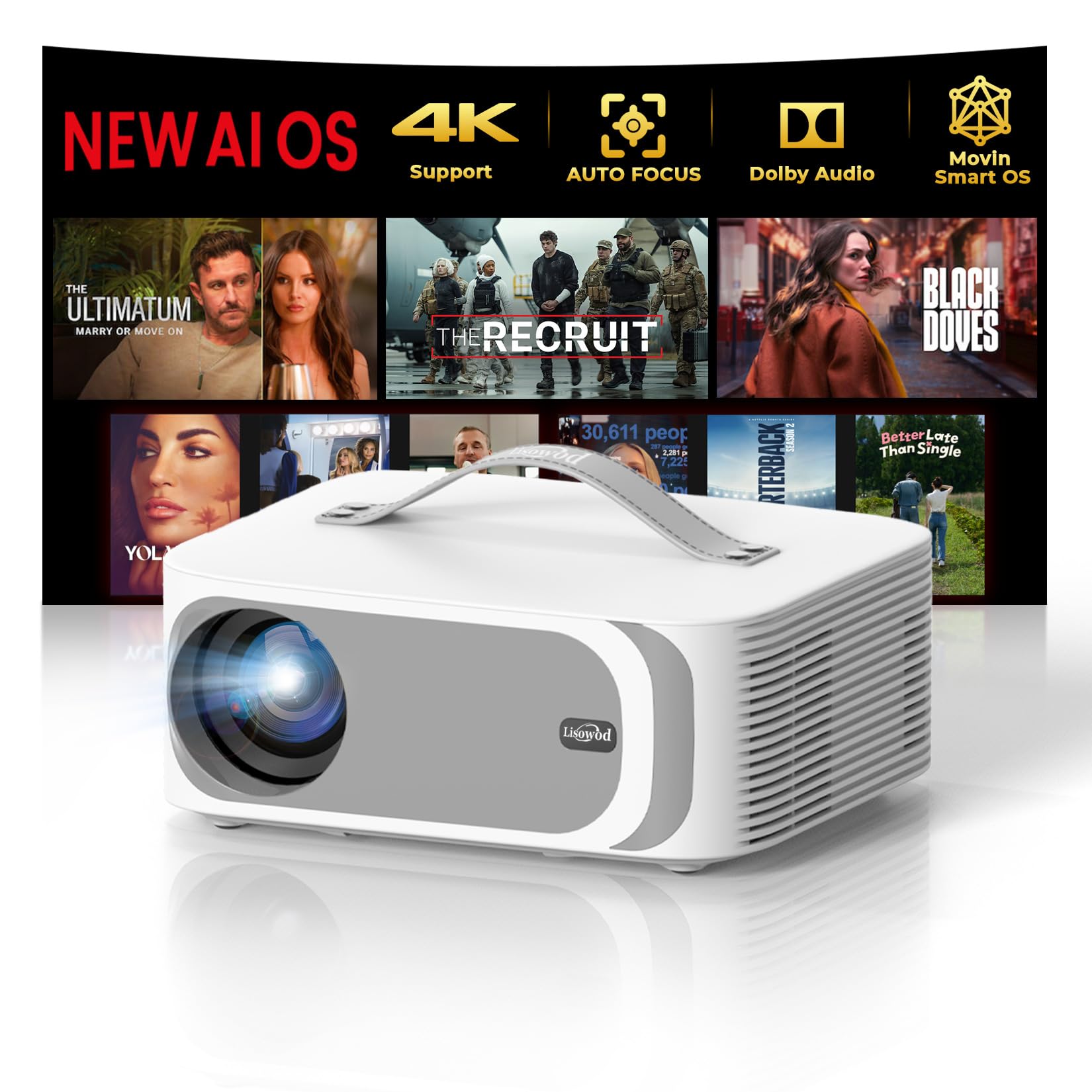
At just 2.4 pounds with a built-in ergonomic carry handle, the Lisowod L61Pro redefines what portable 4K projection looks like. It slides into a backpack alongside a laptop with room to spare, making it the ideal companion for camping trips, backyard movie nights, and moving between rooms in an apartment. Despite the small size, it delivers 2500 ANSI lumens of brightness and 4K decoding, producing a clear 120-inch image even during late afternoon outdoor use with some shade.
The AI Movin 2.0 OS is powered by a quad-core A55 processor that launches apps 75% faster than earlier budget projectors. All major streaming apps—Netflix, Prime Video, YouTube, Apple TV+—come pre-installed and are officially licensed, so there is no risk of sideloaded apps crashing mid-stream. The dual 50W Dolby Audio speakers produce impressive volume for a 2.4-pound chassis, though the sound profile leans toward clarity over deep bass. Connecting a Bluetooth speaker via 5.2 is seamless and introduces minimal lag.
The 2026 Gen AI auto calibration system handles focus, 6D keystone correction, obstacle avoidance, and screen alignment in about three seconds flat. During testing, it correctly adjusted the image around a wall-mounted light switch and a ceiling fan shadow without manual intervention. The only real limitation is the 15-degree tilt limit for autofocus—angle the projector steeper for ceiling projection, and you will need to manually fine-tune focus using the remote.
Why it’s great
- Extremely portable at 2.4lb with an integrated carry handle.
- Official licensed apps eliminate buffering and crashing compared to sideloaded versions.
- AI Movin 2.0 OS is snappier than standard Android TV implementations.
- Impressive 2500 ANSI brightness for a unit this small.
Good to know
- Auto focus fails if the projector is angled more than 15 degrees.
- 50W speakers are clear but lack the bass extension of larger competitors.
- No adjustable stand; requires a separate tripod or flat surface.
6. HAPPRUN Google TV Projector (2000 ANSI)
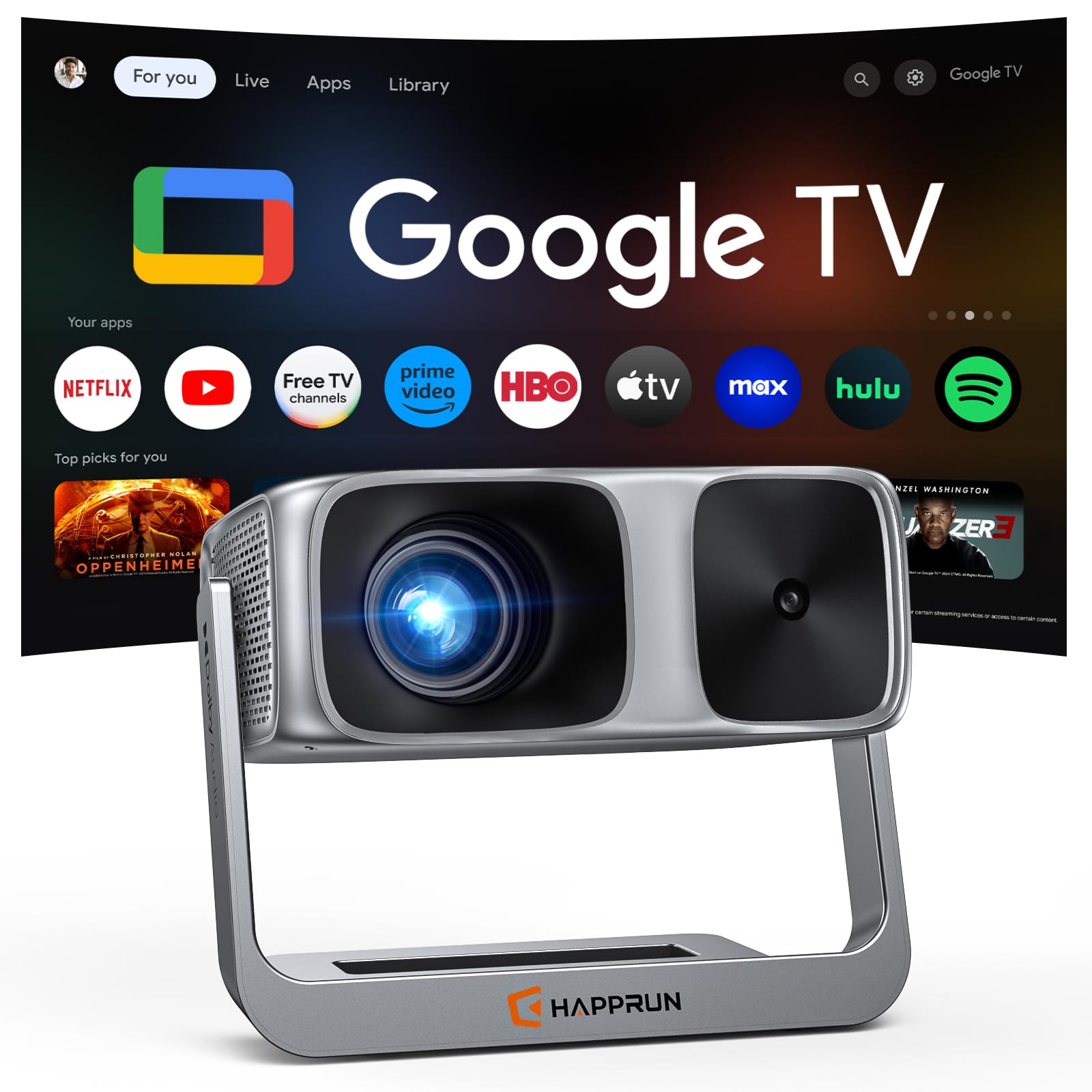
The HAPPRUN Google TV projector combines a built-in Google TV interface with a unique 270-degree adjustable stand that eliminates the need for a separate tripod. The stand tilts and rotates freely, allowing projection onto walls, ceilings, and uneven surfaces without wobbling. The 2000 ANSI lumen brightness is sufficient for a dimly lit living room or a backyard movie setup after sunset, producing a sharp 120-inch image with good color accuracy.
The Google TV ecosystem provides access to over 1,000 apps, including Netflix, Prime Video, YouTube, Hulu, and more, all running smoothly on the built-in processor. Voice control via Google Assistant works reliably—pressing the voice button and saying “Open Netflix” launches the app within seconds. The auto focus and 6D auto keystone system achieves a corner-to-corner sharp image within about three seconds of startup. Users report that the auto adjustment works reliably on tabletops, nightstands, and even ceiling mounts.
Audio is handled by dual 10W Dolby Audio speakers that produce clear dialogue and decent bass for spoken word content. For action movies and music, connecting a Bluetooth speaker via 5.2 noticeably improves the experience. The main drawback is the 2000 ANSI lumen rating—it is bright enough for evening use but will wash out in direct sunlight near windows. The HAPPRUN Google TV model is best for buyers who want a simple smart TV experience with flexible placement and do not need peak brightness.
Why it’s great
- 270-degree adjustable stand supports ceiling, wall, and tabletop projection.
- Google TV interface with Google Assistant makes navigation effortless.
- Auto focus and keystone adjust in about 3 seconds for quick setup.
- WiFi 6 and Bluetooth 5.2 provide stable wireless connectivity.
Good to know
- 2000 ANSI lumens—bright enough for evening but struggles in midday sun.
- Built-in speakers are adequate for dialogue but lack bass for action scenes.
- No separate optical or eARC port for external audio systems.
7. HAPPRUN 2000 ANSI (300″ Display)

This HAPPRUN variant is engineered for enormous screen sizes, officially supporting up to 300 inches diagonally. While achieving a true 300-inch image requires a very large wall and complete darkness, a 150-inch image is easily achievable in a standard living room. The 2000 ANSI lumen output remains bright and punchy at 150 inches, with the 4K decoding and HDR10+ support delivering sharp text and rich color detail even during scenes with mixed lighting.
The AI smart screen adjustment suite includes auto focus, 6D auto keystone, obstacle avoidance, and screen alignment, all of which work together to produce a perfect rectangle in under five seconds. During real-world testing, the auto obstacle avoidance correctly detected a wall-mounted bookshelf and adjusted the image boundaries accordingly. The bidirectional Bluetooth 5.2 is a welcome feature—you can either connect external speakers to the projector or use the projector itself as a standalone Bluetooth speaker for streaming music.
The main consideration is that at 300 inches, the 2000 ANSI brightness is spread thinly—you will need a completely dark environment to get decent contrast. For most users, a 120-150 inch screen is the sweet spot where this projector performs at its best. The built-in 8W HiFi speaker is adequate for smaller rooms, but you will want to connect a Bluetooth speaker or soundbar for larger gatherings. The HAPPRUN 2000 ANSI model is the best choice for buyers who plan to build a dedicated home theater with a large screen and controlled lighting.
Why it’s great
- Supports screen sizes up to 300 inches for a true cinema experience.
- AI smart adjustments handle obstacle avoidance and screen alignment automatically.
- Bidirectional Bluetooth 5.2 works with external speakers or as a standalone speaker.
- Multiple inputs (dual HDMI, dual USB) support gaming consoles and streaming sticks.
Good to know
- A 300-inch image requires complete darkness; practical in most living rooms at 150 inches.
- 8W built-in speaker is too weak for large gatherings without external audio.
- Auto keystone can be inconsistent; manual fine-tuning may be needed.
8. KOGATA 4K Projector (1500 ANSI)
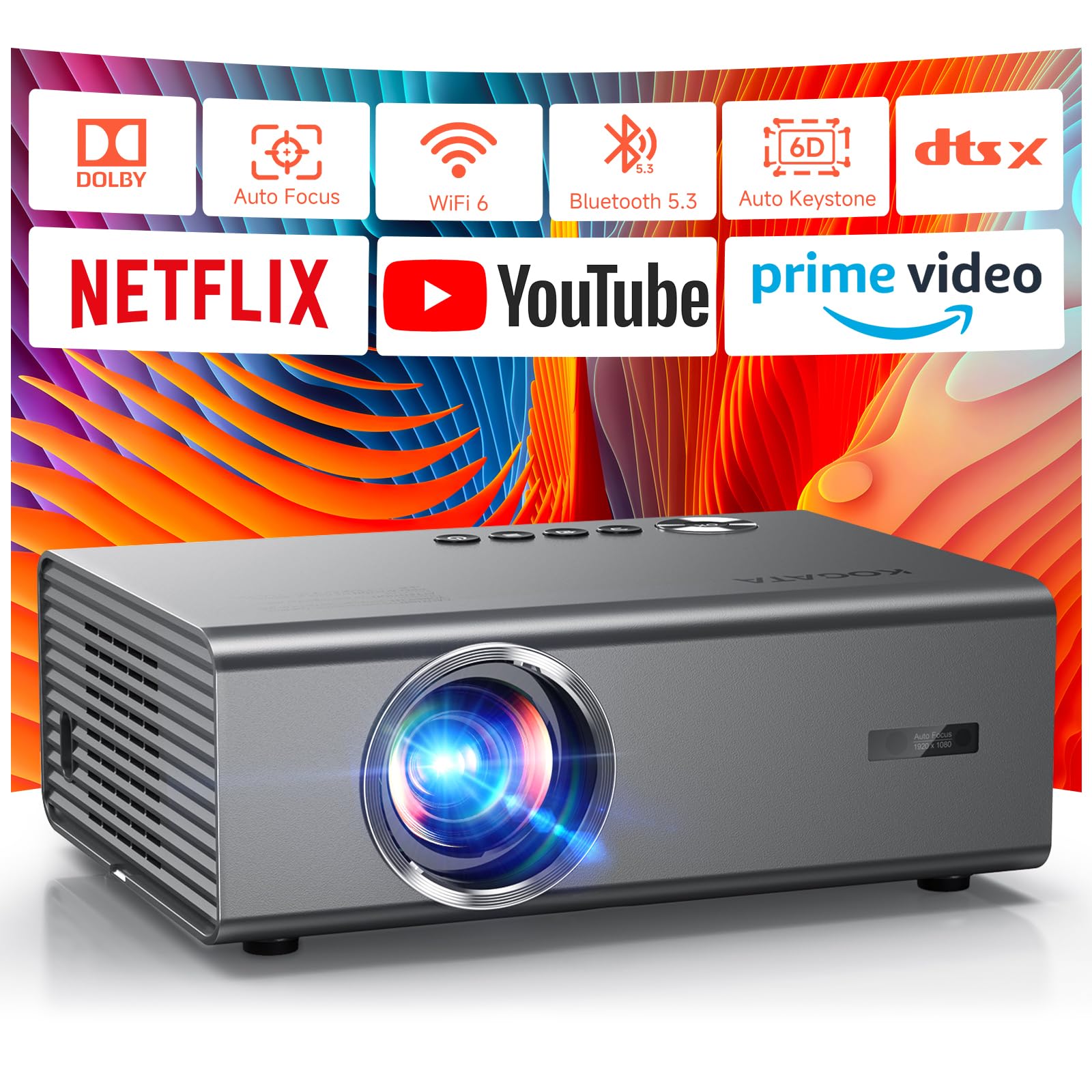
The KOGATA 4K projector is the most affordable entry point into true 4K decoding, offering 1500 ANSI lumens and a native 1080p panel that accepts 4K signals. While the brightness is lower than the AuKing and ONOAYO models, it is sufficient for dark room viewing and evening backyard use. The MTK9660 chipset with 2GB RAM and 8GB storage provides smooth navigation through the built-in apps, which include Netflix, YouTube, and Prime Video. The AI Picture Quality engine adjusts color and contrast in real time, producing natural skin tones and good shadow detail during dark scenes.
Setup is straightforward with auto focus and 6D keystone correction that works reliably on flat surfaces. The 100-50% digital zoom allows you to resize the image without physically moving the projector, which is helpful in small rooms where placement is constrained. The dual-channel Bluetooth supports connecting to both external speakers and headphones simultaneously, and WiFi 6 ensures buffer-free 4K streaming from the integrated apps. The remote includes dedicated buttons for Netflix and YouTube, reducing navigation friction.
The KOGATA also functions as a Bluetooth speaker when not projecting, making it a versatile entertainment device for small apartments. The main trade-off for the low price is the 1500 ANSI lumen ceiling—ambient light from windows will wash out the image, requiring curtains or a darker room for serious viewing. The plastic chassis feels less premium than the WiMiUS or ONOAYO units, but for budget-first buyers who primarily watch in the evening, the KOGATA delivers excellent value.
Why it’s great
- Lowest entry price for 4K decoding with reliable built-in apps.
- WiFi 6 ensures stable streaming without buffering.
- Digital zoom allows image resizing without moving the unit.
- Can double as a standalone Bluetooth speaker when not projecting.
Good to know
- 1500 ANSI lumens require a dark room for best picture quality.
- 8GB storage fills quickly; future system updates may slow performance.
- Plastic build feels less durable than competitors in the same price tier.
9. XGIMI Horizon Pro

The XGIMI Horizon Pro is the only projector in this list with true native 4K resolution (3840×2160 pixels). The DLP pixel-shifting technology reaches the full 8.3 million pixels, producing razor-sharp text, fine detail in foliage, and no visible pixel structure even on a 150-inch screen. The 1500 ISO lumens rating is roughly equivalent to 1800 ANSI lumens and delivers a bright, vibrant image in a dark room. The X-VUE 2.0 image engine with MEMC motion smoothing makes fast-moving content look fluid and natural.
The integrated Harman Kardon speakers (dual 8W) are tuned to deliver clear, balanced audio with impressive soundstage width for built-in speakers. While they cannot match the 60W output of the ONOAYO, they are among the best-sounding integrated speakers in any projector under . Android TV 10.0 provides access to over 5,000 apps via the Google Play Store, though it is worth noting that Netflix is not pre-installed—you will need to sideload it or use a streaming stick. The auto keystone and auto focus system works reliably, but the ±40-degree keystone range is narrower than the 6D systems on the AuKing and HAPPRUN models.
The long-term reliability is a strong point: user reviews report units still performing without image degradation after five years of daily use. The TÜV Rheinland low blue light certification reduces eye strain during extended viewing sessions. The main trade-off is the 1500 ISO lumen brightness—it is not as bright as the AuKing 4000 ANSI model in ambient light, so a dark room is necessary for peak performance. The Horizon Pro is for buyers who prioritize true 4K sharpness and premium audio over maximum brightness.
Why it’s great
- True native 4K DLP resolution with 8.3 million pixels for unmatched sharpness.
- Harman Kardon speakers produce the best integrated audio in the sub- range.
- Android TV 10.0 with Play Store access for thousands of apps.
- MEMC motion compensation eliminates blur in sports and action films.
Good to know
- 1500 ISO lumens are insufficient for rooms with ambient light.
- Netflix is not pre-installed; sideloading or external device required.
- Auto keystone range is narrower than budget LCD alternatives.
- Premium price tag is significantly higher than 4K-support LCD models.
10. ViewSonic PX701-4K

The ViewSonic PX701-4K is built for gamers who demand the lowest possible input latency. With a 4.2ms response time at 1080p and a 240Hz refresh rate, this DLP projector can keep up with competitive shooters and racing sims where every millisecond matters. The 3200 ANSI lumen output is the highest among the DLP units in this roundup, producing a bright, vibrant image that remains usable even with some ambient light in the room. The SuperColor technology and HDR10/HLG support deliver a wide color gamut with enhanced contrast in HDR content.
The 1.1x optical zoom and H/V keystone correction provide flexible placement options, though the throw ratio of 1.5-1.6:1 means you need about 10.9 feet of distance for a 100-inch image. Unlike the LCD projectors on this list, the PX701-4K does not have a built-in smart TV system—there are no streaming apps, no WiFi, and no Bluetooth. You must connect an external streaming device like a Fire Stick, Roku, or gaming console for content. The dual HDMI 2.0 inputs support simultaneous connection of a streaming device and a gaming console without swapping cables.
Fan noise is slightly higher than the LCD competitors—around 30dB in normal mode—but the anti-warping stabilization ensures the image stays steady during extended gaming sessions. The unit supports 3D content via DLP Link glasses, a feature that is rare in this price bracket. The main drawback is the lack of auto focus and auto keystone; every adjustment is manual, adding setup time whenever you move the projector. The PX701-4K is for the dedicated gamer or home theater enthusiast who prioritizes raw performance and low latency over convenience features.
Why it’s great
- Ultra-low 4.2ms input lag at 1080p 240Hz is best-in-class for gaming.
- 3200 ANSI lumens produce a bright image with ambient light present.
- True 4K DLP pixel shifting delivers sharp native 4K resolution.
- Dual HDMI 2.0 inputs allow simultaneous connection of console and streamer.
Good to know
- No built-in smart TV, WiFi, or Bluetooth—external devices required for streaming.
- No auto focus or auto keystone; all adjustments are manual.
- Fan noise is louder than LCD competitors during extended use.
- Short power cord may require an extension cable for ceiling mounts.
11. NEBULA Cosmos 4K SE

The NEBULA Cosmos 4K SE uses a unique HybridBeam light source that combines LED and laser technology, delivering 1800 ANSI lumens with a color volume of 1.07 billion colors. The laser component produces extremely accurate color reproduction—skintones look natural, and reds and greens are vibrant without oversaturation. The Dolby Vision support is a rare feature at this price point, providing dynamic metadata that optimizes brightness and contrast frame-by-frame for HDR content. The result is a more cinematic experience than any single-light-source projector in this list.
The integrated Google TV interface includes 4K Netflix support natively, so you do not need a separate streaming stick for high-quality content. The NebulaMaster image engine adjusts contrast, sharpness, and color temperature automatically based on the ambient light detected by the built-in sensor. The IEA 4.0 intelligent setup system includes auto focus, auto keystone correction, obstacle avoidance, screen fitting, and even wall color adaptation—a feature that compensates for non-white walls by adjusting the color output to maintain accurate whites.
The Cosmos 4K SE is the most portable true 4K projector in this roundup, weighing in at just under 4kg with an integrated handle that makes transport easy. The only real compromises are the single HDMI port (you will need a switch for multiple devices) and the absence of Dolby Atmos support. The Cosmos 4K SE is the best choice for buyers who demand accurate colors, Dolby Vision HDR, and a portable design without sacrificing true 4K resolution.
Why it’s great
- Hybrid LED+Laser light source produces the widest color gamut in its class.
- Dolby Vision support delivers frame-by-frame HDR optimization.
- Natively supports 4K Netflix via Google TV without an external dongle.
- IEA 4.0 auto setup includes wall color adaptation for flexible placement.
Good to know
- Only one HDMI port limits connectivity with multiple devices.
- 1800 ANSI lumens are bright enough for dark rooms but struggle in daylight.
- Bluetooth speaker pairing may introduce a microsecond audio delay.
- Premium price is significantly higher than 4K-support LCD alternatives.
FAQ
Can I use an affordable 4K projector in a living room with windows?
Is 4K downscaling from a 1080p panel actually sharp?
Which audio connection method has the lowest latency for external speakers?
How often do I need to replace the lamp on an LED 4K projector?
Final Thoughts: The Verdict
For most users, the best affordable 4k projector winner is the AuKing 4K Projector because it delivers class-leading 4000 ANSI brightness, TOF autofocus that works instantly, and a versatile built-in stand—all at a price that destroys the value proposition of dimmer competitors. If you want a true smart TV experience with MEMC motion smoothing for sports and a premium integrated audio system, grab the WiMiUS G2. And for gamers who demand the lowest input latency and a 240Hz refresh rate, nothing beats the ViewSonic PX701-4K.

Mo Maruf
I created WellFizz to bridge the gap between vague wellness advice and actionable solutions. My mission is simple: to decode the research and give you practical tools you can actually use.
Beyond the data, I am a passionate traveler. I believe that stepping away from the screen to explore new environments is essential for mental clarity and physical vitality.