Our readers keep the lights on and my smoothie glass nicely filled. As an Amazon Associate, I earn from qualifying purchases.
Leaving your DSLR at home because it’s too heavy—and regretting it when the light hits—is the exact pain an advanced point-and-shoot camera is engineered to solve. These are not your typical pocket snappers; they pack 1-inch or even APS-C sensors, 4K video, raw capture, and optical zooms that can stretch from a sweeping 20mm landscape to a 3000mm bird on a distant branch. The challenge today is parsing the real feature differences between a model and a model when the marketing copy all sounds the same.
I’m Mohammad Maruf — the founder and writer behind WellFizz. I’ve spent hundreds of hours analyzing sensor performance, lens resolution charts, autofocus systems, and real-world user footage across the spectrum of advanced digital compacts to separate the true performers from the spec-sheet bloat.
Whether you need underwater durability, vlogging-friendly wide angles, or a superzoom that bends light across the entire observable horizon, finding the right advanced point and shoot camera comes down to matching your specific shooting scenario with a body that excels at that one job rather than trying to do everything mediocre.
How To Choose The Best Advanced Point And Shoot Camera
Selecting the right advanced compact requires looking past megapixel counts and flashy marketing terms. The key distinctions live in the sensor size, the optical zoom mechanism, and the stabilization system—each directly impacting the kinds of photos you can reliably capture without a tripod or a bag of extra gear.
Sensor Size: The Low-Light and Depth-of-Field Floor
The most important structural difference between entry-level and premium advanced compacts is the sensor. A 1-inch type sensor (used in the Sony RX100 II, Canon PowerShot V1, and Panasonic ZS99) offers roughly four times the light-gathering area of a 1/2.3-inch sensor found in superzoom cameras like the Nikon P950 and P1100. Larger sensors deliver cleaner images at higher ISOs and enable genuine background defocus. The Ricoh GR IIIx goes further with an APS-C sensor—matching many DSLRs in dynamic range. If you shoot indoors, at dusk, or want soft backgrounds, prioritize a 1-inch or larger sensor.
Optical Zoom Range: Matching Reach to Subject
Advanced point-and-shoots split into two distinct camps: moderate zoom (3x-30x) with larger sensors for image quality, and extreme zoom (60x-125x) with smaller sensors for reach. The Panasonic FZ80D’s 60x zoom (20-1200mm) and Nikon P1100’s 125x zoom (24-3000mm) let you photograph distant wildlife or the moon’s craters, but they require bright light and steady hands. The Canon PowerShot V1’s 16-50mm zoom prioritizes wide-angle vlogging and street shooting with a fast aperture. Decide whether you need to reach faraway subjects or capture quality in normal-to-wide scenarios—one camera cannot do both well.
Image Stabilization: Sharp Handheld Shots at Any Focal Length
Optical image stabilization (OIS) or in-body image stabilization (IBIS) is non-negotiable for this category. The OM System Olympus E-M10 Mark IV provides 4.5 stops of in-body stabilization, allowing sharp handheld shots at shutter speeds that would blur on unstabilized cameras. The Panasonic Lumix FZ80D uses Power OIS specifically tuned to suppress shake at the 1200mm telephoto end. The Nikon P1100’s Dual Detect Optical VR compensates for 4.0 stops of shake. Electronic stabilization alone—common in cameras like the Sony ZV-1F—introduces crop and wobble during walking video and is far less effective for stills. Look for optical or in-body stabilization; avoid relying solely on digital correction.
Quick Comparison
On smaller screens, swipe sideways to see the full table.
| Model | Category | Best For | Key Spec | Amazon |
|---|---|---|---|---|
| Nikon P1100 | Superzoom | Ultra-telephoto wildlife & moon shots | 125x optical zoom, 24-3000mm | Amazon |
| Ricoh GR IIIx | Compact APS-C | Everyday street & pocketable quality | APS-C 24MP sensor, 40mm f/2.8 | Amazon |
| Canon PowerShot V1 | Hybrid Vlogging | 4K vlogging & live streaming | 1.4-type sensor, 16-50mm f/2.8-4.5 | Amazon |
| OM System TG-7 | Rugged Compact | Waterproof macro & adventure | Waterproof 15m, 4x zoom, f/2.0 | Amazon |
| Sony RX100 II | Premium Compact | Low-light pocket stills & video | 1-inch 20.2MP sensor, f/1.8 lens | Amazon |
| OM System E-M10 Mark IV | Mirrorless Compact | Interchangeable-lens beginner | 20MP sensor, 5-axis IBIS 4.5 stops | Amazon |
| Nikon P950 | Superzoom | Birding & distant scenery | 83x optical zoom, 24-2000mm | Amazon |
| Sony ZV-1F | Vlogging Compact | Solo content creation & selfies | 1-inch sensor, 20mm ultra-wide f/2 | Amazon |
| Panasonic ZS99 | Travel Zoom | Pocket travel with 30x Leica zoom | 24-720mm Leica lens, 30x zoom | Amazon |
| Panasonic FZ80D | Bridge Zoom | Budget superzoom for hiking/travel | 60x optical zoom, 20-1200mm | Amazon |
| Canon ELPH 360 HS | Pocket Compact | Entry-level travel and family snaps | 20.2MP sensor, 12x zoom, 25-300mm | Amazon |
In‑Depth Reviews
1. Nikon COOLPIX P1100

The Nikon P1100 delivers the most extreme optical zoom available in a single lens system—125x magnification covering a 24-3000mm equivalent range. This translates to pulling in distant birds, wildlife, or lunar craters with clarity that was previously possible only with pro-grade super-telephoto glass costing many times more. The Dual Detect Optical VR image stabilization compensates for up to four stops of shake, which is essential for handholding at the 3000mm telephoto end without a tripod. RAW capture and 4K UHD video round out the feature set, making it a serious tool for nature enthusiasts who refuse to carry interchangeable lenses.
In real-world use, the dedicated Bird-watching mode on the mode dial optimizes settings for feather detail, but experienced photographers note that the continuous autofocus struggles with fast-moving birds in flight—tracking is not as reliable as on DSLR-level hardware. The body feels largely plastic, and advanced controls like aperture and shutter access require diving into menus rather than instinctive dial work. The SnapBridge app for image transfer is significantly more restricted than on Nikon’s mirrorless lineup, occasionally frustrating users who expect seamless smartphone integration.
The P1100 is best suited for someone who wants one camera that can shoot a close-up of a butterfly at 1 cm macro distance and then pivot to photographing a jet at 3000mm without changing lenses. It is not designed for low-light interior shooting or fast-action sports—the small 1/2.3-inch sensor shows grain above ISO 800. For the dedicated birder, hiker, or astronomy enthusiast who values extreme focal range over pocketability, this is the defining superzoom of the current generation.
Why it’s great
- Unrivaled 125x optical zoom (24-3000mm) for wildlife and astrophotography
- Dual Detect Optical VR enables sharp handheld shots at extreme telephoto lengths
- Dedicated Bird-watching mode and close-up macro mode for versatile field use
Good to know
- Autofocus tracking struggles with birds in flight and fast-moving subjects
- Small 1/2.3-inch sensor limits low-light performance above ISO 800
- SnapBridge app functionality is noticeably limited compared to other Nikon cameras
2. Ricoh GR IIIx

The Ricoh GR IIIx is the ultimate pocketable camera for photographers who prioritize image quality above all else. Its 24.2-megapixel APS-C sensor is the same size found in many professional DSLRs, and the dedicated 40mm f/2.8 GR lens is engineered to be exceptionally sharp edge-to-edge. The camera boots in roughly 0.8 seconds and features in-body image stabilization, allowing you to pull sharp handheld shots in dim light that would blur on unstabilized compacts. It is the kind of camera that street photographers, travelers, and documentary shooters slip into a jacket pocket and carry everywhere without thinking twice.
The biggest practical tradeoff is the fixed focal length—there is no zoom at all. You must physically move to frame your shot, which demands an active shooting style. The battery life is genuinely short; most users carry two or three spares for a full day out. Autofocus is reliable when it locks, but it operates via contrast detection and can hunt slightly slower than hybrid systems in competitors. The camera also lacks a built-in flash and has no weather sealing, making it vulnerable to dust ingress without a filter adapter.
For anyone who values absolute image quality and a true photographic tool over spec-sheet breadth, the GR IIIx delivers results on par with much larger interchangeable-lens cameras in a package that truly fits in a pants pocket. It is not a vlogging camera, not a zoom camera, and not a beginner’s all-rounder—it is a specialist instrument for the purist who wants to capture life with the depth and clarity of a full-sized sensor, always at hand.
Why it’s great
- APS-C sensor delivers DSLR-level dynamic range and low-light performance
- Extremely sharp 40mm f/2.8 prime lens renders beautiful depth of field
- Truly pocketable size with in-body image stabilization for handheld sharpness
Good to know
- Fixed 40mm lens means no zoom whatsoever requires active framing
- Battery life is very short—plan on carrying multiple spares daily
- No weather sealing and no built-in flash; dust ingress is a known concern
3. Canon PowerShot V1

The Canon PowerShot V1 is a purpose-built hybrid camera for content creators who need high-quality 4K video and stills from a single compact body. It uses a new 1.4-type sensor that delivers 22.3 megapixels for photos and 18.7 megapixels for video, paired with a built-in 16-50mm f/2.8-4.5 wide-angle zoom lens (35mm equivalent). The standout feature is an internal cooling fan that enables extended 4K recording without overheating, a critical limitation on many pocket cameras. Canon Log 3 with 10-bit color depth provides wide dynamic range for color grading, making the V1 viable as a B-cam for professional video workflows.
The autofocus system is hybrid (phase-detect + contrast-detect) with 100 AF points and eye-tracking that reviewers consistently call “amazing” for both video and stills. However, the camera lacks optical image stabilization—only electronic IS is available, which introduces a noticeable crop and walking wobble that limits run-and-gun vlogging. The SD card slot is inconveniently located under the battery door, making hot-swapping difficult when using a tripod quick-release plate. There is no included battery charger and no built-in flash.
For a vlogger, home studio creator, or live streamer who wants a single camera that does not overheat during long takes and delivers clean, color-rich 4K with shallow depth of field, the V1 is arguably the best current option at this price tier. It is less suited as a pure stills travel camera due to the moderate zoom range and lack of OIS, but as a video-first advanced compact, it sets a new bar for the category.
Why it’s great
- Built-in cooling fan allows unlimited 4K recording without overheating
- Canon Log 3 with 10-bit color for professional-grade color grading
- Excellent hybrid autofocus with reliable eye-tracking for video and stills
Good to know
- No optical image stabilization—electronic IS only with visible crop and walking shake
- SD card slot under battery door is inconvenient with tripod plates
- No built-in battery charger, no flash, and bulkier than pocket-class competitors
4. OM System Olympus Tough TG-7

The Olympus Tough TG-7 is the definitive rugged compact for outdoor adventurers who shoot in environments that would destroy any other camera. It is waterproof to 15 meters (50 feet), shockproof from 2.1 meters (7 feet), crushproof to 100 kgf, and freezeproof to -10°C. The high-resolution f/2.0 lens and back-illuminated CMOS sensor are optimized for macro work, with four dedicated macro modes that allow focusing as close as 1 centimeter from the end of the lens. This makes the TG-7 the best choice for divers, snorkelers, and nature hikers who want sharp close-ups of tide pool creatures, fungi, or ice crystals.
The camera includes five underwater shooting modes—including underwater microscope and underwater HDR—that adjust white balance and exposure for sub-surface conditions. 4K video at 30 fps and 120 fps high-speed recording add flexibility for capturing action in challenging environments. The small 12-megapixel 1/2.3-inch sensor is the TG-7’s main limitation: image quality in bright scenes is good to excellent, but low-light results are hit or miss, and the sensor’s resolution ceiling is lower than 1-inch competitors. The battery life is adequate but drains without warning, so third-party spares are recommended for full-day trips.
If you kayak, snowboard, dive, or backpack into wet and dusty terrain and need a camera that survives bumps and splashes while delivering raw capture and full manual controls, the TG-7 has no true rival. It is not a competitor to 1-inch compacts for pure image quality—it is a specialized tool for people whose primary requirement is that the camera works after being dropped in a river.
Why it’s great
- Certified waterproof to 15m, shockproof to 2.1m, and freezeproof to -10°C
- Exceptional macro capability with four dedicated modes and 1cm subject distance
- Full manual controls and raw capture in a rugged, go-anywhere body
Good to know
- 12MP 1/2.3-inch sensor limits image quality in low-light conditions
- Battery can die without warning—carry spares for day-long adventures
- Small body size makes accessing controls difficult when wearing thick gloves or underwater
5. Sony RX100 II

The Sony RX100 II remains a benchmark in the premium compact category years after its release because the core formula is still sound: a 1-inch 20.2-megapixel Exmor R CMOS sensor combined with a bright f/1.8 Carl Zeiss Vario-Sonnar T* lens delivers image quality that rivals early APS-C mirrorless cameras. The 3.6x optical zoom covers a 28-100mm equivalent range, and the tiltable 3-inch LCD with 1,229,000 dots provides compositional flexibility. The Multi-Interface Shoe (hot shoe) allows attaching an external flash, microphone, or viewfinder—expandability rare in this size class.
In practice, the RX100 II’s low-light performance up to ISO 3200 is excellent for a pocket camera, and the continuous shooting speed of 10 fps captures fleeting moments effectively. The 1080/60p video with full exposure control and a dedicated movie button records clean footage without hunting. However, the autofocus system is contrast-detection only with 25 points—modern hybrid systems are faster and more reliable. The lens extends slowly when powered on, and there is no built-in Wi-Fi to remote control via phone without the NFC connection working consistently. The camera also lacks a built-in electronic viewfinder.
For the photographer who wants the proven 1-inch image quality formula, the flexibility of a hot shoe for accessories, and a tilt screen for waist-level shooting, the RX100 II is a smart pick at its price tier. It is showing its age against newer sensors with faster AF and 4K video, but as a dedicated stills compact with a legendary lens, it still holds its own in good light.
Why it’s great
- Bright f/1.8 Carl Zeiss lens captures excellent low-light images up to ISO 3200
- 1-inch 20.2MP Exmor R sensor delivers DSLR-like dynamic range and detail
- Hot shoe allows external flash and microphone attachments for creative flexibility
Good to know
- Contrast-detect AF with only 25 points is slower than modern hybrid systems
- No built-in electronic viewfinder and lens extends slowly on startup
- Lacks 4K video recording—1080p only, and Wi-Fi connectivity can be inconsistent
6. OM System Olympus E-M10 Mark IV

The OM System Olympus E-M10 Mark IV is a Micro Four Thirds mirrorless camera that offers interchangeable lenses while maintaining a remarkably compact body. The 20-megapixel Live MOS sensor paired with in-body 5-axis image stabilization rated at 4.5 shutter speed stops means you can shoot sharp handheld at exposures that would blur on any unstabilized camera. The flip-down touchscreen enables a dedicated selfie mode—when the monitor flips down, the camera automatically switches to selfie mode, making it one of the most beginner-friendly interchangeable-lens cameras for vlogging and group shots.
The kit lens (M.Zuiko 14-42mm f/3.5-5.6 EZ) is a pancake zoom that collapses to fit in a jacket pocket, making the total package surprisingly portable. The 121-point contrast-detect AF locks quickly in decent light, and the 16 Art Filters including “Instant Film” add creative fun without post-processing. The battery charges via the camera body only and uses an older micro-USB port rather than USB-C, which is an inconvenience. The OI Share app for transferring images and remote control is functional but slower than modern smartphone connections.
For anyone who wants the versatility of changing lenses but finds traditional mirrorless bodies too large, the E-M10 Mark IV hits the sweet spot. The in-body stabilization is genuinely class-leading, and the selfie-friendly flip screen makes it a rare hybrid that works for both serious photography and casual content creation. It is not a pocket camera with a lens mounted, but with the pancake kit lens, it fits in a jacket pocket more easily than any APS-C DSLR alternative.
Why it’s great
- In-body 5-axis stabilization rated at 4.5 stops enables handheld long exposures
- Flip-down touchscreen with dedicated selfie mode perfect for casual vlogging
- Compact Micro Four Thirds body offers lens interchangeability without bulk
Good to know
- Micro-USB charging is dated—no USB-C port or external charger included
- OI Share mobile app is slower and less reliable than modern competitors
- Kit lens is decent but upgrading to PRO glass improves sharpness at the cost of portability
7. Nikon COOLPIX P950

The Nikon COOLPIX P950 is the direct predecessor to the P1100 and remains a powerful superzoom option with an 83x optical zoom covering a 24-2000mm equivalent range. The lens includes a manual focus ring on the barrel—a significant improvement over the P900—giving photographers tactile control for fine-tuning focus at extreme telephoto distances. Built-in Bird and Moon modes optimize settings specifically for those subjects, and the camera captures both stills and 4K UHD video. The rotating LCD screen allows flexible framing for low-angle wildlife shots.
In the field, the P950’s 16-megapixel 1/2.3-inch sensor delivers vibrant images in bright conditions but quickly reveals grain and softness above ISO 800. The autofocus system, while sufficient for static subjects, frequently fails to lock on small birds against busy backgrounds even with the dedicated Bird mode active. The camera is lighter than its telephoto reach suggests (roughly 2 lbs), but the smartphone app connectivity is unreliable, and the NRW (raw) files require specialized software to process. The small aperture at the telephoto end (f/6.5 at 2000mm) limits depth of field control and forces higher ISOs.
For the birder or wildlife enthusiast on a budget who wants 83x reach without spending thousands on interchangeable super-telephoto glass, the P950 remains the best value in its niche. It is not a camera for indoor events or fast action—its strengths are purely in bright outdoor conditions where you need to bring distant subjects into clear view. The P1100 offers 125x zoom and improved stabilization for a higher price, but the P950’s 83x is still enough for most non-professional wildlife needs.
Why it’s great
- 83x optical zoom (24-2000mm) captures distant wildlife without heavy telephoto lenses
- Manual focus ring on the lens barrel adds precision control at extreme zooms
- Dedicated Bird and Moon scene modes optimize settings for specific subjects
Good to know
- Autofocus struggles with small birds against cluttered backgrounds at telephoto distances
- Image quality degrades noticeably above ISO 800 due to small sensor size
- Smartphone app connectivity is unreliable and raw file support is limited
8. Sony ZV-1F

The Sony ZV-1F is a dedicated vlogging compact built around a 1-inch 20-megapixel sensor and a fixed 20mm ultra-wide f/2 lens. The 20mm equivalent focal length is specifically chosen to keep the shooter fully in frame at arm’s length for selfie-style video, making it one of the best choices for solo content creators and travel vloggers. The side-articulating touchscreen LCD flips out for easy composition during self-recording, and the directional 3-capsule microphone with a supplied windscreen captures clear voice audio directly from the camera. Product Showcase mode automatically shifts focus from the presenter’s face to an object held up to the lens.
Autofocus performance with Eye-AF and real-time tracking is reliable and fast, making it easy to stay sharp even when moving around the frame. The lack of optical zoom is the most significant limitation—the 20mm lens is wide-only, meaning you cannot optically magnify distant subjects. Electronic stabilization introduces a visible crop and footstep wobble that makes walking shots look soft. Battery life is roughly 45 minutes of continuous video, so spare batteries are mandatory for a day of shooting. The body is lightweight but feels fragile; users report that a light drop can damage the autofocus system.
For a beginner or solo creator who wants a simple, dedicated camera with excellent image quality, good autofocus, and clean audio for talking-head content, the ZV-1F is purpose-built and effective. It is not a generalist’s camera—no zoom, short battery life, and fragile build mean it is best as a vlogging-only tool rather than an everyday photography companion.
Why it’s great
- 20mm ultra-wide f/2 lens keeps you fully in frame during arm’s-length selfie video
- Excellent Eye-AF and real-time tracking autofocus for moving subjects
- Built-in directional 3-capsule mic and windscreen deliver clear on-camera audio
Good to know
- No optical zoom—fixed wide-angle lens limits versatility for distant subjects
- Battery life is only about 45 minutes of video; multiple spare batteries are needed
- Body feels fragile; a drop can reportedly damage the autofocus system
9. Panasonic LUMIX ZS99

The Panasonic LUMIX ZS99 (also sold as TZ99 in some regions) packs a 30x optical zoom Leica DC Vario-Elmar lens covering a 24-720mm equivalent range into a genuinely pocket-sized body. The 1,840k-dot tiltable touchscreen makes it easy to frame shots from awkward angles, and the 5-axis Hybrid OIS stabilization keeps handheld telephoto shots steady. USB-C charging via universal power banks ensures you never run out of juice on a long travel day, and built-in Bluetooth v5.0 with a dedicated Send Image button simplifies smartphone transfers.
The 20-megapixel 1/2.3-inch sensor delivers decent image quality up to ISO 1600, and the Leica lens renders pleasing color accuracy. The stepped zoom mechanism and lens position resume function are thoughtful touches for travelers who frequently return to a specific focal length. However, the sensor is the same small format as the superzoom cameras, so low-light performance is limited and corner color aberration is visible at wide apertures. The autofocus uses contrast detection with a single point, which is slow and prone to hunting in dim conditions. The included battery charges in-camera via USB-C, which is convenient, but spare batteries are small and affordable.
For the traveler who wants more reach than a phone camera and better ergonomics than a basic compact, the ZS99 hits a sweet spot of zoom range, pocketability, and modern connectivity. It is not a low-light performer or a fast-action camera, but for bright daylight travel photos, family trips, and concert snapshots, the 30x Leica zoom is genuinely impressive in such a small package.
Why it’s great
- 30x Leica zoom (24-720mm) fits in a pocket—ideal for travel and concerts
- USB-C charging and Bluetooth v5.0 with one-touch image transfer
- Tiltable 1,840k-dot touchscreen for flexible framing from waist or overhead
Good to know
- Small 1/2.3-inch sensor limits low-light quality above ISO 1600
- Contrast-detect single-point autofocus is slow in dim conditions
- Corner color aberration visible at wide apertures on the lens
10. Panasonic LUMIX FZ80D

The Panasonic LUMIX FZ80D is a bridge camera that offers 60x optical zoom (20-1200mm equivalent) with Power OIS image stabilization designed specifically to suppress shake at the telephoto extreme. The 2,360K-dot large LVF electronic viewfinder (0.74x magnification equivalent) ensures clear framing even in bright sunlight where rear LCDs wash out. The 18.1-megapixel 1/2.3-inch sensor captures 4K video and supports the 4K Photo feature, which lets you extract 8-megapixel stills from 4K footage at 30 fps—useful for capturing precise moments in action scenes.
In the field, the FZ80D’s stabilization is genuinely effective for handheld shots at 1200mm, and the fast autofocus (for a contrast-detect system) locks quickly on stationary subjects. The camera includes versatile aperture control ranging from f/2.8 at wide to f/8.0 minimum. However, image quality is noticeably grainy even at low ISO settings, and low-light performance is poor—users report that results are best in bright sunlight or for social media sharing where noise is less visible. The interface is not intuitive, and there is no built-in Wi-Fi for direct smartphone transfers. Battery drain accelerates significantly when using the long zoom and electronic viewfinder.
For a budget-conscious buyer who wants extreme optical zoom reach without spending superzoom premium prices, the FZ80D delivers the best value in its class. It is not a camera for low-light interiors, fast wildlife tracking, or pixel-peeping image quality—but for its zoom range and stabilization alone, it outperforms anything a smartphone can approach at a fraction of the price of higher-end bridge cameras.
Why it’s great
- 60x optical zoom (20-1200mm) with Power OIS for steady telephoto handheld shots
- Large 2,360K-dot electronic viewfinder enables bright-sun composition
- 4K Photo mode extracts stills from video at 30 fps for action sequences
Good to know
- Small sensor produces grainy images even at base ISO; poor in low light
- No built-in Wi-Fi for direct smartphone image transfers
- Battery drains quickly with heavy zoom and EVF use—carry spares
11. Canon PowerShot ELPH 360 HS
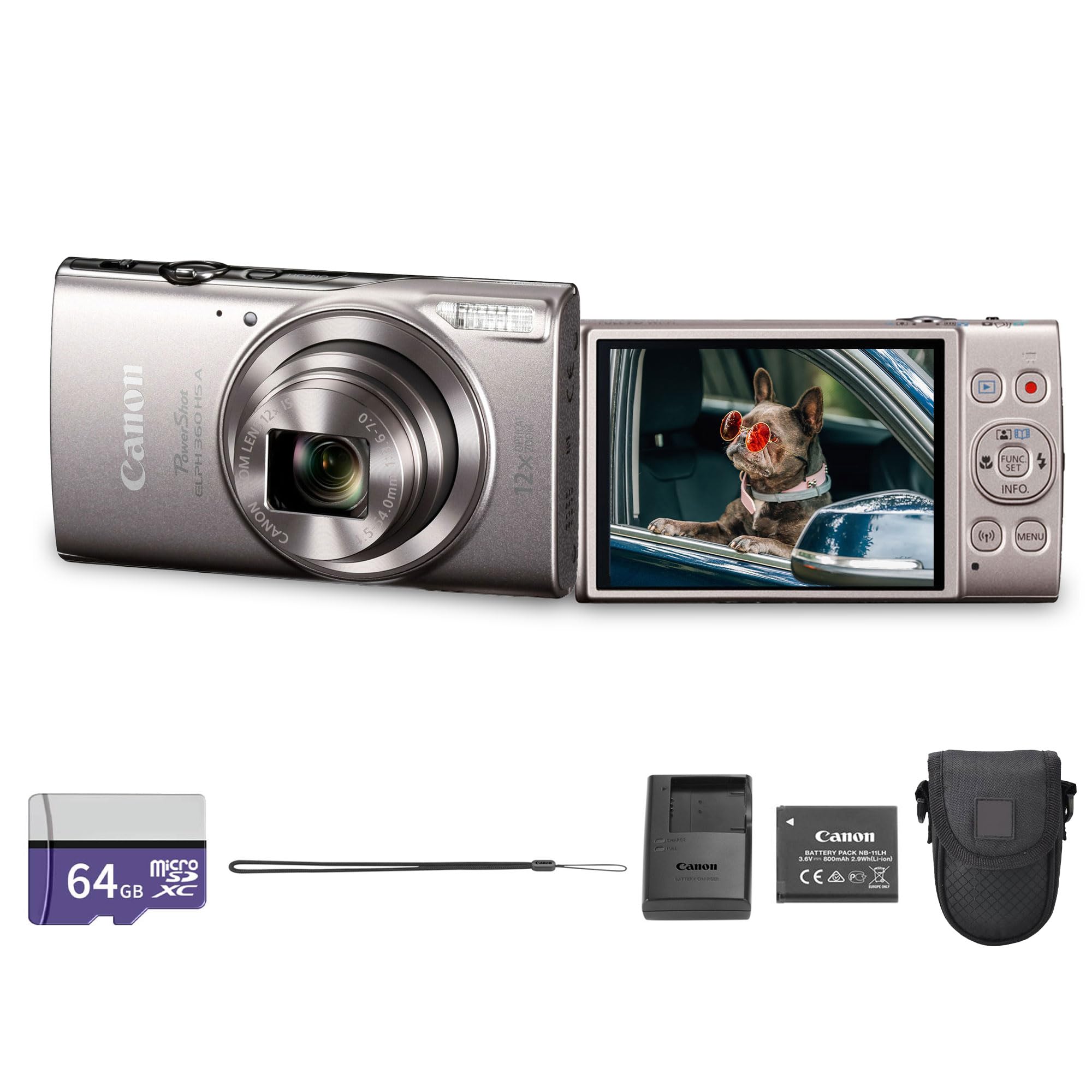
The Canon PowerShot ELPH 360 HS is a pocket-sized compact with a 20.2-megapixel CMOS sensor, a 12x optical zoom covering a 25-300mm equivalent range, and built-in Wi-Fi for easy sharing. The DIGIC 4+ processor enables 7.2 fps continuous shooting and Full HD 1080p video at 30 fps with an Intelligent IS stabilization system that automatically selects the appropriate correction mode for the scene. The 3-inch 461k-dot LCD screen provides clear framing, and creative features like Hybrid Auto, Creative Shot, and Story Highlights generate unique composites and highlight reels directly in-camera without external editing.
In practice, the ELPH 360 HS delivers great out-of-box image quality for daytime travel photos and family snapshots. The 12x zoom offers real versatility over a phone camera, and the pocketable size makes it easy to carry everywhere. However, the initial setup process is reportedly confusing, requiring assistance to configure basic settings. The 1/2.3-inch sensor and limited ISO range (up to 3200) mean low-light performance is mediocre, and the camera lacks 4K video recording. Some users found the included case to be too small for the camera body, requiring maneuvering to close it properly. The kit includes a 64GB memory card, which is a practical bonus.
For a casual photographer upgrading from a smartphone who wants a simple, affordable pocket camera with an optical zoom, the ELPH 360 HS is a competent entry-level choice. It is not an advanced camera by any stretch—it lacks raw capture, full manual controls, and larger sensor performance—but for bright-light travel memories and social media sharing, it provides a noticeable step up from a phone at a very accessible price point.
Why it’s great
- Pocket-sized body with a 12x optical zoom (25-300mm) for travel versatility
- Great out-of-box image quality in bright conditions with minimal editing needed
- Includes 64GB memory card in the box—ready to shoot immediately
Good to know
- No raw capture, no 4K video, and limited manual controls—entry-level only
- Small sensor struggles in low light; image quality drops above ISO 800
- Initial setup process is confusing according to some users
FAQ
Is a 1-inch sensor point-and-shoot really better than a flagship smartphone?
Can an advanced point-and-shoot replace a DSLR or mirrorless camera?
How important is image stabilization for telephoto point-and-shoot cameras?
Final Thoughts: The Verdict
For most users, the advanced point and shoot camera winner is the Nikon COOLPIX P1100 because its 125x optical zoom and Dual Detect VR stabilization deliver extreme telephoto reach that nothing else in this price tier can touch, making it the ultimate all-in-one for nature and travel shooters. If you want absolute pocketable image quality with a large APS-C sensor, grab the Ricoh GR IIIx. And for 4K vlogging with unlimited recording time and professional log color, nothing beats the Canon PowerShot V1.

Mo Maruf
I created WellFizz to bridge the gap between vague wellness advice and actionable solutions. My mission is simple: to decode the research and give you practical tools you can actually use.
Beyond the data, I am a passionate traveler. I believe that stepping away from the screen to explore new environments is essential for mental clarity and physical vitality.