Our readers keep the lights on and my smoothie glass nicely filled. As an Amazon Associate, I earn from qualifying purchases.
Your tomatoes are thriving, but aphids and spider mites are staging a full-scale invasion. *Sigh.* You need a formula that stops the damage without turning your soil into a chemical hazard.
I’m Mohammad Maruf — the founder and writer behind WellFizz. I’ve spent two years analyzing raw consumer feedback on dozens of horticultural sprays, cross-referencing active ingredient efficacy against pest resistance patterns.
That’s precisely why I built this guide: to cut through the shelf clutter and point you to the single most effective bug spray for plants that actually matches your garden, your pest load, and your patience level.
How To Choose The Best Bug Spray For Plants
Walking down the garden aisle is confusing. You see “miticide”, “systemic”, “ready-to-use”, “concentrate”, and “safe for edibles” — all on different bottles. Here is how to decode which one your specific pest outbreak actually needs.
Target Pest vs. Broad Spectrum
A targeted spray works fast on one pest type (like spider mites) but fails on thrips or fungus. A broad-spectrum formula covers more ground but may harm beneficial insects like bees. Ask yourself: *What exactly is eating my leaves?* If unsure, pick a triple-action formula that lists mites, aphids, and powdery mildew together.
Contact Killer vs. Systemic Protection
Contact sprays kill bugs on the spot but wash off in rain and miss pests hiding in leaf curls. Systemic insecticides are absorbed into the plant’s vascular system — providing long-lasting protection inside the plant tissue — but they cannot be used on vegetables or fruit plants. For edible gardens, stick to contact killers that are labeled up to day of harvest.
Concentrate vs. Ready-to-Use
Ready-to-use bottles are grab-and-go convenient, ideal for container gardens or small flower beds. Concentrates require mixing with water and a sprayer, but one bottle can yield multiple gallons of finished spray. The trade-off: concentrate is more economical long-term but demands a hose-end or tank sprayer for even coverage.
Quick Comparison
On smaller screens, swipe sideways to see the full table.
| Model | Category | Best For | Key Spec | Amazon |
|---|---|---|---|---|
| Bonide Captain Jack’s Orchard Spray | Premium | Disease & pest control on fruit trees | 32 oz concentrate, makes 6.4 gal | Amazon |
| Grower’s Ally Crop Defender 3 | Mid-Range | Organic triple-action protection | 24 oz RTU, OMRI listed | Amazon |
| Bonide Systemic Insect Control | Premium | Long-lasting protection for ornamentals | 16 oz concentrate, makes 16 gal | Amazon |
| BioAdvanced Tomato & Vegetable Pest Control | Mid-Range | Ready-to-use on edible gardens | 24 oz RTU, harvest day safe | Amazon |
| Natural Guard Spinosad Soap | Budget-Friendly | Quick contact kill on vegetables | 32 oz RTU, kills in minutes | Amazon |
In‑Depth Reviews
4. Bonide Captain Jack’s Citrus, Fruit & Nut Orchard Spray

This 32-ounce concentrate punches far above its weight — it mixes up to 6.4 gallons of finished spray, making it the most economical heavy hitter I’ve found for fruit and nut trees. Users report it knocking out Japanese beetles within an hour, and the leaf spot fungus on apple trees visibly receded after just two applications. The formula hits three fronts at once: insecticide (beetles, caterpillars, scale), miticide (spider mites), and fungicide (powdery mildew, rust, brown rot).
What surprises me most is how gentle it stays on the plant tissue despite its potency. Customers regularly mention that their citrus, avocado, and pecan trees showed improved color and vigor after treatment. The sulfur-based active ingredient leaves a faint residue, but washing the fruit before eating solves that easily. It is labeled safe to use up to the day before harvest, which is a huge relief for anyone growing edibles.
One note: because it’s a concentrate, you will need a hose-end or tank sprayer for application. That extra step is trivial for the coverage you get. The bottle also has a slight sulfur smell during mixing, but that dissipates quickly after drying. For anyone managing a medium to large garden with multiple pest pressures, this is the single most versatile jug you can own.
Why it’s great
- Triple-action (insecticide, miticide, fungicide) in one concentrate
- One pint makes 6.4 gallons — incredible value per application
- Safe for use on edibles up to day before harvest
- Visible disease reversal on leaves within two weeks
Good to know
- Requires a separate sprayer; not a ready-to-use bottle
- Mild sulfur smell during mixing
- Non-persistent — reapply after heavy rain
2. Grower’s Ally Crop Defender 3
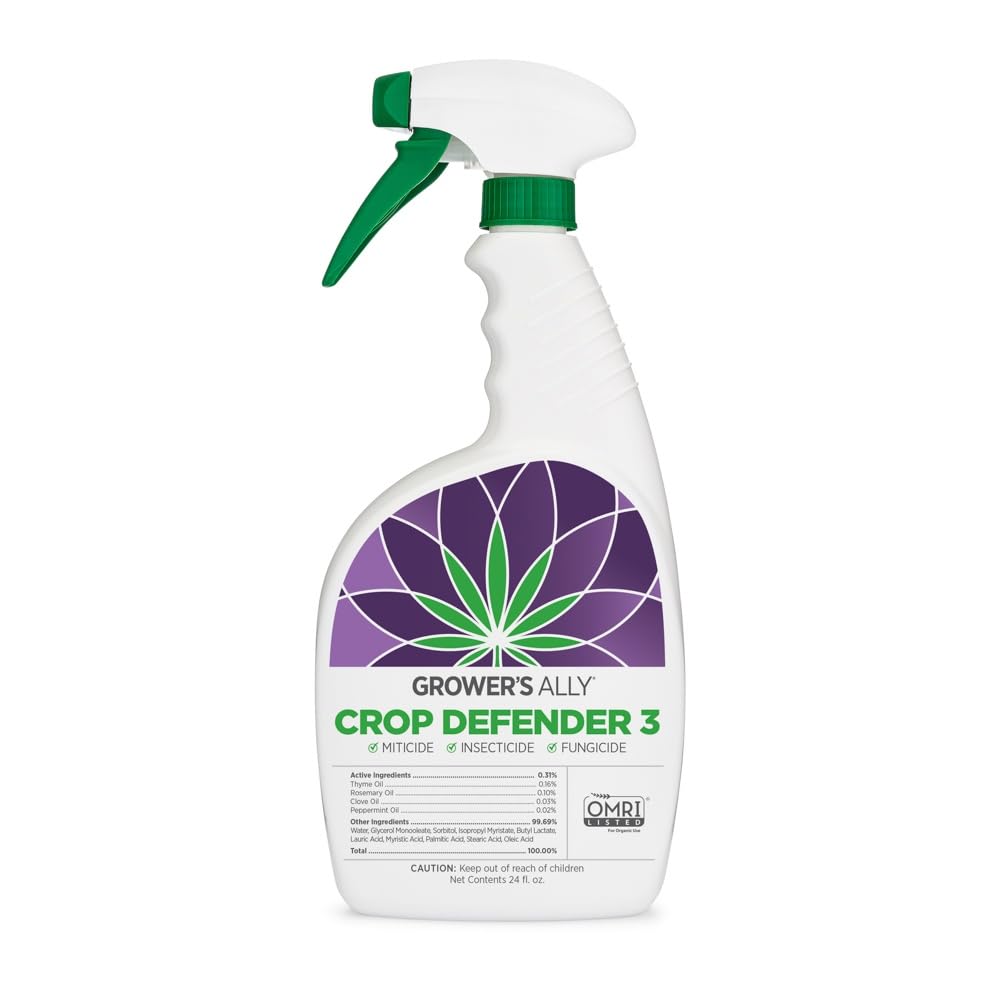
If you are growing consumables and prefer an organic route, this 24-ounce ready-to-use spray checks every box — OMRI listed, FIFRA 25(b) exempt, and loaded with a synergistic blend of botanical oils that target spider mites, russet mites, thrips, aphids, and powdery mildew. Multiple customers confirmed that a single application at the “elimination concentration” wiped out a severe spider mite infestation, and the plants remained pest-free for two weeks. The formula also doubles as a miticide, which is rare for a “natural” product at this price.
The real standout feature here is the zero-burn guarantee. Many botanical oil sprays scorch tender seedlings or flowering plants, but Grower’s Ally users repeatedly mention that even their youngest clones and flowering cycles tolerated the spray without a single leaf curl. It also smells quite pleasant — like cloves and herbs — rather than the typical chemical assault. That makes indoor and greenhouse spraying much more pleasant.
Harvest-same-day safety is another huge advantage. You can spray right through the flowering cycle without worrying about residual toxins. The only trade-off is the bottle size: at 24 ounces, it covers smaller raised beds and container gardens well, but you’ll want the concentrate version if you have a large outdoor plot. For the organic home grower, this is the most thoughtful all-purpose spray I have tested.
Why it’s great
- OMRI listed — safe for organic vegetable gardens
- Triple-action (miticide, insecticide, fungicide) in one RTU bottle
- Does not burn leaves, even on seedlings
- Pleasant herbal scent; no harsh chemical odor
Good to know
- Small bottle runs out quickly on large gardens
- Best used as a weekly preventative; heavy infestations may need re-spray
- Not a systemic — requires thorough leaf coverage
5. Bonide Systemic Insect Control

When you are fighting persistent pests like thrips, whiteflies, or scale on ornamental shrubs and flower beds, a contact spray isn’t enough — you need something that gets inside the plant. Bonide’s Systemic Insect Control is a 16-ounce concentrate that makes up to 16 gallons of finished spray, and the active ingredient acephate is absorbed directly into the plant’s vascular system. Users report bagworm infestations on arborvitae stopped completely after one spring application, and fungus gnats vanished within hours of the first watering.
It works on over 100 ornamental plant varieties, including roses, shrubs, flower beds, and even trees. The fast-acting formula starts killing immediately on contact, but its real strength is the residual protection that lasts inside the plant for weeks. That means pests feeding on the tissue — even the ones you cannot see — get poisoned as they chew. Customers rave about its effectiveness but unanimously warn about the smell: it has been described as a dumpster baking in the sun. That odor dissipates after watering, but it is unpleasantly strong during mixing.
A critical restriction: this product is not labeled for use on vegetables or fruit plants. It is intended for ornamental and flower gardens only. Also, some users noticed minor leaf spotting when applied in direct midday sun — spray in the late afternoon to avoid that. If you have a non-edible garden with stubborn sap-sucking insects, this systemic treatment becomes your most reliable weapon.
Why it’s great
- Systemic action kills hidden pests inside the plant tissue
- One concentrate bottle makes up to 16 gallons of spray
- Fast-acting on whiteflies, thrips, scale, and bagworms
- Residual protection lasts for weeks after application
Good to know
- Not for use on edible crops (vegetables, fruit trees)
- Strong odor during mixing — spray in a ventilated area
- May cause leaf burn if applied in direct sunlight
1. BioAdvanced Tomato & Vegetable Pest Control

For the container gardener or raised-bed grower who wants a grab-and-spray solution, this 24-ounce ready-to-use bottle from Bayer Advanced (now BioAdvanced) delivers instant convenience. It targets aphids, cutworms, and several other common vegetable pests, and it is labeled safe for use on tomatoes, peppers, carrots, and other edibles — right up to the day of harvest. Users with multiple raised beds confirm it is easy to work with and visibly drives bugs away after a single pass.
The fast-acting formula starts killing on contact, which is crucial when you spot a sudden aphid explosion on your pepper plants. The spray nozzle produces a focused stream rather than a wide mist, which helps you target the undersides of leaves without oversaturating the soil. It also seems effective against invasive lantern flies on grapevines, though repeated applications every couple of months are expected for heavy infestations.
That said, this is a contact-only treatment — it does not offer systemic protection, so you need thorough leaf coverage and reapplication after rain. A few users found it less effective against persistent rose pests, so if you have a history of tough spider mites or caterpillars, you may want a stronger broad-spectrum formula. But for the everyday vegetable gardener who needs a ready-to-use fix without mixing, this bottle is a solid first-line defense.
Why it’s great
- Ready-to-use — no mixing, no sprayer needed
- Safe for use on edibles up to day of harvest
- Fast contact kill on aphids, cutworms, and lantern flies
- Easy to apply with a focused stream nozzle
Good to know
- Contact-only — needs thorough leaf coverage; washes off in rain
- Not effective against spider mites or heavy caterpillar infestations
- 24 ounces covers small to medium gardens; larger plots need multiple bottles
3. Natural Guard Spinosad Soap

Spinosad is a naturally derived substance from soil bacteria, and when paired with insecticidal soap, you get a contact spray that kills both on contact and through ingestion. This 32-ounce ready-to-use bottle from Natural Guard is specially formulated for vegetables, crops, and ornamentals, and users report it wiped out cactus beetle infestations in a single spray with no residue or damage to the plant. The active ingredients also target spider mites and powdery mildew when sprayed directly on contact.
The real appeal here is speed — it starts killing within minutes after application, and the soap component helps the solution stick to leaf surfaces for better coverage. Customers with aphid-infested Dracena plants saw complete elimination within hours. The formula is also budget-friendly; you get 32 ounces of ready-to-use spray at a competitive price point, making it an accessible entry-level option for new gardeners.
However, this is not a broad-spectrum powerhouse. It works best on soft-bodied insects and mites, but tougher pests like scale or caterpillars may need a stronger concentrate. A few users also reported minor leakage during shipping due to the bottle design, so check the seal before storing. For small to medium vegetable gardens looking for a clean, fast-acting contact spray, the Spinosad Soap delivers reliable results without the chemical baggage.
Why it’s great
- Naturally derived Spinosad — a unique biological mode of action
- Kills on contact and through ingestion in minutes
- 32 ounces ready-to-use — no mixing required
- Effective on aphids, beetles, spider mites, and powdery mildew
Good to know
- Not broad-spectrum; weaker against tough scale and caterpillars
- Bottle may leak during shipping if cap is not sealed tight
- Contact-only — requires thorough coverage of undersides of leaves
FAQ
Can I use bug spray on my vegetable plants up to the day of harvest?
Why did my plant leaves curl after I sprayed a natural oil spray?
What is the difference between a contact killer and a systemic insecticide?
Final Thoughts: The Verdict
For most users, the bug spray for plants winner is the Bonide Captain Jack’s Orchard Spray because it combines insecticide, miticide, and fungicide in one economical concentrate that covers everything from citrus to roses. If you want an organic, ready-to-use solution that won’t burn your seedlings, grab the Grower’s Ally Crop Defender 3. And for long-lasting protection on your ornamental flower beds, nothing beats the Bonide Systemic Insect Control.

Mo Maruf
I created WellFizz to bridge the gap between vague wellness advice and actionable solutions. My mission is simple: to decode the research and give you practical tools you can actually use.
Beyond the data, I am a passionate traveler. I believe that stepping away from the screen to explore new environments is essential for mental clarity and physical vitality.