Our readers keep the lights on and my smoothie glass nicely filled. As an Amazon Associate, I earn from qualifying purchases.
Indoor cycling season hits, and within three rides the excuses start — setup is a hassle, the noise bleeds through the floor, or the resistance feels nothing like the open road. A badly chosen bike trainer stand turns a structured workout into a frustrating negotiation with wobble, heat, and decibel levels your neighbors can hear. The right one disappears beneath you, letting you focus on watts, cadence, and sweat without thinking about the hardware at all.
I’m Mohammad Maruf — the founder and writer behind WellFizz. For the past several years I’ve been analyzing product hardware across fitness categories, parsing customer pain points and failure modes from thousands of verified reviews to separate durable engineering from marketing hype.
After combing through customer data on seven of the most popular models spanning fluid, magnetic, and smart electromagnetic platforms, I’ve narrowed down the field to the stand that delivers the best real-world balance of noise, stability, and ride feel. This evaluation of the best bike trainer stand cuts through the noise to find the stand you will actually enjoy using daily.
How To Choose The Best Bike Trainer Stand
Selecting a trainer stand requires matching three core attributes to your riding style: resistance type, noise tolerance, and frame stability. A dedicated Zwift user has a completely different priority list than a casual rider looking to spin 20 minutes before dinner. Below are the critical specs that separate a lifeless, noisy stand from one that becomes a seamless part of your training toolkit.
Resistance Type: Magnetic vs. Fluid vs. Electromagnetic
Magnetic trainers use magnets near a spinning metal flywheel to create drag. They are usually the most affordable option, but the resistance curve tends to flatten at higher speeds — you can out-pedal the load. Fluid trainers use a sealed impeller spinning in silicone oil; the fluid heats up and thickens as you pedal faster, creating a progressive, road-like resistance curve that rewards harder efforts with more load. Electromagnetic (smart) trainers employ magnets controlled by a microprocessor, allowing real-time wattage changes from apps like Zwift. If you train exclusively on virtual platforms, an electromagnetic unit with ANT+ FE-C and Bluetooth is the better choice.
Noise Level and Tire Interaction
Every wheel-on trainer is louder than a direct-drive unit because the rubber tire contacts a metal or friction roller. The stand itself generates mechanical noise, but the biggest variable is your rear tire. Knobby mountain bike tires can produce a roar comparable to a vacuum cleaner. Switching to a slick trainer tire or a dedicated road tire with minimal tread drops the noise by 10-15 decibels. Many buyers report that a fluid trainer paired with a slick tire becomes quiet enough to hear a TV at moderate volume, while a magnetic trainer with a hybrid tire remains distracting without earplugs.
Frame Stability and Weight Capacity
A trainer stand must not flex or rock during hard efforts, especially if you ride out of the saddle. Look for an M-shaped or pyramid-style frame that distributes weight evenly. Pay attention to the load capacity in pounds — a 220-pound limit may be adequate for steady spinning, but heavier riders or those who sprint aggressively should target stands rated for 264 to 300 pounds. Non-slip rubber feet and adjustable leveling caps prevent the stand from walking across hard floors and protect the finish beneath it.
Foldability and Storage Footprint
Not everyone has a dedicated pain cave. If you plan to set up and tear down the trainer before every ride, look for a stand that folds with a single latch and stores under a bed or in a closet. The folded thickness matters more than you think — a unit that collapses to roughly seven inches wide slides into narrow gaps, while a bulky frame may sit out permanently. Quick-release skewer compatibility is also critical; most trainers include a skewer for standard dropouts, but thru-axle adapters must be purchased separately for modern disc-brake frames.
Quick Comparison
On smaller screens, swipe sideways to see the full table.
| Model | Category | Best For | Key Spec | Amazon |
|---|---|---|---|---|
| Alpcour Fluid Bike Trainer | Fluid | Quiet indoor spinning with natural resistance | 300 lb capacity | Amazon |
| Saris M2 Smart | Smart | App-controlled training with accurate power | ANT+ FE-C / Bluetooth | Amazon |
| Saris Fluid2 | Fluid | Realistic road feel without electronics | 69 dB at 20 mph | Amazon |
| Garmin Tacx Neo 2T | Direct Drive | Maximum realism and virtual integration | 2,200 watt max | Amazon |
| Topeakmart Magnetic | Magnetic | Budget entry-level indoor riding | 264 lb capacity | Amazon |
| Sunlite F-2 Magnetic | Magnetic | Easy setup for casual riders | Fits 26″ wheels and up | Amazon |
| Goplus Magnetic | Magnetic | Affordable folding unit for small spaces | 8 resistance settings | Amazon |
In‑Depth Reviews
1. Alpcour Fluid Bike Trainer Stand

The Alpcour Fluid tops our list because it nails the two things that matter most in a wheel-on trainer: a progressive, natural-feeling resistance curve and a noise floor low enough to coexist with household activity. The sealed fluid impeller creates drag that increases as you push harder — exactly how wind resistance works outdoors — without the stepped, predictable load of magnetic units. Riders report that the noise level sits around 70 decibels, comparable to a TV at normal volume, making this a viable pick for apartment dwellers when paired with a slick tire.
Construction uses heavy-duty stainless steel with a pyramid-style frame that feels solid even under riders weighing north of 270 pounds. The included front wheel riser block and anti-slip rubber feet keep the setup planted during out-of-saddle efforts. A dual-lock system with a tension knob and locking ring secures the bike without wobble. The foldable frame collapses to a compact footprint, and the included carry bag makes transport to group rides or storage straightforward.
Some users noted that the initial assembly required patience with the L-bolt alignment, and very strong cyclists may find the resistance insufficient below 20 mph wheel speed. A handful of reports mention the front wheel riser block breaking after extended use, though this is not a universal failure point. Overall, the Alpcour delivers the closest approximation of outdoor riding feel in a wheel-on format at a mid-range price point.
Why it’s great
- Progressive fluid resistance mimics real road gradients
- Stainless steel frame rated for 300 pounds
- Low noise footprint works in shared living spaces
- Foldable design fits under most beds
Good to know
- Assembly requires careful L-bolt alignment
- Resistance ceiling may feel low for elite cyclists
- Front wheel block durability is a reported weak point
- Not ideal for mountain bikes with knobby tires
2. Saris M2 Smart Indoor Electromagnetic Trainer

The Saris M2 bridges the gap between a standard wheel-on trainer and a full direct-drive smart unit by embedding a power meter, cadence sensor, and speed sensor directly into the frame. Electromagnetic resistance adjusts in real-time based on app commands via ANT+ FE-C or Bluetooth, so Zwift automatically increases the load when you hit a virtual climb. Accuracy sits at +/- 5%, which is competitive for wheel-on designs and sufficient for structured training plans.
The unit weighs 20 pounds and supports up to 300 pounds of rider weight, with a maximum simulated power output of 1,500 watts at 20 mph. The noise level hovers around 70 decibels — audible but not overwhelming. Assembly is straightforward, though the tension adjustment knob should not be overtightened past the first sign of tire contact. Calibration is handled through the Saris app, and many users report seamless integration with Rouvy and FulGaz in addition to Zwift.
Thru-axle compatibility depends on the specific adapter, and some riders found that the 142×12 1.5 pitch standard was not supported out of the box. A small number of reports describe flex during high-power sprints, though the majority of users find the frame stable enough for standing efforts. If you want app-controlled interactivity without the cost of a direct-drive setup, the M2 is the strongest option in this review.
Why it’s great
- Built-in power/cadence/speed sensors eliminate extra purchases
- ANT+ FE-C and Bluetooth offer broad app compatibility
- Electromagnetic resistance adjusts automatically on virtual climbs
- Rated to 300 pounds with a 20-pound frame
Good to know
- Thru-axle adapters not universal across all standards
- Instructions could be clearer regarding tension adjustment
- Frame may flex slightly during max-power sprints
- Requires calibration via phone app for accurate power
3. Saris Fluid2 Indoor Bike Trainer
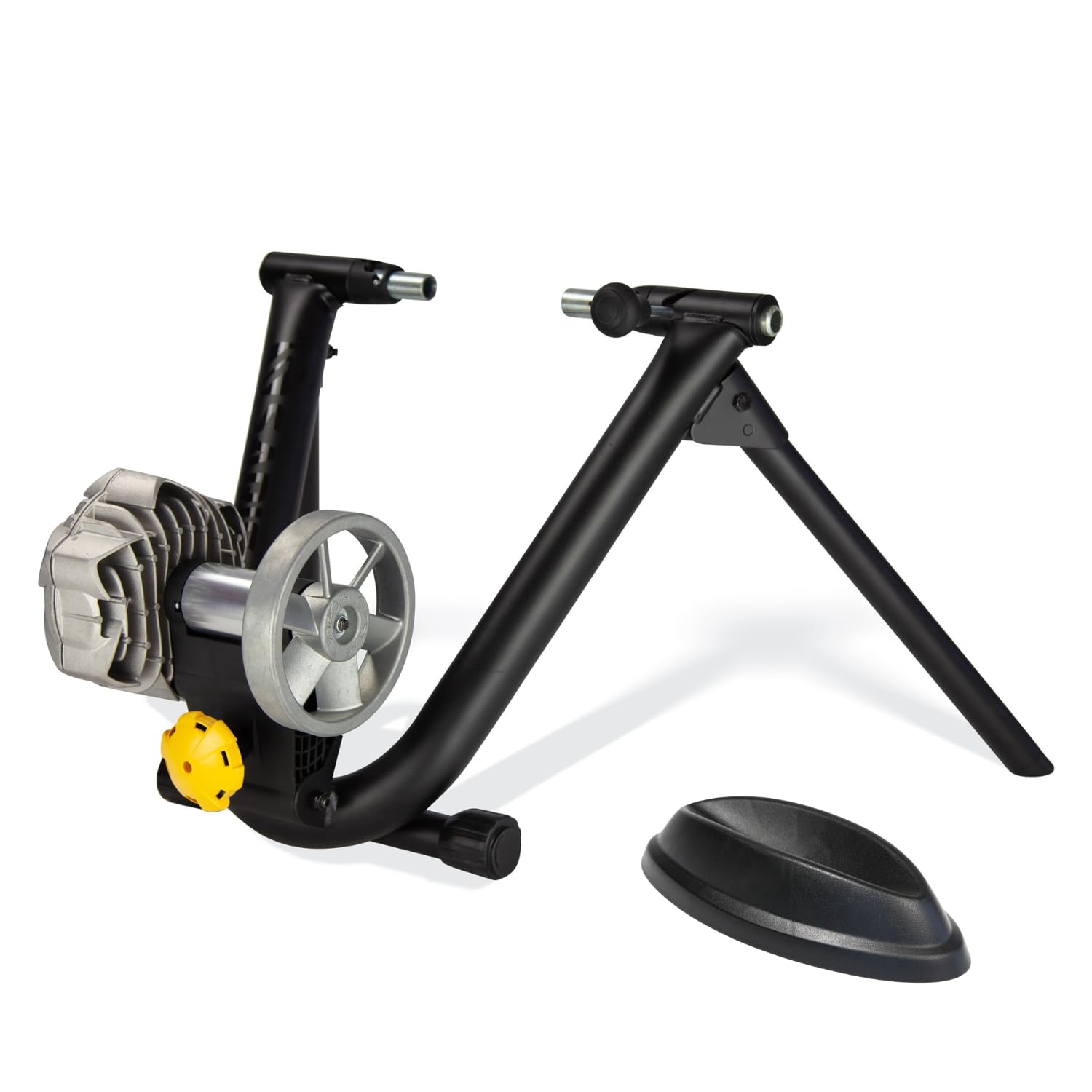
If you prioritize a whisper-quiet ride and realistic road simulation above all else, the Saris Fluid2 is the proven benchmark. The fluid resistance unit uses a large precision-balanced flywheel that Saris has been refining for years, producing a consistent, smooth drag that never feels notched or artificial. The official noise rating is 69 decibels at 20 mph — low enough that users report hearing music clearly without headphones.
The frame is aluminum, keeping weight down to 7.3 pounds while maintaining enough rigidity for steady spinning. Setup takes minutes with the included quick-release skewer, and the legs fold with considerable pressure for storage. The Fluid2 works with Zwift and Rouvy when paired with a separate speed or cadence sensor, so it can function as a basic smart trainer without requiring a full electronics upgrade.
Some users found the assembly instructions confusing regarding the beveled tube end, and the leg folding mechanism requires significant force — it is not designed for daily breakdowns. The skewer seats shallowly on some dropouts, and the right-side lock mechanism may feel stiff initially. Despite these quirks, the Fluid2 remains a favorite among riders who want a realistic, quiet fluid trainer without paying for smart features they will not use.
Why it’s great
- Class-leading low noise at 69 dB
- Fluid resistance provides consistent road-like feel
- Very lightweight frame at 7.3 pounds
- Compatible with training apps via optional sensor
Good to know
- Assembly instructions are poorly laid out
- Legs require substantial force to fold
- Skewer engagement on dropouts could be deeper
- No built-in power or cadence sensor
4. Garmin Tacx Neo 2T Smart Trainer

The Garmin Tacx Neo 2T represents the ceiling of what a smart trainer can deliver. As a direct-drive unit, you remove the rear wheel entirely and mount the bike directly to the trainer via a compatible cassette — eliminating tire wear, slippage, and most mechanical noise. The 32 neodymium magnets provide up to 2,200 watts of resistance, making this the only trainer on this list that can challenge professional-level sprint efforts. Dynamic inertia simulates the momentum you feel on a real bike, and the unit detects road surface textures from virtual platforms to produce subtle vibrations through the frame.
Setup requires installing your own cassette and correctly selecting the spacer stack, but once configured, the Neo 2T pairs instantly with Zwift, Rouvy, and Tacx’s own software via ANT+ and Bluetooth. The built-in power meter is accurate to within 1%, and the trainer does not require calibration — it self-calibrates during use. The footprint is larger than a wheel-on unit, but the frame folds and includes a front wheel support block with two height settings.
The main barrier is weight at 47.4 pounds, making regular relocation a chore. Some users experienced a learning curve connecting to macOS devices via HDMI, and the initial cassette installation requires mechanical comfort. For any rider who trains seriously and wants the most immersive, accurate, and quiet smart trainer available, the Neo 2T is without peer.
Why it’s great
- Direct drive eliminates tire noise and slippage completely
- 2,200 watt max resistance handles elite sprinters
- Self-calibrating power meter with +/- 1% accuracy
- Virtual road feel vibrates through the frame
Good to know
- 47.4 pounds makes it difficult to move regularly
- Requires installing your own cassette
- Setup can be confusing for first-time direct drive users
- Premium cost places it outside the casual rider budget
5. Topeakmart Magnetic Bike Trainer Stand

The Topeakmart Magnetic trainer proves that you do not need to spend heavily to get a stable, functional indoor cycling stand. The M-shaped frame is powder-coated high carbon steel with a load capacity of 264 pounds, and the four levelness-adjustable feet caps allow precise balancing on uneven floors — a detail often missing from budget units. The rust-resistant alloy roller and sealed magnetic resistance unit provide enough drag for zone 2 and tempo efforts without slipping.
Noise is the trade-off. With a hybrid tire, users report a loud hum that demands headphones at moderate volume. Switching to a slick tire drops the noise significantly, though it will still be louder than any fluid or direct-drive unit. Setup is genuinely easy, requiring no tools beyond the included quick-release skewer. The stand folds to seven inches thick, sliding neatly into narrow closet gaps.
Thru-axle bikes are not supported without an aftermarket adapter, and the single resistance setting means you must shift gears to change load rather than adjusting a dial. A handful of reviews note that the resistance is adequate for steady spinning but insufficient for high-power intervals. For the rider who wants an inexpensive, reliable way to spin through winter without app integration, the Topeakmart delivers on value.
Why it’s great
- Levelness-adjustable feet eliminate wobble on uneven floors
- Rust-resistant alloy roller extends service life
- Folds to 7 inches thick for easy storage
- Price makes it accessible for first-time buyers
Good to know
- Noisy with hybrid tires; slick tire recommended
- Single resistance level requires gear shifting for load changes
- Not compatible with thru-axle dropouts out of the box
- Resistance may feel low for strong riders
6. Sunlite F-2 Magnetic Indoor Bicycle Trainer
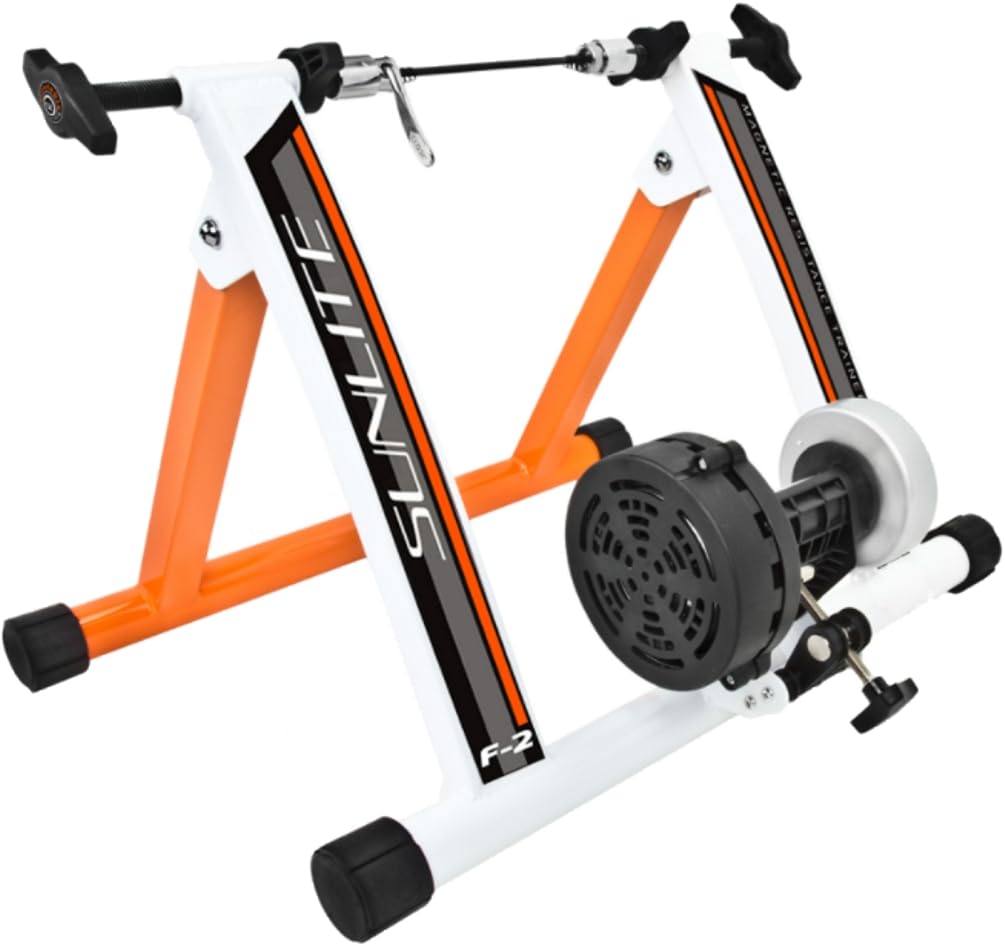
The Sunlite F-2 has been a budget staple for years, and its longevity on the market speaks to a straightforward design that works. The heavy-duty alloy steel frame folds for storage and accepts wheels 26 inches and up, covering the vast majority of road and mountain bikes. Assembly takes roughly 15 minutes without tools — you swap the rear axle skewer and tighten the tension knob against the tire. Magnetic resistance provides a consistent load that is adjustable by shifting through your bike’s gears.
Noise is moderate with smooth tires and significantly louder with knobby tread. Users describe the sound as comparable to a low mixer, which is acceptable for a garage or basement but difficult to ignore in a shared apartment without a vibration-dampening mat. The frame is stable for riders up to 200 pounds, though some customers above that weight found the base too narrow for confident out-of-saddle riding.
A small number of units shipped missing the resistance controller, so inspecting the box contents immediately upon arrival is wise. The tension system can bend the frame if overtightened — the correct procedure is to tighten until you feel slight resistance, then back off a quarter turn. For casual riders doing 2-25 mile indoor sessions a few times per week, the Sunlite F-2 offers the lowest cost of entry with no surprises.
Why it’s great
- Simple tool-free assembly in under 15 minutes
- Fits most wheel sizes from 26 inches upward
- Folds for compact storage
- Proven design with years of customer feedback
Good to know
- Noisy with knobby tires; slick tires recommended
- Frame can bend if tension knob is overtightened
- Base is too narrow for heavy riders sprinting out of saddle
- Some units arrived with missing resistance parts
7. Goplus Magnetic Bike Trainer Stand

The Goplus Magnetic trainer appeals to the bargain-conscious rider who needs a foldable, space-saving solution for occasional indoor rides. The pyramid-style frame is constructed from alloy steel with a 220-pound load capacity, and the double-locking system secures the bike using a quick-release lever and knob. The magnetic unit offers eight resistance settings, which is unusual at this price — most budget magnets offer only one. This gives you a broader load range without shifting gears.
Noise is a recurring theme across the reviews. The unit is loud during use, especially with the included knobby tires that many commuter or mountain bikes ship with. The resistance cylinder heats up noticeably after 30 minutes, producing a burning rubber smell that diminishes with break-in but never entirely disappears. Assembly is quick at under 15 minutes, though the sparse printed instructions require some improvisation. The stand folds narrow enough to slide into a car trunk or closet corner.
Size compatibility tops out at 28-inch wheels, and fat tire bikes will not fit without modification. The frame is sturdy enough for seated cruising but flexes under aggressive pedaling. A handful of international buyers received units that did not match the product photos and struggled with fit. If your budget is tight and you plan to ride mostly in zone 1-2, the Goplus is a functional stopgap, but the noise and heat make it hard to recommend for consistent training.
Why it’s great
- Eight magnetic resistance settings for a wider load range
- Folding pyramid frame stores in tight spaces
- Double-locking system improves bike security
- Very affordable entry point into indoor training
Good to know
- Loud operation; not suitable for shared apartments
- Resistance cylinder gets hot and emits odor during use
- Assembly instructions are sparse and unclear
- Not compatible with fat tire or oversized bikes
FAQ
Can I use a mountain bike with knobby tires on these trainers?
How important is a quick-release skewer versus a thru-axle adapter?
What is the real-world difference between fluid and magnetic resistance for a casual rider?
Does wheel size limit which bikes fit a trainer stand?
Can smart trainers work without a subscription app?
Final Thoughts: The Verdict
For most users, the best bike trainer stand winner is the Alpcour Fluid Bike Trainer Stand because it delivers a realistic progressive resistance curve and a surprisingly low noise floor without jumping into smart-trainer pricing. If you need app-controlled resistance for structured Zwift workouts, grab the Saris M2 Smart Trainer. And for the quietest, most immersive direct-drive experience that rivals riding outdoors, nothing beats the Garmin Tacx Neo 2T.

Mo Maruf
I created WellFizz to bridge the gap between vague wellness advice and actionable solutions. My mission is simple: to decode the research and give you practical tools you can actually use.
Beyond the data, I am a passionate traveler. I believe that stepping away from the screen to explore new environments is essential for mental clarity and physical vitality.