Our readers keep the lights on and my smoothie glass nicely filled. As an Amazon Associate, I earn from qualifying purchases.
The single biggest bottleneck in a modern computer isn’t the processor or the graphics card—it’s the storage drive that has to feed data to both. A mechanical hard drive, or even an older SATA SSD, leaves performance on the table every single time the system waits for a file to load. Upgrading to a 1TB internal SSD transforms boot times from minutes to seconds and eliminates the stutter in high-resolution video editing and large game worlds.
I’m Mohammad Maruf — the founder and writer behind WellFizz. I’ve spent years analyzing storage benchmarks, controller architectures, and NAND flash endurance figures to separate marketing claims from real-world throughput gains.
Whether you are replacing a worn-out drive or building a system from scratch, choosing the right best 1tb ssd comes down to matching the interface generation and NAND type to your motherboard’s capabilities and workload demands.
How To Choose The Best 1TB SSD
Picking the right drive means matching the physical interface on your motherboard to the speed tier your workloads actually need. A Gen4 NVMe drive can reach 7,000 MB/s, but if your system only supports PCIe 3.0, you will be capped at roughly half that speed. Conversely, dropping a high-speed Gen4 drive into a Gen3 slot still works fine—you just leave the extra performance unused.
Interface Generation and Form Factor
The two dominant interfaces are SATA (capped at roughly 560 MB/s) and NVMe over PCIe, which multiplies that ceiling by ten or more. Most modern laptops and desktops accept M.2 2280 NVMe drives. If your motherboard lacks an M.2 slot, a 2.5-inch SATA SSD like the Crucial BX500 remains a massive upgrade over any spinning hard drive. Always check your motherboard manual—installing a drive incompatible with your slot type is the most common purchasing mistake.
NAND Type and Endurance (TBW)
TLC (Triple-Level Cell) NAND is the sweet spot for 1TB drives: it offers good endurance—typically 300 to 600 TBW (TeraBytes Written)—at a reasonable cost. QLC (Quad-Level Cell) reaches higher capacities at lower prices but has much lower write endurance and slower sustained writes once the onboard SLC cache fills. For heavy video editing, large database work, or game installations, TLC-based drives with a DRAM cache maintain consistent speeds far longer than DRAM-less alternatives.
Quick Comparison
On smaller screens, swipe sideways to see the full table.
| Model | Category | Best For | Key Spec | Amazon |
|---|---|---|---|---|
| WD Blue SN5100 | NVMe Gen4 | High-speed productivity | 7,100 MB/s read | Amazon |
| TEAMGROUP MP44L | NVMe Gen4 | Budget Gen4 performance | 5,000 MB/s read | Amazon |
| SANDISK Extreme Portable | External NVMe | Portable rugged storage | 1,050 MB/s read | Amazon |
| fanxiang S501Q | NVMe Gen3 | Older system upgrade | 3,200 MB/s read | Amazon |
| Crucial BX500 | SATA III | Legacy laptop upgrade | 540 MB/s read | Amazon |
| Seagate Portable HDD | External HDD | High-capacity backups | 20 Gbps (USB 3.0) | Amazon |
| Kingston A400 | SATA III | Entry-level system revival | 450 MB/s read | Amazon |
In‑Depth Reviews
1. WD Blue SN5100 1TB
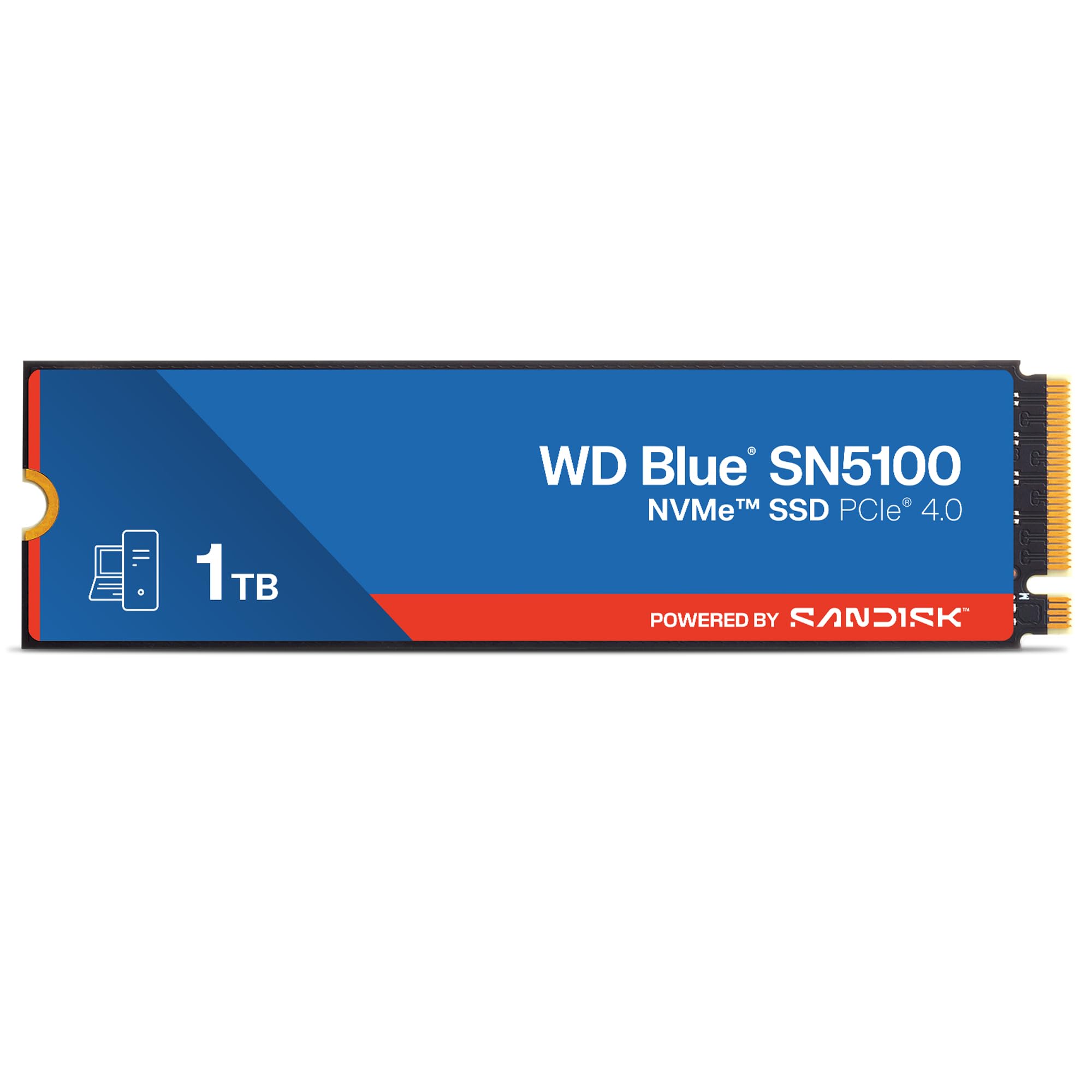
The WD Blue SN5100 delivers top-tier PCIe Gen 4.0 throughput at 7,100 MB/s sequential reads, putting it in the same performance bracket as premium drives from Samsung and SK hynix but with a more accessible price premium. SanDisk nCache 4.0 technology accelerates large file transfers by intelligently buffering hot data, making this drive especially effective for moving project folders and high-resolution video assets.
With capacities up to 2TB on the same M.2 2280 form factor and a 5-year limited warranty from SanDisk, this is a drive built to handle sustained creative workloads without thermal throttling. Users consistently report sub-10-second boot times and zero stutter in AAA game titles, even when the drive is near full capacity.
The bundled Acronis True Image for SanDisk download simplifies cloning your existing operating system, so you can migrate your entire environment in under an hour without reinstalling Windows or macOS. Backward compatibility with PCIe 3.0 slots means it will still run at Gen3 speeds on older hardware, though you will not see the full 7,100 MB/s rate.
Why it’s great
- Industry-leading 7,100 MB/s sequential read speed
- 5-year warranty with proven SanDisk reliability
- Acronis True Image migration tool included
Good to know
- Performance capped at ~3,500 MB/s on Gen3 systems
- No dedicated DRAM cache (relies on Host Memory Buffer)
2. TEAMGROUP MP44L 1TB

The TEAMGROUP MP44L hits a sweet spot for users wanting Gen4 speeds without paying Gen4 flagship prices. Sequential read performance reaches 5,000 MB/s, and writes top out at 4,500 MB/s—roughly double what the fastest Gen3 drives can deliver. The onboard aluminum heat sink combined with a graphene-coated label keeps operating temperatures in check during sustained workloads, which matters for laptop installations where airflow is limited.
SLC caching accelerates burst writes for game installations and file decompression, and the 5-year or TBW limited warranty covers up to 600 TBW for the 1TB variant. Users upgrading from standard SATA SSDs report a night-and-day difference in level load times and system responsiveness, with the drive being instantly recognized across Windows, Linux, and multiple motherboard vendor UEFI implementations.
The MP44L leverages the NVMe 1.4 protocol for improved queue depth handling, meaning it manages simultaneous read/write operations more efficiently than older Gen4 controllers. This makes it a strong choice for dual-drive setups where the OS drive handles both program launches and background updates.
Why it’s great
- Strong Gen4 speeds at a mid-range entry point
- Graphene heat spreader for thermal management
- 600 TBW endurance rating with 5-year warranty
Good to know
- Write speeds drop after SLC cache fills on large continuous transfers
- No dedicated DRAM; uses HMB instead
3. SANDISK Extreme Portable SSD 1TB

For users who need fast, rugged external storage that fits in a jeans pocket, the SanDisk Extreme Portable delivers up to 1,050 MB/s reads and 1,000 MB/s writes over USB 3.2 Gen 2. The IP65 rating means it shrugs off water splashes and dust ingress, and the 3-meter drop protection ensures it survives the inevitable tumble off a desk or backpack strap.
The integrated carabiner loop lets you clip it to a belt loop or camera bag, and password protection with 256-bit AES hardware encryption secures sensitive project files without slowing transfer speeds. Photographers editing in the field report consistent 1,000 MB/s transfers when moving RAW files from a CFexpress card reader to the drive, with the small size making it easy to keep in a side pocket.
The drive does warm noticeably during extended write sessions—a common trait for compact NVMe enclosures—but performance remains stable. The SanDisk Memory Zone app helps manage file backups automatically, which is useful for offloading a phone or tablet without manual drag-and-drop.
Why it’s great
- IP65 water/dust resistance and 3-meter drop rating
- 1,050 MB/s reads in a thumb-drive-sized package
- 256-bit AES hardware encryption built in
Good to know
- Gets warm during sustained large transfers
- Requires USB-C 3.2 Gen 2 port for full speed
4. fanxiang S501Q 1TB

The fanxiang S501Q is built for systems limited to PCIe 3.0, delivering 3,200 MB/s reads and 1,750 MB/s writes through intelligent SLC caching on 3D NAND. The graphene heat dissipation label and included mounting screws make installation straightforward, and the 3-year warranty reflects reasonable confidence in the Taiwan-based manufacturer’s quality control.
At 320 TBW for the 1TB version, the endurance rating is lower than premium Gen4 drives, but it is still more than sufficient for typical OS, application, and game storage over a multi-year lifespan. Users installing the drive in older Dell and HP business-class laptops report consistent boot times under 20 seconds and no compatibility hiccups with Windows 10 and 11.
The key differentiator here is price—this drive targets users who want NVMe performance but whose motherboard lacks Gen4 lanes. The SLC cache handles burst writes effectively, though sustained large-file transfers will slow once the pseudo-SLC buffer fills. It is a solid stopgap for extending the usable life of a Gen3 system.
Why it’s great
- 3,200 MB/s Gen3 performance at an entry-level price
- Graphene sticker and screws included in box
- Good compatibility with desktop and laptop motherboards
Good to know
- Sustained writes slow significantly after SLC cache is exhausted
- 320 TBW endurance is lower than TLC-based competitors
5. Crucial BX500 1TB

The Crucial BX500 is a 2.5-inch SATA III SSD that reaches 540 MB/s reads, making it roughly 300 percent faster than a standard mechanical drive. It is the simplest drop-in upgrade for older laptops and desktops that lack an M.2 slot, requiring only a SATA data cable and power connector. The 1TB capacity is enough for a full operating system, productivity suite, and several AAA game titles.
Micron 3D NAND tech underpins the drive, and the 3-year limited warranty is backed by Crucial’s decades of memory manufacturing. Users frequently report boot times dropping from 90 seconds (on a 5400 RPM HDD) to under 15 seconds, and system responsiveness in Windows Explorer and web browsers improves immediately.
The BX500 is a DRAM-less design, which means sustained write speeds drop once the pseudo-SLC cache is saturated. For bursty desktop workloads, this is rarely noticeable, but heavy video editing or continuous large file transfers will expose the slower sustained write rate. The Frustration-Free Packaging eliminates the blister pack struggle.
Why it’s great
- Easy drop-in replacement for any 2.5-inch SATA system
- 540 MB/s reads vastly improve boot and load times
- Micron 3D NAND with 3-year warranty
Good to know
- No DRAM cache; sustained writes slow after cache fills
- Limited to SATA III bandwidth cap of 560 MB/s
6. Seagate Portable 1TB HDD
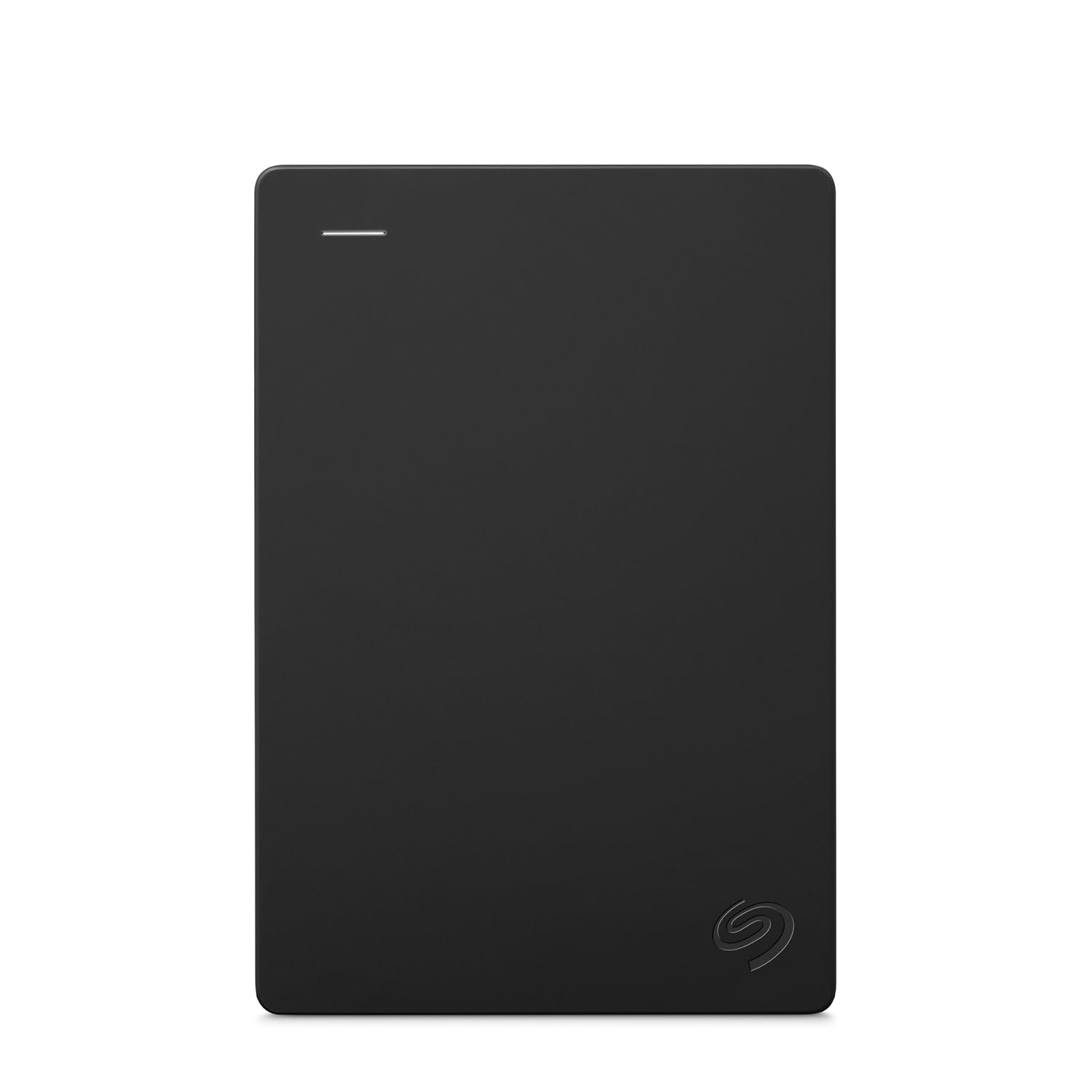
The Seagate Portable 1TB HDD is a traditional mechanical hard drive in a compact USB 3.0 enclosure, offering plug-and-play drag-and-drop backup for Windows, Mac, PlayStation, and Xbox. The 1-year Rescue Service provides data recovery protection, and the 18-inch included cable makes it easy to connect even when rear ports are tight against a wall.
Users on MacBook Pro systems need to reformat the drive via Disk Utility (APFS is recommended) before use, but the process takes under two minutes. The drive is nearly silent during operation and draws power entirely from the USB bus, so no separate power brick is needed. Offloading iPhone photo libraries and video footage at USB 3.0 speeds takes roughly 30 to 45 minutes for large dumps.
The write speed drops significantly after about 100 GB of continuous data due to the SMR (Shingled Magnetic Recording) platter design, so this drive is best suited for backup purposes rather than active video editing. The 5TB version is also available for users needing even higher offline storage density.
Why it’s great
- Lowest cost per gigabyte for bulk offline backups
- 1-year Rescue Service for data recovery
- Compatible with PC, Mac, PS4, PS5, Xbox
Good to know
- Write speed drops to ~25 MB/s after 100 GB of sustained writes
- Mechanical drive—less impact-resistant than SSD
7. Kingston A400 960GB

The Kingston A400 is a DRAM-less SATA III drive offered at 960 GB capacity—just shy of a full terabyte but at a price point that undercuts almost every other entry-level SSD. Sequential reads hover around 450 MB/s, and single-file writes reach approximately 450 MB/s, with mixed workload writes dropping to 280-350 MB/s. The stainless steel enclosure adds a touch of durability without adding weight.
Users reviving decade-old laptops (circa 2013 HP and Dell models) consistently report successful installations that transform boot times from minutes to under 15 seconds. The drive runs cool—typically around 30°C under load—which matters in poorly ventilated older chassis. The 80 TBW endurance figure for the 240GB variant scales proportionally, meaning the 960GB version should handle typical desktop usage for several years before write cycles become a concern.
The A400 is not designed for heavy concurrent I/O: mixed workloads that interleave reads and writes can cause throughput to drop to roughly 350 MB/s. But for an office PC, a student laptop, or a secondary storage drive in a desktop, it delivers a tangible performance uplift at the absolute lowest entry cost in the SATA SSD market.
Why it’s great
- Very low cost for 960 GB of solid-state storage
- Quick boot times and quiet operation
- Durable stainless steel enclosure
Good to know
- No DRAM cache; mixed workload writes slow to ~350 MB/s
- Lower write endurance than TLC-based alternatives
FAQ
Can I install a Gen4 NVMe drive in a Gen3 M.2 slot?
How do I tell if my computer supports M.2 NVMe or only SATA?
What does TBW mean and how much do I need?
Final Thoughts: The Verdict
For most users, the best 1tb ssd winner is the WD Blue SN5100 because it delivers the highest available Gen4 read speeds at a mid-range price premium, backed by a 5-year warranty and straightforward cloning software. If you want a balance of Gen4 throughput and cost savings, grab the TEAMGROUP MP44L. And for breathing new life into an older laptop limited to SATA, nothing beats the Crucial BX500 as a drop-in HDD replacement.

Mo Maruf
I created WellFizz to bridge the gap between vague wellness advice and actionable solutions. My mission is simple: to decode the research and give you practical tools you can actually use.
Beyond the data, I am a passionate traveler. I believe that stepping away from the screen to explore new environments is essential for mental clarity and physical vitality.