Our readers keep the lights on and my smoothie glass nicely filled. As an Amazon Associate, I earn from qualifying purchases.
Buying your first interchangeable-lens camera is a pivot point — the moment you commit to learning aperture, shutter speed, and composition instead of letting a smartphone algorithm decide everything. The right body and kit lens can accelerate that learning curve or grind it to a halt with menus that hide the settings you actually need.
I’m Mohammad Maruf — the founder and writer behind WellFizz. I’ve spent hundreds of hours analyzing sensor specs, autofocus systems, and lens ecosystems to separate practical beginner cameras from dated inventory dressed up as deals.
This guide evaluates 11 models across DSLR and mirrorless platforms, comparing image quality, handling, and upgrade paths so you can confidently choose a camera for beginner photography that grows with your skills rather than boxing them in.
How To Choose The Best Camera For Beginner Photography
The perfect beginner camera balances image quality, ease of use, and room to grow without burying you in debt. Here are the three factors that separate a smart first buy from a regret-filled one.
Sensor Size and Image Quality
Every camera on this list uses an APS-C sensor, which is physically larger than the tiny sensors inside smartphones. That larger surface area captures more light, delivering better low-light shots, shallower depth of field, and richer color depth. Megapixel counts between 16MP and 24.2MP are all sufficient for sharp prints and cropping — don’t obsess over the number.
Autofocus System and Speed
Beginners rely heavily on autofocus. Phase-detection systems (found on most DSLRs and mirrorless cameras) track moving subjects more reliably than older contrast-detection systems. More autofocus points generally mean better coverage across the frame, but the type of detection matters more. Look for Dual Pixel CMOS AF on Canon bodies or similar on-sensor phase detection for mirrorless models.
Lens Ecosystem and Upgrade Path
The camera body is temporary; the lenses are long-term. Canon EF/EF-S and Nikon F mounts have massive used markets with affordable glass. Canon RF and Nikon Z mounts offer modern designs but pricier entry points. Micro Four Thirds (Panasonic G85) offers a compact, mature lens lineup. Choose a system with lenses you can afford to buy next year, not just the kit zoom you get today.
Quick Comparison
On smaller screens, swipe sideways to see the full table.
| Model | Category | Best For | Key Spec | Amazon |
|---|---|---|---|---|
| Canon EOS R50 Creator Kit | Mirrorless | Hybrid photo/video beginners | 651 AF points, 15 fps | Amazon |
| Sony ZV-E10 | Mirrorless | Vlog and content creation | 425 AF points, 4K 30p | Amazon |
| Panasonic LUMIX G85 | Mirrorless | Stabilization on a budget | 5-axis IBIS, 16 MP | Amazon |
| Nikon Z50 II | Mirrorless | Color presets and sharing | 231 AF points, 20.9 MP | Amazon |
| Canon EOS Rebel T7 18-55 + 75-300 | DSLR | Two-lens versatility | 9 AF points, 24.1 MP | Amazon |
| Canon EOS Rebel T7 + 50mm | DSLR | Portrait and low-light | 9 AF points, f/1.8 prime | Amazon |
| Canon EOS Rebel T7 Kit | DSLR | Budget all-rounder | 9 AF points, Wi-Fi | Amazon |
| Canon EOS R100 Bundle | Mirrorless | Compact entry into RF mount | 143 AF points, 24.1 MP | Amazon |
| Canon EOS Rebel T7 (2727C002) | DSLR | Traditional DSLR feel | 9 AF points, 24.1 MP | Amazon |
| Nikon D3500 | DSLR | Long battery life | 11 AF points, 24.2 MP | Amazon |
| Canon EOS 4000D | DSLR | Ultra-low budget entry | 19 AF points, 18 MP | Amazon |
In‑Depth Reviews
1. Canon EOS R50 Content Creator Kit

The EOS R50 bridges the gap between smartphone photography and serious mirrorless shooting with a modern RF mount, a 24.2MP APS-C sensor, and Canon’s latest DIGIC X processor. Its 651-point Dual Pixel CMOS AF II covers nearly the entire frame, making subject tracking for people, animals, and vehicles remarkably reliable right out of the box. The Content Creator Kit adds a tripod grip, microphone, and wireless remote — useful extras for vloggers and hybrid shooters.
At 15 fps with the electronic shutter, you can capture fast action without buffering delays. The 4K video is uncropped and oversampled from 6K, delivering sharp footage with the ability to pull clean frames as stills. The flip-out touchscreen and Advanced A+ Assist mode keep beginners confident while still offering full manual controls when you’re ready to experiment.
The bundle’s RF-S 18-45mm kit lens is compact but slow at the long end (f/6.3). Video transfer to a phone via the Canon app can be finicky with long clips, so plan to shoot in shorter takes or use a card reader. Despite these quirks, the autofocus performance and image quality set a high bar for any beginner mirrorless package.
Why it’s great
- Uncropped 4K oversampled from 6K for excellent video sharpness
- 651-point Dual Pixel AF II with deep-learning subject detection
- 15 fps electronic burst captures action effortlessly
Good to know
- Kit lens aperture is slow at telephoto end (f/6.3)
- Video transfer to phone is cumbersome with long recordings
- Premium pricing before adding extra batteries
2. Sony Alpha ZV-E10

Sony designed the ZV-E10 specifically for content creators, packing a 24.2MP APS-C sensor and the BIONZ X processor into a lightweight body that prioritizes video features. The 425-point phase-detection autofocus with Real-Time Eye AF locks onto faces and eyes with impressive tenacity, and the Product Showcase setting instantly transitions focus from your face to an object held up to the lens — ideal for reviews and unboxings.
4K video is oversampled from a 6K readout with full pixel readout, delivering sharp footage without pixel binning. The background defocus button gives you instant subject separation, and the built-in directional microphone with a windscreen improves audio quality noticeably over typical on-camera mics. The flip-out screen faces forward for self-recording, and the single USB cable makes live streaming simple.
The lack of in-body image stabilization (IBIS) means you’ll need a stabilized lens or gimbal for smooth walking shots. Rolling shutter is noticeable in fast pans, and battery life is modest — expect around 25 minutes of continuous 4K recording before swapping. Investing in a couple of spare batteries is essential for extended shoots.
Why it’s great
- Real-Time Eye AF with 425 points for reliable face tracking
- 4K oversampled from 6K with no pixel binning
- Product Showcase mode simplifies focus transitions for demos
Good to know
- No IBIS requires stabilized lenses or gimbal for stable video
- Severe rolling shutter in fast panning shots
- Short battery life in 4K recording
3. Panasonic LUMIX G85

The G85 stands out for its 5-axis in-body image stabilization, a feature rarely found at this price tier. Dual I.S. 2 combines the in-body system with compatible lens stabilization to eliminate hand shake in both stills and 4K video, allowing handheld shooting at shutter speeds that would blur on unstabilized cameras. The magnesium alloy body is weather-sealed, giving you confidence shooting in light rain or dusty conditions.
Its 16MP Micro Four Thirds sensor delivers excellent image quality for its size, and the no-low-pass-filter design adds a noticeable sharpness boost. The 12-60mm kit lens covers a versatile wide-to-telephoto range, and the 49-point contrast-detection autofocus performs reliably in good light. The tilt-and-touch LCD and high-resolution OLED viewfinder make composition easy in any angle.
The smaller sensor means less shallow depth of field than APS-C cameras, and low-light performance tops out sooner. The autofocus can hunt in dim conditions, particularly during video recording. Battery life is average, so a spare is recommended for day-long shoots.
Why it’s great
- 5-axis IBIS enables sharp handheld shots and smooth video
- Weather-sealed magnesium alloy body for outdoor durability
- Versatile 12-60mm kit lens with effective stabilization
Good to know
- 16MP Micro Four Thirds sensor limits low-light vs. APS-C
- Contrast-detect AF struggles in dim conditions
- No headphone jack for audio monitoring
4. Nikon Z50 II

Nikon’s Z50 II brings the company’s latest autofocus algorithms and subject-detection modes — including dedicated bird and airplane tracking — down to a compact APS-C body. The 20.9MP DX-format sensor is paired with the same EXPEED 7 processor found in the Z9, enabling 11 fps shooting with full autofocus and deep learning subject recognition for people, dogs, cats, birds, and vehicles.
The Picture Control button gives instant access to 31 built-in color presets, and you can download bespoke presets from Nikon Imaging Cloud directly onto the camera. In-body sensor cleaning is absent, but the built-in flash and Night Portrait mode help in low-light scenarios. The 4K UHD/60p video with in-camera 120p slow motion and electronic VR makes it a capable hybrid shooter.
Battery life is the weakest link — expect to carry spares for a full day of shooting. The single SD card slot is limiting for event work, and the Z mount lens selection is still growing compared to Canon EF or Nikon F. Still, the autofocus sophistication and compact size make it a compelling choice for beginners who want advanced subject tracking from day one.
Why it’s great
- Advanced subject detection with dedicated bird and airplane modes
- 31 built-in Picture Control presets for instant creative looks
- 4K 60p video with slow-motion 120p option
Good to know
- Short battery life requires spare packs
- Single SD card slot limits backup options
- Z mount lens ecosystem still developing
5. Canon EOS Rebel T7 (18-55mm + 75-300mm)
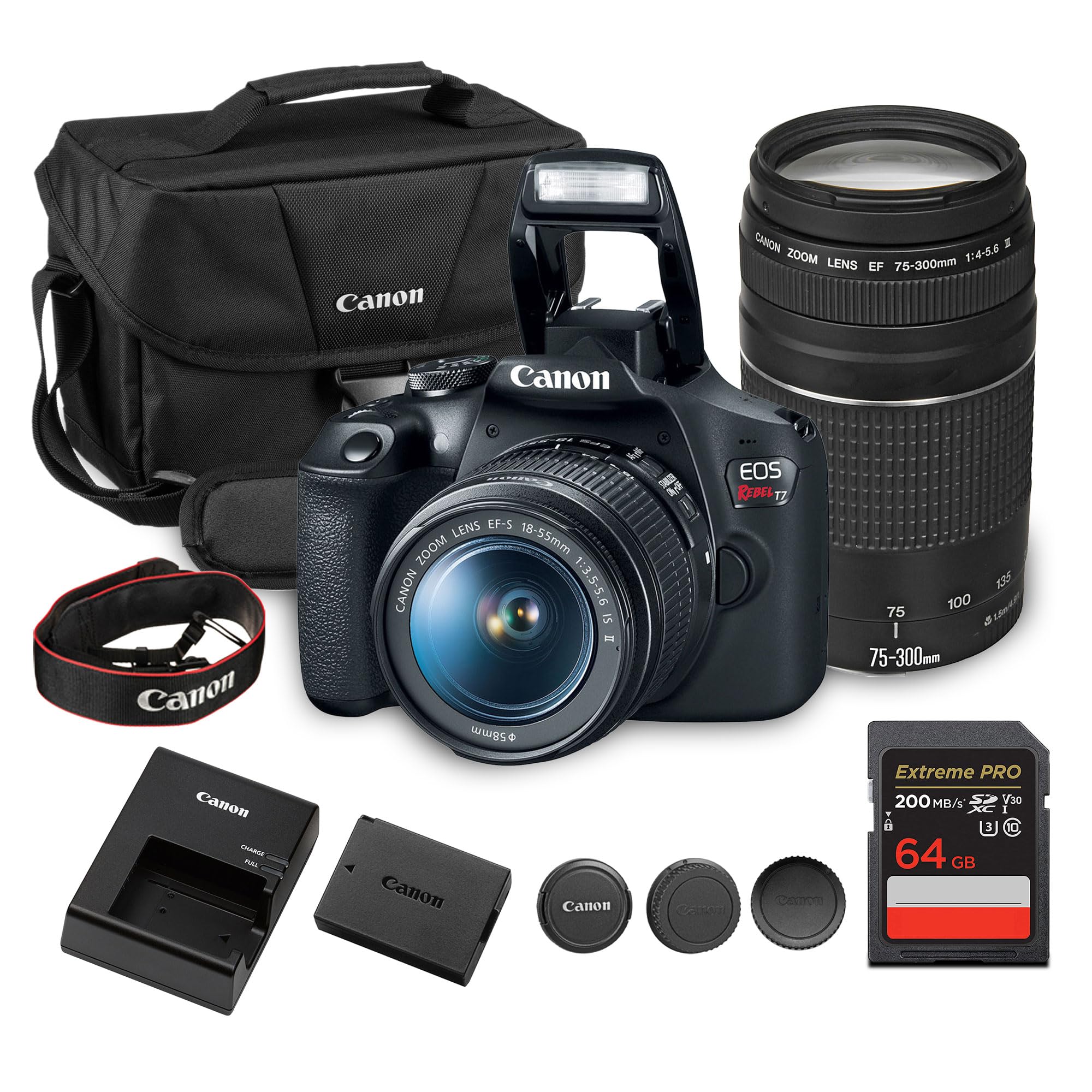
This kit bundles the classic 18-55mm standard zoom with a 75-300mm telephoto lens, covering everything from wide landscapes to distant wildlife without any additional purchase. The 24.1MP APS-C sensor produces sharp, vibrant images with Canon’s characteristic color science, and the 9-point autofocus system, while basic, is reliable for stationary and slow-moving subjects.
The optical viewfinder provides a real-time, lag-free view that many beginners prefer for learning exposure, since you see exactly what the lens sees. Full HD 1080p video at 30 fps is adequate for casual clips, though the autofocus can be audible in quiet scenes. The included 64GB SD card and shoulder bag make this a true out-of-box solution.
The 75-300mm is a budget telephoto — it’s sharp in the center but softens at the edges at 300mm, and its f/5.6 maximum aperture struggles in fading light. The 9-point AF system feels dated compared to mirrorless alternatives, and the EF-S mount is being phased out in favor of RF. Still, the two-lens versatility at this price is hard to beat.
Why it’s great
- Two-lens kit covers wide to 300mm telephoto range
- 24.1MP APS-C sensor with excellent Canon color rendering
- Includes bag, 64GB card, and accessories — ready to shoot
Good to know
- 75-300mm lens shows edge softness at full extension
- 9-point AF system feels basic for action photography
- EF-S mount is a legacy system with limited modern lens development
6. Canon EOS Rebel T7 (18-55mm + 50mm f/1.8)
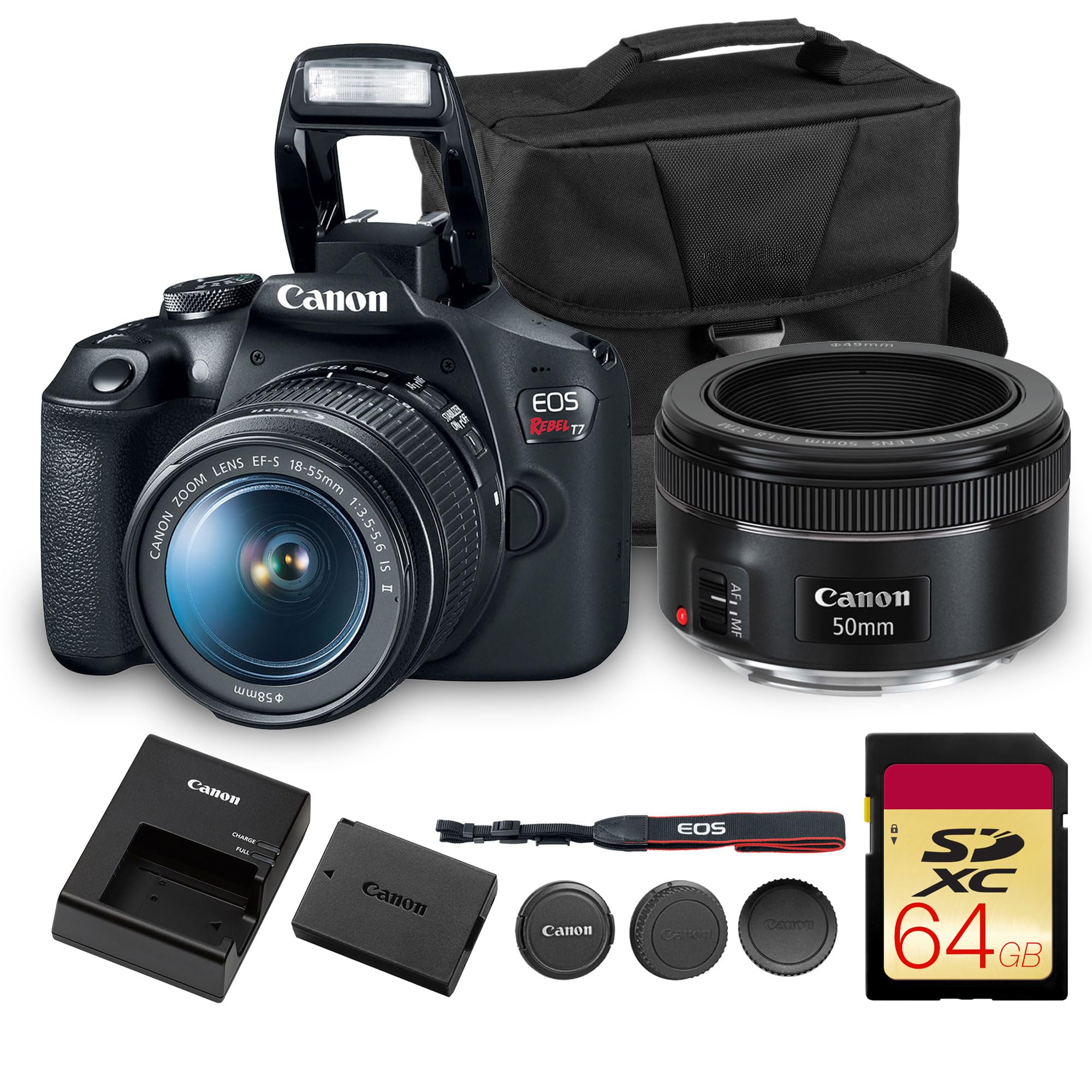
Including the EF 50mm f/1.8 STM lens transforms the Rebel T7 from a capable kit into a portrait and low-light powerhouse. That bright f/1.8 aperture produces smooth background blur (bokeh) and lets in over twice as much light as the kit zoom at 55mm, making indoor and evening photography viable without a tripod. The 24.1MP APS-C sensor pairs well with the sharp prime for detailed, contrast-rich images.
The 18-55mm IS II kit lens handles everyday wide-angle and travel shots, while the 50mm becomes your go-to for people, details, and creative isolation. Full HD 1080p video is functional, and the Canon Camera Connect app enables Wi-Fi photo transfer to your phone for social sharing. The optical viewfinder and straightforward menu system keep the learning curve gentle.
The 9-point autofocus system limits subject tracking for moving kids or pets, and the EF-S mount’s gradual phase-out means fewer new lens releases. The 50mm lens requires you to physically zoom with your feet, which may feel restrictive for beginners accustomed to zooms. The included bag and 64GB card make this a nearly complete starter kit.
Why it’s great
- f/1.8 prime delivers beautiful bokeh and superior low-light performance
- Two-lens versatility with standard zoom and fast prime
- Wi-Fi connectivity for easy photo sharing to smartphone
Good to know
- 9-point AF system is basic for tracking action
- 50mm prime requires physical movement to frame shots
- EF-S mount is being phased out for RF system
7. Canon EOS Rebel T7 Kit (with Bag+64GB)
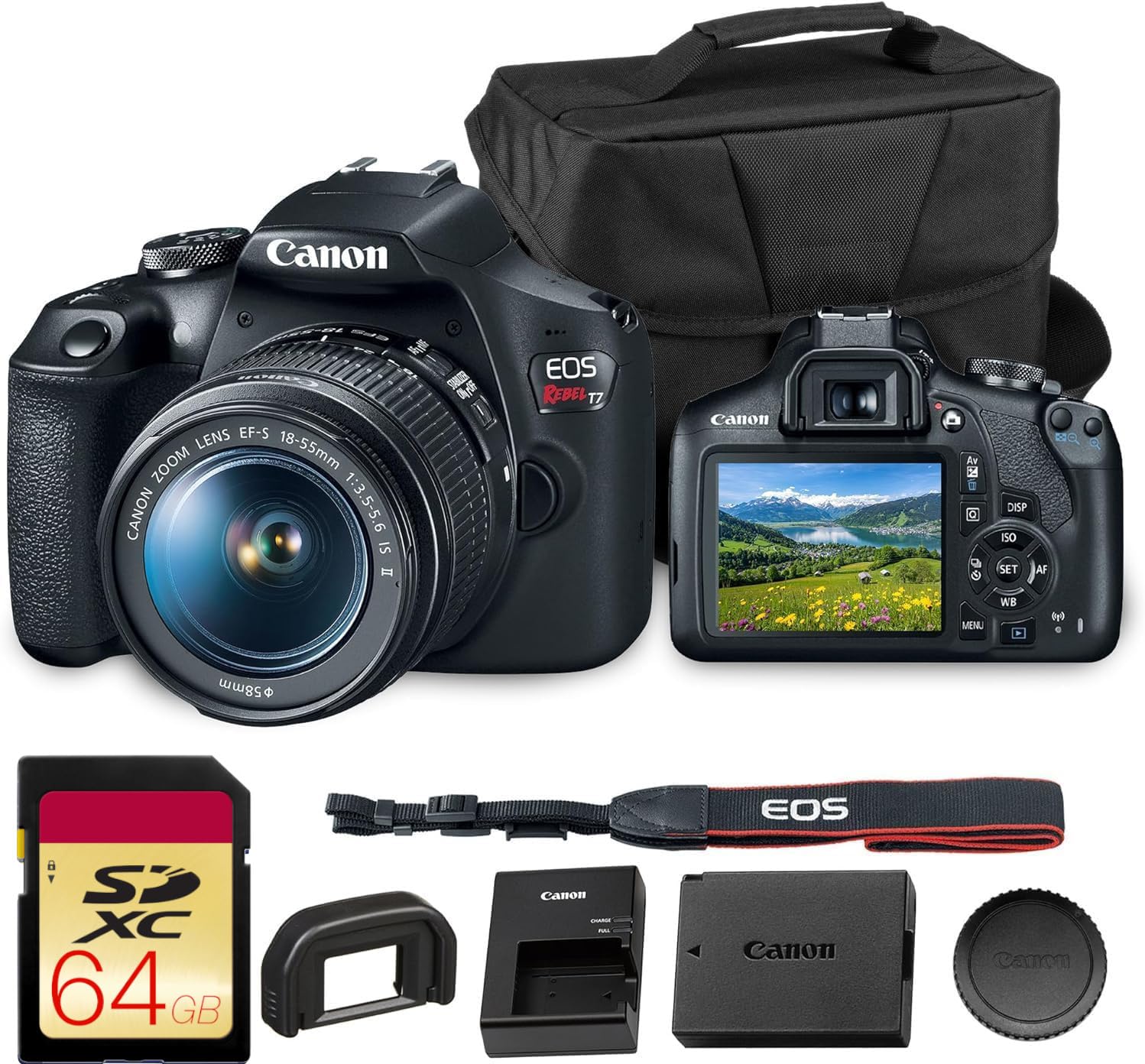
This bundle takes the tried-and-true Rebel T7 and wraps it in a complete package with a shoulder bag and 64GB SD card, removing the two most common friction points for beginners. The 24.1MP sensor with DIGIC 4+ processor delivers clean JPEGs straight out of camera with excellent color, and the 9-point AF system is simple enough to not overwhelm someone learning composition basics.
Built-in Wi-Fi and NFC let you transfer images to a smartphone via the Canon Camera Connect app for sharing on social media. The 18-55mm IS II lens includes image stabilization that reduces blur from hand shake at slower shutter speeds. The optical viewfinder provides a clear, real-time view with no lag, and the scene intelligent auto mode sets exposure, focus, and color balance automatically.
The app experience can be inconsistent — some users report connection drops during transfer. The 9-point AF system is adequate for static subjects but struggles with fast-moving children or pets. The EF-S mount’s long-term viability is uncertain as Canon shifts focus to RF, but the massive used lens market means affordable glass remains plentiful.
Why it’s great
- Complete bundle includes bag, 64GB card, and lens — ready to use
- 24.1MP APS-C sensor with pleasing Canon color science
- Wi-Fi and NFC enable quick photo transfer to smartphone
Good to know
- 9-point AF system is basic for moving subjects
- Canon Camera Connect app can be unreliable
- EF-S mount is a legacy platform with limited future lens development
8. Canon EOS R100 Bundle
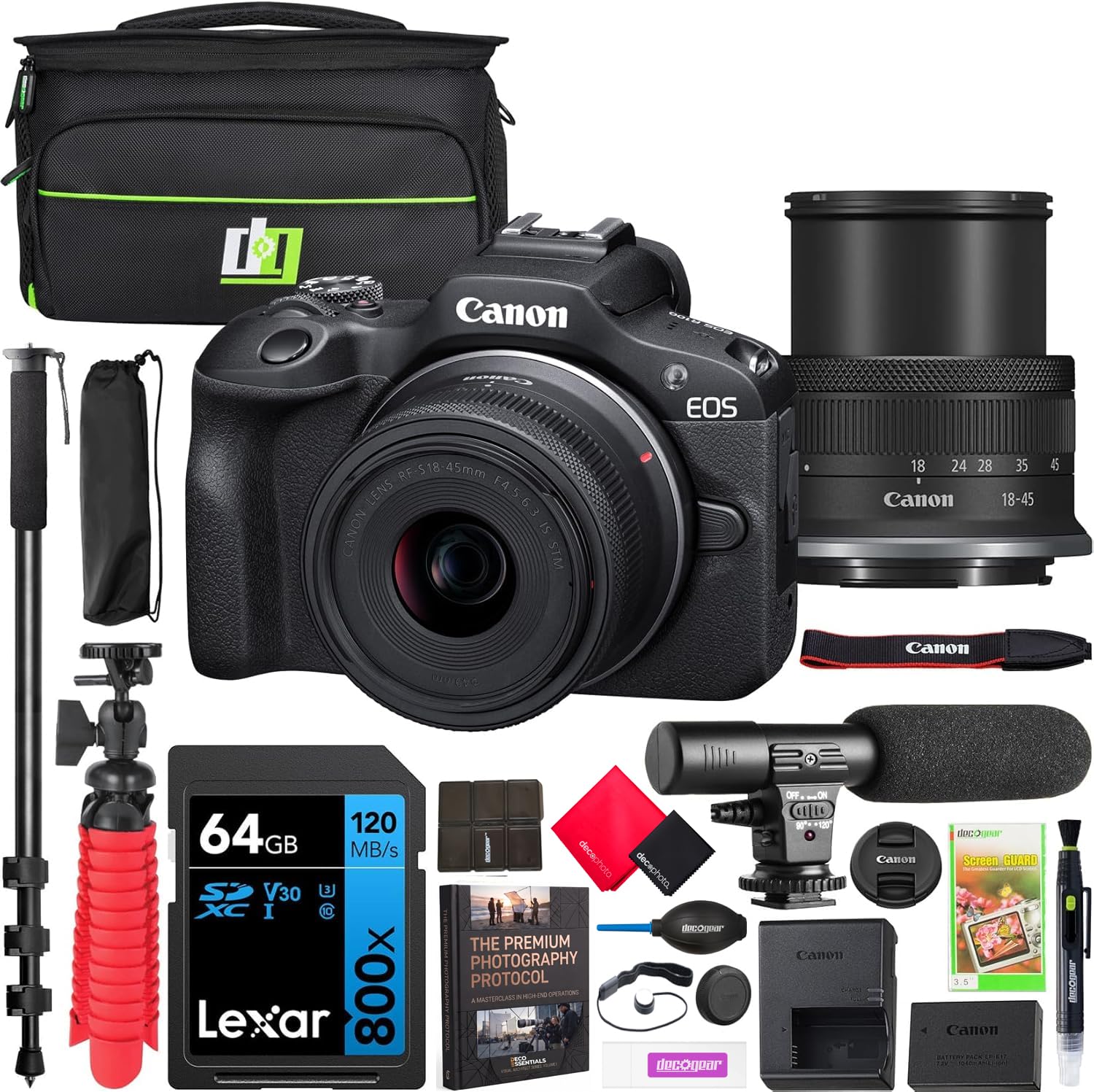
The EOS R100 is Canon’s most affordable RF-mount mirrorless camera, offering a 24.1MP APS-C sensor and DIGIC 8 processor in a body small enough to slip into a coat pocket. The 143-point Dual Pixel CMOS AF system provides smooth focus tracking for faces and moving subjects, and the bundled Deco Gear accessories — including a monopod, shotgun microphone, and 64GB card — cover the basics without requiring additional purchases.
4K video is cropped and limited to 24 fps, but Full HD at 60 fps is smooth for action clips. The 6.5 fps burst rate is modest but adequate for casual action shots. The bundle’s guidebook and digital tutorials help beginners navigate the RF system, and the compact design encourages carrying the camera daily rather than leaving it on a shelf.
The 4K crop factor is significant, making the 18-45mm kit lens feel tighter than expected for wide shots. Battery life is limited — around 4 hours of intermittent use — and the image quality in dim light shows more noise than larger APS-C competitors. The RF-S lens selection is still growing, so affordable third-party options are scarce.
Why it’s great
- Compact RF-mount body is highly portable for everyday carry
- 143-point Dual Pixel CMOS AF for smooth focus tracking
- Generous accessory bundle with monopod, mic, and card
Good to know
- 4K video is cropped with no uncropped option
- Low-light performance lags behind larger APS-C bodies
- RF-S lens ecosystem is limited and comparatively expensive
9. Canon EOS Rebel T7 (2727C002)

The base Rebel T7 kit with the 18-55mm IS II lens is the quintessential beginner DSLR — straightforward, reliable, and backed by decades of Canon EF/EF-S lens compatibility. The 24.1MP sensor with DIGIC 4+ processor captures detailed images with natural color reproduction, and the optical viewfinder provides a clear, lag-free view that helps new photographers understand the relationship between focal length, aperture, and composition.
The 9-point AF system includes a center cross-type sensor that locks on accurately in good light, and the scene intelligent auto mode handles exposure decisions seamlessly while you learn. Full HD 1080p video at 30 fps is functional for home movies, and the built-in flash adds versatility for indoor shots. Battery life is excellent — expect around 500 shots per charge with moderate use.
The 9-point AF system feels restrictive after you outgrow it, with no coverage at the edges of the frame. The 18-55mm lens is optically adequate but not exceptional, and the fixed LCD screen limits creative angles. The menu system, while logical, is dated and lacks touchscreen capability, requiring button navigation.
Why it’s great
- Reliable 24.1MP APS-C sensor with proven Canon color science
- Optical viewfinder is excellent for learning exposure fundamentals
- Excellent battery life — around 500 shots per charge
Good to know
- 9-point AF system has limited frame coverage
- Fixed LCD screen with no touch capability
- Dated menu system with button-only navigation
10. Nikon D3500

The Nikon D3500 is a classic entry-level DSLR known for its exceptional battery life (around 1,550 shots per charge), easy-to-use Guide Mode that teaches exposure triangle concepts step by step, and a 24.2MP DX-format sensor without an optical low-pass filter for extra sharpness. The kit lens includes vibration reduction (VR) to minimize hand-shake blur, and the body is lightweight enough for all-day carrying.
The 11-point autofocus system is basic but reliable, and the 5 fps burst rate captures casual action. Image quality is superb for its class, with natural colors, good dynamic range, and clean files up to ISO 3200. The optical viewfinder is bright and clear, and the ergonomic grip makes long shooting sessions comfortable.
The SnapBridge app for transferring photos to a smartphone is notoriously unreliable — many users report connection failures and crashes, particularly for remote shutter release. There is no IR sensor for a traditional remote, and the lack of a touchscreen or articulating LCD shows the camera’s age. The F-mount is a mature system with a vast used lens market, but Nikon’s focus has shifted to Z mount.
Why it’s great
- Exceptional battery life — around 1,550 shots per charge
- Guide Mode teaches exposure triangle fundamentals interactively
- 24.2MP sensor with no low-pass filter for sharp images
Good to know
- SnapBridge app is unreliable for photo transfer
- No touchscreen or articulating LCD
- No IR sensor for a traditional remote shutter release
11. Canon EOS 4000D (Renewed)

The EOS 4000D is Canon’s entry-point DSLR, packing an 18MP APS-C sensor and a 19-point autofocus system into a stripped-down body designed for the absolute lowest entry cost. While its 18MP resolution is lower than the 24MP standard, the larger sensor still provides significantly better image quality than any smartphone, with natural color reproduction and good dynamic range in good light.
The Pixi Advanced Bundle includes an additional wide-angle and zoom lens attachment, a compact tripod, a UV filter, a bag, and a microfiber cloth — giving you more to experiment with right away. The optical viewfinder provides a real-time view, and the basic scene modes (portrait, landscape, sports) help beginners get started without diving into manual settings. The battery charges via a separate charger, and the included USB cable connects for file transfer.
The 18MP sensor shows its age in low-light situations, with visible noise above ISO 1600. The plastic build feels less robust than the Rebel series, and the fixed, low-resolution LCD screen (230K dots) is difficult to use in bright sunlight for reviewing images. The bundle’s lens attachments are functional but optically inferior to a dedicated second lens. As a renewed model, cosmetic condition and included accessories vary by unit.
Why it’s great
- Lowest entry price for an interchangeable-lens camera system
- 19-point AF system offers decent coverage for basic shooting
- Bundle includes tripod, attachments, bag, and cleaning kit
Good to know
- 18MP sensor shows noise above ISO 1600
- Plastic build feels less durable than higher-tier models
- Low-resolution LCD screen is hard to view in bright sunlight
FAQ
Should I buy a DSLR or mirrorless as my first camera?
How many megapixels do I actually need as a beginner?
What is the difference between a kit lens and a prime lens?
Can I use a beginner camera for professional work later?
Final Thoughts: The Verdict
For most users, the camera for beginner photography winner is the Canon EOS R50 Creator Kit because it combines modern RF mount compatibility, a 24.2MP sensor, uncropped 4K video, and an exceptional autofocus system into a compact mirrorless body that grows with your skills without feeling overwhelming. If you prioritize smooth handheld video over still resolution, grab the Panasonic LUMIX G85 — its 5-axis IBIS is unmatched at this price. And for the absolute best balance of two-lens versatility and budget, nothing beats the Canon Rebel T7 two-lens kit.

Mo Maruf
I created WellFizz to bridge the gap between vague wellness advice and actionable solutions. My mission is simple: to decode the research and give you practical tools you can actually use.
Beyond the data, I am a passionate traveler. I believe that stepping away from the screen to explore new environments is essential for mental clarity and physical vitality.