Our readers keep the lights on and my smoothie glass nicely filled. As an Amazon Associate, I earn from qualifying purchases.
Picking up your first camera that shoots in 4K can feel like stepping into a maze of sensor sizes, lens mounts, and stabilization claims. The real challenge isn’t finding a camera that records 4K—it’s finding one that makes the learning process enjoyable while delivering results that look genuinely impressive on a big screen.
I’m Mohammad Maruf — the founder and writer behind WellFizz. For years I’ve analyzed sensor specs, autofocus systems, and real-world image quality to help new creators find hardware that doesn’t punish them for being beginners.
The right choice balances usability with room to grow, and this guide covers the best beginner 4k camera options that prioritize that exact balance.
How To Choose The Best Beginner 4K Camera
Your first 4K camera should remove friction, not add it. Beginners often over-prioritize raw resolution while ignoring the three factors that actually determine whether you will use the camera daily: stabilization, autofocus reliability, and lens ecosystem affordability.
Sensor Size Matters — But Not the Way You Think
A larger sensor, like full-frame, captures more light and creates shallower depth of field. But for a beginner, an APS-C or Micro Four Thirds sensor offers excellent image quality at a lower price point with lighter lenses. The Panasonic Lumix G85 and G7 use Micro Four Thirds sensors that are impressively capable in good light and come with affordable, high-quality glass.
Stabilization: The Secret to Usable 4K
Shaky footage is the fastest way to make 4K look amateurish. In-body image stabilization (IBIS) is a game-changer for handheld shooting. Cameras like the OM System E-M10 Mark IV and the Xtra Muse with its 3-axis gimbal make smooth video achievable without a gimbal rig, which saves money and backpack space.
Autofocus That Sticks With the Subject
A beginner’s frustration point is fighting with autofocus that hunts during a shot. Look for cameras with phase-detection or hybrid autofocus systems, like the Sony ZV-E10’s 425-point system or the Canon EOS R50’s Dual Pixel AF II. These systems track faces and eyes reliably, letting you focus on composition instead of focus.
Lens Ecosystem and Upgrade Path
The body is the start; the lenses are the investment. Canon’s RF mount for the R50 and R8, and Sony’s E-mount for the ZV-E10 and Alpha 6700, offer a wide range of options from budget-friendly primes to professional zooms. Panasonic’s Micro Four Thirds mount is one of the most mature and affordable ecosystems available.
Quick Comparison
On smaller screens, swipe sideways to see the full table.
| Model | Category | Best For | Key Spec | Amazon |
|---|---|---|---|---|
| Xtra Muse | Pocket Gimbal | Vlogging on the move | 1-inch CMOS, 3-axis gimbal | Amazon |
| Canon EOS R50 | Mirrorless APS-C | All-around beginner shooting | Oversampled 4K, Dual Pixel AF II | Amazon |
| Sony ZV-E10 | Vlogging Mirrorless | Content creation & vlogging | 425-point phase-detection AF | Amazon |
| Panasonic Lumix G85 | Mirrorless M43 | Versatile hybrid shooting | 5-axis IBIS, weather-sealed | Amazon |
| OM System E-M10 IV | Mirrorless M43 | Compact travel & selfies | 20MP sensor, 4.5-stop IBIS | Amazon |
| Panasonic Lumix G7 | Mirrorless M43 | Budget 4K video entry | No IBIS, 4K at 30fps | Amazon |
| Canon EOS R8 | Full-Frame Mirrorless | Entry full-frame quality | Uncropped 4K60p, 6K oversample | Amazon |
| Canon EOS R7 | Mirrorless APS-C | Sports & action photography | 32.5MP, 15fps mechanical | Amazon |
| Sony Alpha 6700 | Mirrorless APS-C | Hybrid photo & video pro | 26MP, 6K oversampled 4K/60p | Amazon |
| Canon EOS Rebel T7 | DSLR APS-C | Traditional DSLR experience | 24.1MP, 9-point AF | Amazon |
| Reolink RLK8-520D4 | Wired Security System | Outdoor security monitoring | 5MP HD, 2TB HDD included | Amazon |
In‑Depth Reviews
1. Xtra Muse Vlogging Camera
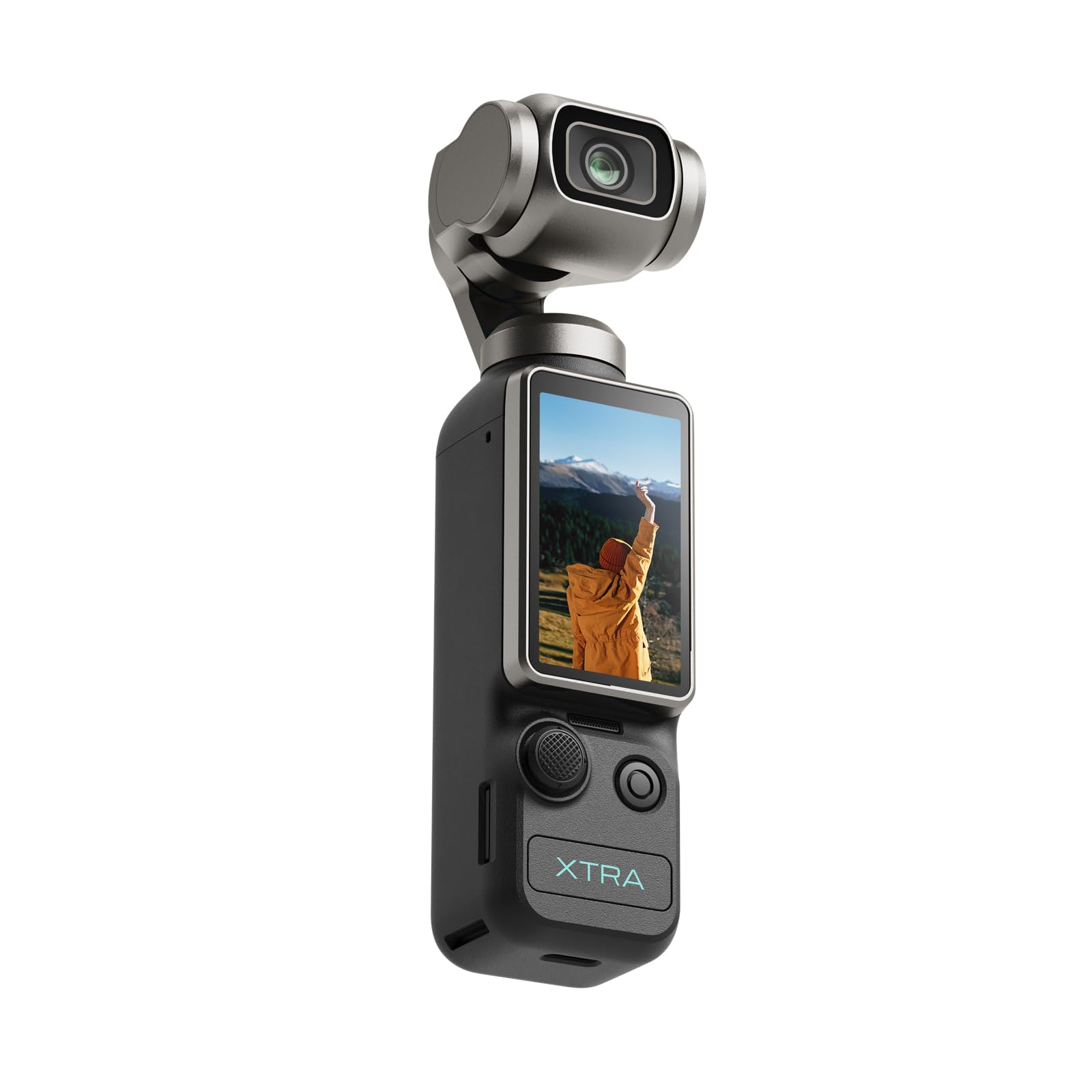
The Xtra Muse is the rare beginner camera that solves the most common 4K video problem before you even press record. Its 1-inch CMOS sensor punches well above its size, and the built-in 3-axis gimbal eliminates the need for a separate stabilizer—a massive advantage for handheld vlogging. The result is buttery-smooth 4K footage at 120fps that looks like it was shot on a much more expensive rig.
Master Follow keeps you centered in the frame during movement, and the 10-bit X-Log color mode gives you room to grade footage without posterization. The 2-inch touchscreen swivels for selfie framing, and the battery lasts roughly 161 minutes, which covers a full day of casual shooting. It also packs down small enough to slip into a jacket pocket.
New users will appreciate that the learning curve is shallow. Autofocus is snappy, face and object tracking is reliable, and the included bundle—carrying bag, wrist strap, and 1/4-inch thread handle—covers the basics out of the box. This is the single most beginner-friendly path to smooth, high-bitrate 4K.
Why it’s great
- Integrated 3-axis gimbal eliminates shakiness without extra gear.
- 1-inch sensor delivers excellent dynamic range for the size.
- 10-bit X-Log color profile allows real post-production grading.
Good to know
- Some third-party DJI accessories may not auto-connect without a firmware update.
- Pocketable form factor means a smaller screen than a full mirrorless body.
2. Canon EOS R50 Mirrorless Camera Kit

The Canon EOS R50 is a lightweight APS-C mirrorless body that makes the leap from smartphone to dedicated camera feel natural. Its Dual Pixel CMOS AF II system covers most of the frame with 99 autofocus points, locking onto faces, eyes, and animals with a confidence that beginners usually only see in high-end bodies. The 18-45mm kit lens covers wide to standard focal lengths, making it versatile for daily photography and casual vlogging.
Oversampled 4K video means the camera uses more than 4K of sensor data to produce a final 4K image, resulting in noticeably sharper and cleaner footage than standard 4K capture. Creative Assist mode provides on-screen explanations of how aperture, shutter speed, and ISO affect the image—a genuine learning tool. There’s also a vertical video mode for social media output without cropping.
The vari-angle touchscreen flips out to face you, and the bundle includes a shoulder bag and 64GB SD card right out of the box. Image quality is very good for the price point, and the RF lens mount opens up a growing lineup of native lenses. Anyone looking for a forgiving, feature-rich entry point into mirrorless 4K should consider this.
Why it’s great
- Oversampled 4K video produces noticeably sharper footage.
- Dual Pixel AF II provides fast, reliable subject tracking.
- Creative Assist teaches exposure fundamentals visually.
Good to know
- Kit lens aperture is relatively slow at f/4.5-6.3.
- No built-in flash requires external lighting in dim settings.
3. Sony ZV-E10 Mirrorless Camera Bundle

The Sony ZV-E10 is purpose-built for content creators who want to shoot 4K without wrestling menus or fighting focus. Its 24.2MP APS-C Exmor CMOS sensor pairs with a 425-point phase-detection autofocus system that sticks to subjects with a tenacity that feels almost automatic. Real-time Eye AF ensures that if a person is in frame, their eye is in focus—even during movement.
Video features include UHD 4K at 30fps and Full HD at 120fps for slow-motion. The Product Showcase Setting transitions focus quickly from your face to an object held up to the lens, which is useful for review-style content. The side flip-out touchscreen works well for self-recording, and the directional 3-capsule microphone with a windscreen captures cleaner audio than most built-in mics.
The deluxe bundle includes a 128GB card, spare battery, charger, wide-angle and 2x lenses, tripod, and editing software. This is an everything-you-need starter kit. The E-mount lens ecosystem is also massive. The ZV-E10 strikes an excellent balance between price, video performance, and ease of use.
Why it’s great
- 425-point AF system provides reliable, fast tracking for video.
- Product Showcase Setting is excellent for demo-style content.
- Deluxe bundle delivers great value with all essential accessories.
Good to know
- Menu system has a learning curve for new Sony users.
- In-body stabilization is decent but not as strong as a gimbal.
4. Panasonic Lumix G85

The Panasonic Lumix G85 is a mirrorless camera that prioritizes in-body stabilization more aggressively than almost any other at its level. Its 5-axis dual image stabilization works with the lens OIS to produce incredibly steady handheld footage, which is critical for a beginner who hasn’t yet mastered panning technique. The 16MP Micro Four Thirds sensor skips the low-pass filter, resulting in a noticeable boost in fine-detail resolving power.
The magnesium alloy body is weather-sealed, so light rain and dust won’t end a shoot. The 12-60mm Power OIS kit lens provides a useful 24-120mm equivalent range, covering wide landscapes to moderate telephoto. The OLED live viewfinder has 2360K dots and is bright even in direct sunlight, and the rear 3-inch tilt-and-touch LCD allows flexible framing angles.
4K video recording at 30fps is solid, and the 4K Photo mode lets you pull 8MP stills from video clips. The G85 is a camera that grows with you: its manual controls are accessible enough for a beginner but deep enough for an enthusiast to explore composition and exposure fully.
Why it’s great
- 5-axis IBIS delivers handheld smoothness that rivals a basic gimbal.
- Weather-sealed magnesium alloy body is durable and reliable.
- 12-60mm kit lens provides a very practical zoom range.
Good to know
- Autofocus can struggle slightly in very low light or when shooting 4K video.
- WiFi implementation can be finicky with the Image App.
5. OM System Olympus E-M10 Mark IV

The OM System E-M10 Mark IV is compact enough to fit into a jacket pocket with the 14-42mm EZ pancake lens attached, yet it packs a 20MP Live MOS sensor and 5-axis in-body stabilization rated for 4.5 shutter speed stops of compensation. That stabilization matters immensely for handheld 4K video at 30fps—footage remains remarkably fluid even when walking slowly.
A flip-down monitor enables dedicated selfie mode, automatically switching the camera into a self-portrait configuration when the screen is tilted downward. The camera also includes 16 Art Filters with 31 variations, including an Instant Film option that gives stills a nostalgic, stylized look straight out of camera. For a beginner who wants to share without editing, these filters can be fun and useful.
The 121-point contrast-detect autofocus is fast in good light, and the OM Systems lens ecosystem—shared with Panasonic’s Micro Four Thirds mount—is one of the most affordable and varied anywhere. This is a strong choice for travelers or anyone who prioritizes portability.
Why it’s great
- Extremely compact size with the pancake lens makes it pocketable.
- 4.5-stop IBIS is excellent for handheld video at this size.
- Built-in art filters and selfie mode are beginner-friendly.
Good to know
- Uses micro-USB for charging instead of USB-C.
- WiFi transfer speeds to the app are slower than modern standards.
6. Panasonic Lumix G7

The Panasonic Lumix G7 remains a strong entry point into 4K video on a tight budget. Its 16MP Micro Four Thirds sensor, which lacks a low-pass filter, resolves sharp images with good dynamic range, and the camera records 4K QFHD video at 30fps. The 4K Photo mode lets you extract high-resolution stills from video clips—a creative tool that many beginners find useful for capturing split-second moments.
The G7’s handling is one of its strongest suits. Front and rear dials let you adjust aperture and shutter speed quickly, and six customizable function buttons put frequently used settings within thumb reach. The high-resolution OLED live viewfinder (2360K dots) is bright and detailed, and the 3-inch touchscreen tilts and swivels for flexible framing. A 3.5mm microphone port allows an external mic connection, which dramatically improves audio quality.
The trade-offs are worth noting: there is no in-body stabilization, so shaky video is a real concern without a gimbal. The plastic body lacks weather sealing, and low-light performance begins to suffer past ISO 1600. Still, for a beginner who prioritizes video features and manual control at the lowest entry cost, the G7 is a capable workhorse.
Why it’s great
- Excellent value for a camera with 4K video and mic input.
- Intuitive dual-dial controls make manual shooting easy to learn.
- 4K Photo mode is a creative asset for capturing stills from motion.
Good to know
- No in-body stabilization means you need steady hands or a gimbal for smooth video.
- Low-light performance is limited; above ISO 3200 images become noisy.
7. Canon EOS R8

The Canon EOS R8 is the lightest full-frame RF mount mirrorless camera Canon makes, and it brings professional-grade imaging down to a price point that ambitious beginners can justify. The 24.2MP full-frame CMOS sensor with DIGIC X processor delivers exceptional dynamic range, low-light performance up to ISO 102400, and natural color science straight out of camera.
Video is a highlight: uncropped 4K at 60fps that is oversampled from 6K, resulting in very detailed footage with organic grain. Canon Log 3 is available for advanced color grading, and the Dual Pixel CMOS AF II system covers 100 percent of the frame with 1,053 zones, tracking subjects automatically using deep learning technology that recognizes people, animals, and vehicles.
The 0.39-inch OLED EVF offers a 120fps refresh rate for smooth viewing, and the vari-angle touchscreen is ideal for selfie positioning. The main compromises are a small battery that drains faster than larger full-frame models and a single SD card slot. For a beginner willing to invest in a system with no cap on growth potential, the R8 is a serious step up.
Why it’s great
- Uncropped 4K60p video oversampled from 6K looks incredibly sharp.
- Full-frame low-light performance is a major upgrade over APS-C.
- Canon Log 3 and deep learning AF make it a hybrid powerhouse.
Good to know
- Battery life is limited—carry a spare for a full day of shooting.
- No in-body stabilization; you’ll need IS lenses or a gimbal for video.
8. Canon EOS R7

The Canon EOS R7 is an APS-C body with a 32.5-megapixel sensor and a burst shooting capability that will satisfy beginners who want to photograph sports, wildlife, or fast-moving kids. It fires at 15fps with the mechanical shutter and up to 30fps with the electronic shutter, with a RAW Burst Mode that captures a half-second of frames before you fully press the shutter.
Dual Pixel CMOS AF technology provides up to 651 autofocus zones covering nearly 100 percent of the frame. The camera’s subject detection is smart enough to lock onto animals during erratic movement, and the 5-axis in-body stabilization (IBIS) with auto-level technology keeps images and video steady even in dim light. The R7 also supports 4K video with oversampling and Movie Servo AF for continuous tracking during recording.
The compact body has a deep, comfortable grip, and dual SD card slots give you backup storage for important shoots. Battery life is surprisingly strong for this class, and the LP-E6NH pack lasts through long sessions. The R7 is a lot of camera for someone who wants to grow into action photography quickly without moving to a full-frame body.
Why it’s great
- 32.5MP sensor and 15fps burst are ideal for action and sports.
- 651-point AF system tracks subjects with high accuracy.
- 5-axis IBIS provides excellent stabilization for handheld shooting.
Good to know
- Body-only purchase requires a separate lens investment.
- Some non-Canon RF lenses may have autofocus compatibility issues.
9. Sony Alpha 6700

The Sony Alpha 6700 is the most advanced APS-C camera on this list, and it justifies its position with a dedicated AI processor that powers real-time recognition for subjects including humans, animals, birds, insects, cars, and trains. The 26MP Exmor R back-illuminated CMOS sensor combined with the BIONZ XR processor delivers exceptional image quality with very low noise at high ISO levels.
Video capabilities are borderline professional: 4K at 60p oversampled from 6K, 4K 120p for high-frame-rate slow motion, and 10-bit 4:2:2 recording with both Long GOP and All Intra compression. Sony’s S-Log3 and S-Cinetone color profiles are available, the latter being the same color science used in Sony’s cinema line. The 759-point phase-detection autofocus array is fast and tenacious.
The body is compact and lightweight, making it easy to carry for long periods. Battery life is strong for mirrorless shooting, though intensive 4K recording can drain it within an hour. The menu system remains complex, but once configured, the shooting experience is fluid. For a beginner who wants a single camera that can handle professional-grade hybrid work, the Alpha 6700 delivers.
Why it’s great
- AI-based subject tracking is the most accurate in this class.
- 6K oversampled 4K60p and 4K120p provide outstanding video quality.
- S-Cinetone color science offers cinematic color straight out of camera.
Good to know
- Sony’s menu system has a steep learning curve for new users.
- Battery life under heavy 4K recording may require carrying spares.
10. Canon EOS Rebel T7

The Canon EOS Rebel T7 is a traditional DSLR that offers a straightforward, optical-viewfinder shooting experience at a very accessible price. Its 24.1MP APS-C CMOS sensor produces the same image quality as many higher-end Canon cameras, and the EF-S 18-55mm kit lens is a capable, stabilized standard zoom. For a beginner who wants to learn exposure fundamentals without a menu-diving touchscreen, the T7 is an excellent teacher.
The 9-point autofocus system is basic compared to mirrorless rivals, but in good light it locks onto static subjects quickly. Built-in WiFi and NFC allow easy transfer of photos to a smartphone for social sharing, though transfer speeds are moderate. The camera also works as a webcam via Canon’s EOS Utility software, adding remote work utility.
The T7’s strengths are simplicity and battery life—the optical viewfinder sips power, so a single charge can last for hundreds of shots. On the downside, it records only Full HD video at 1080p, not 4K. For someone whose priority is learning photography with a classic DSLR feel and who is willing to sacrifice 4K video, the Rebel T7 remains a reliable choice.
Why it’s great
- Optical viewfinder provides a classic, battery-efficient shooting experience.
- Proven 24.1MP sensor delivers great photos at a low entry cost.
- Large ecosystem of affordable EF and EF-S lenses.
Good to know
- Records Full HD, not 4K—this is a stills-first camera.
- 9-point AF system is limited for fast action or video.
11. Reolink RLK8-520D4 5MP Home Security System
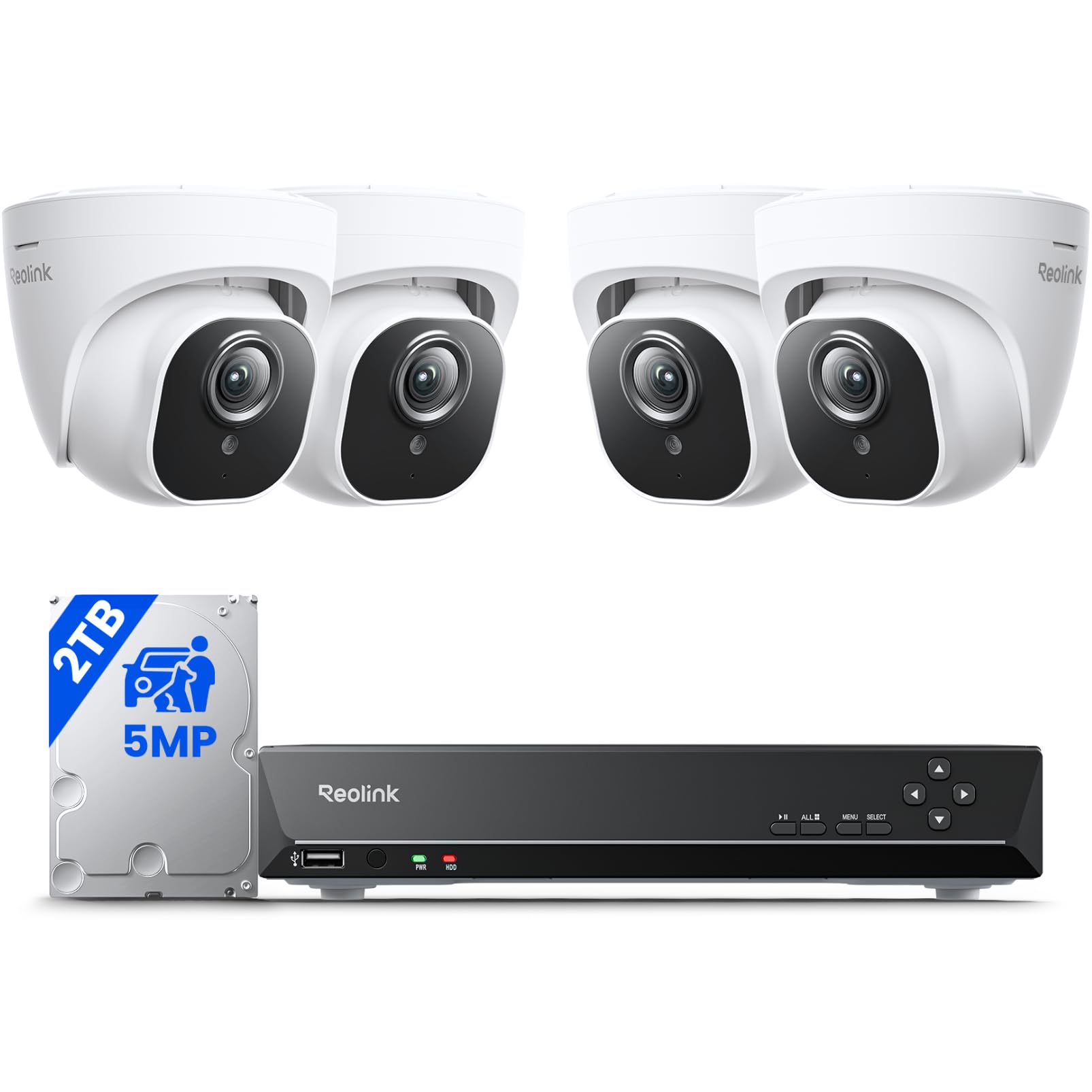
The Reolink RLK8-520D4 is a wired PoE security system that records 5MP HD video 24/7 and stores it on a 2TB hard drive for up to ten days without overwriting. This is not a camera for creative filmmaking, but it is a valid beginner-level surveillance camera option for someone who wants to monitor their property in high resolution. Each of the four cameras features a 100-foot IR night vision range.
Smart person, pet, and vehicle detection reduces false alerts from bugs or moving leaves. The NVR connects directly to the cameras via PoE—no WiFi configuration needed—and the Reolink app allows remote viewing and playback from a smartphone or tablet. The built-in microphone on each camera also captures audio, which can be useful for catching suspicious sounds.
Setup is straightforward: run the Ethernet cables to the NVR, and the system auto-discovers each camera. The image quality is crisp during the day and competently exposed at night. However, motion detection is pixel-based rather than AI-driven on some models, which can lead to occasional false positives. For a security-focused beginner, this is a reliable, no-subscription system.
Why it’s great
- 2TB pre-installed HDD stores days of footage without cloud fees.
- Smart person/vehicle/pet detection cuts down on false alerts.
- PoE setup is simple for a beginner and doesn’t rely on WiFi.
Good to know
- Cameras work only with Reolink NVRs—no third-party integration.
- Camera connectors are bulky and may need additional weatherproofing.
FAQ
Is a full-frame sensor worth the extra money for a beginner?
Do I need a gimbal for smooth 4K video, or is IBIS enough?
Why do some cameras record 4K at 60fps while others only do 30fps?
Final Thoughts: The Verdict
For most users, the best beginner 4k camera winner is the Xtra Muse because it removes the two biggest beginner pain points—shaky footage and complex menus—with a built-in gimbal and simple touchscreen. If you want a versatile mirrorless with room to grow into manual photography, grab the Canon EOS R50. And for aspiring content creators who want the best video value in a complete bundle, nothing beats the Sony ZV-E10.

Mo Maruf
I created WellFizz to bridge the gap between vague wellness advice and actionable solutions. My mission is simple: to decode the research and give you practical tools you can actually use.
Beyond the data, I am a passionate traveler. I believe that stepping away from the screen to explore new environments is essential for mental clarity and physical vitality.