Our readers keep the lights on and my smoothie glass nicely filled. As an Amazon Associate, I earn from qualifying purchases.
The single biggest mistake in a cabinet refinish isn’t the color—it’s the layer underneath. You can spend hours on the perfect top coat, but if the primer fails to bond, chips, or lets stains bleed through, you’re back to square one in months. The right cabinet primer doesn’t just stick; it transforms problematic surfaces into a uniform foundation that holds tight against grease, moisture, and daily slams.
I’m Mohammad Maruf — the founder and writer behind WellFizz. I’ve spent years studying adhesion chemistry, pore-filling capacity, and blocking efficiency across dozens of coatings so you don’t have to guess which can actually delivers a factory-grade finish on laminate, MDF, or old painted wood.
Whether you’re sealing in odors from decades of cooking or prepping glossy thermofoil for a fresh look, the best cabinet primer is the one that sticks without sanding, self-levels to hide brush marks, and forms a waterproof barrier that your top coat can trust.
How To Choose The Best Cabinet Primer
Cabinet primers do more than just add a white layer—they are the mechanical and chemical bridge between your substrate and the final paint. Selecting the wrong one leads to peeling, bleed-through, or a tacky surface that never cures hard. Focus on these three factors before you open a can.
Adhesion Mechanism: Mechanical vs. Chemical Bond
A primer’s job is to grip. On raw wood or sanded surfaces, mechanical adhesion works—the primer flows into micro-grooves and locks in. On glossy laminate, tile, or previously painted cabinets, you need a chemical bond. Look for urethane acrylics or bonding primers that contain specialized resins designed to stick to slick surfaces without sanding. If the manufacturer explicitly calls out “no sanding on glossy surfaces,” you’re looking at a chemical-bond product.
Stain and Odor Blocking Capability
Kitchen cabinets collect grease, smoke, and sometimes pet odors that can migrate through ordinary water-based primers. If you’re covering smoke damage or old wood that smells musty, a shellac-based or odor-killing primer with a sealant property is non-negotiable. These formulas dry clear or white but form a vapor-proof membrane that locks contaminants underneath so they never reach your top coat.
Dry Time and Recoat Window
Cabinet work often involves multiple coats and tight schedules. A primer that dries to the touch in 20 minutes lets you apply the first color coat the same day, while a slow-curing urethane may need 24 hours before sanding. Check the “recoat” time on the label—if you’re working on a single set of doors in a weekend, fast-drying options save you from project paralysis.
Quick Comparison
On smaller screens, swipe sideways to see the full table.
| Model | Category | Best For | Key Spec | Amazon |
|---|---|---|---|---|
| INSL-X Cabinet Coat | Urethane Acrylic | Durable satin finish, no primer needed | 87–112 sq ft per quart | Amazon |
| XIM UMA Bonder/Sealer | Bonding Primer | Laminate/formica adhesion | Low temp application | Amazon |
| Rust-Oleum Painter’s Touch 2X | Aerosol Spray | Small projects and touch-ups | 12 oz per can, 20 min dry | Amazon |
| Zinsser Odor Killing Primer | Odor Blocking | Pet/smoke odor seal | Up to 400 sq ft per gallon | Amazon |
| Heirloom Traditions ALL-IN-ONE | All-in-One Paint | No prep, no separate primer | 140 sq ft per quart, no sanding | Amazon |
In‑Depth Reviews
1. INSL-X Cabinet Coat

This is the closest thing to a factory finish in a can—a urethane acrylic enamel from Benjamin Moore & Co. that doubles as its own primer. It self-levels aggressively, meaning brush strokes and roller texture melt away before the paint sets, leaving a mirror-smooth surface that resists chipping, scuffing, and kitchen grease. Coverage sits around 87–112 square feet per quart, enough for a set of standard upper cabinets with care.
The consistency is thin on purpose; it flows into corners without puddling but can run if you overload the brush. Multiple coats on bare MDF produce a durable shell that one reviewer said lasted 25 years through teens and pets. That’s not marketing—that’s a real lifespan claim from a verified buyer. You do need patience: dry time between coats can stretch to 24 hours, and foam rollers introduce bubbles that ruin the finish.
It applies best with a high-quality nylon/polyester brush and requires a respirator due to strong fumes. The satin sheen is forgiving on imperfect surfaces, and it bonds to hard-to-coat surfaces without a separate primer step. For anyone wanting a single-product solution that delivers commercial-grade toughness, this is the standard.
Why it’s great
- Outstanding self-leveling hides brush marks
- Extremely durable satin finish resists stains and chips
- Bonds without separate primer on most surfaces
Good to know
- Thin formula runs easily on vertical doors
- Foam rollers cause bubbling—avoid them
- 24-hour dry time between coats requires planning
2. XIM UMA Acrylic Bonder and Primer/Sealer

If you’ve ever tried to paint laminate or formica and watched the top coat peel off in sheets within weeks, XIM UMA is the fix. It’s a specialty bonding primer engineered for “wet adhesion”—a chemical grip that locks onto ultra-smooth, glossy surfaces where standard primers slide right off. Reviewers consistently report passing the fingernail scratch test on laminate, which is the ultimate proof of bond strength.
It applies as a matte finish with excellent leveling, so you don’t get those frustrating lap marks. The formula works in low temperatures and high humidity, which is a lifesaver if you’re painting in a garage or basement without climate control. It’s low-odor and compatible with any top coat, including epoxy, which makes it a go-to for countertop refacing as well as cabinet doors.
The one catch is that the finish can appear blotchy or uneven after three coats on certain surfaces like cultured marble. That’s cosmetic—the bond is still there—but you’ll want a quality top coat to cover it. It dries fast enough for same-day top coating, though waiting 24 hours on problematic substrates is insurance against failure.
Why it’s great
- Exceptional adhesion to glossy laminate and formica
- Low-odor formula works in tight spaces
- Effective in low-temp/high-humidity conditions
Good to know
- Blotchy finish may require extra top coat coverage
- Not a stain-blocker—use shellac for odor sealing
- Coverage is moderate; buy two quarts for full kitchen
3. Rust-Oleum Painter’s Touch 2X Ultra Cover

For small cabinet projects, touch-ups, or details like drawer fronts and trim pieces, this aerosol primer/paint hybrid delivers convenience. It’s an oil-based formula that dries to the touch in 20 minutes and fully cures in 48 hours, making it possible to complete a small refresh in a single afternoon. The 2X coverage system means one coat often hides the old surface, reducing the number of passes.
It works on wood, plastic, metal, masonry, and unglazed ceramic, so it’s not cabinet-exclusive—but that versatility is useful if you’re also coating handles or hardware. The gloss white finish provides a bright, clean look that mimics appliance-grade surfaces. Reviewers consistently praise the smooth, even spray pattern and the nozzle design that minimizes drips when used with steady motion.
The trade-off is that aerosol cans are inefficient for full cabinet sets. At 12 ounces per can covering only about 12 square feet, you’ll need multiple cans for a typical kitchen. The fragrance is strong—oil-based—so a respirator and ventilation are mandatory. It’s also not a dedicated primer; on glossy surfaces, the adhesion relies on light sanding, which contradicts the “no prep” promise.
Why it’s great
- Dries in 20 minutes for rapid project turnover
- Smooth spray pattern with minimal drips
- Works on multiple materials beyond cabinets
Good to know
- Low coverage per can—expensive for full kitchens
- Requires sanding for glossy cabinet surfaces
- Strong solvent fumes need heavy ventilation
4. Zinsser Odor Killing Primer
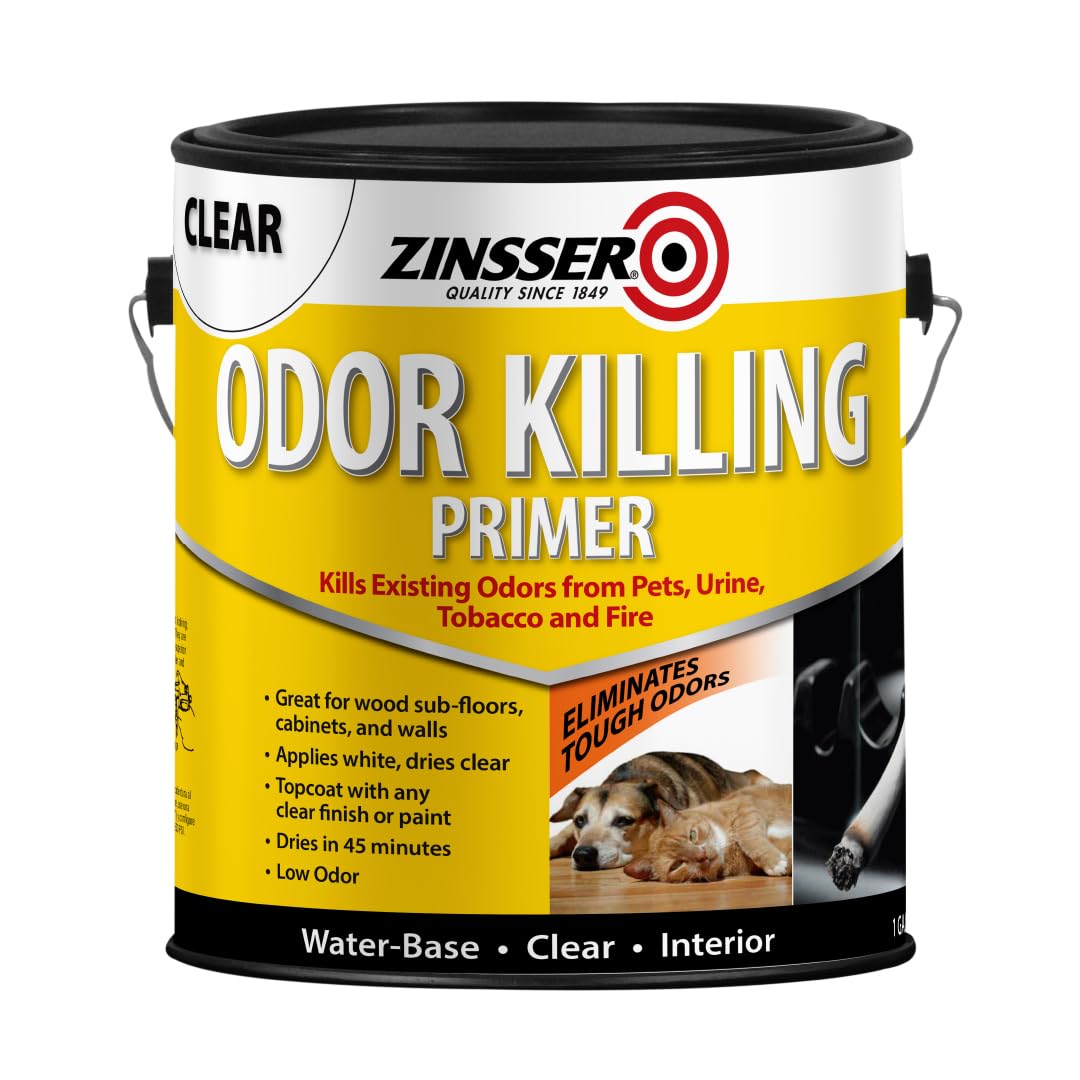
If you’re refinishing cabinets that have absorbed years of pet urine, cigarette smoke, or fire damage, a standard primer will fail. Zinsser’s odor-killing formula is a surface deodorizer that forms a vapor-proof membrane—it doesn’t just mask smells, it seals the source. It applies white and dries clear, so you can see exactly where you’ve coated, and it dries to the touch in 25–30 minutes, allowing rapid top coating.
Coverage is massive: up to 400 square feet per gallon, enough for an entire kitchen’s worth of cabinet boxes and doors on a single can. It adheres to glossy finishes like ceramic tile and glass without sanding, which means it also works on laminate cabinets that have a slick factory coating. Reviewers have used it successfully to lock in cat urine odors on subfloors before laying vinyl, proving its blocking power goes beyond surface level.
The downside is that during the 7-day cure window, the primer itself emits a mild rubber-like odor. It’s not unpleasant, but it’s present. On cabinets, the finish is flat, so you’ll definitely need a separate top coat. It’s also not a bonding primer in the traditional sense—on very stubborn non-porous surfaces, a light scuff may still help adhesion.
Why it’s great
- Outstanding odor seal for smoke, pet, and fire damage
- Dries clear for easy application tracking
- Up to 400 sq ft per gallon—exceptional value
Good to know
- Mild curing odor lasts up to a week
- Flat finish requires a separate top coat
- Not optimized for maximum mechanical bond on plastic
5. Heirloom Traditions ALL-IN-ONE Paint

This is for the DIYer who wants a complete transformation with zero sanding, priming, or top coating. It’s a single-coverage system that includes built-in primer and top coat, formulated to bond to hard surfaces including cabinets, tile, glass, metal, and even vinyl and leather. The “Linen” shade is a soft warm white that modernizes oak or maple cabinets without going sterile.
Coverage is generous at 140 square feet per quart, and reviewers report getting three separate projects from one container. It goes on with a matte, low-luster velvet sheen that hides imperfections well. Self-leveling is decent—not as aggressive as the INSL-X, but good enough that light brush marks smooth out during drying. The no-prep claim holds up on previously painted or sealed surfaces; on raw MDF, a light wipe-down is still recommended for best results.
The cure time is longer than traditional primers—allow 24–48 hours before heavy use. It has a noticeable odor during application, so ventilation matters. Scratch resistance after full cure is impressive; one reviewer tested it against keys and confirmed the finish held. For anyone who dreads the prep phase of cabinet refinishing, this eliminates the biggest barrier to entry, though the final durability isn’t quite at urethane-enamel levels.
Why it’s great
- Genuine no-sanding, no-primer application
- High coverage at 140 sq ft per quart
- Versatile—works on glass, tile, metal, and vinyl
Good to know
- Longer cure time than dedicated primers
- Not as chip-resistant as urethane acrylics
- Strong odor during application
FAQ
Can I use standard wall primer on kitchen cabinets?
How long should a cabinet primer dry before painting?
Will a bonding primer eliminate the need to sand laminate cabinets?
Final Thoughts: The Verdict
For most users, the best cabinet primer winner is the INSL-X Cabinet Coat because it combines self-leveling performance, a durable satin finish, and the ability to act as its own primer in one package. If you need maximum adhesion to laminate without any sanding, grab the XIM UMA Bonder. And for sealing in stubborn pet or smoke odors before applying a top coat, nothing beats the Zinsser Odor Killing Primer.

Mo Maruf
I created WellFizz to bridge the gap between vague wellness advice and actionable solutions. My mission is simple: to decode the research and give you practical tools you can actually use.
Beyond the data, I am a passionate traveler. I believe that stepping away from the screen to explore new environments is essential for mental clarity and physical vitality.