Our readers keep the lights on and my smoothie glass nicely filled. As an Amazon Associate, I earn from qualifying purchases.
Bees and wasps around your deck, garden, or front door turn outdoor time into a high-alert situation. Whether you are dealing with destructive carpenter bees boring into wood or aggressive yellow jackets building a nest under the eaves, the right repellent stops the threat without turning your yard into a chemical zone. The challenge is separating the quick-fix sprays from the long-term deterrents that actually change where these stinging insects choose to build.
I’m Mohammad Maruf — the founder and writer behind WellFizz. My research focuses on comparing active-ingredient concentrations, delivery methods, and real-world residual efficacy so you know exactly what keeps a wasp from landing and what just irritates it.
After analyzing five distinct approaches — from paper decoys that exploit territorial instincts to concentrated peppermint oils that overwhelm insect chemoreceptors — the best bee repellent choice comes down to matching the repellent’s mechanism to your specific pest and location.
How To Choose The Best Bee Repellent
Bees, wasps, hornets, and yellow jackets all react differently to repellents. A spray that instantly drops a paper wasp may do nothing to a carpenter bee that has already burrowed into siding. Understanding the behavior of your target pest and the delivery mechanism of the product is the first step to buying something that actually works.
Identify the Target Pest First
Carpenter bees are solitary wood borers that avoid occupied nests — paper decoys exploit this. Social wasps like yellow jackets and hornets are aggressively territorial around their own colony but will scout and explore decoys before abandoning an area. Knowing whether you face a solitary or social stinging insect determines whether a decoy or a contact spray is the right tool.
Delivery Mechanism: Spray vs. Decoy vs. Oil Barrier
Aerosol sprays with a 20-foot plus stream let you treat an active nest from a safe distance, but the residual protection is short-lived. Decoys create a passive no-build zone that lasts for months if the material holds up to rain and UV. Peppermint oil sprays create a sensory barrier that insects avoid crossing, but the effect degrades faster outdoors and requires reapplication every few days. Match the durability of the method to your environment.
Active Ingredient and Safety Profile
Synthetic pyrethroids like those in conventional wasp killers work within seconds but leave an oily residue that can stain siding and kill beneficial pollinators if misapplied. Plant-based options — peppermint oil, rosemary extract, and clove oil — disrupt the insect’s breathing and chemoreception without broad-spectrum toxicity. If you have dogs, cats, or kids playing in the treated area, the plant-based route reduces risk significantly while still being effective against wasps and hornets.
Quick Comparison
On smaller screens, swipe sideways to see the full table.
| Model | Category | Best For | Key Spec | Amazon |
|---|---|---|---|---|
| Mighty Mint Peppermint Oil Spray | Plant-Based Spray | All-purpose indoor/outdoor barrier | 16 oz ready-to-use, extra-concentrated | Amazon |
| Smart Grower Peppermint Oil Spray | Plant-Based Spray | Rodent & bee dual coverage | 16 oz extra-strength, no mixing | Amazon |
| Spectracide Wasp & Hornet Killer | Synthetic Aerosol | Active nest elimination | 20 oz can, sprays 27 feet | Amazon |
| Stingmon 4-Pack Decoy Nest | Passive Decoy | Carpenter bee & wasp prevention | 8.66 x 11.02 inch paper, 4 pack | Amazon |
| STEM Plant-Based Wasp Killer | Plant-Based Aerosol | Pet-safe nest treatment | 10 oz aerosol, botanical extracts | Amazon |
In‑Depth Reviews
1. Mighty Mint Peppermint Oil Insect Repellent Spray

Mighty Mint uses an extra-concentrated peppermint oil formulation that overwhelms the chemoreceptors of bees, wasps, spiders, and ants without loading your home with synthetic pyrethroids. The 16-ounce bottle comes ready to spray — no measuring, no mixing — and the residual peppermint layer creates a barrier that insects avoid crossing. Multiple verified reviews report complete clearance of roach and ant infestations within hours, and the fresh scent is tolerable for scent-sensitive households after a brief 20-minute drying period.
This spray shines as a preemptive barrier treatment around door frames, windowsills, baseboards, and patio perimeters. The plant-based formula is safe around dogs and cats when applied as directed, and the oily film does not stain most surfaces. Users note it works best as a deterrent rather than a nest-killer — if you already have a large active wasp nest, you will need direct-contact spray first, then use Mighty Mint to keep new scouts from rebuilding.
Where it falls short is rain durability outdoors — a heavy downpour washes the oil barrier away, requiring reapplication every three to five days for continuous protection. The peppermint concentration is strong enough to repel insects but mild enough that some reviewers with serious ant infestations found it insufficient as a standalone cure. Used as part of a rotation with spot-killing sprays, it dramatically reduces daily pest traffic.
Why it’s great
- Extra-concentrated peppermint oil creates a long-lasting sensory barrier for bees and wasps
- Safe around kids and pets with no harsh chemical fumes
- Works indoors and outdoors without staining surfaces
Good to know
- Needs reapplication after heavy rain outdoors
- Not strong enough to eliminate a large active nest alone
2. Smart Grower Peppermint Oil Spray
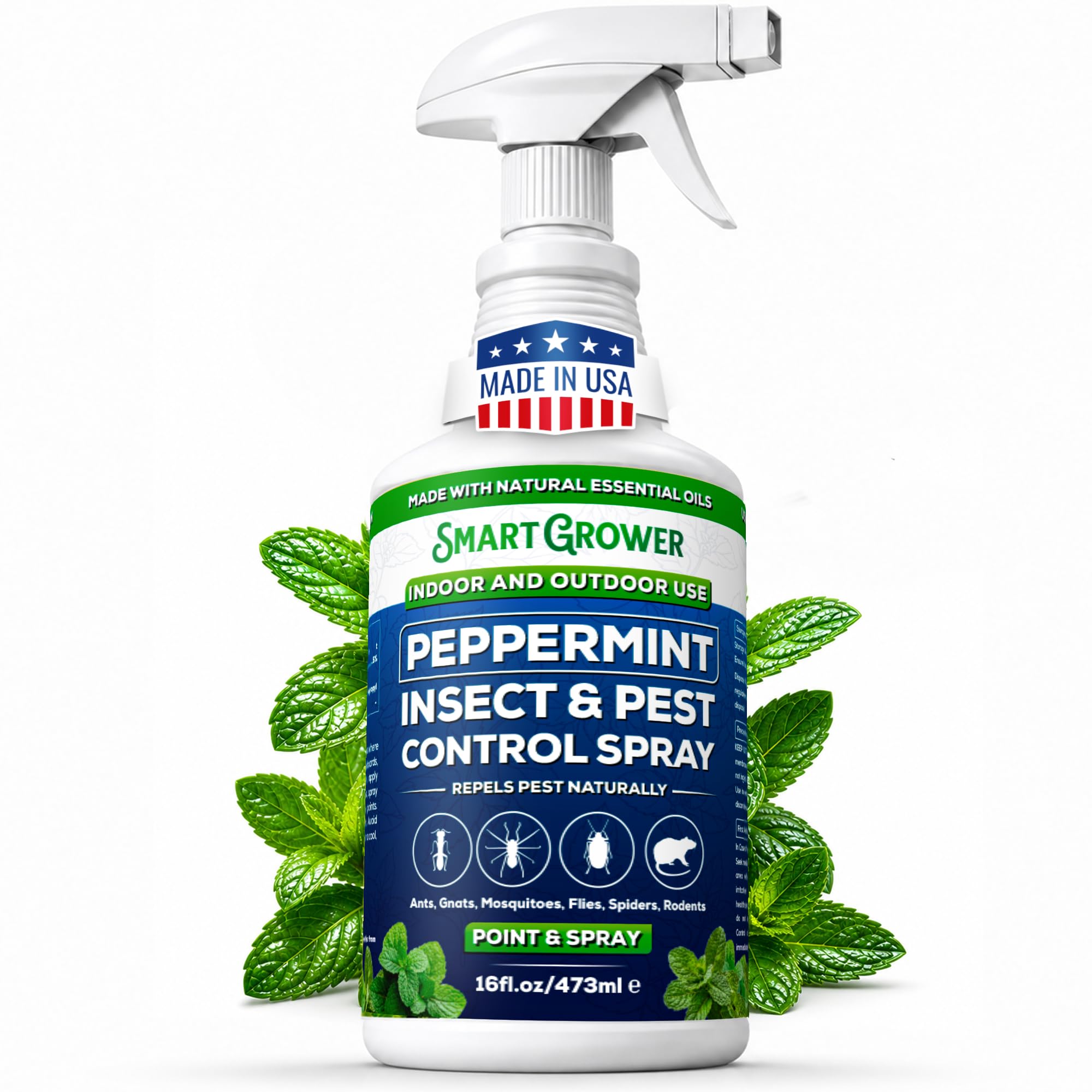
Smart Grower takes the peppermint approach a step further by formulating an extra-strength concentration aimed at repelling not just bees and wasps but also rodents, mice, and spiders. The ready-to-use 16-ounce bottle requires no mixing and delivers a potent mint blast that insects and small mammals find disorienting. Verified buyers report immediate reductions in wasp activity around doors and decks, and the peppermint scent is widely described as pleasant rather than medicinal.
The dual-action claim against rodents is backed by reviews showing mice avoided treated areas entirely. For homeowners dealing with both carpenter bee activity near eaves and mouse traffic in the garage, this single product covers both fronts. The formula is 100% pure peppermint essential oil with no synthetic pesticides, making it a strong contender for households that prioritize nontoxic pest management. Users also note it is effective on spiders, ants, and crickets when sprayed directly.
The main limitation is the same as any oil-based repellent — outdoor longevity suffers in wet conditions. A reviewer mentioned that the spray was ineffective against river mosquitoes, which confirms that peppermint works best on crawling insects and flying pests that land on treated surfaces. The nozzle also requires careful handling after use; letting it cool before storage prevents leakage. Overall, a versatile barrier option for combined pest problems.
Why it’s great
- Repels wasps, bees, and rodents with one application
- No synthetic pesticides, safe around pets after drying
- Pleasant peppermint scent that users actually enjoy
Good to know
- Rain degrades outdoor barrier quickly
- Nozzle may leak if not allowed to cool before storage
3. Spectracide Wasp and Hornet Killer Aerosol

When you need to eliminate an active nest right now, Spectracide is the industry standard. The aerosol propellant launches a targeted stream up to 27 feet, letting you stand well outside the defensive radius of angry yellow jackets, hornets, and paper wasps. The active ingredient is a fast-acting synthetic pyrethroid that drops insects on contact and foams over the nest entrance to trap and kill returning foragers. The three-pack format gives you enough coverage for multiple large nests or continuous monitoring across a full property.
The foam consistency is the standout engineering detail — it clings to vertical surfaces and porous nest material instead of dripping off, ensuring the poison penetrates deep into the nest structure. Multiple verified reviews confirm that spraying in the evening when all foragers are inside results in a completely empty nest by morning. Users also praise the predictable kill speed: wasps hit with the stream stop flying within seconds.
The trade-off is the chemical profile. The oily residue stains wood, vinyl siding, and camera lenses, and the aerosol vapors are strong enough that you should wear a mask if treating a nest in an enclosed eaves area. It also kills beneficial pollinators if misapplied near flowers. This is not a preventative — it is a surgical strike tool for when you have a confirmed nest that poses an immediate sting risk.
Why it’s great
- 27-foot stream keeps you safe from defensive swarms
- Foaming formula traps and kills returning wasps
- Three-pack provides excellent value for multi-nest properties
Good to know
- Oily residue stains surfaces if oversprayed
- Not safe for use near flowering plants or bee hives
4. Stingmon 4 Pack Paper Fake Wasp Nest Decoy
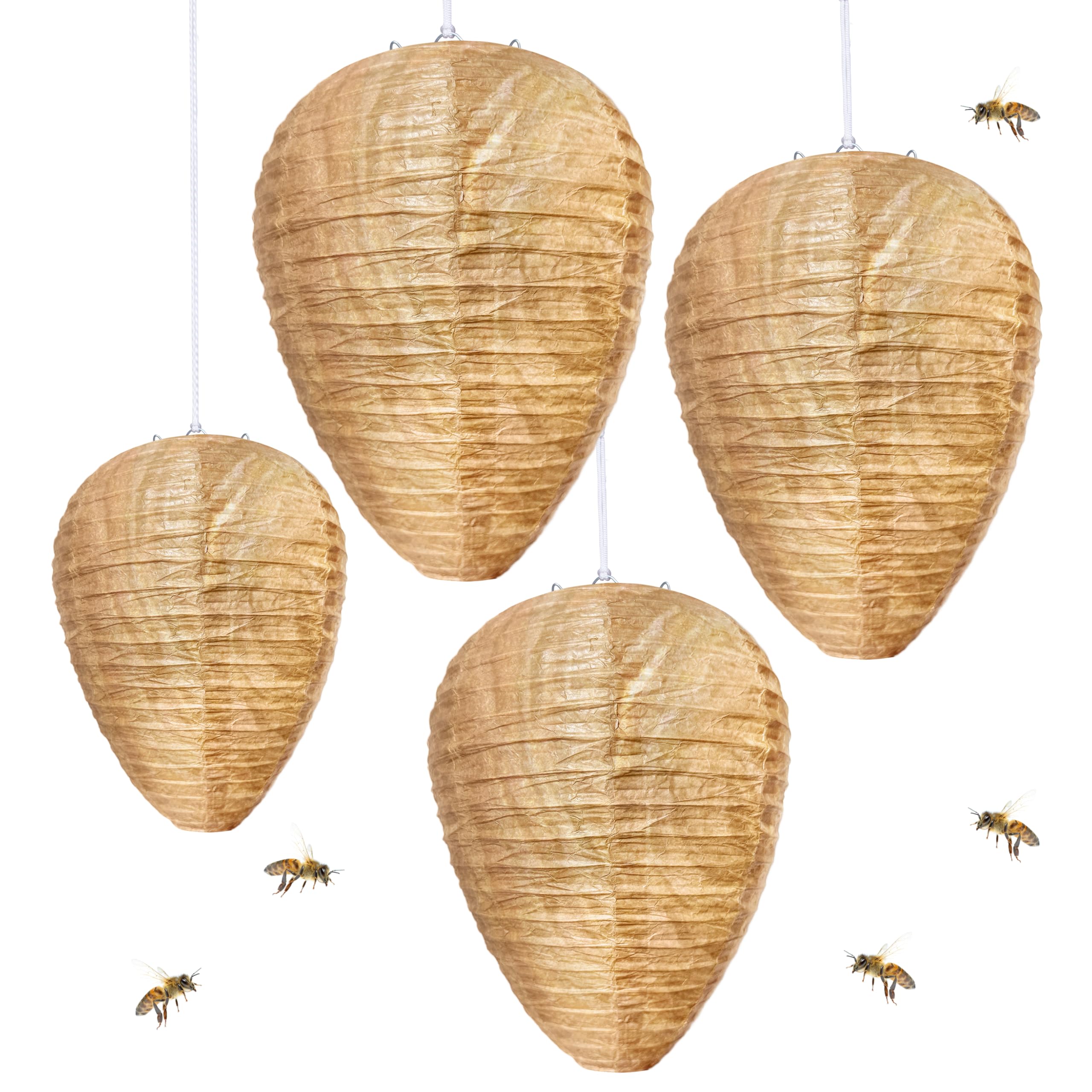
Stingmon’s decoy nests exploit a biological behavior built into wasps and carpenter bees: established colonies avoid building within visual range of a competing colony. The 8.66 x 11.02 inch paper decoys mimic the shape and texture of a real hornet nest, tricking scouts into reporting that the territory is already occupied. The four-pack covers all four corners of a fence line, deck, or garden shed with one purchase, and the lightweight paper material folds flat for off-season storage.
Verified users report noticeably fewer wasps within 24 hours of hanging the decoys, and some noted the nests held up through multiple storms with only the hanging string breaking — the paper nest itself remained intact. For carpenter bee control, this is one of the most effective non-chemical solutions available because solitary bees will not drill into wood near a decoy nest.
The effectiveness varies by species. Some reviewers spotted wasps landing on the decoy to inspect it, which suggests that highly aggressive species like European hornets may eventually habituate. The paper material is not waterproof — hanging it under an eave or porch roof dramatically extends its lifespan. If you have a persistent wasp problem that has already established a nest nearby, you will need to remove that nest first before decoys become effective.
Why it’s great
- Zero chemicals — uses natural territorial instinct
- Effective against carpenter bees that damage wood
- Four decoys cover large yard or fence perimeter
Good to know
- Paper material degrades faster in direct rain without cover
- Some aggressive wasp species may inspect rather than flee
5. STEM Kills Wasps, Hornets and Yellow Jackets

STEM bridges the gap between instant-kill aerosols and plant-based safety. The active ingredient is derived from botanical extracts — no synthetic pyrethroids, no added dyes or fragrances — yet it still drops wasps and hornets within minutes of contact. The 10-ounce aerosol can is smaller than a standard wasp spray, but the stream shoots roughly 15 feet after you remove the plastic safety tab and shake the can thoroughly. Entomologist-tested and labeled for outdoor use, it is an excellent option for pet owners who need the quick knockdown of a spray without the broad-spectrum toxicity of conventional killers.
Verified reviews highlight the immediate effect on hornets and yellow jackets. One user sprayed a medium-sized nest in the evening and found it empty by morning, with only a mild allergic response from the plant oils. The scent is a light botanical aroma rather than the chemical reek of traditional sprays, making it more pleasant to use around patios and doorways. The residual oil does leave a greasy film on surfaces like camera lenses and siding, but it washes off more easily than synthetic foams.
The can’s smaller volume means you get roughly three medium nest treatments per bottle, which is less economical than the three-pack Spectracide for heavy infestations. The nozzle quality is a known weak point — some units arrive with a defective spray mechanism that dribbles instead of streaming. If your priority is a pet-safe, plant-based spray that works as a contact killer rather than just a deterrent, STEM is the strongest option in the natural category.
Why it’s great
- Plant-based active ingredient kills wasps on contact without harsh synthetics
- Light botanical scent is pleasant and non-irritating
- Safe around pets and people when used as directed
Good to know
- 10-ounce can treats only three medium nests
- Nozzle consistency issues reported by some users
FAQ
Do fake wasp nests really work against carpenter bees?
How often do I need to reapply peppermint oil spray outdoors?
Is it safe to use plant-based wasp spray around honey bees?
Final Thoughts: The Verdict
For most users, the best bee repellent winner is the Mighty Mint Peppermint Oil Spray because it creates a long-lasting sensory barrier that keeps wasps, bees, and spiders away without harsh chemicals, and it is safe to use around kids and pets indoors and out. If you need instant elimination of an active nest, grab the Spectracide Wasp and Hornet Killer and its 27-foot stream. And for preventing carpenter bees without any chemicals at all, nothing beats the Stingmon 4-Pack Decoy Nest as a passive, long-term solution.

Mo Maruf
I created WellFizz to bridge the gap between vague wellness advice and actionable solutions. My mission is simple: to decode the research and give you practical tools you can actually use.
Beyond the data, I am a passionate traveler. I believe that stepping away from the screen to explore new environments is essential for mental clarity and physical vitality.