Our readers keep the lights on and my smoothie glass nicely filled. As an Amazon Associate, I earn from qualifying purchases.
Attic antennas occupy a strange middle ground: they avoid the weather exposure and aesthetic compromise of a roof mount, yet they still need to punch through decking, insulation, and sometimes asphalt shingles to lock onto broadcast towers. The margin between a clean 1080p picture and constant pixelation often comes down to one or two design details — the antenna’s native gain on VHF-Hi, the quality of its balun, or how cleanly the elements couple RF energy.
I’m Mohammad Maruf — the founder and writer behind WellFizz. I’ve evaluated dozens of OTA antennas by cross-referencing certified field gain patterns, impedance sweeps, and real-world installation reports from users with varied terrain and roof materials to identify which attic-mounted designs actually deliver usable signal margin.
Whether you are cutting the cord or supplementing streaming with live locals, finding the right best antenna for attic means understanding how range ratings translate through wood, foil-backed insulation, and metal roof flashing.
How To Choose The Best Antenna For Attic
An attic installation introduces signal loss that a rooftop mount never sees. Plywood decking attenuates UHF by roughly 1-3 dB per layer, and radiant barrier foil can kill an already weak signal entirely. The right antenna compensates with higher native gain, narrower beamwidth to reject multipath, and a low-noise balun that doesn’t add its own interference. Here’s what separates a usable attic setup from a frustrating one.
True VHF-Hi Element Length vs. Compromised Designs
Many compact antennas physically lack the element length needed to resonate well on VHF-Hi (170–230 MHz). If your local ABC or NBC affiliate broadcasts on a VHF channel, a short-element antenna will struggle even on a roof. In an attic, where the roof deck further loads the elements, the drop in received signal can push you below the digital cliff edge. Look for antennas with dedicated VHF dipoles or folded-dipole designs that are at least 30 inches in total span — anything shorter is effectively a UHF-only antenna with a token VHF tag.
Balun Construction and Impedance Matching
The balun transforms the balanced signal from the antenna elements to the 75-ohm unbalanced coax your TV expects. Cheap baluns, often potted in ferrite beads with thin enameled wire, introduce 1–2 dB of insertion loss and can saturate from strong local FM stations. A quality balun with a ferrite core and heavier gauge wire preserves the signal-to-noise ratio that matters most when the coax cable run from attic to TV exceeds 30 feet. This is a hidden spec that separates a budget-tier antenna from a mid-range performer in the same physical size class.
Built-in Amplification: Double-Edged Sword
A preamplifier mounted at the antenna can overcome long cable runs and splitting losses, but inside an attic the risk of overload from strong local towers is real. If your nearest towers are within 10 miles and you add an amplifier, the amplifier itself may clip the signal and create dropouts that look like weak reception. Conversely, if you are 40+ miles from the towers or splitting to multiple rooms, a low-noise preamp (noise figure under 3 dB) with gain adjustment or AGC is worth the investment. The Televes DiNova Boss Mix demonstrates how intelligent gain control can thread this needle; a fixed-gain booster in the same scenario often cannot.
Quick Comparison
On smaller screens, swipe sideways to see the full table.
| Model | Category | Best For | Key Spec | Amazon |
|---|---|---|---|---|
| Televes DiNova Boss Mix | Smart Amplified | Rural/hilly terrain with distant towers | TForce auto gain (29/34 dBi) | Amazon |
| Antennas Direct ClearStream MAX-V | Multi-Directional | Suburban areas with towers in multiple directions | 65-degree beam (Hi-VHF/UHF) | Amazon |
| RCA ANT751Z / ANT751E | Compact Yagi | Attics with limited mounting space | Snap-lock UHF reflector | Amazon |
| GE Pro Outdoor Yagi (33685) | Large Yagi | Users needing a trusted brand with lifetime support | 37-inch boom length | Amazon |
| McDuory UHD-3968 Yagi | Long-Range Passive | Budget-friendly entry into attic OTA | 150-mile range claim | Amazon |
| CeKay Outdoor Yagi | Value Yagi+Coax | First-time installers wanting cable included | 40-ft RG6 coax included | Amazon |
| Five Star Outdoor HDTV | Extended Boom | Maximum element length for deep fringe reception | 200-mile range claim | Amazon |
In‑Depth Reviews
1. Televes DiNova Boss Mix 144286

The Televes DiNova Boss Mix is the most technically refined attic antenna in this comparison, precisely because it treats the attic as a hostile RF environment rather than assuming line-of-sight. Its TForce intelligent gain control independently adjusts amplification for UHF and VHF-Hi bands, preventing the overload from close towers that would cause a fixed-gain preamp to clip and drop your signal. The built-in LTE/4G/5G filtering between 608 MHz and 960 MHz is crucial for attic installations near cell towers, where unfiltered interference can swamp the UHF band and turn a strong channel into a pixelated mess.
Assembly is genuinely assembly-free — the radome housing contains all elements, and the included power inserter ships with a J-mount bracket. Users report pulling 42 to 120 channels from 30 to 50 miles out, with one reviewer picking up a CBS affiliate 90 miles away through an attic mount. The white ABS radome is low-profile enough to pass HOA scrutiny if you ever move it to an exterior wall, but its real strength is surviving the temperature swings inside a unconditioned attic without the corrosion that eventually degrades open-element Yagis.
The 2.7-kilogram weight and Zamak mounting hardware give it a solid feel that justifies the premium tier. The primary limitation is that the active amplification requires a nearby 120V outlet — the power inserter is compact, but the installation location must accommodate one. If you are in a deep-fringe area 50+ miles from the nearest robust tower cluster, the DiNova Boss Mix delivers the cleanest gain curve of any antenna here.
Why it’s great
- Intelligent per-band gain prevents overload from nearby towers while boosting weak distant signals.
- Integrated LTE/5G filtering cleans up UHF reception in urban/suburban interference zones.
- Zero assembly and weather-sealed radome mean lower long-term corrosion risk in an attic environment.
Good to know
- Requires a nearby power outlet for the included power inserter.
- Heavier than open-element Yagis (2.7 kg); mounting bracket must be firmly anchored.
2. Antennas Direct ClearStream MAX-V C2MVB
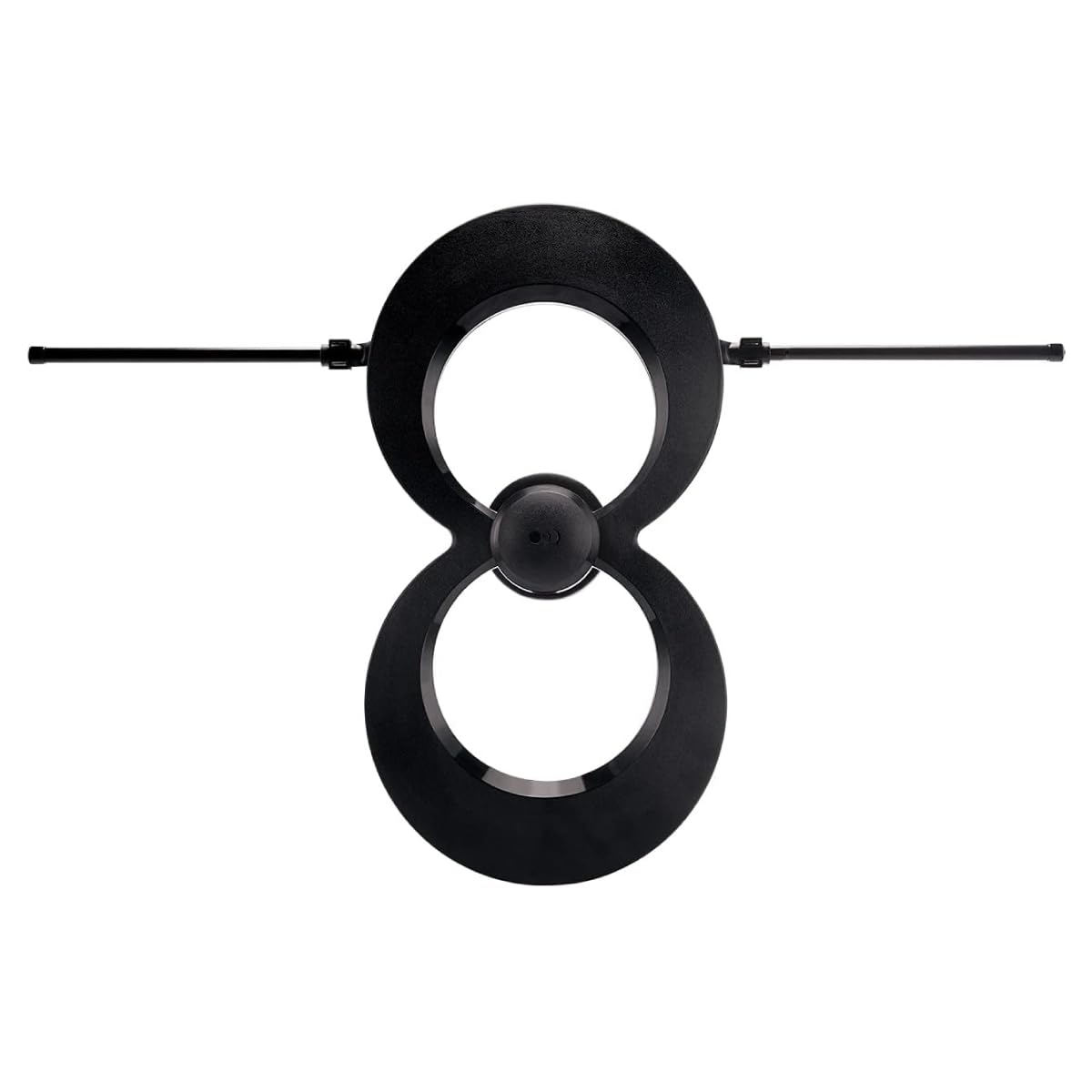
The ClearStream MAX-V stands apart from most Yagi designs because its double-loop UHF elements and dedicated Hi-VHF dipole create a 65-degree beamwidth that is wide enough to capture signals from towers in multiple directions without a rotator. In an attic, this multi-directional pickup pattern is a major advantage when the roof deck and house structure already limit aiming precision — you do not need to thread a needle to a single tower cluster. The 60-mile range rating is honest for moderately obstructed attic use, and the included steel wall bracket provides a low-profile mounting option that hugs roof trusses neatly.
Users installing the MAX-V in attics 25 to 28 miles from city towers (NYC, Charlotte, Detroit) consistently report 60 to 85 channels with stable HD signals. The antenna is 27 inches wide and 17.4 inches tall — large enough that the dedicated VHF elements are physically substantial enough to resonate on real VHF-Hi channels, not just token coverage. Assembly involves snapping the UHF loops into the central hub and attaching the VHF dipole; the entire process takes under 10 minutes without tools.
The lifetime manufacturer warranty from Antennas Direct adds long-term confidence, especially for an attic installation where you do not want to replace a corroded antenna every few years. The tradeoff is that the MAX-V is a passive antenna — it does not include a built-in amplifier. If your coax run exceeds 50 feet or you split the signal to multiple TVs, you will likely need to pair it with a low-noise preamplifier. The aluminum construction is light but dent-prone if handled roughly during installation.
Why it’s great
- Wide 65-degree beam captures signals from different tower directions without a rotator — ideal for attics with limited aiming flexibility.
- Dedicated, physically substantial Hi-VHF dipole ensures real VHF-Hi reception, not just UHF.
- Lifetime manufacturer warranty and multi-directional performance reduce long-term ownership risk.
Good to know
- No built-in amplifier; long cable runs or splits require an external preamp.
- Aluminum body is lightweight but can dent if elements are overtightened.
3. RCA ANT751Z / ANT751E

The RCA ANT751 (sold as ANT751Z with longer hardware or ANT751E as standard) has been a reliable attic performer for years, in large part because its fold-out UHF reflector and snap-lock elements make installation simple even in a tight space. The compact Yagi design with seven UHF directors and a two-element VHF dipole packs reasonable gain into a lightweight package that can be mounted on a roof truss with a single mast clamp. Users consistently report 50 to 80+ channels from attics 20 to 40 miles from towers, with signal strengths of 80 to 100 percent on major networks when combined with the included 75-ohm matching transformer.
The RCA Signal Finder smartphone app helps align the antenna by showing the direction of local towers — a genuinely useful tool when you are working in a dim attic with limited sightlines. Several reviewers note that the antenna works well without an amplifier when towers are within 30 miles, which simplifies the installation wiring and avoids overload issues. When paired with a Winegard LNA-200 preamp, users in hilly terrain near foothills report no dropouts even during weather events.
The main tradeoff for attic use is that the compact element spacing means true deep-fringe performance (beyond 50 miles) is inconsistent, especially on VHF-Hi channels where the shorter dipole cannot develop the same capture area as a full-length Yagi. The kit does not include wood screws for attic-beam mounting, so you will need to supply your own fasteners. The all-metal construction holds up well, but the open-element design will require occasional dusting in a unconditioned attic if you want to maintain optimal contact at the element-to-boom joints.
Why it’s great
- Snap-lock and fold-out design makes assembly trivially simple in confined attic spaces.
- RCA Signal Finder app reduces the guesswork of aiming inside an attic with no tower visibility.
- Works cleanly without an amplifier at moderate distances (under 30 miles), avoiding overload issues.
Good to know
- Compact element spacing limits VHF-Hi capture area beyond 50 miles.
- Open-element design collects dust over time; periodic cleaning of element-to-boom joints helps maintain signal strength.
4. GE Pro Outdoor Yagi (33685)

The GE Pro Outdoor Yagi (model 33685) leverages a full-length 37-inch boom to deliver the element spacing needed for genuine VHF-Hi performance, and its 80-mile range rating is among the most realistic in this category for attic use. The silver and black Yagi includes a weather-resistant J-mount, mast clamp, and mounting bracket, so the hardware you need for a attic truss mount is in the box — just supply the coax. The limited-lifetime replacement pledge and free US-based technical support (call 1-800-654-8483) provide a safety net that is rare in this category and especially valuable if you are new to OTA installation.
Real-world attic installers report success at 35 to 65 miles from towers, including through concrete tile roofs and radiant barrier insulation, with clear reception on all majors after fine-tuning the aim. One user in Boulder, CO reported pulling stations from Nebraska — roughly 80 miles — with a GE 33685 in the attic. The 4K/8K UHD and ATSC 3.0 compatibility means this antenna will continue to work through the NextGen TV transition without needing replacement. The pre-assembled VHF dipole and UHF directors require minimal assembly: attach the boom sections, secure the elements, and mount.
The assembly instructions are sparse and rely heavily on the user’s mechanical intuition, which frustrates some first-time installers. The included mounting hardware uses standard-thread bolts that can seize if over-tightened, so using anti-seize compound on the mast threads is a smart precaution if you anticipate later adjustments. At roughly 5 pounds, the antenna is manageable for a single-person installation on a attic truss, but the 37-inch boom length requires a clear mounting space at least 40 inches across.
Why it’s great
- 37-inch boom provides the element spacing needed for genuine VHF-Hi sensitivity, not just token coverage.
- Limited-lifetime replacement and phone-based US technical support set it apart from cheaper competitors.
- ATSC 3.0 compatible and 4K/8K ready, so the antenna will not become obsolete with broadcast standard changes.
Good to know
- Assembly instructions are minimal; YouTube walkthroughs are essentially required for first-time installers.
- Long 37-inch boom demands a mounting location that can accommodate its full length.
5. McDuory UHD-3968 Outdoor Yagi

The McDuory UHD-3968 uses a Log Periodic Dipole Array (LPDA) design that provides consistent gain across both VHF and UHF bands, making it a better choice for attics where the channel mix varies widely than narrowband Yagis optimized only for UHF. The antenna ships mostly pre-assembled — attaching the remaining few elements to the boom takes minutes without tools. Users within 20 to 30 miles of towers report full-signal reception of all major networks (Fox, NBC, ABC, CBS) after mounting the antenna in the attic, often replacing indoor amplified antennas that failed to hold a lock.
The LPDA architecture also means the antenna is inherently less directional than a traditional Yagi, which can be an advantage in an attic where you cannot precisely aim at a single tower cluster. Several reviewers noted that the antenna delivered stronger VHF-Hi reception (channels 8 and 19) than two previously failed antennas, and the UHF performance was described as “rock solid” with no pixelation. The weather-resistant construction and lightning protection are relevant even in an attic, where static buildup during dry conditions can still discharge through the coax.
The included hardware is functional but basic — serious reviewers recommend using a rubber mallet to fully seat the rod elements into their mounts and greasing electrical connections with Penetrox to maintain long-term conductivity. The 150-mile range claim in the title is marketing fiction; real-world reliable performance caps out around 50 miles for an attic mount. The lightweight aluminum elements are sturdy enough for a sheltered attic environment but would not hold up to a decade of outdoor wind loading.
Why it’s great
- LPDA design delivers consistent VHF and UHF gain across a wider frequency range than narrowband Yagis.
- Mostly pre-assembled with minimal element attachment — ideal for non-mechanical installers.
- Users within 30 miles of towers report full-signal major network reception with no dropouts.
Good to know
- The 150-mile range claim is not achievable in an attic; expect reliable performance only within 40-50 miles.
- Element-to-boom connections benefit from dielectric grease to prevent future oxidation.
6. CeKay Outdoor Yagi HD Antenna

The CeKay Yagi HD antenna packages a 70-mile-rated Yagi with a 40-foot RG6 coax cable and J-mount in a single box, which reduces the friction of a first-time attic install by eliminating the separate cable purchase. The all-metal construction is reasonably durable for an attic environment, and the pre-assembled boom requires only sliding the smaller element rods into the rubber mounting holders — no tools needed. The ATSC 3.0 compatibility future-proofs the antenna for NextGen TV broadcasts as they become available in your area.
Users installing this antenna in attics with concrete tile roofs report picking up 51 local channels with clear HD reception, while those with simpler roof structures at 10 to 20 miles from towers often see a 100 percent signal meter reading on major networks. The included RG6 coax has pre-attached connectors that should screw directly to the antenna balun and your TV or splitter — though one user noted the connector could kink if handled roughly during routing through attic joists. The J-mount bracket is heavy-gauge steel and provides a solid attachment point for truss or rafter mounting.
The arms that slide into the rubber mounting holders require significant force to embed fully — several users mention using a hammer to seat them completely, and the tight fit may prevent full insertion without tools despite the “no tools” claim. The thin-gauge elements are bendable and not suited for outdoor roof-top wind loads, but they are entirely adequate for a sheltered attic where wind is nonexistent. The 70-mile range is realistic for an attic mount only if your roof material is not heavily attenuating; expect a 20-30% range reduction versus outdoor installation.
Why it’s great
- Includes 40-foot RG6 coax cable and J-mount — one-box solution reduces installation friction.
- ATSC 3.0 compatibility ensures the antenna works with next-generation OTA broadcasts.
- All-metal Yagi design with heavy-gauge steel J-mount provides a solid mechanical installation.
Good to know
- Element arms are tight-fitting and may require a hammer to fully seat despite “no tools” marketing.
- Thin-gauge aluminum elements bend easily and are not recommended for outdoor roof-top use.
7. Five Star Outdoor HDTV Antenna

The Five Star Outdoor HDTV antenna differentiates itself with a physically longer boom and wider element spacing than typical budget-tier Yagis, which translates to better VHF-Hi capture area when mounted in an attic. The package includes a J-pole, mounting bracket, and 40-foot RG6 coax, so the total installation kit is comprehensive. Users in the Detroit area report crystal-clear reception from 20 miles away with the antenna mounted in the attic and no pixelation, while a long-term owner in Arizona has had the same unit running on a roof for four years without degradation — suggesting the materials hold up better than the price implies.
The 200-mile range claim in the title and description is a marketing figure that no indoor or attic antenna can realistically achieve — you should discount it mentally to roughly 40-50 miles for attic use. The innovation claim of “longer and larger receiving elements” is directionally correct: the extended dipole elements do provide marginally better VHF-Hi signal collection compared to ultra-compact antennas, but the advantage is incremental rather than transformative. The included RG6 cable uses proprietary ends that may not fit all baluns perfectly; one user reported the connector breaking when tightening, requiring a replacement cable.
The flimsy feel during assembly is worth noting — the aluminum elements and boom are light-gauge and require careful handling. Once mounted in the attic, however, the lack of wind stress means the lightweight construction is not a practical liability. The antenna supports both VHF and UHF bands and can feed multiple TVs through a splitter, though signal loss at each split point should be accounted for. If the primary goal is maximizing element length on a budget for an attic install, the Five Star delivers that without the expense of a premium-tier brand.
Why it’s great
- Longer boom and larger elements provide better VHF-Hi sensitivity than typical compact attic antennas.
- Complete installation kit with J-pole, bracket, and 40-foot RG6 coax simplifies the setup process.
- Long-term owners report multi-year reliability even in outdoor roof-top installations.
Good to know
- The 200-mile range claim is fantasy for attic use; expect 40-50 miles as the real ceiling.
- Light-gauge aluminum feels flimsy during assembly and the included coax connector may be finicky.
FAQ
Will an attic antenna work through a metal roof?
Can I install an attic antenna on a truss without a mast?
Why does my attic antenna work worse than my old flat indoor antenna?
Final Thoughts: The Verdict
For most users, the best antenna for attic winner is the RCA ANT751 because it balances compact size, easy assembly, and proven performance at moderate distances without requiring amplification. If you have a multi-directional tower layout or need wider beam forgiveness, grab the Antennas Direct ClearStream MAX-V. And for deep-fringe rural reception or attics with heavy signal occlusion, nothing beats the Televes DiNova Boss Mix with its intelligent gain control and integrated filtering.

Mo Maruf
I created WellFizz to bridge the gap between vague wellness advice and actionable solutions. My mission is simple: to decode the research and give you practical tools you can actually use.
Beyond the data, I am a passionate traveler. I believe that stepping away from the screen to explore new environments is essential for mental clarity and physical vitality.