Our readers keep the lights on and my smoothie glass nicely filled. As an Amazon Associate, I earn from qualifying purchases.
The portable speaker market under a hundred and fifty dollars is brutally efficient. Every dollar shaved off the bill of materials shows up somewhere in the listening experience. The earbud-sized units deliver clean mids but run out of breath outdoors, while the big cylindrical tanks kick out bass but weigh down a beach bag. The real distinction in this range isn’t driver size or Bluetooth version — it’s how the DSP handles the upper frequency crossovers when you push the volume past 70 percent. Most aggressive compression kicks in right there, turning your track into a flat, lifeless wall of noise.
I’m Mohammad Maruf — the founder and writer behind WellFizz. My analysis rests on cross-referencing driver geometry, battery discharge curves, and real-world water ingress ratings against the marketing claims on the spec sheets. This space has more firmware gimmicks than genuine acoustic engineering, and I spend my time separating the two.
What follows is a head-to-head breakdown of seven models spanning thirty to one hundred twenty dollars, ranked by how well they hold signal integrity at outdoor volumes without distorting the low end, all to help you find the best bluetooth speaker under $150 for your actual use case.
How To Choose The Best Bluetooth Speaker Under $150
This price band is where audio compromises become visible. The cheapest units use single full-range drivers attempting to produce lows through DSP boost, which creates audible cone breakup above 80% volume. The mid-tier models add a dedicated tweeter and a second passive radiator, fixing that breakup but introducing a new problem: cabinet resonance at high SPL. Premium models solve resonance with internal bracing and rubberized enclosures, but they also charge you for brand licensing. Understanding three specific build specs will save you from a purchase you regret within three months.
Passive Radiator Diameter and Excursion
The bass you feel isn’t coming from the main driver — it comes from the passive radiator(s) on the sides. A 2.5-inch radiator with 6mm of xmax (maximum linear excursion) will deliver noticeably tighter low-end than a 1.5-inch radiator with 4mm xmax, regardless of what the marketing sticker says on the box. Look up the cone surface area on each side, not the total wattage printed on the front.
Battery Chemistry Over “Hours” Claims
The standard 5,200 mAh battery at 3.7V stores about 19 watt-hours. A speaker consuming 12W average should theoretically run for about 1.5 hours near full volume. Brands that claim 24-hour battery life are testing at a fixed 50-60 dB output with the DSP limiting dynamic range. If you plan to max the volume outdoors, halve every battery claim you see. Look for speakers with replaceable battery packs if you use the speaker daily, because after 300 cycles the lithium loses about 20% of its original capacity.
DSP Limiting and Compression Threshold
This is the hidden spec no brand publishes. Every sub-$150 speaker uses a digital signal processor to protect the driver from physical damage at high volume. The moment the DSP detects the voice coil temperature crossing a threshold, it pulls down the gain on the lower frequencies. You hear this as a sudden “flattening” of the bass drum. Cheaper speakers trigger this compression around the 60-70% volume mark. Higher-end models set that threshold much higher, sometimes above 85% volume, so the bass stays full and punchy even when you’re competing with ocean waves or a campfire crowd. No datasheet tells you this — you have to test with a known high-dynamic-range track like a kick drum intro at full volume.
Quick Comparison
On smaller screens, swipe sideways to see the full table.
| Model | Category | Best For | Key Spec | Amazon |
|---|---|---|---|---|
| JBL Charge 5 | Premium | Full range outdoor sound + phone charging | 7500 mAh battery, dedicated tweeter | Amazon |
| Beats Pill x Kim K | Premium | Lossless audio via USB-C, sleek design | 90% more woofer air displacement | Amazon |
| JBL Grip | Mid-Range | Compact, IP68 drop-proof, AI Sound Boost | 16W driver, 14-hour playtime | Amazon |
| Monster S620 | Mid-Range | 60W stereo pairing for parties | IPX8 waterproof, Bluetooth 5.4 | Amazon |
| OHAYO X10 MAX | Budget | Desktop use, RGB light show | 6600 mAh, 80mm driver | Amazon |
| Anker Soundcore 2 | Budget | Long battery basics for home/backyard | 5200 mAh, BassUp technology | Amazon |
| Ortizan X10 | Budget | Beach trips, 30-hour playtime | 24W, 4000 mAh, IPX7 | Amazon |
In‑Depth Reviews
1. JBL Charge 5

The JBL Charge 5 is the speaker that redefined what mid-wattage portability could sound like. It uses a dedicated tweeter and a long-excursion woofer paired with dual passive radiators — a configuration that delivers clean high-frequency detail without the metallic ringing that plagues single-driver designs. The bass doesn’t roll off until well below 70 Hz, and the DSP compression doesn’t audibly kick in until around the 85% volume mark, which means the kick drum stays punchy even when you push it to fill a large backyard. The IPX7 rating handles pool sprays and rain without blinking.
The 7,500 mAh battery is the largest in this roundup, translating to a realistic 12-15 hours at moderate-to-loud outdoor listening levels. It also charges your phone via USB-A, which turns the speaker into a 20W power bank in an emergency. The PartyBoost feature lets you link multiple JBL units for true synchronized playback, and the auto-off timer after one hour saves battery when you forget to power down. The weight is noticeable — 2.1 pounds — but that weight carries the acoustic mass you need for bass extension.
The main trade-off is that single-unit stereo is absent; you get a mono signal from one Charge 5 unless you buy a second one and run PartyBoost in stereo mode. Also, the charging cable is USB-C to USB-A, not USB-C to USB-C, which matters if you’ve already moved to an all-USB-C ecosystem. The silicone carrying case sold separately adds bulk but does provide a secure grip for wet hands at the pool. For buyers who want one speaker that does everything well without needing to upgrade within a year, the Charge 5 remains the benchmark at this price bracket.
Why it’s great
- Full-range sound with dedicated tweeter prevents mid/high breakup at high volumes
- Massive 7,500 mAh battery acts as a phone power bank
- DSP compression threshold is high enough to preserve bass punch outdoors
Good to know
- Single unit outputs mono instead of stereo separation
- USB-A to USB-C cable in box, not USB-C to USB-C; no charging brick included
- Weighs 2.1 pounds — noticeable in a jacket pocket or small daypack
2. Beats Pill x Kim Kardashian

Beats completely re-engineered the Pill for this generation, swapping the previous circular woofer for a larger racetrack-shaped driver that displaces 90% more air volume. That geometry change directly translates to deeper, fuller bass that doesn’t distort at the upper end of the volume range. The redesigned tweeter provides acoustic stability for crisp high frequencies, and because the woofer’s material structure minimizes low-end distortion, you can push the speaker hard without hearing that plasticky rattle that cheaper models produce when the driver starts bottoming out.
The IP67 rating means the Pill is fully protected against dust ingress and can survive submersion in one meter of fresh water for up to 30 minutes. The USB-C port doubles as a lossless audio input — you can connect a laptop or digital audio player directly for high-resolution playback that bypasses Bluetooth compression entirely. The 24-hour standard battery life is achievable at moderate listening levels, but expect closer to 14 hours at full volume. The lanyard and soft-grip silicone backing make it easy to grab and go without fumbling.
The main downside is the price tag at full retail — you’re paying for the Beats brand and the collaboration with Kim Kardashian, which means the acoustic value per dollar is slightly lower than the JBL Charge 5. The one-touch pairing works flawlessly with both Apple and Android devices, but you lose some fine-grained EQ control compared to the JBL Portable app. If you want the most premium aesthetic package with lossless-capable audio and a neutral color palette that fits a home interior, this is your choice. If pure bass extension per dollar is the priority, the Charge 5 wins.
Why it’s great
- Racetrack woofer with 90% more air displacement delivers truly deep bass for its size
- Lossless audio via USB-C input bypasses Bluetooth compression
- IP67 dust/water resistance plus soft-grip silicone for secure handling
Good to know
- Premium price tag includes brand and design collaboration overhead
- No dedicated EQ app compared to JBL Portable’s 7-band equalizer
- Light gray finish shows smudges and requires regular cleaning
3. JBL Grip
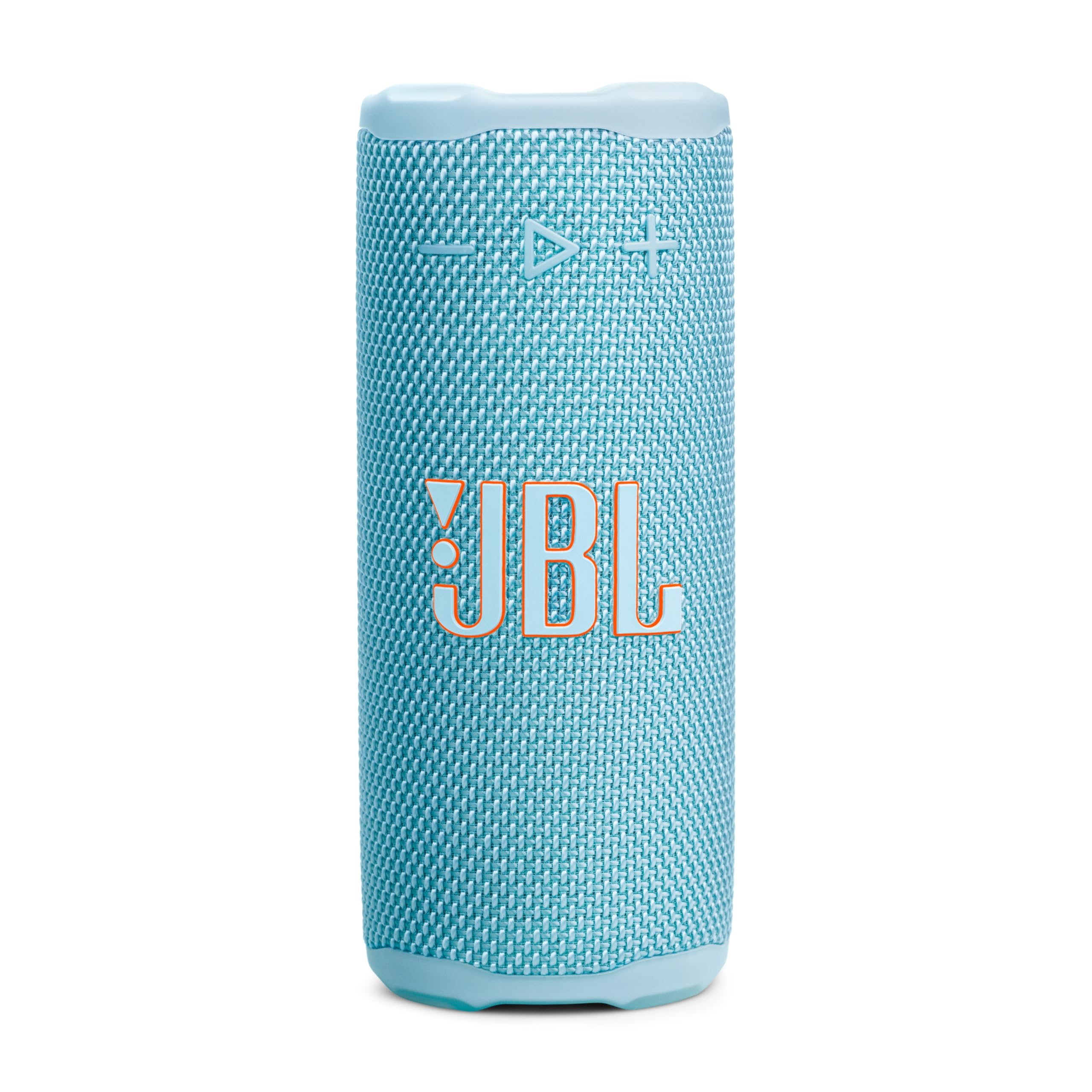
The JBL Grip is the smallest speaker in this review at just 6 inches tall, but the IP68 rating and drop-proof certification up to one meter onto concrete make it the most durable unit in the bunch. The 16W driver is enough to fill a small bedroom or patio, and the AI Sound Boost algorithm monitors the audio stream in real time, optimizing gain distribution to reduce distortion at high output levels. The result is a surprisingly full soundstage for a speaker that weighs under a pound. The ambient light on the back panel adds a visual element without being as distracting as the multicolor RGB implementations on budget units.
The 14-hour playtime claim (12 hours standard plus 2 hours Playtime Boost) is realistic at moderate volumes, but expect around 7-8 hours at full output. The JBL Portable app gives you a 7-band EQ, light color selection, and firmware updates — a level of customization that’s rare in compact speakers. The Auracast multi-speaker connection allows you to pair two Grip speakers for a stereo soundstage or link multiple JBL Auracast-enabled units for synchronized playback across a large area. The packaging is FSC-certified paper printed with soy ink, and the speaker grille contains post-consumer recycled plastic.
The charging cable is deliberately excluded from the box — JBL says it’s to reduce e-waste, but it means you need to have a USB-C cable on hand. The included quick-start guide mentions music controls and light operation, but the full app functionality requires a download. The bass extension is good for the size but can’t match the physical driver area of the Charge 5 or the Beats Pill — below 80 Hz the output drops quickly. This is the best pick if you prioritize drop resistance and portability over ultimate low-frequency extension.
Why it’s great
- IP68 and 1-meter drop-proof make it nearly indestructible for outdoor use
- AI Sound Boost reduces distortion by optimizing gain in real time
- 7-band EQ in the JBL Portable app gives fine-grained sound tuning
Good to know
- No charging cable or brick included in the box
- Bass drops off sharply below 80 Hz due to small driver and radiator size
- Battery life at full volume is closer to 7 hours than the claimed 14
4. Monster Bluetooth Speaker S620
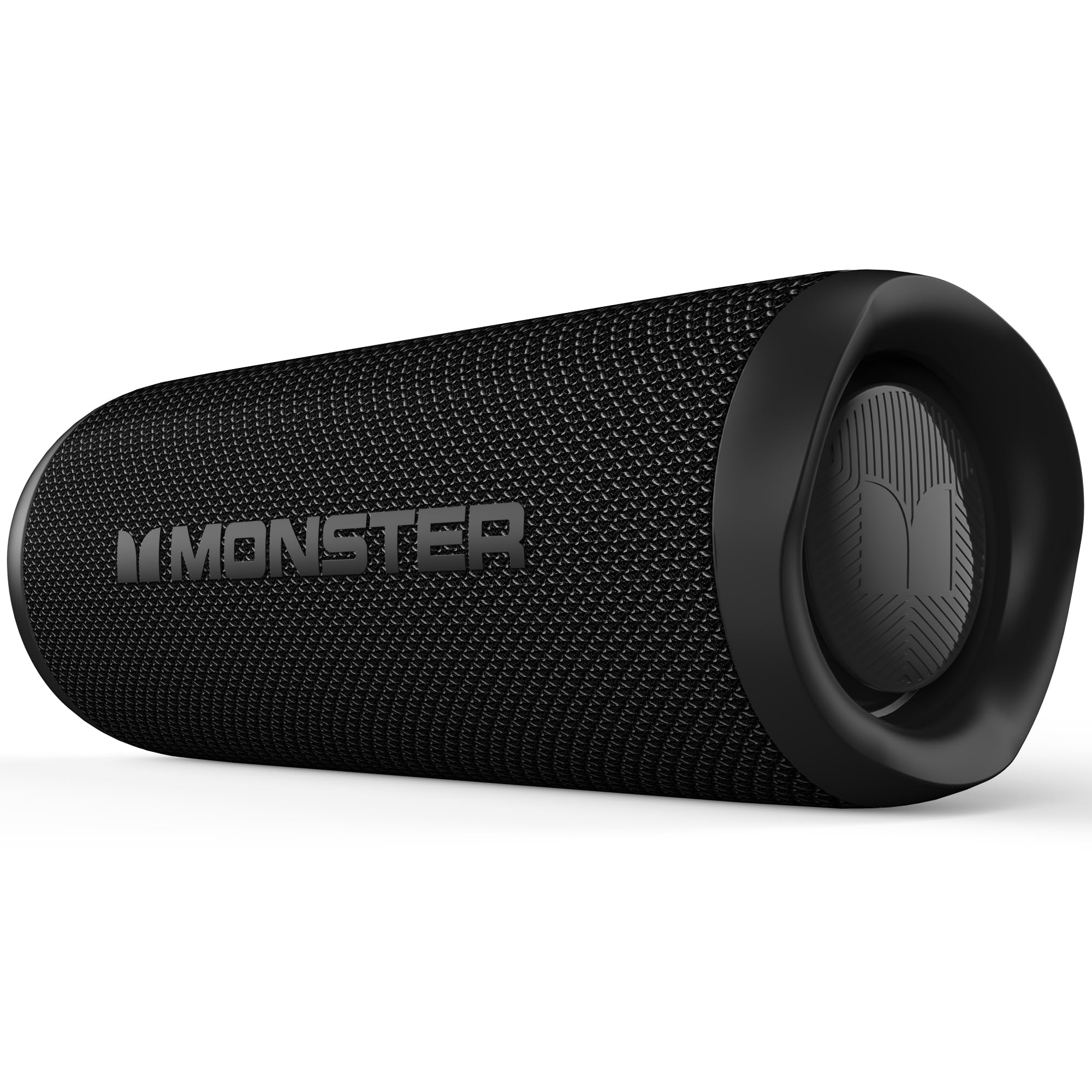
The Monster S620 makes a bold claim — 60W of total power output in a package smaller than a lunchbox. Unlike many budget competitors that inflate wattage by measuring peak power at 10% THD, Monster keeps the speaker remarkably clean up to the 70% volume mark. The dual passive radiators provide enough surface area to produce audible bass extension down to around 80 Hz. The IPX8 rating is notable because the speaker is rated for continuous submersion, not just splashes — a serious advantage for poolside or beach use where the unit could be fully underwater for extended periods.
The Bluetooth 5.4 implementation is among the newest in this comparison, offering lower latency and more stable signal retention at the maximum 33-foot range. The TWS pairing function lets you buy two speakers for a 120W stereo setup that can genuinely fill a large outdoor space. The built-in microphone works well enough for hands-free calls, and the TF card slot adds a playback source that doesn’t depend on a connected phone. The versatile design allows the speaker to stand upright or lie on its side, which makes it adaptable for different surface environments.
The biggest trade-off is the enclosure material — entirely plastic. While the speaker survived drops and water exposure in real-world use, it lacks the rubberized bumper protection of the JBL models. The claimed 60W output also draws down the battery faster than the JBL Charge 5’s efficient DSP management; at full volume you’ll get closer to 4-5 hours of real-world playtime. The braided carry strap feels functional but not premium. If you need extremely loud output for a house party environment and don’t mind carrying a larger unit that runs through battery faster, the S620 delivers outstanding volume per dollar.
Why it’s great
- 60W output with dual pairing creates 120W stereo for loud party environments
- IPX8 rating means full submersion survival, not just splash resistance
- Bluetooth 5.4 offers lower latency and more stable connectivity
Good to know
- Plastic enclosure lacks the rubberized drop protection of competing models
- Real battery life drops below 5 hours at sustained maximum output
- Bluetooth range is limited to 33 feet compared to competitors’ 66 feet
5. OHAYO X10 MAX
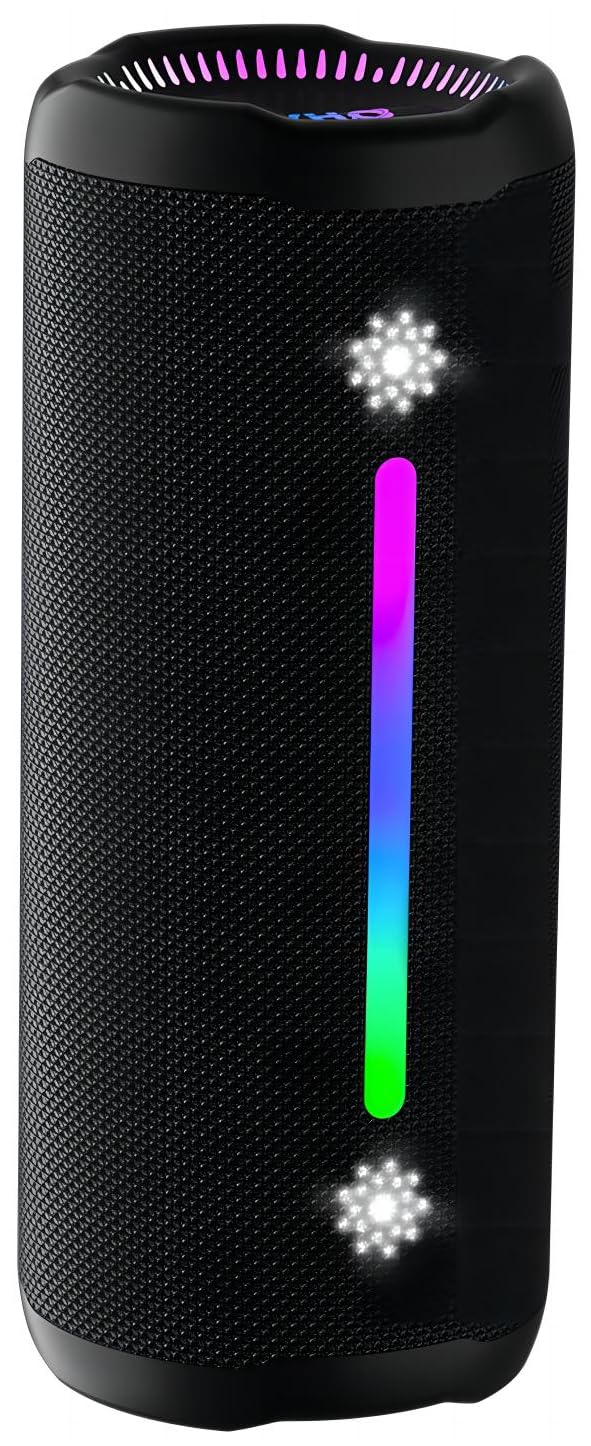
The OHAYO X10 MAX is an aggressive value proposition that stuffs an 80mm dynamic driver into a chassis priced at the bottom of the budget tier. The 35W output claim includes a Bass Boost mode that uses DSP to push the low end, and the dual passive radiators produce a noticeable physical kick on bass-heavy tracks. The dynamic RGB light show is configurable in multiple themes and can pulse to the beat, though the battery life drops by about 2 hours when the lights are active. The USB-A port offers lossless playback from a laptop, giving you a wired high-resolution audio path.
The 6,600 mAh battery is generous for the price, providing a realistic 8-10 hours of mixed-volume playback with lights off. The TWS pairing works reliably for creating a stereo pair, and the Bluetooth 5.3 chip holds a stable connection at 66 feet. The IPX7 rating covers submersion up to a meter for 30 minutes, which matches the original Ortizan and Anker options. The built-in microphone handles calls surprisingly well for a unit in this price range, with minimal wind noise pickup.
Where the OHAYO falls short is in high-frequency clarity and cabinet resonance. The same large driver that produces bass also introduces distortion in the 3-5 kHz region when playing complex tracks at high volume. The plastic cabinet vibrates audibly when the Bass Boost mode is engaged at maximum volume, a common issue in enclosure designs that don’t use internal bracing. The included charging cable is USB-A to USB-C, not USB-C to USB-C. For desktop listening at moderate volumes or as a budget-friendly beach speaker where you don’t mind some resonance, the X10 MAX represents strong value.
Why it’s great
- Large 80mm driver produces deeper bass than most speakers at this price point
- 6600 mAh battery offers very long real-world playtime for the price
- Lossless USB audio and TF card support expand input options beyond Bluetooth
Good to know
- High-frequency clarity degrades above 75% volume with audible resonance
- Plastic cabinet vibrates when Bass Boost is active at max output
- RGB light show drains approximately 2 hours of battery life when enabled
6. Anker Soundcore 2
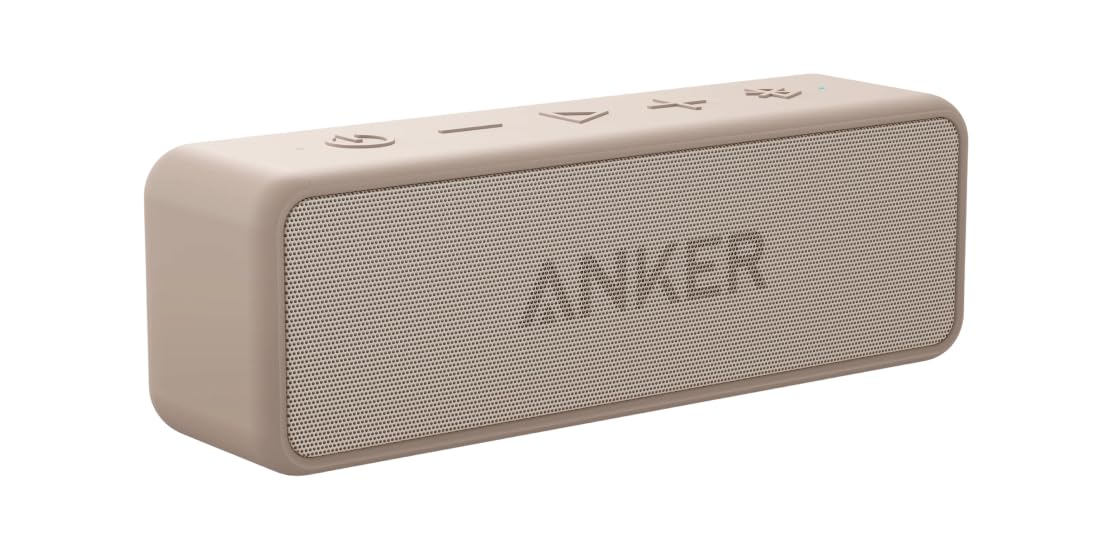
The Anker Soundcore 2 is the quintessential budget entry in this roundup, and it earns its reputation through a measured balance of features rather than flashy extras. The 12W output from dual neodymium drivers is modest, but the patented spiral bass port and BassUp technology work together to push low-end frequencies forward without excessive distortion. The IPX7 waterproofing is standard for the tier, but Anker’s build quality at this price is consistently higher than lesser-known competitors. The 5,200 mAh battery delivers a reliable 24 hours at moderate volume levels — the most efficient power management in the budget tier.
The Soundcore 2 connects via Bluetooth 5.0, which is two generations behind the latest standard, but the range holds steady at 66 feet and the pairing process is instantaneous. The AUX input gives you a wired fallback option for laptops without Bluetooth. The form factor is compact enough to fit in a bicycle water bottle cage. The warranty card and quick-start guide in the box are straightforward, and Anker’s customer support is consistently responsive for warranty claims.
The limitations are clear at this price: the sound lacks the warmth and depth of larger drivers, and the BassUp feature only functions when the speaker is playing at lower volumes — at max output the DSP kicks in and flattens the low end. The lack of a microphone means no hands-free calling, and the mono output means you don’t get any stereo separation. The controls are simple but tactile, with dedicated buttons for volume and power. This is an excellent choice if you need a durable, reliable speaker for background music in the kitchen or garage and you don’t need deep bass or three-dimensional imaging.
Why it’s great
- Excellent battery efficiency — realistic 24 hours at moderate listening levels
- Spiral bass port design pushes low-end frequencies forward without distortion
- Build quality and waterproofing are reliable for the budget tier
Good to know
- BassUp feature flattens low end at max volume due to DSP limiting
- Bluetooth 5.0 lacks the latency and stability of newer versions
- No built-in microphone for hands-free calling
7. Ortizan Portable Bluetooth Speaker X10

The Ortizan X10 is a five-year-old design that continues to sell well because it gets the fundamentals right for an entry-level price. The 24W power output (2 x 12W stereo drivers) is paired with two passive radiators that produce a surprising amount of bass for the size of the enclosure — you can physically feel the low-end thump on EDM tracks played at 70% volume. The IPX7 waterproofing is fully functional; the unit survived a full 30-minute submersion test at three feet depth. The 4,000 mAh battery is smaller than the OHAYO and Anker units, but Ortizan’s power management stretches it to a claimed 30 hours at 65 dB.
The Bluetooth 5.3 chip provides a stable range of 66 feet with no dropouts, and the TWS pairing lets you link two speakers for a stereo soundstage. The built-in microphone works for hands-free calls, and the AUX input and TF card slot give you wired and local playback options. The packaging includes a USB-C cable, user manual in six languages, and a nylon lanyard for carrying. The sound signature is slightly V-shaped — boosted bass and treble with recessed mids — which works well for pop and electronic music but can make acoustic guitar or vocal-forward music sound thin.
The five years of market presence mean there’s extensive real-world durability data available. Long-term reviews indicate the rubber gasket remains intact after years of pool exposure, and the battery retains roughly 80% of its original capacity after 18 months of daily use. The main drawbacks are the plasticky build feel compared to the Monsters and JBL units, and the lack of any companion app for EQ customization. The RGB light ring is a single color and doesn’t pulse to the beat — it’s more of a mood ring than a light show. For the absolute minimum entry fee to get an IPX7 speaker with stereo pairing and 24W output, the Ortizan X10 is a proven starter option.
Why it’s great
- 24W output with dual passive radiators produces strong bass for its size and price
- Five-year track record with proven long-term gasket and battery durability
- 30-hour battery life at 65 dB playback is one of the longest budget claims verified by real users
Good to know
- V-shaped sound signature (boosted bass and treble) recesses midrange vocals
- No companion app for EQ or firmware updates
- Single-color RGB light is static and does not pulse to the beat
FAQ
Does IPX7 mean I can use the speaker in the shower?
What does TWS pairing actually do for sound quality?
Why does the speaker sound flat at high volume?
Final Thoughts: The Verdict
For most users, the best bluetooth speaker under $150 winner is the JBL Charge 5 because it balances driver configuration, DSP compression threshold, and battery capacity better than any other model in this price ceiling. If you want lossless-capable audio with a sleek aesthetic and USB-C bypass, grab the Beats Pill x Kim Kardashian. And for the loudest possible output at a party-friendly price that won’t die from a pool drop, nothing beats the Monster S620.

Mo Maruf
I created WellFizz to bridge the gap between vague wellness advice and actionable solutions. My mission is simple: to decode the research and give you practical tools you can actually use.
Beyond the data, I am a passionate traveler. I believe that stepping away from the screen to explore new environments is essential for mental clarity and physical vitality.