Our readers keep the lights on and my smoothie glass nicely filled. As an Amazon Associate, I earn from qualifying purchases.
Pairing a turntable with the wrong speakers can turn vinyl’s warm analog signal into a thin, lifeless mess. The challenge is finding active speakers that respect the phono preamp’s output, deliver a flat enough response for accurate playback, and stay within a budget that doesn’t dwarf the cost of the table itself.
I’m Mohammad Maruf — the founder and writer behind WellFizz. I’ve spent years analyzing audio hardware specifications, comparing frequency response curves, driver materials, and cabinet construction to separate marketing hype from real performance in the powered speaker market.
A quality pair of active bookshelf speakers should reveal the texture of the vinyl groove without adding false brightness or muddying the low end. That is the core promise of any true budget powered speakers for turntable.
How To Choose The Best Budget Powered Speakers For Turntable
Selecting active speakers for a record player is different than picking a set for your PC or TV. Vinyl is an analog source, and the speakers need to accurately reproduce the preamp’s signal without introducing noise or overly coloring the sound. Focus on these four pillars.
Input Compatibility and Signal Path
Your turntable likely has a built-in or external phono preamp that outputs a line-level signal. The powered speakers must accept that signal through an RCA or AUX input. Some budget speakers include USB and Bluetooth as primary connections, but the RCA connection to your preamp is non-negotiable for analog purity. Check that the speakers have a dedicated RCA input or an AUX jack that works with a 3.5mm-to-RCA cable. Never rely solely on Bluetooth for turntable playback—the signal is compressed and latency creeps in.
Driver Configuration and Cabinet Build
For small to medium rooms, a two-way design with a dedicated tweeter and woofer is ideal. Silk dome tweeters (0.75 to 1 inch) deliver smooth highs without the harshness of metal domes. The woofer should be at least 4 inches in diameter to produce meaningful mid-bass; 5-inch and 6.5-inch drivers extend further into the low end. Cabinet material matters: MDF (medium-density fiberboard) reduces resonance far better than plastic, which can ring and muddy the sound. Look for wood or MDF enclosures with a bass port on the rear to reinforce the low frequencies without sacrificing clarity.
Amplification, Power, and Listening Distance
Active speakers have built-in amplifiers rated in watts RMS (continuous power). For near-field listening (3-6 feet), 20 to 30 watts RMS per channel is enough to fill a room without distortion. If you sit further away or want to fill a larger living space, target 40-50 watts RMS per channel. More power also gives you headroom to handle dynamic peaks in orchestral or jazz recordings. Remember: the amplifier in a powered speaker is matched to the drivers, so you don’t need to calculate impedance matching like with passive speakers.
Size, Placement, and Aesthetic Fit
Turntable setups often sit on a desk, console table, or shelf. Measure the depth and width of your surface before buying. A speaker with a depth greater than 8 inches can feel bulky on a crowded desk. Also consider rear bass port clearance: ported speakers need at least 3-4 inches of space from the wall to avoid chuffing and boomy bass. If space is tight, look for front-ported or sealed designs. Finally, the wood grain or vinyl finish should complement your turntable’s aesthetic—classic walnut or black enclosures blend best with most furniture.
Quick Comparison
On smaller screens, swipe sideways to see the full table.
| Model | Category | Best For | Key Spec | Amazon |
|---|---|---|---|---|
| PreSonus Eris Accent | Premium | Vinyl purists needing a sub out | 50W RMS / 4″ woofer / 55Hz–20kHz | Amazon |
| Edifier MR3 | Premium | Desktop monitoring with app EQ | 36W RMS / 3.5″ woofer / 52Hz–40kHz | Amazon |
| Edifier R1280T | Mid-Range | Classic vinyl setup with remote | 42W RMS / 4″ woofer / wood MDF cabinet | Amazon |
| MEVOSTO DS19 | Mid-Range | Bass & treble tuning on the fly | 36W RMS / 5″ woofer / BT 5.4 | Amazon |
| Ortizan C7 | Mid-Range | Content creators needing TRS input | 3.5″ carbon fiber / 0.75″ tweeter / TRS | Amazon |
| OHAYO 60W | Budget | Small desktop near-field listening | 60W peak / 3″ woofer / MDF enclosure | Amazon |
| Rockville RockShelf 68C V2 | Budget | Passive speakers paired with an amp | 6.5″ Kevlar woofer / 1″ silk tweeter | Amazon |
In‑Depth Reviews
1. PreSonus Eris Accent
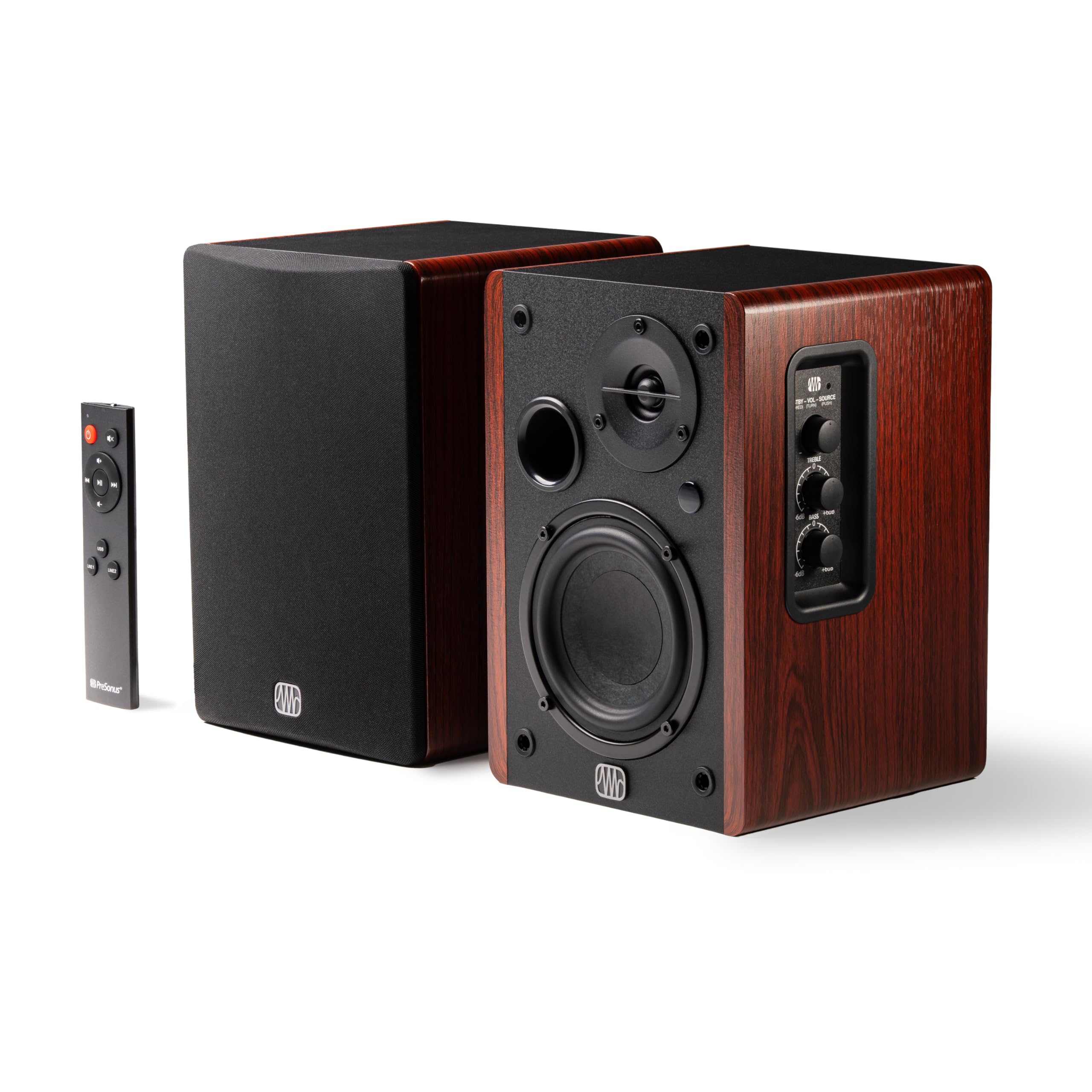
The PreSonus Eris Accent bridges the gap between budget-friendly and professional-grade performance. Its 4-inch woofer and 0.5-inch silk dome tweeter deliver a frequency range of 55Hz to 20kHz with a peak SPL of 85 dB—sufficiently loud for a medium living room without distortion. The 50W RMS total power (25W per channel) gives you clean headroom for vinyl’s dynamic range.
What sets this pair apart for turntable use is the dedicated RCA subwoofer output. If you ever want to extend the low end below 55Hz, you can add an active sub without buying a separate splitter. The onboard bass and treble controls let you compensate for room acoustics, and the woodgrain finish matches vintage turntable aesthetics. The included remote control adds convenience for couch listening.
The only notable omission is Bluetooth—this is a strictly wired setup, which actually benefits analog purists by eliminating any digital compression in the signal chain. The cabinet is well-damped, and reviews consistently praise the lack of audible hiss at idle. For vinyl listeners who value accuracy and expansion potential, this is the most complete package at this price tier.
Why it’s great
- RCA subwoofer output makes future upgrades simple
- Adjustable treble and bass knobs for room tuning
- Clean, neutral sound with no idle hiss
Good to know
- No Bluetooth connectivity
- Grills slightly muffle the high frequencies
2. Edifier MR3

The Edifier MR3 earns its Hi-Res Audio certification with a flat frequency response extending from 52Hz to 40kHz, making it one of the most accurate budget monitors for turntable playback. The 3.5-inch mid-low driver and 1-inch tweeter are wrapped in an MDF cabinet that minimizes resonance, and the 18W RMS per channel (36W total) is sufficient for near-field listening up to six feet away.
This is the only pair in this roundup with balanced TRS inputs, which are a godsend if your phono preamp or mixer has balanced outputs. The Edifier ConneX app allows deep EQ customization, letting you switch between Music, Monitor, and Custom modes to match your room’s acoustics. Bluetooth 5.4 is onboard, but MR3 automatically reverts to wired when an AUX or RCA cable is detected—a thoughtful touch for vinyl listeners who also stream digital sources.
The single potential downside for a turntable setup is the 3.5-inch woofer. While the bass is tight and controlled, it won’t rattle shelves the way a 5-inch driver can. Users report zero idle hiss and no distortion even at higher volumes. The headphone output on the front panel is a bonus for late-night listening sessions without disturbing others.
Why it’s great
- Balanced TRS input for professional preamps
- App-based EQ with three listening modes
- Zero hiss and low distortion at high volume
Good to know
- 3.5-inch driver limits deep bass extension
- Bluetooth volume must be adjusted via knob or app
3. Edifier R1280T

The Edifier R1280T is a proven workhorse for vinyl lovers who want a straightforward, no-fuss active speaker. Its 4-inch full-range driver and 13mm silk dome tweeter produce a natural, balanced sound that respects the character of your records. The wood-effect MDF cabinet reduces box resonance far better than the plastic enclosures common at this price, and the 42W RMS total power fills a standard living room with ease.
A key feature for turntable users is the dual AUX input. You can connect your phono preamp to AUX 1 and a separate source (like a CD player or media streamer) to AUX 2 without having to unplug cables. The side-panel bass and treble knobs let you fine-tune the output to match your room’s acoustic signature. The included remote control is basic but functional, covering volume and mute.
The R1280T lacks Bluetooth entirely, which is consistent with its purist design ethos. Some users report that the stock RCA cable can be finicky, but replacing it with a quality shielded cable resolves any noise issues. The bass is present but not thunderous—it stays controlled and accurate, which is exactly what you want for vinyl. This is the gold standard for entry-level turntable speakers.
Why it’s great
- Dual AUX inputs for multi-source connectivity
- Natural, balanced sound with controlled bass
- Remote control and side-panel EQ knobs
Good to know
- No Bluetooth or USB input
- Stock RCA cable may need replacement
4. MEVOSTO DS19

The MEVOSTO DS19 packs a 5-inch woofer and a 1-inch silk dome tweeter into a compact bookshelf footprint, delivering deeper bass than most competitors at this price. The 36W RMS total power is modest, but the larger driver moves more air, producing a fuller low end for genres like hip-hop and electronic played on vinyl. The natural wood finish and front-panel knobs give it a retro-modern look that pairs well with classic turntables.
What makes this a versatile pick is the combination of RCA, AUX, and USB inputs plus Bluetooth 5.4. The USB input serves as a digital-to-analog converter (DAC) for your computer, ensuring lossless audio when you’re not spinning records. The 10-level bass and treble controls give you precise tonal shaping—boost the bass for party play or flatten it for critical listening. The bundled remote control adds convenience for far-field operation.
The primary trade-off is the lack of high-end refinement. The silk dome tweeter is smooth but slightly rolled off in the top octave, which means cymbals and sibilance won’t be as crisp as on the Edifier MR3. The cabinet is MDF, but the internal damping is less generous, leading to a slightly boxier midrange. For a turntable in a bedroom or den, however, the MEVOSTO delivers excellent bang for the buck.
Why it’s great
- 5-inch woofer provides real low-end presence
- 10-level bass and treble adjustment
- USB DAC input and Bluetooth 5.4 included
Good to know
- Treble extension is slightly rolled off
- Midrange can sound boxy at higher volumes
5. Ortizan C7

The Ortizan C7 studio monitors are built for near-field accuracy, making them a strong candidate for turntable setups on a desk. The 3.5-inch carbon fiber mid-bass driver and 0.75-inch silk dome tweeter are tuned to deliver a flat response curve, meaning what you hear is what’s actually on the record. The built-in 24-bit DAC via USB-C ensures any digital audio you pair with it is faithfully converted, though vinyl playback uses the analog RCA path.
The standout connectivity feature is the 6.35mm TRS balanced input, which allows direct connection to professional mixing consoles or balanced-output phono preamps without hum or interference. The front-panel headphone output and dual AUX inputs give you flexible routing. Ortizan includes all necessary cables, reducing hidden costs. The Monitor/Music mode toggle adjusts the sound signature—use Monitor for accurate playback and Music for a more colored, lively sound.
The 3.5-inch woofers naturally limit bass extension; you won’t feel sub-50Hz frequencies without a subwoofer. Some users note a faint idle hiss when no signal is present, though it’s inaudible during playback. The volume knob has a digital feel that jumps from silent to audible, making fine adjustments tricky. For a small desk setup with a focus on accuracy, the C7 delivers professional features at a mid-range price.
Why it’s great
- Balanced TRS input for clean signal path
- Monitor/Music mode toggle for flexible tuning
- Built-in 24-bit DAC via USB-C
Good to know
- 3.5-inch driver lacks deep bass extension
- Volume knob has a jumpy digital response
6. OHAYO 60W

The OHAYO 60W speakers prove that budget-friendly can still mean quality construction. The MDF wooden enclosure is a rarity at this low price point, effectively reducing cabinet resonance that plagues plastic-bodied competitors. The 0.75-inch carbon fiber silk dome tweeter and 3-inch full-range driver produce clear highs and a surprisingly rich midrange for such a compact footprint. The 30W per channel (60W peak) provides ample headroom for a desktop or small bedroom turntable setup.
Connectivity includes Bluetooth 5.3, RCA, AUX, and USB, covering all the bases for a mixed-use environment. You can keep your turntable plugged into the RCA input while streaming podcasts via Bluetooth from your phone without swapping cables. The front-panel volume knob is smooth and includes an integrated power indicator. Multiple reviews confirm that the frequency response extends down to around 50Hz, which is impressive for a 3-inch driver.
The obvious limitation is the 3-inch woofer—you cannot expect room-shaking bass. The rear bass port helps, but low-end energy still rolls off steeply below 50Hz. The finish is simple black vinyl, which looks fine but won’t win any design awards. For the entry-level turntable enthusiast on a strict budget, the OHAYO offers the best build quality (MDF) of any sub- powered speaker available today.
Why it’s great
- MDF cabinet eliminates plastic resonance
- Multiple inputs with Bluetooth 5.3
- Surprising low-end extension for 3-inch driver
Good to know
- Limited deep bass output
- Simple black finish lacks visual flair
7. Rockville RockShelf 68C V2

The Rockville RockShelf 68C V2 is an outlier in this roundup because these are passive speakers—they require an external amplifier or stereo receiver to function. I’ve included them because their price and performance make them a compelling option if you already own a budget amplifier or are willing to add one. The 6.5-inch Kevlar woofers and 1-inch silk dome tweeters produce a frequency response of 65Hz–20kHz with 87dB sensitivity, which translates to punchy, powerful sound when paired with a 50–100W per channel amp.
The build quality is excellent for the price: MDF cabinets with a classic wood vinyl finish look much more expensive than they are. Gold-plated 5-way binding posts accept banana plugs, spade terminals, or bare wire, giving you flexibility in cable terminations. The magnetically attached grills are removable, and the speakers include integrated wall-mounting brackets for space-saving installation—great for a shelf-based turntable setup where floor space is at a premium.
The main caution is that you must factor the cost of an amplifier into your budget. A basic 50W Class D amp can be had for around -40, bringing the total system cost into the same range as the powered Edifier R1280T. However, this passive pair has the advantage of a larger 6.5-inch driver that will produce deeper bass and higher maximum SPL. For the DIY-minded vinyl listener who doesn’t mind an amp, this is a high-value path to serious sound.
Why it’s great
- 6.5-inch Kevlar woofers deliver deep, punchy bass
- Gold-plated binding posts for clean connections
- Wall-mountable with integrated brackets
Good to know
- Passive design requires a separate amplifier
- Smaller than expected for 6.5-inch designation
FAQ
Do I need a phono preamp between my turntable and powered speakers?
Can I use computer speakers designed for PC gaming with my turntable?
What size woofer is ideal for a turntable setup in a medium-sized room?
Is Bluetooth suitable for playing vinyl?
Final Thoughts: The Verdict
For most users, the budget powered speakers for turntable winner is the PreSonus Eris Accent because it offers studio-quality sound, adjustable EQ, and a subwoofer output in a package that respects vinyl’s analog nature without unnecessary digital frills. If you want precise monitoring with app EQ and balanced inputs, grab the Edifier MR3. And for a classic plug-and-play vinyl setup with dual AUX inputs and a remote, nothing beats the Edifier R1280T.

Mo Maruf
I created WellFizz to bridge the gap between vague wellness advice and actionable solutions. My mission is simple: to decode the research and give you practical tools you can actually use.
Beyond the data, I am a passionate traveler. I believe that stepping away from the screen to explore new environments is essential for mental clarity and physical vitality.