Our readers keep the lights on and my smoothie glass nicely filled. As an Amazon Associate, I earn from qualifying purchases.
Finding a pair of studio monitors that deliver a flat, uncolored frequency response for critical mixing without draining your bank account is the central challenge for any home studio builder. The market is flooded with consumer speakers that hype the bass or smooth the treble, disguising flaws in your mix that only become apparent when you hear your work on a different system. An entry-level pair of monitors must prioritize accuracy over excitement, letting you hear the true balance of your audio.
I’m Mohammad Maruf — the founder and writer behind WellFizz. I’ve spent years analyzing the specifications, driver materials, and amplifier topologies that separate genuine reference monitors from colored bookshelf speakers, particularly within the sub- price bracket where the quality gap between models is widest.
After combing through driver compositions, crossover designs, waveguide technologies, and user feedback for dozens of models, I’ve assembled this guide to help you pinpoint the best affordable studio monitors that give you a genuinely reliable mixing tool without demanding a second mortgage.
How To Choose The Best Affordable Studio Monitors
The difference between a good mix and a great one often comes down to how much your monitors are lying to you. In the affordable segment, manufacturers cut corners that directly impact your ability to hear frequency balance, stereo placement, and dynamic compression. Focus on the components that determine accuracy first.
Driver Size and Composition
A 5-inch woofer is the sweet spot for small to medium home studios, offering enough cone area to produce meaningful bass extension down to around 50 Hz without overwhelming a typical desk setup. Pay close attention to the cone material—woven carbon fiber or glass-aramid composites are stiffer than paper or polypropylene, reducing breakup distortion that masks midrange detail. For tweeters, a silk dome delivers a naturally smooth top end that is less fatiguing over long sessions, while a U-ART (Transformer) tweeter offers greater transient detail at the expense of being more revealing of poorly recorded material.
Amplifier Topology and Power
Bi-amped designs—where separate amplifier channels drive the woofer and tweeter—provide cleaner headroom and more precise crossover control compared to single-amp passive designs with a shared power source. Look for a minimum of 30 watts RMS per driver for a 5-inch woofer to ensure you have enough dynamic range to hear compression artifacts without driving the amp into distortion. Class D amplifiers are now common in this price range due to their efficiency and low heat output, but Class A/B designs often produce a slightly warmer, more musical midrange.
Room Correction and Connectivity
Affordable monitors rarely include DSP-based room correction, but those with rear-panel high-frequency (HF) and low-frequency (LF) shelf filters let you compensate for boundary gain or a bright room without resorting to outboard EQ. Balanced inputs (XLR or TRS) are non-negotiable if your audio interface supports them—they reject ground-loop hum and electrical noise far better than unbalanced RCA connections. If you plan to use Bluetooth streaming for reference listening, ensure the codec supports aptX HD or LDAC to maintain signal integrity.
Quick Comparison
On smaller screens, swipe sideways to see the full table.
| Model | Category | Best For | Key Spec | Amazon |
|---|---|---|---|---|
| JBL 305P MkII (Pair) | Premium | Wide sweet spot imaging | Image Control Waveguide | Amazon |
| ADAM Audio T5V (Single) | Premium | Transient detail & top-end clarity | U-ART tweeter with HPS waveguide | Amazon |
| Yamaha HS5 (Pair) | Premium | Ultra-flat, uncolored reference | 2-way bi-amp 70W total power | Amazon |
| KRK Classic 5 (Pair) | Premium | Low-end extension & bass-heavy genres | Glass-aramid composite woofer | Amazon |
| Edifier S1000MKII (Pair) | Premium | High-resolution playback & home studio | 5.5″ aluminum woofer / 1″ titanium tweeter | Amazon |
| Pioneer DJ DM-50D (Pair) | Mid-Range | DJ production & mixing practice | 5-inch active driver / DJ mode switch | Amazon |
| Edifier MR3 (Pair) | Mid-Range | Desktop near-field / multi-input setup | Hi-Res Audio certified / TRS + Bluetooth 5.4 | Amazon |
| Micca PB42X (Pair) | Mid-Range | Vocal clarity on a tight budget | Woven carbon fiber woofer 4-inch | Amazon |
| Micca RB42 (Pair) | Budget | Passive hi-fi upgrade / small room | 10-element crossover / 4-inch long-throw woofer | Amazon |
In‑Depth Reviews
1. JBL 305P MkII (Pair)

The JBL 305P MkIIs are a masterclass in value engineering for the mid-range studio monitor segment. Their patented Image Control Waveguide creates an unusually wide sweet spot, meaning you don’t have to sit frozen in a single listening position to trust your stereo image and panning decisions. The dual 41-watt Class-D amplifiers deliver ample headroom for dynamic material without audible compression, and the Slip Stream port geometry reduces low-frequency turbulence that plagues lesser ported designs.
With Boundary EQ and HF Trim controls on the rear panel, you can compensate for common placement issues like desk reflections or corner loading without needing additional DSP hardware. The MDF enclosure is rigid and well-damped, minimizing cabinet coloration that would otherwise cloud midrange detail. Acoustically, the 5-inch polypropylene woofer and 1-inch CMMD Lite tweeter produce a frequency response that tracks within a few dB of the legendary JBL 4300 series, which costs many times more.
Owners consistently report hearing micro-details in familiar mixes that were masked by their previous monitors, and the lack of hiss even at idle speaks to the low-noise amplifier design. The main trade-off is that these are revealing—badly recorded or overly compressed material will sound harsh, which is exactly the feedback a producer needs to make better mixing decisions.
Why it’s great
- Exceptionally wide sweet spot from the Image Control Waveguide
- Boundary EQ and HF trim for room adaptation
- Low noise floor with no audible hiss at idle
Good to know
- Requires XLR or TRS cables (not included)
- Rear port requires at least 6 inches of clearance from walls
2. ADAM Audio T5V (Single)
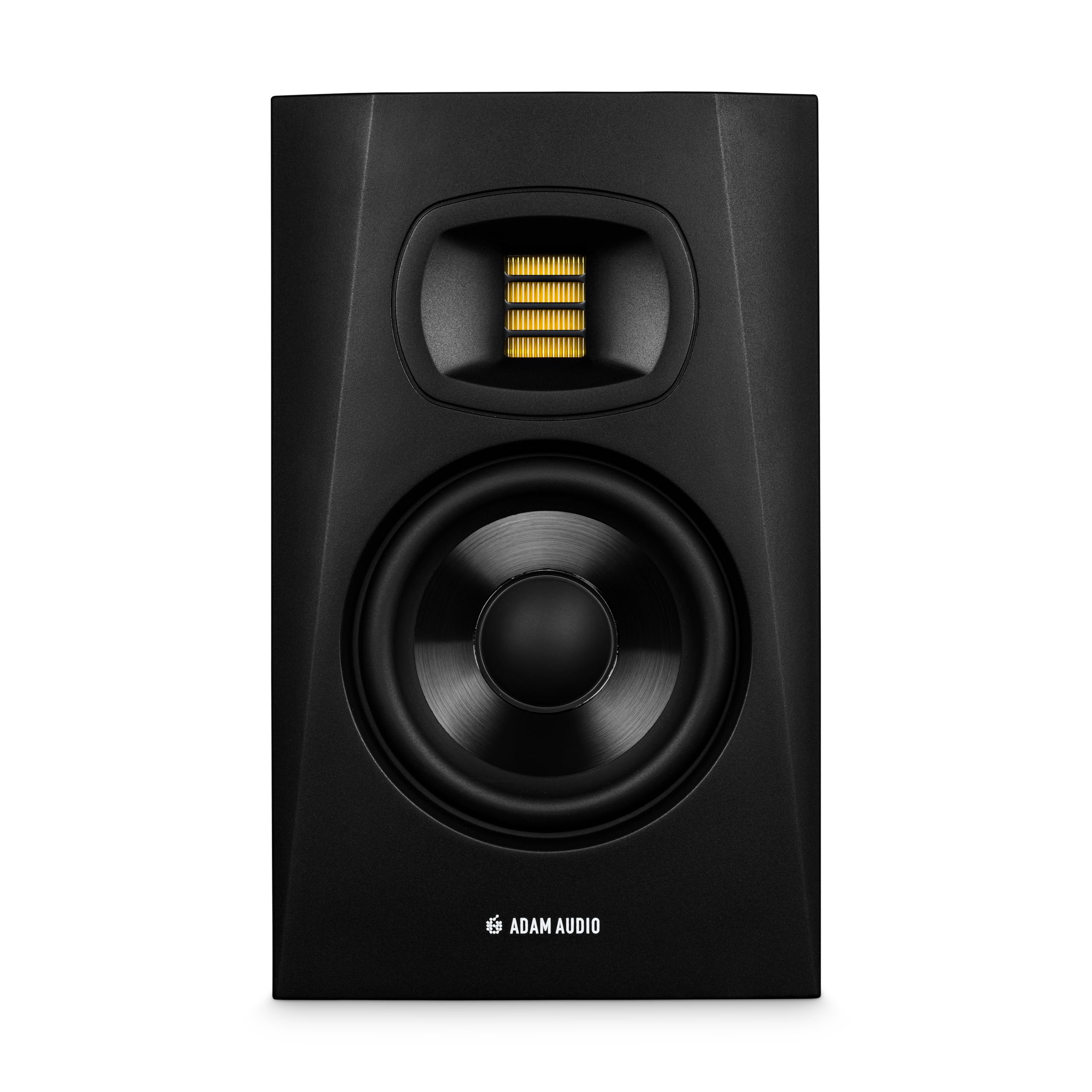
The ADAM Audio T5V brings the brand’s signature U-ART (Accelerated Ribbon Technology) tweeter to the affordable tier, delivering a transient response speed that silk dome designs can’t match. This folded-ribbon design moves air with greater acceleration than a conventional dome, translating to crisper attacks on snares, more defined plosive transients on vocals, and a top end that extends to 25 kHz. For mixing engineers who need to judge reverb tails and high-frequency EQ decisions with confidence, this is a defining advantage.
The 5-inch woofer is powered by a dedicated 50-watt Class D amplifier, while the U-ART tweeter gets its own 20-watt amp, forming a bi-amped system that maintains clarity even when you push the monitors. The HPS waveguide optimizes the dispersion pattern to minimize early reflections from your desktop, and the rear-panel high and low shelf filters use DSP rather than passive components, offering ±6 dB of adjustment in 2 dB steps. This level of control is rare at this price point.
The T5V is a single monitor, so you must buy two for stereo operation. The finish is a slightly slippery matte material that resists fingerprints, and the beveled cabinet with rear-firing port means placement requires careful consideration. Users note that the U-ART tweeter is unforgiving of poor source material—it will reveal sibilance issues and digital clipping without mercy, which is exactly what a reference monitor should do.
Why it’s great
- U-ART ribbon tweeter for unmatched transient speed
- DSP-based room EQ with fine adjustment steps
- Wide frequency response up to 25 kHz
Good to know
- Sold individually, must buy a pair for stereo
- U-ART tweeter can sound aggressive on poorly recorded tracks
3. Yamaha HS5 (Pair)

The 2-way bi-amp system allocates 45 watts to the 5-inch cone woofer and 25 watts to the 1-inch dome tweeter, producing a combined 70 watts of clean amplification that stays linear well into its output range. The white aramid-fiber cone is stiff and lightweight, reducing breakup modes that would otherwise add artificial warmth to the midrange.
The rear panel offers room control switches that cut or boost low frequencies (below 500 Hz) and high frequencies (above 2 kHz) in increments of -2 dB and +2 dB. These filters are passive but well-designed, allowing you to compensate for room modes without coloring the rest of the spectrum. The XLR and TRS inputs accept balanced or unbalanced signals, making them compatible with virtually any audio interface.
Owners consistently report that mixes translated flawlessly from their treated room to car stereos, earbuds, and club systems when using the HS5. The caveat is that these monitors are mercilessly revealing of poor mixing choices—there is no forgiving warmth to mask harsh frequencies or mud in the low midrange. They require a subwoofer for full bass extension below 54 Hz, but for critical midrange and top-end decisions, they remain the gold standard in their class.
Why it’s great
- Industry-standard flat response for mix translation
- Stiff aramid-fiber cone minimizes driver breakup
- Room control switches for placement adjustment
Good to know
- Limited bass extension without a subwoofer
- Requires an audio interface with balanced outputs
4. KRK Classic 5 (Pair)

The KRK Classic 5 carries the lineage of the iconic Rokit series, offering a slightly enhanced low-end response that is particularly useful for producers working in bass-heavy genres like hip-hop, EDM, and trap. The 5-inch woofer is constructed from a lightweight glass-aramid composite that provides excellent stiffness-to-mass ratio, delivering tight, controlled bass without the cone flex that causes distortion. The soft-dome tweeter with an optimized waveguide produces smooth highs that extend to 35 kHz, reducing listener fatigue during long sessions.
Unlike many monitors in this class, the Classic 5 includes a +2 dB bass boost switch derived from the original Rokit design, which many producers have historically used to mimic the low-end energy of club systems. The rear panel also offers a flat low-frequency adjustment setting for more accurate mixing when you don’t want hyped bass. The bi-amped Class A/B amplifier provides clean headroom, and the front-firing bass port reduces room-dependency compared to rear-ported designs.
Users praise the Classic 5 for its ability to reproduce sub-bass content that many 5-inch monitors miss entirely, making subwoofer integration more straightforward. The main criticism is that the bass boost feature can mislead novice mixers into overdriving their low-end on systems that don’t have the same exaggerated response. For experienced engineers who use the switch as a reference tool, these monitors offer exceptional value.
Why it’s great
- Glass-aramid woofer for tight, controlled bass
- +2 dB bass boost for club reference
- Front-firing port for flexible placement
Good to know
- Bass boost can mislead novice mix engineers
- Pair may require a subwoofer for full extension below 50 Hz
5. Edifier S1000MKII (Pair)

The Edifier S1000MKII blurs the line between audiophile bookshelf speaker and studio monitor, making it a versatile choice for producers who also want high-resolution playback for reference listening. The 5.5-inch aluminum alloy midrange-bass driver and 1-inch titanium dome tweeter are driven by a 120-watt (60W x 2) Class D amplifier that delivers impressive dynamic range and clarity. The aluminum cone provides excellent stiffness while remaining lightweight, reducing breakup distortion that can cloud the upper midrange.
Connectivity is unusually comprehensive for a powered speaker at this level—you get Bluetooth 5.0 with Qualcomm aptX HD for near-lossless wireless streaming, optical and coaxial digital inputs for TV or CD player integration, and analog RCA and AUX inputs. The included remote control handles volume, input switching, and tone adjustments, though the speakers can also be controlled via rear-panel knobs. Frequency response extends from 45 Hz to 40 kHz, covering the full audible range with minimal roll-off at the extremes.
Owners highlight the S1000MKII’s ability to sound musical and engaging without being overly colored, though the titanium tweeter does add a slight brightness that some users may find fatiguing over extended periods. The cabinet is large and heavy (16 lbs each), so desk space is a consideration. These are not pure reference monitors like the Yamaha HS5, but they excel as a hybrid tool for production, mixing, and casual listening in a home studio.
Why it’s great
- Comprehensive connectivity including Bluetooth aptX HD and optical inputs
- Powerful 120W Class D amplification with low distortion
- Wide frequency response from 45 Hz to 40 kHz
Good to know
- Titanium tweeter can sound slightly bright
- Large cabinet requires ample desk space
6. Pioneer DJ DM-50D (Pair)

The Pioneer DJ DM-50D is purpose-built for the producer-DJ hybrid workflow, offering a rear-panel switch that toggles between Production mode (flat frequency response for mixing) and DJ mode (enhanced low-end bump for beatmatching and listening). The active 5-inch drivers produce tight bass and crisp highs that translate well in a home studio or small club environment. The sleek black cabinet fits into both a production desk setup and a DJ booth aesthetic.
Setup is straightforward with RCA and 1/4-inch TRS inputs, and each speaker has its own volume knob. The front-firing bass port reduces placement sensitivity, meaning you can position these closer to walls without generating excessive port noise. The maximum SPL is adequate for near-field monitoring without ear fatigue, and the amp delivers consistent performance across its frequency range.
Users appreciate the convenience of the DJ mode for referencing how a track will sound on a club sound system, though some note that the production mode isn’t completely flat—it has a slight upward tilt in the presence region that can make high frequencies seem slightly more aggressive than on true reference monitors. For producers who also DJ and want a single pair of speakers to cover both functions, the DM-50D is a sensible compromise.
Why it’s great
- DJ/production mode switch for dual-purpose use
- Tight bass response for a 5-inch driver
- Front-firing port for flexible placement
Good to know
- Production mode is not completely flat
- No XLR inputs, limited to RCA and TRS
7. Edifier MR3 (Pair)

The Edifier MR3 is a compact near-field monitor that punches well above its physical size, achieving Hi-Res Audio certification with a frequency response that stretches from 52 Hz to 40 kHz. The 3.5-inch mid-low driver and 1-inch tweeter are powered by an 18W x 2 RMS amplifier that produces a peak SPL of 92.5 dB, sufficient for desktop mixing without distortion. The MDF cabinet construction reduces unwanted resonance, improving midrange clarity compared to plastic-bodied competitors.
Connectivity is a highlight: balanced TRS inputs join the usual RCA and AUX options, making these one of the few ultra-compact monitors that can integrate cleanly with professional audio interfaces. Bluetooth 5.4 supports multi-point connections, and the included Edifier ConneX app allows you to switch between Music, Monitor, and Custom EQ modes. This flexibility is rare in the compact segment, where most speakers force you into a single tonal profile.
Owners describe the sound as clean, neutral, and detailed with surprisingly tight bass for a 3.5-inch driver. The highs are sharp without being sibilant, and the mids are well-articulated for vocal monitoring. The main limitation is bass extension—below 60 Hz, the roll-off is steep, so these aren’t suitable for bass-heavy mixing without a subwoofer. For podcasters, video editors, and acoustic-focused producers, the MR3 delivers exceptional value in a desktop-friendly package.
Why it’s great
- Hi-Res Audio certified with extended high-frequency response
- Balanced TRS inputs for pro integration
- App-controlled EQ and multi-mode sound profiles
Good to know
- Limited bass extension below 60 Hz
- Plastic enclosure material
8. Micca PB42X (Pair)

The Micca PB42X represents one of the most cost-effective entries into active near-field monitoring, pairing a 4-inch woven carbon fiber woofer with a silk dome tweeter in a ported enclosure. The carbon fiber cone provides fast transient response and low distortion, while the silk tweeter delivers smooth, non-fatiguing highs. The built-in Class-D amplifier provides 15 watts per channel, enough for desktop use, but the speakers will start to show their limits when pushed above moderate listening levels.
The crossover is a highly optimized design that produces an open, balanced soundstage with particularly strong vocal clarity. Mids are natural and present, vocals cut through without harshness, and the treble is detailed without being brittle. The bass is present and punchy for a 4-inch driver, but rolls off gracefully below 80 Hz, meaning you will want a subwoofer for genres that rely on sub-bass content. The cabinet is built from a composite that feels solid, though the included cables are basic.
Users repeatedly note that the PB42X outperforms the Audioengine A2+ at less than half the price when it comes to midrange clarity and imaging. The twisty speaker cable connection system is a minor annoyance, and the lack of a subwoofer output limits upgrade paths without an external splitter. For vocal-centric mixing and casual listening in a small space, these are a remarkable value.
Why it’s great
- Excellent vocal clarity and midrange presence
- Woven carbon fiber woofer for low distortion
- Silk dome tweeter for smooth high frequencies
Good to know
- No subwoofer output available
- Limited power headroom for larger rooms
9. Micca RB42 (Pair)

The Micca RB42 is a passive bookshelf speaker that requires an external amplifier, which is actually a strength for budget-conscious users who already own a decent amp or want the flexibility to upgrade their amplification later. The 4-inch long-throw woofer features a truncated heavy steel frame and substantial magnet structure, allowing it to move more air than a typical 4-inch driver. The result is bass output that defies the driver size, with extension down to around 55 Hz that can fill a small room without a subwoofer for many genres.
The 0.75-inch silk dome tweeter uses a high-efficiency neodymium magnet and is paired with a 10-element crossover that uses film capacitors and air core inductors. The crossover slopes are 18 dB per octave, which reduces lobing and improves off-axis performance—critical for near-field monitoring where your ears are at different angles relative to each driver. The sound signature is surprisingly full-bodied with a slight V-shape that adds a touch of warmth and sparkle without sacrificing clarity.
Users consistently use words like “sorcery” to describe the bass output, but the RB42 is power-hungry—it needs at least 50-60 watts per channel to sound its best, and excessive volume can cause port noise or woofer bottoming with poorly recorded material. The dark walnut vinyl wrap is tasteful and the magnetic grille adds a clean look. These are best for someone who already owns a good amp and wants a compact passive speaker that delivers hi-fi performance on a tight budget.
Why it’s great
- Exceptionally deep bass for a 4-inch passive driver
- High-quality 10-element crossover with steep 18 dB slopes
- Flexible placement with magnetic grille and multiple finish options
Good to know
- Requires a powerful external amplifier (50W+ per channel)
- Can exhibit port noise at high volume levels
FAQ
Can I use affordable studio monitors for casual music listening?
Do I need a subwoofer with 5-inch monitors?
How important are balanced XLR or TRS inputs?
Final Thoughts: The Verdict
For most users, the best affordable studio monitors winner is the JBL 305P MkII (pair) because the Image Control Waveguide delivers a sweet spot wide enough for two people to collaborate at the desk, and the boundary EQ controls let you tune the response to your specific room without buying additional hardware. If you need absolute transient detail for critical mixing decisions, grab the ADAM Audio T5V paired as a stereo set. And for a compact desktop setup with versatile connectivity, nothing beats the Edifier MR3.

Mo Maruf
I created WellFizz to bridge the gap between vague wellness advice and actionable solutions. My mission is simple: to decode the research and give you practical tools you can actually use.
Beyond the data, I am a passionate traveler. I believe that stepping away from the screen to explore new environments is essential for mental clarity and physical vitality.