Our readers keep the lights on and my smoothie glass nicely filled. As an Amazon Associate, I earn from qualifying purchases.
When a loved one is bedbound, even a few hours of unrelieved pressure can turn healthy skin into a raw, weeping wound. The constant friction against sheets combined with trapped moisture creates the perfect environment for breakdown, and the wrong cream either washes away instantly or stings on contact. Choosing a barrier that adheres to compromised tissue without causing further irritation separates slow healing from active prevention.
I’m Mohammad Maruf — the founder and writer behind WellFizz. I analyze medical-grade skincare hardware and clinical formulation data to match real-world patient outcomes with specific ingredient ratios like zinc oxide concentration, petrolatum occlusion levels, and CHG compatibility.
After cross-referencing independent usage reports and clinical specs, the single most reliable tool for pressure injury staging remains the barrier cream for bed sores that clings to both intact and eroded skin while neutralizing enzymatic drainage at the source.
How To Choose The Best Barrier Cream For Bed Sores
Bed sore barriers aren’t one-size-fits-all lotions. The formulation must survive sweat, urine, and friction without migrating off the target zone. Here are the three specifications that determine whether a cream will hold or fail.
Zinc Oxide Concentration
Zinc oxide is the active ingredient that soothes inflammation and blocks moisture. Products in the 12 to 20 percent range provide strong prevention, while anything above 20 percent pushes toward treatment of active breakdown. Low-single-digit percentages (under 10 percent) are insufficient for stage one pressure injuries and should be reserved for mild chafing only.
Occlusive Base and Adhesion Profile
Petrolatum, lanolin, or dimethicone create the physical barrier that keeps urine and stool enzymes away from denuded skin. A paste-like consistency (often described as “thick” or “stiff”) stays in place longer than a thin ointment, reducing reapplication frequency for caregivers. Some pastes adhere to weeping or eroded surfaces where creams simply roll off.
Antifungal and Antimicrobial Additives
Moisture under an occlusive layer invites Candida or bacterial overgrowth. If your patient has a history of fungal rashes, a barrier with miconazole or clotrimazole built in prevents a secondary infection from forming underneath the protective layer. For surgical or wound-site use, verify CHG (chlorhexidine gluconate) compatibility so the barrier doesn’t interfere with the antiseptic.
Quick Comparison
On smaller screens, swipe sideways to see the full table.
| Model | Category | Best For | Key Spec | Amazon |
|---|---|---|---|---|
| Coloplast Critic-Aid Skin Paste | Paste | Deep wound beds, eroded skin | 6 oz paste adheres to weeping skin | Amazon |
| Triple Paste Adult Incontinence | Ointment | Fragrance-free daily prevention | 12.8% non-nano zinc oxide | Amazon |
| Baza Moisture Barrier Antifungal | Antifungal Barrier | Fungal-prone skin under barrier | 5 oz with antifungal active | Amazon |
| Chamosyn with Manuka Honey | Natural Barrier | Irritated chafed skin, early sores | 4 oz + aloe, chamomile, honey | Amazon |
| Thera Calazinc Body Shield | Calamine Barrier | Weep control and itching relief | 20% zinc + 3% calamine | Amazon |
In‑Depth Reviews
1. Coloplast Critic-Aid Skin Paste

The Coloplast Critic-Aid Skin Paste is a medical-grade zinc oxide paste designed for the most compromised skin environments — ostomy sites, stage one pressure injuries, and incontinence-related skin breakdown. Unlike thin creams that migrate with movement, this paste has a stiff, clay-like consistency that adheres to both intact and eroded surfaces. Caregivers report clearing deep diaper rash within one to two applications, a speed that suggests the zinc concentration and occlusive base work synergistically rather than relying on a single ingredient.
Clinical reviews highlight its compatibility with chlorhexidine gluconate, meaning you can apply it directly over wound antisepsis without neutralizing the disinfectant. The 6-ounce tube lasts significantly longer than 4-ounce alternatives because the thick paste requires less volume per application to achieve full coverage. Users consistently note that even severe, weepy rashes that resisted Desitin and prescription-strength zinc resolved after one or two uses.
What sets this apart from typical consumer barrier creams is the adhesion profile: it stays on wet, denuded skin where standard lotions bead up and slide off. The trade-off is that removal requires a gentle oil-based cleanser rather than simple water rinsing, but for bedbound patients where reapplication frequency is the primary burden, the extended wear time is a net positive. The paste is also rated safe for neonatal use, reinforcing its gentle formulation.
Why it’s great
- Adheres to weeping and eroded skin where other creams fail
- CHG compatible for wound-site protocols
- Neonatal-safe — incredibly gentle on raw tissue
Good to know
- Thick paste is harder to spread than ointment
- Requires oil-based cleanser for full removal
2. Triple Paste Adult Incontinence Rash Treatment
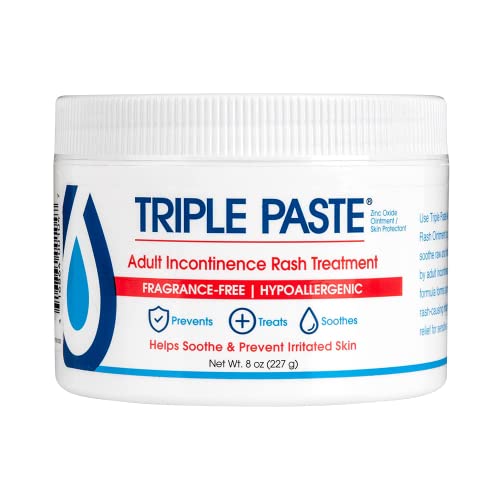
The Triple Paste Adult formulation brings the pediatrician-recommended Triple Paste technology into the adult incontinence space with a 12.8 percent non-nano zinc oxide base. The non-nano particle size means the zinc sits on top of the skin rather than being absorbed, maximizing barrier duration while minimizing systemic exposure. The ointment is fragrance-free, paraben-free, and phthalate-free, making it one of the safest options for patients with multiple chemical sensitivities or fragile epidermal layers.
Caregivers report that the consistency is thick enough to stay put during overnight wear yet rubs in more like a moisturizer than a gritty paste. This makes application easier when the patient cannot tolerate heavy pressure or manipulation of open areas. It cleared upper-thigh rashes almost immediately in documented cases, and multiple independent users noted it was effective where prior prescription antifungals had failed — likely because the barrier function prevented reinjury from friction during the healing window.
One caveat is that the 12.8 percent zinc concentration is on the lower end of the therapeutic range for active pressure injuries. Users treating stage one or earlier irritation find it perfect, but caregivers managing stage two breakdown may need a higher-zinc product underneath. The 8-ounce jar is generous for daily preventive application, and the smooth texture means less waste compared to paste formats where you lose product stuck to gloves or spatulas.
Why it’s great
- Non-nano zinc oxide won’t absorb into bloodstream
- Fragrance-free and paraben-free for sensitive skin
- Smooth consistency spreads easily over large areas
Good to know
- 12.8% zinc is preventive, not optimal for open wounds
- Better suited for daily barrier use than rescue treatment
3. Baza Moisture Barrier Antifungal Cream

The Baza Moisture Barrier Antifungal Cream from Coloplast solves a specific problem that standard zinc barriers miss: fungal colonization beneath the moisture seal. When a bedbound patient has a history of Candida rashes in the groin or intertriginous areas, applying a plain barrier can trap yeast against the skin and worsen the infection. Baza combines the same Coloplast paste technology found in Critic-Aid with an antifungal active that treats and prevents secondary fungal overgrowth.
Clinical reports describe it working “overnight” on raw, breaking skin around ostomy and port sites — the antifungal component inhibits microbial growth while the zinc and petrolatum base reduces friction. This dual-action approach is particularly valuable for patients with compromised immune systems where a simple yeast infection can escalate quickly. The 5-ounce tube comes as a two-pack, providing roughly 10 ounces of total product for long-term care.
The trade-off is that the antifungal component may cause a mild initial burning sensation on extremely raw surfaces, though this typically subsides within a minute. Users coming from the discontinued INZO formula report this as the closest functional replacement. For non-fungal applications, a plain zinc barrier would be equally effective without the potential for sensitization, so reserve this for patients with confirmed or highly suspected fungal involvement.
Why it’s great
- Treats and prevents fungal infections under the barrier
- Two-pack provides extended supply for care facilities
- Paste texture stays in place similar to Critic-Aid
Good to know
- Antifungal active may sting briefly on raw skin
- Unnecessary if no fungal history exists
4. Thera Calazinc Body Shield Barrier Cream
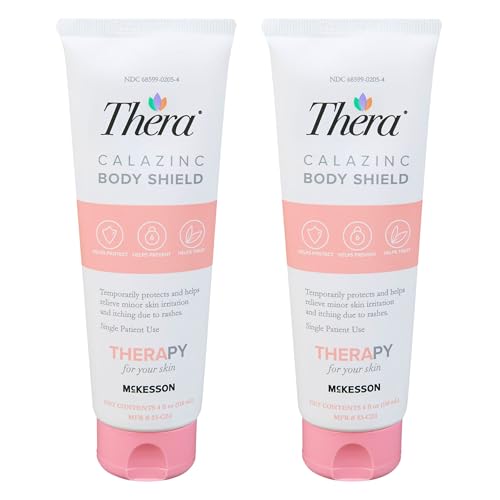
The McKesson Thera Calazinc Body Shield combines 20 percent zinc oxide with 3 percent calamine, creating a barrier that both occludes and dries weepy surfaces. Calamine is a traditional astringent that draws fluid from oozing lesions, making this formulation uniquely suited for bed sores that are actively draining rather than dry or chafed. The addition of hyaluronic acid and a proprietary vitamin blend supports skin integrity under the barrier, reducing the risk of maceration during extended wear.
Users describe a “heavy cream” texture with a mild, clean scent that provides relief within one to two minutes of application. Multiple reviews from patients managing neuropathy and menopause-related skin thinning note that the calamine component delivers lasting itch relief that plain zinc creams cannot match. The snap-lid tube is practical for bedside use, and the 4-ounce size is portable enough for a home care kit without bulk.
The primary limitation is the slow absorption profile — the cream can leave a visible white residue that transfers to clothing and bed sheets. Users recommend applying at night and covering with socks, footies, or a light cotton barrier. It is also harder to wash off from skin folds than standard ointments, requiring warm water and mild soap. For existing drainage and superficial skin breakdown, the calamine drying effect is a distinct advantage over purely occlusive barriers.
Why it’s great
- Calamine dries weepy, oozing wounds effectively
- 20% zinc ranks among highest concentration in this class
- Hyaluronic acid reduces maceration risk
Good to know
- Leaves visible white residue on clothes and sheets
- Hard to wash off completely from skin folds
5. Chamosyn Moisture Barrier with Manuka Honey

The Chamosyn Moisture Barrier Ointment from Links Medical takes a different approach, using Manuka honey, aloe vera, and chamomile as active soothing agents rather than high-concentration zinc oxide. Manuka honey has well-documented antimicrobial and enzymatic debriding properties, making this ointment effective for early-stage bed sores where the goal is to prevent progression rather than occlude heavy drainage. The 4-ounce tube format is compact, and the two-pack provides enough volume for consistent daily application.
Hospice nurses specifically recommend this cream for early bed sore prevention, and independent user reports confirm it works on a wide range of irritations including diaper rash, hemorrhoid chafing, feeding tube site leakage, and minor cuts. The sensation is described as “cooling” on raw areas — unlike zinc-only barriers that sit inert, the honey and aloe provide immediate sensory relief. Patients with Hirschsprung’s disease and long-term incontinence found it outperformed two different prescription creams.
The trade-off is that the natural-based formula does not provide the same level of waterproof occlusion as petrolatum-heavy pastes. For patients with heavy liquid stool or constant urine exposure, a zinc paste layer underneath the Chamosyn may be necessary. The honey component also means a slightly sticky feel during application, though this dissipates as the ointment warms to skin temperature. For mild to moderate barrier needs with an emphasis on soothing ingredients, this is a strong entry-level option.
Why it’s great
- Manuka honey offers natural antimicrobial debriding action
- Cooling sensation provides immediate comfort on raw skin
- Two-pack format reduces per-application cost
Good to know
- Less waterproof than petrolatum-heavy pastes
- Sticky feel during application before absorbing
FAQ
Can barrier cream heal an existing stage two bed sore?
How often should I reapply barrier cream to a bedridden patient?
What does CHG compatible mean on a barrier cream label?
Final Thoughts: The Verdict
For most users, the barrier cream for bed sores winner is the Coloplast Critic-Aid Skin Paste because it adheres to weeping, eroded skin where every other cream slides off, and the CHG compatibility makes it safe for wound protocols. If you want fragrance-free daily prevention with easy application, grab the Triple Paste Adult Incontinence Treatment. And for patients with confirmed fungal involvement under the barrier, nothing beats the Baza Moisture Barrier Antifungal Cream.

Mo Maruf
I created WellFizz to bridge the gap between vague wellness advice and actionable solutions. My mission is simple: to decode the research and give you practical tools you can actually use.
Beyond the data, I am a passionate traveler. I believe that stepping away from the screen to explore new environments is essential for mental clarity and physical vitality.