Our readers keep the lights on and my smoothie glass nicely filled. As an Amazon Associate, I earn from qualifying purchases.
The moment you run your thumb across a fresh carbon steel edge, you feel it—a sticky, aggressive bite that stainless can never reproduce. That bite, paired with a steel that actually patinas and takes a screaming edge, is why seasoned cooks abandon their German workhorses. But the trade-off between edge retention, reactivity, and handle comfort is real, and the wrong pick leaves you fighting rust instead of cooking.
I’m Mohammad Maruf — the founder and writer behind WellFizz. I’ve spent years analyzing blade metallurgy, Rockwell hardness charts, and real-world edge retention data across forged and stamped carbon steel lines, filtering out the marketing noise to find what actually performs on a busy cutting board.
Whether you are transitioning from stainless or upgrading your kit, finding the right carbon steel chef knife means balancing steel purity, handle geometry, and maintenance demands with your daily prep style.
How To Choose The Best Carbon Steel Chef Knife
Choosing a carbon steel chef knife is more personal than picking a stainless blade because the steel itself evolves with use. The patina that develops tells the story of your prep style, and the way the handle sits in your grip determines whether this knife becomes your daily driver or a shelf decoration.
Steel Core & Cladding Structure
Look past marketing terms like “Damascus” and focus on the core steel. Pure high-carbon steel (like Swedish carbon) offers the best edge potential but reacts aggressively with acidic foods. Multi-layer construction—where a high-carbon core is sandwiched between stainless or softer steel layers—reduces reactivity while keeping the cutting edge hard. A VG10 core at 62 HRC holds its edge longer than 10Cr15CoMoV at 60 HRC, but both require more care than a pure carbon monosteel blade.
Handle Geometry & Balance Point
An octagonal wa-handle (traditional Japanese style) naturally centers the pinch grip and shifts the balance point forward for precise push-cuts. Western-style contoured handles offer more palm fill for rock-chopping but often make the knife feel blade-heavy. The ideal balance point for an 8-inch chef knife sits just ahead of the bolster—if the knife tips backward, you will fatigue faster during long prep sessions.
Edge Bevel & Maintenance Commitment
A 70:30 asymmetrical bevel delivers extreme thinness behind the edge and slices with less resistance than a symmetrical 50:50 grind. That thinness also means the edge is more prone to chipping on hard chopping boards or bones. Assess your sharpening setup: if you only own a pull-through sharpener, avoid ultra-hard carbon steels above 62 HRC and stick with softer, easier-to-maintain high-carbon alloys that respond to a quick strop.
Quick Comparison
On smaller screens, swipe sideways to see the full table.
| Model | Category | Best For | Key Spec | Amazon |
|---|---|---|---|---|
| Misono EU Carbon Steel Gyuto | Premium | Pure carbon purists | Swedish carbon, 70:30 bevel | Amazon |
| KAWAHIRO VG10 Gyuto | Mid-Range | Premium feel on a daily driver | VG10 core, 62 HRC | Amazon |
| Atumuryou JPCK Damascus | Mid-Range | Gift-ready aesthetics | 67-layer VG10 Damascus | Amazon |
| SYOKAMI Butcher Knife Set | Mid-Range | Meat processing | 3-piece set, Wenge handle | Amazon |
| Serbian Chef Knife by Nikos | Mid-Range | Compact cleaver duties | Full tang, 6.7-inch blade | Amazon |
| HOSHANHO 10Cr15CoMoV Gyuto | Value | Sharp out-of-box performance | 9-layer, 10Cr15CoMoV core | Amazon |
| Sunnecko 8-Inch Gyuto | Budget | Entry-level carbon steel | 3-layer 9Cr18MoV steel | Amazon |
In‑Depth Reviews
1. Misono EU Carbon Steel Professional Gyuto

Misono has been forging knives in Sakai, Japan since 1935, and the EU Carbon line represents a purist approach—no cladding, no damascus layers, just a monosteel Swedish carbon blade with a dragon engraving that signals honest heat-treat work. The 70:30 asymmetrical bevel is immediately noticeable: this knife favors a right-handed push-cut motion and slices through onion skins with almost zero vertical resistance. Home cooks coming from a 50:50 German grind will need to adjust their cutting angle, but the learning curve pays off in thin, clean cuts that stainless knives cannot match.
At 8.2 inches and a composite wood handle, the balance point sits precisely at the pinch grip, making this gyuto feel alive during long mise en place sessions. The composite wood handle is less slippery than untreated rosewood when wet, though it lacks the tactile warmth of a natural wa-handle. Owners report that the factory edge arrives extremely sharp—often exceeding a 200 grit finish—and takes a refined patina within a few uses if you start with fatty proteins rather than acidic fruits.
Experienced carbon steel users will appreciate the edge retention—it holds a working sharpness for weeks of home use—but beginners should budget for a dedicated sharpening stone and a drying towel within arm’s reach.
Why it’s great
- Pure Swedish carbon steel delivers exceptional edge retention and easy sharpening on whetstones.
- 70:30 asymmetrical bevel produces noticeably thinner slices than symmetrical grinds.
- Classic Sakai-forged profile with dragon engraving adds genuine craftsmanship to your kit.
Good to know
- Extremely reactive—requires immediate drying and oiling after every use to prevent rust.
- Asymmetrical bevel is less comfortable for left-handed users and rock-chopping motions.
2. KAWAHIRO VG10 Gyuto 8.24-Inch
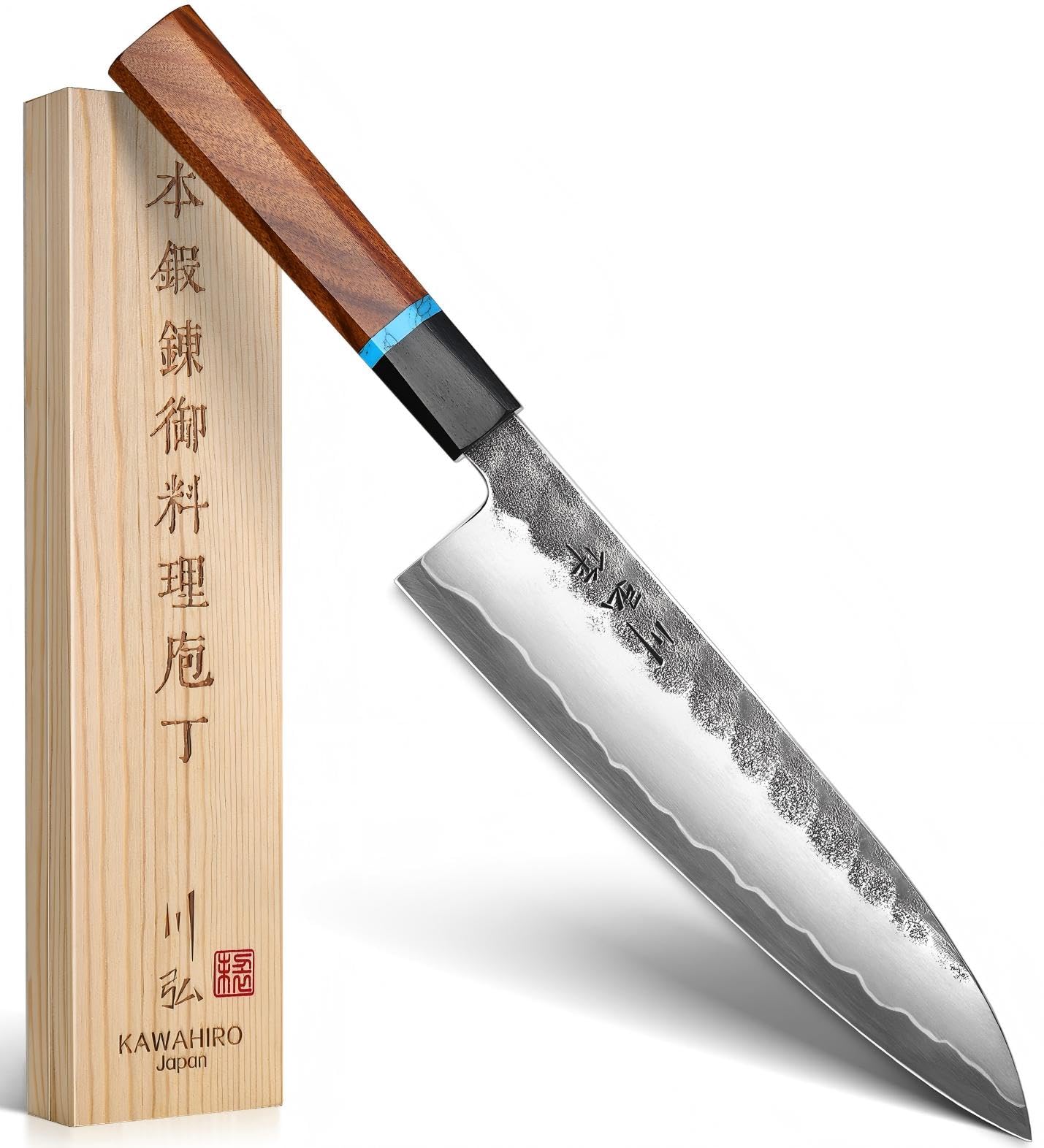
KAWAHIRO’s KH-6601 series brings a three-layer composite construction to the table: a Japanese VG10 core rated at 62 HRC, clad in softer stainless steel that protects the outer face from reactivity. This sandwich structure means the cutting edge stays hard and thin while the cladding resists the rapid oxidation that plagues monosteel carbon knives. The 8.24-inch blade carries a black-forged finish that naturally reduces food release, and the layered pattern visible along the spine confirms the multi-steel forging process without faking a Damascus look.
The handle is where this knife earns its conversation-starter status: a mix of premium ruby wood, turquoise, and ebony creates a multicolor wa-handle that is both visually arresting and ergonomically sound. The octagonal shape locks into a pinch grip without hot spots, and the full-tang construction ensures the balance point sits directly over the bolster. Long prep sessions feel controlled because the handle does not twist in a wet grip—the stabilized wood and resin infusion add weight without making the knife back-heavy.
Out-of-box sharpness is impressive, with several users reporting a sub-150 grit BESS score after sharpening. The VG10 core holds that edge for weeks of home use and responds well to a ceramic honing rod between full sharpening sessions. The included wooden storage case and certificate of authenticity are genuine value-adds for gifting, though the packaging volume is excessive for kitchen storage.
Why it’s great
- Clad construction drastically reduces reactivity while keeping a hard VG10 cutting edge.
- Unique turquoise-and-ebony handle provides excellent wet grip and balanced ergonomics.
- BESS scores in the 140-150 range after light sharpening deliver professional-grade sharpness.
Good to know
- Minor edge chipping reported after extended use; avoid hard chopping boards.
- Manufacturing origin is China, not Japan, despite Japanese branding cues.
3. Atumuryou JPCK 67-Layer Damascus VG10 8-Inch
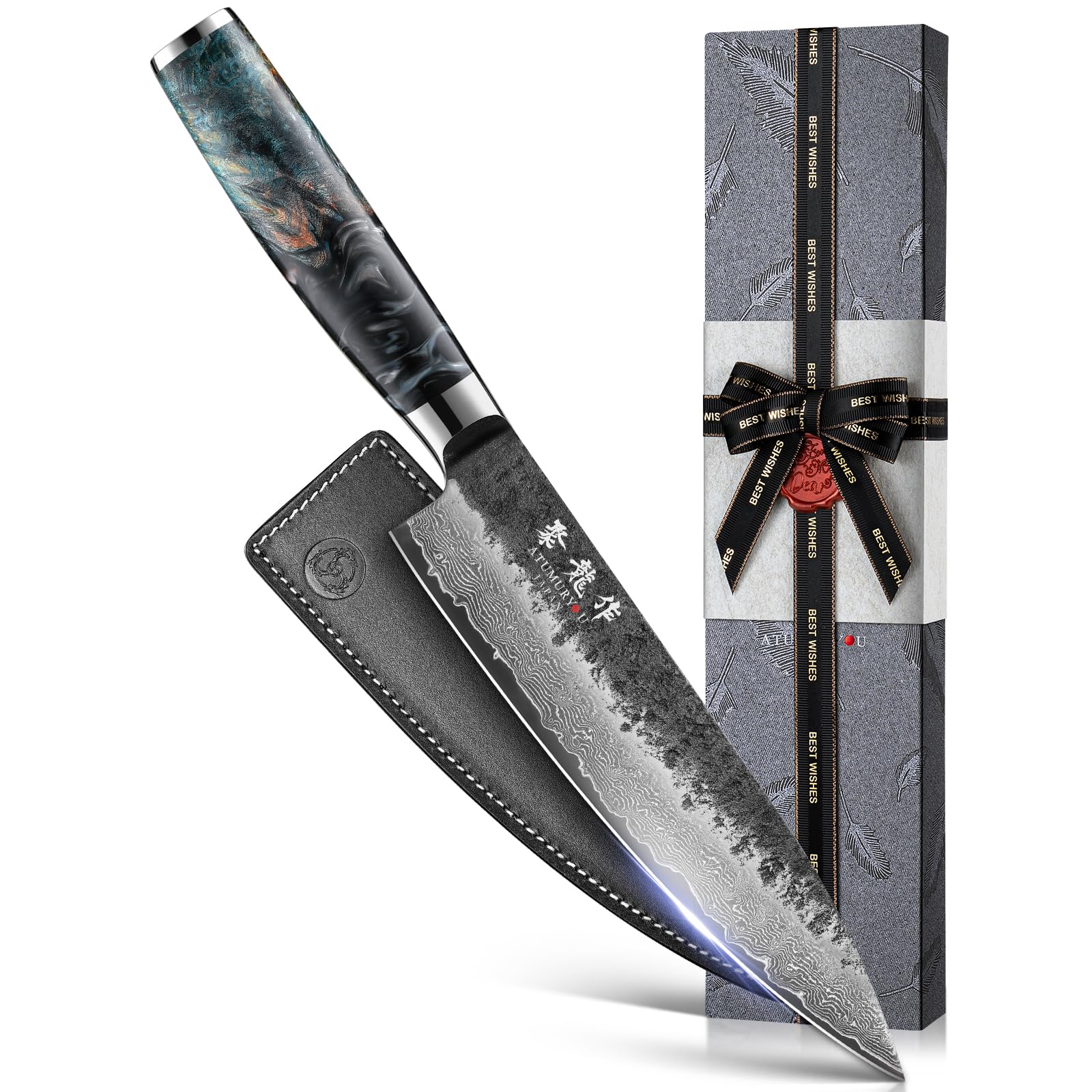
The Atumuryou JPCK brings 67-layer Damascus aesthetic to a VG10 core, combining 33 layers of Damascus steel on each side with a single-layer VG10 core center. This construction provides the visual depth of traditional pattern welding while keeping the cutting edge at a reliable 62 HRC. The black-forged finish on the blade reduces glare during prep and helps food slide off the flat of the knife, though the etched layers can trap moisture if not dried promptly after washing.
What sets this knife apart for the gift-buying crowd is the complete unboxing experience: a black gift box with feather-pattern embossing, a golden butterfly knot, a certificate of authenticity, a genuine leather sheath, and a wipe cloth. The stabilized wood and resin handle creates a unique multicolor pattern that no two buyers will get exactly alike. The octagonal handle profile is less aggressive than traditional sharp-cornered wa-handles, making it more forgiving for cooks who are not accustomed to Japanese handle geometry.
Edge performance out of the box is consistently sharp, though not quite at the level of the KAWAHIRO or Misono. The VG10 core holds a working edge through heavy vegetable prep and light meat slicing without chipping. The leather sheath is a practical bonus—it protects the edge during drawer storage and makes the knife travel-ready for outdoor cooking.
Why it’s great
- Gorgeous 67-layer Damascus pattern makes this the most visually striking knife on the list.
- Complete gift packaging with leather sheath and certificate adds serious gifting value.
- Stabilized resin handle offers a comfortable, non-slip grip for extended prep.
Good to know
- VG10 core requires immediate cleaning and drying to prevent surface rust on the cladding line.
- Packaging is overbuilt for daily use; the wooden box takes up significant drawer space.
4. SYOKAMI 3-Piece Butcher Knife Set
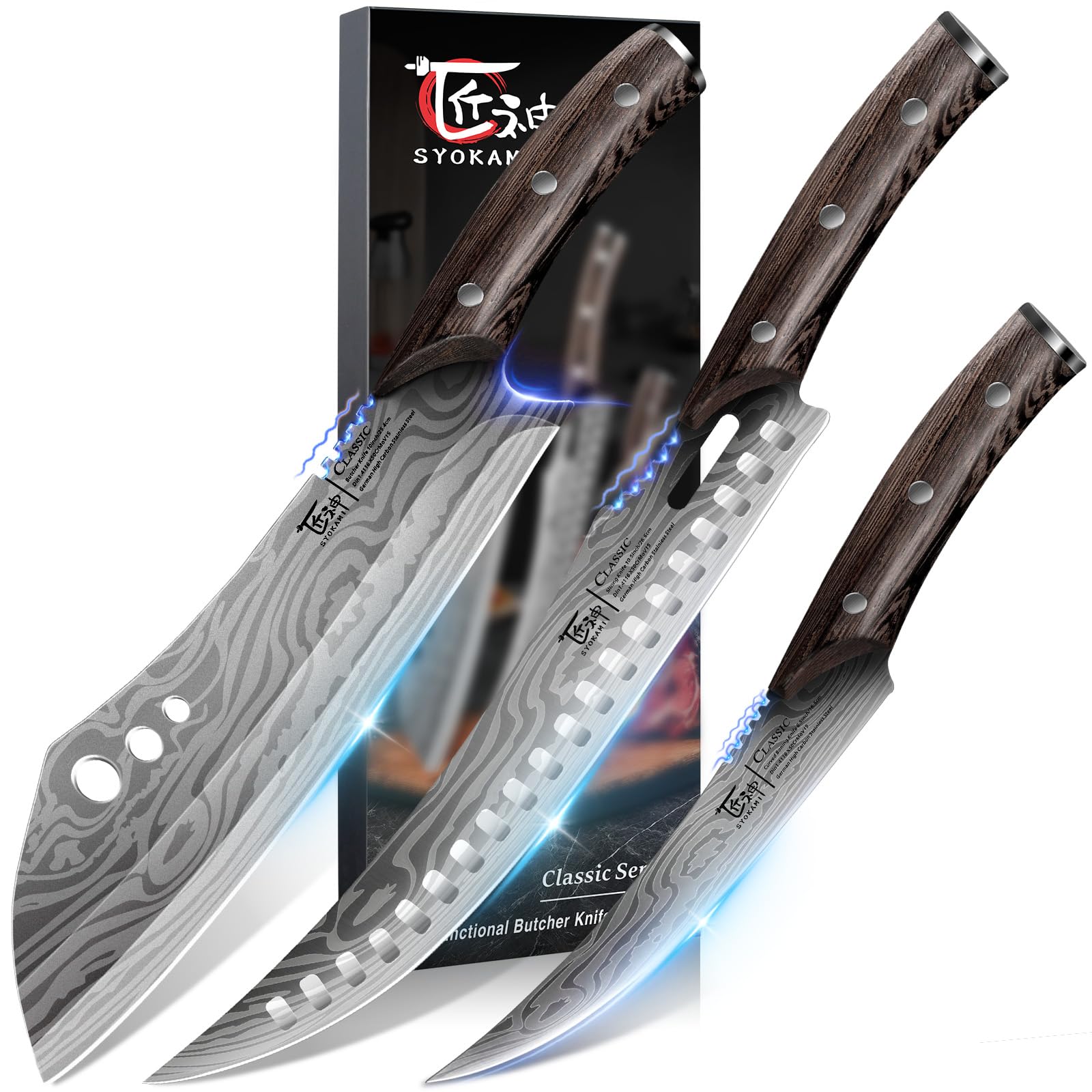
SYOKAMI’s 3-piece set covers the three essential meat-processing profiles—a 10-inch butcher knife, a 10.5-inch breaking knife, and a 6.5-inch curved boning knife—all forged from high-carbon stainless steel with a Rockwell hardness of 56+ HRC. This hardness is intentionally lower than the VG10 knives above because butchery work demands toughness and flexibility over razor thinness. The breaking knife’s curved cimeter blade geometry excels at slicing through cartilage and trimming fat cap in a single pass, while the boning knife’s 20-degree flexibility curve allows you to trace around hip bones without snapping the tip.
The Wenge wood handles are the standout feature here: the dense, oily African hardwood provides a natural non-slip surface even when your hands are coated in fat and blood. The gear-tooth texture along the spine of the handle adds mechanical grip that synthetic handles cannot replicate. At roughly 1-inch handle thickness, the knife blank runs through a full half-inch of wood on each side, creating a sturdy full-tang structure that feels reassuringly unbreakable during heavy breaking tasks.
Out-of-box sharpness is excellent for butchery work—the 56 HRC edge is easy to touch up with a steel rod mid-session. The faux-Damascus etch on the blade surface is cosmetic only, but the underlying steel takes and holds a working edge well. The set comes with three knives, which is a strong value proposition for home butchers and BBQ enthusiasts who want dedicated tools for primal breakdown.
Why it’s great
- Three-knife set covers all butchering tasks with dedicated blade profiles for each step.
- Wenge wood handles with gear-tooth texture provide unmatched slip resistance during greasy prep.
- 56+ HRC strikes a durable balance between edge retention and chip resistance for bone contact.
Good to know
- Large chef knife tip can snag on cutting boards due to the lack of a bullnose profile.
- Faux-Damascus pattern is cosmetic only and does not indicate layered steel construction.
5. Serbian Chef Knife by The Nikos Knife
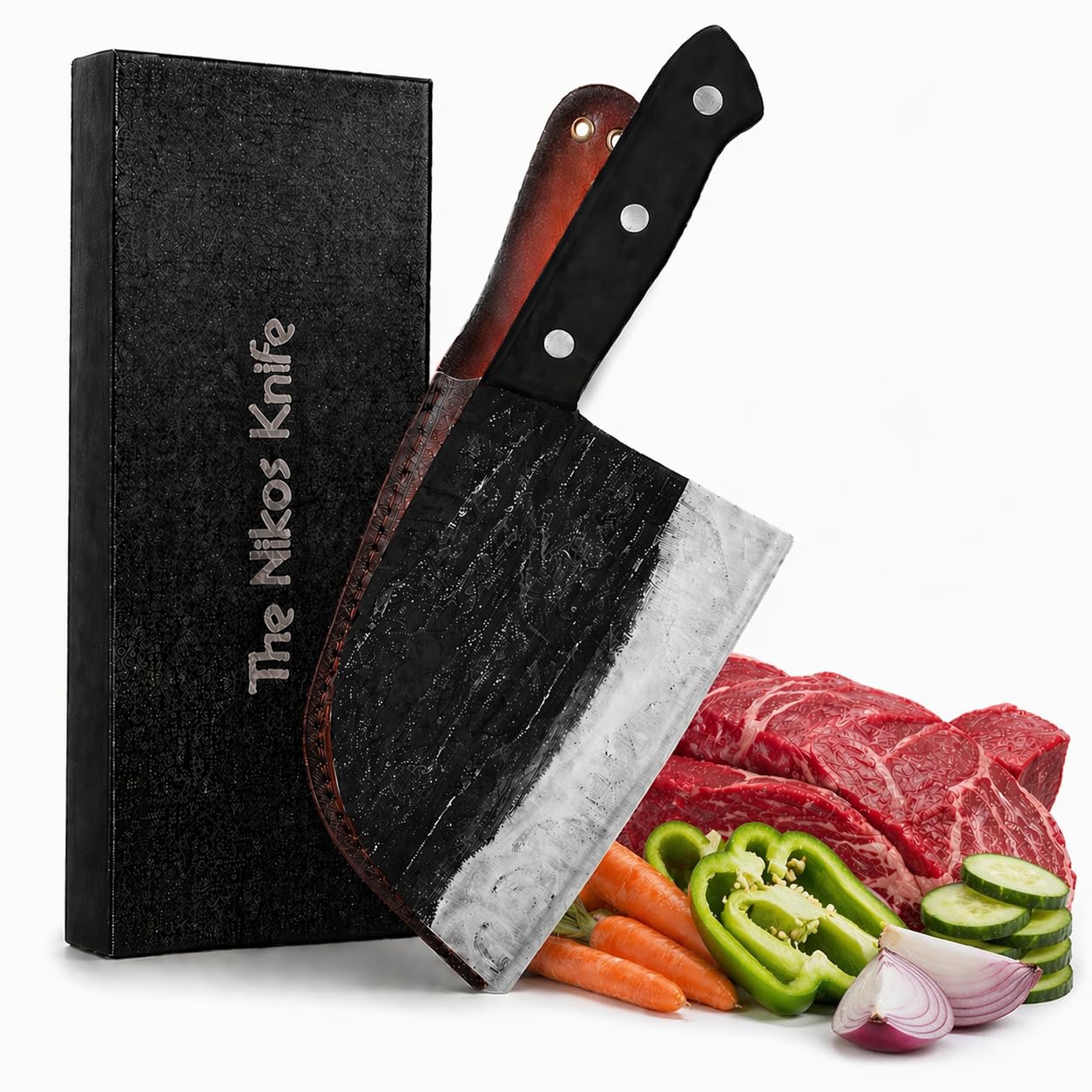
The Serbian chef knife silhouette is a niche shape—a 6.7-inch blade with a raised tip that combines cleaver mass with chef knife agility. The Nikos Knife version is hand-forged from high-carbon steel with a full-tang ebony handle, delivering a weight of 0.87 kilograms that gives it authoritative heft for chopping through squash and dense root vegetables. Unlike a standard chef knife, the Serbian profile’s curved belly allows for a rocking motion while the raised tip keeps your knuckles clear of the cutting board during push-cuts.
Ebony is a dense, naturally oily wood that resists moisture absorption better than rosewood or walnut, and the contoured handle shape fills the palm more completely than an octagonal wa-handle. The included leather sheath is lined and fits snugly, making this a strong candidate for camp cooking or outdoor prep where you need a single knife that can handle meat, vegetables, and even light bone work. The steel arrives coated in oil from the forge, and the edge comes sharp enough to slice paper cleanly on arrival.
Maintenance is straightforward: the high-carbon steel will develop a dark patina with use, which actually protects against further corrosion. Retired professional chefs in the reviews specifically praised this knife as a replacement for their full Wusthof and Henckels sets when downsizing, which speaks to its versatility. The lack of branding on the blade or sheath is a minor aesthetic complaint for collectors, but for pure function, this knife punches above its weight class.
Why it’s great
- Full-tang ebony handle provides excellent balance and natural moisture resistance.
- Serbian profile combines cleaver chopping power with chef knife slicing control.
- Included leather sheath adds portability and safe storage for outdoor use.
Good to know
- Heavier than typical 8-inch chef knives at nearly 2 pounds; may fatigue smaller hands.
- No branding on blade or sheath makes identification difficult in a shared kitchen.
6. HOSHANHO 10Cr15CoMoV 8-Inch Gyuto

HOSHANHO uses a 9-layer sandwich structure with a 10Cr15CoMoV super steel core—a Japanese high-carbon alloy that sits between VG10 and Aogami Blue in edge retention. The wet V-shaped sharpening technology creates a 12-15 degree bevel on both sides, resulting in an out-of-box edge that consistently impresses buyers with its aggressive bite. The hammered finish on the blade surface reduces food sticking during vegetable prep, and the layered lines from the 9-fold forging give each knife a unique pattern without the cost of true Damascus construction.
The imported rosewood handle follows the traditional Japanese octagonal profile with two copper wire accents that add visual interest and a small amount of moisture wicking at the ferrule. The 8.11-inch blade paired with a 6.1-inch handle creates nearly a golden ratio of length distribution, and the balance point falls directly under the index finger when pinch gripping. At 221 grams, this knife feels noticeably lighter than the Serbian or SYOKAMI options, making it ideal for precision slicing rather than heavy chopping.
Reviewers consistently note this knife is extremely sharp out of the box but warn about two issues: the blade heel can have a sharp edge that catches your hand if not ground down, and the steel is prone to chipping if used against hard surfaces. The 10Cr15CoMoV core also develops surface oxidation if left wet, so immediate drying is necessary. For the price, the combination of sharpness, handle ergonomics, and layered steel construction is hard to beat for cooks who are comfortable with basic knife maintenance.
Why it’s great
- Exceptionally sharp 12-15° edge straight from the box outperforms many premium knives.
- 9-layer steel construction provides a good balance of edge retention and chip resistance.
- Lightweight at 221 grams with near-perfect balance for repetitive slicing tasks.
Good to know
- Sharp heel and occasional burrs require immediate filing or grinding for safe use.
- Reactive core still develops surface oxidation if not dried and oiled after each use.
7. Sunnecko 8-Inch Gyuto Chef Knife
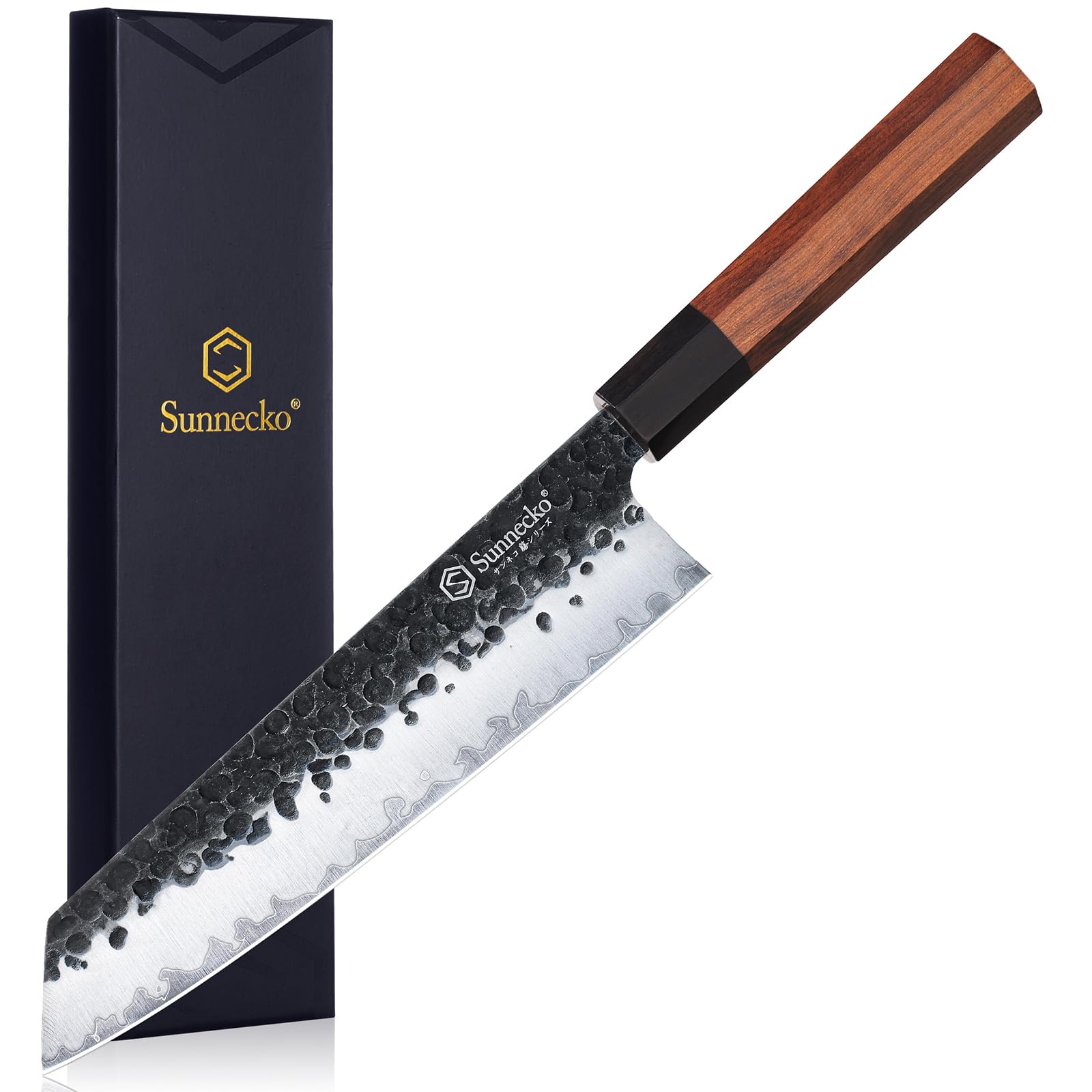
The Sunnecko gyuto serves as a low-risk entry point into carbon steel chef knives, featuring a 3-layer construction with a 9Cr18MoV steel core. 9Cr18MoV is a Chinese high-carbon stainless alloy that sits between German X55CrMo14 and Japanese VG10 in hardness, landing at roughly 58-60 HRC. This means the edge takes a keen sharpness but won’t shatter if you accidentally hit a cutting board edge or chicken bone. The blackened, heat-treated finish on the blade gives it a vintage appearance that looks more expensive than the price tag suggests.
The rosewood handle is octagonal in cross-section and comfortable for pinch-grip users, though the fiberglass ferrule feels less premium than the solid wood ferrules on the HOSHANHO or KAWAHIRO. At 203 grams, this is the lightest knife on the list, and the thin blade stock behind the edge makes it excel at slicing through soft produce and boneless proteins. The included gift box packaging is serviceable and makes this a decent option for gifting to someone who is curious about carbon steel but not ready to invest in a high-maintenance blade.
Out-of-box sharpness is adequate but not exceptional—one reviewer measured it at 210 on the BESS scale, which is noticeably duller than the HOSHANHO or KAWAHIRO. A few minutes on a whetstone drops that number to around 145, bringing it in line with mid-range options. The steel core develops patina slowly and is less reactive than pure Swedish carbon, making this a forgiving first carbon steel knife. The manufacturer claims dishwasher safety, but any carbon steel owner knows that hot water and detergent cycles will destroy the edge and finish over time.
Why it’s great
- Lightweight at 203 grams and thin blade stock reduce wrist fatigue during long prep sessions.
- 9Cr18MoV steel is less reactive than pure carbon, making it beginner-friendly.
- Vintage aesthetic and gift box packaging offer strong perceived value.
Good to know
- Out-of-box sharpness is below average at 210 BESS; expect to sharpen immediately.
- Fiberglass ferrule and simple construction feel less refined than multi-layer competition.
FAQ
Is a carbon steel chef knife better than stainless for a home cook?
How do I prevent my carbon steel knife from rusting?
What is the difference between VG10 and Swedish carbon steel?
Can I sharpen a carbon steel chef knife with a pull-through sharpener?
Final Thoughts: The Verdict
For most users, the carbon steel chef knife winner is the Misono EU Carbon Steel Gyuto because pure Swedish carbon with a 70:30 asymmetrical bevel delivers professional edge performance that improves with use. If you want a low-maintenance blade with premium aesthetics, grab the KAWAHIRO VG10 Gyuto. And for dedicated meat processing, nothing beats the SYOKAMI 3-Piece Butcher Set for having the right tool for every cut.

Mo Maruf
I created WellFizz to bridge the gap between vague wellness advice and actionable solutions. My mission is simple: to decode the research and give you practical tools you can actually use.
Beyond the data, I am a passionate traveler. I believe that stepping away from the screen to explore new environments is essential for mental clarity and physical vitality.