Our readers keep the lights on and my smoothie glass nicely filled. As an Amazon Associate, I earn from qualifying purchases.
Dragging a massive battery pack into the backcountry defeats the purpose of sleep apnea therapy on the trail. The core tension of backpacking with a CPAP is balancing enough watt-hours to make it through the night against a pack weight that won’t break your back or your spirit. Dedicated portable power stations, purpose-built lithium cells, and universal travel batteries have evolved to solve this exact equation, letting you run your ResMed, Philips, or Z2 without a wall outlet for multiple nights.
I’m Mohammad Maruf — the founder and writer behind WellFizz. I’ve spent hundreds of hours cross-referencing battery chemistries, discharge curves, cable compatibility matrices, and real-world runtime reports so you don’t have to guess which power solution will actually keep your airway open on the trail.
Whether you’re planning a multi-day thru-hike or a weekend car-camp trip, finding the right backpacking cpap power source means understanding capacity, weight, voltage matching, and recharge speed — and I’ve broken down the nine most viable options on the market right now to help you choose with confidence.
How To Choose The Best Backpacking CPAP
Selecting a portable power source for your CPAP machine while backpacking is a trade-off between energy density and weight. Unlike car camping where you can haul a 10-pound power station, backpacking demands a unit that delivers enough runtime without becoming the heaviest item in your pack. The three most critical factors are total capacity measured in watt-hours, the physical weight of the battery, and the voltage compatibility with your specific machine.
Match Voltage to Eliminate Conversion Loss
Running your CPAP through an AC inverter wastes 10-15% of your battery’s capacity as heat. The most efficient backpacking setups use a direct DC-to-DC connection at the exact voltage your machine expects — 24V for most ResMed AirSense and AirCurve models, 12V for many travel CPAPs like the Transcend, or a multi-voltage system that auto-detects. Always check the input voltage of your specific CPAP model and choose a battery that offers a native DC output at that voltage.
Weigh Watt-Hours Against Pack Weight
Every pound of battery adds roughly 100-120 watt-hours with current lithium-ion technology. For a single night in the backcountry with humidification and heated tubing turned off, you generally need between 50Wh and 90Wh. Two nights push that to 100-180Wh. Three nights require closer to 200Wh or more. The lightest TSA-compliant units (under 100Wh) weigh about 1-1.3 pounds and can cover one to two nights if you run a low-pressure setting. For longer trips, you either accept a heavier battery (3-7 pounds) or carry multiple smaller packs.
Pass-Through Charging for Multi-Day Trips
If you’re moving between campsites with access to a vehicle, solar panel, or RV hookup, pass-through charging functionality allows the battery to power your CPAP while simultaneously recharging. This feature matters most for multi-night trips where the battery needs a top-up during the day. Units with USB-C input at 65W or 100W recharge significantly faster than older DC-only models, letting you fully replenish between sleeps.
Quick Comparison
On smaller screens, swipe sideways to see the full table.
| Model | Category | Best For | Key Spec | Amazon |
|---|---|---|---|---|
| Zopec Explore 5700 | Universal Travel | Multi-night backpacking | Up to 3 nights runtime | Amazon |
| Zopec Explore Mini | Ultra-Compact | Carry-on & ultralight trips | 1.1 lb, FAA compliant | Amazon |
| BLUETTI X30 | Mid-Range Power Station | Camping & hurricane prep | 297Wh, 3 DC outputs | Amazon |
| EASYLONGER ES960 PRO | High-Capacity LiFePO4 | Extended off-grid trips | 297.6Wh, 6 output ports | Amazon |
| EASYLONGER ES720 PRO | Value Power Station | Budget multi-night camping | 276.48Wh, 100W USB-C | Amazon |
| Pilot Flex 98Wh | Dual-Voltage Travel | 12V & 24V travel CPAP | 98Wh, 1.2 lb | Amazon |
| Pilot-24 Lite (95Wh) | TSA-Approved Lightweight | Air travel & 24V CPAP | 95Wh, aluminum case | Amazon |
| Medistrom Pilot-24 Lite Bundle | All-In-One Travel Set | ResMed AirMini/AirSense 10 | 95Wh, bundled cables | Amazon |
| Medistrom Pilot-24 Lite + Wipes | Travel & Hygiene Combo | International travel | 95Wh, LED flashlight | Amazon |
In‑Depth Reviews
1. Zopec Explore 5700 Universal Travel CPAP Battery

The Zopec Explore 5700 is the closest thing to a true multi-night backpacking battery that doesn’t require a team of sherpas to carry. It delivers up to three nights of runtime without humidification or heated tubing, and its universal 110-240V input voltage means you can recharge from virtually any wall outlet or car inverter worldwide without a step-down transformer. The 7.7 x 5.7 x 1-inch form factor slides easily into the side pocket of a 40-liter pack.
Real-world testing shows that with pressure settings below 12 cm H₂O and no heated tube, you can expect 16 to 24 hours of total use — enough for two to three full nights in the backcountry. When you do need to top up, the battery recharges from 20% to full in roughly two hours, a remarkably fast turnaround for a unit in this capacity class. It also meets FAA/TSA requirements at under 100Wh, so it can fly in your carry-on without hassle.
One crucial caveat: running heated humidification cuts runtime drastically, dropping to around three to four hours per night. You must manage your expectations and turn off heat and humidity for multi-day trips. The unit is slightly heavier than dedicated one-night travel batteries at about 2.5 pounds, but the extended runtime justifies the weight for longer excursions.
Why it’s great
- Delivers 2-3 nights off-grid without humidification
- Recharges in about 2 hours from 20%
- Universal voltage input works globally
Good to know
- Runtime drops sharply with heated humidification
- Weighs more than compact 1-night travel batteries
- Simultaneous phone charging drains it faster
2. Zopec Explore Mini CPAP Battery UPS Backup

At just 1.1 pounds with dimensions of 6.5 x 3 x 1 inches, the Zopec Explore Mini is the lightest and smallest travel battery that still delivers enough power for a full night’s sleep. Patented automatic multi-voltage technology means it adapts to 24V, 12V, or 19V devices without you flipping any switches — plug in your ResMed AirMini or AirSense 11 and it just works. It uses the same Panasonic lithium-ion cells found in Tesla vehicles, and solid-state cooling eliminates the need for any noisy fan.
Runtime is rated at up to two nights, and in controlled tests with a ResMed AirMini at moderate pressure without humidity, users reported 2.75 nights of use before depletion. Recharge speed is exceptional at just 1.5 hours using the included 65W USB-C charger. The 99.9Wh capacity sits just under the FAA 100Wh limit, so it passes TSA security without pushback. An included travel pouch and three ResMed-specific cables make the kit ready to deploy straight out of the box.
The Achilles’ heel is the charging requirement — it needs a high-wattage USB-C PD charger; a standard 40W USB-A charger will not provide enough power to charge it effectively. Some users reported the unit getting warm during charging cycles, and there is no auto shut-off when the battery is left on but not actively powering a device, which can drain it inadvertently if you forget to power it down after use.
Why it’s great
- Extremely lightweight at 1.1 pounds
- Auto-voltage detection for hassle-free setup
- Fast recharge in under 2 hours
Good to know
- Requires high-wattage USB-C PD charger
- No auto shut-off when idle
- Gets warm during fast charging
3. BLUETTI CPAP Battery Backup X30 297Wh

The BLUETTI X30 sits in a unique middle ground — it’s small enough at 4.1 pounds to toss into a car-camping kit but large enough (297Wh) to power a CPAP for five to seven nights without humidification. This makes it the right choice for basecamp-style backpacking where you set up a central tent and do day hikes, or for RV and van-life users who want a single battery that covers the entire trip without a recharge stop.
Three dedicated DC output ports deliver 12V/5A, 15V/4A, and 24V/4A, covering the voltage requirements of ResMed AirSense, AirMini, Philips DreamStation, and many more. Users reported using their ResMed AirSense 10 on 24V for three nights and still having 52% remaining, suggesting the battery can comfortably manage a full week if you run conservative pressure settings with humidity off. A built-in handle and large accessory bag make it easy to transport and store the five included colored cables.
There are two notable downsides. First, it’s heavier than the listed 3.9 pounds — actual weight measures closer to 4.2 pounds, which matters for backpackers counting every ounce. Second, it only powers one CPAP device at a time; you cannot daisy-chain multiple machines. Some users also reported a continuous beeping sound when the battery drops below 5%, which can be disruptive if you’re trying to sleep through the final minutes of battery life.
Why it’s great
- Massive 297Wh capacity for week-long trips
- Three separate DC voltage outputs
- Rapid 4-hour recharge with included AC adapter
Good to know
- Heavier than spec at 4.2 pounds actual weight
- Cannot power multiple devices simultaneously
- Beeps continuously when battery is nearly depleted
4. EASYLONGER ES960 PRO CPAP Battery Backup 297.6Wh LiFePO4
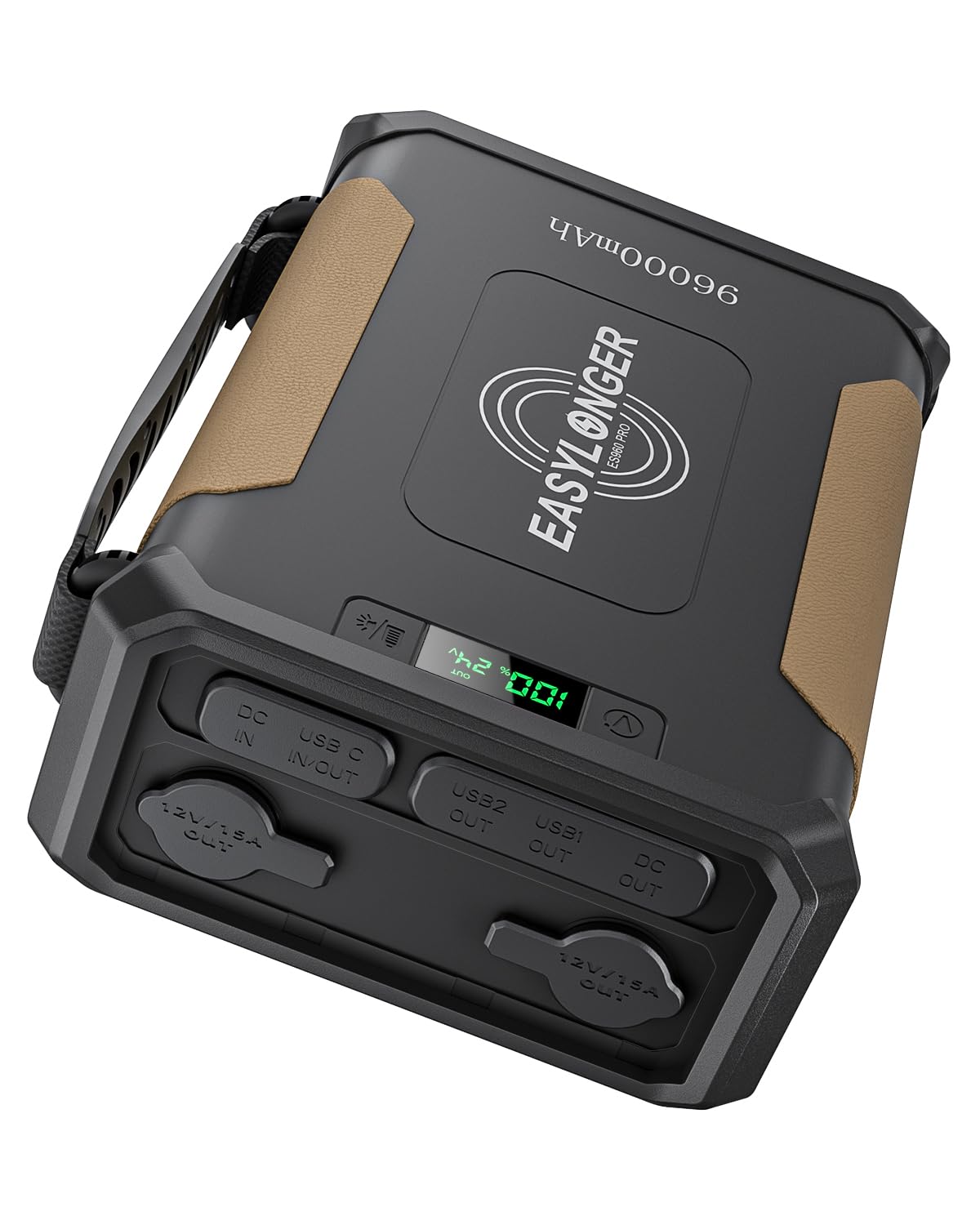
LiFePO4 battery chemistry sets the ES960 PRO apart from every other unit on this list. While standard lithium-ion packs degrade after 500-800 cycles, the ES960’s lithium iron phosphate cells are rated for over 3,000 recharge cycles, meaning this battery will likely outlast your CPAP machine itself. The 297.6Wh capacity supports two or more nights of CPAP use without humidification, and the six output ports — including a 100W USB-C PD port — let you power laptops, phones, drones, and even a car refrigerator alongside your machine.
Recharging is flexible: the included wall adapter brings it to full in about five hours, a 100W solar panel handles it in a day, and a 12-24V car outlet can top it up in roughly six hours. The pass-through function means you can keep your CPAP running while the battery itself recharges, which is ideal for RV travel or situations where you have intermittent access to shore power. Users running an AirSense 11 with humidifier at level 5 reported getting two bars of battery remaining after three nights of camping, confirming its real-world endurance.
The main trade-off is weight: at 6.6 pounds, this is not a unit you want carrying up a mountain pass. It’s best suited for car camping, paddle-in campsites, or RV setups where weight is less of a constraint. The accidental light-activation issue — the flashlight button is easy to press in a pack — drains battery if you don’t notice it’s on, so careful stowage is required.
Why it’s great
- LiFePO4 cells last 3000+ recharge cycles
- Six output ports including 100W USB-C
- Pass-through charging keeps CPAP running during recharge
Good to know
- Very heavy at 6.6 pounds
- Flashlight button easily pressed accidentally in bag
- No direct 12V car charging port
5. EASYLONGER ES720 PRO CPAP Battery Pack 276Wh
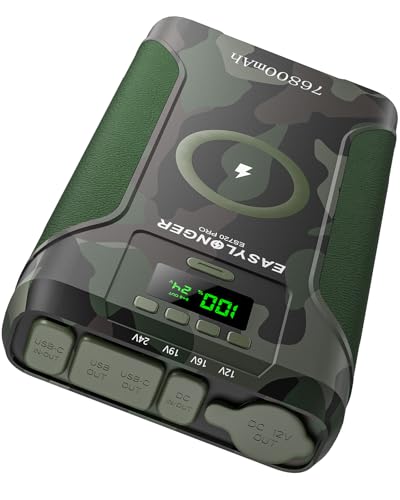
The EASYLONGER ES720 PRO offers 276.48Wh of capacity at a weight of 3.35 pounds, making it one of the more balanced options for backpackers who need multi-night power but want to keep pack weight under four pounds. The upgraded 100W USB-C output lets you fast-charge a MacBook Pro from 0% to 50% in under 30 minutes, and the four included CPAP cables cover ResMed AirSense 11/10, AirCurve 11/10, AirMini, Luna TravelPAP, and Philips DreamStation models.
The digital display provides real-time battery level, voltage, and charging status, and a dedicated voltage adjustment button lets you switch between output voltages with one touch — no menu-diving. Pass-through functionality ensures your CPAP never shuts off during a power outage; the battery seamlessly takes over while remaining connected to wall power. Recharging takes 4-5 hours via the included AC adapter, and it also supports solar and RV/car charging for true off-grid flexibility.
The biggest limitation here is that the ES720 PRO is not TSA-approved for air travel because its capacity exceeds the 160Wh limit. This makes it strictly a ground-travel battery for car camping, RV trips, and backcountry basecamps — you cannot carry it onto a plane. Some users also noted the unit is “a little heavy” for true ultralight backpacking where every ounce is counted.
Why it’s great
- 3.35 pounds is manageable for multi-night trips
- Pass-through mode prevents CPAP shutdowns
- 100W USB-C for fast laptop/device charging
Good to know
- Not approved for air travel (over 160Wh)
- Too heavy for ultralight backpacking
- Unique camo design divides opinion
6. Pilot Flex 98Wh CPAP Battery Backup

The Pilot Flex 98Wh is a purpose-built travel battery designed for users who own both 12V and 24V CPAP machines, or who plan to upgrade their machine in the future. Its dual-voltage support means it can power a 12V Transcend Mini equally as well as a 24V ResMed AirSense 11, making it a versatile companion for households with multiple CPAP users. The aluminum case houses LG industrial-grade cells, providing durability that can handle being tossed into a backpack or carry-on bag.
At 1.2 pounds and measuring just 6.57 x 2.95 x 0.79 inches (about the size of a large smartphone), it’s compact enough to fit into any CPAP travel case or the front pocket of a backpack. It comes bundled with two DC cables — one for AirSense 11 and one for AirMini — and can be charged using the ResMed AirMini’s own power adapter, eliminating the need for a separate charger. Runtime is rated at up to 16 hours, though real-world testing with an AirSense 11 at moderate pressure without humidity delivered about 8 hours on a full charge.
The major drawback reported by multiple users is that the cable connectors require precise insertion and can disconnect if the battery shifts inside a bag during transit. One user reported the unit failing to power their DreamStation entirely, suggesting compatibility issues with certain Philips models. The claimed two-night runtime for an AirMini is optimistic in practice, with most users reporting closer to 1.5 nights before needing a recharge.
Why it’s great
- Supports both 12V and 24V CPAP machines
- Ultra-compact at 1.2 pounds
- Charges using ResMed AirMini power adapter
Good to know
- DC cables disconnect easily with movement
- May not work with Philips DreamStation models
- Real-world runtime shorter than advertised
7. Pilot-24 Lite Battery 95Wh CPAP Backup

The standalone Pilot-24 Lite 95Wh is the same core battery platform as the bundled version but sold without extra cables, keeping the price down for users who already own ResMed-specific adapters. Weighing just 1.3 pounds with a compact 0.79 x 3.54 x 6.69-inch footprint, it’s one of the lightest TSA-approved options that still delivers enough juice for a full night’s sleep. The aluminum case provides structural rigidity that plastic competitors lack, and the LG industrial-grade cells deliver consistent power output through hundreds of cycles.
Real-world users report 8-10 hours of runtime powering a ResMed AirSense 10 with humidification turned off, or about 14 hours for a ResMed AirMini — enough for one long night plus a short second night. Recharge time is impressively quick at 2-3 hours, and the battery can be topped up using the CPAC adapter from the ResMed S9, AirSense 10, or AirMini directly, so you don’t need to carry a separate charger block. The built-in USB port lets you charge your phone or tablet from the same battery, though this cuts into CPAP runtime.
The included cables have been a point of frustration for some buyers. Several users reported that the AirMini cable only works when partially unplugged, or fails to make a consistent connection. The battery also cannot power a CPAP while simultaneously being charged — it lacks pass-through functionality — which means you need to plan your charging schedule carefully on multi-day trips.
Why it’s great
- Lightweight 1.3 pounds for easy carry-on
- Durable aluminum case with LG cells
- Quick 2-3 hour recharge time
Good to know
- Cable quality issues reported with AirMini connection
- No pass-through charging functionality
- Single USB port limits simultaneous device charging
8. Medistrom Pilot-24 Lite Bundled for ResMed

This bundled version of the Medistrom Pilot-24 Lite comes specifically configured for ResMed users, including output cables for AirSense 10, AirMini, and S9, plus the AC adapter cable for the AirMini. This eliminates the guesswork of figuring out which cables you need — everything in the box plugs straight into your existing ResMed machine. At 95Wh and 1.3 pounds, it holds the same TSA-approval and FAA-compliance as the standalone unit, making it a seamless travel companion for fly-in backpacking trips.
The built-in standby mode detects unstable utility power and automatically switches to battery backup without interrupting therapy, a feature that matters when you’re camping near unreliable RV hookups or staying in older cabins with flickering power. A touchlight LED at the top of the unit provides illumination in dark tents or power-outage situations. Runtime with a ResMed AirMini is approximately 14 hours — two full seven-hour nights — which covers most weekend backpacking trips without needing a recharge.
As with the standalone version, cable reliability is the weak spot. One user reported that the battery fails to power the CPAP unless the cable is unplugged and re-plugged at the battery end, suggesting a seating issue with the connector. The battery also does not include a power adapter — you must use your ResMed machine’s existing AC cord to charge it — which is convenient if you already carry the cord, but an oversight if you pack separately and forget it.
Why it’s great
- Comes with all ResMed-specific cables included
- Standby mode protects against power fluctuations
- Integrated touchlight for dark environments
Good to know
- Cable connector may require re-seating to work
- No power adapter included in the box
- Occasional reports of battery not holding charge long-term
9. Medistrom Pilot-24 Lite + 3 Pack Travel CPAP Wipes

This variant of the Medistrom Pilot-24 Lite bundles the standard 95Wh battery with a pack of three Travel CPAP wipes, making it a solid grab-and-go option for international travelers who want both power and hygiene in one order. The core battery specifications are identical to the standalone version — 1.3 pounds, 95Wh capacity, TSA-approved, aluminum case with LG cells — but this package adds the convenience of cleaning wipes for your mask and tubing at the start of your trip.
The built-in LED flashlight is brighter than the touchlight found on other Pilot-24 configurations, providing genuine camp-usable illumination for navigating a tent at night or finding items in a dark backpack. The USB port supports charging of smartphones, tablets, and MP3 players, though pulling power for your phone will proportionally reduce your CPAP runtime. Users who have owned this unit for several years report that it reliably holds its charge between trips and handles a full night of CPAP with humidification enabled, which is rare in this weight class.
There is a significant durability concern, however. This suggests the LG cells may degrade faster when regularly discharged to near-zero, which is common during multi-day backpacking trips. The bundled wipes are a nice bonus but add no functional value to the battery itself.
Why it’s great
- Lightweight and TSA-compliant for air travel
- Bright LED flashlight for camp use
- Included wipes keep mask clean on the trail
Good to know
- Some units fail after 12 months of regular use
- Cell degradation occurs with deep discharges
- Premium pricing for the bundled wipes
FAQ
Can I take a CPAP battery on a plane for my backpacking trip?
How do I calculate how many nights a CPAP battery will last while backpacking?
What’s the difference between LiFePO4 and standard lithium-ion for CPAP batteries?
Do I need to turn off humidification and heated tubing when using a CPAP battery backpacking?
Final Thoughts: The Verdict
For most users, the backpacking cpap winner is the Zopec Explore 5700 because it delivers three nights of usable runtime in a package that won’t dominate your pack weight and carries universal voltage for international travel. If you want an ultra-light option for fly-in trips or single-night camps, grab the Zopec Explore Mini at 1.1 pounds with auto-voltage detection. And for extended basecamp trips where weight is less of a concern, nothing beats the long-cycle durability and pass-through charging of the EASYLONGER ES960 PRO with its 3,000 recharge cycles.

Mo Maruf
I created WellFizz to bridge the gap between vague wellness advice and actionable solutions. My mission is simple: to decode the research and give you practical tools you can actually use.
Beyond the data, I am a passionate traveler. I believe that stepping away from the screen to explore new environments is essential for mental clarity and physical vitality.