Our readers keep the lights on and my smoothie glass nicely filled. As an Amazon Associate, I earn from qualifying purchases.
Waking up stiff, cold, and tossing all night on a hard forest floor is the fastest way to kill a camping trip. The difference between a miserable night and a rejuvenating sleep under the stars comes down to one piece of gear: the pad beneath you. With dozens of options claiming ultimate comfort, zeroing in on a pad that balances real insulation, durable construction, and a reasonable price tag requires understanding what actually separates a supportive mat from a punctured disappointment.
I’m Mohammad Maruf — the founder and writer behind WellFizz. My deep market research focuses on analyzing foam densities, R-values, and valve mechanisms across the mid-range and premium camping pad landscape to identify which models deliver genuine value for their cost without sacrificing backcountry performance.
After evaluating seven pads spanning self-inflating foam, closed-cell ultralight, and thick air chamber designs, these picks represent the strongest options for shoppers seeking a best affordable sleeping pad that doesn’t compromise on support or insulation.
How To Choose The Best Affordable Sleeping Pad
Selecting a sleeping pad isn’t just about picking the thickest foam or the highest number. The right choice depends on how you camp, your sleeping habits, and the conditions you expect. Prioritize the specs that align with your specific use case: car camping priorities differ drastically from a lightweight backpacking setup.
Insulation: R-Value and 4-Season Capability
The R-value measures a pad’s resistance to heat loss through conduction. Entry-level pads typically rate between 1.0 and 2.0, suitable for summer-only use. Pads with an R-value above 4.0 extend your comfort into shoulder seasons, while anything above 8.0 is built for true winter camping. If you sleep cold, do not underestimate this number — a low R-value pad will suck warmth out of your body all night long.
Thickness, Foam Density, and Comfort Style
Thicker pads (3 to 6 inches) provide more cushioning and prevent your hips from bottoming out when side sleeping. Self-inflating pads use open-cell foam that expands when the valve is opened, offering plush support with less air loss risk. Pure air pads pack smaller but require inflation effort and are more prone to punctures. Memory foam pads combine plush comfort with reliable insulation, though they are heavier to carry.
Width and Weight: The Car Camping vs Backpacking Divide
Standard pads measure 20 inches wide — adequate for back sleepers but restrictive for side sleepers who need extra room for knees and arms. Wide pads (25 to 30 inches) dramatically improve comfort but add weight and bulk. For car camping or RV trips, weight is secondary to comfort. For backpacking, every ounce counts, so a lighter closed-cell foam pad or a thin self-inflating model is the smarter choice.
Quick Comparison
On smaller screens, swipe sideways to see the full table.
| Model | Category | Best For | Key Spec | Amazon |
|---|---|---|---|---|
| OGERY 6″ Sleeping Pad | Air Pad | Couples car camping | 79 x 24.5 x 6 inches | Amazon |
| Wevelel Memory Pad | Memory Foam | All-season insulation | 9.5 R-value | Amazon |
| CYMULA 3″ Foam Pad | Memory Foam | Car camping & guest use | 72 x 24 x 3 inches | Amazon |
| NEMO Switchback | Closed-Cell Foam | Ultralight backpacking | 2.0 R-value | Amazon |
| Sea to Summit Camp Self-Inflating | Self-Inflating Foam | Versatile 4-season camping | 78 x 25 x 1.5 inches | Amazon |
| Hikenture 4″ Self-Inflating | Self-Inflating Foam | Luxury car camping | 4 inches thick | Amazon |
| Exped MegaMat Max Duo | Self-Inflating Foam | Couples luxury camping | 77.6 x 52 x 6 inches | Amazon |
In‑Depth Reviews
1. Sea to Summit Camp Self-Inflating Foam Mat

The Sea to Summit Camp is a self-inflating foam pad built around a vertical coring technique that keeps body contact areas warm while reducing packed volume. At 1.5 inches thick, it won’t offer the plush depth of a 4-inch air pad, but the dense open-cell foam provides reliable cushioning that doesn’t deflate mid-night. The 4.2 R-value handles spring and fall conditions well, making it a genuine 3-season performer that also works for milder winter trips.
The multi-function reversible valve is a standout design choice — it allows fast inflation, one-way deflation to prevent air from re-entering during pack-up, and fine-tuning of firmness. The 75D polyester face fabric feels sturdy and resists abrasion from tent floors. The tapered large size (78 x 25 inches) offers ample width for a standard adult without the bulk of a mummy-shaped pad, and the included repair kit adds peace of mind for multi-day trips.
Some users note that the 1.5-inch thickness is a compromise on ground clearance, particularly for side sleepers who may feel rocks through the foam on uneven terrain. Deflation and rolling require more effort than a pure air pad due to the foam core, and the stuff sack is a snug fit when rolling tightly. This pad prioritizes durability and insulation over maximum plushness, so it’s best suited for campers who value reliability over luxury.
Why it’s great
- Durable 75D polyester fabric resists punctures and abrasion
- Multi-function valve prevents air re-entry during deflation
- 4.2 R-value provides insulation for 3-season and cold-weather use
- Lightweight at 2.3 lbs for a self-inflating large pad
Good to know
- 1.5-inch thickness offers limited ground clearance for side sleepers
- Rolling and packing takes more effort than an air pad
- Stuff sack fit is tight when foam is fully compressed
2. Hikenture 4 Inch Self Inflating Sleeping Pad

The Hikenture 4-inch self-inflating pad bridges the gap between air mattress comfort and foam reliability. The memory foam and air hybrid design delivers a plush 4-inch thickness that side sleepers will appreciate — hips and shoulders sink into the foam layer without hitting the ground. The 9.5 R-value is a winter-ready spec, making this pad suitable for sub-freezing temperatures where lesser pads would conduct cold directly into your sleeping bag.
The patented 2-way valve works with the included pump sack to speed inflation beyond relying solely on self-expansion. Users report the pad self-inflates to about 70% capacity, then a few pump-sack fills top it off to full firmness. The wide 28-inch width accommodates broad shoulders and restless sleepers, and the 80-inch length fits campers up to 6’3″. The soft 50D polyester face fabric is notably quieter than crinkly nylon alternatives, reducing rustle noise during position changes.
At 6.5 pounds, this pad is too heavy for backpacking — it is a dedicated car camping or RV mattress. Deflation requires effort to squeeze the foam core fully, and rolling it tightly enough to fit the carry bag takes practice. The pump sack is effective but adds an extra piece of gear to keep track of. Overall, it offers exceptional warmth and comfort for its price point, rivaling pads that cost significantly more.
Why it’s great
- 4-inch thickness provides excellent cushioning for side sleepers
- 9.5 R-value ensures warmth in true winter conditions
- Wide 28-inch design accommodates larger body types
- Quiet polyester fabric minimizes noise during sleep
Good to know
- Heavy at 6.5 lbs, not suitable for backpacking
- Deflation and rolling require practice and effort
- Pump sack is required for full inflation, adding gear complexity
3. Wevelel Memory Sleeping Pad

The Wevelel Memory Pad stands out for its high-density 50D memory foam core, which is significantly denser than the 19D foam found in many budget pads. This density translates to better weight distribution and reduced pressure on hips and shoulders, making it feel less like a camp mat and more like a firm mattress. The 3.1-inch thickness provides enough loft for most side sleepers to avoid bottoming out, and the built-in pillow adds convenience for car camping setups.
The 9.5 R-value is the same top-tier insulation rating as the Hikenture pad, meaning it reliably blocks ground cold in freezing temperatures. The self-inflating mechanism works quickly — open the dual-layer valves, let the foam expand for 10 seconds, then close the inner valve and use the front valve to fine-tune firmness. The 50D stretch knit fabric is breathable and noiseless, which is a welcome upgrade from crinkly alternatives. The pad supports up to 800 pounds, so two-person use on a larger surface is feasible.
The actual inflated width is 26 inches, not the advertised 30 inches, which may be a tight fit for broad-shouldered sleepers. The built-in pillow is low-profile and works best for back sleepers. At 6.59 pounds, it is bulkier than an air pad and best suited for car camping, truck beds, or home guest use. Deflation and rolling require patience, though the dual-use valve design helps prevent air from sneaking back in.
Why it’s great
- 50D memory foam provides superior pressure relief compared to standard foam pads
- 9.5 R-value delivers exceptional cold-weather insulation
- Noiseless knit fabric ensures quiet sleep without crinkling
- 800-pound capacity suits larger users or double-duty use
Good to know
- Actual width is 26 inches, narrower than some listings suggest
- Built-in pillow is low and best for back sleepers only
- Heavy and bulky, not practical for backpacking
- Deflation and rolling require effort and technique
4. NEMO Equipment Switchback Foam Sleeping Pad
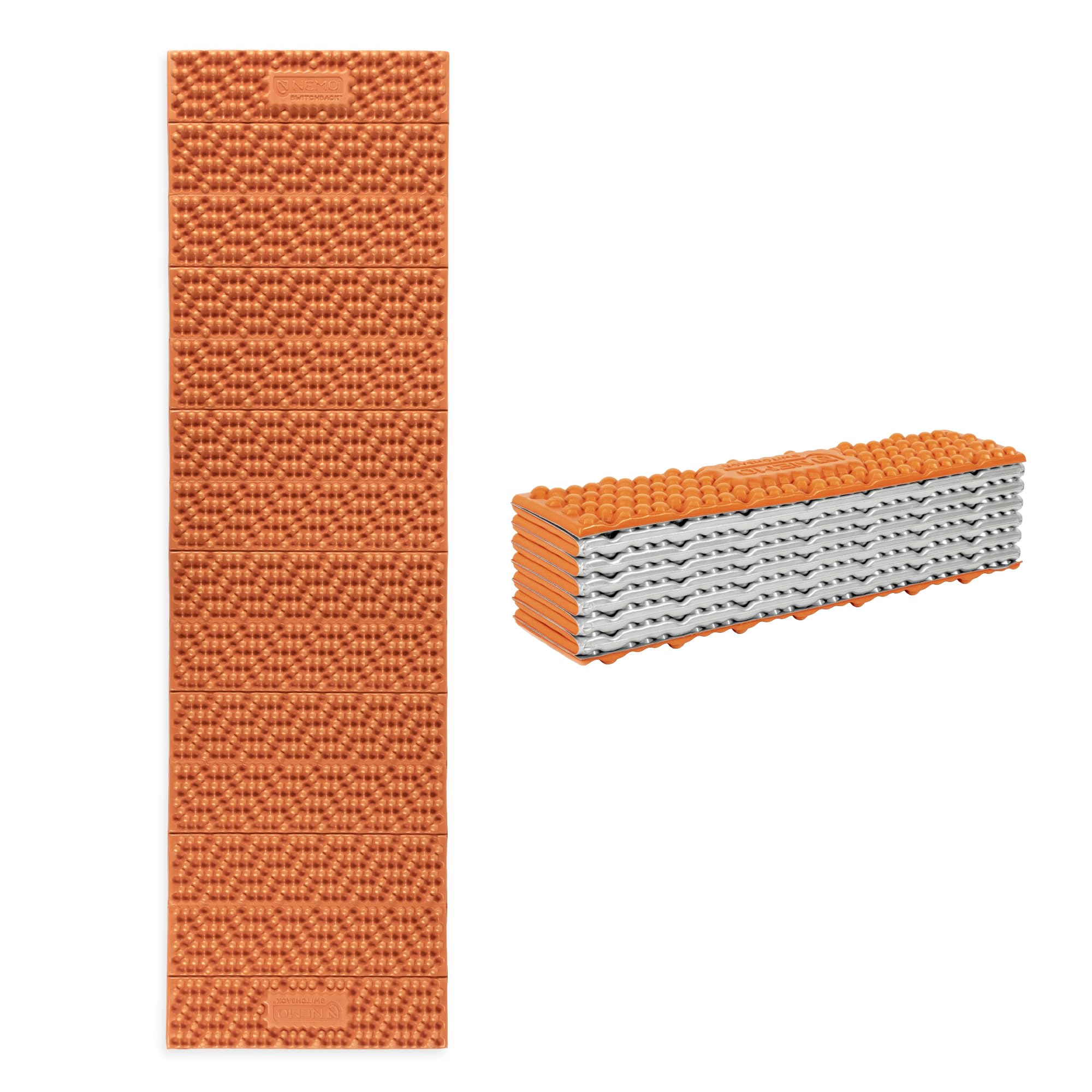
The NEMO Switchback is a closed-cell foam pad that prioritizes reliability, weight, and packability over plush comfort. Its hexagonal nesting pattern creates taller air-trapping nodes that provide more cushioning than a standard flat foam pad, while the Axiotomic dual-density foam layers a soft surface over a firm support base. The metallized reflective film on the underside bounces radiant body heat back, boosting effective warmth beyond the base 2.0 R-value.
At just 14.8 ounces, this is the lightest pad in this comparison by a wide margin, making it ideal for backpackers, bikepackers, and hammock campers who need a backup or sit pad. It folds to a compact 20 x 5 x 5.5 inches and can be lashed to the outside of a pack without worry — there is no inflation mechanism to fail and no valve to leak. The foam is inherently durable, and NEMO backs it with a lifetime warranty against defects.
The Switchback is noticeably less comfortable than a 3-inch air or foam pad, especially for side sleepers who will feel pressure points through the foam. The 20-inch width is standard but feels narrow for those accustomed to wider sleeping surfaces. It is not sufficiently insulating for cold-weather camping alone — pairing it under an inflatable pad is a popular technique for achieving both comfort and warmth. Consider this a specialty tool for weight-conscious adventures rather than a luxury sleeping solution.
Why it’s great
- Weighs under 15 ounces, extremely packable for backpacking
- Closed-cell foam construction is puncture-proof and never fails
- Reflective film adds warmth beyond the 2.0 R-value rating
- Lifetime warranty from NEMO provides long-term confidence
Good to know
- Less comfortable than air or memory foam pads, especially for side sleepers
- 20-inch width feels restrictive for broad-shouldered or restless sleepers
- 2.0 R-value is only sufficient for warm-season use without supplementation
- Folded size is still bulky relative to inflatable pads
5. OGERY Sleeping Pad with Built-in Foot Pump

The OGERY sleeping pad offers a 6-inch thickness that rivals many home air mattresses, making it one of the most comfortable pads in the affordable range. Its dual-layer air construction with a built-in foot pump means you never need to carry a separate inflation device or risk moisture from mouth inflation — simply step on the foot pump repeatedly until firm. The included built-in pillows add convenience for car campers who prefer not to pack a separate camping pillow.
The 50D polyester shell with TPU waterproof coating holds up well against tent floor wear and damp ground. The 79 x 24.5-inch size is designed for two-person use, though the twin-style width means each sleeper has about 12.25 inches of personal space — adequate for couples who sleep close but less flexible for two restless individuals. The packed size of 5.9 x 5.9 x 11 inches is compact for a double pad, and the 2.4-pound weight is reasonable for car-to-tent carry.
The foot pump requires approximately 200 steps for full inflation, which is a moderate workout but still easier than a hand pump. The pad is crinkly when shifting weight, a common trait of TPU-coated air chambers. The 24.5-inch width may feel narrow for two average-sized adults, and the foot pump mechanism adds bulk to one side of the pad. Overall, it delivers exceptional comfort and thickness at a very accessible price point for entry-level campers.
Why it’s great
- 6-inch thickness provides near-home mattress comfort on the ground
- Built-in foot pump eliminates need for external inflation gear
- Compact packed size for a double pad (5.9 x 5.9 x 11 inches)
- Built-in pillows add convenience for car camping
Good to know
- Crinkly TPU fabric makes noise when shifting sleep positions
- 24.5-inch width feels tight for two adults
- Foot pump requires ~200 steps for full inflation
- Air pad design is more susceptible to punctures than foam alternatives
6. CYMULA 3 Inch Memory Foam Camping Pad
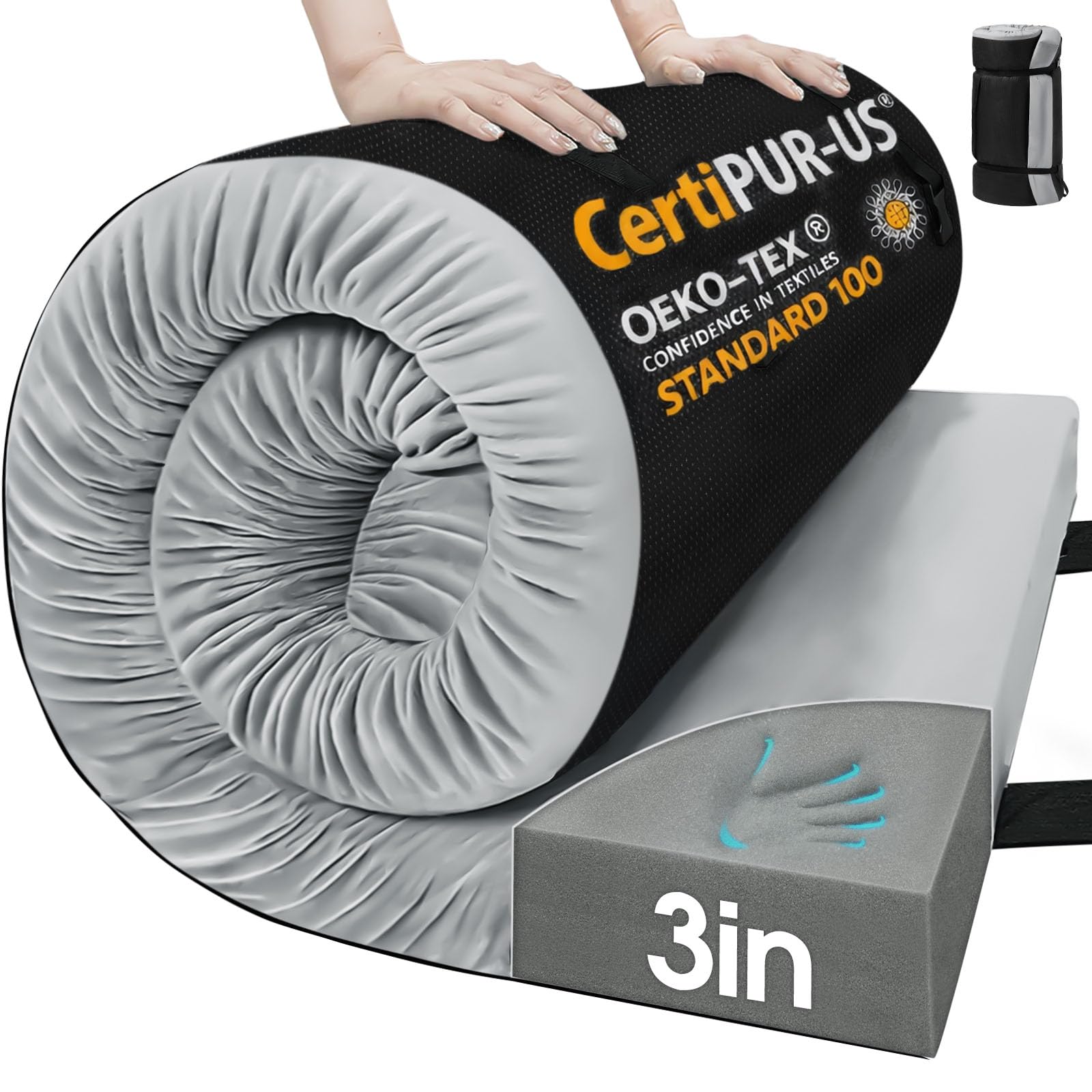
The CYMULA 3-inch memory foam pad is the only roll-up foam mat in this roundup, offering a simple setup that requires no inflation, no valves, and no pump. It uses a carbon-fiber high-elasticity memory foam layer bonded to a high-density base foam, creating a supportive surface that molds to the body without losing shape. The 3-inch thickness provides enough cushioning for floor sleeping, cot use, or as a supplement to a thinner air pad.
The removable, machine-washable cover is a practical feature that sets it apart from most camping pads in its tier. After a dusty weekend, unzip the cover and toss it in the washing machine instead of trying to spot-clean the foam. The waterproof non-slip bottom uses rubberized dots to grip tent floors or cot surfaces, reducing the sliding that plagues many smooth-bottomed pads. The roll-up design secures with attached straps and compresses to roughly the size of a large bath towel, making it easy to stow in a car trunk.
The pad is bulky compared to an inflatable option and is not suitable for backpacking. A strong chemical smell upon first opening requires airing out before use. The 24-inch width is generous for a single sleeper but may not provide enough side-to-side room for people who spread out. This pad is best for car campers, truck dwellers, or home guest use where a no-fuss, quiet, and cleanable sleeping surface is the priority.
Why it’s great
- Zero setup required — unroll and sleep, no inflation or pump needed
- Machine-washable removable cover keeps the pad clean easily
- Waterproof non-slip bottom prevents sliding on tent floors and cots
- Memory foam provides quiet, body-molding comfort without crinkling
Good to know
- Bulky when rolled, not suitable for backpacking
- Strong chemical odor requires airing out before first use
- 3-inch thickness may not be enough for side sleepers on hard ground
- Straps attached to the pad can get in the way during use
7. Exped MegaMat Max Duo Long Wide Plus
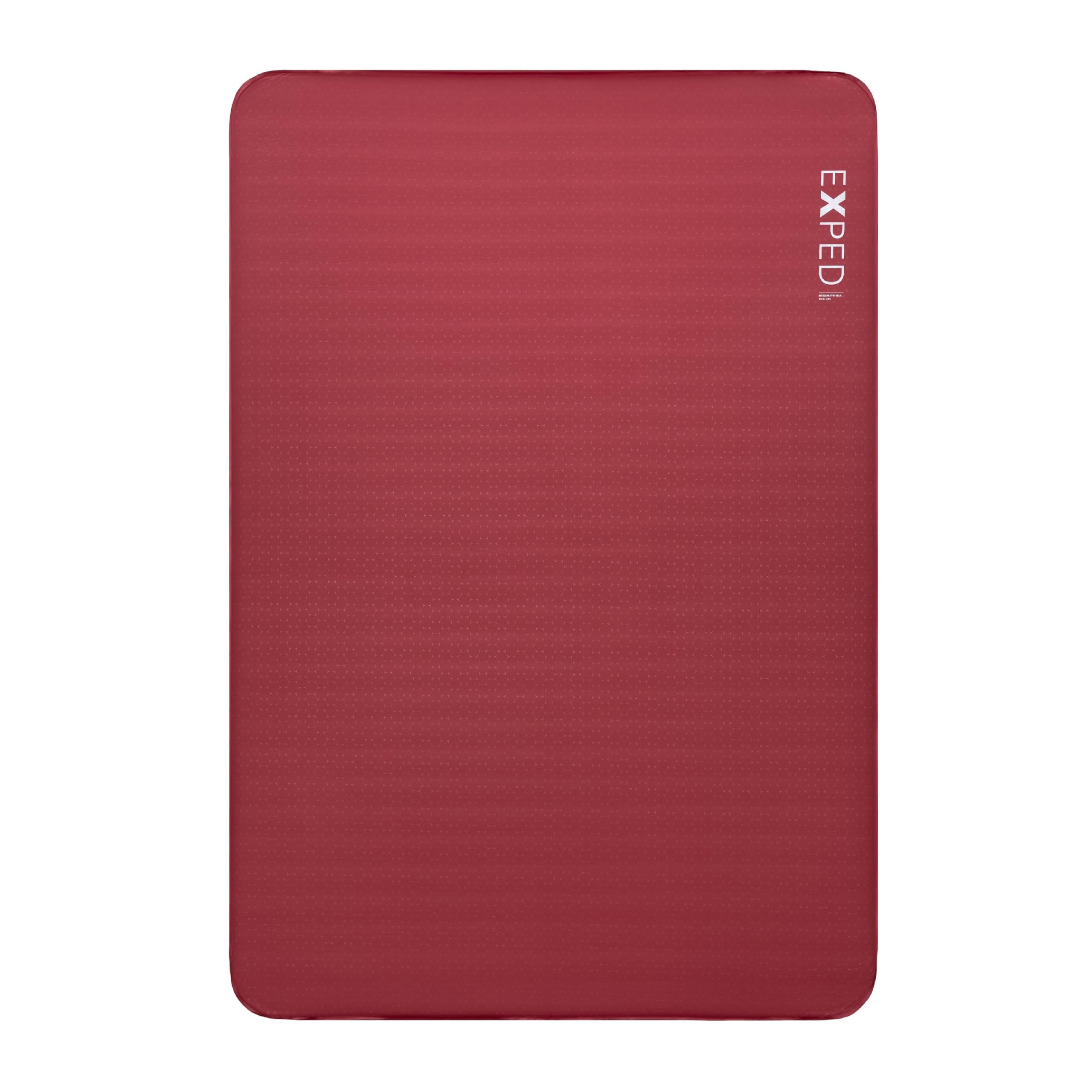
The Exped MegaMat Max Duo is the most luxurious sleeping pad in this lineup, designed explicitly for couples who refuse to compromise on comfort while car camping or sleeping in an RV. At 77.6 x 52 inches, it is essentially a double mattress with 6 inches of open-cell foam. The 3D vertical sidewall construction eliminates the edge tapering found on standard pads, so both sleepers get full surface area without rolling toward the center.
The self-inflating foam core achieves a 10.6 R-value, the highest rating in this comparison, making it suitable for extreme winter conditions. The included Top-Up Pump allows each side to adjust firmness independently — one partner can have a plush sink-in feel while the other prefers a firmer surface.
The price is the highest in this roundup by a wide margin, positioning it as a long-term investment for frequent car campers. At roughly 12 pounds, it is heavy and bulky, trading portability for unmatched at-home comfort. Some users report durability issues with the foam core losing support or the fabric developing punctures from routine gear storage. For couples who car camp regularly and value sleep quality above all else, the MegaMat delivers a bed-like experience that standard pads cannot match.
Why it’s great
- 52-inch width provides true double-bed sleeping space with no center dip
- 10.6 R-value is the highest insulation rating available in a camping pad
- 3D vertical sidewalls eliminate edge tapering for full-surface comfort
- Separate firmness adjustment per side accommodates different preferences
Good to know
- Heaviest and bulkiest pad at ~12 lbs, strictly for car camping
- Highest price point by a significant margin
- Some reports of punctures and foam degradation over time
- Storage and transport require a large duffel or dedicated trunk space
FAQ
What is the difference between self-inflating and air pad construction?
How do I choose the right sleeping pad width for my body type?
Can I use a camping sleeping pad in winter below freezing?
Final Thoughts: The Verdict
For most users, the best affordable sleeping pad winner is the Wevelel Memory Sleeping Pad because it combines a 9.5 R-value, high-density 50D foam, and noiseless fabric at a price that undercuts premium competitors while still delivering true winter insulation. If you want OGERY’s 6-inch thick pad offers the most generous cushioning for couples car camping with a built-in foot pump. And for NEMO Switchback is the go-to choice for backpackers who prioritize lightweight reliability and a puncture-proof foam design over plush comfort.

Mo Maruf
I created WellFizz to bridge the gap between vague wellness advice and actionable solutions. My mission is simple: to decode the research and give you practical tools you can actually use.
Beyond the data, I am a passionate traveler. I believe that stepping away from the screen to explore new environments is essential for mental clarity and physical vitality.