Our readers keep the lights on and my smoothie glass nicely filled. As an Amazon Associate, I earn from qualifying purchases.
A power outage that drags on for days—without fuel to run, fumes to vent, or noise to endure—defines the real promise of a high-capacity solar generator. Stepping up from smaller portable units to a system that can actually run a well pump, a central air conditioner, or even a full kitchen requires understanding a different set of specs: split-phase 240V output, continuous inverter wattage, solar input voltage range, and expandable battery capacity measured in multiple kilowatt-hours.
I’m Mohammad Maruf — the founder and writer behind WellFizz. Over the years I’ve analyzed dozens of high-wattage power station specs, comparing inverter topologies, battery chemistries, charge controller limits, and real-world capacity retention data to separate reliable whole-home backup from marketing hype.
This guide breaks down the thirteen most serious contenders for serious backup power, focusing on the actual hardware decisions that determine whether a unit can protect your home through a multi-day outage. Read on to find the best 5000 watt solar generator for your specific energy demands.
How To Choose The Best 5000 Watt Solar Generator
A 5000-watt class solar generator is a multi-year investment in home resilience. Unlike smaller units meant for camping or tailgating, these systems must reliably start and run heavy inductive loads—pumps, compressors, and electric motors that demand high inrush current. Selecting the wrong unit can leave you without power when you need it most. Focus on these four criteria.
Continuous vs. Surge Wattage
Continuous output wattage is the number that determines what you can run indefinitely. Surge (peak) wattage handles the momentary inrush when a motor starts. A well pump rated at 1.5 HP may draw around 2500W running but can spike past 5000W during startup. A unit with 3600W continuous but only a brief 7200W surge may trip its inverter if the pump cycles on. Look for continuous inverter ratings that exceed your largest motor load by a comfortable margin.
Split-Phase 120V/240V Capability
Most whole-home backup scenarios require 240V to feed a transfer switch or sub-panel. Not all high-wattage power stations support true split-phase output. Some units simply double 120V through a combiner cable, which may disable EPS pass-through or create grounding concerns. A native 240V inverter—like those in the OUPES Guardian 6000 or Jackery 5000 Plus—integrates directly with standard residential electrical panels without workarounds.
Solar Input Voltage and MPPT Range
Fast solar recharging is the defining advantage of a generator you never have to fuel. The voltage window of the MPPT charge controller dictates how many solar panels you can wire in series. A narrow range (e.g., 12-60V) limits you to low-voltage configurations and thinner-gauge wire, but at the cost of efficiency over long cable runs. Wider ranges (e.g., up to 150V or 450V) allow higher string voltages, smaller-gauge wire, and less power loss during cloudy conditions. Check both the max input voltage and the optimal MPPT starting voltage, not just the rated wattage.
Expandable Capacity and Chemistry
A base unit with 3-5 kWh may cover a day of essentials, but multi-day outages demand expansion. LiFePO₄ chemistry is the current standard for cycle life—most premium units guarantee 3500 to 6000 cycles before reaching 70% capacity. Confirm whether expansion batteries use the same cell type and voltage architecture. Some systems require proprietary expansion packs, while others accept third-party or generic modules. The total addressable capacity (e.g., 24 kWh, 48 kWh, 60 kWh) should match your expected load duration, not just the headline number on the box.
Quick Comparison
On smaller screens, swipe sideways to see the full table.
| Model | Category | Best For | Key Spec | Amazon |
|---|---|---|---|---|
| Jackery 5000 Plus | Premium | True whole-home 240V backup | 7200W continuous / 60kWh expandable | Amazon |
| OUPES Guardian 6000 | Premium | 240V transfer switch integration | 6000W cont. / 41kWh expandable | Amazon |
| EcoFlow DELTA Pro 3 | Premium | Ultra-quiet whole-home + RV | 4000W cont. / 48kWh expandable | Amazon |
| Anker SOLIX F3800 | Premium | High continuous 240V output | 6000W cont. / 26.9kWh expandable | Amazon |
| OSCAL PowerMax 6000 | Mid-Range | Fast AC recharge + 240V output | 6000W surge / 2200W AC input | Amazon |
| EcoFlow DELTA Pro (3600Wh) | Mid-Range | Modular expandability + fast recharge | 3600W cont. / 25kWh expandable | Amazon |
| GROWATT HELIOS 3600 | Mid-Range | Cold-weather performance | 3600W cont. / 36kWh expandable | Amazon |
| Jackery HomePower 3000 | Mid-Range | Lightweight 3kWh home backup | 3600W cont. / 3072Wh (non-expandable) | Amazon |
| AFERIY P310 | Mid-Range | High-capacity value with bifacial panel | 3600W cont. / 11.5kWh expandable | Amazon |
| OUKITEL P5000 Pro | Mid-Range | 5kWh base capacity, lighter build | 3600W cont. / 5120Wh base | Amazon |
| Anker SOLIX F3000 | Mid-Range | Expansion-friendly 3kWh starter | 3600W cont. / 24kWh expandable | Amazon |
| EcoFlow DELTA Pro + 400W Panel | Mid-Range | Bundled panel for immediate solar | 3600W cont. / 22.4% panel efficiency | Amazon |
| IEE P3200 | Budget | High-value 3.2kW output bundle | 3200W cont. / 2048Wh base | Amazon |
In‑Depth Reviews
1. Jackery Solar Generator 5000 Plus
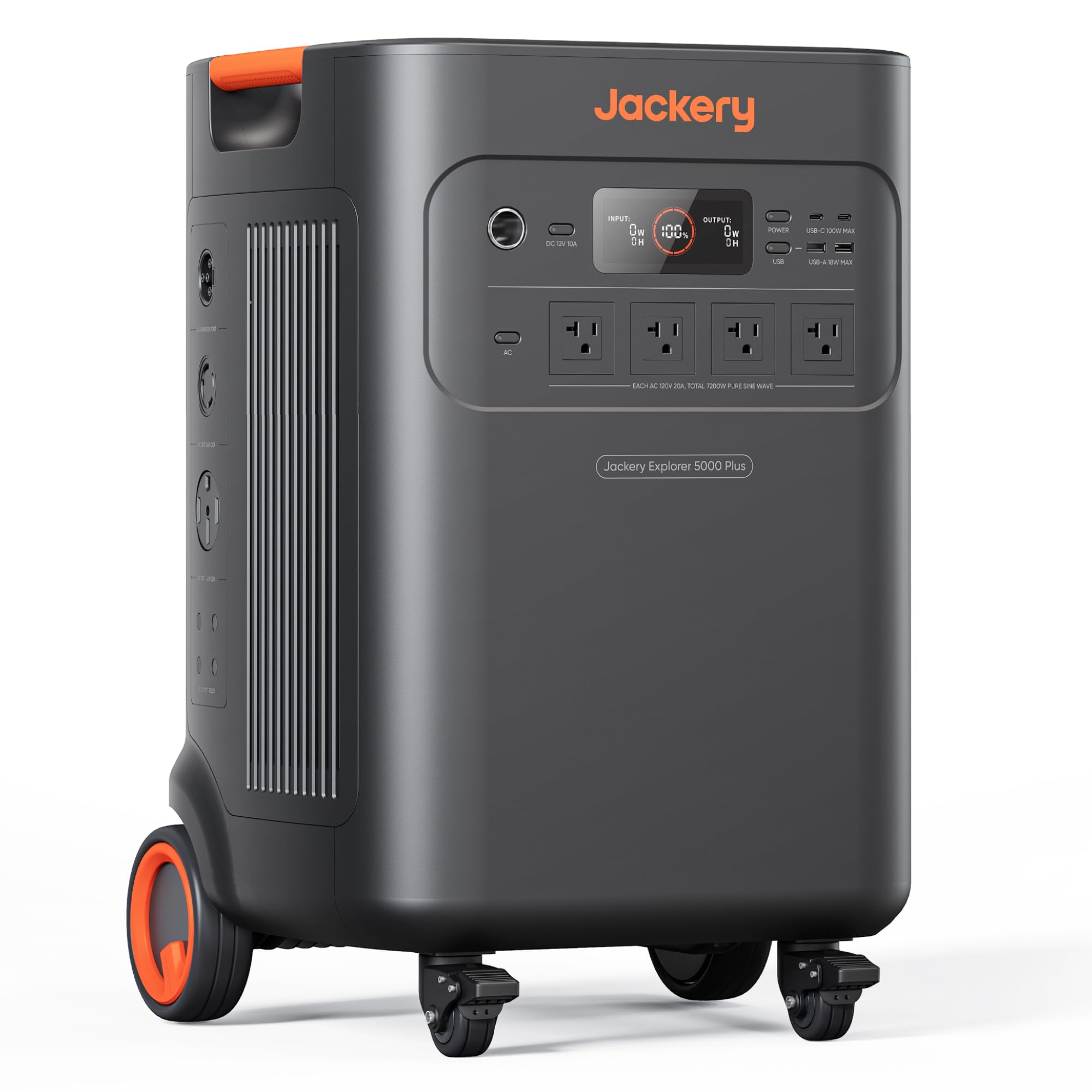
The Jackery 5000 Plus is the only unit in this roundup that delivers 7200W of continuous split-phase 120V/240V output from a single base unit, with 5040Wh of onboard LiFePO₄ storage. That continuous rating is enough to start and run a 5-ton central AC unit or a well pump without relying on a brief surge window. The expansion capability scales to 60kWh, which translates to roughly 13 days of typical home essentials during an extended outage.
ChargeShield 2.0 technology manages the charging algorithm to preserve cycle life, while the unit accepts both high-voltage and low-voltage solar input—up to 4000W—recharging in roughly two hours under full sun. The 60A Smart Transfer Switch pairs with up to twelve 120V circuits or six 240V circuits, making this one of the few true drop-in replacements for a gas-burning whole-home generator.
At 134.5 pounds, the 5000 Plus is not lightweight, but the integrated handle and wheel design make garage positioning feasible. The app interface is basic and updates slowly, but for pure backup capability—especially for high-draw appliances and whole-home integration—this unit sets the benchmark in this class.
Why it’s great
- Native 240V split-phase output at 7200W continuous without bridging two units
- Expandable to 60kWh for extended multi-week outages
- Accepts up to 4000W solar input for fast off-grid replenishment
Good to know
- High standby draw in UPS mode can drain 30% charge per day
- App schedules can reset with timezone changes
- Heavy 134.5 pounds requires the included cart for mobility
2. OUPES Guardian 6000
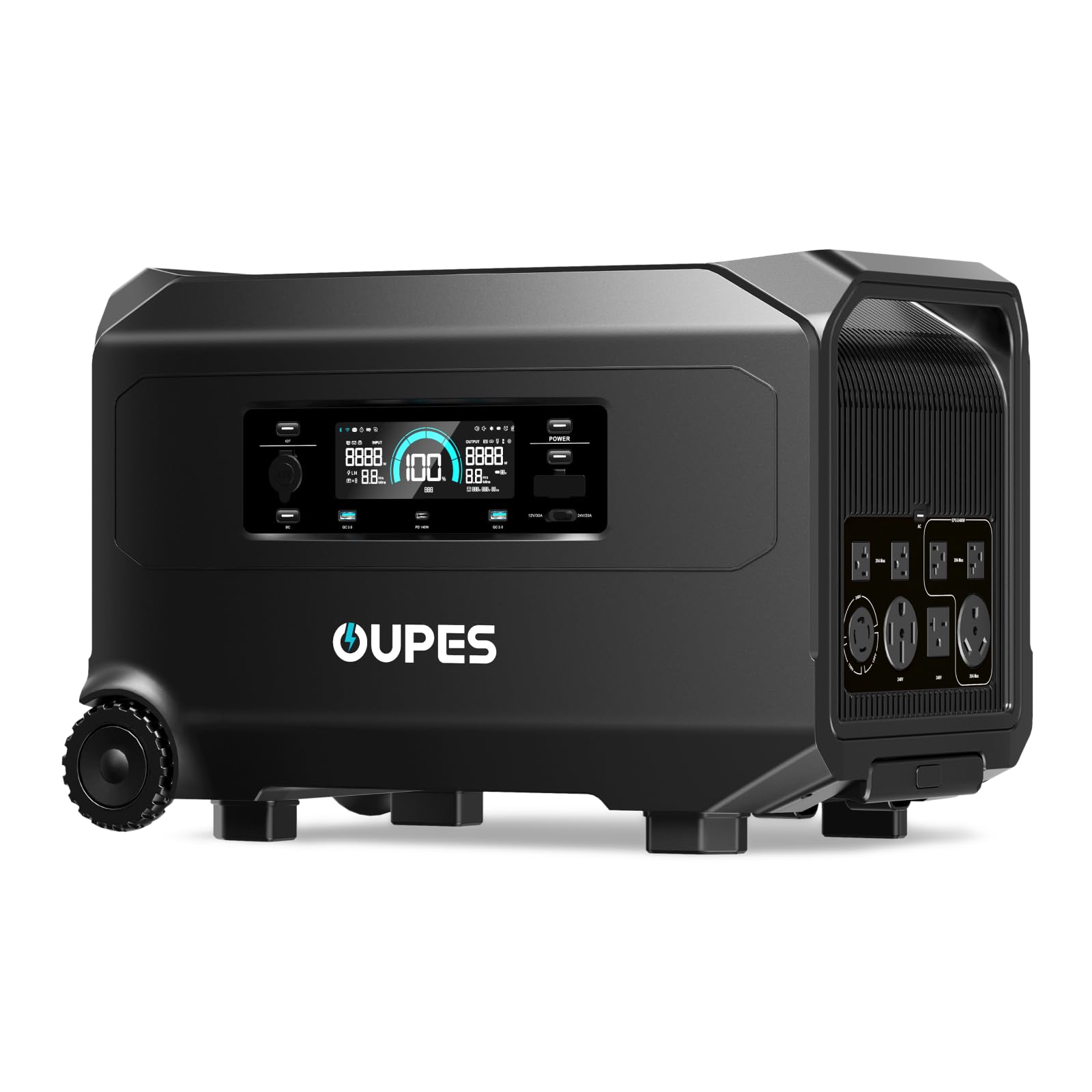
The OUPES Guardian 6000 brings true 120V/240V dual-voltage output with a continuous 6000W rating (7200W boost, 9000W surge) from its 4608Wh base LiFePO₄ pack. The inverter natively supports NEMA 14-50R, L14-30E, and TT-30R outlets, meaning you can plug directly into an RV inlet or a home transfer switch without adapter cables. The expansion ecosystem scales to 41,472Wh when paired with extra battery packs.
Recharge speed is a standout feature: combining 240V AC input with solar replenishes the battery from empty in about 90 minutes. The 2100W solar input capacity and wide 12-140V MPPT range give flexibility for different panel string configurations. Built specifically for the US market, the unit complies with standard NEMA configurations and includes a 5-year warranty.
Some users have reported a beta-quality app with occasional disconnection issues, and the solar charging spec (140V/15A) is difficult to achieve with off-the-shelf panels without a secondary charge controller. But for users who need a genuine 240V transfer-switch-ready generator without pairing two separate units, this is the most cost-effective option in the premium tier.
Why it’s great
- Genuine 240V output with NEMA 14-50R and L14-30E built in
- Extremely fast 90-minute combined recharge time
- Expands to over 41kWh for extended off-grid periods
Good to know
- App connectivity can be unreliable and disconnects frequently
- Solar input spec (140V/15A) is very difficult to reach with standard panels
- At 111 pounds, it requires its wheeled cart for repositioning
3. EcoFlow DELTA Pro 3
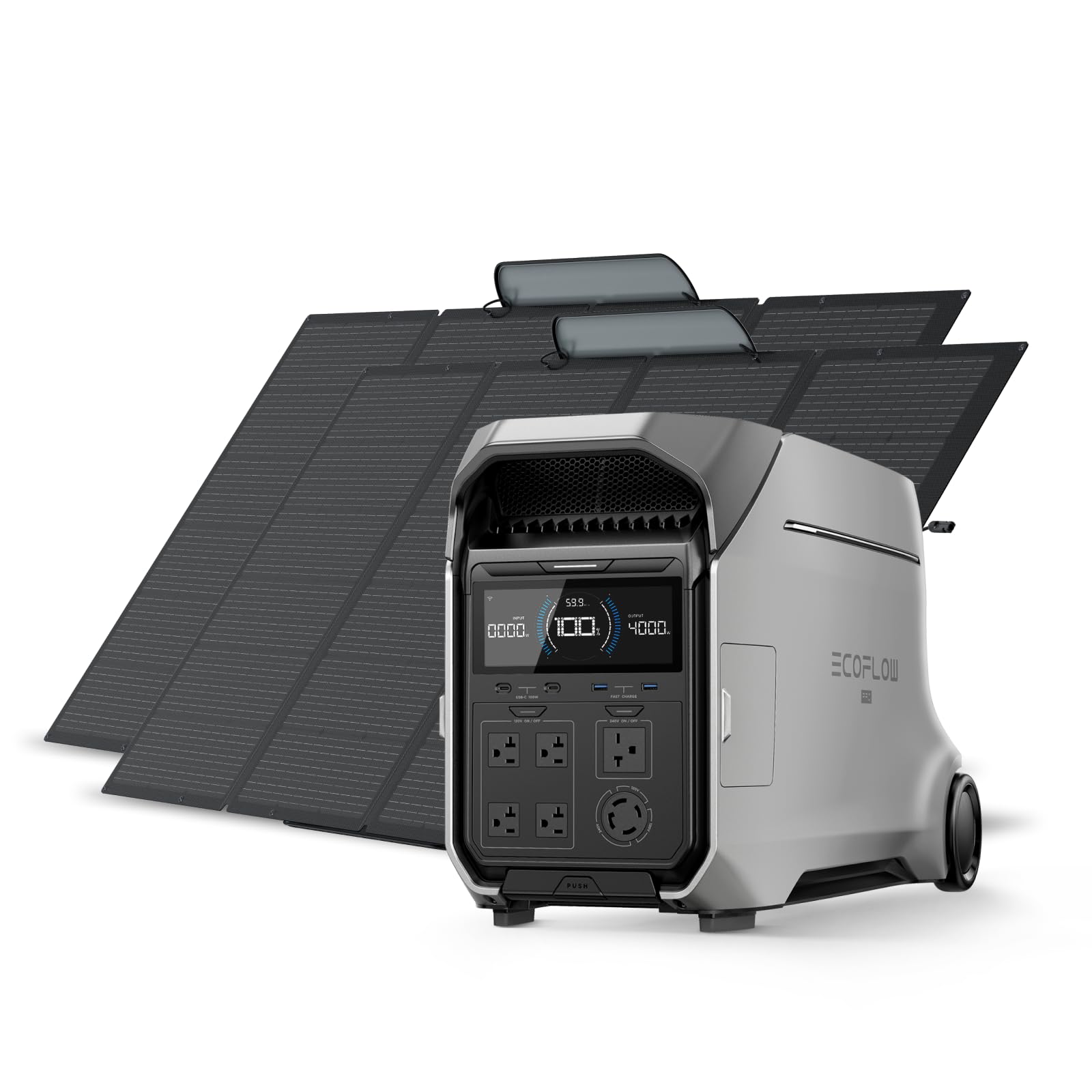
The DELTA Pro 3 brings the latest generation of EcoFlow’s large-format platform, featuring a 4096Wh LFP battery with an IP65-rated CTC (cell-to-chassis) pack. The unit outputs 4000W continuous (6000W with X-Boost) at 120V/240V, scalable to 12,000W by pairing two units. The 10ms UPS switch-over protects sensitive electronics, and X-Quiet technology drops fan noise to 30 dB—roughly the level of a quiet library.
Expansion reaches 48kWh via extra batteries or the smart generator, and charging flexibility includes 18 methods: AC, solar, EV stations, gas generator, and the EcoFlow Smart Home Panel 2. The dual 400W solar panels included in this bundle feature 22.4% conversion efficiency, though users note the panel stand is flimsy and the panels themselves are heavy for portable use.
At 115 pounds, the Pro 3 is heavy but manageable thanks to an extendable handle and oversized wheels. The main downside reported is limited customer service availability after the initial purchase window—some users have struggled to reach support for error codes. For those who prioritize silent operation and modular expandability, this is the top choice.
Why it’s great
- Extremely quiet 30 dB operation suitable for indoor or bedroom placement
- IP65-rated battery pack for dust and water resistance
- 10ms UPS switch-over for sensitive electronics
Good to know
- Customer service response time is slow after the initial warranty period
- Included solar panels are heavy and have a poor stand design
- Error code issues have been reported that require firmware updates
4. Anker SOLIX F3800

The Anker SOLIX F3800 outputs 6000W continuous at 120V/240V from its 3.84kWh base, with a NEMA 14-50 port that allows direct EV charging at 6000W. The expansion ecosystem supports up to six extra battery packs for a total of 26.9kWh, and pairing two F3800 units yields 12,000W max output. The built-in wheels and telescoping handle make the 132-pound unit easier to maneuver than its weight suggests.
Anker’s InfiniPower technology includes EV-class LFP cells and a smart temperature management system rated for a 10-year lifespan. Simultaneous AC+DC charging is enabled via firmware 2.1.5, allowing full recharge in under two hours from a wall outlet. The MPPT is optimized for Anker’s own panels, accepting up to 2400W solar input, though third-party panel compatibility may require tuning.
Cold-weather performance is a limitation—the BMS restricts charging below 50°F (below 710W DC and below 685W AC). Users also report that firmware updates requiring Wi-Fi can cause unexpected behavior, such as blocking generator charging after an update. The F3800 is exceptionally well-built but demands some technical patience for full functionality.
Why it’s great
- 6000W continuous 240V output with NEMA 14-50 for direct EV charging
- Fast 2-hour combined AC+DC recharge time
- 10-year lifespan rating from EV-grade LFP cells
Good to know
- Charging rate limited below 50°F ambient temperature
- Firmware updates can change charge behavior unexpectedly
- At 132 pounds, moving it without the wheel kit is difficult
5. OSCAL PowerMax 6000
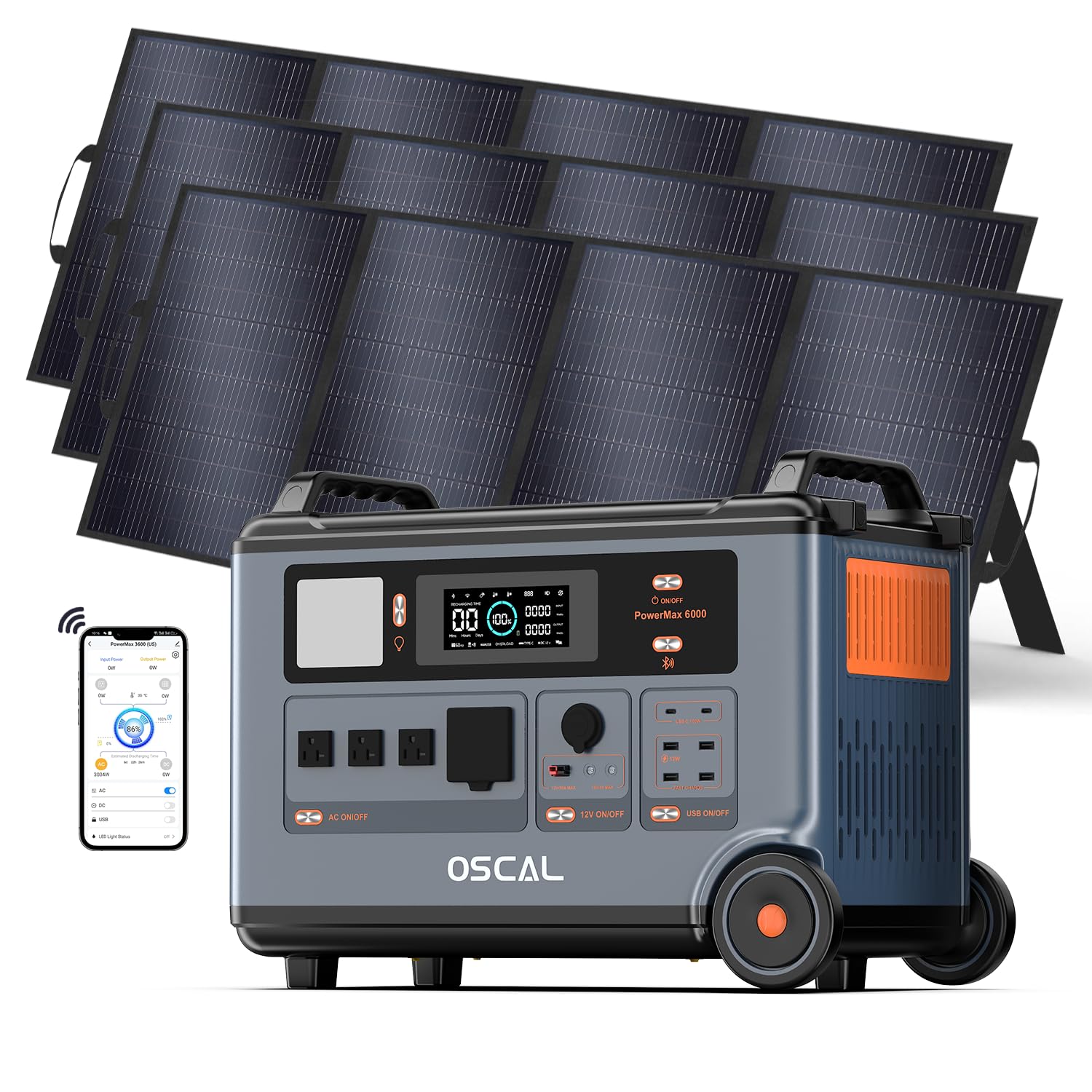
The OSCAL PowerMax 6000 distinguishes itself with a 2200W bi-directional inverter that charges the 3600Wh LFP battery from zero to full in under two hours through an AC wall outlet. It also supports 2400W solar input for off-grid recharging, and outputs 120V/240V split-phase voltage at up to 6000W (9000W surge) through four AC outlets and a total of fourteen ports.
The EPS switchover is rated at 5-8ms, fast enough to protect network equipment and sensitive electronics during an outage. The included three 400W solar panels provide a respectable 1200W total array out of the box, and the 25-year service life rating (3500 cycles to 80% capacity) is one of the longest in this class. The app provides remote monitoring and power usage tracking.
Some users have reported that the actual continuous output struggles to reach 6000W under load, and the included AC charge cord is shorter than ideal. The unit performs best for whole-home backup of essential circuits rather than running the entire house at full draw. Given the fast recharge speed and included panel array, this is a strong value-focused entry in the premium-mid range crossover.
Why it’s great
- Ultra-fast 1.44-hour full recharge via 2200W AC input
- 5-8ms EPS switchover for sensitive electronics protection
- Includes three 400W panels for immediate solar capacity
Good to know
- Actual continuous power may not reach 6000W under heavy loads
- AC charge cord is shorter than preferred for standard garage outlets
- Requires own MC4 branch connectors for parallel panel wiring
6. EcoFlow DELTA Pro (3600Wh)
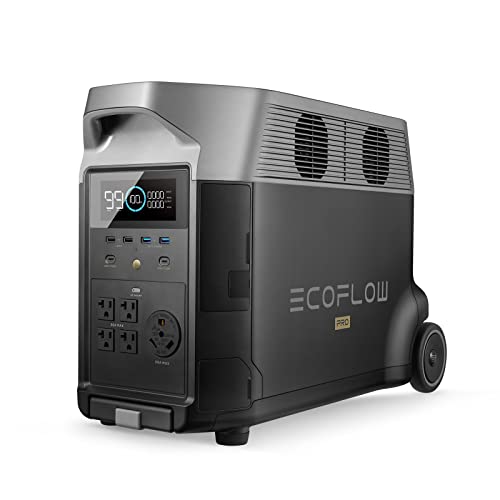
The original DELTA Pro remains one of the best modular platforms for building a whole-home backup system incrementally. Starting with 3600Wh and 3600W output (4500W with X-Boost), the system scales to 25kWh via extra batteries and can pair two units for 7200W at 240V. X-Stream charging replenishes the base unit in 2.7 hours via a 1800W wall outlet or in 1.8 hours via 240V.
Five charging methods—AC, solar, car outlet, EV station, and the smart generator—offer unmatched flexibility for recharging in any scenario. The 15 output ports include five AC outlets, dual 100W USB-C, and an Anderson port, providing plenty of connectivity for home appliances, tools, and mobile setups. The EcoFlow app offers detailed energy monitoring and scheduling.
That means you realistically get about 2700Wh of useable energy. The unit also weighs 99 pounds, making the extra battery integration a long-term commitment. For users who want to start with a strong base and grow over time, this remains a solid foundation.
Why it’s great
- Highly modular platform expands to 25kWh and pairs for 240V
- Five charging methods including EV stations and car outlets
- Reliable pass-through mode switches seamlessly during outages
Good to know
- Usable capacity is only 2700Wh due to the 25% low-battery cutoff
- At 99 pounds, adding extra batteries increases total weight significantly
- Solar panels required for fast off-grid charging add considerable bulk
7. GROWATT HELIOS 3600
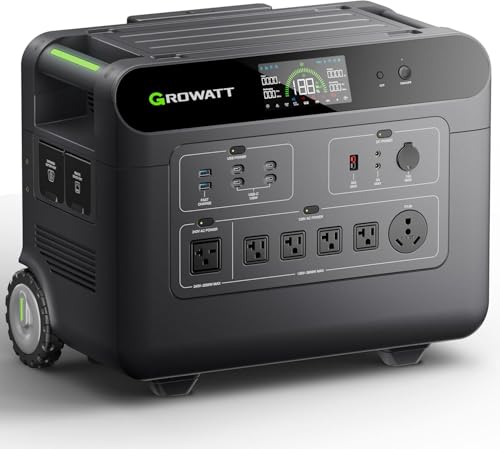
The GROWATT HELIOS 3600 brings cold-start technology that allows the battery to operate and charge at temperatures as low as -22°F, making it the only large-format unit in this comparison designed for extreme winter climates. The base unit delivers 3600W continuous output and 3600Wh LFP capacity, expandable to 36kWh via parallel connection of two units for 240V/7200W split-phase output.
Solar charging reaches 2000W, replenishing the base pack in about 2.8 hours under full sunlight. AC charging supports dual-voltage input: three hours at 120V or 1.5 hours at 240V. The app includes Time-of-Use (TOU) settings and solar prioritization to minimize grid consumption. The NEMA TT-30 outlet and Anderson port make it RV-ready out of the box.
At 51 pounds for the base unit, the HELIOS is notably lighter than most 3kWh-class competitors, though the parallel connection for 240V requires two units. The Bluetooth app has mixed reviews for reliability, and the unit can emit a noticeable humming noise above 1200W draw. For users in cold climates who need a generator that actually starts and charges in sub-freezing weather, this is uniquely suited.
Why it’s great
- Operates and charges down to -22°F with cold-start technology
- Lightweight 51-pound base unit for a 3.6kWh system
- Dual-unit parallel provides true 240V/7200W split-phase output
Good to know
- Parallel connection for 240V disables EPS auto-switchover
- Humming noise noticeable above 1200W continuous draw
- Bluetooth app reliability is inconsistent
8. Jackery HomePower 3000
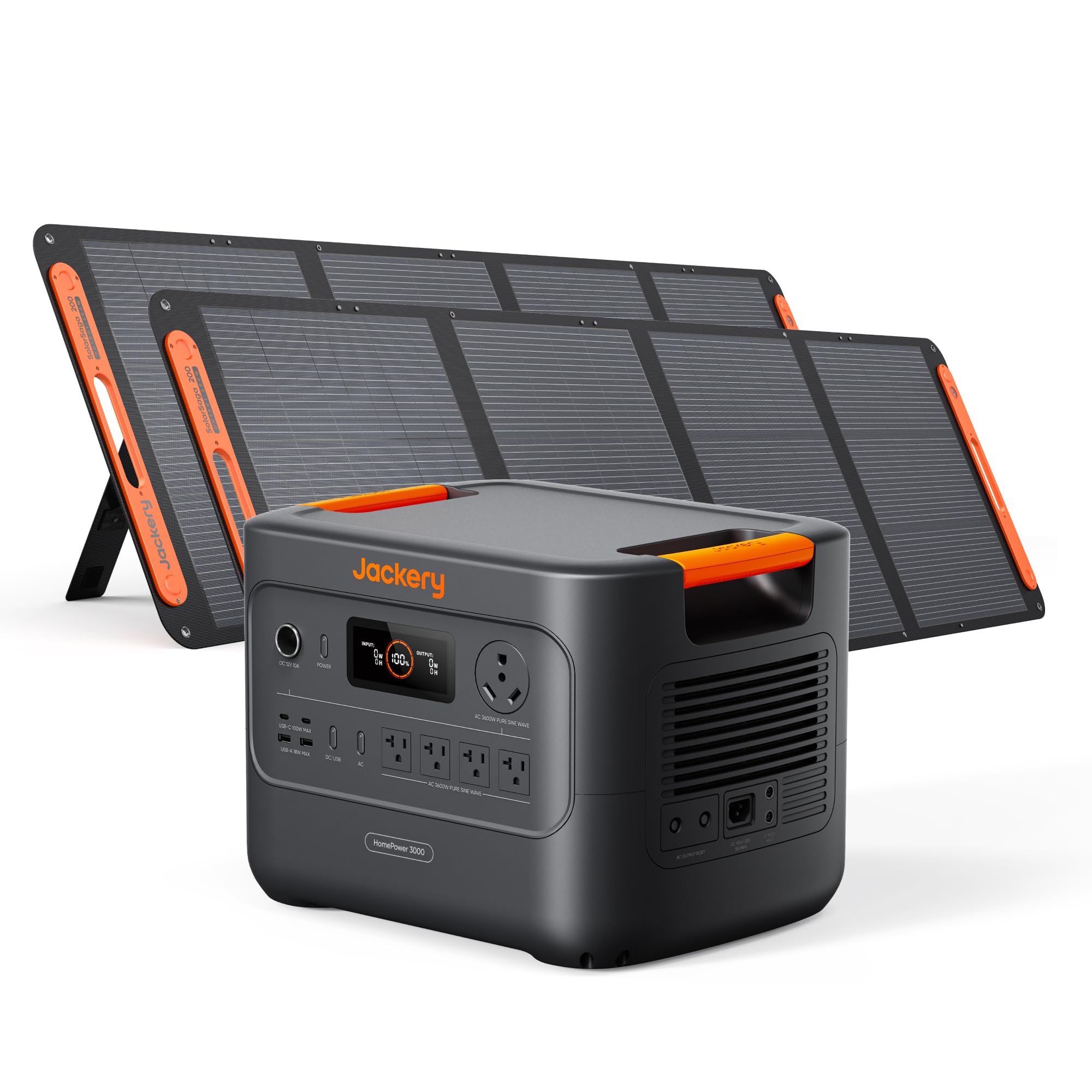
The Jackery HomePower 3000 is the lightest and most compact unit in the 3kWh class thanks to Jackery’s CTB (cell-to-body) technology, which integrates battery cells directly into the chassis structure. At just 59.5 pounds and measuring 16.4 x 12.8 x 12 inches, it is 43% lighter than many comparable 3kWh stations—a significant advantage for anyone who needs to move their backup power between home and RV.
The unit outputs 3600W continuous (7200W surge) from its 3072Wh LFP battery, with a ≤20ms UL-certified UPS for seamless switchover during outages. The charge speed is competitive: 1.7 hours via hybrid AC+DC input, or 2.2 hours using AC alone. The included two 200W SolarSaga panels deliver a total of 400W, recharging the unit to 80% in about nine hours.
The main limitation is that the HomePower 3000 is not expandable—there are no extra battery ports. The 3072Wh capacity is fixed, making it best suited for overnight or single-day backup rather than multi-day outages without solar replenishment. It also lacks 240V output. For users who prioritize portability and a compact footprint over raw capacity, this is the most travel-friendly option in the mid-range.
Why it’s great
- Extremely light at 59.5 pounds for a 3kWh LFP station
- Fast 1.7-hour hybrid AC+DC recharge time
- UL-certified UPS with ≤20ms switchover for sensitive electronics
Good to know
- Battery capacity is not expandable beyond the base 3072Wh
- No 240V output for whole-home transfer switch use
- Wheel kit sold separately; heavy enough to require one for frequent moves
9. AFERIY P310 Solar Generator
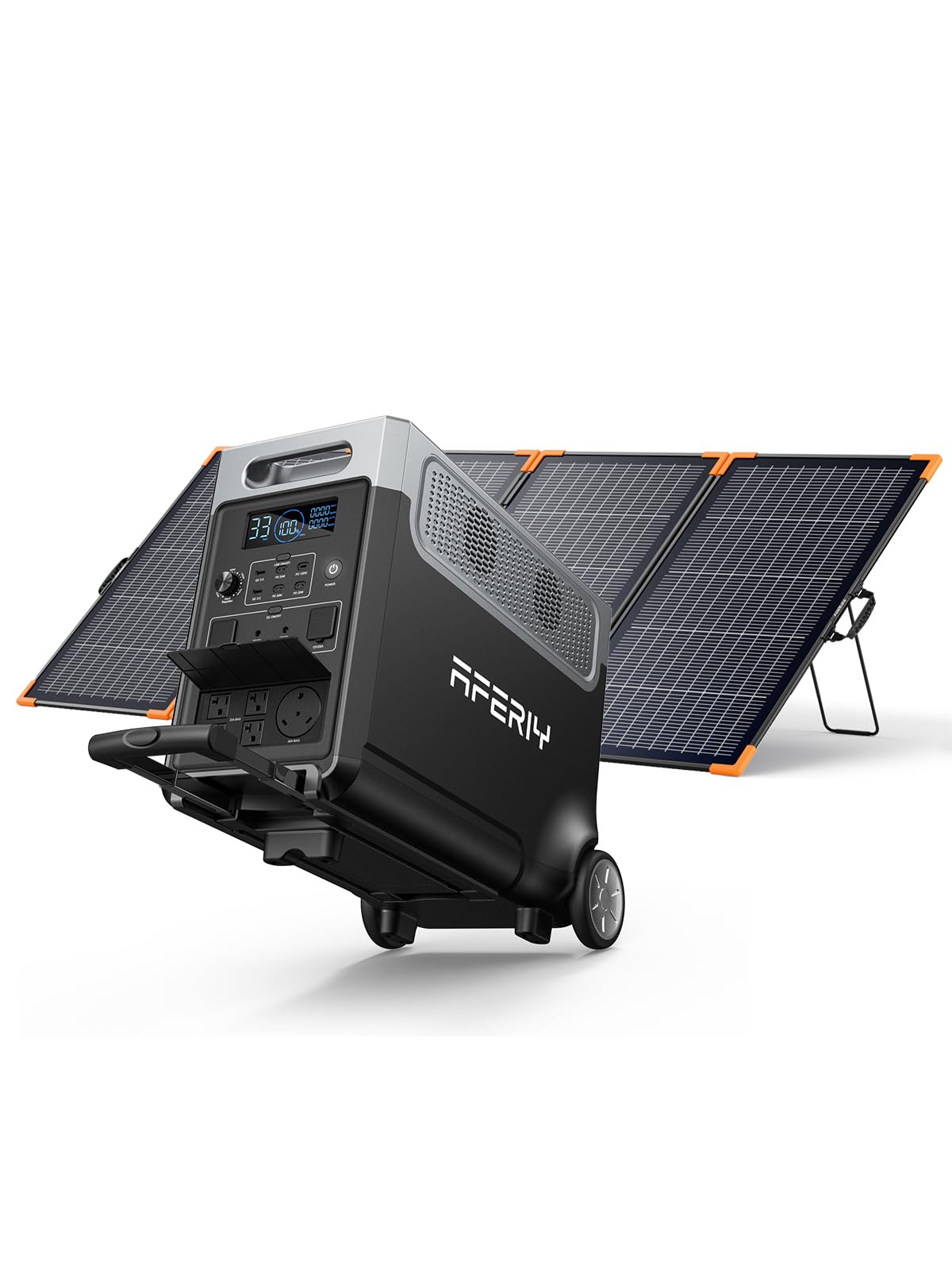
The AFERIY P310 system pairs a 3840Wh power station with a 400W bifacial solar panel that captures light from both front and rear surfaces, boosting overall efficiency up to 25%. This is the only kit in this comparison that includes a bifacial panel, making it a strong choice for users with limited roof or ground space who need to maximize energy harvest per square foot.
The power station delivers 3600W continuous output (7200W surge) with pure sine wave AC, and expands to 11.5kWh with extra battery packs. The UPS switchover is rated at under 10ms, protecting medical devices, computers, and security systems from interruption. The 15 output ports include USB-C PD 3.0, AC, DC5521, and a 12V car outlet. The unit is UL certified, and the solar panel carries an IP67 waterproof rating.
User experiences are split—buyers praise the build quality, cost per kWh, and responsive customer support, but a small number have reported display pixel issues or charging failures that required replacement. The system is best suited for RV and home backup where panel space is tight. The included panel and station ship separately, so delivery coordination is worth noting.
Why it’s great
- Bifacial 400W solar panel boosts efficiency in limited space
- UL certified with 7-year warranty for long-term peace of mind
- Excellent cost per kWh compared to premium brand alternatives
Good to know
- Some units have had display or charging defects requiring warranty service
- Panel and station ship in separate packages
- At 131.6 pounds with panel and station, moving it is a two-person job
10. OUKITEL P5000 Pro
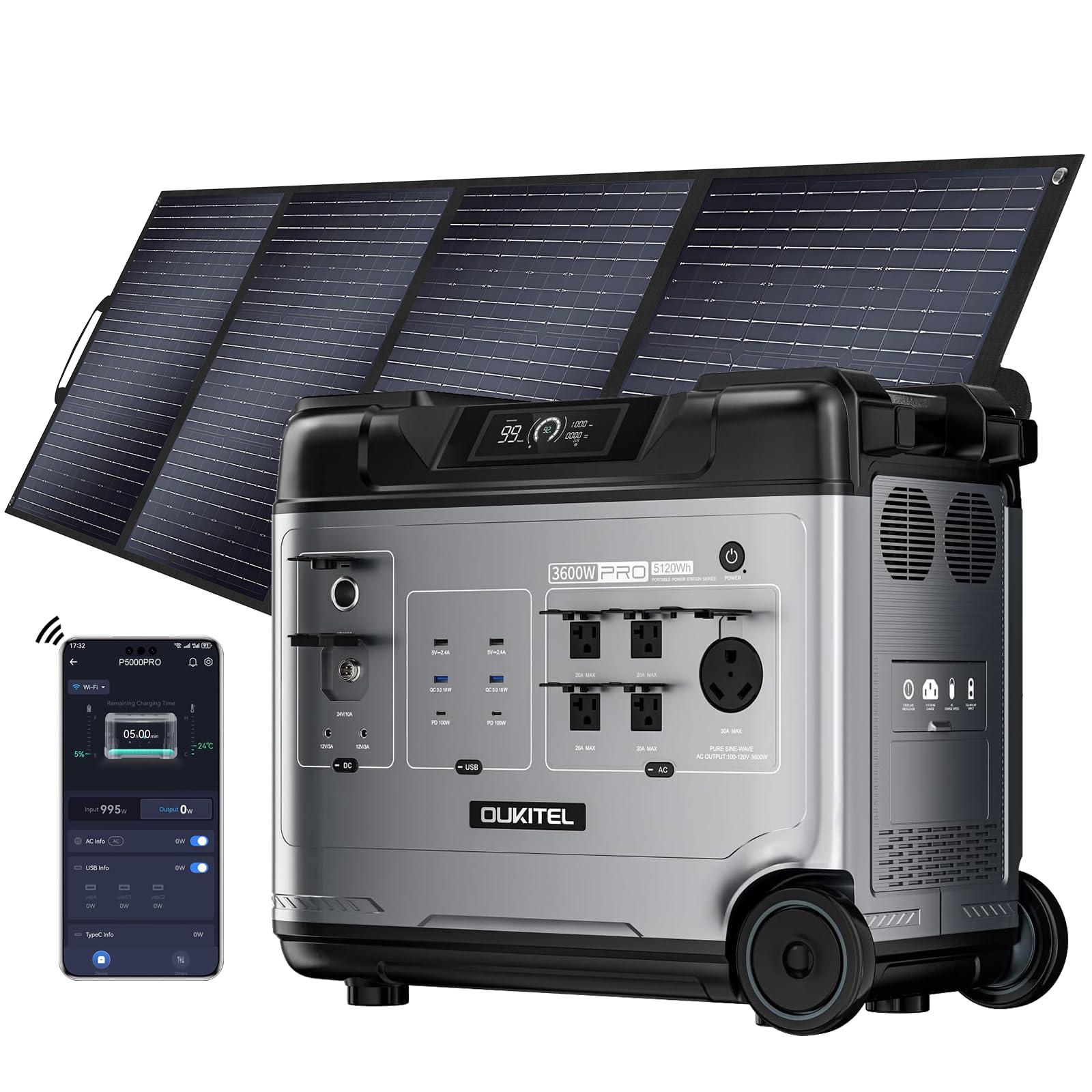
The OUKITEL P5000 Pro starts with a 5120Wh LFP battery—one of the largest base capacities in this comparison—yet the unit is 39% smaller and about 25 kg lighter than conventional 5kWh power stations. The 3600W continuous output (6000W surge) powers most heavy household appliances, and the 15 outlets include five AC, dual USB-C, and a 12V car port. The built-in drawbar and two wheels make the 120-pound unit easier to move than its weight suggests.
Recharge speed is competitive: 1800W AC input fully charges the battery in 2.8 hours, and 1000W solar input tops it up in about five hours with four 400W panels. The LFP cells are rated for 6000 cycles to 70% capacity, which translates to roughly 10 years of daily use. The UPS function switches in under 10ms for data protection.
The main drawback for iOS users is that the companion app is not yet available on the US App Store, limiting remote monitoring to Android devices. The included 400W solar panel is made of a cloth-like material that is not waterproof, so it requires dry storage when not in use. For users who want a massive base capacity without expanding—or who want the option to add panels later—the P5000 Pro delivers strong value per watt-hour.
Why it’s great
- Large 5120Wh base capacity in a relatively compact chassis
- 6000-cycle LFP cells for long operational lifespan
- Drawbar and wheels aid mobility despite 120-pound weight
Good to know
- No iOS app available in the US App Store
- Included 400W solar panel is cloth and not waterproof
- Requires 2.4GHz Wi-Fi for app connectivity—no Bluetooth-only mode
11. Anker SOLIX F3000
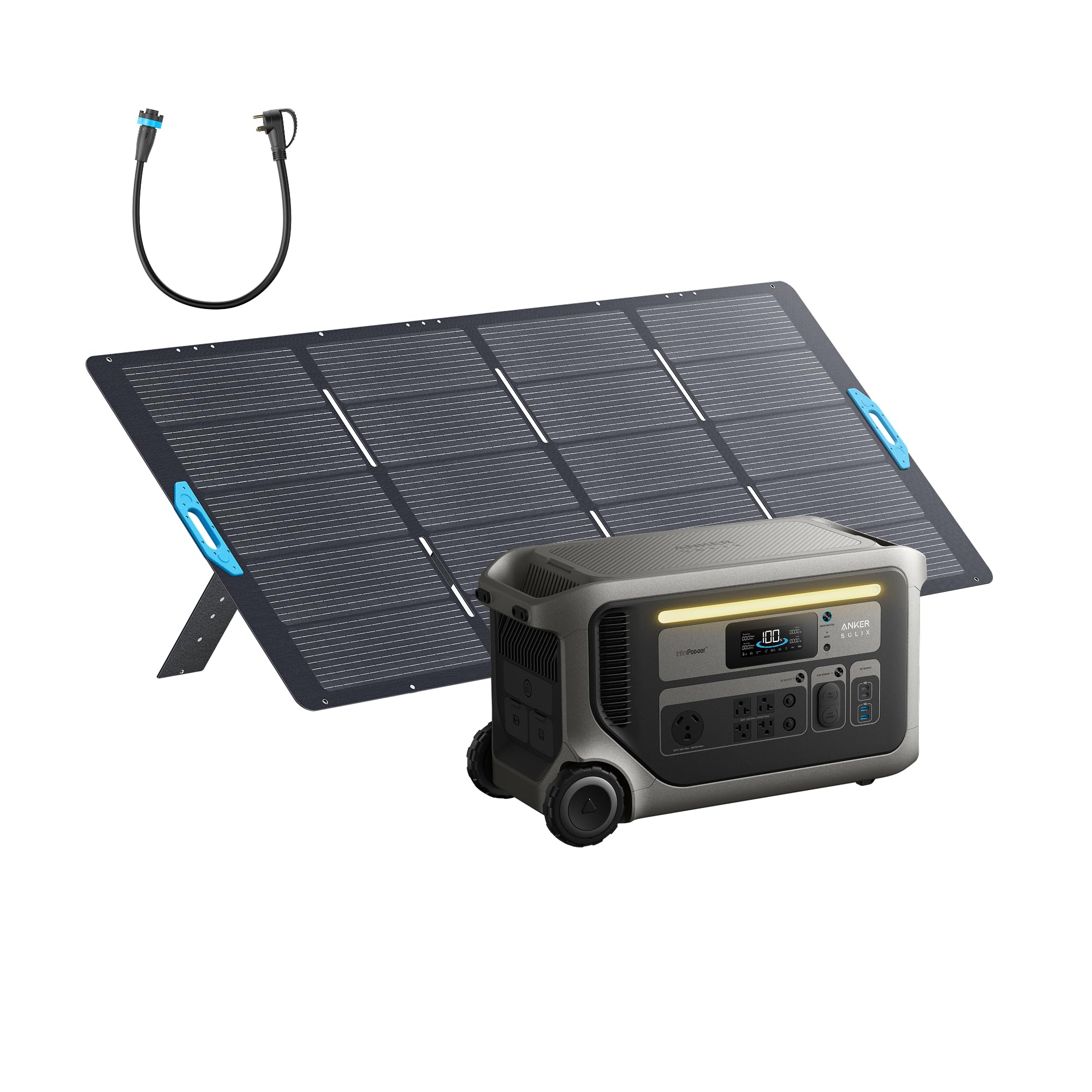
The Anker SOLIX F3000 starts with a 3072Wh LFP base that expands to 24kWh with additional battery packs, making it a scalable entry point for users who want to build capacity over time. The unit delivers 3600W output through 120V/240V outlets, including a TT-30R port for RV hookups. Pairing two units in split-phase mode provides 240V for larger home loads.
Charging versatility is strong: 2400W solar input, 3600W pass-through charging that allows simultaneous input and output, and up to 6000W combined input when pairing AC generator and solar power. The ultra-low idle consumption delivers up to 125 hours of AC standby time or 42 hours running a 190W refrigerator on a single charge.
Both the unit and the included 400W solar panel are heavy and bulky—the panel alone weighs enough that its stand struggles in wind, and it only produced about 160W in September testing (far below its 400W rating). Wi-Fi disconnection issues are reported. The F3000 serves best as a modular basement for a larger future system, but the panel experience may leave users underwhelmed if they rely on it for daily charging.
Why it’s great
- Expandable from 3kWh to 24kWh for future capacity upgrades
- Very low AC idle power consumption extends standby time
- Supports simultaneous generator and solar charging at up to 6000W
Good to know
- Included 400W solar panel underperforms and has a flimsy stand
- Wi-Fi connectivity can drop frequently
- Panel and station are both heavy, making transport challenging
12. EcoFlow DELTA Pro + 400W Panel

This bundle pairs the standard DELTA Pro 3600Wh station with a single 400W foldable solar panel featuring 22.4% conversion efficiency. The panel weighs 35.3 pounds, folds into an adjustable carry case, and carries an IP68 waterproof rating. In full sun, a single panel recharges the DELTA Pro in about 11 hours, while three panels cut that to 3.5 hours.
The station itself retains all the capability of the standalone DELTA Pro: 3600W output (4500W X-Boost), five AC outlets, dual USB-C, and the full 25kWh expandability and dual-unit pairing features. The smart app control via Wi-Fi or Bluetooth gives detailed energy monitoring. The panel is also compatible with other EcoFlow stations.
Customers consistently note that the DELTA Pro is heavy (99 pounds), and the foldable 400W panel is large and cumbersome for solo setup. Some users feel the 3600Wh capacity is misleading because the unit shuts off at 25% remaining, giving only about 2700Wh of usable power. This bundle is a good complete starter package for someone who wants one delivery rather than sourcing panels separately.
Why it’s great
- Includes an IP68-rated 400W panel with 22.4% conversion efficiency
- DELTA Pro offers full modular expansion up to 25kWh
- Smart app provides detailed charge scheduling and energy monitoring
Good to know
- Panel and power station ship in separate packages
- The panel is large and heavy for a single person to move easily
- Usable capacity is only about 2700Wh due to 25% low-battery cutoff
13. IEE P3200

The IEE P3200 offers the lowest entry point in this comparison while still delivering genuine whole-appliance backup capability. The 2048Wh LFP battery drives a 3200W continuous inverter (6400W peak) through four AC outlets and sixteen total ports. The unit is notably compact and light for its output class—52 pounds—which is about half the weight of many 3kWh competitors.
Recharge speed is the standout spec: 1800W AC input charges from zero to full in just 1.2 hours, and combined AC+solar input pushes that even faster. The LiFePO₄ cells are rated for 4000 cycles, which provides roughly 15 years of nightly use. The EPS auto-switchover is rated at under 10ms for uninterrupted operation during grid failures.
At this price point, some compromises exist. The AC charge cord is only 14 AWG rather than the preferred 12 AWG for sustained high-current charging, and the app interface has somewhat rough English translations and limited features. The battery is not user-replaceable, and expansion beyond 2048Wh is not supported. For budget-conscious buyers who need full-home essential circuit backup without paying for expandability they won’t use, the P3200 delivers impressive raw value.
Why it’s great
- Extremely fast 1.2-hour full recharge via 1800W AC input
- Lightweight 52-pound chassis for a 3.2kW output station
- Excellent cost per watt of inverter output for budget-oriented buyers
Good to know
- 14 AWG charge cord should be upgraded to 12 AWG for sustained use
- No battery expansion option—base 2048Wh capacity is fixed
- App interface has rough translations and limited functionality
FAQ
Can a 5000 watt solar generator run a central air conditioning unit?
What is the difference between a 5000 watt peak and a 5000 watt continuous rating?
How many solar panels do I need to recharge a 5000Wh solar generator in a day?
Can I plug a 5000 watt solar generator directly into my home’s breaker panel?
Final Thoughts: The Verdict
For most users, the best 5000 watt solar generator winner is the Jackery Solar Generator 5000 Plus because it delivers genuine 7200W continuous split-phase output, expands to 60kWh, and accepts up to 4000W solar input—all features that make it a true gas-generator replacement for whole-home backup. If you want native 240V output with the fastest recharge time in its class, grab the OUPES Guardian 6000. And for the most silent operation combined with modular expandability, nothing beats the EcoFlow DELTA Pro 3.

Mo Maruf
I created WellFizz to bridge the gap between vague wellness advice and actionable solutions. My mission is simple: to decode the research and give you practical tools you can actually use.
Beyond the data, I am a passionate traveler. I believe that stepping away from the screen to explore new environments is essential for mental clarity and physical vitality.