Our readers keep the lights on and my smoothie glass nicely filled. As an Amazon Associate, I earn from qualifying purchases.
A blood oxygen monitor that reads 98% when you are actually at 90% is worse than no monitor at all — it gives you a false sense of security. The difference between a cheap optical sensor and one using validated plethysmography can mean catching a dangerous desaturation event or missing it entirely. Whether you manage COPD, sleep apnea, or simply want data on how your body responds at altitude, the sensor accuracy and data-logging capability of your chosen device will define its real-world value.
I’m Mohammad Maruf — the founder and writer behind WellFizz. My research focuses on comparing optical sensor architecture, perfusion indexing, and regulatory clearance across consumer and near-clinical pulse oximeters to identify which units deliver data you can actually trust.
After analyzing seven leading models across price tiers and use cases, the most dependable data comes from devices that prioritize waveform validation and low-perfusion accuracy. This guide to the best blood oxygen monitor breaks down which specs matter, which marketing claims to ignore, and which three units earn a spot in your home health kit.
How To Choose The Best Blood Oxygen Monitor
Not all pulse oximeters are built to the same standard. A monitor that drifts 2% at rest can show a 4% error during exercise or sleep, which is enough to mask a dangerous trend. Understanding three core differentiators will keep you from buying a device that just blinks numbers.
Measurement Accuracy and Sensor Architecture
The critical spec is the declared accuracy tolerance — look for devices advertising ±1% SpO₂ in the 70-100% range rather than ±2%. A ±2% tolerance means a true 88% reading could display as 86% or 90%, which is clinically meaningful for anyone on supplemental oxygen. Premium units use dual-wavelength LED arrays and proprietary algorithms that compensate for motion artifact and low perfusion, while budget fingertip clips often use simpler photodiodes that struggle with cold fingers or rapid breathing.
Monitoring Mode: Spot-Check vs. Continuous Trend Recording
A spot-check oximeter takes a single reading when you press the button — useful for quick assessments but completely blind to overnight desaturations or exercise-induced dips. Continuous trend models record SpO₂ and pulse rate at intervals (often every 1 to 10 seconds) and store thousands of data points with timestamps. If you need to track overnight oxygen levels, evaluate CPAP efficacy, or monitor recovery after a respiratory infection, skip spot-check models and choose a unit with at least 10 hours of onboard memory per session.
Regulatory Clearance and Intended Use
Many consumer pulse oximeters carry a disclaimer: “For sports and aviation use only, not intended for medical purposes.” This means the device has not been submitted for FDA 510(k) clearance, and its accuracy across diverse skin tones and low-perfusion states has not been validated. For general fitness tracking, this is acceptable. For anyone with a diagnosed respiratory, cardiac, or sleep disorder — or for elderly home monitoring — an FDA-cleared unit like the Nonin TruO2 provides documented performance across the full patient population.
Quick Comparison
On smaller screens, swipe sideways to see the full table.
| Model | Category | Best For | Key Spec | Amazon |
|---|---|---|---|---|
| Wellue Checkme O2 Max | Ring Style | All-day continuous tracking | 72-hour battery, 10-hour memory per session | Amazon |
| Nonin TruO2 3250 | Fingertip | Clinical-grade spot checks | FDA cleared, ±2% accuracy, 2200 spot checks | Amazon |
| HealthTree JKS50F | Handheld | Multi-user home trending | 18-hour battery, 300 records per user | Amazon |
| HOLFENRY JKS50F | Handheld | Continuous overnight monitoring | 24-hour plugged use, alarm thresholds | Amazon |
| Manhero C101B1 | Handheld | Budget continuous recording | ±1% SpO₂ accuracy, plethysmograph display | Amazon |
| PRCMISEMED VPM350B | Veterinary | Pet health monitoring | 20-hour standby, animal-specific algorithms | Amazon |
| Pepultech 1300-003 | Fingertip | Entry-level sports tracking | 15-hour battery, one-button operation | Amazon |
In‑Depth Reviews
1. Wellue Checkme O2 Max

The Wellue Checkme O2 Max abandons the traditional spring-loaded clip in favor of a silicone ring sensor that wraps around the fingertip — a design that eliminates the finger numbness and motion artifacts common with clip-style units during sleep or extended wear. Its optical sensor captures SpO₂ and pulse rate continuously for up to 72 hours on a single charge, storing four 10-hour sessions onboard before needing a Bluetooth sync to the Vihealth app.
The smart vibration and audio alarm is configurable: you set your low SpO₂ threshold (typically 88-90%), and the ring vibrates plus emits a drip tone when levels drop. This feature is particularly useful for overnight COPD monitoring or sleep apnea screening, where silent desaturations often go unnoticed. The app exports data to O2 Insight Pro for PC-based trend analysis, and the device integrates with Apple Health.
A handful of users report the proprietary charging cable connection can loosen over time, and the finger strap requires a brief adjustment period to achieve a consistent seal. For anyone needing hands-free, long-duration monitoring — especially during sleep — this is the most comfortable and data-rich option in the current market.
Why it’s great
- Silicone ring design prevents finger numbness during all-night wear
- 72-hour continuous recording with onboard memory for four sessions
- Configurable vibration and audio alarm alerts you to desaturations
Good to know
- Proprietary charging cable is a single point of failure
- Battery life closer to 48 hours under continuous logging
- App must remain active in foreground for real-time alarms on phone
2. Nonin TruO2 OTC Pulse Oximeter 3250

Nonin invented the fingertip pulse oximeter, and the TruO2 3250 applies that legacy with FDA 510(k) clearance for over-the-counter home use — a distinction almost no consumer pulse oximeter holds. The PureSAT technology inside this unit uses adaptive digital signal processing to maintain accuracy across all skin pigmentation levels and in low-perfusion states like cold hands, Raynaud’s, or post-exercise vasoconstriction.
The CorrectCheck feature actively alerts you if your finger is positioned incorrectly, eliminating the most common source of erroneous readings — partial occlusion or off-center placement. Each unit delivers up to 2,200 spot checks on two included AAA batteries, and secure Bluetooth pairs with the NoninConnect app for Apple Health export and email-based data sharing. The housing is Made in USA with a 2-year warranty.
The trade-offs are real for continuous use: the spring clip is stiffer than ring-style sensors, making extended wear uncomfortable, and the unit prioritizes burst accuracy over data logging — it is designed for spot checks, not overnight trend recording. For anyone who needs a single, verifiably accurate reading before making a clinical decision, this is the most trustworthy monitor on the list.
Why it’s great
- FDA-cleared for OTC home use with documented accuracy across skin tones
- CorrectCheck finger positioning sensor eliminates false readings
- 2,200 spot checks per battery set — essentially yearly battery life
Good to know
- Clip design is firm and can be uncomfortable during extended wear
- Does not support continuous trend recording or onboard memory
- Higher acquisition cost reflects medical-grade validation
3. HealthTree JKS50F Pulse Oximeter
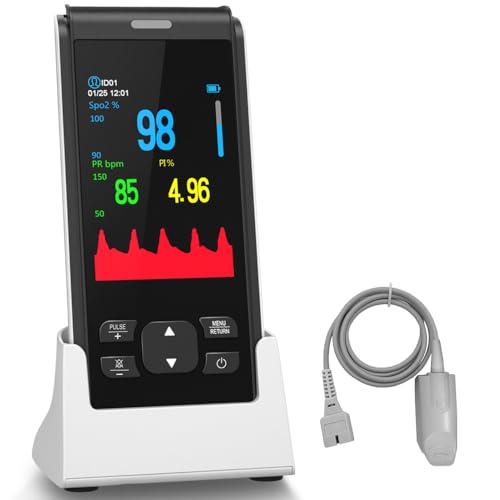
The HealthTree JKS50F bridges the gap between a simple fingertip clip and a full handheld monitor by offering both spot-check and trend record modes in a compact form factor. Its rechargeable battery delivers 18 hours of continuous operation, and the included magnetic charging cradle keeps the unit ready between uses without fumbling with cables.
Ten independent user profiles allow a household to share one device while keeping personal data separate — each profile stores up to 300 timestamped readings. The Bluetooth connectivity pairs with the HealthTree app for data export and sharing, and the configurable low-SpO₂ alarm (audible beep plus flashing numerals) provides a safety net for overnight monitoring. Accuracy is rated at ±2% SpO₂ between 70 and 100%, with pulse rate resolution to 1 bpm.
Some users report that the button interface is slightly confusing across the multiple display modes, and the silicone finger cuff, while comfortable, uses a proprietary magnetic connector that should not be yanked. For families managing multiple members’ oxygen levels — or for a home health aide tracking trends between doctor visits — the multi-user architecture offers a practical blend of capacity and cost.
Why it’s great
- 10-user profiles with 300 records each — ideal for shared household use
- Magnetic charging cradle eliminates cable wear issues
- Configurable alarm thresholds for both SpO₂ and heart rate
Good to know
- Button layout is unintuitive across multiple display modes
- Magnetic connector is fragile if the cord is pulled laterally
- Accuracy spec is ±2%, not the tighter ±1% of premium units
4. HOLFENRY JKS50F Handheld Pulse Oximeter
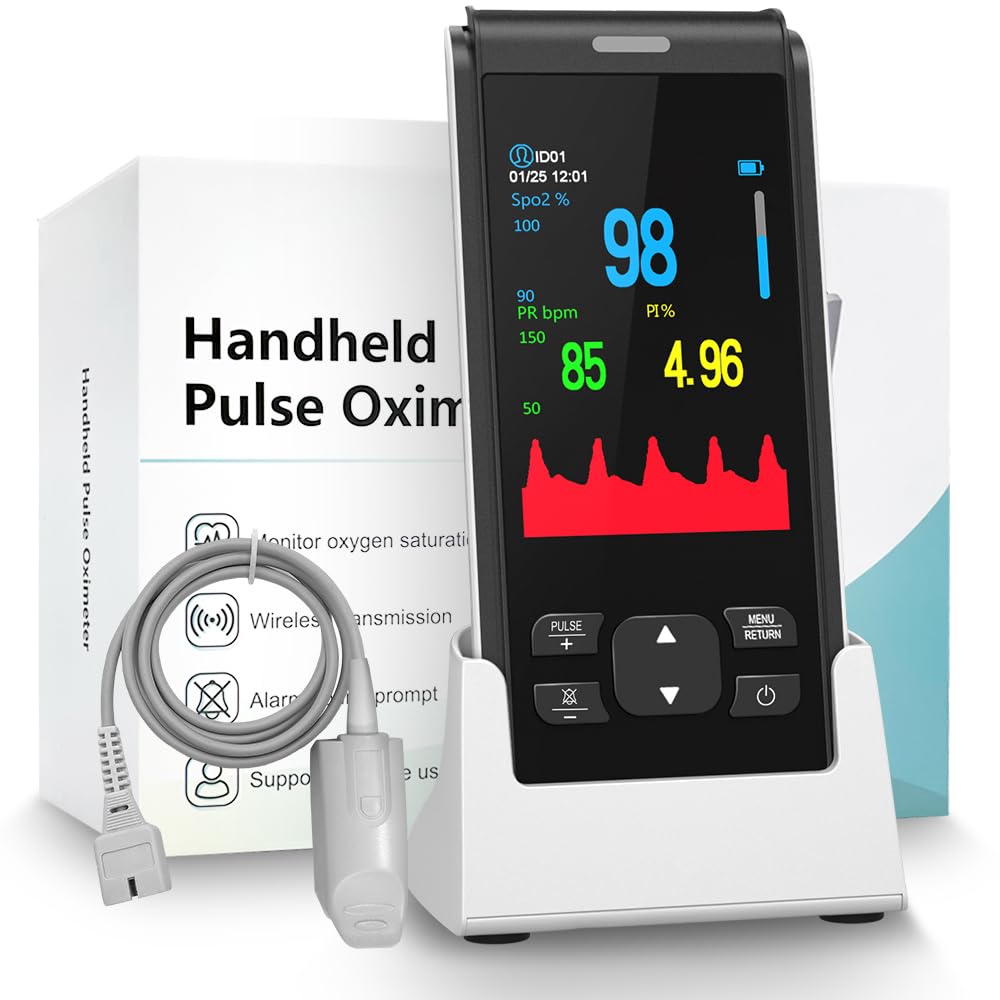
This HOLFENRY unit shares the JKS50F model number with the HealthTree above, but it emphasizes continuous plugged-in use — you can run it 24 hours while connected to USB-C power, making it a strong candidate for overnight respiratory monitoring or post-operative recovery at home. The accuracy spec is tight at ±1% SpO₂ between 70 and 100%, and the handheld chassis accepts a standard adult finger probe via a removable cable.
The alarm system is adjustable: you set the low SpO₂ threshold (default 90%) and the low heart rate threshold (default 50 bpm), and the device flashes the offending value while emitting a beep. Multi-user memory stores 300 records per ID across 10 users, and free HealthTree app syncs data for trend analysis. The unit is slim — roughly the size of a smartphone — and the USB-C charging cradle keeps the probe connector free of wear.
A small number of units have experienced charging base failures within the first month, and the magnetic charging contact on the oximeter body is not replaceable. Users who intend to rely on this device for critical overnight monitoring should verify the alarm volume is sufficient to wake them — and keep a backup battery plan.
Why it’s great
- 24-hour continuous operation while plugged into USB-C power
- ±1% SpO₂ accuracy — matches premium-tier tolerance
- Accepts standard hospital-style adult probe for replacement flexibility
Good to know
- Charging base failure reported in a subset of units
- Magnetic charging contact is non-replaceable if damaged
- No hard carrying case included for travel protection
5. PRCMISEMED Veterinary Handheld Pulse Oximeter VPM350B
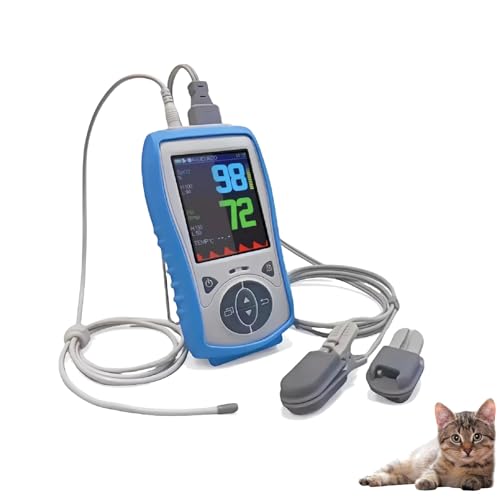
Standard human pulse oximeters fail on animals because fur, skin pigmentation, and paw pad thickness scatter the optical signal unpredictably. The PRCMISEMED VPM350B solves this with three animal-specific measurement modes for small pets, medium pets, and large animals, plus two sizes of SpO₂ clip sensors and a rectal temperature probe. The 2.8-inch color TFT display shows SpO₂, heart rate, and temperature simultaneously, and customizable alarm thresholds trigger if any value leaves your preset range.
The device runs on a rechargeable lithium battery rated for 20 hours of standby, and the auto-shutdown after 3 minutes of inactivity preserves charge between uses. Data export to a computer via USB allows record-keeping for multi-pet households or small veterinary practices. The silicone protective shell and adjustable back bracket support both handheld and bedside positioning.
Real-world performance is best on non-hairy surfaces like the lip, paw pad (after removing silicone sleeves), or ear margin. On conscious animals with thick coats or heart/lung disease, readings can be inconsistent — the unit is most reliable under calm or sedated conditions. For pet owners managing CHF, post-surgical recovery, or hospice care, this fills a genuine gap that no consumer fingertip clip can address.
Why it’s great
- Three animal-specific algorithms for small, medium, and large pets
- Includes both SpO₂ clip sensors and a rectal temperature probe
- Rechargeable with 20-hour standby and data export via USB
Good to know
- Readings are unreliable on conscious, active animals with thick coats
- No printed manual — instructions are on an included CD only
- Not certified for human medical use despite working on earlobes
6. Manhero C101B1 Continuous Pulse Oximeter
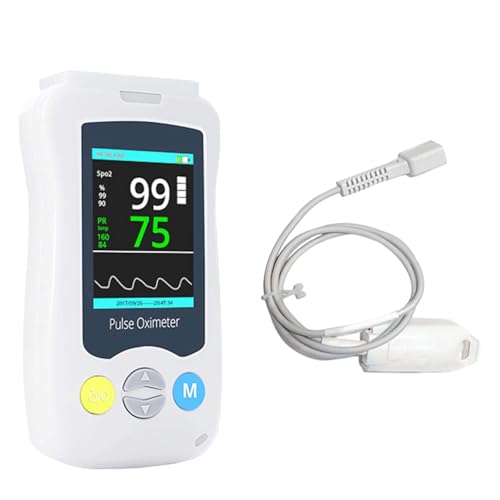
The Manhero C101B1 brings a feature often reserved for hospital monitors — a real-time plethysmograph (pulse wave) display — to the consumer market. This visual waveform lets you assess signal quality yourself: a consistent, uniform wave means the reading is reliable, while a flat or erratic wave warns you to reposition the finger probe. The 2.4-inch HD screen shows SpO₂, pulse rate, and the pleth waveform all at once.
This unit supports both continuous monitoring via AC power and spot checking with two AA batteries (not included). The adjustable alarm system lets you set upper and lower bounds for SpO₂ and pulse rate, and the included finger probe uses a cable that can be swapped for a longer sensor if needed. Accuracy is advertised at ±1% SpO₂ between 70 and 100%, matching premium handhelds at a budget-tier entry point.
Battery life is the unit’s weakest link — three AA batteries drain noticeably within one to two nights of continuous use, making AC power nearly mandatory for overnight sessions. The finger probe plug is mechanically shallow and can disconnect with minimal movement. For daytime spot-checking where the plethysmograph helps verify reading quality, this offers a unique visual validation tool.
Why it’s great
- Plethysmograph waveform display lets you judge signal quality visually
- ±1% SpO₂ accuracy — rare in the budget continuous-monitor segment
- AC power option eliminates battery anxiety for overnight use
Good to know
- AA batteries drain in 1-2 nights; AC power is almost required for sleep monitoring
- Finger probe plug is shallow and disconnects with minor cable tension
- No Bluetooth or app connectivity for data export
7. Pepultech Fingertip Pulse Oximeter 1300-003
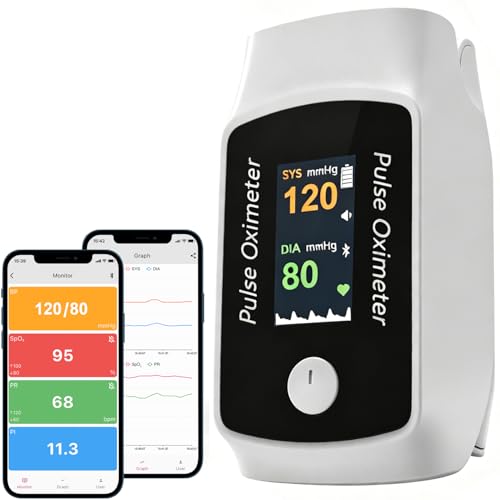
The Pepultech 1300-003 is the most straightforward device on this list: a single-button fingertip clip that displays SpO₂ and pulse rate on a bright OLED screen within seconds. The display rotates orientation via button press, which is a thoughtful touch for left-hand users. Battery life is rated at 15 hours of continuous operation from two AAA batteries (not included), and a 8-second auto-shutdown prevents accidental drain.
Bluetooth connectivity links to the Berry Health app for real-time viewing and recording, though this unit is explicitly labeled “for sports and aviation use only” and carries no medical certification. SpO₂ accuracy has not been independently validated across skin tones or low-perfusion states. The unit weighs 63 grams including batteries, making it genuinely pocketable for gym bags or hiking packs.
A single verified review notes that the blood pressure trend functionality (a secondary display mode) does not track accurately against a wrist or upper-arm cuff, so consider the BP feature a bonus rather than a reliable metric. For a casual athlete who wants to confirm they are not desaturating during high-altitude training or interval work, this delivers basic data at the lowest entry cost.
Why it’s great
- Ultra-simple one-button operation with auto-rotating OLED display
- Lightweight 63g design is truly pocketable for active use
- Bluetooth app sync for real-time viewing during workouts
Good to know
- Not FDA-cleared; labeled for sports and aviation only
- Blood pressure trend mode is inaccurate against clinical cuffs
- No multi-user memory or continuous trend recording
FAQ
What does the “sports and aviation use only” label actually mean?
Can I wear a pulse oximeter overnight to check for sleep apnea?
Why do my readings vary between my left and right hand?
Final Thoughts: The Verdict
For most users, the best blood oxygen monitor winner is the Wellue Checkme O2 Max because its ring-style sensor enables comfortable all-day and all-night recording with configurable alarms — a combination no fingertip clip can match. If you need FDA-cleared accuracy for critical spot checks, grab the Nonin TruO2 3250. And for budget-friendly continuous overnight monitoring with a plethysmograph display, nothing beats the Manhero C101B1.

Mo Maruf
I created WellFizz to bridge the gap between vague wellness advice and actionable solutions. My mission is simple: to decode the research and give you practical tools you can actually use.
Beyond the data, I am a passionate traveler. I believe that stepping away from the screen to explore new environments is essential for mental clarity and physical vitality.