Our readers keep the lights on and my smoothie glass nicely filled. As an Amazon Associate, I earn from qualifying purchases.
A fractured vertebra demands absolute immobilization of the spine’s motor segments during healing. Wrapping a generic elastic bandage around your torso won’t cut it—you need a rigid orthosis that locks the lumbar and sacral regions into neutral alignment while you move, sit, or sleep. The wrong brace shifts pressure onto the injured site and delays bone union, or worse, causes further displacement.
I’m Mohammad Maruf — the founder and writer behind WellFizz. I’ve spent years analyzing orthopedic bracing designs, pulley tensioning mechanisms, PDAC codes, and patient outcome data to separate medical-grade stabilization from flimsy fabric supports.
Whether you’re recovering from a compression fracture, a burst fracture, or post-surgical stabilization, finding the back brace for fractured vertebrae that delivers true load-shielding and controlled motion is the single most important tool to protect bone healing and avoid re-injury.
How To Choose The Best Back Brace For Fractured Vertebrae
Choosing a brace for a vertebral fracture isn’t like picking a general lumbar support. You need an orthosis that provides rigid immobilization, customizable compression, and proper vertebral height coverage. Here are the critical factors to evaluate before buying.
Rigid vs. Elastic Stabilization
Fractured vertebrae require an LSO (Lumbo-Sacral Orthosis) with rigid posterior panels or a bionic decompression plate. Elastic neoprene belts allow too much flexion and rotation, which can disrupt the healing callus. Look for a brace that includes stiff support inserts or a molded back plate that physically limits forward bending and lateral twisting.
Compression Mechanism and Tension Control
A pulley system with easy-pull tabs lets you apply targeted compression across the lumbar spine without straining your arms or torso. This is vital for post-op or elderly patients with limited grip strength. The pulley should tighten the upper and lower portions independently, so you can offload pressure from the fractured segment while stabilizing adjacent vertebrae.
Height and Length Adjustment
A one-size-fits-all approach doesn’t work for vertebral fractures. The brace must cover from T11 down to S1, and the back panel height should be adjustable to match your torso length. Some premium models offer telescoping back panels that extend from about 11 to 14 inches, ensuring the rigid support lands exactly where you need it on the spine.
PDAC Codes and Insurance Reimbursement
If you’re submitting a claim, look for braces that carry PDAC codes such as L0631 (rigid LSO), L0648 (lumbar-sacral orthosis with adjustable support), or L0650 (lumbo-sacral orthosis with multiple adjustments). These codes confirm the device meets Medicare classification for medical necessity and may qualify for partial or full reimbursement.
Quick Comparison
On smaller screens, swipe sideways to see the full table.
| Model | Category | Best For | Key Spec | Amazon |
|---|---|---|---|---|
| Comfyorthopedic LSO Back Brace | Premium LSO | Maximum post-fracture stabilization | PDAC codes L0631/L0648/L0650 | Amazon |
| VertebrAlign LSO Lumbar Back Brace | Premium LSO | Medical-grade stabilization with one-handed pulley | PDAC L0631/L0637/L0648/L0650 | Amazon |
| LSO Back Brace with Maximum Decompression Plate | Premium | Immobilization with adjustable arch support | 26-degree bionic lumbar arch | Amazon |
| LSO Spine Decompression Support-Entire ARC Back Brace | Mid-Range | Adjustable back panel height for varying torso lengths | 11.8–13.5 inch adjustable panel | Amazon |
| BaxMAX Adjustable Back Brace | Mid-Range | Lightweight active recovery with 5-to-1 pulley | 0.3 lb nylon/kevlar mesh | Amazon |
| ASPEN Medical Products Quikdraw PRO | Mid-Range | Clinical-grade trunk stability for L1-L5 | Dual PullTab inelastic fabric | Amazon |
| Adjustable LSO Lumbar Back Brace by Brace Align | Budget | Entry-level LSO with PDAC code L0642 | PDAC L0642 certified | Amazon |
In‑Depth Reviews
1. Comfyorthopedic LSO Back Brace

The Comfyorthopedic LSO is a true medical-grade orthosis built for serious spinal injuries, including compression fractures and post-surgical stabilization. It carries PDAC approval for codes L0631, L0648, and L0650, meaning it qualifies for insurance reimbursement as a rigid lumbo-sacral support. The dual medical-grade drawstrings allow you to apply even, graduated compression across the L1–L5 segments without creating pressure points.
What sets this brace apart is the patented adjustable sizing system that fits abdominal circumferences from 25 to 48 inches, so you don’t need to buy a new brace if your weight fluctuates during recovery. The back panel includes a detachable hard foam cushion that contours to the spine, plus two removable side support pads that limit lateral bending—critical for preventing rotational torque on a healing fracture. Users recovering from discectomy procedures report immediate posture improvement and reduced strain when bending.
One caveat: the back panel height is not adjustable, which means taller users may find the rigid support lands too high or too low on their spine. The build quality is excellent, with reinforced Velcro and durable foam that holds up to daily wear. If you need a brace that offers hospital-grade immobilization and a one-year warranty against manufacturer defects, this is a top contender.
Why it’s great
- PDAC-approved for L0631/L0648/L0650 — insurance-friendly
- Adjustable abdominal fit from 25 to 48 inches
- Removable side pads for customizable lateral support
Good to know
- Back panel height is not adjustable; may be short for users over 6 feet
- Requires dry cleaning only
2. VertebrAlign LSO Lumbar Back Brace
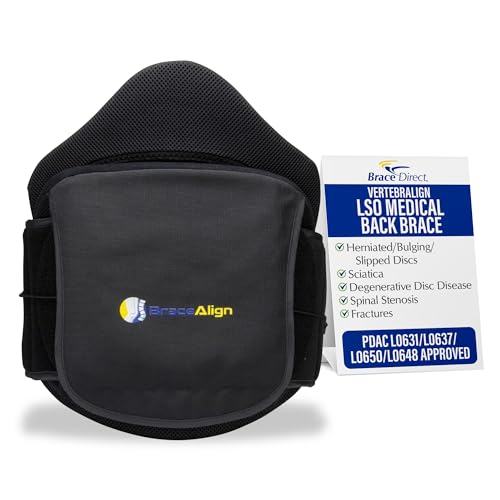
The VertebrAlign is a heavy-duty LSO brace that carries PDAC approval for multiple codes including L0631, L0637, L0648, and L0650 — a strong indicator that it meets Medicare’s criteria for medical necessity in fracture management. Its defining feature is the effortless one-handed pulley compression system, which distributes tension evenly across the lumbar and sacral regions without requiring you to twist or strain. For post-op patients or seniors with limited grip strength, this is a significant advantage.
The brace uses removable rigid panels that allow you to dial in the level of immobilization. For early-stage fracture healing, you can install all panels for maximum restriction; as you progress, you can remove some for more flexibility. The breathable mesh construction keeps you cool even during all-day wear, and the universal sizing accommodates waist circumferences from 23 to 50 inches. If your waist exceeds 50 inches, a Plus Extension model extends the fit up to 66 inches. Brace Direct also offers a free video fitting session to dial in the perfect adjustment.
A frequent user complaint is that the pulley strings don’t retract on their own, making it slightly awkward to re-tighten after loosening. Additionally, the back padding can detach from the Velcro spots after repeated use. Nevertheless, physical therapists and chiropractors recommend this brace for its proven ability to stabilize the L1–L5 segments, and users report it provides life-changing relief for herniated discs and post-surgical recovery.
Why it’s great
- One-handed pulley system ideal for limited hand strength
- Removable rigid panels for customizable immobilization
- Free video fitting session included
Good to know
- Pulley strings don’t retract, making re-tightening cumbersome
- Back padding may detach from Velcro over time
3. LSO Back Brace with Maximum Decompression Plate

This brace introduces a bionic decompression plate combined with an adjustable arch system that can be set to three positions: full 26-degree extension for lumbar correction before activity, a moderate arch for daily protection, and a flat position for prevention. For a fractured vertebra, the full extension setting creates a gentle lordotic curve that offloads pressure from the anterior vertebral body — a mechanism directly beneficial for compression-type fractures.
The dual-pulley system uses easy-pull finger tabs that let you achieve targeted compression without needing significant upper body strength. The brace also includes a removable soft plastic abdominal plate and an extension pocket for additional core support, which can help stabilize the spine indirectly by bracing the abdominal wall. The sizing is broken into three ranges: S/M fits bellies 23.5–33.75 inches, L/XL fits 33.75–47 inches, and 2XL/3XL fits 47–59 inches, so you can get a precise match.
Users note that this brace is exceptionally stiff when tightened, immobilizing about 80% of lower back movement — exactly what you want for fracture recovery. The main limitation is the hook-and-loop closure for the extension belt, which some users find less secure than a full lace-up system. However, for those needing a brace that actively decompresses the lumbar spine while limiting flexion, this model delivers impressive performance.
Why it’s great
- Three-position bionic arch for active decompression
- Dual-pulley system with easy finger tabs
- Removable abdominal plate for core stabilization
Good to know
- Hook-and-loop extension may feel less secure than lace-up
- Stiffness can make sitting in vehicles uncomfortable
4. LSO Spine Decompression Support-Entire ARC Back Brace

The TANDCF Entire ARC back brace stands out for its unique height-adjustable back panel, which ranges from 11.8 to 13.5 inches — a critical feature for fracture patients whose injury sits at a specific vertebral level. A button-release mechanism on the panel lets you slide the rigid support up or down, ensuring the bionic decompression plate aligns precisely with the T11-S1 segment. This prevents the brace from applying force to healthy vertebrae while missing the fracture site.
The lacing closure system allows for very fine tension control, and users praise how tightly they can cinch the brace without the material digging in. The 3D pad design uses raised spacer fabric and a concave groove to keep the spine ventilated even under heavy compression. For users with waist measurements from 23 to 50 inches, it fits in one size, with a free extension belt that extends up to 67 inches.
A known issue is that the adjustment knob on the back panel reportedly fell off on one user’s unit, though they noted the knob didn’t seem necessary for function. The large grey cushion also detaches from the three small Velcro dots during active movement. Despite these quirks, the brace provides immediate mobility relief during flare-ups and offers the most precise torso-length customization in this price tier.
Why it’s great
- Back panel height adjusts from 11.8 to 13.5 inches
- Lace-up closure allows micro-adjustments in tension
- Free extension belt included for larger waists
Good to know
- Back cushion detaches from small Velcro spots
- Adjustment knob reported missing on some units
5. BaxMAX Adjustable Back Brace
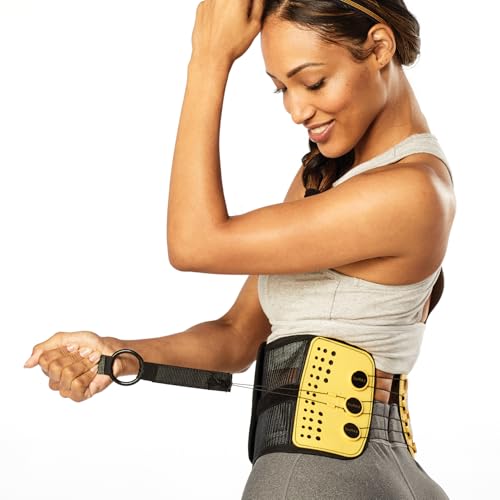
At only 5 ounces, the BaxMAX is surprisingly lightweight for a brace that delivers 5-to-1 compression through its patented pulley system. The nylon/kevlar blend mesh is breathable and non-bulky, making it a good option for patients who need to wear a brace under clothing while staying active during early recovery. It has been used in over 3,000 chiropractic clinics for 15 years, indicating strong clinical trust.
The brace supports three wearing positions — high, mid, and low compression — which you can adjust throughout the day depending on whether you’re sitting, standing, or exercising. The Kevlar-reinforced pulley cable resists stretching over time, maintaining consistent tension on the lumbar spine. It is compatible with optional hot/cold therapy packs that can be inserted into the front panel for additional pain relief.
The main drawback is that the material tends to roll up when you sit down, which can cause discomfort and reduce support effectiveness. For this reason, it works best during standing and walking activities. For patients who need reliable immobilization while sitting or sleeping, a more rigid brace may be preferable. But for active recovery where weight and breathability matter, the BaxMAX is a standout choice.
Why it’s great
- Ultra-lightweight 5 oz design with Kevlar-reinforced pulley
- Three compression positions for different activities
- Compatible with hot/cold therapy packs
Good to know
- Material rolls up when sitting, reducing support
- Best suited for standing and walking, not prolonged sitting
6. ASPEN Medical Products Quikdraw PRO Back Brace

Aspen Medical Products is a recognizable name in clinical bracing, and the Quikdraw PRO reflects that pedigree. Its inelastic fabric and Dual PullTab system have been shown in clinical research to improve trunk stability more effectively than elastic back braces — a critical distinction for fractured vertebrae where uncontrolled motion delays healing. The brace targets the L1-L5 vertebrae and is designed for conditions like spondylolisthesis, herniated discs, and spinal osteoarthritis.
The patented technology allows you to tighten the upper and lower portions of the brace independently, delivering localized compression exactly where you need it. The breathable, lightweight materials can be worn against the skin all day without irritation, and the ergonomic design permits a full range of motion for activities like walking. One user reported using the same brace for 10 years with no loss of performance, which speaks to its long-term durability.
A thoughtful detail is the clear sizing guidance in the image section of the product page, warning buyers not to use pant or belt size. This reduces the chance of ordering the wrong fit, which is a common frustration with stiff orthoses. The only limitation is that the medium size may feel snug for users at the upper end of the size chart, so careful measurement is essential. For those needing a proven, clinically-tested brace with adjustable localized support, the Aspen Quikdraw PRO is a reliable choice.
Why it’s great
- Clinically proven inelastic fabric for superior trunk stability
- Independent upper and lower tension adjustment
- Extremely durable — users report 10-year lifespan
Good to know
- Requires precise measurement (not pant size)
- Medium size may be snug for upper-end waist measurements
7. Adjustable LSO Lumbar Back Brace by Brace Align
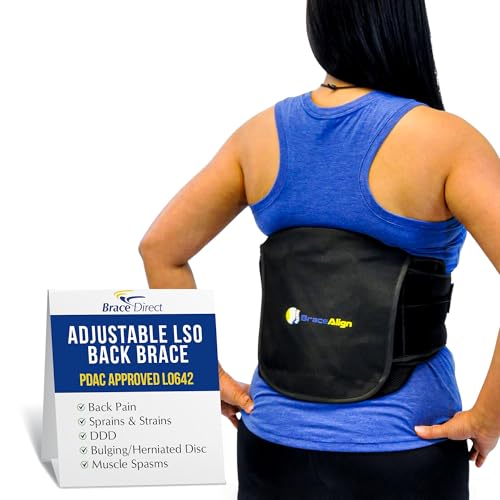
The Brace Align Adjustable LSO is a budget-friendly entry point into PDAC-certified lumbar support. It carries code L0642, which qualifies it as a lumbo-sacral orthosis for insurance purposes, though coverage depends on your plan. The pulley compression system uses easy-pull tabs to set tension, and the breathable lightweight material helps prevent heat buildup during extended wear.
This brace fits a universal waist range of 23 to 50 inches, measured at the navel, and Brace Direct provides a free video fitting session to ensure proper placement. For a fracture patient, the rigid panels offer meaningful stabilization, though they are less aggressive than the bionic plates found on premium models. Users recovering from back surgery report that the brace feels supportive and the strings reinforce the compression effectively, even for plus-size individuals.
The main trade-off is that the brace uses a hook-and-loop closure system that is less secure than lace-up or ratchet mechanisms, and the overall rigidity is moderate rather than maximum. It works best for patients with stable compression fractures who need cost-effective support without the full immobilization of a premium LSO. If your budget is tight but you still want a PDAC-coded orthosis, this is a solid starting point.
Why it’s great
- PDAC L0642 certified for insurance submission
- Universal fit covers 23–50 inch waists
- Free video fitting appointment included
Good to know
- Moderate rigidity — not for severe unstable fractures
- Hook-and-loop closure less secure than lace-up
FAQ
Can I wear a back brace for fractured vertebrae while sleeping?
How do I know if a back brace is too tight after a vertebral fracture?
Final Thoughts: The Verdict
For most users, the back brace for fractured vertebrae winner is the Comfyorthopedic LSO Back Brace because it provides hospital-grade rigidity, PDAC-approved codes for insurance, and adjustable abdominal sizing that adapts to post-surgical weight changes. If you need precise height adjustment to align the brace with your specific vertebral level, grab the TANDCF Entire ARC Back Brace. And for active recovery where weight and breathability matter most, nothing beats the BaxMAX Adjustable Back Brace.

Mo Maruf
I created WellFizz to bridge the gap between vague wellness advice and actionable solutions. My mission is simple: to decode the research and give you practical tools you can actually use.
Beyond the data, I am a passionate traveler. I believe that stepping away from the screen to explore new environments is essential for mental clarity and physical vitality.