Our readers keep the lights on and my smoothie glass nicely filled. As an Amazon Associate, I earn from qualifying purchases.
Building a home cinema that delivers true theatrical impact hinges on one component: the AV receiver. It acts as the neural hub, decoding immersive audio formats like Dolby Atmos and DTS:X while routing pristine 8K video to your display. Choosing the wrong one means muddy dialogue, weak surround imaging, and compatibility headaches that turn movie night into a troubleshooting session.
I’m Mohammad Maruf — the founder and writer behind WellFizz. I’ve spent years analyzing amplifier topologies, HDMI 2.1 chipset revisions, and room correction algorithms to separate genuine performance gains from marketing fluff in the home theater space.
This guide matches real-world listening demands to specific hardware specs, helping you find the very best av receiver for home cinema that fits your setup without overspending on unneeded channels.
How To Choose The Best AV Receiver For Home Cinema
A great AV receiver anchors your entire system. To avoid buyer’s remorse, focus on four pillars: channel count, room correction, HDMI 2.1 compliance, and amplification headroom. Each interacts directly with your speaker layout and display.
Channel Count and Speaker Layout
Channel count dictates how many speakers you can wire. A 7.2-channel receiver supports a 5.1.2 Atmos layout (five ear-level, one sub, two overhead). For a true 5.1.4 or 7.1.4 setup, you need 9.2 or 11.2 channels. Buying a 7-channel unit today means you cannot add rear height speakers later without a separate amplifier.
Room Correction Is Not Optional
Your room’s acoustics color everything you hear. Basic calibration (YPAO, basic Audyssey) helps with distance and level. Advanced systems like Dirac Live or Audyssey MultEQ XT32 apply precise filters to tame bass nodes and smooth frequency response. For dedicated home theaters, Dirac Live is the gold standard.
HDMI 2.1 and Gaming Features
If you own a PS5, Xbox Series X, or a 120Hz display, HDMI 2.1 bandwidth (40Gbps or 48Gbps) is non-negotiable. Look for VRR, ALLM, and QFT support to avoid screen tearing and input lag. All inputs should support 4K/120 or 8K/60 pass-through — not just one port.
Quick Comparison
On smaller screens, swipe sideways to see the full table.
| Model | Category | Best For | Key Spec | Amazon |
|---|---|---|---|---|
| Onkyo TX-NR7100 | Premium | Best Overall Performance | Dirac Live Bass Control | Amazon |
| Denon AVR-S970H | Mid-Range | Best Value Workhorse | 90W x 7 Channels | Amazon |
| Yamaha RX-A4A | Premium | Audiophile Clarity | Surround:AI Processing | Amazon |
| Denon AVR-S770H | Mid-Range | Entry-Level 8K Ready | 75W x 7 Channels | Amazon |
| Onkyo TX-NR6100 | Mid-Range | THX Certified Gaming Hub | THX Select Certification | Amazon |
| Yamaha RX-V6A | Mid-Range | Reliable All-Rounder | YPAO R.S.C. Calibration | Amazon |
| Pioneer VSX-935 | Mid-Range | Budget Atmos Virtualization | 7.2 Channel Configuration | Amazon |
| Sony STR-AZ1000ES | Premium | 360 Spatial Sound Mapping | 7.2 Ch / 100W Per Channel | Amazon |
| JBL MA9100HP | Premium | Shallow Chassis Design | 9.2 Channels / Class D | Amazon |
| Marantz SR8015 | High-End | Flagship 11.2 Powerhouse | 140W x 11 Channels | Amazon |
| Sony STR-AZ7000ES | High-End | Ultimate 13.2 Ch Cinema | 150W x 13 Channels | Amazon |
In‑Depth Reviews
1. Onkyo TX-NR7100 9.2-Channel AV Receiver
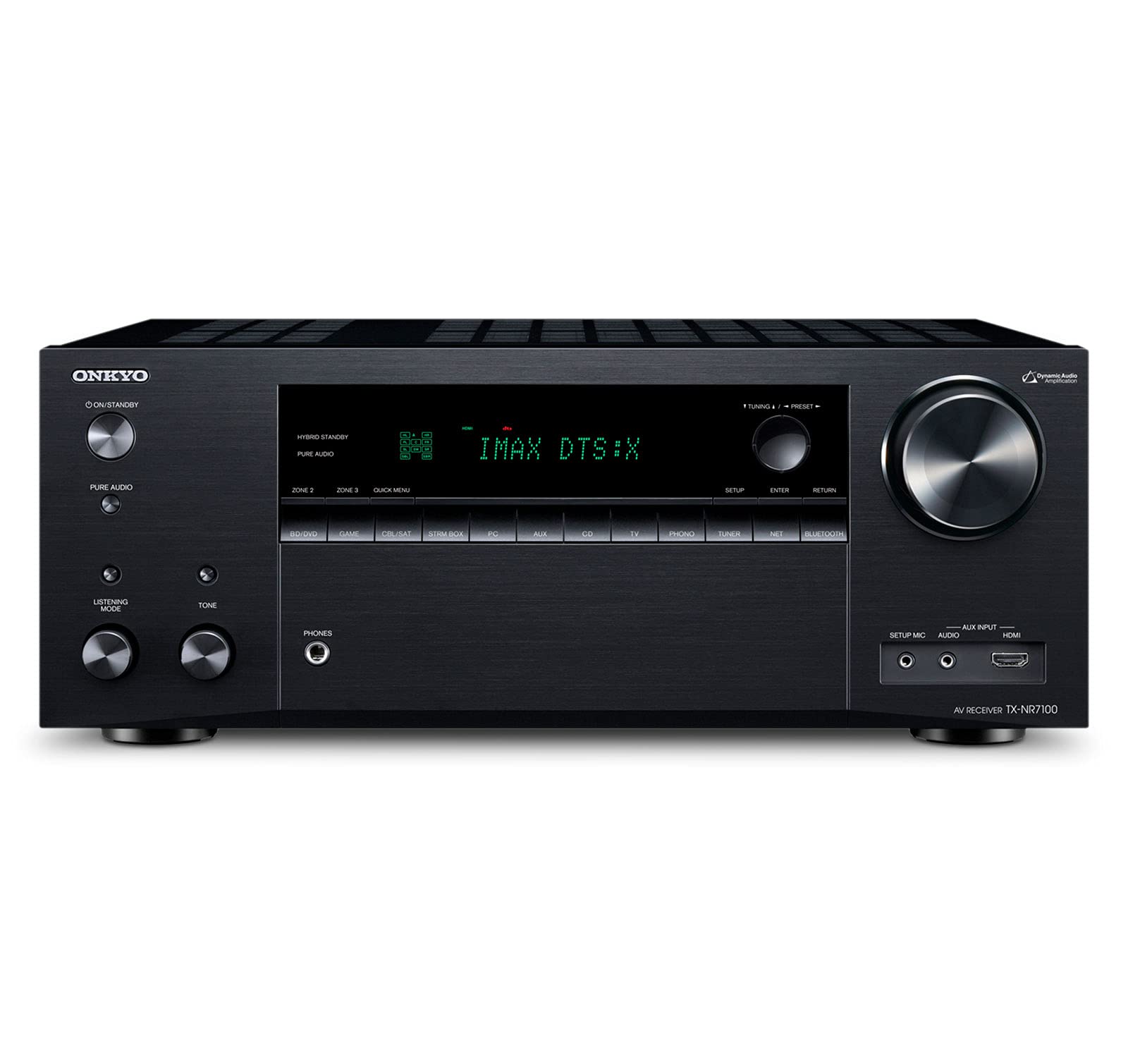
The Onkyo TX-NR7100 brings Dirac Live room correction out of the box, which is rare at this level. Dirac analyzes your room’s acoustics with 3D measurement points and applies precise filters to flatten bass response and tighten imaging. Combined with six 40Gbps HDMI 2.1 inputs, it’s a future-proof foundation for a 5.1.4 or 7.1.2 setup.
THX Select certification guarantees reference-level loudness in medium-sized rooms. The 100W per channel (8 ohms, 2ch driven) provides clean headroom for dynamic movie soundtracks. The unit also works with Sonos via a Port, making multi-room integration seamless.
Setup is more involved than basic receivers, partly due to the depth of Dirac’s calibration interface. Some users report HDMI handshake quirks with specific source devices. The remote lacks a backlight, which is annoying in a dark theater. For the Dirac integration alone, this receiver punches far above its bracket.
Why it’s great
- Full Dirac Live room correction included, no extra license fee
- Six HDMI 2.1 inputs with 40Gbps bandwidth for multi-device setups
- THX Select certification ensures reliable high-volume performance
Good to know
- Dirac setup is time-consuming and requires careful mic positioning
- Remote control is not backlit, inconvenient in dark home theaters
- Runs warm during extended use; adequate ventilation needed
2. Denon AVR-S970H 7.2-Channel AV Receiver

The Denon AVR-S970H hits a sweet spot with 90W per channel across seven channels, offering noticeably more grunt than entry-level 75W units. It supports 8K/60Hz and 4K/120Hz pass-through on three HDMI inputs, with VRR and ALLM for smooth gaming. The on-screen setup assistant guides you through speaker configuration and Audyssey calibration without needing a manual.
HEOS built-in allows wireless multi-room audio with other Denon Home speakers, supporting Spotify, TIDAL, and TuneIn directly. The phono input is a welcome inclusion for vinyl enthusiasts. eARC handles lossless Dolby TrueHD and DTS-HD Master Audio from TV apps.
Powered Zone 2 uses the surround back channels, limiting you to 5.2 in the main room when Zone 2 is active. The remote is functional but not premium-feeling. For a dedicated home theater on a budget that prioritizes clean power and modern HDMI features, the AVR-S970H delivers.
Why it’s great
- 90W per channel provides real-world headroom for dynamic peaks
- HEOS platform enables seamless multi-room streaming
- Phono input included for turntable integration
Good to know
- Powered Zone 2 uses surround back channels, limiting main zone to 5.1
- No Dirac or advanced Audyssey XT32 room correction
- FM tuner preset configuration is cumbersome via menu
3. Yamaha RX-A4A AVENTAGE 7.2-Channel AV Receiver

The Yamaha RX-A4A belongs to the AVENTAGE line, which features a rigid H-frame chassis, anti-resonance legs, and high-quality DACs for cleaner signal paths. Surround:AI analyzes audio scenes in real-time and adjusts dialogue clarity, surround effect depth, and bass impact dynamically. It’s a genuinely useful feature for movies with mixed loud and quiet passages.
All seven HDMI inputs support 8K60 and 4K120 at 40Gbps, with eARC, VRR, and ALLM. YPAO R.S.C. with multipoint and precision EQ measures at multiple positions for a more even soundstage. The unit also includes a phono input and supports Roon Tested certification for high-resolution music streaming.
Firmware updates require a USB drive — a tedious process compared to network updates found on most competitors. The setup menu is dense and not as intuitive as Denon’s assistant. Once configured, the RX-A4A rewards you with detailed, spacious sound that elevates both movies and stereo music.
Why it’s great
- Surround:AI adapts audio parameters in real-time for cinematic immersion
- Premium AVENTAGE build reduces vibration for cleaner sound
- YPAO R.S.C. provides accurate multipoint room calibration
Good to know
- Firmware update requires USB flash drive, not over-the-air
- Setup menu is complex with many sub-menus
- No front HDMI input for quick device connection
4. Denon AVR-S770H 7.2-Channel AV Receiver

The Denon AVR-S770H is the entry point for 8K-ready home theater without sacrificing essential features. Its 75W per channel drives most bookshelf and tower speakers comfortably in medium rooms. The unit supports Dolby Height Virtualization and DTS Virtual:X to create overhead effects even without ceiling speakers — a useful trick for renters or simple setups.
Three HDMI inputs support 8K/60Hz and 4K/120Hz with VRR, ALLM, and QFT for gaming. The HEOS platform enables multi-room streaming, and voice control via Alexa, Google Assistant, or Siri works reliably. Audyssey MultEQ provides basic room correction that improves tonal balance.
Some users report firmware-related glitches like random volume drops or no picture on startup, which typically require a power cycle. The remote takes time to learn due to non-intuitive button layout. For the price, the AVR-S770H offers a solid foundation with modern HDMI features and decent amplification.
Why it’s great
- 8K/60Hz and 4K/120Hz support with full HDMI 2.1 gaming features
- Dolby Height Virtualization adds overhead effects without height speakers
- HEOS multi-room streaming with Alexa voice control
Good to know
- Firmware glitches reported including random volume drops and black screen
- Only 75W per channel limits headroom with low-sensitivity speakers
- Remote control button layout is not intuitive
5. Onkyo TX-NR6100 7.2-Channel THX Certified AV Receiver
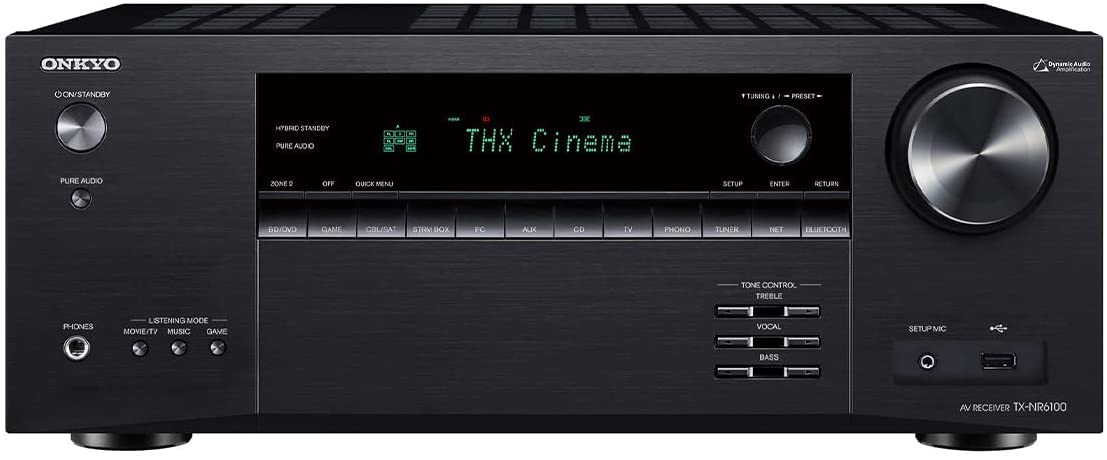
The Onkyo TX-NR6100 is THX Select certified, meaning it passed rigorous testing for distortion-free playback at reference levels in medium rooms. Its dynamic amplification system delivers 210W per channel (6 ohms, 1ch driven), providing substantial headroom for explosive action scenes. The receiver supports 5.2.2 Dolby Atmos and DTS:X setup with three HDMI 2.1 inputs at 40Gbps.
Eight HDMI inputs (including one on the front) give you ample connectivity for consoles, streamers, and Blu-ray players. The Onkyo Controller app works well for basic adjustments. Customizable sound modes per device let you optimize EQ for gaming versus movies without manual swapping.
Bi-amping front speakers uses two of the seven channels, dropping the system to 5.1 in that configuration. Some users report HDMI 2.1 processor failure after extended use, manifesting as loss of 4K/120Hz signal. The remote is not backlit. For pure gaming performance with THX certification, it’s a strong mid-range contender.
Why it’s great
- THX Select certification ensures reference-level sound quality
- Dynamic amplification provides high current for demanding speakers
- Front HDMI input simplifies temporary device connections
Good to know
- HDMI 2.1 processor failure reported in some units after extended use
- Bi-amping reduces surround channels to 5.1
- Remote lacks backlighting for dark room use
6. Yamaha RX-V6A 7.2-Channel AV Receiver

The Yamaha RX-V6A delivers proven reliability with a 7.2-channel layout and YPAO R.S.C. multipoint room correction. Three of its seven HDMI inputs support 8K60 and 4K120 at 40Gbps, including eARC, VRR, and ALLM. The MusicCast platform enables multi-room audio with other Yamaha wireless speakers and supports high-res streaming from Qobuz, TIDAL, and Amazon Music HD.
Dolby Atmos with Height Virtualization lets you experience overhead effects without installing ceiling speakers. The dual subwoofer outputs provide more balanced low-frequency distribution. The setup process takes about 20 to 25 minutes via the on-screen guide, and most users find the auto-calibration accurate enough for immediate enjoyment.
The receiver does not automatically turn on with TV via eARC in all configurations, requiring manual power-on. Some settings are buried in complex menus. For a balanced mix of modern video features, reliable amplification, and streaming versatility, the RX-V6A remains a solid choice.
Why it’s great
- Reliable Yamaha build quality with high slew rate amplification
- MusicCast multi-room supports high-res audio streaming
- Dual subwoofer outputs for smoother bass response
Good to know
- Does not auto-power on with TV via eARC in all setups
- Menu navigation can be complex for advanced settings
- Some users report HDMI handshake quirks with specific source devices
7. Pioneer VSX-935 7.2-Channel Network Receiver
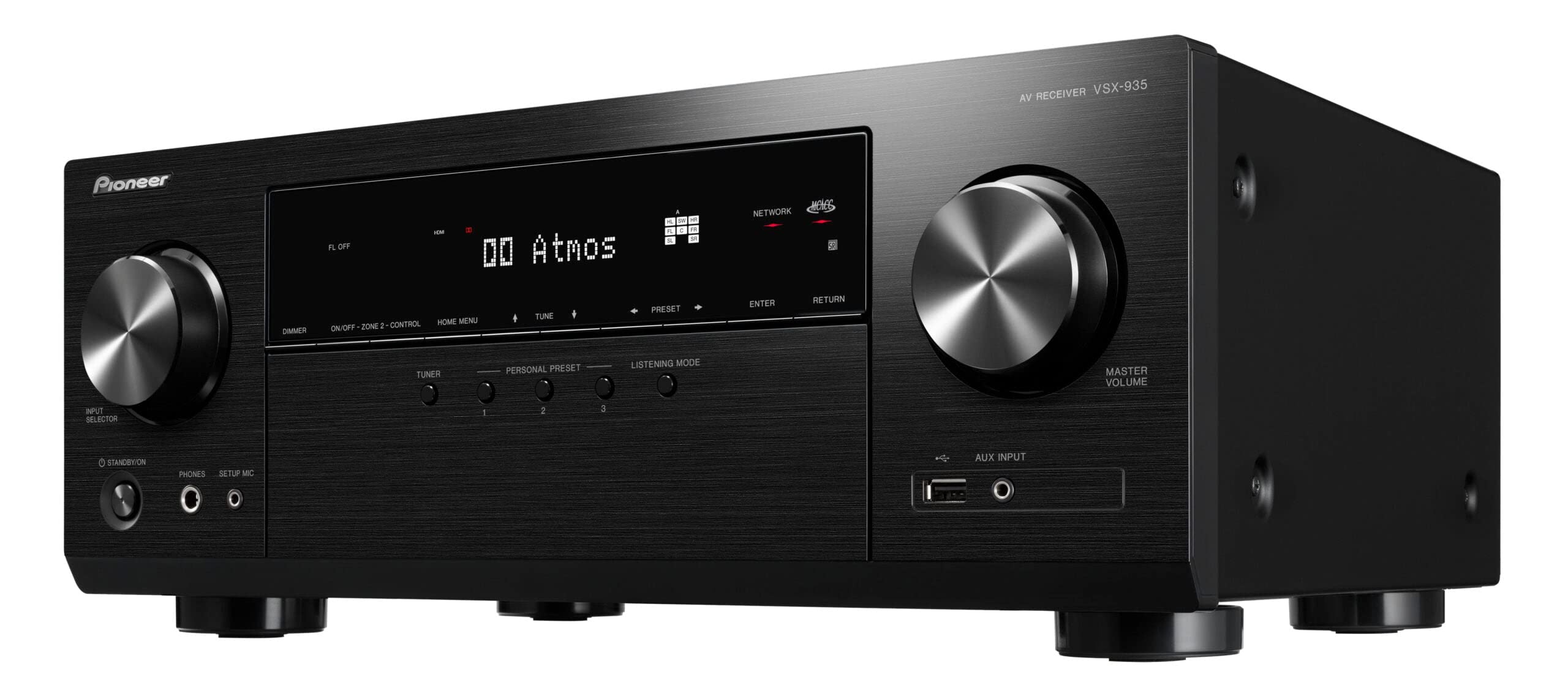
The Pioneer VSX-935 is a 7.2-channel receiver that packs Dolby Atmos Height Virtualization and HDMI 2.1 with 8K pass-through at a competitive price. Its multi-channel amplifier delivers crisp, clear sound with good dynamic range for both movies and music. The RF remote is a rare and practical feature — it does not require line-of-sight to function.
Dual-zone output allows music in another room while the main zone plays surround sound. The front display is clear and includes a dimmer for dark rooms. Chromecast built-in and AirPlay 2 provide simple streaming from mobile devices. The unit replaced older Onkyo models for several users who reported significant sound quality improvements.
Firmware updates are USB-only, which is less convenient than network updates. Some users report DOA units requiring replacement, and the firmware update process can fail with error codes. The lack of sophisticated compression or EQ controls limits advanced tuning. For budget-conscious buyers who prioritize virtual Atmos and modern connectivity, the VSX-935 works well.
Why it’s great
- RF remote works without line-of-sight, convenient for rack installations
- Dolby Atmos Height Virtualization adds immersion without extra speakers
- Dual-zone audio output independent from main surround zone
Good to know
- Firmware updates require USB drive, not over the network
- Some users received DOA units requiring immediate replacement
- Limited advanced EQ and compression controls compared to competitors
8. Sony STR-AZ1000ES 7.2-Channel ES AV Receiver

The Sony STR-AZ1000ES is part of Sony’s premium ES line, featuring 360 Spatial Sound Mapping (360SSM) that creates phantom speakers from a 5.1.2 layout, effectively simulating a much larger array. Digital Cinema Auto Calibration IX (D.C.A.C. IX) measures your room with a supplied mic and optimizes frequency response and speaker timing with high precision.
With 100W per channel (8 ohms, 2ch driven) and six HDMI 2.1 inputs, it offers robust amplification and connectivity for modern sources. The receiver supports Dolby Atmos and DTS:X natively and integrates with Sonos systems. ChromeCast built-in, Spotify Connect, and Apple AirPlay 2 enable flexible streaming options.
There is no HDR10+ support, which limits compatibility with some Samsung and Panasonic displays. The unit runs hot during extended use — an external fan is recommended. For those seeking Sony’s unique spatial audio processing in a 7.2-channel package, the STR-AZ1000ES delivers a truly immersive, expansive soundstage.
Why it’s great
- 360 Spatial Sound Mapping creates phantom channels for immersive effect
- D.C.A.C. IX auto-calibration delivers precise room correction
- Full HDMI 2.1 suite with 8K/60 and 4K/120 support
Good to know
- No HDR10+ support limits compatibility with some displays
- Runs very hot during extended use; external ventilation recommended
- Auto calibration fails if height channels are plugged into wrong ports
9. JBL MA9100HP 9.2-Channel 8K AV Receiver

The JBL MA9100HP is a 9.2-channel receiver that delivers Dolby Atmos and DTS:X decoding in 5.1.4 or 7.1.2 configurations. Its Class D amplification runs cool and efficient, a major advantage for tight media cabinets. The chassis is surprisingly shallow for a 9.2-channel unit, fitting into spaces where traditional receivers cannot.
Six HDMI 2.1 inputs (one front) support 8K/60 and 4K/120 with eARC. Network streaming includes Apple AirPlay 2 and Chromecast built-in. The aesthetic is clean and modern, with a subtle front display that blends into dark environments. Users report that it drives tower speakers like Polk ES60s with ease.
The remote is not backlit, forcing you to fumble in a dark room. Auto shut-off defaults to 20 minutes and must be changed manually. Some users report that the unit fails to mix down DTS-HD Master Audio to 2.1 for stereo setups, limiting its use with Blu-rays in two-channel configurations. For those needing a low-profile 9-channel solution, the MA9100HP is a smart pick.
Why it’s great
- Shallow chassis fits media cabinets where most receivers cannot
- Class D amplification runs cool and energy efficient
- Front HDMI input for convenient temporary device connection
Good to know
- Remote lacks backlighting, hard to use in dark rooms
- No DTS-HD Master Audio downmix to 2.1 for stereo Blu-ray listening
- Auto shut-off defaults to 20 minutes, requires manual override
10. Marantz SR8015 11.2-Channel AV Receiver

The Marantz SR8015 is a true 11.2-channel flagship delivering 140W per channel, enough power to drive a full 7.1.4 Atmos system with authority. The high-current discrete amplifier section provides exceptional transient response and dynamic headroom, making explosions and orchestral swells hit with realistic impact. Marantz’s proprietary HDAM preamp stage ensures low-distortion signal processing.
Eight HDMI inputs support 8K/60Hz and 4K/120Hz, and HEOS built-in allows multi-room streaming with voice control via Alexa, Google Assistant, and Siri. The unit includes Audyssey MultEQ XT32 for advanced room correction, along with Sub EQ HT for dual-subwoofer integration. A phono input is included for vinyl playback.
The receiver runs hot — at least 8 inches of clearance above is mandatory, and some users report 3 to 4 inches causes overheating shutdowns. The remote control feels cheap and unresponsive for a flagship product. Bi-amping lacks a high-pass crossover setting for the HF amplifier, sending full-range signal to tweeters. For uncompromising power and channel count, the SR8015 remains a reference-grade choice.
Why it’s great
- 140W per channel across 11 channels powers large, demanding speakers
- Audyssey MultEQ XT32 with Sub EQ HT optimizes dual subwoofer performance
- HEOS multi-room streaming with broad voice control support
Good to know
- Runs very hot; requires substantial clearance to avoid thermal shutdown
- Remote control is low quality and unresponsive for the price point
- Bi-amping lacks HF crossover, sending full-range signal to tweeters
11. Sony STR-AZ7000ES 13.2-Channel ES AV Receiver

The Sony STR-AZ7000ES is the flagship 13.2-channel receiver in Sony’s ES lineup, pushing 150W per channel. It supports the most ambitious speaker layouts, including 7.1.6 or 9.1.4, with 360 Spatial Sound Mapping that fills missing positions with synthesized phantom channels. D.C.A.C. IX room calibration provides precise equalization and speaker distance correction.
Seven HDMI 2.1 inputs handle 8K/60 and 4K/120 signals with full gaming support. The unit works with Sonos systems, Chromecast built-in, Spotify Connect, and Apple AirPlay 2. The replaceable power cord and IP control integration make it ideal for custom installations. Users report that a 5.1.2 setup with 360SSM sounds convincingly like a 7.1.4 system.
Like its smaller sibling, it lacks HDR10+ support. Heavy thermal output under load necessitates active cooling in enclosed racks. The setup requires careful placement of height channel connections to avoid auto-calibration failures. For those building a reference-grade theater with maximum channel count and Sony’s spatial audio processing, the STR-AZ7000ES is the pinnacle.
Why it’s great
- 13.2 channels support 7.1.6 or 9.1.4 immersive layouts
- 360 Spatial Sound Mapping synthesizes phantom channels for massive soundstage
- 150W per channel provides exceptional dynamic headroom
Good to know
- No HDR10+ support limits compatibility with some displays
- Generates significant heat; active cooling recommended
- Auto-calibration fails if height channels are plugged into surround ports
FAQ
What is the difference between 7.2 and 9.2 channels for home theater?
Is Dirac Live worth the extra cost over YPAO or basic Audyssey?
Do I need a receiver with HDMI 2.1 if I only watch movies at 4K/60?
Can I use a 9.2-channel receiver with only five speakers?
Final Thoughts: The Verdict
For most users, the best av receiver for home cinema winner is the Onkyo TX-NR7100 because Dirac Live room correction transforms untreated rooms, and its six HDMI 2.1 inputs keep your entire system connected without compromise. If you want a balanced blend of clean power and multi-room streaming, grab the Denon AVR-S970H. And for a massive 11-channel flagship experience with audiophile-grade amplification, nothing beats the Marantz SR8015.

Mo Maruf
I created WellFizz to bridge the gap between vague wellness advice and actionable solutions. My mission is simple: to decode the research and give you practical tools you can actually use.
Beyond the data, I am a passionate traveler. I believe that stepping away from the screen to explore new environments is essential for mental clarity and physical vitality.