Our readers keep the lights on and my smoothie glass nicely filled. As an Amazon Associate, I earn from qualifying purchases.
A balance board that feels like a toy can wreck your rehab progress, destabilize your standing desk flow, or just gather dust in a corner. The real challenge is finding the right board—one with the correct tilt angle, weight capacity, and surface texture to match your specific goal, whether it’s post-injury therapy, core conditioning, or staying active at a workstation.
I’m Mohammad Maruf — the founder and writer behind WellFizz. I’ve spent years analyzing biomechanics data, customer durability reports, and material science specs to separate boards built for serious training from those that are just decorated plywood.
After cross-referencing hundreds of verified customer experiences across weight limits, deck textures, and base geometries, I’ve narrowed the field to the seven most reliable contenders. This is the definitive guide to finding the best balance board for your body and your routine.
How To Choose The Best Balance Board
Before you buy, match the board’s mechanical design to your primary use case. A one-size-fits-all approach often leads to frustration or injury. Focus on these three critical factors.
Base Geometry and Movement Freedom
The shape of the base determines whether a board rocks in a single plane (forward/backward), tilts in multiple directions, or spins 360 degrees. Rocker boards confine movement to one axis—ideal for ankle rehab and targeted muscle work. Wobble or 360-degree boards challenge every stabilizer in your hips and core simultaneously, which is excellent for overall athleticism but can be dangerous if you have a fresh ligament injury. Never choose a 360-degree board for acute rehab without a therapist’s approval.
Deck Width, Grip, and Foot Comfort
Boards narrower than 16 inches often cause foot fatigue for men with size 12 or larger feet. The surface material matters just as much: high-traction grip tape works with shoes but can be abrasive on bare feet. Cork tops offer a softer, sweat-resistant grip that feels better during long standing desk sessions, but they wear faster than rubber or textured wood. If you have wide feet or plan to use the board barefoot, prioritize an 18-inch or wider deck with a smooth but grippy finish.
Weight Limit and Material Density
Budget boards made from thin plywood or particle board may crack under repeated stress above 250 pounds. Premium boards use Baltic birch, American maple, or Lauan hardwood with cross-laminated plies that resist splitting. Always check the manufacturer’s maximum weight rating and add a 20 percent safety margin. A board rated for 350 pounds will feel significantly more rigid and last years longer when used by a 200-pound person than a board rated right at the limit.
Quick Comparison
On smaller screens, swipe sideways to see the full table.
| Model | Category | Best For | Key Spec | Amazon |
|---|---|---|---|---|
| StrongTek Professional | Wobble | 360-degree core training | 350 lb limit, Lauan hardwood | Amazon |
| Fitterfirst Professional 16” | Wobble | Adjustable beginner therapy | 300 lb limit, wood | Amazon |
| Fitterfirst Rocker 20” | Rocker | Ankle/leg rehab | 350 lb limit, Baltic birch | Amazon |
| Whirly Board Spinner | Spinner | Sport agility training | 400 lb limit, Canadian maple | Amazon |
| FluidStance Plane | Wobble | Standing desk micro-movement | 200 lb limit, recycled rubber | Amazon |
| GIBBON SlackBoard | Slackline | Core, skate/surf cross-train | 400 lb limit, American maple | Amazon |
| Original Indo Board | Roller | Advanced balance/surf training | 350 lb limit, maple/bamboo | Amazon |
In‑Depth Reviews
1. StrongTek Professional Wooden Balance Board

The StrongTek uses a crossed hardwood base that unlocks 360-degree rotation and multi-directional tilting, pushing your core stabilizers harder than a standard square wobble board. At 17.5 by 13.5 inches, the deck is spacious enough for shoulder-width stance exercises like squats and lunges. The Lauan plywood construction supports up to 350 pounds, and customer reports confirm the board feels solid and free of flex at that limit after months of daily use.
The non-slip surface retains grip even during sweaty sessions, and the bottom pads protect your floor from scratches. Several reviewers with size 13 feet confirm comfortable placement, which is rare for boards under 15 inches wide. Advanced users will appreciate the challenge curve—this board rewards progress with deeper, more controlled 360-degree rock sequences that traditional rocker boards cannot simulate.
For post-injury work, the multidirectional instability forces your ankles, knees, and hips to react in all planes, making it an ideal tool for rebuilding proprioception after a strain or fracture. The only recurring complaint is that the four corner pads arrive with adhesive backing that can lose grip over time, though a small dab of super glue eliminates the issue permanently.
Why it’s great
- Cross-shaped base provides true 360-degree instability for advanced core work
- Spacious deck fits large feet and shoulder-width stances comfortably
- Sturdy Lauan plywood supports heavy users without creaking or warping
Good to know
- Corner pad adhesive tends to fail after a few weeks
- Not ideal for narrow rocking plane rehab that requires isolated movement
2. Fitterfirst Professional Balance Board 16”

The 16-inch Fitterfirst is the same model used in physical therapy clinics for ankle and knee rehabilitation. Its adjustable difficulty system lets you increase the tilt angle as your strength returns, so beginners start with a shallow, forgiving rock and progress to a steep, demanding balance challenge. The solid wood construction feels premium, and the rounded base offers a smooth, predictable wobble that won’t throw you sideways unexpectedly.
Reviewers recovering from ankle surgery and Achilles tendon repairs consistently report that this board allowed them to regain controlled range of motion within weeks. The surface works best with grip socks or athletic shoes—bare feet may find the texture too slick for aggressive training. At 16 inches wide, the board accommodates average to slightly larger feet, but users above size 12 may wish for the 20-inch version.
Physically, this board sits low to the ground, making falls less punishing than roller-style trainer boards. It’s also compact enough to slide under a couch or bed. The natural wood finish looks clean in a home gym setting, but keep in mind that the board lacks a non-slip top coating, so moisture from your feet during long sessions can reduce grip over time.
Why it’s great
- Adjustable difficulty settings allow progressive rehab loading
- Low profile reduces fall risk during recovery training
- Physical therapy standard—trusted by clinics nationwide
Good to know
- Surface is too smooth for secure barefoot training
- Limited to wobble-only movement; no forward-back rocker plane
3. Fitterfirst Professional Rocker Board 20”

This is a dedicated rocker board, not a general-purpose wobble board. The Fitterfirst 20-inch model restricts movement to a single forward-backward plane, which makes it uniquely suited for rehabbing ankle fractures, knee ligament repairs, and hip instability. The board comes with three adjustable spheres that change the pivot height—10, 12, and 15 degrees—letting you start with a minimal rock and increase the challenge only when your joint can handle it.
The deck is cut from Baltic birch plywood, a dense, void-free material that resists splitting and maintains its shape under repeated high-impact loading. At 20 inches square, the platform provides a very stable stance even for large frames. Several reviewers in their 70s and 80s report using this board safely for balance maintenance, which speaks to its forgiving rocker geometry and secure non-skid surface.
It’s heavier than most alternatives at 7.5 pounds, but that weight translates into a grounded feel—the board will not slide or tip during aggressive rocking. The non-skid tape provides excellent traction with shoes or bare feet. For any buyer whose primary goal is single-plane rehabilitation or senior balance training, this is the safest and most durable rocker board available.
Why it’s great
- Adjustable pivot spheres allow precise control of tilt angle for safe rehab
- Baltic birch construction is exceptionally dense and crack-resistant
- Wide 20-inch deck provides a forgiving, stable stance for seniors
Good to know
- Single-plane movement limits core cross-training versatility
- Heavy build is less portable for gym bag storage
4. Whirly Board Spinning Balance Board
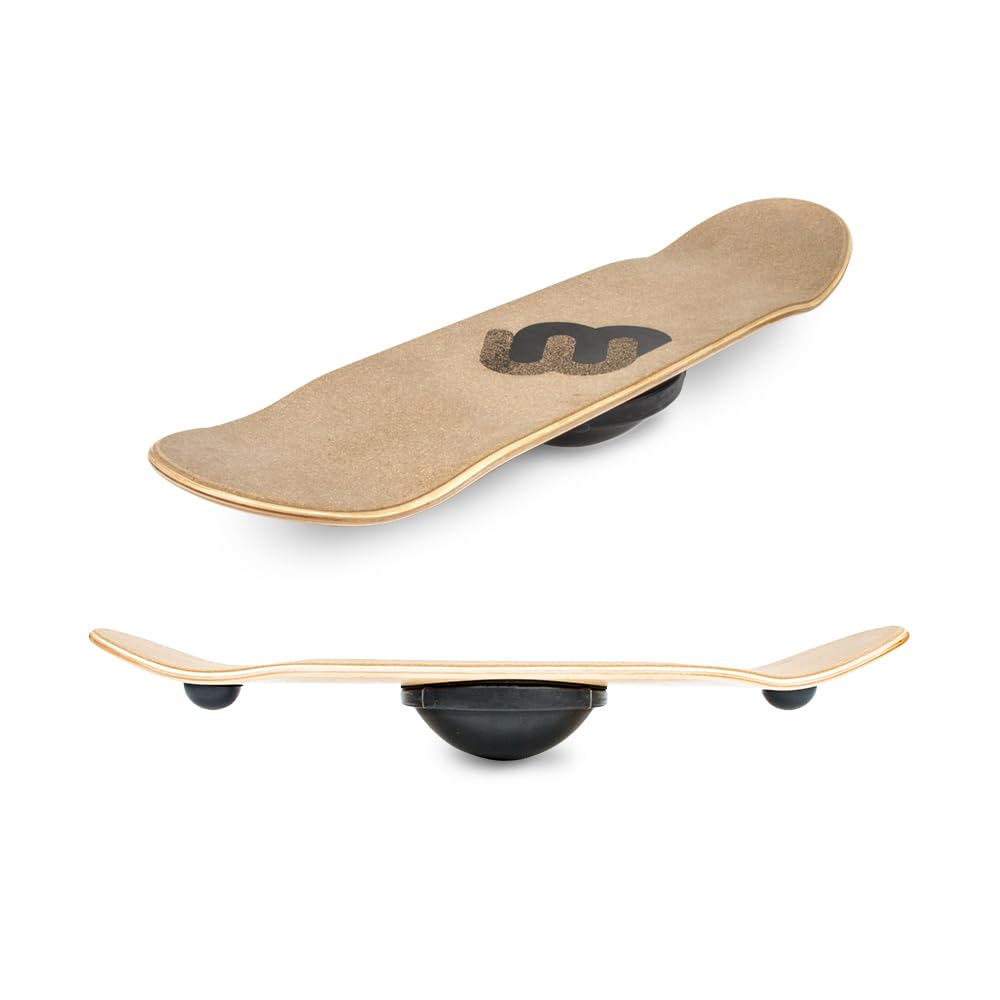
The Whirly Board is a 360-degree spinner built for sport-specific agility rather than static balance holds. It combines a 7-ply Canadian maple base with a unique cork/rubber grip top that provides comfortable, non-slip barefoot contact without the abrasiveness of skate-style grip tape. The spinning action mimics the lateral and rotational movements required in hockey, pickleball, tennis, and surfing, making it a favorite among multi-sport athletes.
With a 400-pound weight limit and a lifetime replacement promise from its Wisconsin-based manufacturer, this board is built to endure aggressive daily use. The cork top does have downsides: users with size 15 feet report that the raised edge creates painful pressure points after 20 minutes, and softer cork can feel uncomfortable underfoot during long barefoot standing desk sessions. Whirly Board offers a wider version for desk users that eliminates the edge issue.
For family fitness, the spinning board turns balance training into a game that kids genuinely enjoy. Parents of children with ADHD report that the Whirly Board channels restless energy into focused movement practice. Just be aware that the cork surface will show wear faster than hardwood, and the board requires a smooth, non-carpeted surface to spin freely.
Why it’s great
- True 360-degree spinning trains rapid directional changes for sport agility
- Cork grip is comfortable and sweat-resistant for barefoot use
- Lifetime replacement promise from a domestic manufacturer
Good to know
- Raised edge causes discomfort for very large feet (size 14+)
- Not designed for stationary desk use out of the box—wide version recommended
5. FluidStance Plane Balance Board
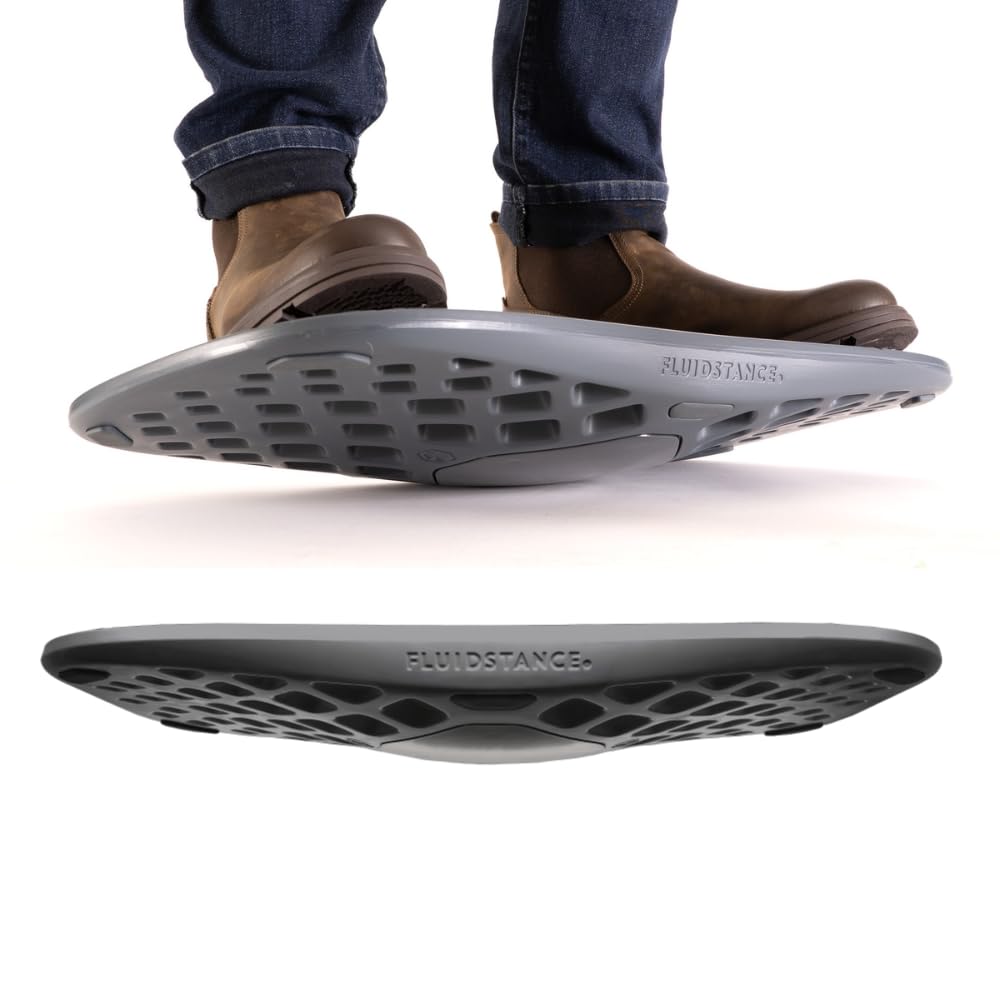
The FluidStance Plane is engineered specifically for the standing desk environment, not for aggressive training. Its recycled rubber top deck and recycled plastic base create a quiet, low-profile platform that encourages micro-movements—weight shifting, subtle rocking, and calf raises—without disrupting your typing flow. At 24.25 by 12.25 inches, the board is long enough to allow forward-backward sway but narrow enough to fit under most standing desks without bumping the frame.
The limited 200-pound weight maximum is the lowest among all boards in this guide, reflecting its design focus on lighter work-from-home users rather than heavy lifters. The rubber bumpers on each side provide natural stopping points, preventing the board from tipping too far and causing a fall. Users report that the board increases their standing time from one hour to four or five hours per day by reducing lower back and hip stiffness.
Made in California from sustainable materials, the Plane comes with a 30-day money-back guarantee. The main trade-off is that the board is deliberately low-challenge—it will not replace a wobble board for serious core training. It excels at what it’s designed for: keeping your body moving during a workday without demanding intense concentration.
Why it’s great
- Quiet, low-profile design integrates seamlessly into a standing desk workflow
- Rubber bumpers prevent dangerous over-tilting during micro-movements
- Sustainable materials and US-based manufacturing
Good to know
- Low 200-pound weight limit excludes many larger users
- Too gentle for anyone seeking a challenging core workout
6. GIBBON SlackBoard GiBoard

The GIBBON SlackBoard reimagines the balance board by attaching a low-profile slackline system to a maple wood platform. Instead of a fixed base, you stand on a board suspended by two lines, creating an unstable yet forgiving surface that mimics the feel of a slackline without the height risk. At 42 inches long, the deck provides ample space for wide stance exercises and foot placement adjustments.
The board comes ready to use with two lines for beginners, and you can remove one line as your balance improves for a more challenging single-line configuration. Made from sustainably sourced American maple, the construction is robust and visually striking—several reviewers call it a piece of furniture. The included free app provides guided workouts and tracking, which is rare for balance boards in this price range.
This is not a traditional rocker or wobble board. The slackline suspension creates a unique training stimulus that targets the deep stabilizers in your ankles, knees, and hips differently than any fixed-base board. It’s especially effective for surfers, skateboarders, and snowboarders looking to refine edge control. The learning curve is steeper than a wobble board, so beginners should expect a few days of wobbly frustration before finding their footing.
Why it’s great
- Unique slackline suspension trains stabilizers that fixed-base boards cannot reach
- Long 42-inch deck accommodates dynamic foot placement for sport training
- Sustainable American maple construction is furniture-grade quality
Good to know
- Steep learning curve can be frustrating for absolute beginners
- Requires more floor space than a compact wobble board
7. The Original Indo Board
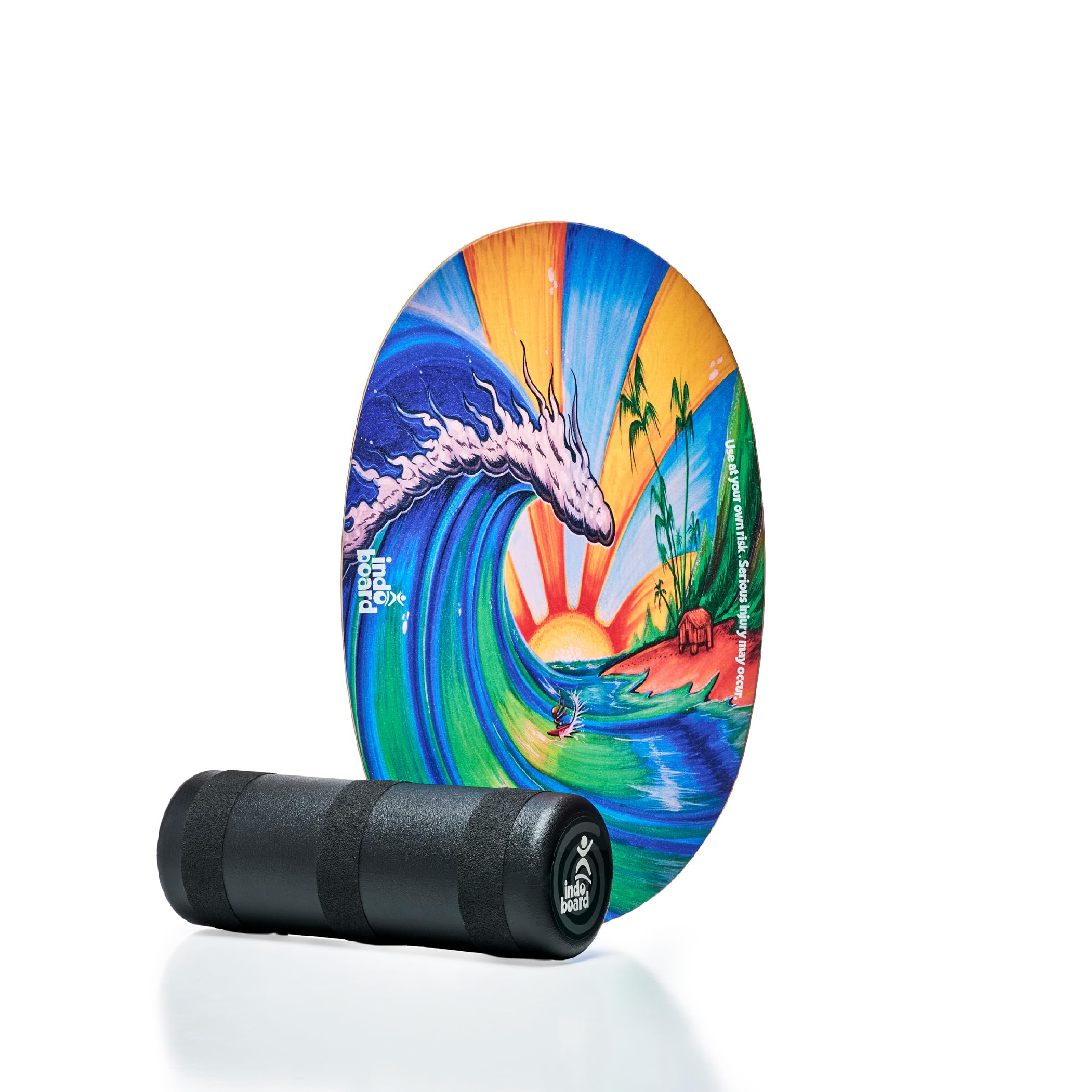
The Indo Board is the original roller-style balance platform that started the modern balance training movement nearly 30 years ago. It consists of a wide 30-inch maple deck and a separate cylindrical roller. Unlike wobble boards that offer a gentle incline, the roller creates a high, unstable pivot point that forces you to constantly adjust your weight distribution across all planes—this is why it’s the gold standard for surf training and elite athletic conditioning.
Endorsed by Olympic and world champions, the Indo Board demands serious attention and control. The large roller sits higher off the ground than a half-ball base, meaning falls can be more jarring, especially on hard floors. Because of this, the manufacturer recommends using a carpeted area or the optional Flo-Cushion accessory, which replaces the roller with a more forgiving air-filled cushion for safer 360-degree training.
The deck features a gritty traction surface that works well barefoot, though it can feel rough on sensitive skin during longer sessions. At 13.8 pounds, it’s the heaviest board in this lineup, but that solidity gives it a premium, indestructible feel. For advanced athletes who need maximum instability to build competition-ready balance and reflexes, the Indo Board is unmatched—just be prepared for a steep challenge and a dedicated storage spot.
Why it’s great
- Roller design provides the most demanding instability for elite athletic training
- Trusted by Olympic champions for surf, skate, and snowboard conditioning
- Nearly indestructible maple construction backed by decades of development
Good to know
- High roller profile increases fall risk for beginners and fragile joints
- Heavy and bulky—not practical for frequent transport or travel
FAQ
Can I use a balance board on a carpeted floor?
How do I know if I need a rocker board or a wobble board for ankle rehab?
Final Thoughts: The Verdict
For most users, the best balance board winner is the StrongTek Professional because it combines 360-degree instability with a spacious deck and a 350-pound weight limit at a mid-range entry point. If you need a rocker board for safe ankle or knee rehab, grab the Fitterfirst Rocker 20” for its adjustable pivot spheres and dense Baltic birch build. And for dedicated standing desk users who prioritize ergonomic micro-movement over challenging workouts, nothing beats the FluidStance Plane for its quiet, low-profile design.

Mo Maruf
I created WellFizz to bridge the gap between vague wellness advice and actionable solutions. My mission is simple: to decode the research and give you practical tools you can actually use.
Beyond the data, I am a passionate traveler. I believe that stepping away from the screen to explore new environments is essential for mental clarity and physical vitality.