Our readers keep the lights on and my smoothie glass nicely filled. As an Amazon Associate, I earn from qualifying purchases.
Reverb and echo turn a home theater into a hollow cavern and make conference calls unintelligible. Acoustic ceiling tiles catch those stray sound waves, absorbing them before they bounce back into the room. Unlike foam stuck to walls, ceiling tiles solve the overhead reflection problem — the one that kills clarity in open rooms, recording booths, and gaming dens.
I’m Mohammad Maruf — the founder and writer behind WellFizz. I spend my time in the weeds of acoustic material specs, NRC ratings, and density figures to separate real sound absorption from marketing vaporware.
Whether you are taming a home studio echo or quieting an open-plan office, knowing which material, density, and NRC rating actually works makes all the difference. This guide breaks down the best acoustic ceiling tiles for every real-world application, so you can stop guessing and start absorbing.
How To Choose The Best Acoustic Ceiling Tiles
Ceiling absorption is a physics game — you are trapping mid-to-high frequency sound before it reflects down. The wrong tile on the ceiling leaves reverb untouched, no matter how many wall panels you add.
NRC Rating — The Number That Matters
NRC (Noise Reduction Coefficient) is a decimal between 0 and 1. A tile rated 0.90 absorbs 90% of the sound that hits it. For ceiling installations, look for NRC 0.85 or higher. Below that, you are mostly decorating, not treating.
Material Density and Thickness
Polyester fiber tiles at 9–14 lb/ft³ density absorb far more energy than open-cell polyurethane foam. Thicknesses of 0.5 inches work for mid-high frequencies; 1-inch wedges extend absorption lower. For a ceiling, 0.4–0.5 inches is the sweet spot for most rooms.
Self-Adhesive vs. Spray Mount
Self-adhesive backing saves hours on ladder work. Spray adhesive or construction adhesive offers a stronger, more permanent bond. If your ceiling is textured or painted with flat latex, adhesive-backed tiles stick reliably — but test one corner first.
Quick Comparison
On smaller screens, swipe sideways to see the full table.
| Model | Category | Best For | Key Spec | Amazon |
|---|---|---|---|---|
| BXI Thickened Sound Panels | Polyester Fiber | Balanced echo control & density | NRC 0.91 / 9.4 lb/ft³ | Amazon |
| Soundsbay Self-Adhesive Panels | Polyester Fiber | Quick peel-and-stick ceiling install | NRC 0.92 / 0.4″ thick | Amazon |
| Sonicism Flat Panels | Polyester Fiber | High density for demanding spaces | 250 kg/m³ density | Amazon |
| Honeycomb Hexagon Panels | Polyester Fiber | Decorative visual + absorption | NRC >0.95 / 14.36 lb/ft³ | Amazon |
| Saiqiang 56-Pack Wedge Panels | Polyurethane Foam | Large coverage on a budget | 1″ wedge / 56 sq.ft | Amazon |
In‑Depth Reviews
1. BXI Thickened Sound Absorbing Panels – 12 Pack
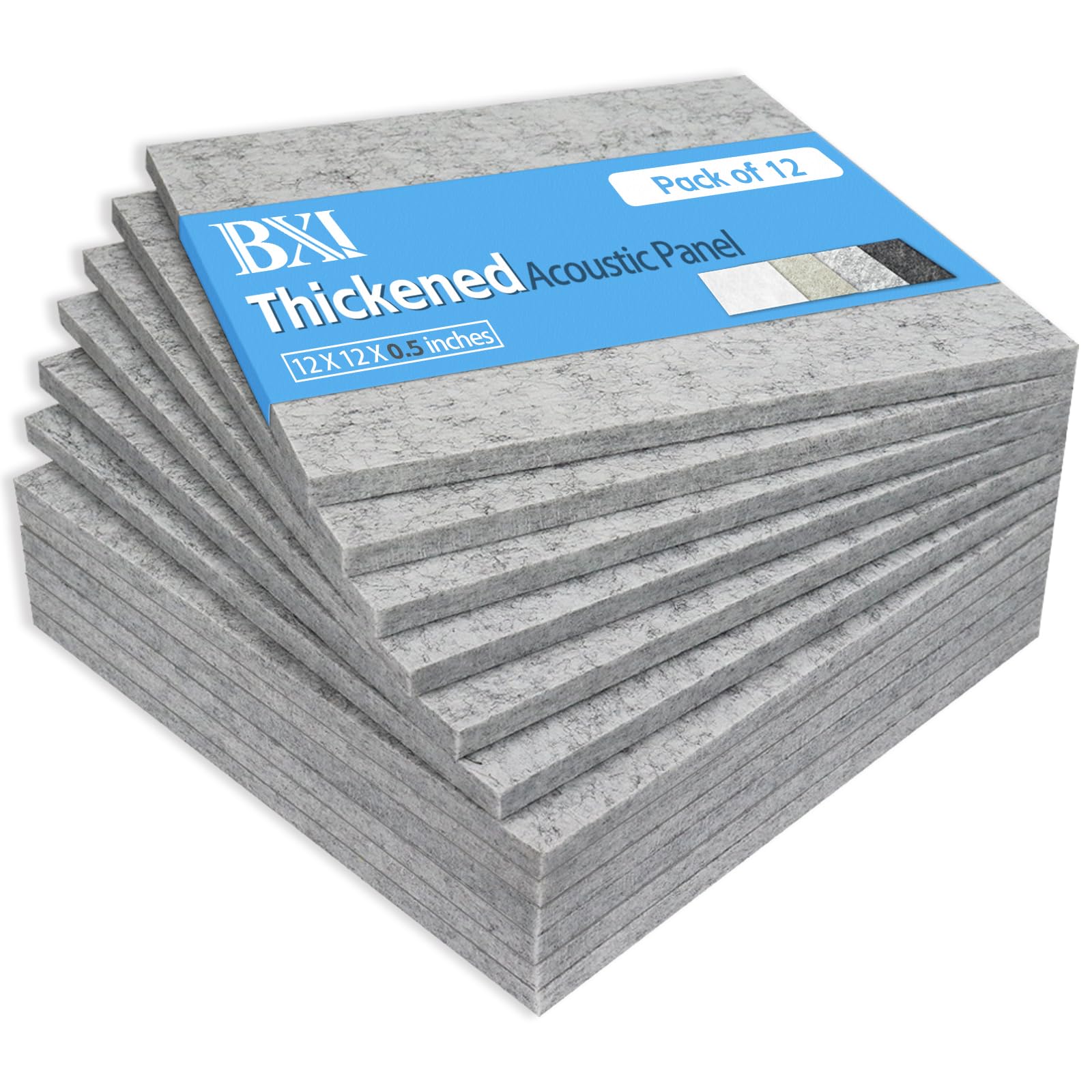
The BXI panels hit the acoustic ceiling tile sweet spot: 0.5 inches thick with a dense 9.4 lb/ft³ polyester fiber core that delivers a verified NRC of 0.91. That means 91% of the sound energy hitting these tiles gets absorbed rather than reflected back into the room. Each panel weighs just 0.36 pounds, so ceiling adhesive or double-sided tape holds them securely without sagging over time.
Users report measurable reductions in mid-high frequency echo from noisy downstairs neighbors and loud appliances. The panels are Class B1 flame retardant and formaldehyde-free, making them safe for indoor ceiling installations in bedrooms, home theaters, and office spaces. The 12-pack covers roughly 11.6 square feet, which is enough to treat a small ceiling zone or one wall entirely.
Installation requires 3M spray adhesive or VHB tape (sold separately) — there is no peel-and-stick backing. The silver gray color is subtle and blends well with most white or gray ceilings, though it may not match bright white ceiling paint exactly. For a dense, high-NRC tile that handles real echo problems, this is the most balanced choice on the list.
Why it’s great
- NRC 0.91 with dense 9.4 lb/ft³ polyester fiber blocks mid-high frequency echo effectively.
- Class B1 flame retardant and formaldehyde-free for safe indoor use.
- Lightweight at 0.36 lbs per panel — easy to mount on ceilings without heavy hardware.
Good to know
- No self-adhesive backing — you must buy spray adhesive or double-sided tape separately.
- 0.5-inch thickness is effective for mid-high frequencies but won’t tame deep bass rumble.
- Silver gray color may not match pure white ceiling paint exactly.
2. Soundsbay Self-Adhesive Acoustic Panels – 12 Pack

The Soundsbay panels solve the biggest pain point of ceiling installation — no adhesive spray, no tape, no mess. Each 12×12 inch panel comes with a robust self-adhesive backing that peels and sticks directly to drywall or painted ceilings. The 150 kg/m³ high-density polyester fiber delivers an NRC of 0.92, matching the top-tier absorption of the BXI panels but in a slimmer 0.4-inch profile.
The vertical-stripe design is minimalist and clean, which matters when these tiles cover a large portion of your ceiling. Users in classrooms and bedrooms report significant echo reduction, with speech becoming more muffled and less intelligible from adjacent rooms. The 12-pack covers 11.6 square feet, and the adhesive holds well on smooth surfaces with no reported sagging after months of use.
Some batches had adhesive issues where the protective paper was difficult to peel, and adhesive strength on textured ceilings may be less reliable. The 0.4-inch thickness is slightly thinner than the BXI, so deep low-frequency absorption is limited. For a no-tools ceiling job that still delivers real echo control, this is the most convenient option.
Why it’s great
- Built-in peel-and-stick adhesive — zero tools or separate glue needed for ceiling installation.
- NRC 0.92 from 150 kg/m³ high-density polyester fiber rivals thicker panels.
- Minimalist vertical-stripe design blends cleanly with modern ceiling aesthetics.
Good to know
- 0.4-inch thickness offers less low-frequency absorption than 0.5-inch or 1-inch panels.
- Adhesive quality varies between batches — some panels had peeling paper issues.
- Not ideal for heavily textured or popcorn ceilings without additional adhesive.
3. Sonicism Self-Adhesive Acoustic Panels – 12 Pack

At 250 kg/m³, the Sonicism panels pack the highest density in this lineup — significantly denser than the BXI at 150 kg/m³ and the honeycomb panels at 230 kg/m³. That density translates to better absorption across a wider frequency range, especially the mid frequencies where speech clarity matters most. The 0.4-inch flat panels have a felt-like finish that feels more substantial than typical acoustic foam.
The 12-pack covers exactly 12 square feet, and the black color option blends well with darker room themes or home theater environments. Echo reduction is noticeable, with standing waves and reverberation time decreasing in treated rooms.
Cutting these dense panels to fit irregular ceiling spaces is more difficult than cutting standard foam. Utility scissors produce rough edges, and an electric knife is recommended for clean cuts. The felt-like surface collects dust more visibly than smooth panels. For high-traffic sound spaces like home theaters or conference rooms where density matters most, this is the top performer.
Why it’s great
- 250 kg/m³ density is the highest in this comparison — superior mid-frequency absorption.
- Self-adhesive backing holds securely for over a year on vertical and ceiling surfaces.
- Felt-like finish feels premium and adds a modern designer aesthetic to treated rooms.
Good to know
- Dense material is difficult to cut cleanly — an electric knife is almost required for precise fitting.
- Felt surface collects dust and may require occasional cleaning in high-traffic areas.
- Only available in black; no white or gray options for light-colored ceilings.
4. Honeycomb Hexagon Acoustic Panels – 12 Pack
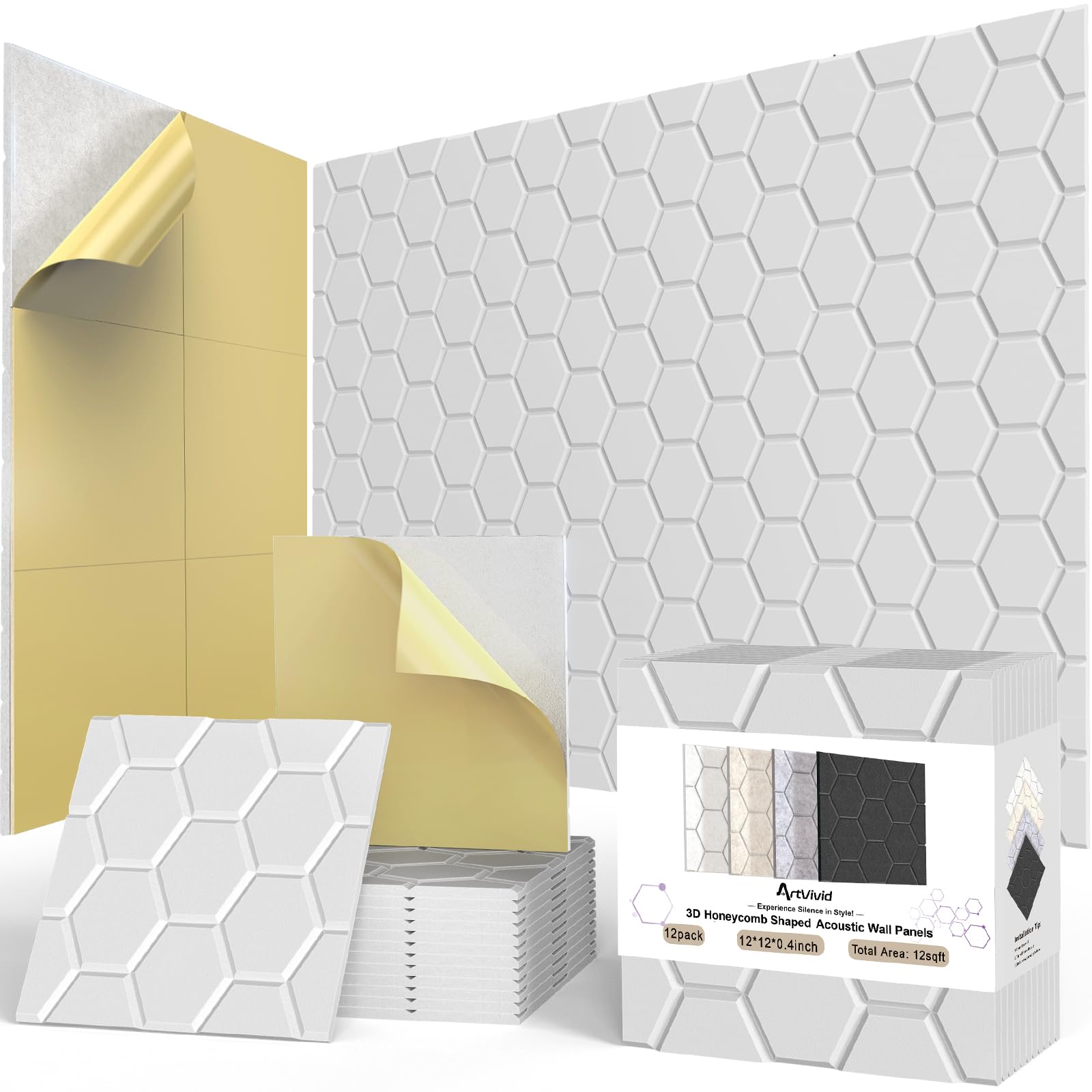
The honeycomb hexagon design from this brand breaks the monotony of square tiles while delivering the highest claimed NRC in this group — over 0.95. The 14.36 lb/ft³ polyester fiber density is second only to the Sonicism panels, meaning these tiles absorb aggressively. The 3D groove cutting technique creates a textured surface that scatters remaining reflections, reducing flutter echo even more effectively than flat panels.
Self-adhesive backing eliminates the need for spray glue, and each 12×12 inch hexagon panel weighs very little despite its density. Users in 15×15 foot rooms used 11 packs to kill echo entirely, revealing fine audio details in their sound systems. The panels come in four colors — black, grey, white, and camel — making it easy to match ceiling paint or create intentional contrast patterns.
Cutting hexagons to fit around ceiling fixtures or irregular corners is more challenging than straight-edged squares. The pattern creates some waste when covering a rectangular ceiling grid — you’ll need to buy extra packs to account for lost coverage around edges. The adhesive is strong enough for smooth ceilings, but liquid nails is recommended for extra hold on textured surfaces.
Why it’s great
- NRC >0.95 is the highest claimed absorption rating in this comparison.
- 14.36 lb/ft³ dense polyester fiber with 3D groove texture scatters residual reflections.
- Four color options (black, grey, white, camel) offer real design flexibility for ceiling aesthetics.
Good to know
- Hexagon shape creates cutting waste around edges — you will need more panels than square tiles for full coverage.
- Cutting hexagons to fit fixtures requires careful measurement and a sharp blade.
- Adhesive alone may not hold on heavily textured ceilings; additional construction adhesive recommended.
5. Saiqiang 56-Pack Acoustic Wedge Panels – 1x12x12 Inches
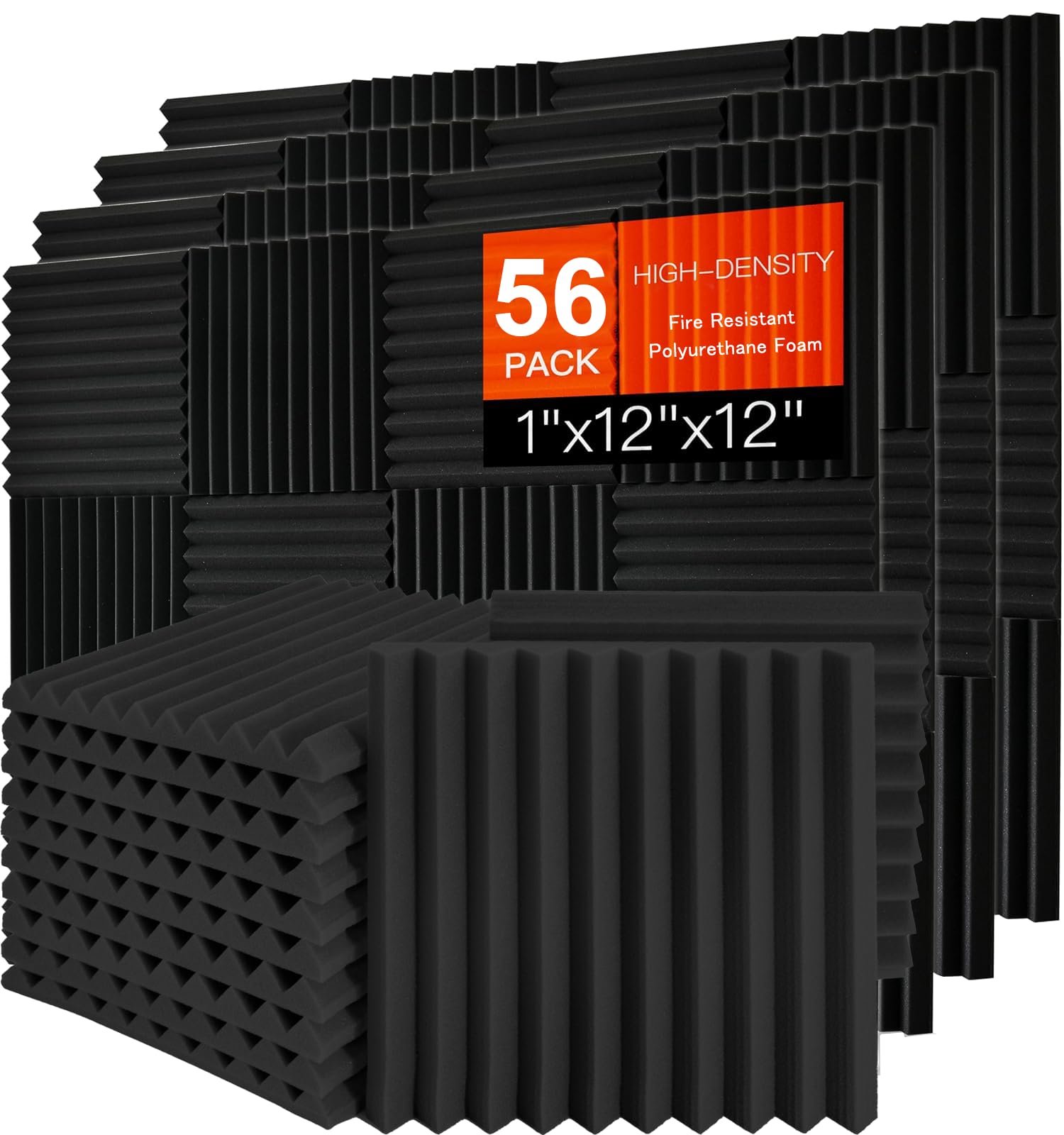
The Saiqiang 56-pack is the value king for large-area ceiling coverage — 56 square feet of 1-inch thick wedge foam for significantly less cost per square foot than any polyester fiber option. The polyurethane foam construction is lightweight and easy to cut with a utility knife, making it the most forgiving material for DIY ceiling installations around light fixtures and vents.
The 1-inch wedge profile absorbs more low-mid frequency energy than 0.4-inch or 0.5-inch flat panels, which is useful for larger rooms where deeper reflections accumulate. Users report noticeable noise reduction from AC returns and improved call clarity in remote work setups. The panels are vacuum-packed and require 24-48 hours to fully expand to their 1-inch thickness before installation.
The included double-sided adhesive dots are weak and unreliable — multiple users recommend buying a separate roll of quality double-sided tape or construction adhesive. The foam has a slight chemical odor initially that dissipates over a few days. Polyurethane foam is less dense than polyester fiber, so the NRC is lower per inch of thickness, and the material is less tackable for pinning documents or artwork.
Why it’s great
- 56 square feet of coverage in one pack offers the lowest cost-per-square-foot for large ceiling areas.
- 1-inch wedge profile absorbs lower frequencies than thinner 0.4-inch flat panels.
- Lightweight polyurethane foam is easy to cut with a utility knife for custom fits.
Good to know
- Included adhesive dots are weak — plan to buy quality double-sided tape or spray adhesive separately.
- Polyurethane foam has a lower density than polyester fiber; NRC per inch is lower.
- Slight chemical odor on opening; needs 24-48 hours to fully expand and off-gas.
FAQ
Can acoustic ceiling tiles stop sound from traveling between rooms?
What thickness should I choose for a standard 8-foot ceiling?
How do I calculate how many tiles I need for my ceiling?
Final Thoughts: The Verdict
For most users, the best acoustic ceiling tiles winner is the BXI Thickened Sound Absorbing Panels because a dense 9.4 lb/ft³ polyester core with NRC 0.91 at 0.5 inches thick offers the best balance of real absorption, safety certifications, and value for ceiling installation. If you want the easiest install with zero adhesive hassle, grab the Soundsbay Self-Adhesive Panels. And for the highest density and most premium felt-like finish, nothing beats the Sonicism 250 kg/m³ Panels.

Mo Maruf
I created WellFizz to bridge the gap between vague wellness advice and actionable solutions. My mission is simple: to decode the research and give you practical tools you can actually use.
Beyond the data, I am a passionate traveler. I believe that stepping away from the screen to explore new environments is essential for mental clarity and physical vitality.