Our readers keep the lights on and my smoothie glass nicely filled. As an Amazon Associate, I earn from qualifying purchases.
Finding a warm-season grass that survives under a dense canopy of trees or along a north-facing wall is one of the most persistent challenges in lawn care. Standard Bermuda varieties demand full, direct sunlight for six to eight hours daily, and when they don’t get it, they thin out, develop bare patches, and eventually surrender to moss or weeds. The right blend of seed genetics and shade tolerance changes that equation entirely, allowing you to maintain a dense, green lawn even where sunlight is a scarce resource.
I’m Mohammad Maruf — the founder and writer behind WellFizz. I have spent years analyzing turfgrass research, soil science reports, and thousands of consumer reviews to identify which seed blends deliver measurable results in low-light conditions.
This guide focuses exclusively on seed options proven to establish and persist in partial to deep shade, cutting through the marketing noise to give you a clear, data-backed path to a healthier lawn. Here is my take on the best bermuda grass for shade and the alternative blends that often outperform it in those tricky spots.
How To Choose The Best Bermuda Grass For Shade
Not all grass seed is created equal, and the term “shade tolerant” gets thrown around loosely. For a lawn that genuinely thrives under limited sunlight, you need to look beyond the bag label and understand three critical factors.
Shade Tolerance vs. Shade Survival
Many standard Bermuda varieties will survive in partial shade for a season, but they won’t thicken or spread. True shade-tolerant blends contain fine fescues or specific turf-type tall fescues that maintain density and color with as little as three to four hours of dappled sunlight. If your lawn receives fewer than four hours of direct sun, a cool-season blend may outlast any Bermuda variety.
Seed Coating and Germination Technology
Uncoated seeds are vulnerable to drying out, especially in shaded areas where soil stays cooler and moist longer but may also be compacted by tree roots. Premium seeds treated with a water-absorbing coating (like Pennington’s Penkoted or Scotts’ Water Smart) can double moisture uptake and improve germination rates in less-than-ideal soil conditions.
Growth Habit: Rhizomatous vs. Bunch Type
Bermuda grass spreads via stolons and rhizomes, which helps it repair bare spots — but only when it gets enough sun. In shade, bunch-type grasses like fine fescue tend to perform better because they don’t rely on aggressive spreading to fill gaps. For a shaded lawn, a mix that includes creeping red fescue or chewings fescue often yields a denser, more uniform turf than pure Bermuda.
Quick Comparison
On smaller screens, swipe sideways to see the full table.
| Model | Category | Best For | Key Spec | Amazon |
|---|---|---|---|---|
| Jonathan Green 40600 Dense Shade | Cool-Season Mix | Heavy shade under trees | 3 lb bag, 1,800 sq ft coverage | Amazon |
| Jonathan Green Black Beauty Shady Nooks | Cool-Season Mix | Deeply shaded lawns | 7 lb bag, 2,625 sq ft new lawn | Amazon |
| Pennington Bermudagrass | Warm-Season Bermuda | Drought-tolerant warm-season lawns | 5 lb bag, cold-tolerant varieties | Amazon |
| Gulfkist Centipede Grass Seed | Warm-Season Centipede | Sun to moderate shade in Southern US | 1 lb coated seeds, moderate shade tolerant | Amazon |
| Scotts Turf Builder All-Purpose Mix | Cool/Warm Season Mix | Sun and shade areas, Northern lawns | 20 lb bag, 8,000 sq ft coverage | Amazon |
In‑Depth Reviews
1. Jonathan Green 40600 Dense Shade Grass Seed, 3 lb
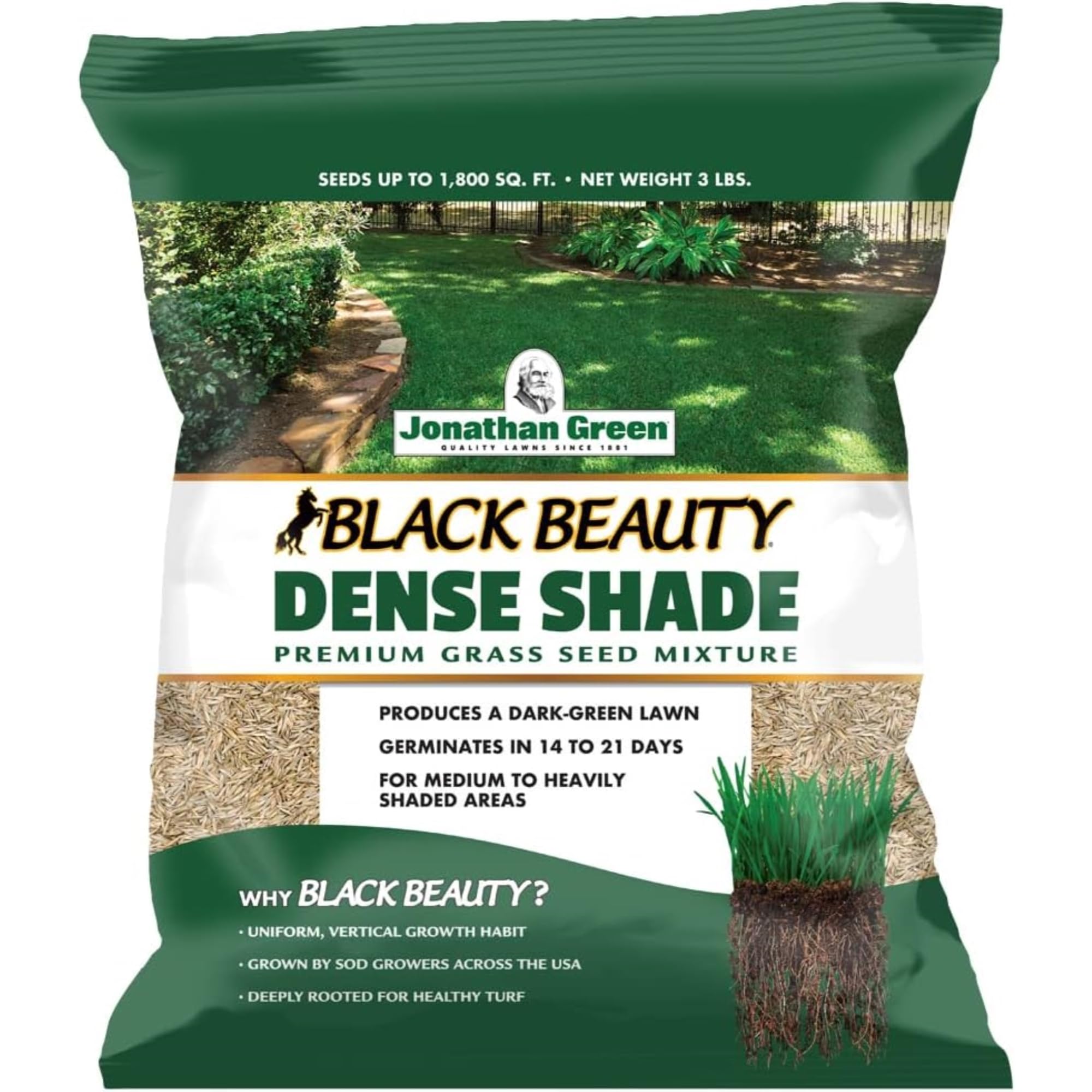
This is a cool-season grass seed blend that directly addresses the most common complaint about shade coverage: it produces a thick, beautiful color in areas where Bermuda and St. Augustine consistently fail. Multiple verified reviews confirm germination in as little as three days, with grass reaching four to five inches tall even under dense tree canopies. The 3-pound bag covers up to 1,800 square feet, making it a cost-effective trial for problem spots.
The seed contains no fillers and is 100% superior grass seed, meaning you aren’t paying for inert coating or fertilizer you don’t need. Reviews on heavy clay soil under a deck showed successful establishment after simple tilling and topsoil addition, with sprouts appearing within days and filling in to two inches of growth within a few weeks. It handles both wet and dry shady conditions, which is a rare combination in this category.
That said, a few users reported poor germination rates (5–10%) despite following watering and fertilization schedules, suggesting that soil contact and consistent moisture are absolutely critical with this blend. The 3-pound bag is relatively small; if you are covering a large shaded area, you may need multiple bags, which pushes the investment higher. Overall, this is the most reliable pick for deep shade where Bermuda has failed.
Why it’s great
- Germinates rapidly (3 days in many reports) even in heavy shade
- Beautiful dark green color and strong hardiness
- Effective on clay soil with minimal prep
Good to know
- Small bag size may require multiple purchases for large areas
- Germination is inconsistent without perfect seed-to-soil contact
- Leaves can kill the grass if not raked
2. Jonathan Green Black Beauty Shady Nooks Grass Seed, 7 lb

The Black Beauty Shady Nooks mix is widely regarded as the most shade-tolerant grass seed mixture in Jonathan Green’s lineup, blending tall fescues, perennial rye, and fine fescue varieties. This combination allows the grass to grow right up to the base of trees, an area where most other turfs thin out completely. The 7-pound bag seeds up to 2,625 square feet for a new lawn or 5,250 square feet for overseeding, offering substantial coverage for a moderate investment.
Customer reviews from wooded lots in New Hampshire and Maryland confirm that this seed outperformed other premium blends in deep shade, producing dense, lush turf after fall seeding that survived winter and thrived into the following summer. One user specifically noted that the grass was “soft, fine, and dark green,” with an estimated 75–80% germination rate. The blend also requires less fertilizer and water than competitor mixes, which translates to lower ongoing maintenance.
On the downside, germination takes 10–20 days, which is slower than the Dense Shade blend. A few reviewers noted that spring plantings died off during the summer heat, requiring a fall reseeding to establish strong roots before the next hot season. For deep, persistent shade that receives only two hours of direct sun per day, this is still the strongest performer available.
Why it’s great
- Specially formulated for deep shade near tree bases and structures
- Requires less fertilizer and water than most shade mixes
- Large bag covers significant area for the price
Good to know
- Slower germination (10–20 days) requires patience
- Spring plantings may die in summer; fall seeding is recommended
- Seed density may appear thin in bare areas initially
3. Pennington Bermudagrass Grass Seed, 5 lb

This is a straight Bermuda grass seed — not a shade-adapted mix. It contains improved cold-tolerant varieties and Pennington’s Penkoted technology, which helps retain moisture during germination. The 5-pound bag is a solid value for warm-season lawns in full sun, and it produces an aggressively self-spreading turf with deep roots and high drought tolerance. The seed is very fine and powder-like, requiring multiple passes for even coverage.
However, the key limitation is that Bermuda grass is inherently a full-sun grass. It will not thrive in shade. Customers who used this seed in partially shaded areas reported success only when the area received at least six hours of direct sun. In deeper shade, germination rates dropped sharply, and the grass became thin and patchy. This product is ideal for sunny spots in a larger lawn where Bermuda is desired, but it should not be your primary choice for a shaded section of your property.
Reviews from Florida and other southern states show excellent results when conditions are right: fast germination in 7–10 days with daily watering, a thick green carpet within weeks, and year-round performance in warm climates. If your “shade” is actually a spot that gets five to six hours of sun, this Bermuda can handle it — but for genuine low-light conditions, you’ll want one of the cool-season blends listed above.
Why it’s great
- Cold-tolerant and drought-resistant for warm-season lawns
- Penkoted technology improves moisture absorption
- Excellent wear resistance and deep root system
Good to know
- Requires full sun (6+ hours) — not a true shade grass
- Very fine seed requires careful spreading and annual overseeding
- Some batches reported poor germination
4. Gulfkist Centipede Grass Seed, 1 lb Coated

Centipede grass is a warm-season alternative that holds up better in moderate shade than traditional Bermuda. Gulfkist’s coated seeds are designed for improved germination and survivability without added mulch, and the company claims it is “more shade tolerant than Bermuda grass seed.” This makes it a legitimate option for southern lawns where the goal is a low-maintenance, slow-growing turf that stays green year-round in mild climates.
Customer experiences are mixed but informative: one user reported that sprouts appeared in full shade but at only one-quarter the density of sun-exposed areas, while another saw excellent germination in 7–10 days during a Florida heatwave. The key with centipede is patience — it takes about a month to establish a decent stand, and it requires heavy soil preparation mixing the seed with sand or topsoil for best contact. The coated seeds also help prevent washout, which is a concern in rainy periods.
On the downside, this product is not a true “shade grass.” It tolerates moderate shade but will not produce a thick lawn in deep, all-day shade. Additionally, the 1-pound bag covers only 900 square feet if you want a dense result, making it less economical for large areas. For a southeastern homeowner with a partially shaded yard who wants a warm-season grass without the fertilizer demands of St. Augustine, this is a solid mid-range option.
Why it’s great
- More shade tolerant than standard Bermuda grass
- Low maintenance: requires less fertilizer and mowing
- Coated seeds improve germination without mulch
Good to know
- Density in full shade is significantly reduced
- Slow to establish; needs 4–6 weeks for full coverage
- 1 lb bag is small; may need multiple bags for larger areas
5. Scotts Turf Builder All-Purpose Mix, 20 lb

Scotts Turf Builder All-Purpose Mix is a versatile, 20-pound blend designed for both sunny and shady areas, making it a practical choice for homeowners who want a single bag to cover their entire northern lawn. The seed is coated with Water Smart technology, which absorbs twice as much water as uncoated seeds — a helpful feature for shaded spots where soil may be compacted by tree roots. The bag covers up to 8,000 square feet, which is exceptional coverage for the money.
Customer feedback confirms that this mix germinates quickly (within two weeks) and produces a deep green, soft turf that blends well with existing blue ryegrass and tall fescue. Several users noted that it held up well under high heat and that the grass was thick enough to crowd out weeds. The 99.9% weed-free guarantee is also reassuring, as many budget mixes contain weed seeds that create more work later.
The trade-off is that this is a general-purpose blend, not a specialized shade formula. It works fine in areas with dappled sun or morning shade, but several reviewers mentioned that it performed best in sunnier spots and that crabgrass became an issue in some cases. The 20-pound bag is heavy and may be overkill for small yards or targeted patch repair. For a budget-conscious buyer with a mix of sun and moderate shade, this is a reliable entry-level choice.
Why it’s great
- Excellent value — 20 lbs covers up to 8,000 sq ft
- Coated seeds absorb 2x more water for better germination
- 99.9% weed-free, with strong heat tolerance
Good to know
- Not a dedicated shade mix; best in moderate light
- Large bag is heavy and may be excessive for small areas
- Some users reported crabgrass growth despite claims
FAQ
Can Bermuda grass grow in full shade?
How do I prepare soil for grass seed under a tree?
Why did my shade grass seed germinate then die?
Final Thoughts: The Verdict
For most users, the best bermuda grass for shade winner is the Jonathan Green 40600 Dense Shade Grass Seed because it germinates rapidly, produces a beautiful dark green color, and is explicitly bred for the kind of heavy shade that kills standard Bermuda. If you want deeper coverage for a larger area, grab the Jonathan Green Black Beauty Shady Nooks — it requires less fertilizer and handles wet, deeply shaded spots right up to tree bases. And for a southern homeowner with moderate shade who wants a warm-season alternative, nothing beats the Gulfkist Centipede Grass Seed for low-maintenance year-round green.

Mo Maruf
I created WellFizz to bridge the gap between vague wellness advice and actionable solutions. My mission is simple: to decode the research and give you practical tools you can actually use.
Beyond the data, I am a passionate traveler. I believe that stepping away from the screen to explore new environments is essential for mental clarity and physical vitality.