Our readers keep the lights on and my smoothie glass nicely filled. As an Amazon Associate, I earn from qualifying purchases.
When a storm knocks out the utility feed, the difference between a minor inconvenience and a serious disruption comes down to how much stored energy you have waiting in your garage. Home backup batteries have moved far beyond the tiny UPS boxes that used to keep only a modem alive — today’s units carry enough capacity to run a refrigerator, medical equipment, lights, and communications for days, if you choose wisely.
I’m Mohammad Maruf — the founder and writer behind WellFizz. I’ve spent years analyzing the specifications and real-world performance data of lithium-iron-phosphate power stations, focusing on inverter quality, battery cycle life, solar charging speeds, and the expansion capabilities that separate a true home backup system from a glorified gadget.
This guide evaluates twelve of the strongest contenders to help you find the best backup battery for home that matches your capacity needs, appliance requirements, and long-term reliability expectations.
How To Choose The Best Backup Battery For Home
Selecting a home backup battery requires matching the unit’s capacity and output to your critical loads. A 2,000Wh station can handle a fridge and router for a day, while a 4,000Wh unit with 240V split-phase covers a well pump or central air. Look for LiFePO4 chemistry, a high-quality pure sine wave inverter, and UPS response under 20ms to protect sensitive electronics.
Capacity vs. Inverter Output
Watt-hours (Wh) tell you how long the battery lasts under a given load. Inverter wattage tells you what you can actually start and run at once. A refrigerator might draw 700W running but need 2,000W surge to kick on the compressor. If your unit has 3,072Wh but only a 1,800W inverter, you cannot run a 1,500W space heater even though the energy is there — the inverter is the gatekeeper.
Battery Chemistry and Cycle Life
LiFePO4 (LFP) cells dominate the premium tier because they offer 3,500 to 6,000 cycles before degrading to 80% capacity. Compare that to older NMC batteries that might only last 500 cycles. For daily use or frequent outage preparedness, LFP pays for itself over a decade of service. Automotive-grade cells with a robust BMS add safety against over-temperature and short circuits.
Charging Speed and Solar Compatibility
A home backup battery that takes 12 hours to recharge is less useful than one that hits 80% in 45 minutes. Check the max AC input wattage and whether the unit supports simultaneous AC + solar charging for the fastest refill. Solar input voltage range also matters — most panels output 18-50V, so a wide MPPT range (e.g., 12-145V) keeps charging efficient in partial shade or with different panel configurations.
Quick Comparison
On smaller screens, swipe sideways to see the full table.
| Model | Category | Best For | Key Spec | Amazon |
|---|---|---|---|---|
| EF ECOFLOW DELTA Pro 3 | Premium | Whole-house 240V backup | 4096Wh / 4000W / 48kWh expandable | Amazon |
| BLUETTI AC200L | Mid-Range | Expandable home + RV | 2048Wh / 2400W / 8192Wh expandable | Amazon |
| EF ECOFLOW DELTA 3 Max | Mid-Range | Ultra-fast charging | 2048Wh / 2400W / 0-80% in 1.13hr | Amazon |
| BLUETTI Elite 200 V2 | Mid-Range | Compact 2kWh with 17-yr lifespan | 2073Wh / 2600W / 6000+ cycles | Amazon |
| Jackery Explorer 2000 v2 | Mid-Range | Lightest 2kWh unit | 2042Wh / 2200W / 39.5 lbs | Amazon |
| Anker SOLIX C2000 Gen 2 | Mid-Range | Low standby power | 2048Wh / 2400W / 9W idle | Amazon |
| DJI Power 2000 | Mid-Range | Pro build with 30dB noise | 2048Wh / 3000W / 0-80% in 55 min | Amazon |
| PECRON F3000LFP | Premium | High-wattage 3kWh with app | 3072Wh / 3600W / 2hr full charge | Amazon |
| AFERIY 3840Wh | Premium | Large capacity with wheels | 3840Wh / 3600W / 11.5kWh expandable | Amazon |
| GROWATT HELIOS 3600 | Premium | 240V split-phase whole house | 3600Wh / 3600W / 36kWh expandable | Amazon |
| Jackery HomePower 3000 | Premium | 3kWh with included solar panels | 3072Wh / 3600W / 47% smaller than peers | Amazon |
In‑Depth Reviews
1. EF ECOFLOW DELTA Pro 3

The DELTA Pro 3 sits at the top of the home backup hierarchy because it delivers true 120V/240V split-phase output from a single, portable unit. With 4,096Wh of LFP capacity and a 4,000W inverter (6,000W with X-Boost), it can start and run a 3-ton central AC or a 1 HP well pump. The system expands to 48kWh via extra batteries or the Smart Generator, meaning you can cover two to four days of whole-house power without tying into a permanent installation.
Charging flexibility is unmatched — seven unique methods including AC, solar (up to 2,600W input), EV charging piles, and gas generator refill mean you are never stranded. The IP65-rated CTC battery pack and automotive-grade LFP cells ensure durability even in humid garage or outdoor settings. At 115 pounds with integrated wheels, you can roll it into position without a dolly. The 10ms UPS switch keeps NAS systems, medical devices, and entertainment equipment safe during any grid flicker.
A few trade-offs exist: there is no dedicated 12V car port, the control interface relies heavily on the EcoFlow app for some settings (like neutral-ground bonding), and the manual lacks depth for first-time users. But for a buyer who wants whole-house 240V capacity without a professional electrician, the DP3 delivers the most complete package in the category.
Why it’s great
- Native 240V output powers central AC, well pumps, and EV charging
- Expands to 48kWh for multi-day whole-home backup
- 10ms UPS transfer protects sensitive equipment
- 2,600W solar input for rapid renewable charging
Good to know
- No 12V car port — you lose a common accessory outlet
- Some settings require the app and an internet connection
- Quite heavy at 115 pounds despite wheels
2. BLUETTI AC200L

The BLUETTI AC200L is the updated version of the popular AC200MAX, increasing the inverter output to 2,400W continuous and 3,600W in Power Lifting mode. That extra 200W over the previous generation lets it start a 12,000 BTU RV air conditioner or a 1,500W kettle without tripping. The base 2,048Wh LFP battery expands to 8,192Wh using B300, B300K, or B210 expansion packs, giving you room to grow as your energy needs increase.
Charging speed is a standout feature: 0-80% in just 45 minutes via 2,400W AC input, and a full charge from solar in under 2.2 hours if you have 1,200W of panels. The 30A RV port eliminates the need for a separate adapter when plugging into a travel trailer or camper. Real users report running a home security system, 64-inch OLED TV, fridge, freezer, and router for about 10 hours through a 30A transfer switch.
The unit weighs 61 pounds and uses a proprietary AC power cord, which could be inconvenient if you lose it. The form factor is boxy but stackable. For homeowners who want one modular system that starts at a reasonable capacity and scales up without replacing the core unit, the AC200L represents the sweet spot of value and expandability.
Why it’s great
- Scales from 2kWh to 8kWh with three expansion battery options
- 45-minute fast recharge minimizes downtime between outages
- 3600W surge handles demanding appliances and tools
- 30A RV port streamlines trailer and camper hookup
Good to know
- Proprietary AC charging cable — no standard IEC cord
- Heavy enough at 61 lbs to require two hands for carrying
- No built-in wheels; you need to purchase an accessory cart
3. EF ECOFLOW DELTA 3 Max
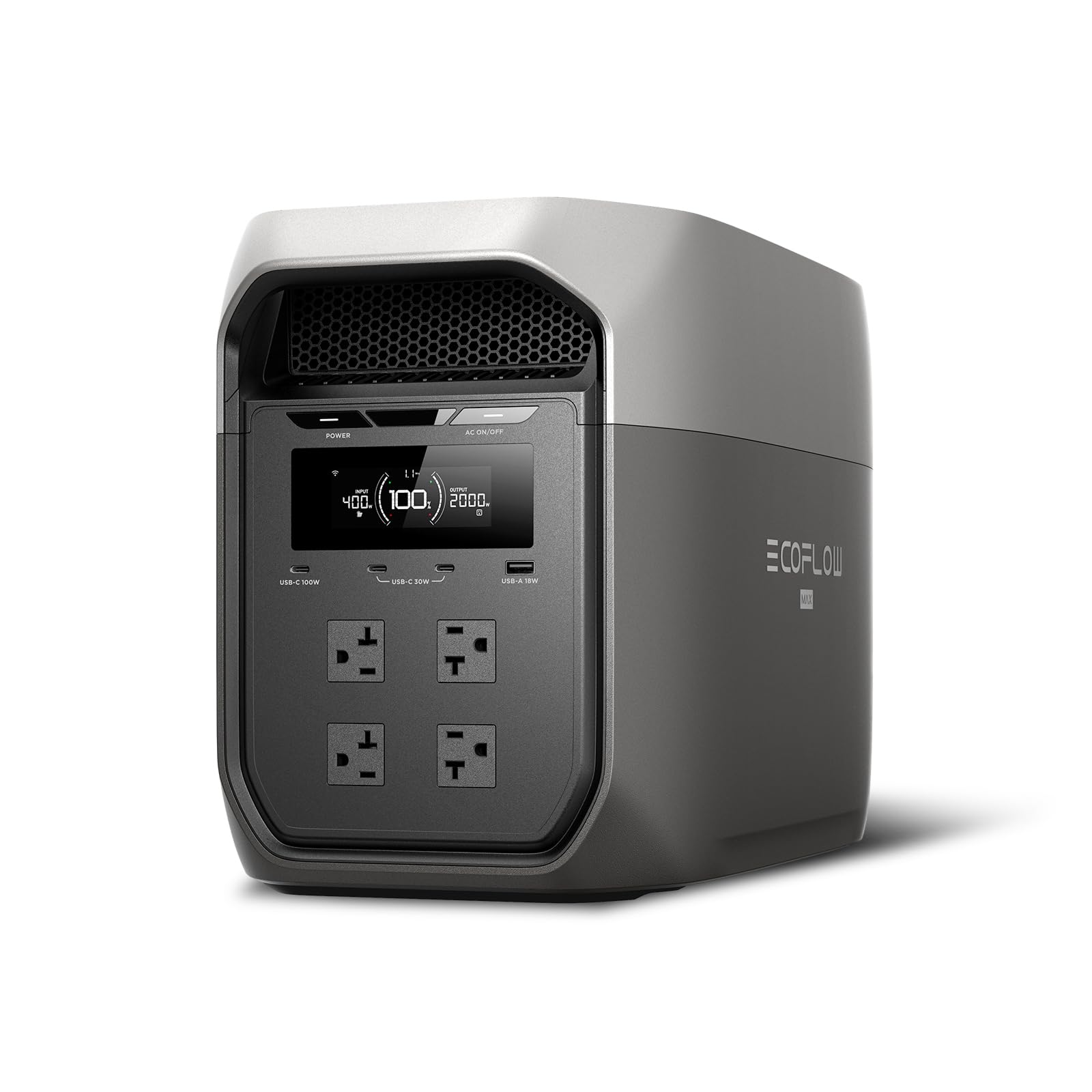
The DELTA 3 Max from EcoFlow brings a 2,048Wh LiFePO4 core with an inverter rated at 2,400W continuous and 3,400W in X-Boost mode. That means you can run 99% of household appliances including a microwave, refrigerator, and power tools simultaneously. The charger uses X-Stream technology to reach 80% charge in just 1.13 hours — perfect for topping up between storm alerts. The unit also features a 10ms UPS transfer to keep computers and medical devices online.
Build quality is excellent with an aluminum and plastic chassis, dual handles for balanced lifting, and a weight of roughly 55 pounds. The EcoFlow app provides real-time energy monitoring, charge scheduling, and a storm readiness feature that automatically tops off the battery before bad weather hits. Users on film sets report reliable power for cameras, monitors, and laptops in remote locations, while RV owners appreciate how quietly the unit operates even under a 1,700W load.
The DELTA 3 Max lacks a 30A RV outlet and a 240V output, so it is best suited for 120V essential circuits via a transfer switch. The fan is audible during heavy charging but stays quiet enough for indoor sleeping areas. If rapid recharge speed and a robust app ecosystem matter most, this EcoFlow is hard to beat.
Why it’s great
- Fastest AC recharge in its class — 80% in 68 minutes
- Smart storm pre-charge feature via the app
- 3400W X-Boost powers nearly any 120V appliance
- Dual handles make carrying manageable despite weight
Good to know
- No 30A RV receptacle — you’ll need an adapter
- No 240V output for split-phase appliances
- Fan noise increases under high continuous load
4. BLUETTI Elite 200 V2

The Elite 200 V2 delivers 2,073.6Wh of capacity and a 2,600W continuous inverter (3,900W Power Lifting) in a chassis that is 40% more compact than previous BLUETTI 2kWh units. The secret is automotive-grade LiFePO4 cells certified by CNAS, rated for over 6,000 cycles — translating to a 17-year lifespan under daily use. Standby power consumption is a mere 10W, three times lower than the industry average, so you waste less energy when the unit is idling.
The three charging modes (Turbo, Standard, Silent) give you fine control over recharge speed versus noise. Silent mode operates at 16-30dB, making it among the quietest power stations for bedroom or RV use. Solar charging hits a full battery in 2.4 hours with 1,000W of panels, and the unit supports dual AC + DC charging to reach 80% in 50 minutes. Real-world users report running a 12,000 BTU air conditioner for four hours on solar alone, and a 1,500W kettle without the inverter complaining.
There is no 30A RV port, which limits direct camper hookup. The 53-pound weight is manageable but the handle design is less ergonomic than some competitors. However, if you want the smallest 2kWh station on the market with the longest battery warranty and whisper-quiet operation, the Elite 200 V2 is a compelling choice.
Why it’s great
- Industry-leading 6,000+ cycle life for 17 years of daily use
- Compact footprint — 40% smaller than similar 2kWh stations
- Silent charging mode at 16-30dB for bedroom placement
- Only 10W standby power consumption
Good to know
- No 30A RV outlet for direct camper power
- Handle design is functional but not as comfortable as some rivals
- 53 lbs still requires a stable grip for transport
5. Jackery Explorer 2000 v2

Jackery’s Explorer 2000 v2 uses Cell-to-Body (CTB) technology borrowed from electric vehicle manufacturing to achieve a 2,042Wh capacity in a package that weighs just 39.5 pounds — a full 40% lighter than typical 2kWh stations. The 2,200W pure sine wave inverter handles three AC outlets, two USB-C (100W PD), one USB-A, and a 12V car port. The 20ms UPS switch is UL 1778 certified, meaning it qualifies as a true uninterruptible power supply for sensitive electronics like CPAP machines and computers.
Fast charging options include AC Fast Charge (0-80% in 66 minutes) and Emergency Super Charging via the app (full charge in 102 minutes). Silent charging mode operates below 30dB, allowing you to recharge overnight without disturbance. Users report running a refrigerator for over 21 hours on a single charge, and the built-in flashlight with SOS mode adds emergency utility. The handle is well-designed for a unit this light, making it feasible to carry from garage to campsite.
The lack of a 30A RV outlet limits direct RV plug-in, and the 2,200W inverter is lower than some competitors in the same price tier. Solar charging with only a 200W panel is slow — expect 6+ hours for a full charge. But for portability and certified UPS performance, the lightest 2kWh option on the market is a clear winner.
Why it’s great
- Ultra-light at 39.5 lbs — easy to carry anywhere
- UL 1778 certified UPS for medical and computer backup
- CTB construction improves durability and space efficiency
- Emergency Super Charging mode for fast refills
Good to know
- 2,200W inverter is lower than comparable 2kWh units
- No 30A RV port for camper direct connection
- Solar charging is slow without high-wattage panels
6. Anker SOLIX C2000 Gen 2

Anker’s SOLIX C2000 Gen 2 packs 2,048Wh of LFP capacity and a 2,400W inverter (4,000W peak) into a chassis that is 25% lighter and 29% smaller than similar products. The headline feature is the 9W standby power draw — the lowest in the 2kWh category — meaning if you leave it plugged in for weeks between outages, it wastes almost no energy. That efficiency translates directly into longer runtimes: Anker claims 32 hours powering a dual-door fridge, and 64 hours with the expansion battery doubling capacity to 4kWh.
Six charging methods include AC (full charge in 58 minutes), solar (800W input via XT60i), car alternator (800W for 3-hour full charge), and mixed AC+ solar. The 21% weight reduction comes from a smart internal layout, making this 41.7-pound station one of the easiest to move in its class. Real users praise the build quality, calling it “built like a tank,” and report powering a 30-quart fridge for 5-7 days on a single charge during van camping trips.
The peak output of 4,000W is transient and not continuous, so you should not expect to run high-draw tools indefinitely. The fan is audible under sustained load. Also, the proprietary XT60i connector for solar may require an adapter if you already own standard MC4 panels. But for energy-conscious buyers who want maximum runtime per kWh and the smallest physical footprint, the C2000 Gen 2 delivers on every efficiency metric.
Why it’s great
- Industry-low 9W standby power draw saves energy between outages
- Expandable to 4kWh for extended home backup
- 800W alternator charging — 8x faster than a car socket
- Compact at 41.7 lbs and 18.1 x 9.8 x 10.1 inches
Good to know
- 4000W peak is surge only, not continuous
- Solar uses XT60i connector — may need adapter for standard panels
- Fan noise is noticeable under high inverter load
7. DJI Power 2000
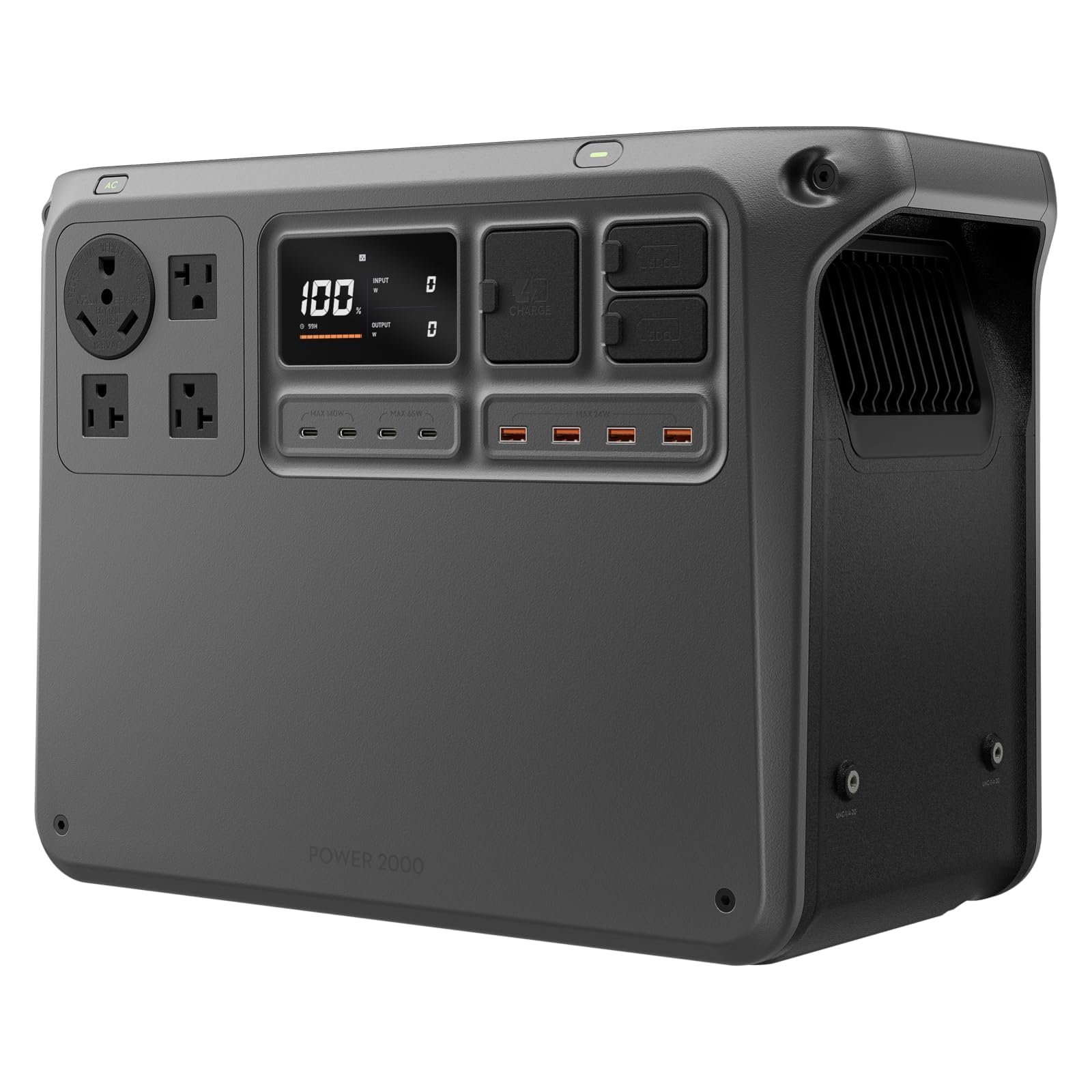
DJI, best known for drones, enters the home backup battery space with the Power 2000, a 2,048Wh LFP station that outputs a robust 3,000W continuous (4,000W peak). The inverter is strong enough to run a 1 HP water pump or a large window AC with headroom. It recharges from 0-80% in 55 minutes and hits full in 90 minutes via AC input. The portable form factor weighs 48 pounds and measures 17.6 x 8.9 x 12.8 inches, making it one of the more space-efficient 2kWh units.
Noise output is a major selling point — DJI rates it under 30dB, meaning it is genuinely quiet enough for bedroom or RV use without disrupting sleep. The unit includes 4 AC outlets, 4 USB-C (two at 140W), and 4 USB-A ports. Build quality reflects DJI’s reputation for precision engineering: a flame-retardant housing, sub-nano coating for moisture resistance, and 26 temperature sensors monitoring the battery pack. Users replacing Honda EU3000 gas generators report that the Power 2000 runs high-power tools and electric winches with zero maintenance and no emissions.
The ecosystem is DJI-specific, so you will need proprietary connectors for expansion and some features like solar MPPT require separate adapters. The app control works well but is DJI-only. Sleep mode can be confusing, with some users reporting unexpected shutdowns. However, for someone who values build quality, quiet operation, and a high continuous inverter output above all else, the Power 2000 is a serious contender.
Why it’s great
- 3,000W continuous output handles demanding tools and pumps
- Under 30dB noise level — genuinely silent for indoor use
- Rugged, flame-retardant build with 26 temperature sensors
- Fast charge 0-80% in 55 minutes
Good to know
- Proprietary connectors for expansion and solar MPPT
- Sleep mode can confuse new users
- No built-in wheels despite the weight
8. PECRON F3000LFP
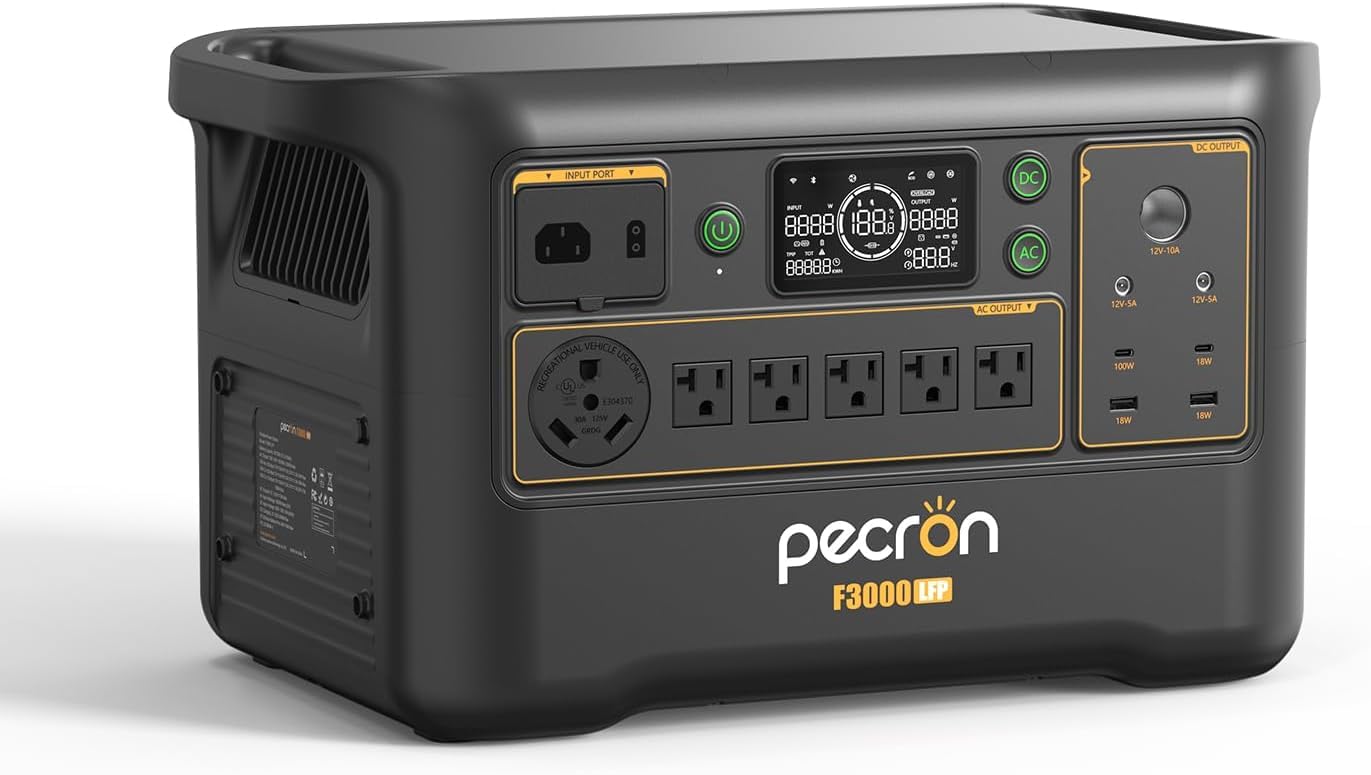
The PECRON F3000LFP delivers a 3,072Wh battery and a 3,600W pure sine wave inverter at a price point that undercuts most premium 3kWh brands by a significant margin. It can power 13 devices simultaneously via 6 AC outlets, 2 USB-C (100W PD), 2 USB-A, a car port, and two DC 5525 outputs. The inverter is strong enough to run a refrigerator, air conditioner, and power tools concurrently without voltage sag. An expansion cable allows connecting the EP3800-48V battery pack to reach 10,752Wh.
Charging is surprisingly fast for a 3kWh unit: 0-100% in just 2 hours via 1,800W AC input. Solar compatibility is rated at 1,600W max with a wide 25-120V MPPT input range. The UPS switch operates within 8-20ms, keeping computers and medical equipment safe. Real owners praise the app control for monitoring real-time power usage and the quiet fan operation during typical loads. The included XT60 to MC4 solar cable makes it easy to hook up existing panels without buying adapters.
The unit weighs 63 pounds and does not include wheels, so it is best suited for semi-permanent placement. Some users note that the fan runs often even at moderate loads. The PECRON brand is less established than EcoFlow or Jackery, so long-term support remains unproven. But for sheer capacity per dollar, the F3000LFP is the strongest value proposition among large batteries.
Why it’s great
- 3,072Wh capacity at a budget-friendly price point
- Full recharge in just 2 hours via AC
- 3600W inverter runs heavy appliances without dropouts
- Expandable to 10,752Wh for serious whole-home backup
Good to know
- 63 lbs with no wheels — not easy to move once placed
- Fan runs frequently even under moderate loads
- Brand is less established with shorter track record
9. AFERIY 3840Wh

The AFERIY unit starts at 3,840Wh of LFP capacity — the largest base capacity in this guide without requiring an expansion battery. The inverter outputs 3,600W continuous with a 7,200W peak, enough to start a large RV air conditioner or a well pump. Expansion batteries push the total to 11,520Wh, making this one of the few sub- stations that can power a whole house for days. A pull handle and rugged wheels make the 104-pound unit transportable across a garage floor or patio.
The UPS switch is rated under 10ms, and the unit is UL listed for safety compliance. It offers 15 ports including 5 AC outlets, USB-C PD, DC5521, and XT60 for solar. Charging options include AC, solar, car, and hybrid AC+ solar, with a fast 1.5-hour full charge when using the highest AC input. The app provides charge scheduling, light mode selection, and remote power-off. Real users report running an entire RV except the air conditioner off-grid with 4x 445W solar panels, and the unit handles Starlink, a 75-inch TV, and a Traeger grill simultaneously.
Some early units had display issues (dark segments) that required support intervention, though AFERIY customer service appears responsive. The fan noise is noticeable during charging but acceptable for a garage. The sheer size and weight mean this is not a portable camping station — it lives in one spot. But for the buyer who wants the most battery per dollar without expansion, the AFERIY is unmatched.
Why it’s great
- Highest base capacity at 3,840Wh without needing expansion
- Built-in pull handle and rugged wheels for garage portability
- 7200W peak surge starts large AC units and pumps
- UL listed and meets recognized safety standards
Good to know
- 104 lbs — this is a stationary unit, not portable
- Some units have exhibited display glitches
- Fan noise is noticeable during active charging cycles
10. GROWATT HELIOS 3600
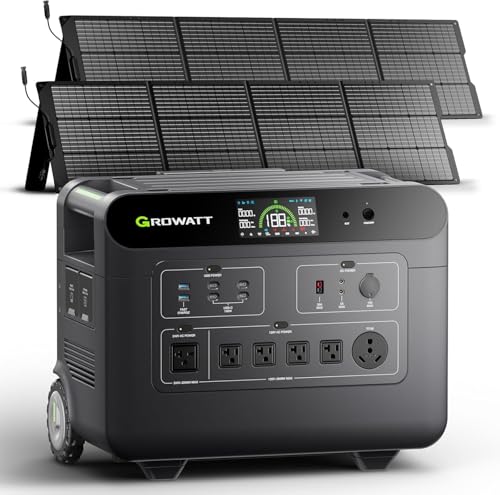
Growatt, a veteran in the solar inverter industry, brings the HELIOS 3600 with a 3,600Wh LFP battery and a 3,600W inverter that supports true 240V split-phase output when pairing two units. That means you can run a 240V well pump, central air conditioner, or EV charger directly — something most portable stations cannot do. The base unit expands to 36kWh, enough for days of whole-home backup. The bundled 2x 200W solar panels get you generating power right out of the box.
The unit uses EV-grade LFP cells rated for 4,000 cycles (80% capacity retention at 10 years) and features a cold-start function that operates down to -22°F, making it suitable for garages in cold climates. The 15ms EPS switch and 2,000W solar input (99% MPPT efficiency) ensure fast, reliable recharging. The Growatt app enables time-of-use scheduling to shift loads to cheaper rate periods and prioritize solar input to reduce electricity bills. A NEMA TT-30 port and Anderson input/output make it RV-friendly.
At 149 pounds, this is a heavy unit best left in place or moved only on wheels. Some users report that the Bluetooth and Wi-Fi app connection can be finicky, and the EPS stays active when the unit is plugged into AC, which could drain the battery if not monitored. The manual lacks depth on charging settings. However, for buyers who need real 240V output and professional-grade inverter technology from a reputable solar manufacturer, the HELIOS 3600 is a strong contender.
Why it’s great
- True 240V split-phase output powers well pumps and central AC
- Expandable to 36kWh for multi-day whole-home backup
- Bundled with 400W solar panels for immediate off-grid use
- Cold start function operates down to -22°F
Good to know
- Very heavy at 149 lbs — essentially a stationary unit
- Bluetooth/Wi-Fi connectivity can be unreliable
- EPS stays active when plugged into AC, potentially draining the battery
11. Jackery HomePower 3000
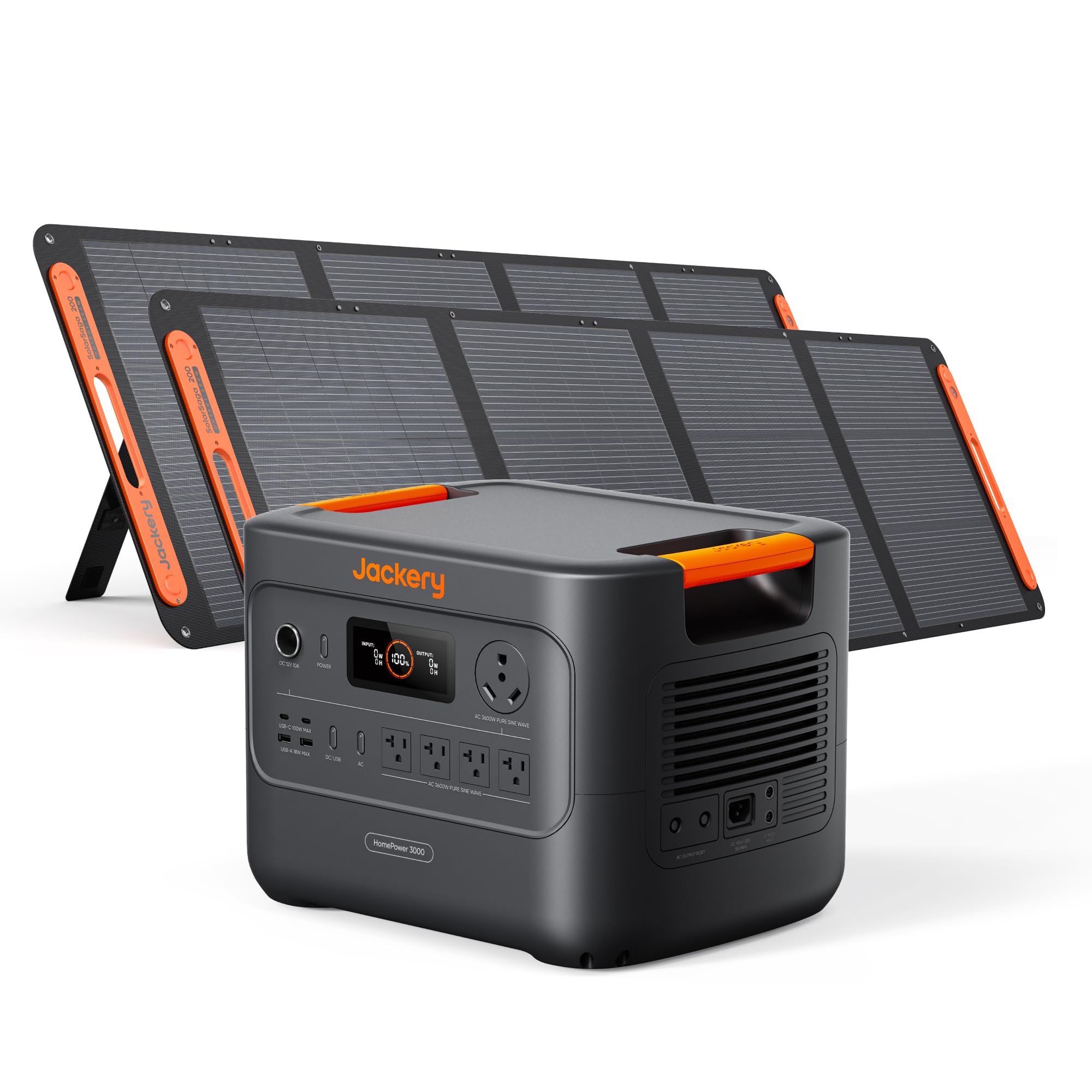
The Jackery HomePower 3000 combines a 3,072Wh LFP battery with a 3,600W inverter (7,200W surge) in a chassis that claims to be 47% smaller and 43% lighter than comparable 3kWh units, thanks to CTB technology. At 59.5 pounds, it is genuinely portable for a station this large. The bundle includes two 200W SolarSaga panels, giving you a complete solar generator out of the box. The inverter can surge to 7,200W for starting appliances, making it capable of handling a refrigerator, window AC, and entertainment devices simultaneously.
Charging is versatile: full recharge in 1.7 hours via hybrid AC+DC, or 2.2 hours via AC alone. The ≤20ms UPS switch is UL certified for seamless backup in hurricanes and storms. ChargeShield 2.0 uses AI algorithms to optimize charging speed while preserving battery health to 4,000 cycles (70% capacity retention). Users report running a refrigerator for 1-2 days, charging two e-bikes and phones simultaneously, and using it for dry camping with existing RV solar systems. The built-in TT-30 RV port provides plug-and-play power for travel trailers.
The unit cannot be expanded with additional batteries, so your capacity is fixed at 3,072Wh. At 60 pounds, it is heavy without a wheel kit (sold separately). Solar panel boxes sometimes arrive separately, which can cause confusion. But for a buyer who wants a complete 3kWh solar generator system that is genuinely portable and includes panels, the HomePower 3000 delivers solid value.
Why it’s great
- Includes two 200W solar panels for immediate renewable charging
- 47% smaller and 43% lighter than comparable 3kWh units
- 7200W surge handles demanding appliance starts
- TT-30 RV port for direct camper connection
Good to know
- No expansion battery support — fixed 3,072Wh capacity
- Wheel kit is an optional extra purchase
- Solar panels ship in separate boxes, causing delivery confusion
FAQ
Can a home backup battery run my entire house off-grid?
What size battery do I need for a 24-hour power outage?
How long does a LiFePO4 home battery actually last?
Can I recharge a power station with solar panels during a blackout?
Final Thoughts: The Verdict
For most users, the best backup battery for home is the EF ECOFLOW DELTA Pro 3 because it combines native 240V split-phase output, massive 48kWh expandability, and a 10ms UPS in a single portable chassis. If you want a more budget-friendly entry with strong expansion potential, grab the BLUETTI AC200L. And for a lightweight, solar-ready 3kWh system that includes panels out of the box, nothing beats the Jackery HomePower 3000.

Mo Maruf
I created WellFizz to bridge the gap between vague wellness advice and actionable solutions. My mission is simple: to decode the research and give you practical tools you can actually use.
Beyond the data, I am a passionate traveler. I believe that stepping away from the screen to explore new environments is essential for mental clarity and physical vitality.