Our readers keep the lights on and my smoothie glass nicely filled. As an Amazon Associate, I earn from qualifying purchases.
Mold in the corner, warping guitar wood, a cough that won’t quit — indoor humidity swings silently wreck comfort and possessions before you even notice. A reliable air humidity monitor is the only way to stop guessing and start controlling your environment with actual data.
I’m Mohammad Maruf — the founder and writer behind WellFizz. I’ve spent years analyzing sensor hardware, connectivity protocols, and data logging features to separate monitors that deliver real accuracy from those that just display a number.
After evaluating dozens of models across price tiers, I’ve curated the five monitors that actually earn their place in your home. This is your complete guide to the best air humidity monitor for every use case and budget.
How To Choose The Best Air Humidity Monitor
Not every humidity monitor is built the same. Choosing the right one means understanding how accuracy, connectivity, and data handling affect your daily experience. Here are the three factors that separate useful monitors from decorative gauges.
Sensor Accuracy and Calibration
The most critical spec is humidity accuracy, measured in ±% RH. Budget monitors often drift by ±5% or more, which is the difference between 55% (safe) and 60% (mold-friendly). Look for Swiss-made Sensirion sensors with ±2% or ±3% RH accuracy. These maintain precision over years, unlike cheaper capacitive sensors that degrade.
Connectivity and Range
Your connectivity choice determines how you interact with data. WiFi monitors let you check readings from anywhere via phone app — essential for vacation homes or greenhouses. Zigbee sensors require a hub but offer lower power consumption and mesh networking for larger homes. Bluetooth-only models are simpler but require physical proximity. Multi-sensor kits with a dedicated gateway generally offer the best experience for whole-home monitoring.
Data Logging and Export
A monitor that just shows current humidity is a toy. Real value comes from trend charts and data export. Models that store 20 days to 2 years of history and allow CSV export let you spot patterns — like humidity spikes after showers or drops when HVAC cycles. Cloud storage with unlimited retention gives you full diagnostic power, especially important for wine cellars, reptile enclosures, and grow tents.
Quick Comparison
On smaller screens, swipe sideways to see the full table.
| Model | Category | Best For | Key Spec | Amazon |
|---|---|---|---|---|
| SensorPush HTP.xw | Premium | High-accuracy remote monitoring | ±0.1°F / ±0.1% RH resolution | Amazon |
| GoveeLife 2.0 WiFi 3-Pack | Mid-Range | Whole-home smart monitoring | ±0.54°F / ±3% RH accuracy | Amazon |
| X-Sense WiFi 3-Sensor Kit | Mid-Range | Accurate alerts & easy setup | ±0.36°F / ±2% RH accuracy | Amazon |
| Aqara Zigbee 3-Pack | Mid-Range | Smart home automation hub | ±0.3°C / ±3% RH + pressure | Amazon |
| eMylo WiFi 5-Pack | Value | Multi-zone value kit | ±0.9°F / ±5% RH accuracy | Amazon |
In‑Depth Reviews
1. SensorPush HTP.xw

The SensorPush HTP.xw is the gold standard for precision environmental monitoring. It doesn’t just measure temperature and humidity — it calculates heat index, dewpoint, barometric pressure, and VPD, making it the only sensor on this list that delivers professional-grade data. The 0.1°F and 0.1% RH resolution means you catch micro-changes that cheaper sensors miss entirely.
Setup takes seconds — no WiFi passwords, no gateways required out of the box. The Bluetooth range extends impressively through walls and steel studs, with users reporting reliable connections at 25 feet through multiple obstacles. Battery life stretches 1-2 years under normal use, and the included CR2477 coin cell is easily replaceable. For remote access, the optional G1 WiFi gateway (sold separately) unlocks cloud storage and push notifications.
Where this sensor truly shines is reliability in extreme conditions. Users report it functioning flawlessly in freezers, pump houses, and greenhouses where competing sensors fail. The CSV data export makes it a favorite for serious growers, cigar enthusiasts, and homeowners who want documented evidence of temperature excursions in fridges or wine cellars.
Why it’s great
- Lab-grade accuracy with 0.1°F and 0.1% RH resolution
- Unlimited in-app data storage with CSV export
- Water-resistant design for damp environments
Good to know
- Bluetooth only — requires separate gateway for remote WiFi access
- Single sensor unit — no multi-pack option for whole-home coverage
2. GoveeLife 2.0 WiFi Hygrometer 3-Pack
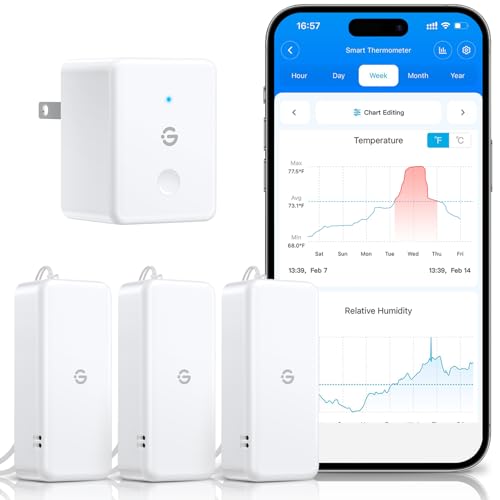
The GoveeLife 2.0 nails the optimal balance of accuracy, connectivity, and value. Each of the three sensors packs a Swiss-made sensor with ±0.54°F temperature and ±3% RH humidity accuracy, refreshing data every 2 seconds. The included WiFi gateway connects to your 2.4GHz network and supports up to 10 sensors total, making it easy to expand coverage later.
Battery life is a standout feature — rated at 2 years on AAA batteries, which means you’re not constantly climbing ladders to swap cells. The app provides trend charts for the past 20 days and allows data export going back 2 years, giving you long-term trend analysis without subscription fees. Remote alerts work via both app notifications and email when conditions exceed preset thresholds.
Compact and lanyard-equipped, these sensors fit into tight spaces like wine cabinets, guitar cases, and reptile enclosures. The gateway’s 2.4GHz-only requirement is standard for smart home sensors, but worth noting for households running mesh networks that don’t separate bands. Setup instructions are minimal, but the app onboarding is intuitive enough for most users.
Why it’s great
- Three sensors cover multiple rooms right out of the box
- Up to 2-year battery life on standard AAA cells
- 20-day trend + 2-year exportable data history
Good to know
- Requires 2.4GHz WiFi only — no 5GHz band support
- Setup guide is sparse; app-based onboarding required
3. X-Sense WiFi 3-Sensor Kit
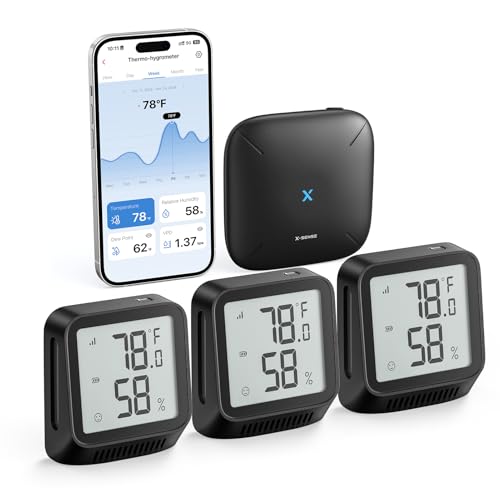
The X-Sense kit takes sensor accuracy seriously with Swiss-made sensors delivering ±0.36°F temperature and ±2% RH humidity precision — the tightest accuracy spec in this lineup. The included base station doubles as a display and audible alarm, so you get alerts even when your phone isn’t nearby. Comfort indicator icons on each sensor give instant readability without needing the app.
The X-Sense Home Security app provides 24/7 remote monitoring with min/max/average tracking and graph views. Up to 12 users can view the same data simultaneously — useful for families or caretakers monitoring elderly relatives’ homes. The base station alarm volume is adjustable, and you can customize comfort thresholds for each sensor individually.
Setup is straightforward: plug in the base station, insert batteries in the sensors, and pair through the app. One minor limitation is the 2.4GHz-only WiFi requirement, but this is consistent across virtually all smart sensors. Users praise the large, readable LCD screens that show data clearly from across the room, making the X-Sense ideal for quick visual checks throughout the day.
Why it’s great
- Best-in-class ±0.36°F and ±2% RH accuracy
- Base station with audible alarm — no phone needed for alerts
- Comfort indicator icons for instant readability
Good to know
- Cannot integrate with other thermostat or smart home systems
- 2.4GHz WiFi only — incompatible with 5GHz networks
4. Aqara Zigbee 3-Pack

The Aqara sensor is built for smart home automation enthusiasts. Unlike WiFi sensors that talk directly to your router, these use Zigbee protocol — meaning they require an Aqara hub (sold separately) but offer lower power consumption and mesh networking benefits. The 3-in-1 sensor measures temperature, humidity, and atmospheric pressure, providing more environmental data than typical dual-function monitors.
Integration is where this sensor flexes. Pair it with an Aqara hub and you can trigger automations — turn on a fan when humidity exceeds 65%, turn off a humidifier when it drops below 40%, or flash the hub’s night light when temperature crosses a threshold. Compatibility with Apple HomeKit, Alexa, and IFTTT means these sensors can feed data into broader automation routines with other brands.
The Sensirion sensor inside delivers reliable accuracy, but there are caveats. Battery replacement requires a tiny screwdriver to access the hatch — a common complaint. Some users report initial DOA units or pairing difficulties with third-party Zigbee dongles (which are not officially supported). For best results, pair these with an official Aqara hub and use within 33 feet of the hub for stable connections.
Why it’s great
- Measures temperature, humidity, and barometric pressure
- Deep smart home integration with Apple HomeKit and Alexa
- Battery life reportedly lasts 2+ years in normal use
Good to know
- Requires Aqara hub — not a standalone system
- Battery hatch is difficult to open; finicky pairing process
5. eMylo WiFi 5-Pack
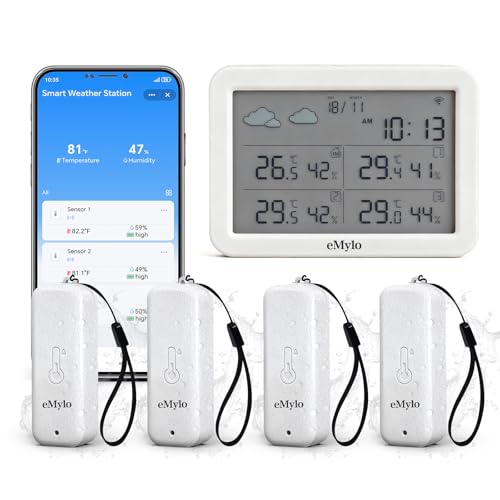
The eMylo kit offers the most sensors per dollar, packing one WiFi gateway and four wireless sensors into a single package. The gateway connects to your 2.4GHz WiFi, while sensors communicate with the gateway over a proprietary RF link rated at 426 feet line-of-sight. This long range makes it practical for monitoring a large property with detached structures like garages or greenhouses.
The IP65-rated sensors are splash-resistant, expanding the kit’s usability to outdoor locations like covered patios or greenhouse frames. The gateway’s large LED display shows temperature, humidity, date, time, and weather at a glance — one of the few units in this roundup with a built-in clock display. The Smart Life/Tuya app supports smart automation routines to trigger AC, humidifiers, or fans based on readings.
Accuracy is ±0.9°F and ±5% RH — adequate for general awareness but not suitable for precision applications like cigar humidors or reptile enclosures where tighter tolerances matter. Some users report calibration inconsistencies, with base station readings occasionally drifting by 4°F. The touchscreen on the gateway can also activate accidentally. For casual whole-home monitoring where exact precision isn’t critical, this kit delivers impressive sensor density.
Why it’s great
- Five sensors included — best sensor-to-dollar ratio
- IP65 waterproof sensors for outdoor use
- Large gateway display with time and weather information
Good to know
- ±5% RH accuracy — not for precision monitoring
- Gateway requires USB power; no backlight on display
FAQ
What is the ideal indoor humidity range for comfort and health?
Can I use a humidity monitor outdoors in rain or snow?
Do I need WiFi for a humidity monitor to work?
Why does my humidity monitor show different readings in different rooms?
How often should I calibrate my humidity monitor?
Final Thoughts: The Verdict
For most users, the best air humidity monitor winner is the GoveeLife 2.0 WiFi 3-Pack because it delivers Swiss-made sensor accuracy, long battery life, and three-room coverage at a price that doesn’t hurt. If you need laboratory-grade precision for wine cellars or sensitive materials, grab the SensorPush HTP.xw. And for deep smart home automation where every sensor triggers action, nothing beats the Aqara Zigbee 3-Pack.

Mo Maruf
I created WellFizz to bridge the gap between vague wellness advice and actionable solutions. My mission is simple: to decode the research and give you practical tools you can actually use.
Beyond the data, I am a passionate traveler. I believe that stepping away from the screen to explore new environments is essential for mental clarity and physical vitality.