Our readers keep the lights on and my smoothie glass nicely filled. As an Amazon Associate, I earn from qualifying purchases.
Getting rid of cable makes sense until your living room fills with pixelation or you lose channels after a gust of wind. The Antenna For Outdoor TV you pick has to handle real weather, deliver consistent gain on both VHF and UHF bands, and stay locked onto signals without constant readjustment.
I’m Mohammad Maruf — the founder and writer behind WellFizz. I’ve spent years analyzing antenna specs, customer durability reports, and signal-gain charts so you don’t have to guess which model will work at your address.
After digging into build quality, real-world range tests, and customer durability patterns across five distinct models, I’ve landed on a clear picture of what the antenna for outdoor tv segment genuinely delivers — and where the shortcuts hide.
How To Choose The Best Antenna For Outdoor TV
Not every antenna works in every location. Your distance from broadcast towers, surrounding terrain, and the mix of VHF and UHF channels in your area determine which design will produce a clean, stable signal. Skip one of these factors and you’ll end up with dropouts regardless of the “mile range” printed on the box.
Range vs. Real-World Gain
A 200-mile claim on a budget antenna usually relies on perfect line-of-sight conditions that don’t exist in normal neighborhoods. What matters more is the antenna’s gain — measured in dBi — which tells you how strongly it captures weak signals. A high-gain passive Yagi can outperform a cheaper amplified unit when you are more than 40 miles from towers, because cheap amplifiers add noise that washes out distant stations.
VHF vs. UHF Reception Balance
Many antennas concentrate on UHF (channels 14-36) and neglect high-VHF (channels 7-13), which still carries major networks and sports in many markets. If your local stations broadcast on high-VHF, a Yagi with long elements (longer than 30 inches) is non-negotiable. Compact units and flat-panel designs often skip or underperform on VHF, leaving you without ABC, CBS, or NBC if those are in your VHF band.
Build Quality and Weather Resistance
An outdoor antenna sits through rain, snow, UV exposure, and wind year after year. Aluminum elements with stainless steel hardware resist corrosion far longer than painted steel or mixed metals. Plastic snap-together frames save time during installation but can become brittle after two or three seasons of direct sun and freeze-thaw cycles. Properly sealed coaxial connections and the option to add a weather boot over the connector prevent moisture from degrading your signal over time.
Mounting Height and Installation Location
Every 10 feet of additional height adds meaningful range, especially in areas with trees or hills. An attic installation works when towers are within 25-35 miles, but roof-mounting on a J-pole or mast always delivers stronger, more consistent results. Make sure the included mounting hardware (J-bracket, mast clamps, or U-bolts) matches your existing setup — some models ship with only basic straps that aren’t sufficient for high-wind roof mounting.
Quick Comparison
On smaller screens, swipe sideways to see the full table.
| Model | Category | Best For | Key Spec | Amazon |
|---|---|---|---|---|
| Televes DAT BOSS Mix LR | Premium | Extreme fringe & rural areas | 46 dBi UHF gain, TForce amplifier | Amazon |
| Five Star Outdoor HDTV Antenna | Mid-Range | Long-range with large element design | 46-inch boom length, 200-mile rated | Amazon |
| GE Outdoor Yagi | Mid-Range | Reliable brand, ATSC 3.0 ready | 80-mile range, J-mount included | Amazon |
| Yeceny Amplified Rotator | Mid-Range | Motorized rotation, dual TV output | 200-mile rated, 60ft RG6 included | Amazon |
| McDuory Yagi | Budget | Entry-level Yagi for close towers | 150-mile rated, LPDA design | Amazon |
In‑Depth Reviews
1. Televes DAT BOSS Mix LR 149884
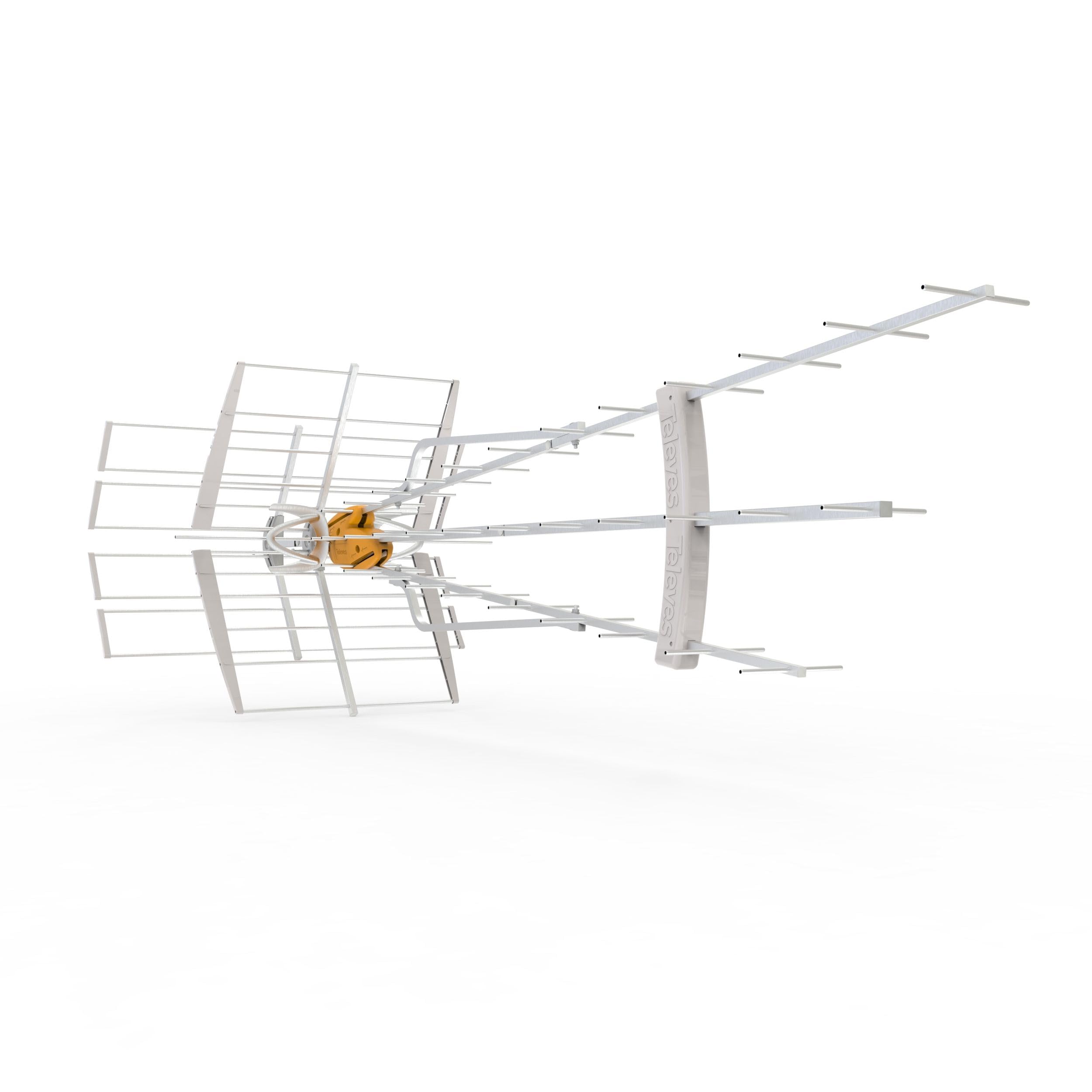
This is the highest-performing antenna in the group by a noticeable margin. The stacked triple-boom design and built-in TForce preamplifier deliver 46 dBi of UHF gain and 38 dBi on high-VHF, which is enough to pull in 80–114 channels 60 miles from Dallas towers even behind tree cover, according to verified installs.
The intelligent gain control automatically adjusts amplification per band so you don’t overload on strong local signals while still digging out weak fringe stations. Integrated LTE, 4G, 5G, and FM filtering clean up interference that causes pixelation on other amplified models, which is critical if you live near a cell tower.
Build quality is top-tier: aluminum elements with stainless steel hardware, a durable ABS housing, and a supplied dual-output power inserter with a weather boot. It measures over 84 inches wide, so plan your mounting space accordingly, and the included mast clamps fit diameters up to 2.4 inches.
Why it’s great
- Highest measured gain of any model tested; outperforms most amplified units in fringe reception
- Automatic band-specific gain control prevents overload while boosting weak signals
- Professional-grade weather sealing with stainless steel hardware and aluminum elements
Good to know
- Large footprint (84 inches wide) demands adequate mounting space
- Premium pricing places it out of range for casual budget buyers
2. Five Star Outdoor HDTV Antenna

The extended 46-inch boom and larger receiving elements give this Five Star antenna a genuine performance edge over shorter passive models in the same price tier. Verified owners 45 miles from Houston towers reported 128 channels after assembly, and a high-elevation install near Sandia Crest pulled 90 channels with 72 crystal clear.
Assembly is straightforward — the VHF vibrator alignment detail (screw heads must face the same direction) is the only step that’s easy to miss if you skip the fine print. The kit includes a mounting bracket, J-pole, and a TV splitter that feeds up to four televisions without needing an additional distribution amplifier over short cable runs.
The design includes a moderate front-to-back ratio that helps reject signals from the rear, reducing multipath ghosting in suburban settings. It’s ATSC 3.0 ready, so you won’t need to swap hardware when NextGen TV broadcasts expand in your area.
Why it’s great
- Long boom length and large elements provide strong UHF and VHF capture at moderate distances
- Supports up to four TVs directly with included splitter
- Solid assembly instructions result in reliable channel counts 45+ miles from towers
Good to know
- Included 40ft coax is shorter than ideal if your run requires longer routing
- Non-amplified design may need a separate preamp for runs over 100 feet
3. GE Outdoor HD Digital TV Antenna 33685

GE’s 33685 is the most popular Yagi in America for a reason: the 80-mile range claim is conservative enough that most buyers in suburban and moderately rural areas report solid reception without fuss. A Seattle owner at only 15 miles mounted it on a shed and got perfect picture quality, while a Colorado user 35 miles out from four separate towers pulled everything clean through a concrete tile roof with no pixelation.
The rugged aluminum construction and weather-resistant J-mount hold up well in exposed roof installations. The assembly requires some attention — the instructions lack detail, but the design is common enough that YouTube videos fill the gap. Owners at 20-25 miles routinely report 90-plus channels without needing an amplifier.
NextGen TV (ATSC 3.0) compatibility future-proofs the unit for when broadcasters in your market switch to the new standard. GE backs this with a limited-lifetime replacement pledge and U.S.-based phone support, which is rare in this category.
Why it’s great
- Proven real-world performance at 20-35 miles; often outperforms its 80-mile rating in practice
- ATSC 3.0 ready with limited-lifetime replacement guarantee
- U.S.-based technical support available by phone during business hours
Good to know
- Assembly instructions are sparse — you’ll likely need to watch a video for guidance
- No amplifier included; long coax runs may require a separate preamplifier
4. Yeceny Digital Amplified HDTV Antenna

The Yeceny stands out because of its built-in 360-degree motorized rotator and wireless remote, which let you turn the antenna from inside your house to lock onto towers in different directions. One owner went from roughly 35 channels with an old fixed antenna to over 80 after installing this unit, simply by rotating toward the strongest signal cluster.
It includes a 60-foot RG6 coaxial cable and a built-in low-noise amplifier, plus support for two televisions without an external splitter. The snap-together construction requires no tools, and the assembly takes under 30 minutes even for someone without prior antenna experience. The rotator is genuinely useful if your local towers are spread across a wide arc and you don’t want to climb onto the roof twice a week.
The main trade-off is durability. The housing is mostly plastic, and several owners reported failure after one year of exposure to heavy rain or snow. At this price point, the expected lifespan is roughly two years before the amplifier or rotator motor gives out, making it a convenient but ultimately disposable option.
Why it’s great
- Wireless remote rotator eliminates the need to manually reposition the antenna
- Supports two TVs without a splitter and includes 60 feet of RG6 coax
- Tool-free snap assembly makes initial setup fast and beginner-friendly
Good to know
- Plastic construction is prone to weather damage; typical lifespan around 2 years outdoors
- Range claim mismatch between packaging (150 miles) and listing (200 miles) raises trust issues
5. McDuory UHD-3968 Outdoor Yagi

The McDuory is a classic LPDA Yagi that works best when your local towers are within 20-25 miles and you want the lowest-cost entry into proper outdoor reception. Owners at 15-20 miles report full signal bars on all major networks with zero pixelation, and the long VHF elements successfully pulled in high-VHF channels 8 and 19 that two previous indoor antennas missed entirely.
Assembly is mostly pre-done, but the remaining steps require a rubber mallet to fully seat the rod elements into their mounting blocks to ensure proper electrical contact. A few owners noted that the hardware can rust over time, so adding a dab of dielectric grease (Penetrox) to the metal joints and sealing the coaxial connection with weatherproof tape is recommended for any outdoor install.
For the entry-level price, you get a functional passive antenna with no amplifier, no rotator, and no frills. It’s a solid proof-of-concept unit if you’re testing whether over-the-air TV works at your location before investing in a more robust or amplified setup.
Why it’s great
- Strong high-VHF performance; picks up channels that many indoor and compact antennas miss
- Low entry cost makes it a risk-free way to test OTA viability at your location
- Lightweight LPDA design is easy to handle and mount on a basic mast
Good to know
- Rod elements must be fully seated with a rubber mallet for proper electrical contact
- Hardware may rust over time; dielectric grease and coax sealing are almost mandatory
FAQ
Can an outdoor antenna work in an attic?
Do I need an amplifier for a Yagi antenna under 40 miles?
Final Thoughts: The Verdict
For most users, the antenna for outdoor tv winner is the Televes DAT BOSS Mix LR because its TForce amplifier and triple-boom design deliver the best raw gain and interference filtering in fringe conditions. If you want a proven mid-range workhorse with ATSC 3.0 readiness, grab the GE Outdoor Yagi 33685. And for a motorized setup that lets you chase signals from multiple directions without climbing onto the roof, nothing beats the Yeceny Amplified Rotator.

Mo Maruf
I created WellFizz to bridge the gap between vague wellness advice and actionable solutions. My mission is simple: to decode the research and give you practical tools you can actually use.
Beyond the data, I am a passionate traveler. I believe that stepping away from the screen to explore new environments is essential for mental clarity and physical vitality.