Our readers keep the lights on and my smoothie glass nicely filled. As an Amazon Associate, I earn from qualifying purchases.
You rely on your nose to tell you when the air is bad, but by the time you smell smoke, VOCs from fresh paint, or mustiness from poor ventilation, you’ve already been breathing particulates and gases for minutes or hours. An air quality sensor removes the guesswork, giving you real-time data on invisible threats like rising CO₂ that makes you drowsy, PM2.5 from cooking, or formaldehyde off-gassing from new furniture. The difference between feeling sluggish and focused often comes down to a number you can’t see — until now.
I’m Mohammad Maruf — the founder and writer behind WellFizz. I’ve spent years analyzing environmental sensor hardware, from NDIR CO₂ modules to laser particle counters, comparing accuracy specs, response times, and smart-home integration across dozens of models so you don’t have to sort through the marketing noise.
Whether you’re fighting brain fog in a home office or protecting a nursery from hidden pollutants, this guide breaks down the specs that matter so you can confidently pick the right best air quality sensor for your space without overpaying for features you won’t use.
How To Choose The Best Air Quality Sensor
The ideal sensor depends on which pollutants matter most to your environment. A bedroom plagued by CO₂ buildup at night needs a different device than a workshop filling with sawdust. Before you click buy, match the sensor type to your specific air quality problem.
Match the Sensor to the Pollutant
Laser particle counters excel at detecting PM2.5, PM1.0, and PM10 — think dust, smoke, and pollen. If you’re monitoring a woodshop or an urban apartment near a busy road, prioritize a monitor with a high-accuracy PM sensor (look for ±15 µg/m³ or better). For carbon dioxide, you need an NDIR sensor (non-dispersive infrared), which measures CO₂ specifically and accurately. Units like the SwitchBot Meter Pro CO₂ use Swiss-made NDIR sensors for ±50 ppm accuracy. If formaldehyde (HCHO) or TVOCs are your concern — common after renovations or in new furniture setups — choose a sensor with dedicated electrochemical or photoionization detection for those gases, not just a PM sensor that ignores them.
Refresh Rate and Response Time
A sensor that updates every 1–2 seconds catches spikes instantly, like a burst of smoke from cooking or a sudden CO₂ rise from a full meeting room. Slower refresh modes (5–30 minutes) save battery but can miss transient events entirely. If you need real-time awareness for health reasons or smart-home triggers, aim for a response time under 5 seconds. The GoveeLife H5106 refreshes in 2 seconds, while the Temtop S1 offers multiple modes from 1.5 seconds to 30 minutes depending on whether you want speed or battery longevity.
Smart Home Integration and Data Export
Many modern sensors connect via Wi-Fi or Bluetooth to trigger fans, purifiers, or humidifiers automatically when thresholds are breached. If you already have smart appliances, check compatibility before buying — the GoveeLife H5140 links with humidifiers and tower fans but specifically cannot link to air purifiers (which don’t reduce CO₂). Data logging matters if you track trends over weeks: look for built-in storage or app-based graphs. Models like the GoveeLife H5106 export up to two years of data via CSV, useful for medical consultations or energy-efficiency audits. Standalone units without connectivity still provide real-time display but lack remote monitoring and historical trending.
Quick Comparison
On smaller screens, swipe sideways to see the full table.
| Model | Category | Best For | Key Spec | Amazon |
|---|---|---|---|---|
| GoveeLife H5106 | Multi-Sensor | Smart-home purifier integration | 2-second PM2.5 refresh | Amazon |
| Temtop S1 (2-Pack) | Portable PM2.5 | Multi-room battery monitoring | Up to 25-day battery life | Amazon |
| SwitchBot Meter Pro CO2 | CO2 Focus | CO₂ and ventilation tracking | NDIR ±50 ppm accuracy | Amazon |
| GoveeLife H5140 | CO2 Smart | Office/bedroom CO₂ alerts | SCD4x NDIR ±40 ppm | Amazon |
| YNAK 16-in-1 | Full Lab | Comprehensive pollutant panel | 7-inch display, 9 parameters | Amazon |
| KDWKD AK23CA | Broad Spectrum | PM0.3–PM10 + VOCs | 9-hour battery, 6 particle sizes | Amazon |
| YNAK AK22A (Upgraded) | Extended Battery | All-day portable monitoring | 12-hour, 3500mAh battery | Amazon |
In‑Depth Reviews
1. GoveeLife Smart Air Quality Monitor H5106

The GoveeLife H5106 balances accuracy, smart-home integration, and price better than any other unit in this roundup. Its PM2.5 sensor delivers ±15 µg/m³ accuracy with a 2-second refresh — fast enough to catch a dust cloud from vacuuming or a spike from cooking bacon. The LED display cycles through clock, PM2.5, temperature, and humidity, and a four-level color indicator gives an instant visual read on ambient air quality. It connects seamlessly to GoveeLife air purifiers and humidifiers, enabling automatic appliance triggers when pollutants rise above your preset threshold. Remote monitoring via Wi-Fi works reliably, and the 2-year data export via CSV is a legit bonus for trend-trackers or health documentation.
Setup takes under five minutes: plug in the Type-C cable, open the GoveeHome app, and the device pairs over 2.4 GHz Wi-Fi. The display brightness adjusts with a long press, and a night mode dims the screen to avoid sleep disruption. Unlike battery-powered units, this monitor needs constant AC power — a trade-off for uninterrupted 24/7 monitoring. At 5.31 x 1.57 x 2.47 inches, it’s compact enough for a nightstand or desk without dominating the space, and the 0.34-pound weight makes it easy to relocate if needed.
Customer reviews consistently highlight the device’s ability to visually confirm air quality changes — one user running it in a workshop saw PM2.5 readings spike instantly when sanding or painting. The auto-trigger feature works about 70-80% of the time per feedback, with occasional missed activations that may require a router closer than 30 feet. For most homes and offices, this sensor is the gold standard of value.
Why it’s great
- 2-second refresh catches pollution spikes instantly
- Seamless auto-trigger with GoveeLife purifiers and humidifiers
- Two-year data export available via CSV
Good to know
- Requires constant AC power — no battery backup
- Auto-activation may miss about 30% of triggers per some users
2. Temtop S1 2-Pack Indoor Air Quality Monitor
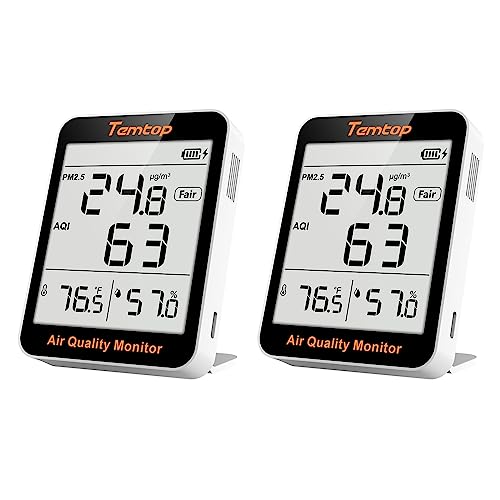
Each monitor has a 3.3-inch LCD that displays PM2.5, AQI, temperature, and humidity with large digits readable from across the room. A built-in fan draws air across a laser sensor for real-time particle counts, and the magnetic back plate lets you stick the unit on a fridge or metal surface without wall-mount hardware. Four modes — Real-time (12-hour battery), Interval (4 days), Smart (12 days), and Power-saving (25 days) — let you dial in the balance between update frequency and runtime.
The lack of Wi-Fi or Bluetooth connectivity is the main trade-off — there’s no app, no remote monitoring, and no data export. You read the screen and use the information in the moment. For someone who just wants to check air quality while cooking or see if a bedroom needs ventilation before sleep, that’s sufficient. But if you want historical trends or smartphone alerts, this isn’t the right pick. The interface is dead simple: one button cycles through modes, and the air quality indicator shows Poor/Fair/Good at a glance.
Reviewers consistently praise accuracy within the spec’s margin of error, with one user cross-checking against a professional unit and confirming the S1 held within ±5 PPM at low PM2.5 levels. The rechargeable USB-C battery is a practical convenience, and the compact dimensions (0.7 x 2.7 x 3.5 inches) make it easy to toss in a bag for hotel rooms or temporary spaces. For budget-conscious buyers who want reliable PM2.5 data across multiple rooms, this 2-pack is a straight win.
Why it’s great
- Two monitors cover multiple rooms for the same cost as one premium unit
- Up to 25-day battery in power-saving mode
- Magnetic back plate allows easy placement without drilling
Good to know
- No Wi-Fi, Bluetooth, or app connectivity
- Only measures PM2.5 — no CO₂, VOCs, or formaldehyde
3. SwitchBot Meter Pro CO2 Detector

The SwitchBot Meter Pro CO2 uses a Swiss-made NDIR sensor with ±50 ppm accuracy across a 400–9000 ppm range — one of the most reliable CO₂ measurements you’ll find at this price point. The 92mm large screen simultaneously displays CO₂, temperature, humidity, time, date, and a comfort level icon, eliminating the need to toggle between menus. Customizable alarms (sound, visual, and app notification via the SwitchBot Hub) trigger when CO₂, temperature, or humidity exceeds your set thresholds, making it a practical tool for offices where stuffy air kills afternoon productivity or greenhouses that need precise CO₂ management.
Battery life is the headline feature here: up to 12 months on two AA batteries. That’s because the sensor checks CO₂ every 5 minutes in battery mode (1-minute refresh when plugged in via USB-C). For most use cases, a 5-minute refresh is sufficient to detect problematic CO₂ trends — you don’t need sub-second updates for a gas that builds slowly from human respiration. The design is minimalist and logo-free, with wall-mount holes and an adjustable kickstand for desks. At 3.62 x 3.62 x 0.98 inches and 4.8 ounces, it’s unobtrusive enough for any room.
Users have cross-validated readings against premium devices like the Aranet4 and reported deviation within 50–100 ppm initially, though one unit drifted 400 ppm after a week (customer service resolved it quickly). The device is best used on battery power for consistent accuracy; plugging it in can occasionally freeze readings, per reviewer feedback. If CO₂ is your primary concern — for sleep quality, classroom ventilation, or office productivity — this is the most accurate and long-lasting dedicated CO₂ monitor on this list.
Why it’s great
- Swiss-made NDIR sensor delivers ±50 ppm CO₂ accuracy
- 12-month battery life on two AA batteries
- Customizable triple-alert system (sound, screen, app)
Good to know
- No particulate (PM2.5) sensor — CO₂ only
- Plug-in mode may freeze readings; best used on battery
4. GoveeLife Smart CO2 Monitor H5140
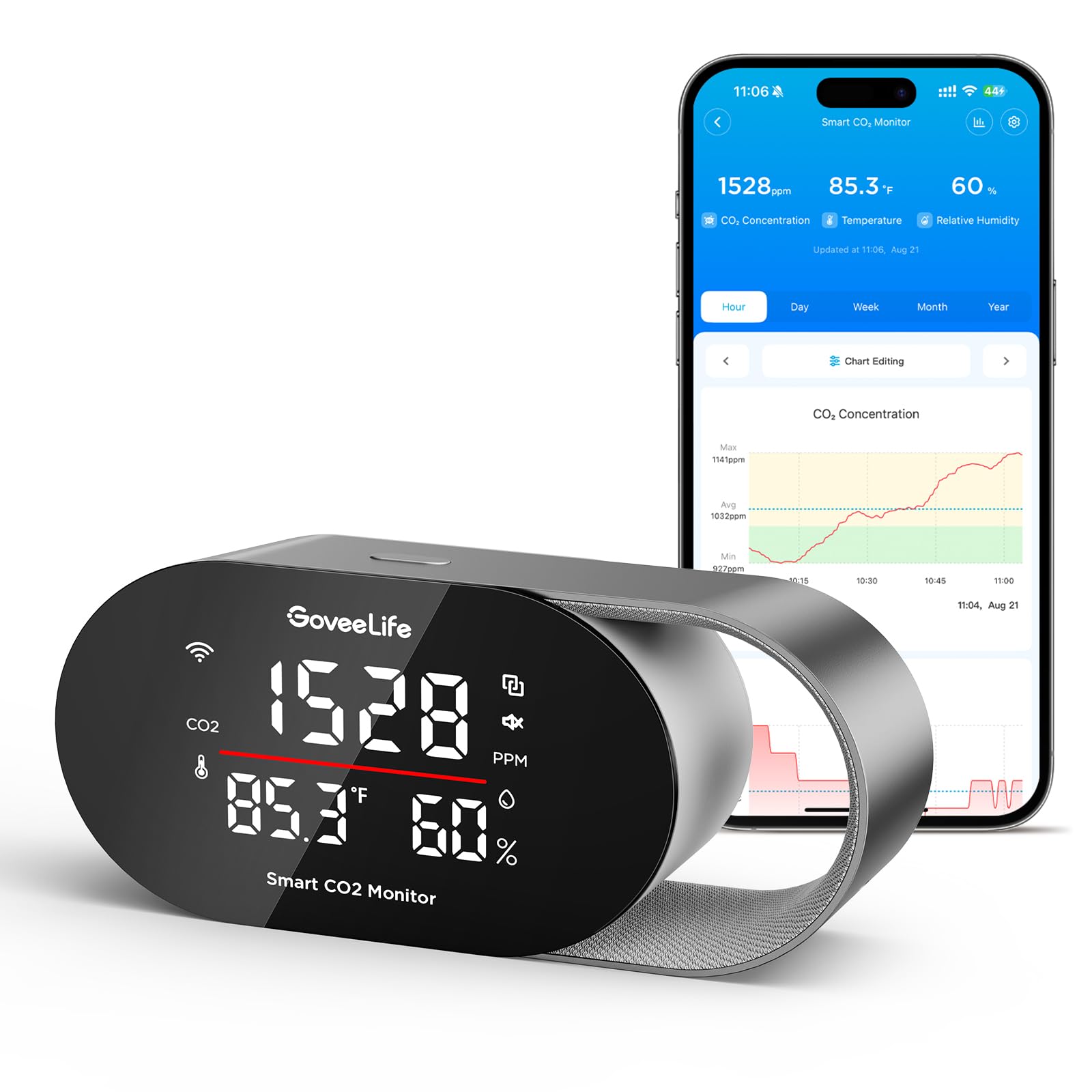
The GoveeLife H5140 is the CO₂-focused sibling in Govee’s lineup, equipped with the Sensirion SCD4x sensor — a photoacoustic NDIR chip known for ±(40 ppm + 5%) accuracy with built-in altitude compensation. That’s a measurable step up in precision from the SwitchBot’s ±50 ppm spec, and the 5-second refresh keeps you aware of CO₂ changes faster than the SwitchBot’s 5-minute battery cycle. The 4.82-inch display shows CO₂, temperature, humidity, and dew point, plus a tri-color light bar that adjusts brightness on a day/night schedule to avoid disturbing sleep. It’s AC-powered only — no battery option — which guarantees uninterrupted monitoring but limits placement to near an outlet.
Smart integration is the H5140’s strongest asset. It connects to Alexa and Google Assistant for voice queries and links with GoveeLife humidifiers and tower fans for automatic environmental correction when CO₂ climbs. Note the critical constraint: air purifiers cannot reduce CO₂, so the device won’t link to them — a point many buyers miss. The triple-alert system (buzzer, app notification, email report) ensures you’re notified even if you’re away from the display. Two-year data tracking via CSV export is identical in scope to the H5106, but with a CO₂ focus that’s more actionable for cognitive performance than particulate monitoring alone.
Reviewers consistently report noticeable improvements in alertness after using the H5140 to time ventilation — one WFH user described it as a “must-have” for tracking brain fog triggers during meetings. The only recurring complaint is occasional Wi-Fi connectivity dropouts when placed far from the router, which is common across all smart sensors. For anyone serious about sleep quality, nursery safety, or office productivity, the H5140’s NDIR accuracy and smart automation capabilities make it the best CO₂-focused choice on the market today.
Why it’s great
- Sensirion SCD4x sensor with ±(40 ppm + 5%) accuracy and altitude compensation
- Smart automation with GoveeLife humidifiers and tower fans
- Triple-alert system with customizable day/night display
Good to know
- AC-powered only — no battery option for placement flexibility
- Does not link to air purifiers (purifiers don’t reduce CO₂)
5. YNAK 16-in-1 Air Quality Monitor AK22A
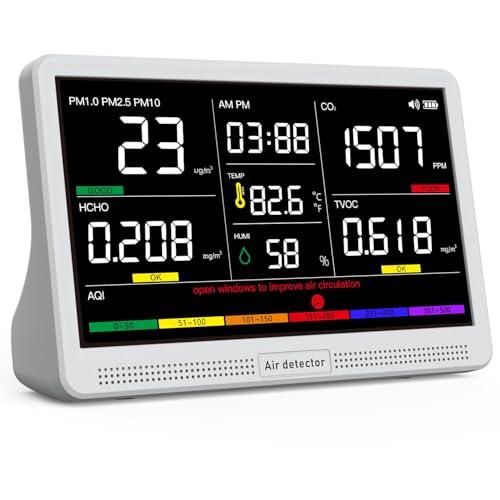
The YNAK 16-in-1 is the most comprehensive air quality sensor on this list, measuring nine parameters — CO₂, PM2.5, PM1.0, PM10, HCHO (formaldehyde), TVOC, temperature, humidity, and AQI — all on a single 7-inch LED display that shows every metric simultaneously without menu navigation. The external high-precision sensor array claims 0.001-unit accuracy sensitivity, and the multi-sensor airflow design catches rapid changes: one reviewer noted it detected vape smoke and UV printer fumes within 3–7 seconds, comparable to much pricier professional gear. The 2500mAh battery delivers up to 8 hours of cordless operation, and the mute button silences the seven distinct AQI alert buzzers when needed.
Setup is refreshingly simple — no app required if you just want the display. Three brightness settings adapt to ambient light, and the color-coded AQI line (green smiley at good through dark at 150–500) gives instant visual context. The unit is larger and heavier (1.48 pounds, 7.91 x 5.59 x 2.95 inches) than single-parameter monitors, so it’s not pocketable, but the size is justified by the information density. A few users reported that Wi-Fi and mirror features are not well-documented in the manual, and one reviewer noted the sensor failed to detect strong chemical cleaner fumes — potentially a calibration variance or unit-specific issue.
For anyone with multiple pollutant concerns — post-renovation formaldehyde, urban PM2.5, office CO₂, and general VOCs — this is the only single device that covers all bases without requiring a second sensor. The 8-hour battery is adequate for a full workday or overnight monitoring, and the included USB-C adapter charges it fully in about three hours. If you want a complete picture of your indoor air without buying three separate monitors, the YNAK 16-in-1 is the definitive choice.
Why it’s great
- Comprehensive 9-parameter detection in one display
- External high-precision sensor array with 0.001-unit sensitivity
- No app required — all data visible on the 7-inch screen
Good to know
- Larger footprint — not suitable for tight desks or bedside tables
- Wi-Fi/mirror features lack detailed documentation
6. KDWKD AK23CA Indoor Air Quality Monitor
The KDWKD AK23CA stands out for its granular particulate detection — it measures six particle size categories from PM0.3 through PM10, plus CO₂, formaldehyde (HCHO), TVOC, benzene (C6H6), temperature, and humidity. This level of particle-size segmentation is critical for identifying the specific type of airborne contaminant: PM0.3–0.5 penetrates deep into lung tissue, while PM5–10 is more associated with dust and pollen. The 3-inch digital display cycles through each parameter, and a built-in audible alarm triggers when any reading exceeds your chosen threshold. The ABS enclosure is lightweight and durable, measuring 5 x 3 x 2 inches with a 9-hour rechargeable battery for room-to-room portability.
Despite the impressive spec list, the AK23CA has a sparse user review base — the few existing reviews are mostly from unrelated products (cable railing systems), which raises questions about the listing’s legitimacy and the sensor’s real-world reliability. The manufacturer, KDWKD, is a less established brand compared to Govee or SwitchBot, meaning customer support and firmware updates may be less responsive. The unit does include a USB-C charging adapter and manual, but there’s no mention of Wi-Fi, app connectivity, or data export — this is strictly a standalone real-time display device.
If your priority is detecting the widest range of particle sizes and gases on a budget, the AK23CA’s sensor diversity is unmatched at this price tier. But the lack of community validation and brand track record makes it a higher-risk purchase than the more established options above. It’s best suited for users who need a quick, portable snapshot of multiple pollutants and don’t require smart-home integration or long-term data tracking.
Why it’s great
- Detects six particle sizes from PM0.3 to PM10 plus CO₂, HCHO, TVOC, and benzene
- 9-hour rechargeable battery for multi-room use
- Audible alarm for threshold exceedances
Good to know
- Limited user reviews and brand support history
- No Wi-Fi, app, or data export functionality
7. YNAK Upgrade AK22A Extended Battery Monitor
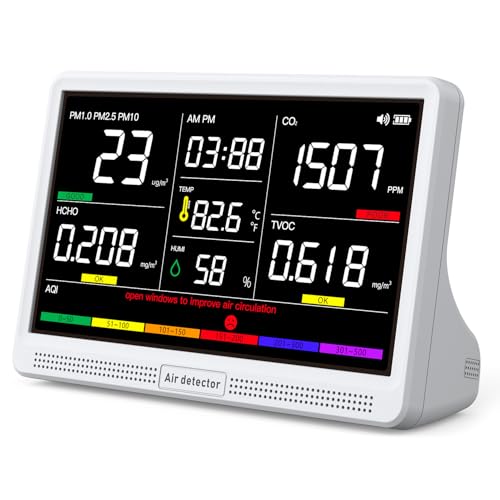
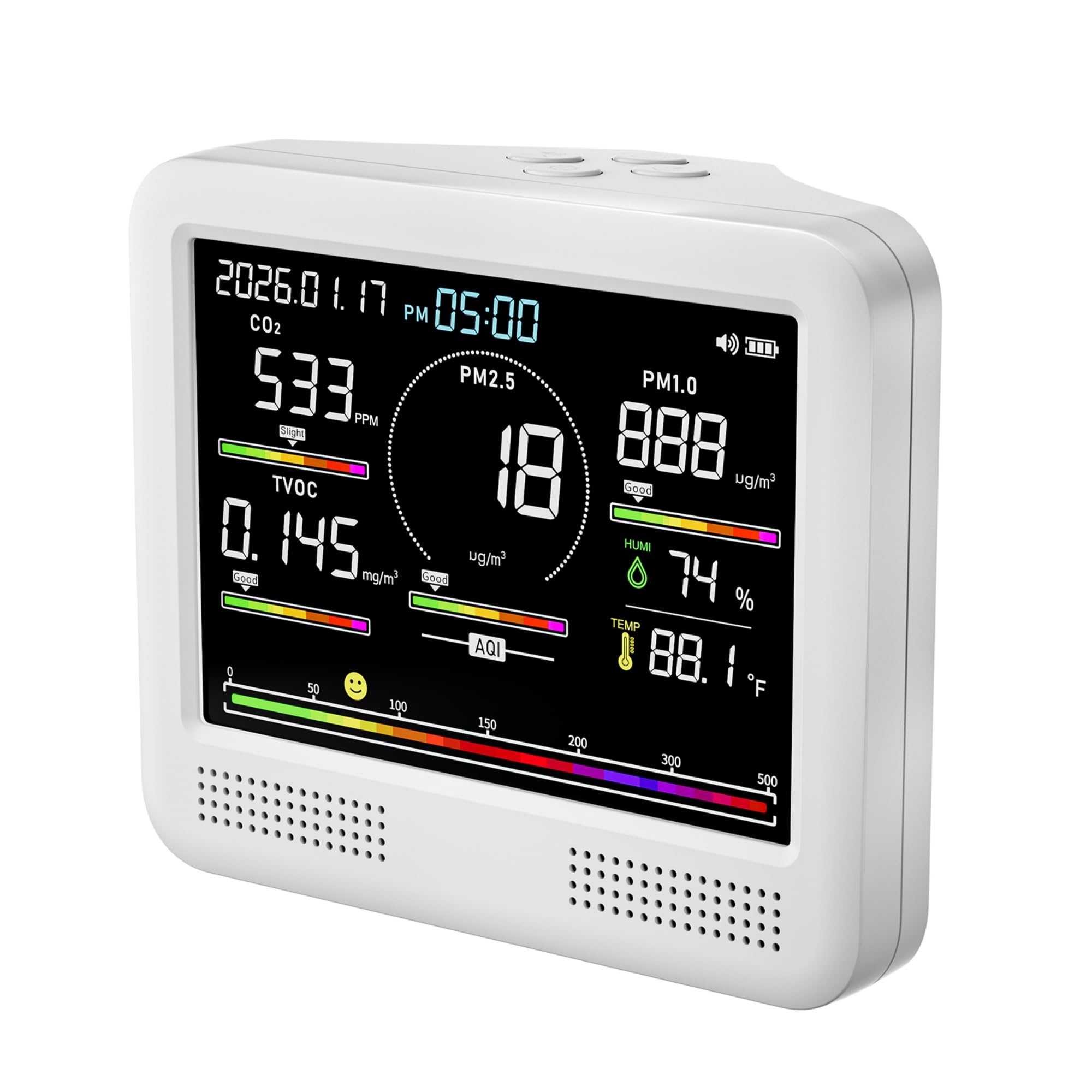
The YNAK Upgrade AK22A is essentially the same 16-in-1 sensor panel as the standard AK22A, but with a larger 3500mAh battery that extends cordless runtime from 8 to 12 hours — a meaningful upgrade for all-day monitoring without hunting for an outlet. It measures the same nine key parameters (CO₂, PM2.5, PM1.0, PM10, HCHO, TVOC, temperature, humidity, AQI) on a 7-inch LED display with three brightness settings. The external high-precision sensor array with 0.001-unit sensitivity is identical to the standard model, as is the multi-sensor airflow design that detects changes within seconds. Seven AQI alert buzzers with a mute button provide audible warnings when pollutant levels cross set thresholds.
The extended battery makes this the better choice for users who want to move the sensor between rooms throughout the day — from the bedroom in the morning to the home office during work hours to the nursery at night — without recharging mid-day. The package includes a USB-C cable and adapter, and full charge takes approximately three hours. Like the standard AK22A, this unit doesn’t require a smartphone app to function; all readings are displayed live on the screen. The weight is similar at 1.52 pounds, and the dimensions (7.91 x 5.59 x 2.95 inches) are identical, so it’s still a desktop-sized device, not a pocket monitor.
User reviews mirror the standard AK22A’s feedback: fast, accurate readings for CO₂, PM, and VOCs, with sensitivity to cooking, candles, and cleaning products. The battery upgrade is the sole differentiator, and for an additional investment, it delivers exactly that — four more hours of untethered operation. If you don’t need the extra runtime, the standard model offers identical performance. But for serious whole-home monitoring without a power cord tether, this upgraded version justifies the bump.
Why it’s great
- 12-hour battery covers a full day of multi-room monitoring
- Same comprehensive 9-parameter detection as the standard AK22A
- Fast 3–7 second response to pollution events
Good to know
- Wi-Fi and mirror features lack documentation
- Larger footprint than single-parameter sensors
FAQ
What is the best air quality sensor for detecting brain fog from CO₂?
Can an air quality sensor detect mold or mildew?
Do I need a sensor that measures formaldehyde (HCHO)?
How often should I calibrate my air quality sensor?
What is the difference between TVOC and CO₂ sensors?
Final Thoughts: The Verdict
For most users, the best air quality sensor winner is the GoveeLife H5106 because it combines fast 2-second PM2.5 refresh, reliable Wi-Fi connectivity, and seamless smart-home integration with GoveeLife purifiers and humidifiers at a price that undercuts many less-capable competitors. If you want the deepest data panel without sacrificing portability, grab the YNAK Upgrade AK22A for its 9-parameter detection and 12-hour battery — ideal for whole-home monitoring. And for pure CO₂ accuracy with a focus on cognitive performance and sleep quality, nothing beats the GoveeLife H5140 and its Sensirion SCD4x sensor.

Mo Maruf
I created WellFizz to bridge the gap between vague wellness advice and actionable solutions. My mission is simple: to decode the research and give you practical tools you can actually use.
Beyond the data, I am a passionate traveler. I believe that stepping away from the screen to explore new environments is essential for mental clarity and physical vitality.