Our readers keep the lights on and my smoothie glass nicely filled. As an Amazon Associate, I earn from qualifying purchases.
Mobile homes present a unique challenge for cooling. With thinner walls, less insulation, and often odd-sized windows, a standard window unit from the big-box store can feel like a losing battle against the heat. The right air conditioner for a mobile home needs to match the structure’s specific cooling load, ductwork limitations, and window dimensions without causing excessive strain on the electrical system. Choosing wrong means high energy bills, uneven cooling, or a unit that simply can’t keep up.
I’m Mohammad Maruf — the founder and writer behind WellFizz. I’ve spent years analyzing hardware specifications and energy consumption data across hundreds of residential cooling products to match real-world home structures with the best performing equipment. This guide focuses on mobile home specific factors like narrow window openings, low-height casings, and limited wall space for through-wall installations.
After evaluating efficiency ratings, cooling capacities, and installation requirements across multiple types of units, I’ve narrowed down the options to deliver a clear view of the best ac for mobile home setups that actually work with the realities of manufactured housing.
How To Choose The Best AC For Mobile Home
Mobile homes, built to HUD code, have different construction standards than traditional site-built houses. The walls are typically 2×3 or 2×4 studs with less insulation value (R-13 or lower), and the roof is often a metal or single-ply membrane with limited attic space. These factors mean your cooling system faces a higher thermal load per square foot. Before buying any unit, you need to consider BTU sizing, voltage compatibility, window dimensions, and installation type — each one affects whether the unit will work or just sit there blowing lukewarm air.
BTU Capacity and Room Size Matching
Standard BTU calculators assume decent insulation and standard ceiling heights. For a mobile home, you generally want to size up by about 10–20% compared to a standard home calculator. A 700 sq. ft. mobile home section often needs around 12,000 to 14,000 BTU, especially if it has several windows or is located in a hot climate. Undersizing means the compressor runs constantly without reaching the set temperature, which drives up electricity bills and wears out the unit faster.
Window Dimensions and Form Factor
Mobile home windows are often narrower (23 to 28 inches wide) and shorter (14 to 16 inches tall) than standard residential double-hung windows. Many window ACs are designed for 24-inch wide openings, but some budget units require wider frames. If your mobile home uses slider windows, you need a unit that supports horizontal installation or you must build an adapter frame. Always check the minimum window width and height in the specs — this is where portable ACs or mini-splits become the easier option for many mobile home layouts.
Voltage and Electrical Load Considerations
Most mobile homes have 120V outlets in the living areas, but larger window ACs (over 12,000 BTU) often require a 230V dedicated circuit. If your mobile home’s electrical panel is already loaded with appliances, you might trip breakers frequently with a high-wattage window unit. Portable ACs and smaller mini-splits (9,000 BTU and below) operate on standard 115V outlets, making them a drop-in solution without electrical upgrades. If you’re considering a 230V mini-split like the MRCOOL or Cooper & Hunter, factor in the cost of running a new circuit from the panel.
Installation Type: Window vs Portable vs Mini-Split
Window units are the cheapest upfront but often require permanent modifications to the window frame or a custom-built wooden filler to fit the gap. Portable ACs connect to a window with a kit (no permanent modification) and can be moved from room to room, but they tend to be less efficient because the compressor and electronics are inside the living space. Mini-splits involve a wall penetration but offer the highest efficiency (SEER2 ratings over 20) and the quietest operation because the compressor sits outside. For a long-term mobile home setup like a park model or rental unit, a mini-split delivers the best return on comfort and energy savings.
Quick Comparison
On smaller screens, swipe sideways to see the full table.
| Model | Category | Best For | Key Spec | Amazon |
|---|---|---|---|---|
| LG 14,000 BTU DUAL Inverter | Window | Large rooms up to 800 sq ft | 14,000 BTU / 44 dB in sleep mode | Amazon |
| Midea Duo 14,000 BTU | Portable | Whole-room cooling with heat | 12,000 BTU SACC / dual hose-in-hose | Amazon |
| Gasbye Dual Hose Inverter | Portable | Efficiency and low noise | 13.6 CEER / 45 dB inverter mode | Amazon |
| ROVSUN 9000 BTU Mini Split | Mini-Split | Small rooms and DIY install | 9000 BTU / 28 dB mute mode | Amazon |
| Confortotal 12000 BTU Mini Split | Mini-Split | Medium spaces up to 750 sq ft | 12,000 BTU / 110V plug-in | Amazon |
| Friedrich CCW15B10A | Window/Wall | Permanent in-wall installation | 15,000 BTU / slide-out chassis | Amazon |
| DREO 515S Portable | Portable | Quiet drainage-free cooling | 8,000 BTU SACC / 45 dB | Amazon |
| Electactic 8000 BTU Window | Window | Entry-level small room cooling | 8,000 BTU / 51 dB operation | Amazon |
| BLACK+DECKER 8,500 BTU Portable | Portable | Compact budget-friendly cooling | 5,100 BTU SACC / R-32 refrigerant | Amazon |
| Cooper & Hunter 18K Dual Zone | Mini-Split | Dual-room coverage in one system | 18,000 BTU / 22.5 SEER / 230V | Amazon |
| MRCOOL 18,000 BTU DIY | Mini-Split | DIY whole-home or garage cooling | 18,000 BTU / pre-charged quick-connect | Amazon |
In‑Depth Reviews
1. LG 14,000 BTU DUAL Inverter Window Air Conditioner
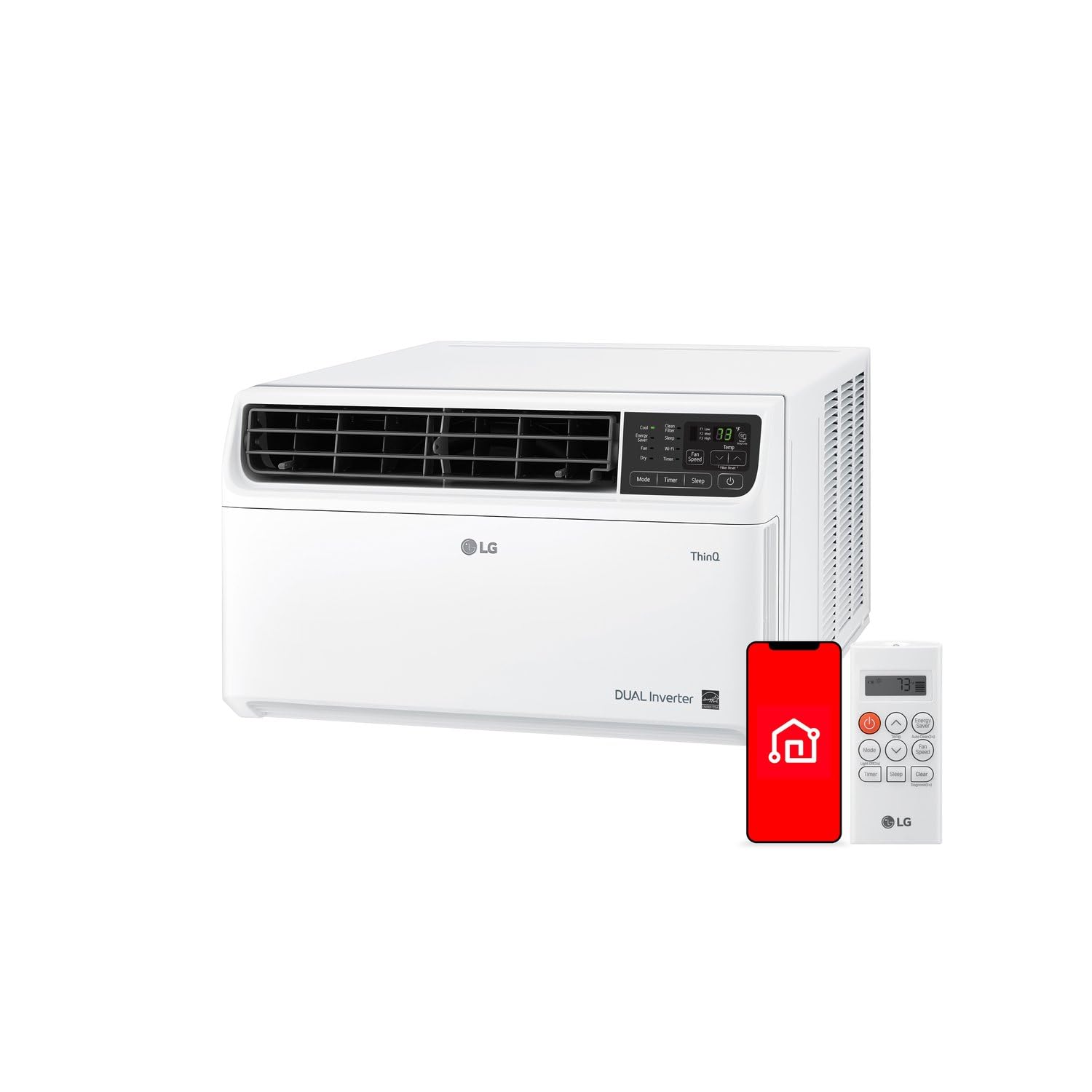
The LG 14,000 BTU DUAL Inverter window AC is a powerhouse for large rooms in a mobile home, covering up to 800 sq. ft. with genuine cold air. Its variable-speed rotary compressor paired with a BLDC motor drops the sound level to just 44 dB in sleep mode, which is quieter than most refrigerators. The unit uses R-32 refrigerant and claims up to 35% more energy savings than the Energy Star minimum, making it one of the most efficient window units on the 115V market.
Installation requires a double-hung window at least 23 inches wide, which fits many mobile home frames but be mindful of the 15.25-inch height requirement — some short mobile home windows may need a low-profile mount. The LG ThinQ app provides real-time energy monitoring, scheduling, and voice control via Alexa or Google Assistant, so you can cool the bedroom before walking in from the heat. The washable dust filter and self-cleaning function reduce maintenance frequency compared to units that require manual fin cleaning.
The main trade-off is weight — this unit is heavy and requires a solid window sill or bracket support. Some users report shipping damage due to insufficient packaging, so inspect the fins and chassis immediately upon arrival. The fixed-chassis design means you cannot slide the unit out without removing the entire frame from the window, making off-season storage more involved than a portable unit.
Why it’s great
- Extremely quiet operation at 44 dB in sleep mode
- Smart app control with energy usage tracking
- High efficiency inverter saves on monthly bills
- Washes dust filter without replacing
Good to know
- Heavy and bulky, must check window weight limits
- Requires minimum 23″ window width
- Packaging can be inadequate, inspect on delivery
- No heating function for winter use
2. Midea Duo 14,000 BTU Portable Air Conditioner with Heat

Midea’s Duo design uses a dual hose-in-hose configuration that pulls intake and exhaust air from the same double-wall hose, preventing the negative pressure problem that plagues single-hose portables. This allows the 12,000 BTU SACC rating (14,000 BTU ASHRAE) to cool rooms up to 550 sq. ft. efficiently without pulling hot air from adjacent rooms. The inverter compressor gives it faster pull-down and maintains a steady temperature without the on-off cycling that makes cheap units feel wavy.
One major advantage for mobile home owners is the built-in heat pump, which works down to 41°F outside. That means this single unit can handle both summer cooling and shoulder-season heating without installing a separate space heater. The window kit adapts to both sliding and double-hung windows (minimum opening width 16.5 inches), and the unit itself stands 34.5 inches tall — make sure your floor-to-window gap can accommodate the vertical height.
The remote control requires AAA batteries (not included), and some users note that the Matter/HomeKit integration is less reliable than the native SmartHome app. The unit is heavy at 77 pounds, so moving it from room to room is not a casual task. The startup fan is louder than expected during the first minute before the inverter settles into quiet mode. If you plan to use the heating function extensively in freezing temperatures, note that the heat pump efficiency drops sharply below freezing.
Why it’s great
- Dual hose minimizes inefficiency from negative pressure
- Heat pump extends usability into spring and fall
- Inverter technology reduces energy consumption by over 40% vs federal std
- Quiet operation in steady-state cooling mode
Good to know
- Very heavy at 77 lbs, not easy to relocate
- Startup fan burst is noticeably loud for about a minute
- Smart home integration may have compatibility issues
- Heat pump struggles below 41°F outdoor temps
3. Gasbye Dual Hose Portable Air Conditioner 14,000 BTU
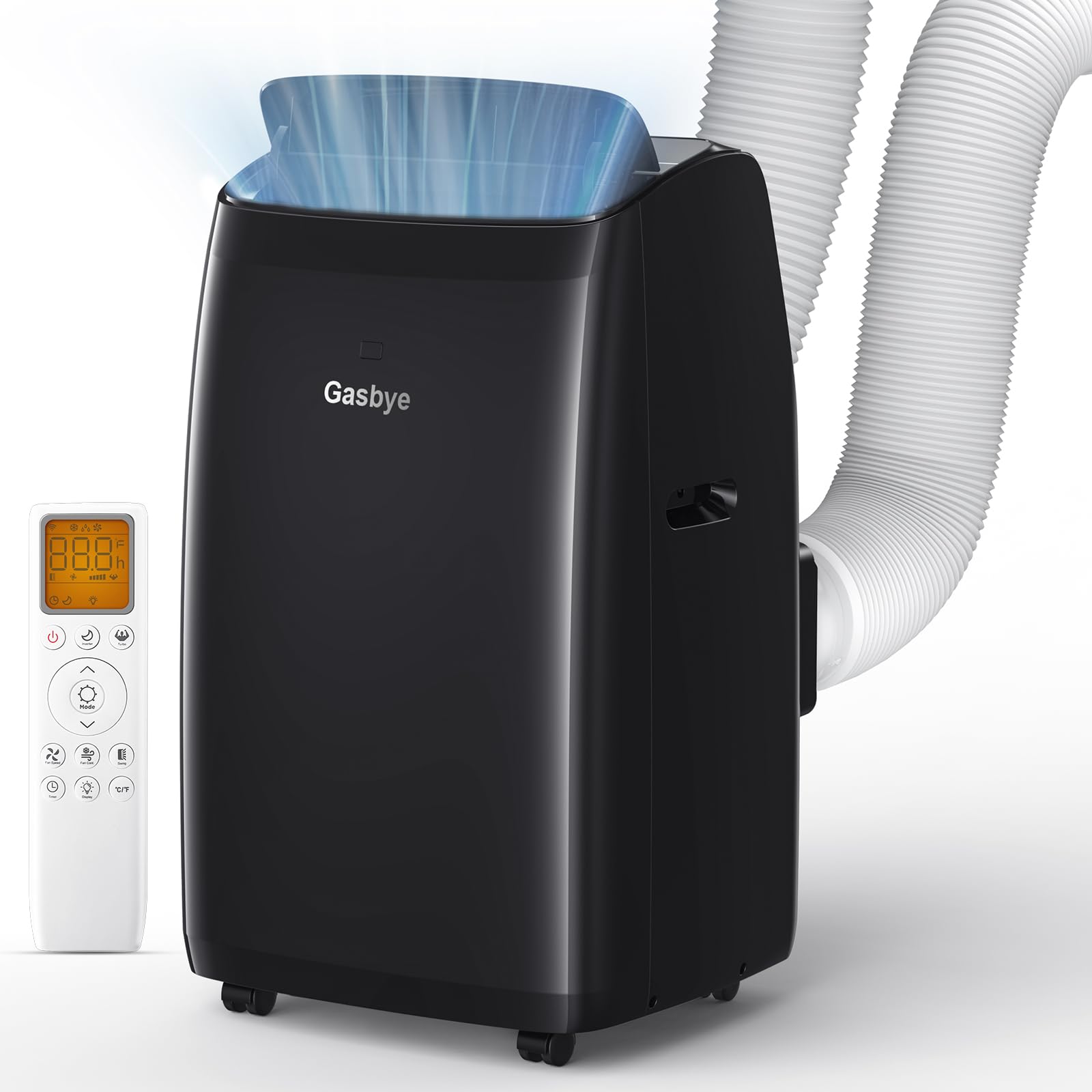
The Gasbye dual hose unit delivers a true 10,500 BTU SACC rating (14,000 BTU ASHRAE) with a full DC inverter compressor that adjusts its output from 500 to 800 watts in inverter mode for mild nights, and up to 1,300 watts in turbo mode for extreme afternoons. That adaptive load is perfect for mobile homes where the electrical panel may be near capacity — using 500 watts instead of a fixed 1,300 makes a measurable difference for a 15-amp circuit.
Noise levels drop to approximately 45 dB in inverter mode, which is low enough for uninterrupted sleep. The unit’s display-off feature and backlit remote make it easy to use in the dark without phone glare. The dual 5.9-inch diameter hoses (59 inches long) provide faster heat exchange than the skinny hoses on cheaper units, but the length is not extendable — if your window is higher than the AC’s placement, you might need to set the unit on a sturdy stand to reduce resistance.
The 3-year warranty and responsive customer support (reported response within 12 hours) is a standout for a brand at this price. Some users note that the thermostat sensor is located above the hot discharge line, which can cause the unit to overcool if not shielded with a simple foil enclosure. The window kit is thin plastic and may need reinforcement with foam tape for a proper seal in older windows.
Why it’s great
- Full DC inverter provides variable power from 500W to 1300W
- 13.6 CEER rating is among the highest for portable units
- Backlit remote and display-off mode ideal for bedrooms
- 3-year full refund or replacement policy
Good to know
- Thermostat sensor placement can cause overcooling if unmodified
- Window kit is thin plastic, may need reinforcement
- Hoses are non-extendable, placement matters
- Unit is large (29.3″ tall) — floor space required
4. ROVSUN 9000 BTU WiFi Mini Split Air Conditioner & Heater

The ROVSUN 9000 BTU mini-split uses inverter technology to achieve a 19 SEER rating, offering substantial energy savings over a window unit of the same capacity. It covers up to 400 sq. ft., which is ideal for a mobile home master bedroom or living area. The indoor unit operates at 28 dB in mute mode — that is barely audible, far quieter than any portable or window AC. The heat pump function works down to 5°F, providing year-round comfort in a single wall-mounted unit.
Installation requires a 2.5-inch hole through the wall for the line set, which may be easier in a mobile home’s thin exterior wall compared to a brick or stucco house. The included 16.4-foot pre-flared copper line set and signal cord, plus a drain hose, cover most layouts. The unit works with both the remote and the Smart Life app, plus voice control via Alexa and Google Assistant. The 115V power requirement means no electrician needed for most mobile home receptacles — just a standard 15-amp outlet.
The main catch is that ROVSUN recommends professional installation, and many users report that the instructions skip critical steps like proper vacuum pump preparation and leak testing. You will need a vacuum pump and manifold gauge set (around extra) if you install it yourself. Some users also report that the compressor can become louder after a year of operation, though the heating and cooling functions continue to perform reliably.
Why it’s great
- Ultra-quiet 28 dB mute mode operation
- 19 SEER inverter efficiency lowers energy bills
- Heat pump effective down to 5°F outdoor temp
- 115V plug-in — no 230V wiring needed
Good to know
- Professional installation recommended, not a true DIY unit
- Instructions lack vacuum and leak test details
- Some units reported compressor noise increase over time
- Prefilled R-410A charge may not be exact for your line set length
5. Confortotal 12000 BTU Mini Split Air Conditioner and Heat Pump

The Confortotal 12,000 BTU mini-split is a plug-in model that runs on standard 110V — a key feature for mobile homes without a dedicated 230V line. It covers up to 750 sq. ft., making it suitable for an open-concept mobile home living and kitchen area. The unit provides both cooling and heating (heat pump) and is WiFi-enabled with compatibility for Alexa and Google Assistant. The rotary scroll compressor is known for reliability in budget mini-splits.
Installation is approachable for a DIYer with a drill and a vacuum pump. The pre-charged line set eliminates the need for refrigerant handling. Some users report the unit works exceptionally well in cabins and mobile homes, maintaining comfortable temperatures even when running on a generator. The indoor unit is rated at approximately 40 dB, which is very quiet — comparable to a gentle conversation. The remote control includes a temperature display but lacks backlighting.
However, a notable share of users report that the heat function is unreliable. Some units blow cool air even in heat mode, leaving rooms below 60°F. Customer support responsiveness has been criticized, with some users unable to get replacements or repairs. For buyers who need guaranteed heating in winter, this unit may not be the safest choice unless you verify heat performance immediately after installation and return if defective.
Why it’s great
- Plugs into standard 110V outlet — no electrical upgrade
- Affordable entry point for mini-split cooling and heating
- WiFi control with voice assistant integration
- Quiet operation at approximately 40 dB indoor
Good to know
- Inconsistent heat pump performance reported by several users
- Customer support may be unresponsive for warranty claims
- Not a true 12,000 BTU cooling capacity if ductwork is restricted
- Remote control lacks backlight
6. Friedrich CCW15B10A Chill Premier Smart Air Conditioner
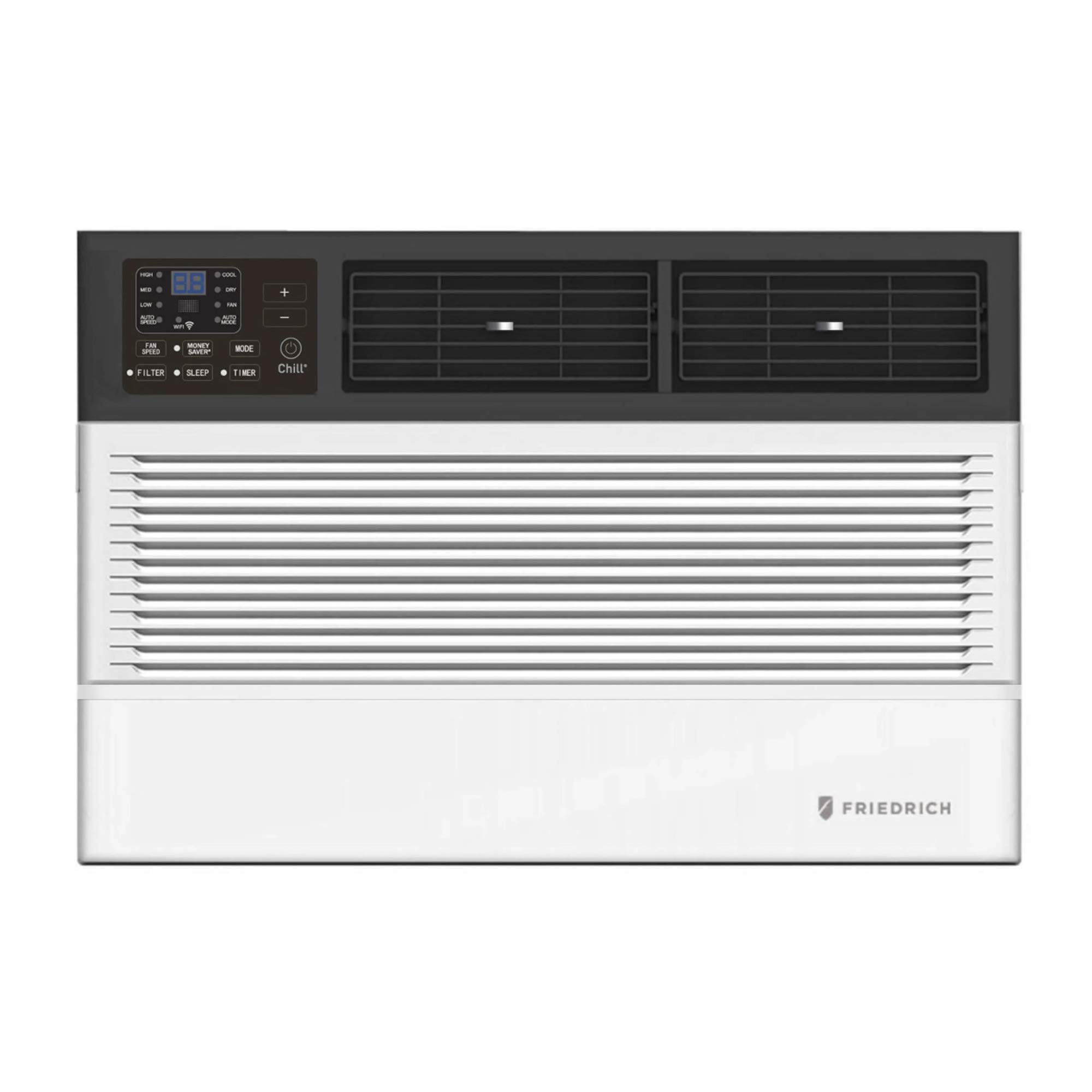
The Friedrich CCW15B10A is built with a full sheet-metal chassis and heavy-duty insulation, making it structurally robust enough for permanent through-wall installation — ideal for a mobile home wall if you cut a sleeve opening. Its 15,000 BTU rating cools up to 700 sq. ft. (some users report effective cooling for 1,500 sq. ft. bungalows in high humidity). The unit runs 25% quieter than many competitors, using a rotary scroll compressor and three fan speeds. The built-in WiFi works with the FriedrichGo app, Alexa, and Google Home.
This unit is designed for windows and walls, but the slide-out chassis means you can mount it in a wall opening and still pull the chassis for maintenance or replacement without ripping out the sleeve. The washable filter and filter alert reduce maintenance guesswork. The Money Saver setting cycles the fan and compressor independently, maintaining comfort while reducing power draw — a useful feature for mobile homes where every watt counts.
The price is premium for a window/wall unit, and the metal construction adds significant weight. Some units arrive with damaged cabinets or seals even when the outer box appears undamaged, suggesting potential return or manufacturing defects. The WiFi and remote setup process can be finicky, and the R-410A refrigerant is less eco-friendly than newer R-32 units but still widely serviced. For mobile home owners planning a permanent wall mount, this unit offers long-term durability that cheaper window ACs lack.
Why it’s great
- Slide-out chassis for permanent wall or window installation
- Very quiet operation with heavy-duty sound insulation
- Money Saver mode reduces cycling and power consumption
- WiFi app and voice control with smart home integration
Good to know
- Premium price for a window/wall unit form factor
- Some units ship with cosmetic or mechanical damage
- R-410A refrigerant, not the newer R-32 standard
- WiFi setup can be intermittent and slow
7. DREO Portable Air Conditioner 515S (12,000 BTU ASHRAE)
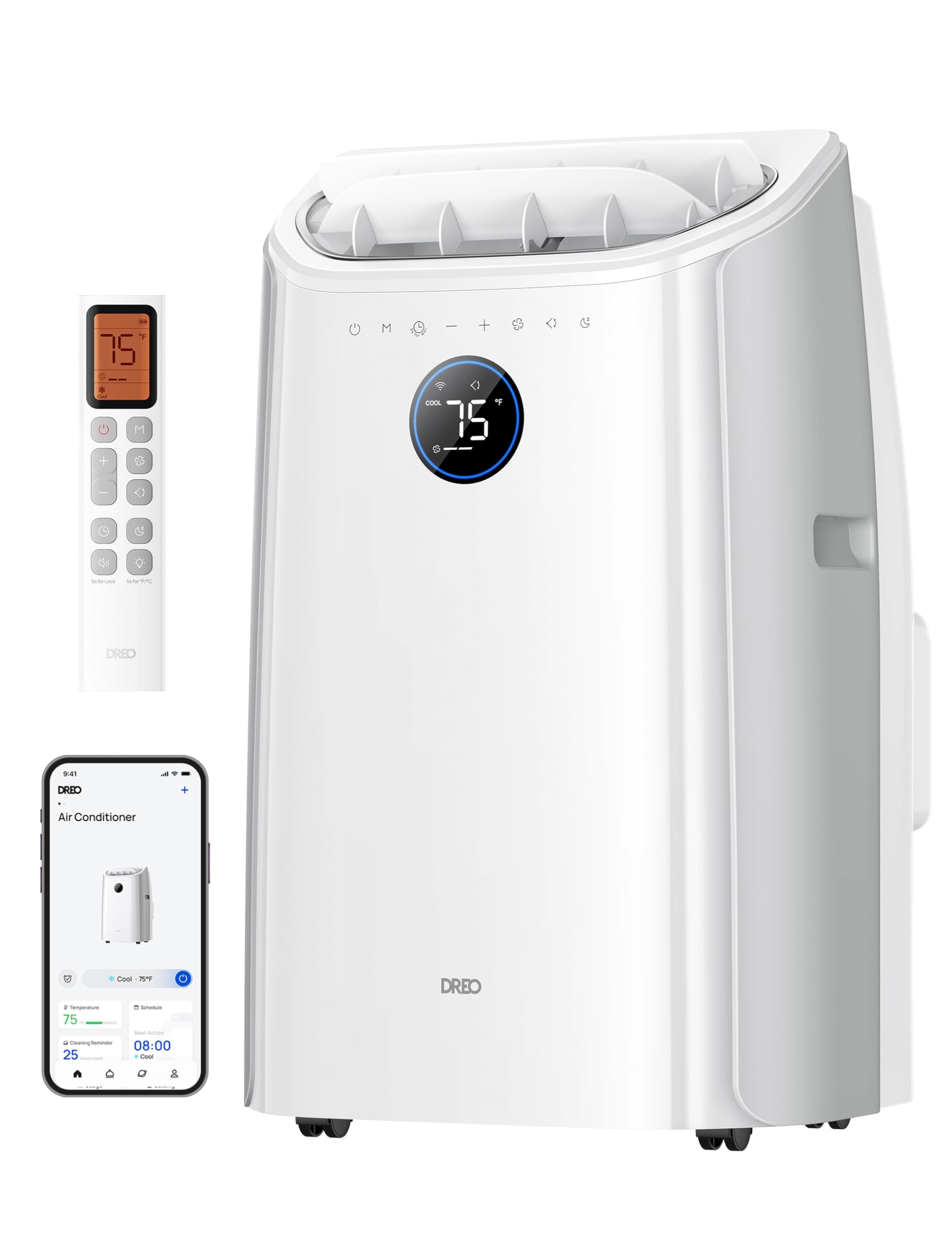
The DREO 515S uses a patented noise isolation system and inverter-style compressor to deliver 45 dB cooling, making it one of the quieter portable ACs on the market at this capacity. Its IceCool System pushes air up to 16 feet, which works well for the long, narrow rooms typical in mobile homes where the AC must be placed against one wall. The 8,000 BTU SACC rating covers up to 300 sq. ft., so it fits a single bedroom or small living area rather than open-concept layouts.
DREO’s patented drainage-free system uses a sensor and pump to evaporate condensate automatically in humidity up to 90%. This means you never need to manually drain the unit, even in muggy summer conditions — a huge convenience compared to budget portables that fill a bucket in hours. The Smart Climate Control feature integrates with Siri, Alexa, Google Home, and the DREO app, allowing remote monitoring of temperature, humidity, and sleep curve customization.
While the unit is sleek and well-built, the installation process can be frustrating due to the window seal kit’s adhesive foam that leaves residue if you reposition it. The foam is very sticky and can damage window frames if applied without care — using removable tape instead of the foam is a workaround. Some users also note that the display stays on during the first power outage and requires a reset, though this does not affect cooling performance.
Why it’s great
- Patented drainage-free system eliminates manual emptying
- 45 dB quiet operation suitable for sleep
- 16-foot throw distance for long room layouts
- Smart app, voice, and sleep curve customization
Good to know
- Window seal kit adhesive can leave residue and damage frames
- Display may require reset after power interruption
- Limited to 300 sq. ft. at true SACC rating
- Setup can be tricky with foam alignment
8. Electactic 8000 BTU Window Air Conditioner
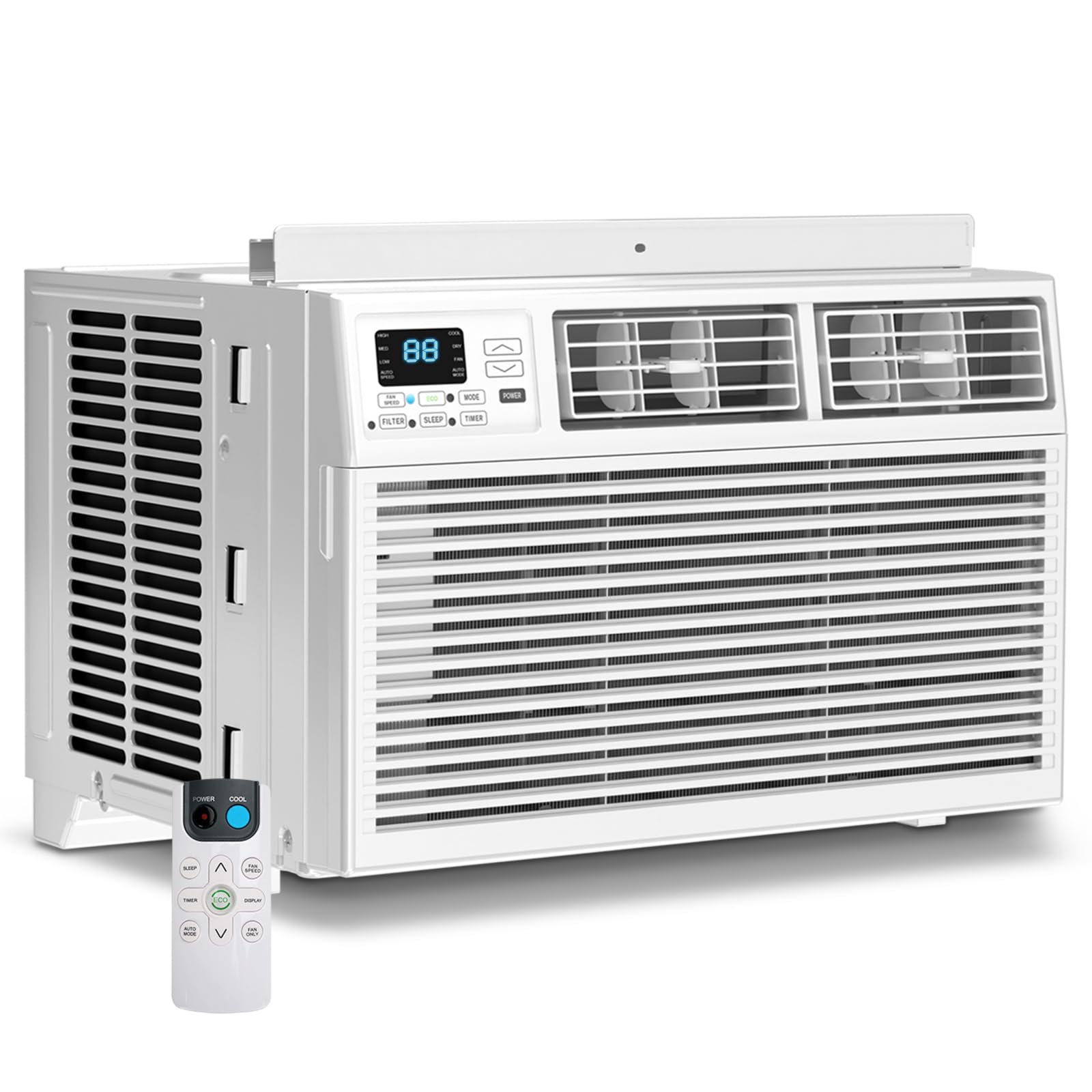
The Electactic 8000 BTU window AC is an entry-level unit that delivers genuinely fast cooling for rooms up to 350 sq. ft., perfect for a mobile home bedroom or small den. Its six modes (Cool, Dry, Fan, Auto, Sleep, Eco) and 24-hour timer give you enough flexibility for most needs without overwhelming the user interface. The compressor type is reciprocating, which is noisier than inverter units but more affordable to manufacture and repair.
Installation is straightforward with the included kit for double-hung windows 23 to 36 inches wide and 14.5 inches tall — widths that fit many mobile home frames. The self-draining system removes condensate automatically, so no bucket emptying. The remote control lets you adjust fan speed and temperature from across the room, and the washable mesh filter slides out for quick cleaning. The unit runs at 51 dB, which is about as loud as a moderate rainfall — tolerable for most but not library-quiet.
Several users note that while this unit cools effectively for the price, the build quality is not as refined as premium brands. The plastic housing can feel thin, and some units arrive with minor cosmetic scratches. The Eco mode tends to cycle the compressor more aggressively than a manual low fan setting, causing slight temperature swings. For budget-conscious mobile home owners who just need the bedroom cool for sleeping, this unit gets the job done without breaking the bank.
Why it’s great
- Fast cooling for small rooms up to 350 sq ft
- 6 operating modes provide year-round flexibility
- Self-draining system eliminates manual water removal
- Easy window installation with included kit
Good to know
- Reciprocating compressor is noisier than inverter units
- Plastic build feels less durable than metal-frame units
- Eco mode can cause temperature swings
- Some units arrive with minor cosmetic defects
9. BLACK+DECKER Portable Air Conditioner 8,500 BTU

The BLACK+DECKER 8,500 BTU portable AC is a compact budget option that covers up to 350 sq. ft. with three functions: air conditioner, dehumidifier, and fan. The 5,100 BTU SACC rating is the real-world DOE figure, which means this unit is best for small bedrooms or personal spaces rather than whole-room cooling. The R-32 refrigerant is environmentally friendlier than R-410A and improves overall energy efficiency. The top-mounted control panel with LED display is easy to reach without bending down.
This unit is lightweight for a portable AC (under 50 lbs), making it easy to move from room to room as needed. The exhaust hose and window kit fit standard double-hung windows, and the washable filter maintains air quality with minimal maintenance. The remote control handles all the essential functions — temperature, fan speed, timer, and mode. In sleep mode, the unit maintains a steady temperature while running quietly enough for most users to sleep through the night.
However, the cooling capacity is limited. Some users report that the unit does not get as cold as they expect, especially in mobile homes with limited insulation. The noise level is comparable to a loud box fan, which may disturb light sleepers. One user mentioned receiving the wrong remote control and the unit lacks a clear condensate management system in high humidity conditions. If you need a portable AC for occasional use in a small space, this unit works, but it will not satisfy a large living room on a 95°F day.
Why it’s great
- Lightweight and easy to move between rooms
- R-32 refrigerant is more eco-friendly than R-410A
- 3-in-1 function: AC, dehumidifier, and fan
- Top-mounted controls for easy access
Good to know
- SACC rating is only 5,100 BTU — modest cooling power
- Noise comparable to a loud box fan
- Limited cooling performance in poorly insulated spaces
- Some users report remote control and quality control issues
10. Cooper & Hunter 18,000 BTU Dual 2-Zone Mini Split

The Cooper & Hunter 18,000 BTU dual-zone mini-split pairs one outdoor condenser (CH-18MES-230VO) with two 12,000 BTU wall-mounted air handlers, letting you cool two separate rooms or zones from one system. For a mobile home with two bedrooms or a bedroom and living area, this eliminates the need for two separate window units cluttering the walls. The 22.9 SEER2 rating is very efficient, and multiple users report noticeable drops in their electricity bills after replacing a central unit or multiple window ACs with this system.
Each indoor unit comes with a 25-foot pre-flared and insulated copper line set, communication wires, and a 16-foot drain extension, which covers most single-wide or double-wide layouts. The smart port adapters allow each air handler to be controlled individually via the C&H Remote app, so you can set the bedroom to 68°F while the living room runs at 74°F. The whisper technology keeps both indoor units extremely quiet even at medium fan speeds.
This system requires 208–230V and professional installation — it is not a DIY unit. The outdoor unit ships via freight truck, and you need to coordinate delivery with the carrier. Some users report difficulty finding an HVAC technician willing to install a customer-supplied unit, and the line sets are stiff and require careful bending without kinking. Despite the high upfront cost and installation logistics, the dual-zone capability and efficiency make this a top-tier solution for larger mobile homes.
Why it’s great
- Two independent zones from one outdoor unit
- 22.9 SEER2 efficiency reduces long-term energy costs
- Each air handler individually controllable via app
- Extremely quiet operation
Good to know
- Requires 230V electrical circuit — not plug-and-play
- Professional installation needed (difficult to find HVAC tech for third-party units)
- Freight delivery requires scheduling with the carrier
- Line sets are stiff and require careful handling during installation
11. MRCOOL 18,000 BTU 4th Gen DIY Mini Split

The MRCOOL 18,000 BTU 4th Gen DIY system is designed specifically for homeowners who want ductless comfort without paying for a licensed HVAC technician. The pre-charged R-410A quick-connect line set lets anyone with basic tools — a crescent wrench and a hole saw — install the system by themselves. It covers up to 750 sq. ft., which is enough for an entire single-wide mobile home or a large garage workshop. The Energy Star certified rating confirms the 18K model meets strict efficiency standards.
Users report that this unit can handle extreme conditions, with several reviews noting effective cooling in Arizona summer temperatures exceeding 105°F and one aerospace engineer using it to replace a dead 36K unit with better results. The noise level is very low, especially compared to window ACs. Digital assistant integration with Alexa and Google Assistant means you can turn on the AC remotely before arriving home. The low ambient cooling feature works down to 5°F, making this a versatile year-round solution.
Because the line set is pre-charged and uses quick-connect fittings, you cannot adjust the line length — the 25-foot set may be too long for some installations, and excess line must be coiled without kinking. Some users report that the unit cannot cool below 87°F when the outdoor temperature exceeds 100°F in large spaces without adequate insulation. Also, the 230V power requirement means you need an existing 230V outlet or an electrician to run a new circuit. While the DIY concept is appealing, hiring an electrician for the disconnect and breaker still adds to the total cost.
Why it’s great
- True DIY installation with pre-charged quick-connect line set
- Energy Star certified for efficiency
- Effective cooling in extreme heat (105°F+)
- Low ambient cooling works down to 5°F
Good to know
- Requires 230V circuit — professional electrician needed for wiring
- Pre-charged line set length is fixed at 25 feet
- May struggle in poorly insulated spaces above 100°F
- Poor instructional documentation; YouTube guides recommended
FAQ
Can I install a window AC in a mobile home slider window?
What size AC do I need for a 14×70 mobile home?
Do portable ACs work well in mobile homes with low ceilings?
How do I reinforce a window AC mount in a mobile home with thin walls?
Can a mini-split be installed in a mobile home without an existing duct system?
Final Thoughts: The Verdict
For most mobile home owners, the best ac for mobile home overall is the LG 14,000 BTU DUAL Inverter because it combines the highest 14,000 BTU window capacity with whisper-quiet 44 dB sleep mode and smart app control — ideal for large rooms where noise and energy bills matter. If you need heat pump capability and prefer a portable form factor that avoids window modification, grab the Midea Duo 14,000 BTU for year-round comfort. And for the best long-term investment with the highest efficiency and quietest operation, nothing beats the MRCOOL 18,000 BTU DIY Mini Split, especially if you are willing to handle the 230V wiring and don’t mind a one-time DIY installation that will outlast any window unit by years.

Mo Maruf
I created WellFizz to bridge the gap between vague wellness advice and actionable solutions. My mission is simple: to decode the research and give you practical tools you can actually use.
Beyond the data, I am a passionate traveler. I believe that stepping away from the screen to explore new environments is essential for mental clarity and physical vitality.