Our readers keep the lights on and my smoothie glass nicely filled. As an Amazon Associate, I earn from qualifying purchases.
Your callers hear every shuffle, every hum, every distant conversation — and that kills first-call resolution. A headset that fails to isolate your voice from the background chatter of an open floor plan or a busy home office erodes professional credibility call after call. The difference between a headset that muffles sound and one that actively rejects it is measurable in both customer satisfaction scores and your own daily fatigue.
I’m Mohammad Maruf — the founder and writer behind WellFizz. I’ve spent years parsing the acoustic specs, mic polar patterns, and compliance certifications that separate a good day on the phones from a frustrating one.
Whether you manage a ten-agent team or handle high-volume calls solo, choosing the right equipment directly impacts your output. This guide breaks down the wired and wireless options that define the best call center headset for real work environments — from DECT roamers to dual-connectivity studio-grade mics.
How To Choose The Best Call Center Headset
Selecting a headset for high-volume call work is not the same as picking a pair for music or gaming. The microphone’s ability to reject ambient noise, the driver’s voice tuning, and the physical endurance of the ear cushions directly affect your call quality and your comfort across an eight-hour shift. Below are the four specs that matter most.
Wired vs Wireless — DECT vs Bluetooth
Wired headsets deliver zero-latency audio and never run out of battery, making them the reliable choice for fixed-desk agents. Wireless options offer mobility but introduce two distinct technologies. DECT (Digital Enhanced Cordless Telecommunications) provides a dedicated frequency band that reaches up to 350 feet through walls without the interference common in crowded 2.4 GHz Bluetooth environments. Bluetooth headsets pair easily with smartphones and laptops but often suffer from audio compression and range drop-offs beyond 30 feet. For a call center agent who needs to walk the floor or grab a file while staying on a call, DECT is the superior wireless architecture.
Noise-Canceling Microphone vs Passive Isolation
The microphone’s pickup pattern determines what the person on the other end hears. A cardioid or super-cardioid boom mic focuses on your voice and rejects sound from the sides and rear — this is what separates a professional headset from a consumer pair. Passive noise isolation comes from the ear cushions themselves, which physically block ambient noise from reaching your ears. Active noise cancellation (ANC) uses electronics to cancel low-frequency hums (HVAC systems, server fans). Look for a headset that combines a noise-canceling boom mic with at least passive isolation; ANC is a bonus for the wearer’s focus, not the caller’s experience.
Driver Size and Voice Tuning
Call center audio does not need booming bass or sparkling highs. The driver (typically 28mm to 40mm) should be tuned for vocal clarity — that means a frequency response that emphasizes the 300 Hz to 3.4 kHz range where human speech lives. Some headsets use wideband audio (150 Hz to 6.8 kHz) for richer call quality, which is becoming standard on Teams and Zoom certified models. A driver with neodymium magnets (common in broadcast-style headsets) produces higher output with lower distortion, which helps you hear subtle customer cues without turning the volume to an uncomfortable level.
Certifications and Platform Compatibility
A headset certified for Microsoft Teams, Zoom, or Avaya/Cisco desk phones ensures that the call control buttons (answer, hang up, mute, volume) work without manual configuration. Without certification, you may lose inline control functionality or experience garbled audio on softphones. For desk phone users, confirm that the headset includes an RJ-9 or RJ-11 cable and an electronic hookswitch interface (EHS) cable if you want to answer calls away from the base. Compatibility is not a feature you can skip — it determines whether setup takes sixty seconds or sixty minutes.
Quick Comparison
On smaller screens, swipe sideways to see the full table.
| Model | Category | Best For | Key Spec | Amazon |
|---|---|---|---|---|
| EPOS Impact 860T ANC | Wired ANC | Open-office noise rejection | Adaptive ANC + AI mic | Amazon |
| Jabra Engage 75 | Wireless DECT | Roaming with desk phone | 150m range / 13hr talk | Amazon |
| Leitner LH570 | Wireless DECT | Dual desk/PC connectivity | 350ft range / 8hr talk | Amazon |
| Audio-Technica BPHS1 | Broadcast Wired | Voice recording / podcast | Dynamic cardioid XLR mic | Amazon |
| Poly Blackwire 5220 | Wired USB-C | Multi-device switching | USB-C/A + 3.5mm | Amazon |
| Plantronics CS540 | Wireless DECT | Desk phone mobility | 400ft range / 7hr talk | Amazon |
| Jabra Evolve 20 | Wired USB | Budget wired clarity | 28mm driver / USB-C/A | Amazon |
In‑Depth Reviews
1. EPOS Impact 860T ANC

The EPOS Impact 860T ANC is purpose-built for the open office. Its adaptive active noise cancellation reduces low-frequency hum from HVAC and server racks, while the EPOS AI-powered boom mic isolates your voice so aggressively that callers report hearing zero background noise — even from a room with a loud washing machine or barking dog. The super-wideband audio (150 Hz to 6.8 kHz) delivers richer voice detail than standard narrowband headsets, which helps you catch subtle tonal shifts in customer conversations.
Comfort is where this headset earns its daily-wear badge. The double-sided over-ear design distributes weight evenly across the headband, and the leatherette ear cushions are deep enough to avoid pinching. The quick-access boom arm automutes when flipped up, and the ActiveGard circuit protects against sudden acoustic shocks — a genuine risk for agents who forget to lower volume before a loud callback. Setup is plug-and-play on Windows and macOS, with the USB-C to USB-A adapter covering older ports.
The only real tradeoff is the price tag — this is a premium wired headset, and the ANC electronics add cost without directly improving what the caller hears. If your workspace is already quiet, the standard Impact 860 (without ANC) saves money. But for anyone in a shared office or loud home environment, the 860T’s mic cancellation and comfort justify every penny. It also includes a hard carrying case, which is rare at this price tier.
Why it’s great
- AI-driven mic cancels 60-75dB of background noise
- Adaptive ANC for wearer focus
- Super-wideband audio for clear voice reproduction
Good to know
- Premium pricing reflects ANC and certification
- Wired only — no wireless option
2. Jabra Engage 75

The Jabra Engage 75 is the wireless headset that agents who move around need. Using DECT technology instead of Bluetooth, it maintains a solid connection up to 150 meters / 490 feet — enough to walk the entire office floor, grab coffee in the break room, or step into the warehouse without dropping the call. The advanced noise-canceling microphone filters out ambient sounds like office chatter and printer noise, and callers consistently report clear, professional audio on the receiving end.
Battery life is a genuine 13 hours of talk time, which covers even the longest shifts without a mid-day charge. When you do need to top up, the fast-charge feature hits 40% in 30 minutes. The integrated busy light on the headband acts as a visual do-not-disturb indicator for colleagues, which is a small but appreciated touch in open-plan spaces. Intuitive controls on the earcup handle answer, end, mute, and volume without fumbling. The base station connects to both a desk phone (RJ-9) and a PC (USB), and it supports up to five simultaneous device connections.
The biggest drawback is the mute button placement on the boom arm — it’s easy to bump accidentally, which can cause awkward moments on a call. Some users also note that the battery depletes faster than the advertised 13 hours when roaming at the edge of the DECT range. And the base station’s touchscreen interface is a bit clunky for daily use. Still, for agents who need true wireless freedom without compromising audio quality, the Engage 75 is the top performer.
Why it’s great
- Exceptional 150m DECT range through walls
- 13-hour talk time with fast charge
- Busy light reduces office interruptions
Good to know
- Mute button on boom can be accidentally triggered
- Premium pricing for DECT technology
3. Leitner LH570

The Leitner LH570 is a DECT wireless headset that bridges desk phones and computers better than most alternatives. Its dual-connectivity base station lets you toggle between a desk phone (via RJ-9) and a PC (via USB-C) with a single button press — no re-plugging cables or switching profiles. The DECT UltraRange Mobility technology delivers up to 350 feet of range, which in real-world terms means you can walk through a warehouse or across a large office floor and stay on the call without static or dropouts.
Audio quality is clean and focused on the voice band. The Ultra Noise-Canceling Microphone uses CleanSound Technology to filter out background rumble, and callers confirm that they hear you clearly even from a noisy environment. The headset is lightweight (single-ear mono configuration) and comfortable for all-day wear, with an over-the-ear loop, over-the-head band, and behind-the-neck options included in the box. Battery life is a solid 8 hours of talk time with a quick 1-hour recharge. Setup takes about five minutes, and no software is required for basic operation on Windows, macOS, or Linux.
The main caveat is that the LH570 uses DECT, not Bluetooth — it will not pair with a smartphone or tablet. Some users have also reported signal interference near large appliances like refrigerators and ovens, a known quirk of DECT in the 1.9 GHz band. But the 5-year full replacement warranty from Leitner is a standout peace-of-mind feature that most competitors do not match. For agents who split their day between a desk phone and a softphone, this headset offers unbeatable connectivity flexibility.
Why it’s great
- Seamless desk phone and PC switching
- 350-foot DECT range for full office roaming
- 5-year full replacement warranty
Good to know
- Not compatible with cell phones (no Bluetooth)
- Signal may break near large metal appliances
4. Audio-Technica BPHS1

The Audio-Technica BPHS1 is not a typical call center headset — it is a broadcast-grade stereo headset designed for professional voice work, and it excels in environments where audio fidelity is paramount. The dynamic cardioid boom microphone rejects off-axis noise with precision, and its frequency response is tailored for intelligible vocal reproduction — think podcast narration, audiobook recording, or critical customer interactions where every nuance matters. The neodymium magnets in both the mic and headphones deliver high output with low distortion.
The closed-back circumaural ear cups provide excellent passive noise isolation, blocking out crowd noise and office distractions so you can focus on the conversation. The boom arm can be positioned on either the left or right side, which is helpful for shared workstations or personal preference. Audio quality on the headphone side is comparable to the well-regarded Audio-Technica M50x, with a balanced sound signature that does not fatigue the ears over long sessions. The cables are sturdy and detachable, running 10.8 feet with an 8-pin connector at the headset end and separate XLR and TRS outputs.
The BPHS1 requires an XLR microphone input and a 6.3mm headphone output — it is not plug-and-play with a standard laptop combo jack. This makes it ideal for agents who already have an audio interface or mixer. The long, heavy cable can be cumbersome, and the lack of a 3.5mm adapter in the box is an oversight. But for voice professionals who demand studio-level clarity, the BPHS1 delivers a sound quality that no USB headset can match.
Why it’s great
- Dynamic cardioid mic with excellent off-axis rejection
- Neodymium drivers for clear, low-distortion audio
- Stereo sound comparable to premium monitors
Good to know
- Requires XLR/TRS interface — not USB plug-and-play
- Long cable can be prone to snagging
5. Poly Blackwire 5220

The Poly Blackwire 5220 is a wired headset that solves the multi-device problem elegantly. It comes with a built-in USB-C connector, a tethered USB-A adapter, and a separate 3.5mm audio jack — so you can switch between a laptop, a desktop, and a mobile phone without carrying dongles or swapping cables. The noise-canceling boom mic uses a flexible arm that stays where you set it, and it effectively filters out background noise so callers hear only your voice. Dynamic EQ automatically adjusts the audio profile between voice calls and multimedia playback.
Comfort is a strong point. The over-ear design uses conforming ear cushions with soft leatherette padding that creates a good passive noise seal. The headband is adjustable with a flexible strap that accommodates larger head sizes without pressure points. Inline controls handle volume, mute, and call management, and the headset is certified for both Microsoft Teams and Zoom, so those buttons work out of the box. The carrying case included in the box is a nice bonus for remote workers who move between locations.
Some users have reported that the noise cancellation performance degrades after several months of heavy use, and the occlusion effect — hearing your own voice muffled as if your ears are covered — can be distracting until you adjust. The retractable cable design is convenient but adds a potential failure point over time. For a mid-range wired headset with flexible connectivity, the Blackwire 5220 is a solid contender, but it may not survive the same multi-year abuse as a premium Jabra or EPOS model.
Why it’s great
- Triple connectivity: USB-C, USB-A, 3.5mm
- Teams and Zoom certified for plug-and-play
- Comfortable padding for large heads
Good to know
- Noise cancellation may degrade over time
- Occlusion effect takes getting used to
6. Plantronics CS540

The Plantronics CS540 is a veteran of the call center world — a DECT wireless headset designed exclusively for desk phone users who need mobility. The base station connects to your desk phone via an included RJ-11 cable, and the headset delivers up to 400 feet of roaming range, so you can walk the floor, retrieve files from a cabinet, or step into a huddle room without losing the call. The noise-canceling microphone does a solid job of filtering out ambient office noise, and callers report clear, consistent audio quality.
The wearing style is fully convertible: you can wear it over the head, over the ear, or behind the head, with all three configurations included in the box. The single-ear (mono) design keeps one ear open for situational awareness, which is preferred in many call centers where agents need to hear colleagues or alarms. Talk time is rated at 7 hours, and the battery charges quickly — under one hour for a full charge. The base station also functions as a charger, so the headset is always ready when you return to your desk.
The CS540 has a few critical limitations. It is not compatible with Cisco desk phones without manual configuration, and it does not include an electronic hookswitch (EHS) cable for remote call answering — you must be at your desk to pick up the handset. The Bluetooth range is listed at 100 meters but only works within the DECT environment. For pure desk phone users who do not need softphone integration, the CS540 is a reliable workhorse; for hybrid desk/PC work, you will need additional adapters.
Why it’s great
- 400-foot DECT range for office roaming
- Three wearing styles in one box
- Fast charging under one hour
Good to know
- Not compatible with Cisco phones out of the box
- Requires desk proximity to answer calls
7. Jabra Evolve 20
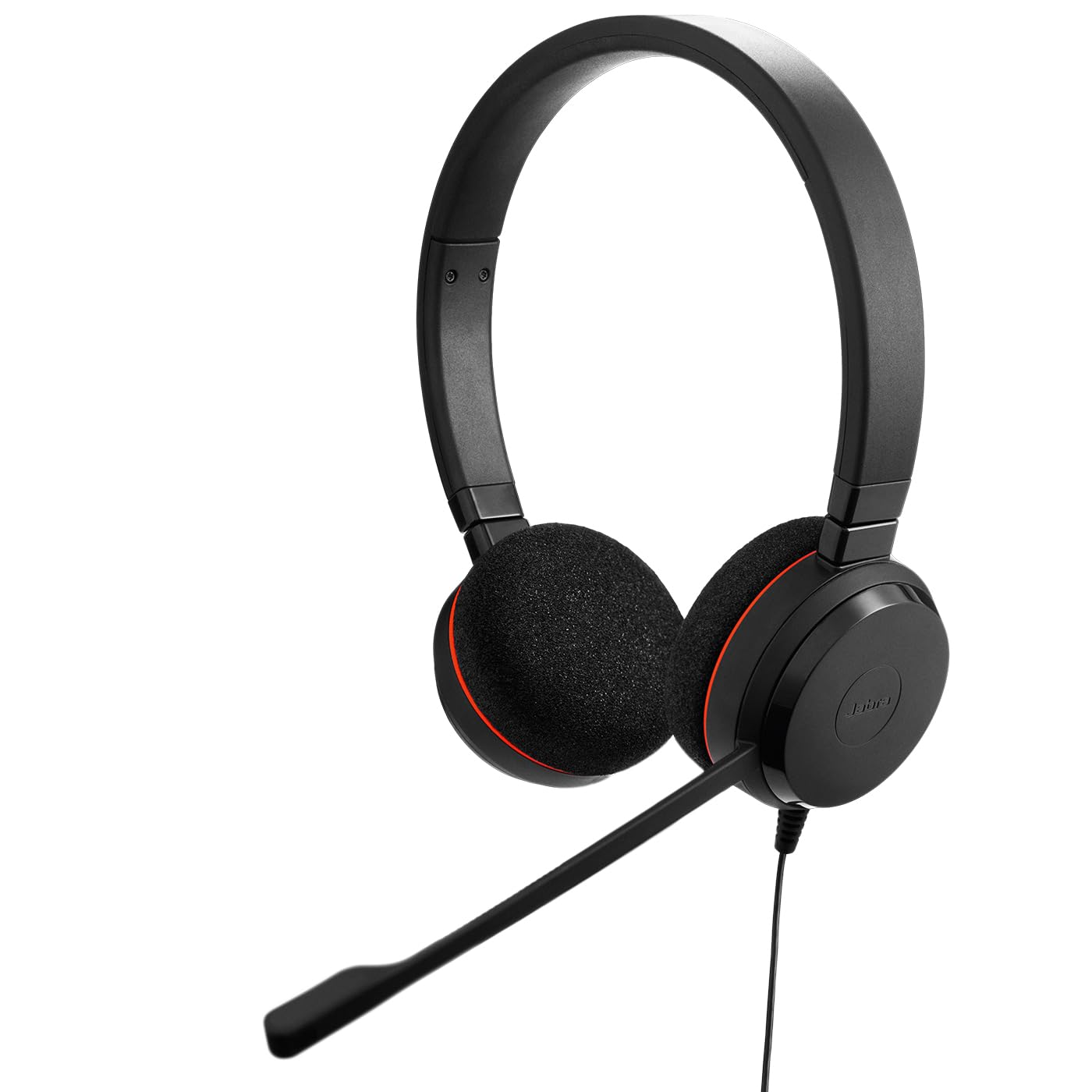
The 28mm dynamic drivers deliver clear, intelligible audio for voice calls, and the noise-canceling microphone effectively dampens background noise like lawnmowers and barking dogs, as confirmed by telehealth and remote workers who have tested it in challenging home environments. The dual USB-C and USB-A connectivity covers modern laptops and legacy desktops without needing an adapter.
All-day comfort is the standout feature here. The headset is lightweight, and the foam or leatherette ear cushions (depending on the variant) do not create pressure points even after eight hours of continuous wear. The inline remote handles call control and volume adjustment with tactile buttons that are easy to locate without looking. Setup is truly plug-and-play — no drivers, no software, no configuration. The headset works with all major meeting platforms (Zoom, Teams, Webex) and is certified for Avaya and Cisco environments.
The tradeoffs are about long-term repairability and audio refinement. The ear pads are not user-replaceable on some units, and the cable is hard-wired rather than detachable, meaning a damaged cord requires replacing the entire headset. The sound is tuned for voice clarity, not music, so do not expect bass response or soundstage. For budget-conscious buyers who need a dependable wired headset for high-volume calls, the Evolve 20 delivers proven performance at an accessible price point.
Why it’s great
- Lightweight design with excellent all-day comfort
- Effective noise-canceling mic for home offices
- Plug-and-play with USB-C and USB-A
Good to know
- Non-replaceable ear pads and cable
- Voice-focused tuning, not for music
FAQ
Can I use a Bluetooth headset for call center work?
What is the difference between a mono and stereo call center headset?
Do I need Microsoft Teams certification on a call center headset?
Final Thoughts: The Verdict
For most users, the call center headset winner is the EPOS Impact 860T ANC because it combines best-in-class mic noise cancellation with adaptive ANC and all-day comfort — everything an agent in a shared workspace needs. If you want wireless freedom with the ability to roam a large office or warehouse, grab the Jabra Engage 75. And for budget-conscious buyers who prioritize voice clarity and comfort, nothing beats the Jabra Evolve 20.

Mo Maruf
I created WellFizz to bridge the gap between vague wellness advice and actionable solutions. My mission is simple: to decode the research and give you practical tools you can actually use.
Beyond the data, I am a passionate traveler. I believe that stepping away from the screen to explore new environments is essential for mental clarity and physical vitality.