Our readers keep the lights on and my smoothie glass nicely filled. As an Amazon Associate, I earn from qualifying purchases.
An exercise bike sits in the corner of a home gym, and the difference between a dust collector and a daily driver comes down to one thing: how the resistance feels under your feet. Magnetic systems deliver a frictionless pedal stroke that won’t wake your partner at 5 AM, while air resistance scales with your effort for a lung-burning sprint session. The right frame geometry keeps your knees happy through hour-long rides, and the wrong seat cushion turns a 20-minute cooldown into a chore you dread. This guide walks you through nine models that earned their spot by balancing build quality, rider fit, and real-world durability — no marketing fluff attached.
I’m Mohammad Maruf — the founder and writer behind WellFizz. I spend my weeks dissecting product specs, cross-referencing buyer feedback, and stress-testing build claims against real customer wear patterns so you don’t have to guess which frame will creak after month three.
Whether you are recovering from a knee injury, squeezing a full-body workout into a tight morning routine, or outfitting a home gym that needs to serve riders from 5’1″ to 6’5″, this deep-dive into the best exercise bike options on the market will help you match the right resistance system and frame to your specific goals without overspending on features you will never use.
How To Choose The Best Exercise Bike
Three decisions determine whether your bike delivers years of silent, comfortable service or ends up listed on the classifieds within six months: resistance type, frame geometry (upright vs. recumbent vs. fan), and the range of adjustability for your specific body dimensions. Ignore brand-name hype and focus on these structural choices first.
Magnetic vs. Felt vs. Air Resistance
Magnetic resistance uses a flywheel and magnets to create drag without physical contact, which means near-silent operation and zero pad replacements. It is the standard for anyone living in an apartment or sharing a wall with a sleeping household. Felt-pad resistance (cheaper upright bikes) wears down over months, requiring replacement pads and producing a distinct rubbing sound. Air resistance uses a fan blade that spins faster as you pedal harder — resistance is infinite and proportional to effort, making it ideal for high-intensity interval training, but it generates wind noise that rises sharply with cadence. For general cardio and joint-friendly rehab, magnetic wins. For sprint-based HIIT, a fan bike delivers a unique progressive load.
Upright, Recumbent, or Fan Frame?
Upright bikes mimic a road cycling position — core engaged, handlebars forward, hips flexed. They deliver the highest calorie burn per minute but require good lower-back mobility and wrist flexibility. Recumbent bikes place you in a laid-back chair position with the pedals in front, transferring load off the wrists and lower back onto a cushioned seat and backrest. This is the go-to choice for seniors, post-surgery rehab, and anyone with chronic back pain. Fan bikes (sometimes called air bikes) feature dual-action handlebars that move with your arms while your legs pedal, engaging the entire body in a single movement. They are loud and intense, built for CrossFit-style conditioning rather than long steady-state rides.
Seat and Handlebar Adjustability — The Real Fit Test
A bike that does not fit your inseam will hurt your knees regardless of resistance quality. Look for four-way seat adjustment (fore-aft, tilt, and height) plus handlebar height adjustment. Recumbent bikes should offer fore-aft slider rails that extend to accommodate inseams up to 40 inches. Check the stated user height range against your own measurements — a bike that claims to fit up to 6’5″ may still feel cramped if the seat rail is too short. Read user reviews from riders of similar height to yours; that is where the real fit data lives.
Quick Comparison
On smaller screens, swipe sideways to see the full table.
| Model | Category | Best For | Key Spec | Amazon |
|---|---|---|---|---|
| 3G Cardio Elite RB X | Recumbent | Tall riders & long rehab rides | 25-position seat rail; 350 lb cap | Amazon |
| Schwinn 130 Upright | Upright | Zwift / app-based training | 16 magnetic resistance levels | Amazon |
| MERACH S19 Recumbent | Recumbent | Knee rehab & quiet steady-state | 8-level car-style lever resistance | Amazon |
| pooboo W216 Recumbent | Recumbent | Full-body with arm exerciser | 400 lb weight capacity | Amazon |
| VANSWE RB405 Recumbent | Recumbent | Heavy users & precise seat fit | Infinite slider seat system | Amazon |
| pooboo Fan Bike | Air Bike | HIIT & full-body conditioning | Dual-action handlebars; 350 lb cap | Amazon |
| MERACH MR-S29R2 | Upright / Spin | Quiet home spin-style sessions | Self-powered; 16 magnetic levels | Amazon |
| YESOUL S3 | Upright / Spin | App-interactive spin training | 100 micro-resistance levels | Amazon |
| Sunny Health SF-B220030 | Upright | Budget entry-level cardio | Belt drive; 242 lb weight cap | Amazon |
In‑Depth Reviews
1. 3G Cardio Elite RB X Recumbent Exercise Bike

The 3G Cardio Elite RB X is the benchmark for recumbent bikes that serve riders from 5’0″ to 6’5″ without compromise. The 16-level magnetic resistance is driven by a 14-pound electro-magnetic flywheel that delivers smooth, near-silent transitions, and the FreeSync FTMS Bluetooth chip pairs with third-party apps like Zwift and Kinomap without requiring a proprietary subscription. The Airflow Mesh Flex backrest tilts independently, which means your lumbar spine gets continuous support even when you shift position mid-ride.
Customer reviews consistently highlight the frame’s rock-solid stability at 350 pounds and the fact that the bike rolls easily through standard doorways on built-in wheels despite its 115-pound weight. Several buyers used the bike for pre- and post-knee replacement rehab and reported zero joint pain during 30-minute sessions. The included non-coded wireless heart rate strap and handheld grip sensors give you two options for zone tracking — the strap is more reliable for interval work. A tablet shelf sits above the console so you can run app workouts without propping your phone on the handlebars.
The only real trade-off is the console itself: it’s functional with 12 preset programs and three heart-rate programs, but the display feels utilitarian next to the modern touchscreen units on commercial bikes. The lifetime frame warranty and seven-year parts coverage offset that, especially if you plan to keep this bike for a decade. For home users who prioritize fit adjustability, build longevity, and joint-friendly geometry over flashy screens, this is the closest thing to a buy-once recumbent solution on the market.
Why it’s great
- 25-position seat rail fits inseams up to roughly 40 inches — genuinely accommodates tall riders up to 6’5″.
- Lifetime frame warranty + 7-year parts coverage, backed by an Arizona-based company with decades of fitness industry experience.
- FTMS Bluetooth connects directly to Zwift, Peloton app, and Kinomap without needing a separate dongle or monthly fee.
Good to know
- Console is basic LCD — no touchscreen, no streaming capability. You supply your own tablet for app workouts.
- 115-pound shipping weight makes it a two-person unboxing job, though the built-in wheels help after assembly.
2. Schwinn Fitness 130 Upright Bike
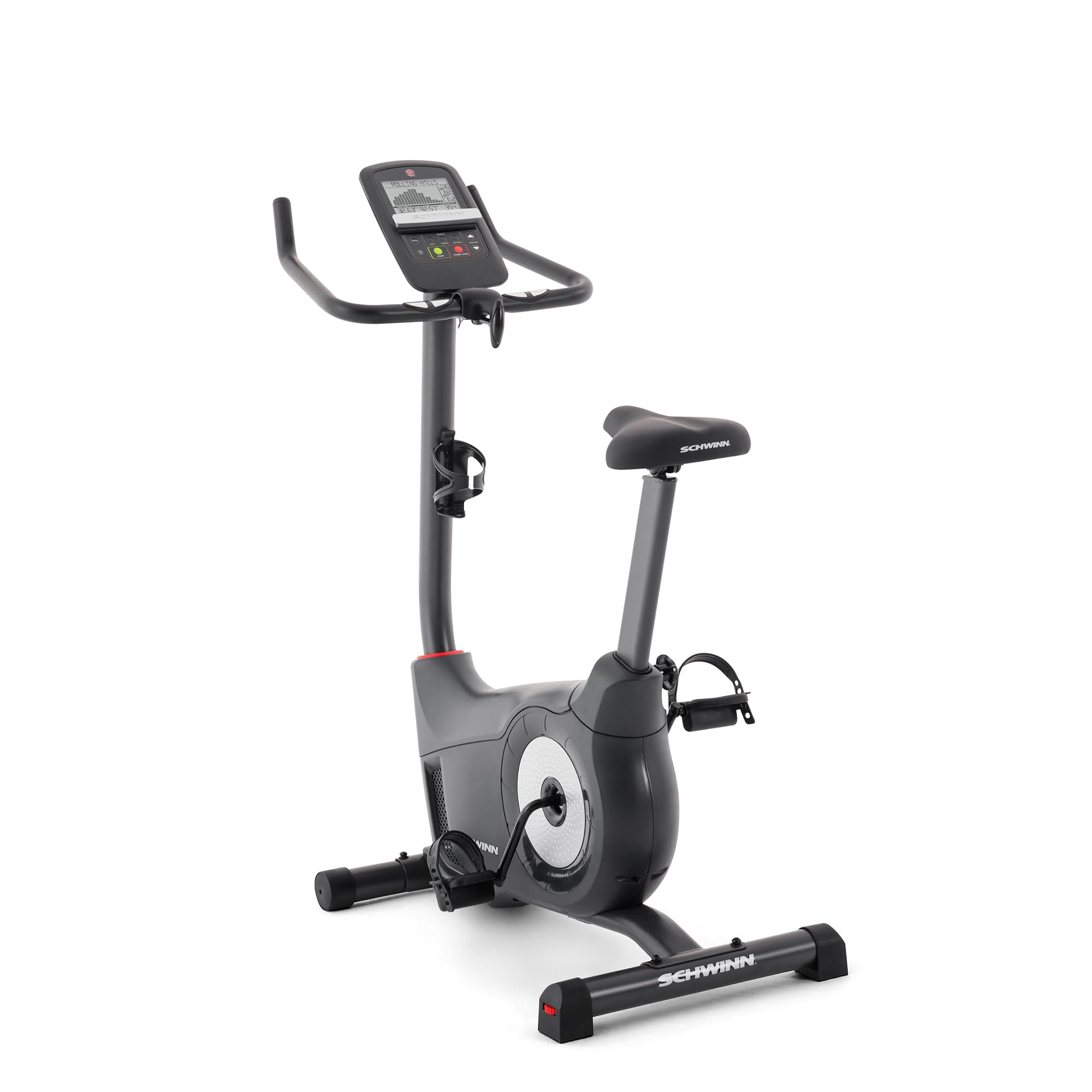
The Schwinn 130 Upright occupies a sweet spot for riders who want app integration — specifically Zwift and Explore the World — without paying for a built-in screen. Its Bluetooth chip broadcasts speed, cadence, and power data that Zwift reads as a controllable trainer, so your avatar’s speed responds to your real-time effort. The 5.5-inch LCD offers 13 workout programs (including heart-rate-controlled programs when paired with a telemetry chest strap), and the 16 levels of magnetic resistance cover everything from recovery spins to simulated hill climbs. The perimeter-weighted flywheel delivers enough inertia to smooth out your pedal stroke at low cadences, which matters during the slow, high-resistance segments of structured workouts.
Owners note that assembly is a one-person job, though the plastic flywheel covers can be finicky to snap into place. The foam comfort seat gets mixed early reviews — several riders reported a break-in period of two to three weeks before it stopped feeling firm. The handlebars adjust vertically, which helps shorter riders find a comfortable reach, but the lack of fore-aft adjustment means taller users with longer torsos may feel slightly stretched. The weighted, strapped pedals accommodate standard athletic shoes, and the bike’s 57-pound weight makes it easy to relocate compared to a spin-style steel frame.
The main limitation is that the resistance does not auto-adjust within Zwift — you turn the tension knob manually based on what the app tells you. This is the norm at this level, but it does interrupt interval flow compared to smart bikes that sync resistance automatically. The telemetry heart rate receiver works well with a Polar-style chest strap but does not support Bluetooth HR broadcasting from an armband, so you are limited to the grip sensors or an ANT+ setup. For riders who want a solid upright platform with broad app compatibility and a sub-premium price point, the Schwinn 130 delivers dependable performance that has held up well in long-term owner reports.
Why it’s great
- Bluetooth broadcasts speed/cadence/power data that Zwift reads as a controllable trainer — no extra sensors needed.
- 13 preset workout programs and 16 magnetic resistance levels give structured training variety without requiring a subscription.
- Relatively lightweight at 57 pounds with transport wheels, making it easy to move between rooms.
Good to know
- Resistance must be adjusted manually during app workouts — it does not auto-sync with Zwift gradient changes.
- Seat comfort requires a break-in period; some owners add a gel cover for the first few weeks.
3. MERACH S19 Recumbent Exercise Bike
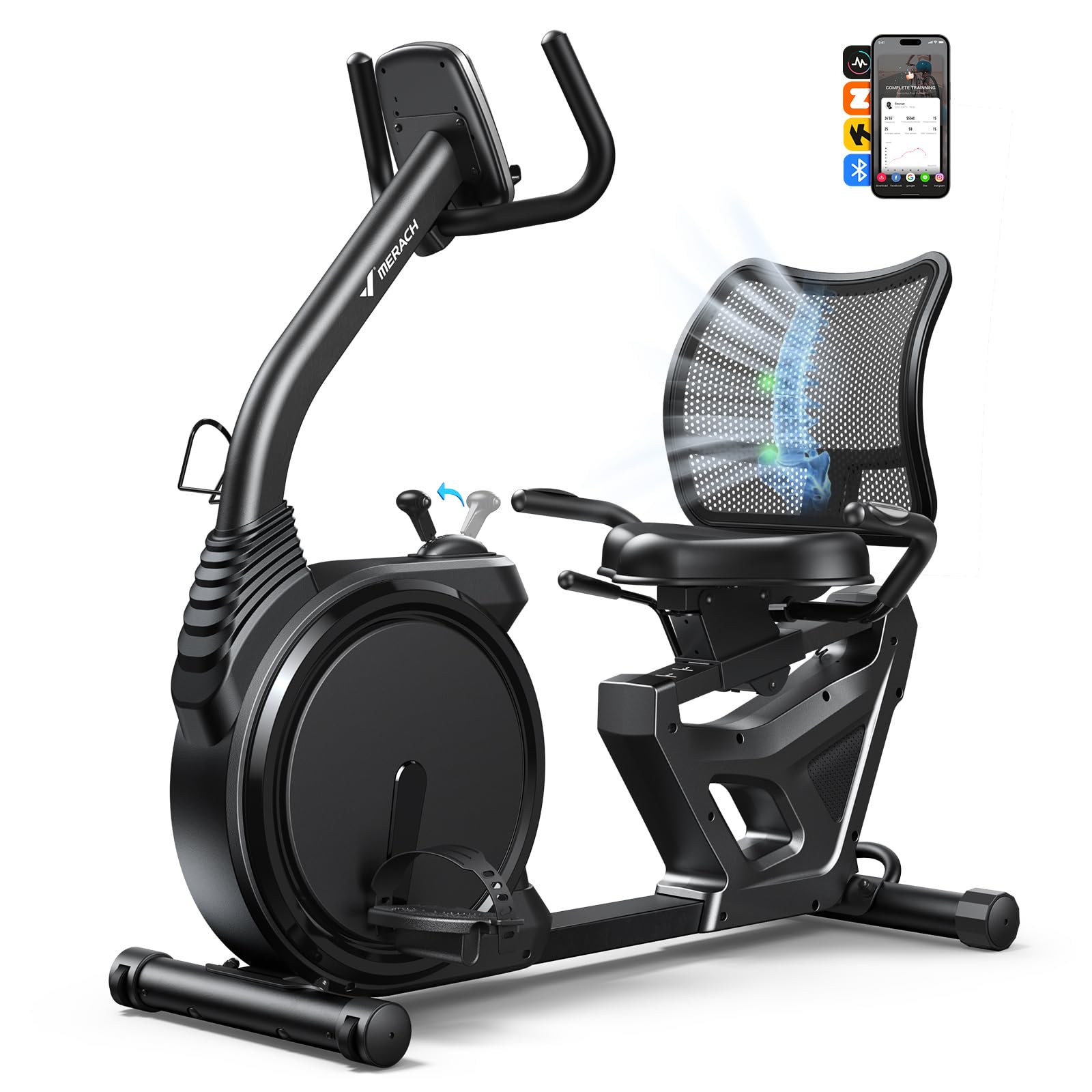
The MERACH S19 uses an eight-level car-style lever to switch resistance, which is far more intuitive than a twist knob for older riders or anyone with reduced hand dexterity. The magnetic resistance itself is belt-driven and nearly silent — multiple owners reported using it while their partner slept in the same room. The seat cushion is noticeably thicker than most recumbent seats in this tier, and the breathable mesh backrest prevents sweat pooling during 45-minute rides. The frame supports up to 330 pounds and feels solid during pedaling, with no lateral wobble even during out-of-saddle efforts on the frosted handlebars.
The seated leg length range runs from roughly 28 to 35 inches, which accommodates riders from about 5’2″ to 5’10” well. Taller users beyond 6’0″ in multiple reviews reported feeling cramped — the seat rail simply does not extend far enough for long femurs. The LCD display shows time, distance, speed, calories, and heart rate from the grip pulse sensors, but the numbers are basic and not backlit, making them hard to read in low light. The MERACH self-developed app syncs via Bluetooth to track session data and offers a gamified FantomFite mode, though the app experience is serviceable rather than polished.
Where the S19 shines is its assembly simplicity. The bike arrives about 80 percent pre-assembled, and multiple buyers over age 60 finished setup in under 30 minutes with the included video guide. The compact footprint (48 x 24 inches) fits into small apartments or home offices without dominating the room. For knee rehab specifically, the combination of low-impact pedal position, lumbar-supporting backrest, and whisper-quiet resistance makes this a strong contender for anyone recovering from surgery or managing chronic joint pain on a mid-range budget.
Why it’s great
- Eight-level car-style lever is the most accessible resistance adjustment for seniors or arthritis sufferers.
- Ultra-quiet magnetic belt drive lets you ride without disturbing others — measured well under conversational volume.
- Quick 30-minute assembly with 80 percent pre-assembled frame and video walkthrough.
Good to know
- Seat rail length limits comfortable fit for riders over 6’0″ — tall users should look at the VANSWE or 3G Cardio instead.
- Display is basic, non-backlit, and the grip heart rate sensors are less accurate than a chest strap.
4. pooboo W216 Recumbent Exercise Bike
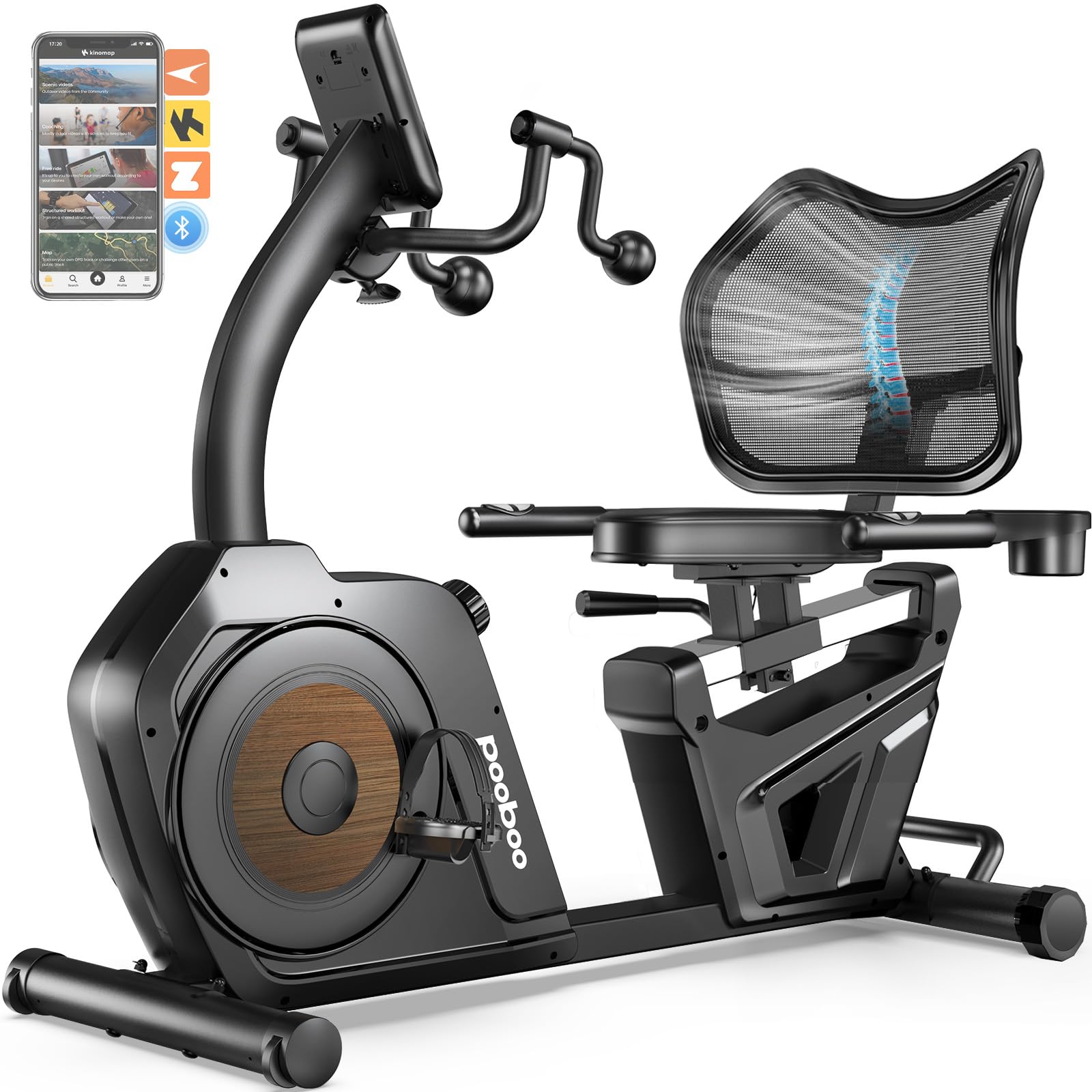
The pooboo W216 stands apart from standard recumbent bikes by including a hand-cranked arm exerciser integrated into the front of the frame. This allows you to work your upper body independently of your legs or in a synchronized full-body motion, which raises heart rate faster than leg-only cycling and engages shoulders, triceps, and grip strength. The 15-pound flywheel and belt drive keep the operation whisper-quiet at around 20 decibels, and the eight-level magnetic resistance knob provides a clear tactile click at each level so you know exactly where you are without looking at a screen. The frame is rated for 400 pounds and uses a one-piece steel chassis that several reviewers described as “commercial-feel” with no creaking or play after months of daily use.
The adjustable sliding seat rail extends up to 18.5 inches, accommodating user heights up to 6’3″. The mesh backrest follows the natural curve of the spine and allows airflow that keeps your back dry during longer sessions. Pedal straps with eight hole-positions fit a wide range of shoe sizes, from smaller women’s feet to men’s size 13. The LCD monitor tracks speed, distance, time, calories, odometer, and pulse, though the display is not backlit and can be hard to read if the bike is not positioned under direct light. The included tablet holder works with most phone and iPad sizes, and the bike connects to KINOMAP and Zt Fitness apps via Bluetooth for data syncing and virtual rides.
Assembly requires about an hour and is rated as moderately difficult due to the arm exerciser mechanism—several owners noted that the instruction manual could be clearer about routing the sensor wire around the crank arm. The handle for the arm exerciser does not offer its own independent resistance (it moves with the pedals), so upper body engagement is limited to the cadence you set with your legs. That said, the ability to keep your arms moving during a ride improves total caloric burn and provides a gentle range-of-motion exercise for shoulder stiffness. For a household with multiple users who want low-impact cardio plus some upper-body activation, the W216 delivers a unique combo that standard recumbent bikes do not offer at this build level.
Why it’s great
- Integrated arm exerciser allows synchronized or independent upper-body movement during rides — unique in this price tier.
- 400-pound weight capacity with a one-piece steel frame that feels more stable than bolted-together competitors.
- Eight-level magnetic resistance is nearly silent (reported ~20 dB) and the knob provides tactile click feedback.
Good to know
- Arm exerciser does not have independent resistance — it moves with pedal cadence, not as a separate challenge.
- Assembly time runs closer to 60–90 minutes, especially when routing the sensor wire for the arm mechanism.
5. VANSWE RB405 Recumbent Exercise Bike
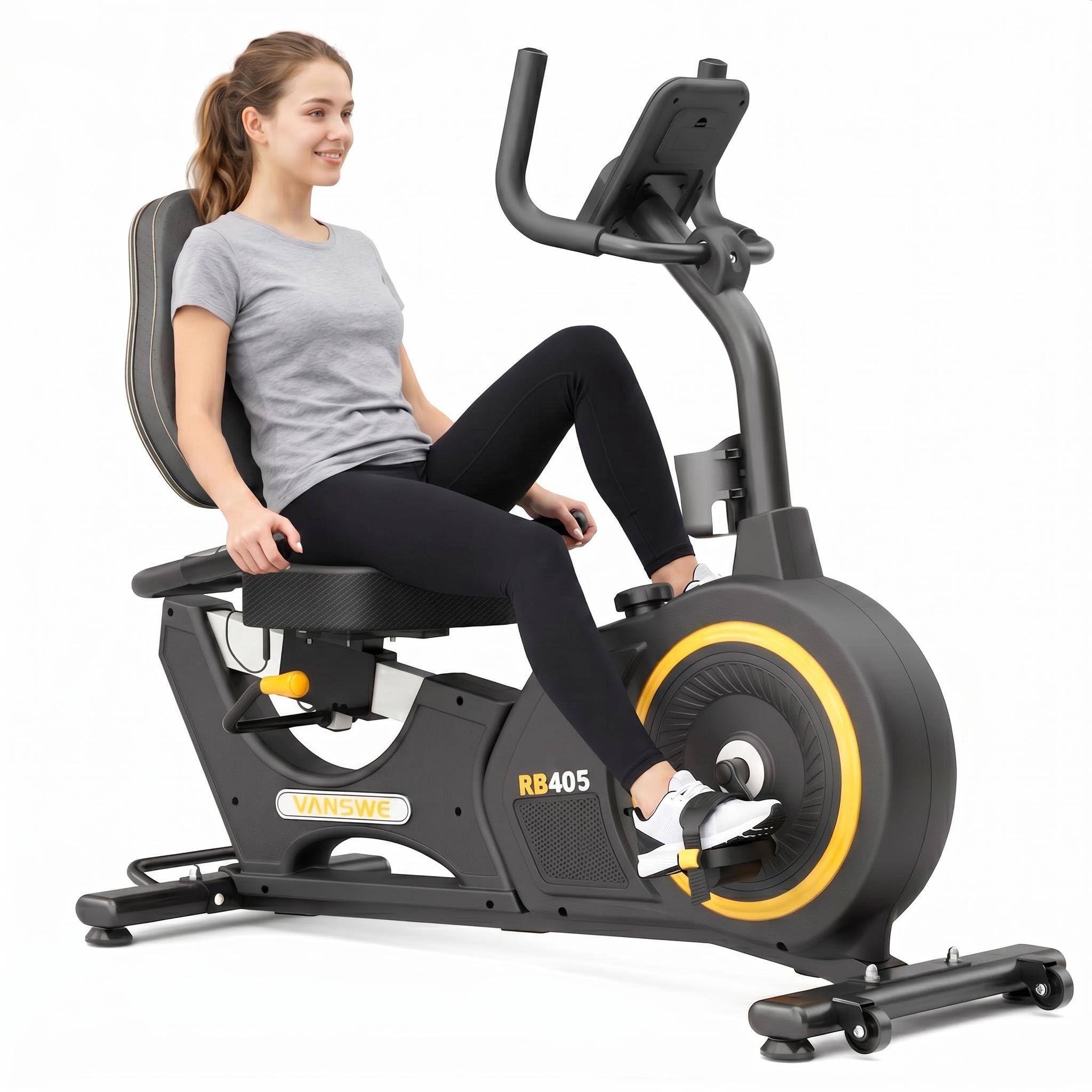
The VANSWE RB405 differentiates itself with an Infinite Slider Seat System that adjusts continuously rather than locking into pre-drilled holes. This millimeter-precision rail means you can find the exact leg extension that keeps your knees from hyperextending or over-bending — a critical detail for rehab users and anyone with a previous knee injury. The seat cushion measures 3.4 inches thick with a contoured backrest, and the low step-through design makes mounting and dismounting easy for seniors or anyone with limited hip mobility. The 400-pound weight capacity is matched by a commercial-grade steel frame that does not wobble during aggressive pedaling, even at the highest of the eight magnetic resistance levels.
The backlit LED monitor displays time, distance, speed, calories, odometer, and heart rate from the pulse grips, and the numbers are large enough to read without glasses. Bluetooth connectivity syncs with Kinomap and Zwift, though several owners reported that pairing can be hit-or-miss on the first attempt — resetting the console usually resolves the connection. The 11-pound flywheel provides enough rotational mass to smooth out pedal dead spots, and the belt drive keeps total noise low enough that early-morning workouts do not disturb others. The integrated tablet holder sits above the monitor and stays stable even during higher cadence efforts.
The main limitation appears to be leg room for very tall riders. While the company lists a fit range of 5’1″ to 6’4″, owners at 6’0″ and above in multiple reviews reported that the seat rail maxes out before their legs fully extend. If you are over 6’2″, the 3G Cardio Elite RB X offers significantly more stretch-out room. The pedal cages are also narrow — a few users with US men’s size 12 or larger shoes noted that their toes occasionally clipped the frame housing during the pedal stroke. The included assembly tools are low quality, and replacing them with a proper Allen key set speeds up the build considerably. For riders under 6’0″ who need precise knee alignment and a heavy-duty frame, the VANSWE delivers a premium fit experience at a mid-range price.
Why it’s great
- Infinite Slider Seat System adjusts in real millimeters (not preset holes) for precise knee alignment — ideal for injury recovery.
- 90 percent pre-assembled out of the box, with tools and video guide included; most owners finish in under 30 minutes.
- Backlit LED monitor with large digits is legible in any room lighting, unlike many basic LCD screens.
Good to know
- Seat rail length may feel short for riders over 6’0″ — not the best choice for tall inseams.
- Pedal cages are narrow; riders with US size 12+ shoes should check fit before committing.
6. pooboo Exercise Bike (Air Resistance Fan Bike)

This pooboo fan bike uses an air resistance system where a fan blade creates drag proportional to your pedaling speed — the harder you push, the more resistance you feel, with no upper limit. Unlike magnetic resistance, which caps at a fixed level, air resistance scales infinitely with effort, making this the most intense cardiovascular option in this lineup. The dual-action handlebars move with your arms while your legs pedal, engaging your shoulders, back, and core simultaneously. The result is a full-body conditioning tool that can spike your heart rate in under 60 seconds, ideal for HIIT finishers after weight training or standalone metcon sessions.
The frame uses carbon steel with a steel cage around the fan wheel for safety, and it supports up to 350 pounds. The drive system combines a belt (for the fan) and a chain (for the pedals) — the belt keeps fan operation quieter than a pure chain system, while the chain delivers a direct road-bike feel to the drivetrain. The seat adjusts vertically and fore-aft, and the handlebars feature high-density foam grips that hold up to sweaty hands without degrading. The Bluetooth performance monitor tracks time, speed, distance, odometer, and calories, and it connects to your phone for structured interval programs. A built-in fan blows air at you as you pedal, providing active cooling that becomes more effective the harder you work — a genuinely useful feature during high-intensity intervals.
The trade-off is noise. The fan produces a distinct whoosh that rises with cadence, and the chain drive adds a slight mechanical hum that is not present on fully belt-driven bikes. This is not a bike for quiet post-work meditation — it is a tool for loud, anaerobic effort. The seat cushion is less padded than recumbent models, and some taller riders (6’4″ in one review) found the forward riding position uncomfortable for longer sessions due to the fixed handlebar angle. The fan also blows air directly at your face, which some users love and others find distracting. If your goal is steady-state zone-2 cardio, choose a magnetic recumbent. If you want a full-body conditioning machine that punishes you in proportion to your effort, this fan bike delivers a value that competes with gym-brand air bikes at a fraction of the price.
Why it’s great
- Air resistance scales infinitely with effort — the only bike in this guide that offers unlimited progressive load.
- Dual-action handlebars engage upper body with each pedal stroke, producing a full-body HIIT stimulus in one machine.
- Built-in cooling fan blows air proportional to speed, keeping you comfortable during all-out sprints.
Good to know
- Fan noise is substantial at high cadences — not suitable for noise-sensitive environments like apartments with thin walls.
- Chain drive requires occasional lubrication and is not as silent as a pure belt-drive system.
7. MERACH MR-S29R2 Magnetic Exercise Bike
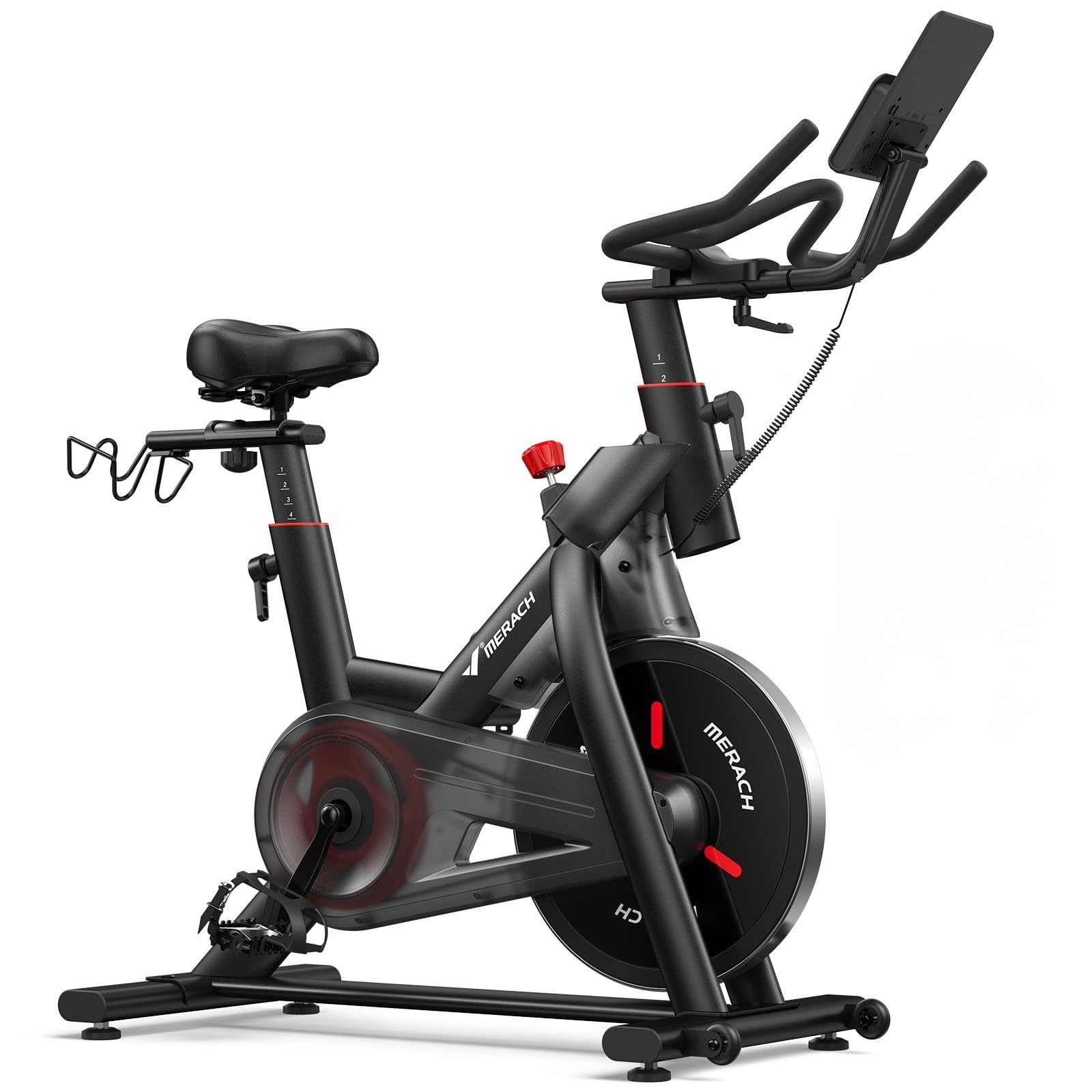
The MERACH MR-S29R2 is an upright spin-style bike that generates its own power as you pedal, eliminating the need for a wall outlet or batteries. This matters if you want to place the bike in a garage, basement corner, or any room where running an extension cord is inconvenient. The 16-level magnetic resistance uses a stepless adjustment dial — you turn it incrementally, and the resistance changes smoothly without hard clicks. The bike supports up to 350 pounds with a reinforced steel frame, and the grade-level flywheel (the manufacturer does not specify exact weight, but it provides enough inertia for smooth coasting) keeps the pedal stroke quiet at under 25 decibels even during resistance level 16 climbs.
The handlebars and seat are both adjustable for height, though the handlebars lack fore-aft movement, which caused discomfort for a reviewer at 6’4″ who felt forced to lean too far forward. Riders under 6’0″ generally found the fit comfortable for 30- to 45-minute sessions. The dual water bottle holders and tablet mount are well-placed — the mount clamps onto the handlebar stem and holds a phone or iPad securely without bouncing during high-cadence work. The Merach app syncs via Bluetooth to display real-time stats (resistance level, distance, time, calories) and exports data to Apple Health and Google Fit, though the app’s resistance tracking showed zero for the stepless dial on some units, indicating a firmware glitch rather than a hardware failure.
The assembly process is straightforward, with most components pre-attached and a single Allen key handling the remaining bolts. The nylon pedals with toe cages are standard and functional, though serious cyclists will want to swap in their own pedals with Look Delta or SPD cleats. The bike does not come with a heart rate monitor — you rely on the app or a third-party device. For a home user who wants a self-powered, whisper-quiet spin bike that does not hog floor space (19 inches wide, 53 inches long) and does not tether you to a power outlet, the MR-S29R2 delivers competent performance at a mid-range price point without the subscription lock-in of connected competitors.
Why it’s great
- Self-powered magnetic resistance — no power cord needed, place it anywhere without outlet access.
- 16 stepless resistance levels with near-silent operation at under 25 dB, suitable for shared walls.
- Compact footprint (19 x 53 inches) with dual bottle holders and a stable tablet mount.
Good to know
- Handlebar lacks fore-aft adjustment — tall riders over 6’2″ may find the reach uncomfortable.
- Merach app resistance tracking had a zero-display issue with the stepless dial on some units.
8. YESOUL S3 Black Exercise Bike

The YESOUL S3 is built around the YESOUL Fitness app ecosystem, offering access to hundreds of on-demand and live spin classes with instructors who coach you through cadence and resistance changes. The magnetic resistance system provides 100 micro-adjustable levels, giving you far finer control over intensity than the typical 8- or 16-level systems — you can find the exact pressure that keeps your cadence steady at 85 RPM without jumping between overly easy and too-hard. The bike pairs via Bluetooth to display cadence, distance, time, calories, and heart rate (armband sold separately), and the resistance knob includes an emergency brake function — press it down to stop the flywheel instantly.
The frame is constructed from carbon steel with a 350-pound weight capacity, and the bike arrives roughly 70 percent pre-assembled. Multiple owners reported finishing assembly in under 30 minutes with the included tool pack. The 10-inch tablet mount sits at eye level and accommodates most iPads and large phones without wobbling. The seat and handlebars adjust vertically, and the SPD-compatible dual-sided pedals let you clip in with cycling shoes or ride flat with the included toe cages. The belt drive is genuinely quiet — several reviewers described it as “whisper quiet” and noted they could watch TV at normal volume while riding at moderate resistance levels.
The main drawback is fit range. Multiple owners at 5’10” and above reported that the seat-to-handlebar distance felt short, and the handlebar height adjustment range is limited. Riders under 5’8″ will find the geometry comfortable, but taller users may struggle to achieve a road-bike-like extended position. The heart rate armband is not included, which adds cost if you want to use the app’s heart-rate-controlled training programs. The app itself offers a free trial with limited content, then requires a monthly subscription for full class access. For shorter to average-height riders who enjoy structured spin classes with real-time metric feedback, the S3 provides a polished app-bike integration that rivals much more expensive machines on class quality and resistance granularity.
Why it’s great
- 100 micro-resistance levels allow precise tuning for cadence-specific training — far more granular than typical 8- or 16-level systems.
- YESOUL Fitness app offers hundreds of live and on-demand spin classes with real-time metric sync via Bluetooth.
- Dual-sided pedals accept SPD cleats or standard toe cages, giving flexibility for cycling shoe users.
Good to know
- Frame geometry favors shorter riders — users over 5’10” may feel cramped in the cockpit.
- Heart rate armband sold separately, and the full app library requires a subscription after the free trial period.
9. Sunny Health & Fitness SF-B220030 Upright Bike

The Sunny Health & Fitness SF-B220030 is the entry-level anchor of this list, and it earns its spot by delivering a belt-driven magnetic resistance bike at a price that undercuts most competitors by a significant margin. The 4-way adjustable seat (up/down, fore/aft) accommodates a range of body types, and the ergonomic foam-padded handlebars provide a comfortable grip for extended sessions. The digital monitor tracks time, speed, distance, calories, and odometer, and the integrated pulse sensors on the handlebars give you a rough idea of your heart rate without needing a chest strap. The bike’s 45-pound weight and small footprint (38.6 x 23.4 inches) make it easy to slide under a desk or into a closet after use.
What sets this bike apart from generic budget uprights is the SunnyFit app integration — you can connect your phone via Bluetooth to access over 1,000 workout videos, virtual location tours, and leaderboard challenges. The app is free with no required subscription, which is rare among connected fitness platforms. The magnetic resistance is adjusted manually via a knob on the frame; it is not programmable, but the frictionless mechanism delivers a smooth pedal stroke without the jerky catch points that plague cheap felt-pad systems. Several owners noted that the bike is significantly quieter than comparably priced units from Marcy or Exerpeutic, and the alloy steel frame wobbles less during moderate-resistance efforts.
The compromises are clear at this level. The maximum user weight is 242 pounds, which limits the bike to lighter riders. The seat cushion is firm and narrow — most reviewers either added a gel cover or replaced the seat entirely within the first two weeks. The monitor is basic and not backlit, and the pulse sensors are notoriously inaccurate when your hands are sweaty. The resistance range is adequate for light to moderate cardio but lacks the top-end bite that experienced cyclists need for hard intervals. For someone who wants a quiet, compact, app-connected bike for casual daily movement — not intense training — this Sunny model provides a solid foundation at a price that leaves room for a better seat and pedals down the line.
Why it’s great
- Belt-driven magnetic resistance at an entry-level price — far smoother and quieter than felt-pad budget alternatives.
- SunnyFit app is completely free with over 1,000 workout videos and virtual route tours — no subscription trap.
- Compact and lightweight (45 pounds) with transport wheels, easy to store in small spaces.
Good to know
- 242-pound weight capacity limits use for heavier riders; the frame is not designed for aggressive workouts.
- Stock seat is hard and narrow — budget for a gel cover or replacement saddle within the first month.
FAQ
Should I choose an upright or recumbent exercise bike for lower back pain?
What does the flywheel weight actually mean for my workout?
Can I connect any exercise bike to Zwift or Peloton app?
How much space should I plan for around the bike?
Final Thoughts: The Verdict
For most users, the best exercise bike winner is the 3G Cardio Elite RB X because its 25-position seat rail and narrow Q factor fit riders from 5’0″ to 6’5″ while delivering the quietest magnetic ride in the premium tier — all backed by a lifetime frame warranty that makes this a truly final purchase for home cardio. If you want Zwift integration without the screen expense, grab the Schwinn 130 Upright for its reliable Bluetooth data broadcasting and 16 levels of app-compatible resistance. And for full-body HIIT conditioning that pushes your lungs and muscles simultaneously, nothing beats the pooboo Air Bike — just be ready for the fan noise that comes with the intensity.

Mo Maruf
I created WellFizz to bridge the gap between vague wellness advice and actionable solutions. My mission is simple: to decode the research and give you practical tools you can actually use.
Beyond the data, I am a passionate traveler. I believe that stepping away from the screen to explore new environments is essential for mental clarity and physical vitality.