Our readers keep the lights on and my smoothie glass nicely filled. As an Amazon Associate, I earn from qualifying purchases.
The coldest nights in a tent aren’t about discomfort — they’re about safety and sleep quality. A heater that fails at 3 AM or burns through oxygen faster than it warms the space isn’t just inconvenient; it’s a real hazard. The market is flooded with units that claim high BTUs but deliver uneven heat, unreliable ignition, or dangerous carbon monoxide risks. Choosing the right heater means understanding the specific interplay between tent volume, fuel type, and safety certifications, not just picking the highest number on a box.
I’m Mohammad Maruf — the founder and writer behind WellFizz. Over years of analyzing portable heating gear, I’ve broken down hundreds of real user reports and technical specs to separate the units that actually perform under freezing tent conditions from those that burn through fuel and patience.
My focus here is on portable heaters that combine reliable ignition, robust oxygen depletion sensors, and even heat distribution for enclosed tents. After sorting through dozens of models, I’ve narrowed the field to the seven most trustworthy camping heaters for tents that meet genuine cold-weather demands without compromising safety.
How To Choose The Best Camping Heaters For Tents
Camping heaters aren’t one-size-fits-all. A unit that works well in a 6-person canvas tent might be overkill or a fire hazard in a small backpacking shelter. You need to weigh three core factors: BTU output relative to tent volume, fuel availability in your environment, and the safety redundancies built into the heater’s design.
BTU Output and Tent Volume
The British Thermal Unit (BTU) rating tells you how much heat the unit can produce. A general rule is 5,000 to 9,000 BTU for a 100–200 square foot tent. Higher-output units like the 13,000 BTU MOZODAWN can quickly warm larger spaces, but in small tents, excess heat creates condensation and oxygen depletion risks. Always size your heater to the small-to-medium side for enclosed spaces — you can always crack a vent, but you can’t reduce a unit’s heat output beyond its lowest setting.
Safety Systems: ODS and Tip-Over Shutoff
Oxygen Depletion Sensors are non-negotiable for any combustion-based camping heater you intend to use inside a tent. This safety device monitors the oxygen level in the room and automatically shuts off the gas supply if levels drop too low. Tip-over switches add another layer of protection, cutting the fuel flow if the unit is knocked over. Every heater on this list includes at least one of these systems — some include both. Never use a heater in a closed tent that lacks these certifications.
Fuel Type and Runtime
Propane is the most common fuel for tent heaters because 1 lb disposable cylinders are widely available and the gas performs well in cold temperatures. Butane, used in the Naturehike model, is quieter and burns cleaner but can struggle in freezing conditions unless the canister is kept warm. Kerosene heaters like the Sengoku HeatMate offer very long runtimes — up to 12 hours per fill — but require proper ventilation and more careful fuel handling. Electric heaters like the Caframo True North are the safest option but depend entirely on a power source, limiting them to campsites with hookups or RVs.
Ignition Reliability and Control
A heater that requires a match or struggles to light in cold weather is frustrating and dangerous. Piezo-electric ignition systems are standard on most modern units, but some models (like the Dyna-Glo 10K and Heat Hog) have documented issues with pilot lights staying lit or igniting on lower settings. Look for a heater with a proven track record of reliable ignition, especially if you camp at elevation or in sub-freezing temps where thin air makes lighting more difficult.
Quick Comparison
On smaller screens, swipe sideways to see the full table.
| Model | Category | Best For | Key Spec | Amazon |
|---|---|---|---|---|
| Heat Hog 9,000 BTU | Propane Radiant | Hunting blinds & ice fishing | 9,000 BTU, tiltable head | Amazon |
| CAMPLUX 8,500 BTU | Propane Radiant | Lightweight backpacking & trips | 4.2 lbs, includes storage bag | Amazon |
| Dyna-Glo 10K BTU | Propane Radiant | Large tents up to 250 sq ft | 10,000 BTU, variable heat | Amazon |
| Naturehike 3-in-1 Butane | Butane Radiant | Multifunction heating & cooking | 3,750 BTU, 108 sq ft coverage | Amazon |
| MOZODAWN 2-in-1 | Propane Radiant | Budget heat & cooking combo | 13,000 BTU, 360° heating | Amazon |
| Caframo True North | Electric Forced Air | RV/camper noise-sensitive use | ~1,200W, anti-freeze mode | Amazon |
| Sengoku HeatMate Kerosene | Kerosene Convection | Large tents & emergency backup | 23,500 BTU, 1,000 sq ft | Amazon |
In‑Depth Reviews
1. Heat Hog 9,000 BTU Portable Propane Radiant Heater

The Heat Hog delivers 9,000 BTU of radiant heat to cover up to 225 sq ft, making it an excellent fit for hunting blinds, ice fishing tents, and medium-sized camping shelters. Its defining feature is the tiltable head — a rare design in this category that lets you angle the heat directly at your body or gear. This curved plaque technology provides a 33-degree wider heating spread than standard flat-panel units, which translates to more even warmth across the tent floor rather than a single hot spot.
Built with an Oxygen Depletion Sensor and a rugged tip-over switch, the Heat Hog meets essential safety marks for enclosed use. It runs on standard 1 lb propane cylinders without needing electricity, and users consistently report reliable ignition after the initial propane line is purged. Real-world testing shows it keeps a hunting blind comfortable in 20°F weather for full 8-hour stretches on high with a 20 lb tank adapter attached — a workhorse cadence that few units in this price tier match.
The downsides are intermittent ignition issues — some buyers report the pilot light struggles to stay lit on initial use, and the heat output transitions can cause the flame to snuff out before the low setting engages. At 9,000 BTU it’s not the most powerful unit here, but for the tent sizes most campers actually use (100–200 sq ft), it’s right in the sweet spot. The tiltable design alone makes it a compelling choice over static-angle competitors.
Why it’s great
- Tiltable head directs heat exactly where needed
- ODS and tip-over shutoff for safe enclosed use
- Compatible with 20 lb propane tanks via accessory hose
Good to know
- Some units have intermittent ignition on the lowest heat setting
- Only runs on high, making low setting functionally unavailable for some buyers
- 9,000 BTU may leave large tents (250+ sq ft) under-heated
2. CAMPLUX Portable Propane Heater 8,500 BTU

At 4.2 lbs with detachable tripod legs and a dedicated storage bag, the CAMPLUX is built for campers who prioritize weight and packing efficiency without giving up meaningful heat output. Its 8,500 BTU heats up to 200 sq ft, and the 360° radiant design means heat radiates in every direction from the central burner. The built-in conduction plate on top is a smart touch — it keeps your mug warm without requiring a separate stove surface, though it won’t boil water.
The piezo ignition is simple: press and turn the knob, and you get a flame within 30 seconds. Users confirm it fires up reliably even at elevation, a known pain point for many pilot-ignition heaters. The ODS and tip-over protection are standard, but the tripod legs add stability on uneven tent floors — a detail that matters more in real campsite conditions than on a spec sheet. The rear flap design supports a 20 lb propane tank without condensation pooling, and the unit is pre-assembled out of the box.
Some users report that the heater’s heat output is borderline for tents much larger than 120 sq ft in sub-20°F conditions. The built-in conduction plate adds warmth to drinks but won’t replace a camp stove for real cooking. A handful of buyers received defective units that posed ignition hazards, so inspecting the unit before first use is wise. Still, for backpackers and car campers who want a no-hassle, lightweight propane heater that packs small, this is a strong contender.
Why it’s great
- Ultralight 4.2 lbs with storage bag for easy packing
- 360° radiant heat for even tent coverage
- Reliable piezo ignition works at elevation
Good to know
- Sleeps 120 sq ft well but struggles in larger tents in deep cold
- Conduction plate warms drinks only — not a substitute for a camp stove
- Quality control issues reported on a small number of units
3. Dyna-Glo 10K BTU Grab N Go Portable Propane Heater
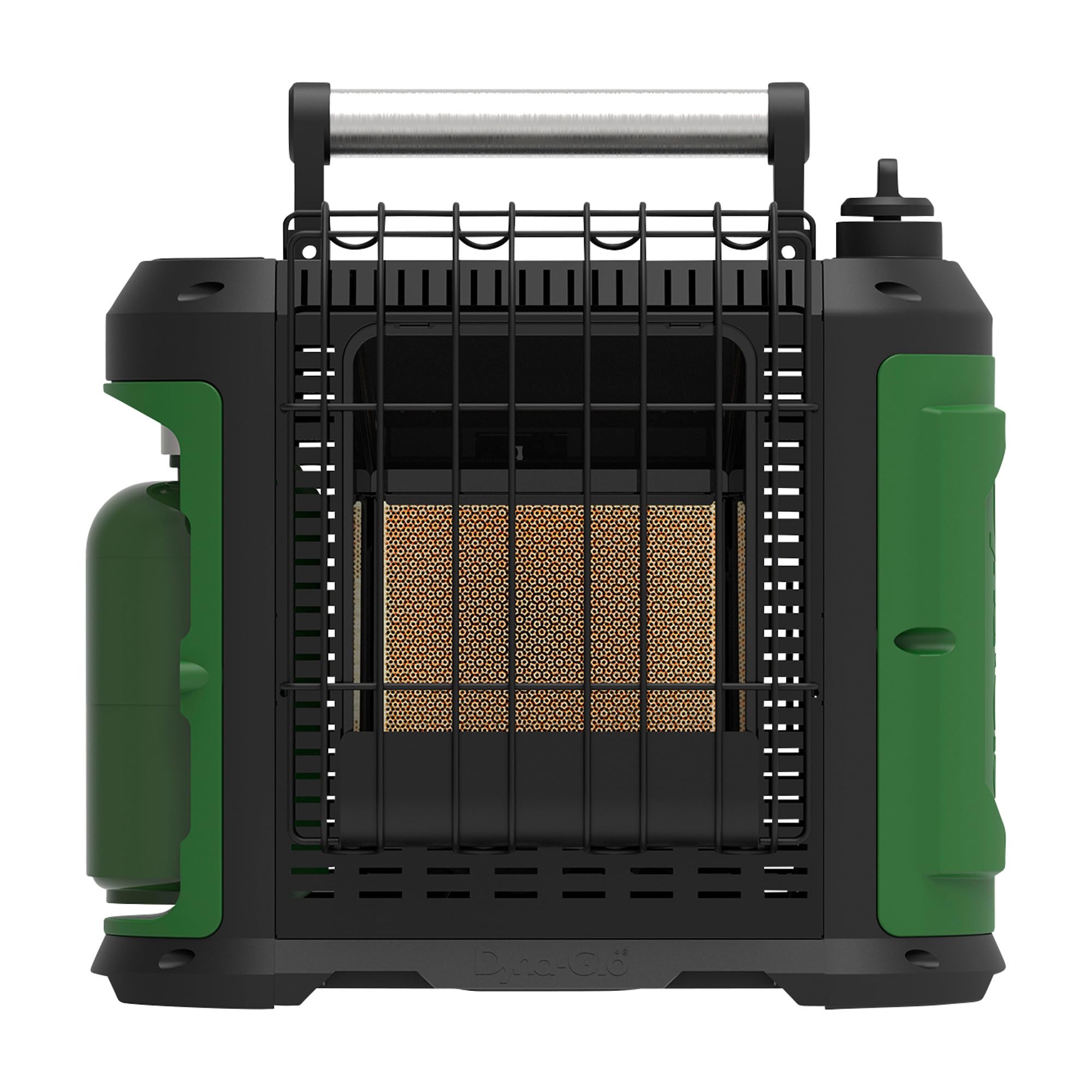
The Dyna-Glo 10K BTU Grab N Go is a straightforward propane heater that focuses on raw heat output and simplicity. With 10,000 BTU heating capacity, it’s rated for up to 250 sq ft, making it one of the more powerful options for larger family tents or group shelters. The swivel valve design makes cylinder replacement easy without having to unscrew the regulator each time, and the continuously variable heat settings let you dial in the temperature rather than jumping between fixed stages.
The piezo ignition is CSA certified, and the heater includes a tip-over shutoff and ODS for safe enclosed operation. In practice, the heater produces intense radiant heat quickly — multiple user reports describe it as “cooking them out of hunting blinds.” The unit runs on 1 lb disposable propane tanks, and owners who adapt it to a 20 lb tank via a hose report all-week runtime without issues. The build is solid for the price, with a compact footprint that doesn’t take up excessive floor space in a tent.
The biggest complaint is a recurring ignition problem: for some units, the pilot light won’t stay lit, or the flame blows out when transitioning from pilot to the low setting. This appears to be a design tolerance issue that affects a non-trivial number of units. Additionally, the low heat setting often fails to function at all, leaving users stuck with high output only — which severely limits its usefulness for smaller tents where 10,000 BTU on high is too much heat too fast.
Why it’s great
- 10,000 BTU output heats up to 250 sq ft efficiently
- Swivel valve makes propane cylinder swaps tool-free and fast
- Continuously variable heat control
Good to know
- Recurring pilot light and low-setting ignition failures reported
- Low setting often non-functional, leaving only high output
- Unit shuts off if moved while operating — safe but inconvenient
4. Naturehike Portable 3-in-1 Butane Heater 3,750 BTU
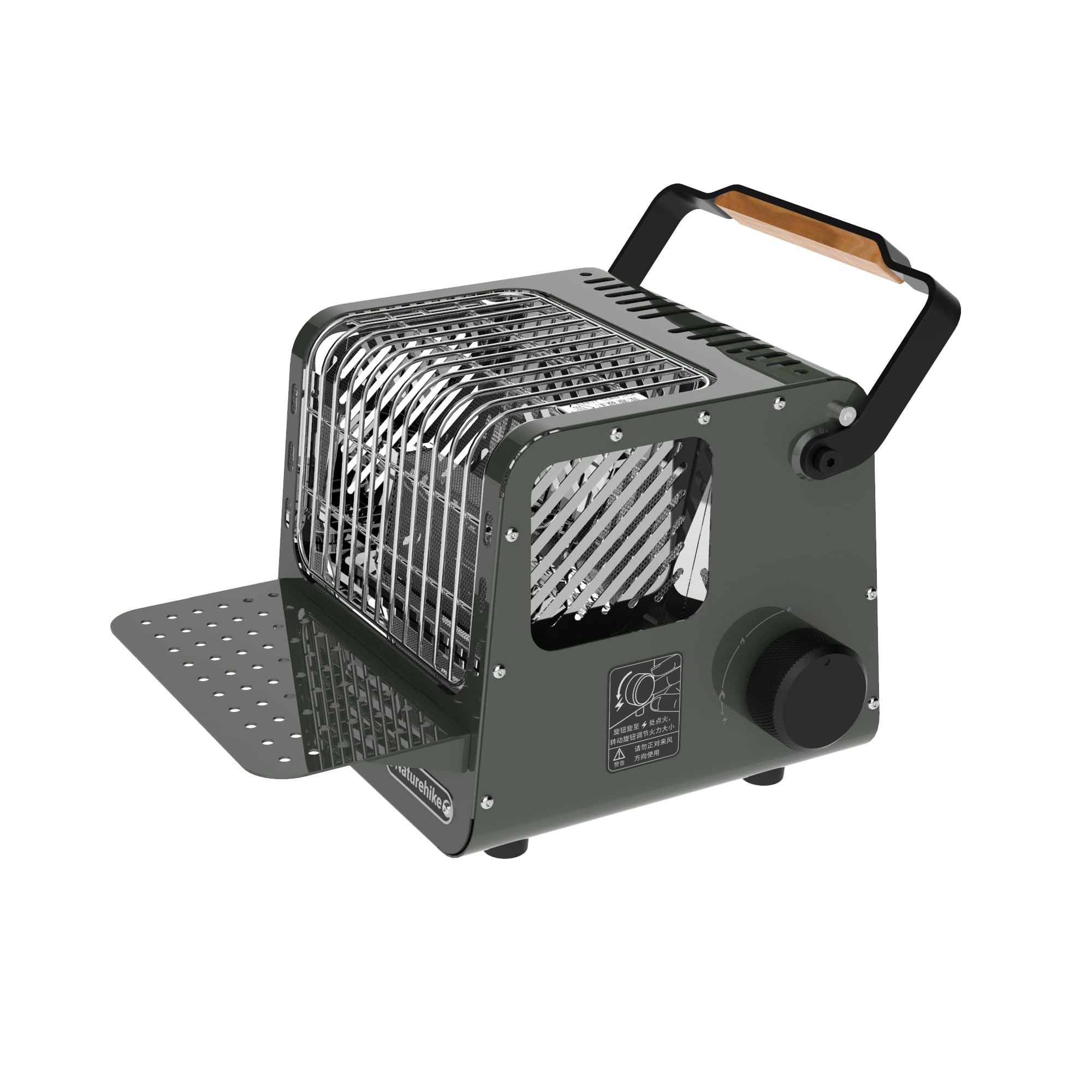
The Naturehike 3-in-1 is a compact butane-powered heater that doubles as a stove and warming shelf for smaller tents, awnings, and hunting blinds. Its 3,750 BTU output is modest — it heats 54 to 108 sq ft — which makes it perfect for removing the chill from a 2-person tent or keeping a hunting blind comfortable. The detachable warming shelf on top can hold a mug or a small pan, and users confirm it can toast English muffins or heat soup, though it won’t boil water quickly.
The butane fuel is a double-edged sword: it burns cleaner than propane with less odor and the magnetic canister connection is tool-free and fast. However, butane loses vapor pressure in freezing temperatures — below about 32°F, the canister struggles unless kept warm. Naturehike includes a metal heat transfer tab that helps warm the canister during operation, but this only works once the heater has been running for a few minutes. Runtime is roughly 4 hours on a full 8 oz canister at 75% power, which is good for evening use but not all-night operation.
The build quality is excellent for the price, with a sturdy metal cabinet and a vintage aesthetic that looks better than most utilitarian camping heaters. The unit is small enough to sit on a camp table but not tiny — it needs a stable, flat surface. The magnetic connection’s grip on the butane canister can feel too tight initially, and buyers using a propane adapter have reported failures in sub-freezing conditions. For mild-weather tent camping where you need heat and a surface for warming food, this is a clever, space-saving solution.
Why it’s great
- Compact 3-in-1 design serves as heater, stove-top, and warming shelf
- Butane burns cleaner than propane with less odor
- Sturdy build with attractive vintage aesthetics
Good to know
- Butane struggles in sub-freezing temperatures without pre-warming
- Stove function is slow — 10 minutes to heat 12 oz of water
- Needs a flat, stable surface — not free-standing on the ground
5. MOZODAWN 2 in 1 Propane Heater & Stove, 13,000 BTU

MOZODAWN’s 2-in-1 delivers a striking 13,000 BTU output — the highest raw heat in this lineup — combined with a built-in stove top for cooking. The 360° radiant heating design pushes warmth in every direction, making it effective for quick warming of medium-to-large tents. User reports confirm it kept a pair of attached 10×13 tents comfortable for sleeping overnight, and the cooking surface handles coffee, soup, and simple meals, though not a rolling boil. The heater runs approximately 30 hours on a large 20 lb propane tank, giving it exceptional fuel efficiency for the heat output.
Safety is well-covered with a triple system: tip-over shutoff, automatic gas shutoff if the flame extinguishes, and an ODS for low oxygen detection. The stainless steel threaded interface resists rust, which is a common failure point on cheaper propane heaters. Users consistently praise the reliable piezo ignition — a major advantage over units that require matches or struggle in wind. The package includes a 5 ft hose connector for attaching to standard propane tanks.
The unit’s 3.92 kg (8.6 lb) weight makes it one of the heavier options here — not ideal for backpacking but fine for car camping. The heat-to-cook switch has a flimsy feel according to several users, and the rubber feet on the bottom tend to come loose over time. A few owners replaced the feet with larger screws to fix the issue. For the price, it offers an unbeatable BTU-to-dollar ratio, but the build quality on the cooking switch and base feet reflects its budget positioning.
Why it’s great
- Highest heat output at 13,000 BTU for large tents
- Integrated stove top for cooking and boiling water
- Triple safety system with ODS and tip-over shutoff
Good to know
- 8.6 lb weight is heavy for backpacking
- Heat-to-cook switch feels flimsy and prone to wear
- Rubber base feet can detach over time
6. Caframo True North Heater — Electric, Quiet

The Caframo True North is the only electric heater in this lineup, and it occupies a distinct niche: RV campers, covered tent platforms with shore power, and workshops. Its forced-air design pushes warm air outward rather than relying on radiant heat, which means more even room temperature distribution and no exposed flame inside your tent. The 5 settings include three heat levels (roughly 500W, 900W, and 1,200W) plus two fan-only modes, giving you granular control over power draw — critical when running off a campground pedestal or generator with limited amperage.
The standout feature is the anti-freeze setting, which automatically kicks the heater on when ambient temperature drops to 38°F (3°C). This makes it indispensable for winter RV storage or keeping a camper van’s interior above freezing overnight without manual intervention. The all-steel housing with a low-profile design prevents tip-overs, and electronic safety systems protect against overheating. Users rate it as exceptionally quiet, making it the best choice for light sleepers who can’t tolerate the hiss and click of propane heaters.
The 1,200W maximum output (roughly 5,200 BTU) is significantly lower than any propane unit here, meaning it’s only effective in well-insulated small spaces — think a small camper, tent under 100 sq ft, or an enclosed truck bed. It requires a constant 120V AC power source, which limits its use to campsites with electrical hookups. The internal thermostat has a reputation for failing after extended use, leading some owners to pair it with an external thermostat. For those who can supply power, it’s the safest, quietest, and most reliable long-term heating solution available.
Why it’s great
- Exceptionally quiet forced-air operation — ideal for sleepers
- Anti-freeze mode protects gear and pipes automatically
- All-steel rugged build with 5-year warranty
Good to know
- Low heat output (~5,200 BTU) limits use to small insulated spaces
- Requires 120V AC power — not usable off-grid
- Internal thermostat may fail; external thermostat recommended for precision
7. Sengoku HeatMate Portable Kerosene Heater 23,500 BTU

The Sengoku HeatMate HMC-23K is a kerosene convection heater with 23,500 BTU output, making it the undisputed heavyweight champion of this list for raw heating capacity. Its 1.9-gallon fuel tank runs for up to 12 hours on a single fill, heating spaces up to 1,000 sq ft — orders of magnitude larger than typical camping tents. This heater is designed for base camping, large group shelters, emergency home backup, and garages where propane heaters would require constant cylinder swaps.
The convection heating method works differently from radiant heaters: instead of directly radiating heat in a straight line, the HeatMate warms the surrounding air, which naturally circulates and rises. This results in more even temperature distribution across large spaces, but it also means the unit itself gets very hot — the safety guard grills are essential, especially around kids and pets. The push-button start and automatic ignition make setup simple: fill with kerosene, press the button, and adjust the flame with the EZ flame adjuster. The tip-over switch and automatic shutoff meet safety standards for both indoor and outdoor use.
Kerosene has tradeoffs: it burns cleaner than propane when using high-quality “Clean Fuel” (K-1), but lower-grade kerosene produces noticeable odors and more soot. The unit weighs 27 lbs and measures roughly 2 feet tall, making it impractical for backpacking or small car camping setups — this is strictly for scenarios where weight and size don’t matter. Wick maintenance is required after each season of use, which adds a recurring task most propane users won’t deal with. For campers who need reliable, long-duration heat for large tents or who want a dual-purpose heater for home emergency prep, the HeatMate is the most powerful and fuel-efficient choice.
Why it’s great
- Massive 23,500 BTU heats up to 1,000 sq ft
- 12-hour runtime on a single 1.9-gallon fill
- Convection heating provides even temperature distribution
Good to know
- 27 lbs is extremely heavy — unsuitable for backpacking
- Requires K-1 kerosene; lower grades produce odor and soot
- Annual wick maintenance needed for optimal performance
FAQ
Can I leave a propane heater running all night in my tent?
How do I know what BTU rating I need for my tent?
Is butane or propane better for cold-weather tent camping?
Do I need to ventilate my tent even with an ODS heater?
Final Thoughts: The Verdict
For most users, the camping heaters for tents winner is the Heat Hog 9,000 BTU because it balances safety, heat output, and directional control in a package that works across hunting blinds, ice shelters, and standard tents. If you want an ultralight heater for backpacking, grab the CAMPLUX 8,500 BTU. And for base camp or emergency home backup, nothing beats the Sengoku HeatMate Kerosene Heater as a long-duration powerhouse.

Mo Maruf
I created WellFizz to bridge the gap between vague wellness advice and actionable solutions. My mission is simple: to decode the research and give you practical tools you can actually use.
Beyond the data, I am a passionate traveler. I believe that stepping away from the screen to explore new environments is essential for mental clarity and physical vitality.