Our readers keep the lights on and my smoothie glass nicely filled. As an Amazon Associate, I earn from qualifying purchases.
That vintage amp gathering dust in your living room has a hidden weakness: it cannot speak to your phone’s 24-bit audio files. A Bluetooth DAC bridges the gap without replacing a single piece of your existing gear, converting digital wireless signals into clean analog sound your amplifier can actually amplify. The challenge right now is separating the entry-level adapters from the portable powerhouses while knowing exactly which codec (LDAC, aptX HD, or AAC) your phone actually supports — because buying the wrong one leaves you listening to compressed garbage.
I’m Mohammad Maruf — the founder and writer behind WellFizz. I have spent hundreds of hours analyzing Bluetooth DAC specifications, decoding chipset comparisons, and cross-referencing real-world user feedback to separate marketing fluff from measurable audio performance.
Understanding which DAC chip drives your soundstage and whether your listening setup needs a portable amplifier or a dedicated home-station receiver is how you avoid wasting money on gear that doesn’t improve your system. This is the complete guide to finding the best bluetooth dac for your specific setup and budget.
How To Choose The Best Bluetooth DAC
Bluetooth DACs live in a strange middle ground: they are not complete receivers, yet they are more than simple dongles. Your buying decision hinges on three factors: your device’s codec support, your amplifier’s input type, and whether you need portability or a permanent home-station unit. Misjudging any one of these three elements turns a promising upgrade into an expensive paperweight.
Codec Compatibility is Non-Negotiable
LDAC (Sony) delivers up to 990 kbps, which is the closest wireless gets to CD-quality. aptX HD (Qualcomm) caps at 576 kbps but offers lower latency. AAC works best inside the Apple ecosystem. If your phone only supports AAC, buying a premium LDAC receiver gains you nothing — the DAC will automatically downshift to the highest common codec, so you are paying for a feature you cannot use. Check your phone’s Bluetooth developer options before you check out.
DAC Chip Architecture Dictates Sound Signature
ESS Sabre chips (ES9018K2M, ES9219) lean analytical, with wide soundstage and crisp treble. AKM chips (AK4493S) deliver a warmer, more organic tonality that many audiophiles prefer for vocal-heavy music. Texas Instruments (PCM5102A) holds its own in the mid-range bracket, offering a natural balance without the top-end sparkle of ESS. Your ears and your music genre should dictate which silicon to trust.
Output Stage: Analog vs Digital
If your amplifier has optical or coaxial input, choose a DAC that outputs digital — the digital path bypasses the DAC’s own analog stage entirely, letting your amplifier’s internal conversion handle the heavy lifting. If your amp only accepts RCA analog, you need a DAC with a strong analog output stage (look for 2V RMS or higher) to avoid a weak, lifeless signal that forces you to crank the volume knob.
Quick Comparison
On smaller screens, swipe sideways to see the full table.
| Model | Category | Best For | Key Spec | Amazon |
|---|---|---|---|---|
| FiiO BTR7 | Portable | High-impedance headphones on the go | Dual ES9219C + 4.4mm balanced | Amazon |
| iFi GO blu | Portable | IEMs and on-the-go LDAC | 4.4mm S-Balanced + XBass | Amazon |
| SLASH3 | Home Station | Direct plug into vintage amps | ESS ES9219 Quad DAC 130dB SNR | Amazon |
| Fosi Audio Q6 | Desktop | TV/CD player to vintage receiver | AKM AK4493S + DSD512 support | Amazon |
| FiiO BR13 | Home Station | Value-priced all-codec receiver | ES9018K2M + QCC5125 chipset | Amazon |
| 1Mii B06HD+ | Home Station | Digital output to old receivers | ES9018K2M + BT 5.3 | Amazon |
| BluDento BLT-2 | Home Station | Simple analog upgrade for secondary systems | TI PCM5102A + external antenna range | Amazon |
In‑Depth Reviews
1. FiiO BTR7

The FiiO BTR7 blurs the line between portable dongle and desktop-grade amplifier. Dual ES9219C chips — one per channel — deliver a left-right separation that single-chip units simply cannot match, and the 4.4mm balanced output pushes 320mW into 32-ohm loads, which means it drives 300-ohm Sennheiser HD6XX headphones with zero strain. Bluetooth 5.1 covers every codec you need: LDAC, aptX Adaptive, aptX HD, AAC, and even MQA 8x rendering for Tidal subscribers.
The XMOS XUF208 processor handles PCM up to 384kHz and native DSD256, so if you are feeding it high-res files from a laptop via USB, it keeps every bit intact. The built-in microphone with cVc 8.0 noise suppression makes hands-free calls genuinely usable, and the aluminum alloy chassis feels dense enough to survive daily pocket carry. Battery life sits around 8 hours with balanced output active — shorter than the previous BTR5, but that is the trade-off for the larger color display.
Where it stumbles is the software. The FiiO Control app has a confusing menu layout with non-labeled EQ bands, and the on-device navigation requires muscle memory to master. Once you set the parametric EQ and forget it, though, the BTR7 becomes the most versatile Bluetooth DAC under for anyone who wants both portability and the ability to power full-size cans.
Why it’s great
- Dual ES9219C DACs deliver true balanced separation
- Drives 300-ohm headphones with authority
- Full codec support including MQA and LDAC
Good to know
- Confusing on-device menu and app interface
- Battery life shorter than previous BTR generation
- Larger than typical Bluetooth dongles
2. iFi GO blu

The iFi GO blu weighs 27 grams — light enough to clip onto a shirt collar without dragging — yet it packs the Qualcomm 5100 series chipset that supports LDAC 24/96, aptX HD, and AAC simultaneously. What sets it apart from the FiiO BTR7 is the analog control philosophy: a physical volume knob (no accidental screen taps) and toggleable XBass and XSpace filters that add sub-bass weight and widen the soundstage without sounding artificial.
The S-Balanced circuitry cuts single-ended channel crosstalk by 50 percent, which means even the 3.5mm jack sounds cleaner than most competitor’s standard outputs. With the 4.4mm balanced output active, the GO blu drives the Sennheiser HD660S2 to satisfying levels without breaking a sweat. Battery life hits about 10 hours in real-world use, and the built-in microphone handles voice calls clearly enough for work commutes.
The Achilles heel is the missing clip and case in the retail package — you have to buy a separate belt clip. The physical volume knob has very fine increments (too fine for some users), and the housing of a few units has been reported to separate after a few months, possibly due to battery swelling. For listeners who prioritize a warm, liquid sound signature over clinical detail, this remains the best portable Bluetooth DAC under .
Why it’s great
- Analog volume knob avoids unreliable touch controls
- XBass/XSpace filters add genuine depth and air
- Extremely lightweight at 27 grams
Good to know
- No included clip or carrying case
- Volume knob increments can be too fine for quick adjustments
- Reported housing separation in early units
3. SLASH3 Bluetooth DAC Receiver
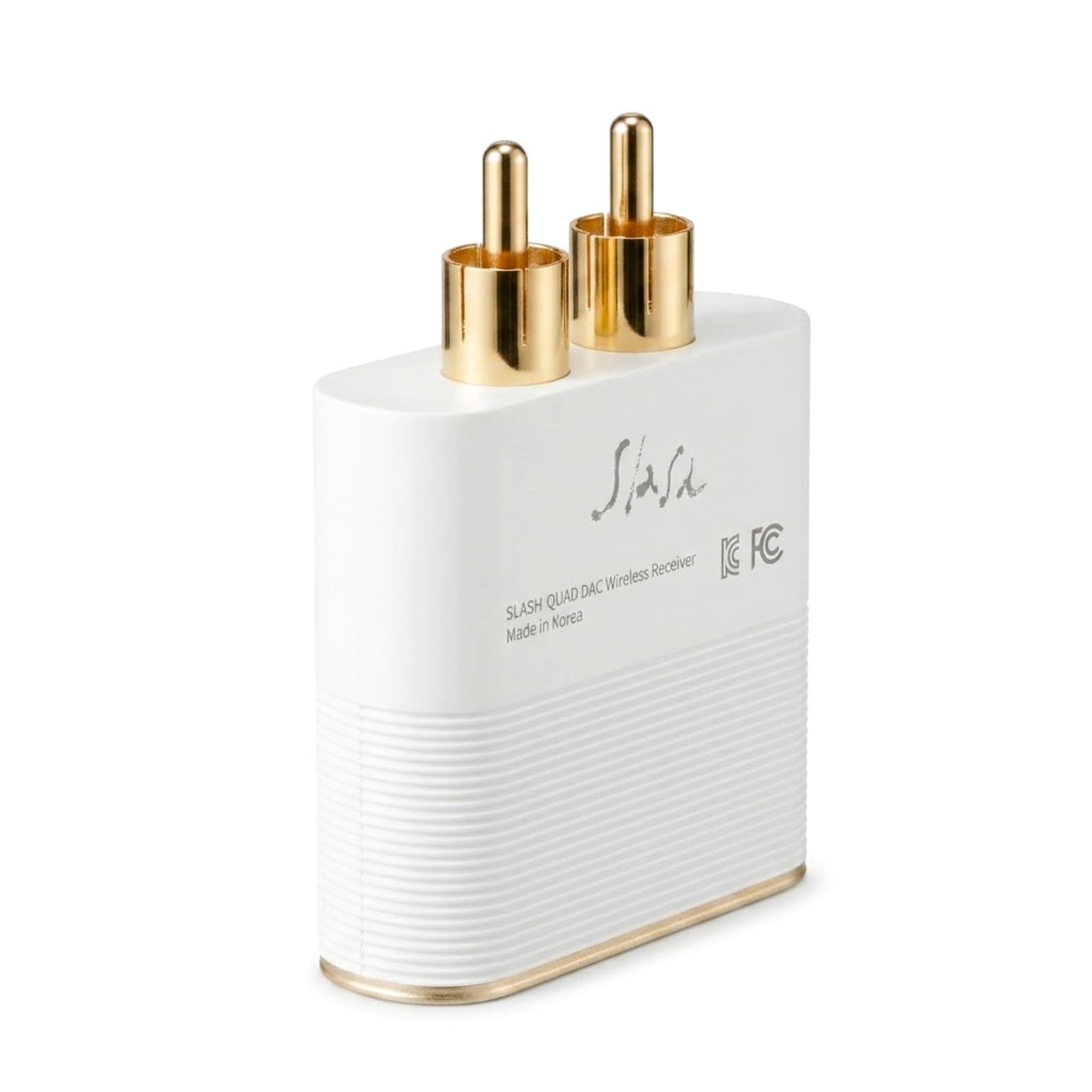
The SLASH3 solves an ergonomic problem that most home-station receivers ignore: cable clutter. Its Direct Plug RCA design lets the unit screw directly into your amplifier’s RCA inputs — no extra interconnects, no loose wiring, no signal degradation from cheap cables. The ESS ES9219 Quad DAC delivers a 130dB signal-to-noise ratio, which is a spec typically reserved for desktop DACs, and combined with the QCC5125 chipset it supports LDAC at 24-bit/96kHz and aptX Adaptive.
In blind listening tests against similarly priced competition like the Auris Blume Pro, the SLASH3 consistently scored higher on dynamics and bass punch, particularly when fed LDAC from an Android source. The auto-reconnect feature picks up the last paired device within a few seconds of power-up, and the high-purity copper RCA connectors maintain signal integrity even with older amplifiers that have finicky jacks.
The downsides: it is not rechargeable (USB-C power only, no internal battery), and switching between paired devices can be slow. A few users have reported that feeding USB power from a computer introduces noise into the analog output — a linear 5V power supply cleans it up noticeably. For a permanent installation on a vintage receiver in your living room, the SLASH3 is the most elegant space-saving solution currently available.
Why it’s great
- Zero-cable Direct Plug RCA connection
- 130dB SNR rivals premium desktop DACs
- Auto-reconnect is fast and reliable
Good to know
- No internal battery — requires constant power
- Slow device switching between paired sources
- USB power from computers can introduce noise
4. Fosi Audio Q6

The Fosi Audio Q6 is a desktop-centric DAC that happens to support optical and coaxial inputs — making it a superb bridge between a TV’s optical output and a vintage amplifier that only has RCA. The AKM AK4493S chip delivers a warmer, more organic sound than the ESS Sabre competition, with a 121dB SNR and 0.00012% THD+N that keeps distortion inaudible. It supports PCM up to 32-bit/768kHz and native DSD512, which means it can handle high-res files that most mid-range DACs choke on.
The build quality is surprising at this tier: the aluminum alloy chassis is dense and compact (about the size of a deck of cards), and it includes a Sub-Out for connecting a powered subwoofer directly — a feature rarely seen under . The XMOS XU316 processor handles input switching cleanly, and there is zero audible pop when switching between optical and coaxial sources.
The main limitation is the lack of a Bluetooth receiver — this is a pure wired DAC. You will need to pair it with a separate Bluetooth receiver if you want wireless streaming. The analog power switch is a simple rocker on the back, which feels a bit cheap compared to the premium chassis. For a dedicated desktop setup where you already have a source like a Wiim Pro or a CD player, the Q6 offers the best sound-per-dollar ratio of any DAC in this list.
Why it’s great
- AKM AK4493S delivers warm, fatigue-free sound
- DSD512 and 768kHz PCM support for high-res files
- Sub-Out output for powered subwoofer integration
Good to know
- No built-in Bluetooth — wired-only DAC
- Cheap rocker power switch on back panel
- Requires separate receiver for wireless streaming
5. FiiO BR13

The FiiO BR13 is the cheapest entry in this roundup that still supports LDAC, aptX Low Latency, and AAC — and it does so with the ES9018K2M reference DAC plus the QCC5125 Bluetooth chip. That combination alone makes it a no-brainer for anyone on a tight budget who refuses to sacrifice codec support. The OLED display shows codec status and sample rate, and the aluminum case resists fingerprints and scratches.
The versatility of inputs and outputs is the real story here: USB input, optical input and output, coaxial input and output, RCA output, and even SPDIF conversion between optical and coaxial signals. The FiiO Control app adds seven preset EQ profiles and two fully customizable bands, plus firmware OTA updates that have actually added features since release. In multi-device testing, the BR13 auto-switched between an Apple TV (AAC) and an Android phone (aptX Adaptive) without manual intervention, which is rare at any price.
Reliability concerns emerge from a small but vocal minority of reviews: some units stop powering on after a month, and the included USB cable is too short to reach many setups. The power button on a few units has developed a tactile failure where it stops registering presses. For the price, the sound quality and feature set are unmatched, but the build consistency is not quite at FiiO’s usual standard.
Why it’s great
- Supports all seven major Bluetooth codecs including LDAC
- Full EQ customization via FiiO Control app
- SPDIF conversion between optical and coaxial
Good to know
- Some units reported failing after 1-2 months
- Power button may become unresponsive over time
- Included USB cable is very short
6. 1Mii B06HD+
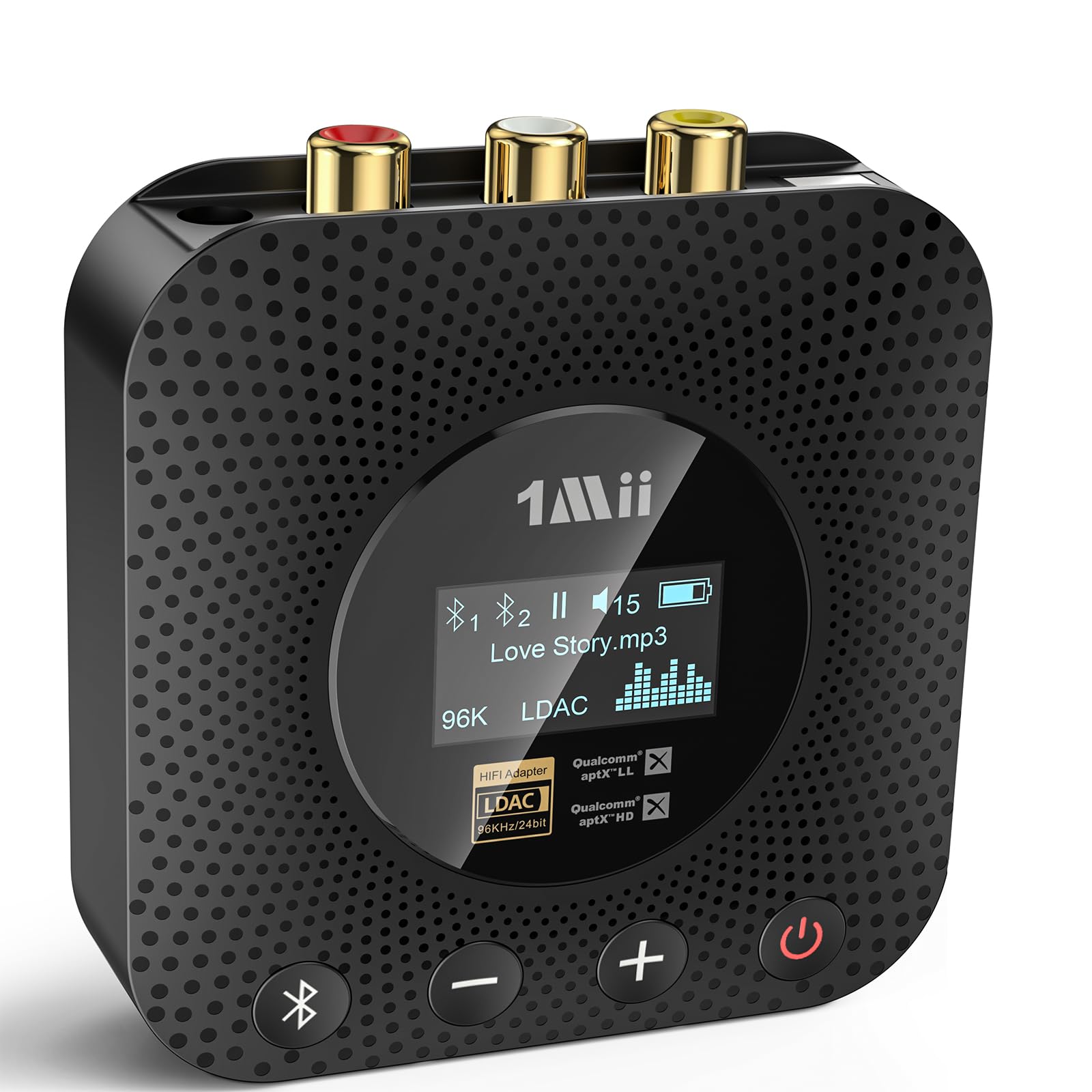
The 1Mii B06HD+ uses the ES9018K2M DAC paired with Bluetooth 5.3 — the newest version in this roundup — and offers optical, coaxial, and RCA outputs. The Bluetooth 5.3 implementation provides a stable LDAC connection at 990 kbps across about 50-80 feet indoors, and the 13-hour battery life means you can leave it unplugged for an entire listening session. The OLED screen scrolls song metadata, codec info, and battery percentage, which is genuinely useful for troubleshooting.
The digital output (optical and coaxial) is where this receiver shines: it bypasses the onboard DAC entirely and sends the raw digital signal to your external amplifier’s converter, which often produces superior sound quality if your amp has a high-quality built-in DAC. Users switching from LDAC to aptX HD via the Android Developer Options menu reported that optical output became more stable — a trick worth knowing if you experience dropouts.
The auto-power-off feature (triggers after 10 minutes of inactivity) is annoying in practice because you have to press the power button manually to reconnect. Some users reported a low hum on vintage amplifiers when using analog RCA, which was resolved by switching to high-quality shielded cables. For users who want a portable receiver they can move between rooms, the B06HD+ offers the best battery life and range in the mid-range category.
Why it’s great
- Bluetooth 5.3 provides 50-80ft stable indoor range
- 13-hour battery battery for extended listening sessions
- Optical/coaxial Pure Path bypasses onboard DAC
Good to know
- Auto-power-off after 10 minutes requires manual restart
- Analog output can hum on vintage amps without shielded cables
- Initial Bluetooth pairing is finicky until unit is power-cycled
7. BluDento BLT-2

The BluDento BLT-2 strips away everything unnecessary — no app, no screen, no fancy chassis — and focuses on delivering clean analog signal via the Texas Instruments PCM5102A DAC. The external antenna provides better range than most internal-antenna models, maintaining a stable connection across two floors in a typical home. It supports aptX HD, aptX Low Latency, AAC, and SBC, with auto-pairing that reconnects to the last device as soon as power is applied.
All three outputs (RCA, optical, coaxial) remain active simultaneously, which means you can send analog to your amp and digital to a separate DAC at the same time. In A/B blind tests, the BLT-2 sounded identical to a wired connection for most users, though the analog output level was slightly lower than the source (likely due to the 0.6A USB power limit). The compact metal case dissipates heat well and fits into crowded AV racks.
The obvious compromises: the blinking blue pairing light cannot be disabled (users have resorted to electrical tape), there is no dedicated power button so you have to unplug it to turn it off, and the included cables are mediocre. The Bluetooth menu requires you to manually select the BLT-2 each time on some phones, which adds friction. For a secondary system, a garage setup, or a guest room, the BLT-2 delivers reliable performance without costing more than dinner out.
Why it’s great
- External antenna provides superior Bluetooth range
- All three outputs (RCA, optical, coaxial) simultaneous
- Auto-pair reconnects reliably to last device
Good to know
- Blinking blue pairing light cannot be turned off
- No power button — must unplug to shut down
- Analog volume lower than source level
FAQ
Can I use a Bluetooth DAC with my iPhone?
What is the difference between a Bluetooth DAC and a Bluetooth receiver?
Do I need a balanced 4.4mm output on my Bluetooth DAC?
Why does my Bluetooth DAC sound worse via USB power from my computer?
Final Thoughts: The Verdict
For most users, the best bluetooth dac winner is the FiiO BTR7 because it combines dual ES9219C DACs, balanced 4.4mm output, and full codec support in a genuinely portable package that drives everything from IEMs to demanding 300-ohm headphones. If you want a warm, analog-feeling listening experience with physical controls and a sub- price tag, grab the iFi GO blu. And for a permanent home-station installation with zero cable clutter and a transparent 130dB SNR, nothing beats the SLASH3.

Mo Maruf
I created WellFizz to bridge the gap between vague wellness advice and actionable solutions. My mission is simple: to decode the research and give you practical tools you can actually use.
Beyond the data, I am a passionate traveler. I believe that stepping away from the screen to explore new environments is essential for mental clarity and physical vitality.