Our readers keep the lights on and my smoothie glass nicely filled. As an Amazon Associate, I earn from qualifying purchases.
Parking your camper in a scenic spot only to find the TV has no signal is a uniquely frustrating travel ritual. Between metal roofs, distant broadcast towers, and constant motion, the average RV needs a purpose-built antenna that can lock onto over-the-air channels without the bulk of a permanent house install.
I’m Mohammad Maruf — the founder and writer behind WellFizz. I’ve spent hundreds of hours analyzing product specifications, consumer feedback, and engineering data for portable and RV-specific antennas, focusing on how range, gain patterns, and mounting hardware translate into real-world campsite performance.
After combing through the latest models, one design consistently emerges as the most practical balance of reception and simplicity for travelers: the best antenna for camper needs to survive highway winds and deliver clear HD channels from unpredictable tower locations.
How To Choose The Best Antenna For Camper
Not every antenna that works on a house roof will survive on a moving camper. The most critical factors are physical durability, gain pattern, and mounting simplicity. Here’s what separates a campground workhorse from a weekend frustration.
Directional vs. Omnidirectional
A directional Yagi antenna concentrates its reception in one direction, which gives it superior range — often 50 to 70 miles — but requires aiming toward the broadcast tower. An omnidirectional antenna like the Winegard Air 360+ captures signals from all directions without adjustment, making it ideal for frequent moves but typically limited to about 55 miles. For stationary camping in remote areas, directional wins on raw performance.
Motorized Rotation Matters
If you choose a directional antenna, a motorized rotator with a wireless remote is a game-changer. Without it, you have to climb the ladder and twist the mast manually every time you change campsites. Models like the PBD and Five Star include a 360-degree motor that lets you fine-tune reception from inside the camper.
Build Quality and UV Resistance
Camper antennas face constant UV exposure, rain, and highway vibration. All-metal construction on Yagi antennas resists cracking far better than plastic housings. Check the mounting hardware — stainless steel clamps and thick-gauge J-poles prevent the antenna from snapping off during a gusty drive.
Cable and Impedance
A 75-ohm RG6 coaxial cable with compression fittings is the only standard that maintains signal integrity over the 20 to 40 feet typical in an RV run. Any antenna that ships with RG59 or thin, kinked cable will degrade your reception before the signal even reaches the TV.
Quick Comparison
On smaller screens, swipe sideways to see the full table.
| Model | Category | Best For | Key Spec | Amazon |
|---|---|---|---|---|
| PBD Amplified Outdoor | Motorized Yagi | Optimizing campsite signal without climbing | 360° motorized rotation | Amazon |
| Winegard RV-3095 Sensar III | Batwing Directional | Upgrading a stock RV antenna | 55-mile range, 4K Ready | Amazon |
| Winegard Air 360+ V2.S | Omnidirectional | Frequent travelers who avoid aiming | 55-mile omnidirectional | Amazon |
| Five Star 150-Mile | Motorized Yagi | Running up to 5 TVs in a large rig | 5-TV splitter included | Amazon |
| GE Outdoor 29884 | Passive Yagi | Budget attic or stationary campsite use | 70-mile range, no amplifier | Amazon |
| CeKay Yagi HD | Budget Yagi | Entry-level directional reception | 70-mile range, all-metal | Amazon |
| Yeceny Motorized 150 | Motorized Yagi | Dual TV output on a tight budget | 150-mile motorized rotation | Amazon |
In‑Depth Reviews
1. PBD Amplified Outdoor TV Antenna

The PBD antenna combines a high-gain Yagi with a built-in 360-degree motorized rotator and wireless remote, making it the most camper-friendly directional antenna on this list. Users report picking up 80 channels from 25 miles away with crystal-clear reception, and the ability to re-aim from inside the RV eliminates the worst part of directional antenna ownership.
The included 40-foot RG6 cable and dual TV outputs allow simultaneous viewing without a splitter. The amplifier and 4G LTE filter reduce interference from cell towers, a common problem in populated campgrounds. The all-metal construction and weatherproof housing hold up well in rain and highway wind.
A few buyers noted the mounting bolts snapped during installation and the supplied cable needed re-terminating, so plan for a minor upgrade if you have thick RV walls. The lifetime warranty and responsive customer support mitigate these concerns considerably.
Why it’s great
- Wireless remote rotation saves roof climbs
- Dual TV output with no splitter needed
- 4G/LTE filter keeps signal clean near cell towers
Good to know
- Mounting hardware can be brittle over-torquing
- 40-foot cable may be short for large Class A rigs
2. Winegard RV-3095 Sensar III Batwing
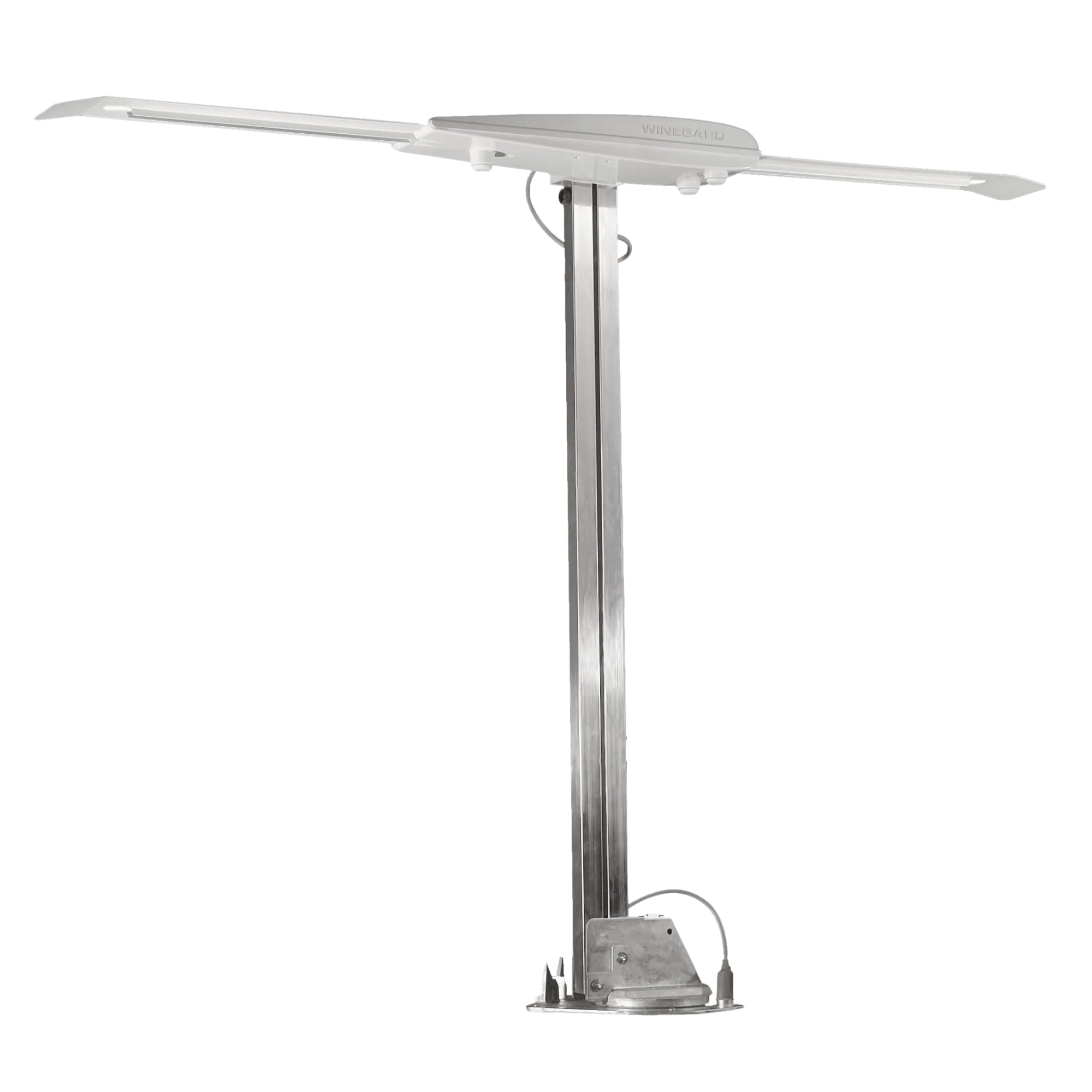
If your camper already has a vintage batwing-style antenna with a dead amplifier, the Winegard Sensar III is the most straightforward swap you can make. It bolts directly onto the existing base plate, and users report picking up 50 to 60 channels after replacement — a massive improvement over the original 13-year-old unit.
The Sensar III supports 4K resolution and ATSC 1.0 broadcasts with a listed 55-mile range. The amplifier is built into the power supply unit inside the camper, which means no climbing onto the roof to adjust gain. The aerodynamic batwing shape reduces wind drag during travel compared to a full Yagi.
It is a manual-crank directional antenna, so you still have to rotate it by hand from inside via the ceiling crank mechanism. It lacks motorized rotation or omnidirectional convenience, but the massive install base and proven durability make it the safe choice for classic RV owners.
Why it’s great
- Exact-fit replacement for most RV roofs
- Internal crank avoids roof climbing
- Proven 20-year design history
Good to know
- Manual aiming only — no remote rotation
- Plastic housing can crack under tree branches
3. Winegard Air 360+ V2.S
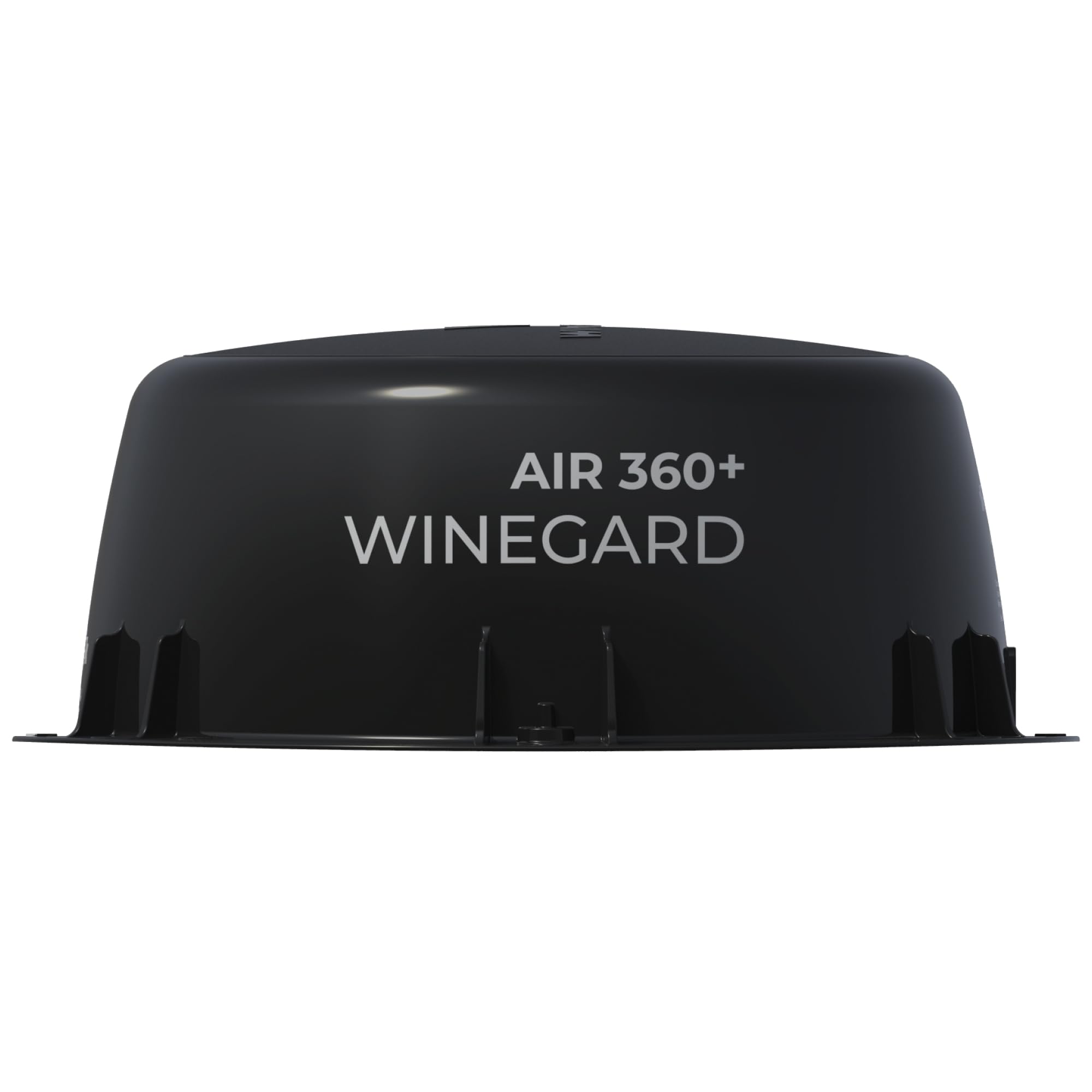
The Air 360+ V2.S is the highest-tier low-profile omnidirectional antenna on the market, designed for campers who change sites every day and cannot be bothered with aiming. It captures VHF, UHF, and FM signals from all directions at once, and users report equal performance to the classic batwing without the manual cranking.
This model includes a built-in satellite port, plus pre-installed WiFi and cellular antennas for pairing with the Winegard Gateway 4G router. The low-profile black dome sits flush on the roof and does not need to be lowered for highway travel — a major convenience over Yagi masts. The power supply runs on 12V DC, compatible with standard RV electrical systems.
In deep-woods campgrounds far from towers, you may struggle. The install requires butyl tape and sealant for waterproofing, and the 12V power draw, while small, needs to be wired into your RV’s system.
Why it’s great
- Zero aiming — just park and watch
- Low-profile dome withstands highway travel
- Built-in satellite and cellular antenna ports
Good to know
- Range limits in very remote locations
- Install requires roof sealant experience
4. Five Star 150-Mile Antenna

The Five Star antenna is built for large RVs with multiple TVs. It includes a remote-controlled 360-degree rotator, a 40-foot RG6 cable, and a powered splitter that feeds up to five televisions without additional hardware. Users report pulling in stations from 60 miles away with outstanding picture quality.
The upgraded smart chip provides automatic gain control, which helps maintain signal strength when broadcast towers are scattered around the horizon. The aerodynamic design reduces wind load, and the included J-pole mounting kit gets you set up quickly. Assembly requires extending five reflector elements, but no tools are needed.
The amplifier’s 150-mile claim is optimistic under real conditions — most users see reliable reception up to 60-70 miles. Technical support has been flagged as difficult to reach, with some customers receiving wrong contact numbers. The coaxial cable included is also a bit short for very large rigs.
Why it’s great
- Powers up to 5 TVs from one antenna
- Automatic gain control for fluctuating signals
- Easy no-tool assembly
Good to know
- Amplifier range claims exceed real-world performance
- Customer support is inconsistent
5. GE Outdoor HD Antenna 29884
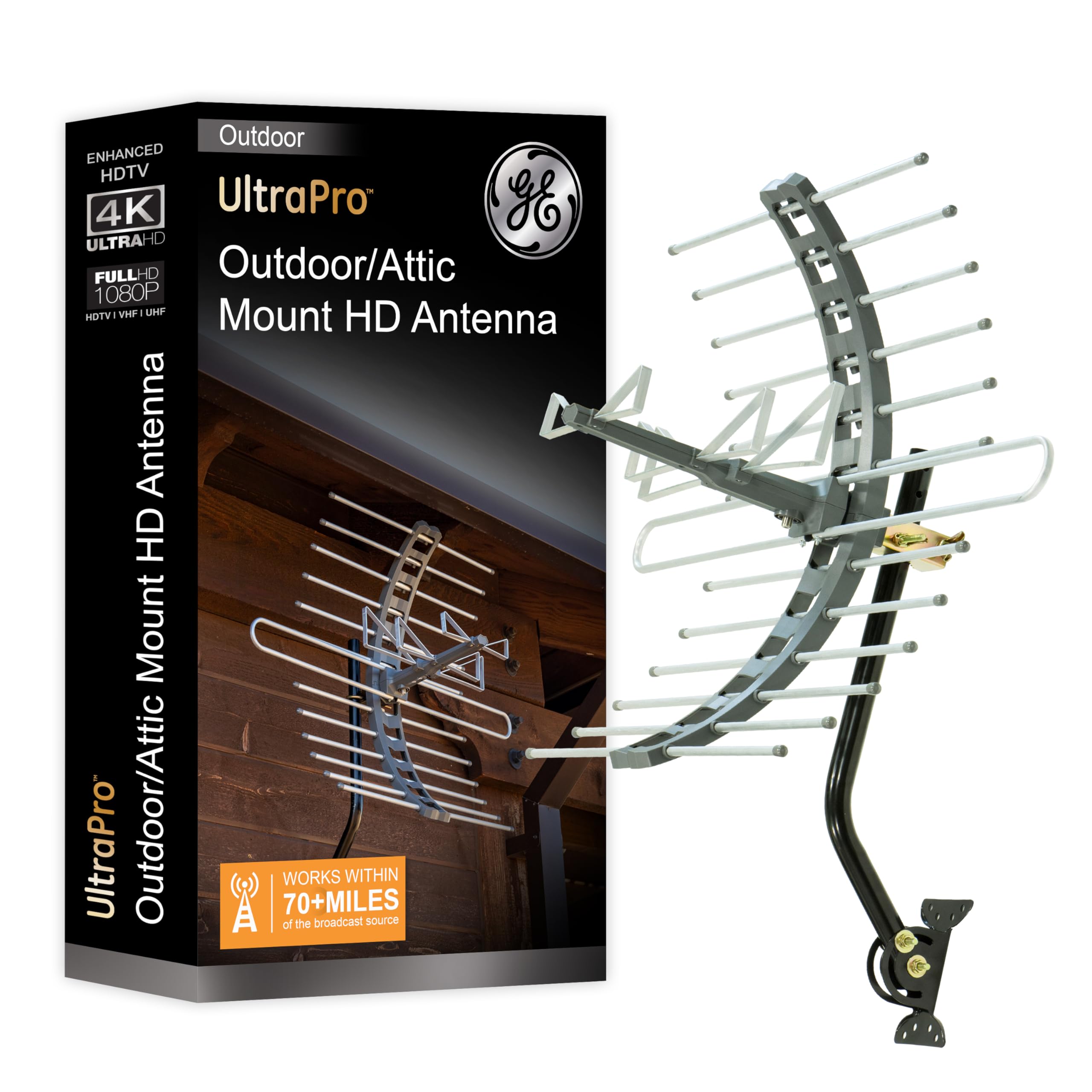
The GE 29884 is a passive Yagi antenna that proves you don’t always need a powered amplifier. Users mounted in attics 60 miles from broadcast towers and still pulled in over 100 channels with clear 4K reception. The included J-mount is lightweight and easy to install on a camper’s ladder or roof rack.
At just 3 pounds, this antenna places minimal strain on mounting points. It supports both VHF and UHF bands, and the 75-ohm impedance matches standard RG6 cabling. Many buyers found it actually outperformed their old amplified flat antennas, especially on channels in the high UHF range.
The housing is plastic, not metal, so long-term UV exposure is a concern for full-time RVers. The instructions are notoriously sparse — use online videos for assembly. Without an amplifier, weak signals at the edge of its 70-mile range may pixelate. Still, for the price, it delivers stunning raw sensitivity.
Why it’s great
- Ultra-lightweight at 3 pounds
- Excellent 70-mile passive reception
- Includes J-mount for camper installation
Good to know
- Plastic housing may degrade in full sun
- Poorly written assembly instructions
6. CeKay Outdoor Yagi HD Antenna

The CeKay Yagi is a budget-friendly directional antenna built entirely from metal, making it one of the most durable options for outdoor camper use. Users report picking up 51 channels even through a cement tile attic roof, and the included 40-foot RG6 cable is properly terminated with compression fittings.
The antenna supports ATSC 3.0 (NextGen TV), 4K, and 1080p without any external amplifier. The Yagi design gives strong rejection of multipath interference, which is common in mountainous camping areas. Assembly is mostly pre-done, but the reflector elements fit tightly — a rubber mallet helps.
The thin metal elements can bend in high winds or during highway travel if the antenna is left mounted. Users also note the J-mount pole connections feel loose for permanent outdoor exposure, so adding lock washers or a sturdier mast is recommended for full-time RV use.
Why it’s great
- All-metal construction resists cracking
- ATSC 3.0 ready for future broadcasts
- High VHF/UHF gain without amplifier noise
Good to know
- Thin elements can bend in transit
- J-mount pole connectors feel loose
7. Yeceny Motorized 150-Mile Antenna

The Yeceny antenna brings a motorized 360-degree rotator and wireless remote control into the budget tier, allowing campers to adjust direction without stepping outside. Users in hilly terrain report picking up over 80 channels with crystal-clear reception after mounting the antenna on a 20-foot mast.
The amplifier supports both VHF and UHF bands, and the dual TV output feeds two televisions without a splitter. Setup takes about five minutes with snap-on elements, and the included 40-foot RG6 cable is sufficient for most mid-size RVs. The lightning protection system adds peace of mind for outdoor roof mounting.
Real-world range is closer to 50-75 miles rather than the advertised 150, and some users noted the remote requires line of sight to the antenna’s sensor. For close-to-mid range campsites, however, the combination of rotation and dual TV support at this budget level is unmatched.
Why it’s great
- Motorized rotation at a budget price point
- Snap-on assembly requires no tools
- Dual TV output included
Good to know
- Range is overstated in the specifications
- Remote requires clear line of sight
FAQ
Can I mount a house Yagi antenna on my camper roof permanently?
How do I aim a directional camper antenna without climbing on the roof?
Will a camper antenna work if I am parked under dense tree canopy?
Final Thoughts: The Verdict
For most users, the best antenna for camper winner is the PBD Amplified Outdoor because it combines a motorized rotator, dual TV output, and a clean 4G/amplifier setup at a price that undercuts premium competitors. If you want a no-aim, stay-on-the-roof solution that works without any adjustments, grab the Winegard Air 360+ V2.S. And for the budget-conscious RVer who wants a durable all-metal directional antenna, nothing beats the CeKay Yagi HD.

Mo Maruf
I created WellFizz to bridge the gap between vague wellness advice and actionable solutions. My mission is simple: to decode the research and give you practical tools you can actually use.
Beyond the data, I am a passionate traveler. I believe that stepping away from the screen to explore new environments is essential for mental clarity and physical vitality.