Our readers keep the lights on and my smoothie glass nicely filled. As an Amazon Associate, I earn from qualifying purchases.
Walking into a cold room and waiting for central air to catch up is a familiar winter frustration. A dedicated 110V space heater solves this instantly, delivering targeted warmth exactly where you need it without firing up the whole house furnace. The challenge is filtering through dozens of similar-looking towers to find one that actually heats evenly, stays quiet, and doesn’t spike your electric bill.
I’m Mohammad Maruf — the founder and writer behind WellFizz. Over years of analyzing consumer heating products, I’ve evaluated ceramic elements, airflow designs, thermostat accuracy, and safety certifications to separate effective heaters from underpowered fans in disguise.
This guide breaks down the top contenders and their real-world performance so you can confidently choose the best 110v heater for your home, office, or bedroom without wasting money on a model that just blows lukewarm air.
How To Choose The Best 110V Heater
Selecting a space heater isn’t just about wattage. You need to match the heating method to your room size, prioritize safety certifications, and understand how thermostat precision and oscillation coverage affect your comfort. Here are the key factors that separate a great heater from a disappointing one.
Heating Element Type: PTC Ceramic vs. Infrared Quartz
The heating element determines how quickly and evenly a room warms up. PTC (Positive Temperature Coefficient) ceramic elements self-regulate: they draw maximum power when the room is cold and automatically reduce wattage as the target temperature approaches, preventing overheating and saving energy. Infrared quartz heaters, by contrast, heat objects and people directly rather than the air, giving a cozy radiant feel but taking longer to raise ambient temperature in a drafty room. For rapid whole-room warmth, PTC ceramic is generally the better choice.
Oscillation and Airflow Design
A stationary heater creates a hot spot and leaves the rest of the room cold. Look for a model with at least 70 degrees of horizontal oscillation — some premium units offer 90 degrees. The blower design also matters: a cross-flow fan platform distributes heat more evenly than a simple axial fan. Combined with a tower form factor, these features push warm air into corners and prevent the heater from working overtime.
Thermostat Accuracy and Adjustability
An accurate thermostat is what turns a heater from a blast-furnace into a climate control device. Budget models often use on/off cycling based on a fixed internal sensor, which can overshoot or undershoot the set temperature. More precise units allow 1-degree Fahrenheit increments and use external ambient sensing to maintain a steady room temperature. ECO mode, which automatically adjusts power based on the difference between ambient and target temps, can cut energy use significantly without sacrificing comfort.
Quick Comparison
On smaller screens, swipe sideways to see the full table.
| Model | Category | Best For | Key Spec | Amazon |
|---|---|---|---|---|
| DREO Space Heater | Tower PTC | Large rooms, quiet operation | Dual DC motors, 10 ft/s airflow | Amazon |
| Dr Infrared Heater DR-968 | Cabinet Hybrid | Radiant heat, large spaces | Infrared + PTC, 5200 BTU | Amazon |
| Heat Storm HS-1500 | Cabinet Infrared | Supplemental zone heating | HMS exchanger, 1500W/750W modes | Amazon |
| Lasko 751320 | Tower PTC | Reliable brand, small rooms | Self-regulating ceramic element | Amazon |
| BREEZOME Space Heater | Tower PTC | Budget-friendly, even heat | 90° oscillation, 250 sq.ft coverage | Amazon |
| AUBKN Space Heater | Tower PTC | Entry-level, quiet sleep | 70° oscillation, 12-hour timer | Amazon |
| VOCRS Space Heater | Tower PTC | Compact spaces, ECO mode | 32 dB noise, 1-84°F range | Amazon |
In‑Depth Reviews
1. DREO Space Heater
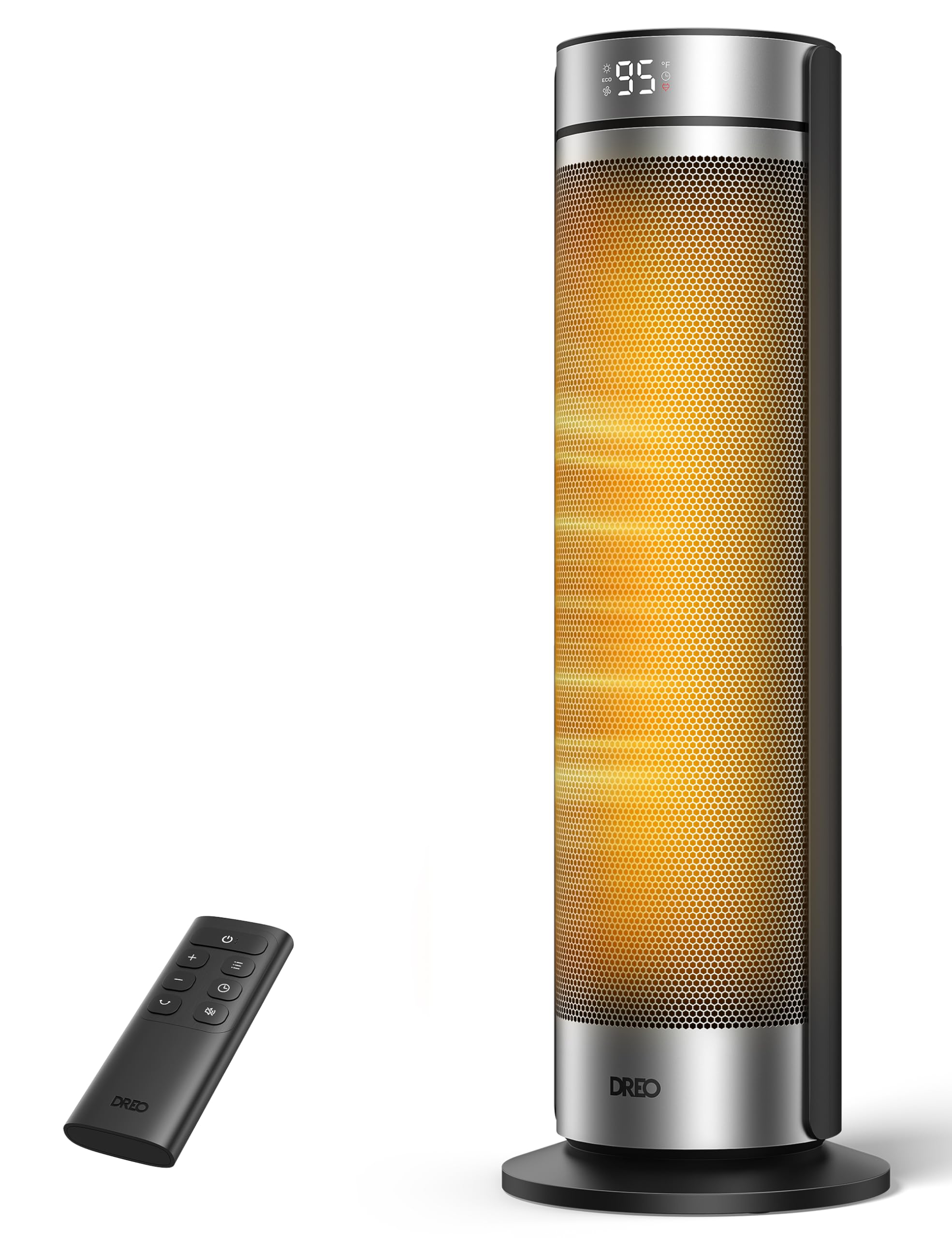
This translates to faster room warm-up without the noisy turbine whine you get from some forced-air units. The 25-percent-larger heating plate and 70-degree oscillation mean more even heat across rooms up to 250 square feet.
Its ECO mode is not a gimmick: the heater samples ambient temperature and adjusts power output in real time, which users report cutting energy use by up to 40 percent compared to full-blast operation. The thermostat adjusts in 1-degree Fahrenheit increments from 41 to 95°F, giving you precise control that budget models lack. At 34 dB, it’s genuinely quiet enough for a nursery or home office.
Safety is thorough with child-lock, cool-touch housing, overheat protection, and an ETL listing. The remote includes a battery, a small but appreciated detail. The only real complaint is the intake grille collects dust quickly and is tricky to clean without a small brush. For the combination of airflow, precision, and silence, this is the most well-rounded 110V heater available right now.
Why it’s great
- Dual DC motors double airflow for faster heating
- Precise 1°F thermostat increments reduce temperature swings
- Very quiet at 34 dB for undisturbed sleep
Good to know
- Dust accumulates on the intake and is hard to clean without a thin brush
- High fan speed is fixed — no separate low-speed option in set-temperature mode
2. Dr Infrared Heater DR-968

This cabinet-style unit breaks the tower mold by combining an infrared quartz tube with a PTC ceramic element, generating roughly 60 percent more heat output than a standard ceramic-only design. Rated at 5,200 BTU, it can effectively warm spaces up to 500 square feet — double what most towers claim. The dual heating system means you feel radiant warmth on your skin while the fan circulates warmed air.
Build quality is noticeably better than the plastic towers: the cherry wood cabinet, metal interior, and caster wheels give it furniture-grade heft at 19 pounds. The noise level sits at 39 dB, which is still whisper-quiet but slightly higher than the DREO. Users consistently report that the low setting (roughly 1050W) is enough to keep a 250-square-foot room comfortable without the fan cycling on and off constantly.
One caveat: the thermostat sensor is located inside the cabinet, so it reads ambient temperature a bit slow, and some owners found it needs a calibration offset. The remote is also required to set the timer, which is inconvenient if you misplace it. But for raw heating capacity in a sturdy, long-lasting package, the DR-968 is in a league of its own.
Why it’s great
- Dual heating system delivers more BTUs than standard ceramic heaters
- Solid wood cabinet and metal interior offer exceptional durability
- Caster wheels make moving easy despite the 19-pound weight
Good to know
- Thermostat sensor is inside the unit and reads ambient temp with a delay
- Timer function requires the remote control to set
3. Heat Storm HS-1500

The Heat Storm takes a different approach with its patented HMS (Heat Management System) heat exchanger. Rather than blasting hot air, it uses infrared quartz technology combined with a ceramic heat exchanger to produce heat that doesn’t reduce oxygen or humidity. This makes it a strong option for bedrooms and nurseries where dry air causes discomfort. At 1500W (with an energy-saving 750W mode) and 5,200 BTU, it covers up to 300 square feet as a primary source or 1,000 square feet as a supplement.
One of its smartest features is the ability to calibrate the ambient temperature sensor. If the heater consistently reads 2 degrees off from your actual room temperature, you can adjust the calibration in the menu. This avoids the cycling issues that plague less accurate thermostats. Users also praise the unit’s cool-touch exterior, which stays safe even during extended operation — important if you have curious kids or pets.
The downsides are tied to its heating method: infrared quartz warms objects and people first, so ambient air temperature rises more slowly than a forced-air PTC heater. In a drafty or poorly insulated room, you may feel a delay before the space truly feels warm. It’s also not ideal as a primary heater in open-concept layouts. But for consistent, non-drying warmth in a well-sealed room, this is a premium choice.
Why it’s great
- HMS heat exchanger retains humidity and oxygen for comfortable warmth
- Adjustable temperature sensor calibration for accurate thermostat control
- Cool-touch exterior stays safe even after hours of operation
Good to know
- Infrared heating raises ambient air temperature more slowly than forced-air designs
- Not the best choice for drafty or open-concept rooms
4. Lasko 751320

Lasko is the veteran name in space heaters, and the 751320 model shows why the brand has endured. The self-regulating ceramic element means the wattage automatically adjusts based on the room temperature — it draws full 1500W when the room is cold and tapers down as it approaches the set point, preventing the element from overheating. This makes it inherently safer than older coil-based designs and extends the heater’s lifespan.
The tower is slim at 22.5 inches tall and weighs only 2.5 pounds, making it one of the most portable options on this list. The widespread oscillation covers a broader arc than many competitors, and users report consistent heat distribution in bedrooms and living rooms up to 150 square feet. The remote has onboard storage via a magnetic slot on the back of the unit, solving the “where did the remote go” problem that plagues other models.
Where it falls short is temperature granularity: the thermostat only adjusts in 5-degree Fahrenheit increments (70, 75, 80, etc.), so you can’t fine-tune the climate like you can with the DREO or Heat Storm. Some owners also note that the fan can become audible on the high setting, though it remains quieter than many similarly priced units. For a reliable, space-saving heater from a trusted brand, this is a solid mid-range pick.
Why it’s great
- Self-regulating ceramic element adds safety and extends heater life
- Compact 2.5-pound tower with magnetic remote storage
- Widespread oscillation provides even heat in small to medium rooms
Good to know
- Thermostat adjusts in 5°F increments, limiting precision control
- Fan noise is noticeable on the highest setting
5. BREEZOME Space Heater

BREEZOME delivers an impressive feature set at a budget-friendly price point, starting with a 90-degree oscillation range — the widest on this list. That extra 20 degrees of sweep compared to the standard 70-degree models means heat reaches further into room corners, reducing cold spots. The 1500W PTC ceramic element heats up in about 2 seconds, and the cross-flow fan platform distributes air more evenly than a traditional axial fan.
The ECO mode uses a precise temperature sensor to maintain your chosen temperature between 59 and 95°F, automatically adjusting the power level to avoid wasting electricity. Users in real-world conditions report that the heater effectively warms spaces up to 250 square feet, making it suitable for a master bedroom or a small living room. At under 35 dB, it’s quiet enough for a nursery, and the included remote makes adjustments from across the room easy.
One quirk: on the lower fan settings, the heater can blow cool air while the element warms up, which some users found confusing at first. The build is decent but the plastic construction feels less premium than the Lasko or DREO. Still, for the price, the combination of wide oscillation, fast heat-up, and energy-saving ECO mode makes this an outstanding value pick.
Why it’s great
- Widest oscillation range at 90° for superior heat distribution
- Smart ECO mode adjusts power to maintain set temperature efficiently
- Heats up in about 2 seconds with cross-flow fan design
Good to know
- Lower settings may blow cool air briefly before the element fully heats
- Plastic housing feels less robust than mid-range and premium models
6. AUBKN Space Heater
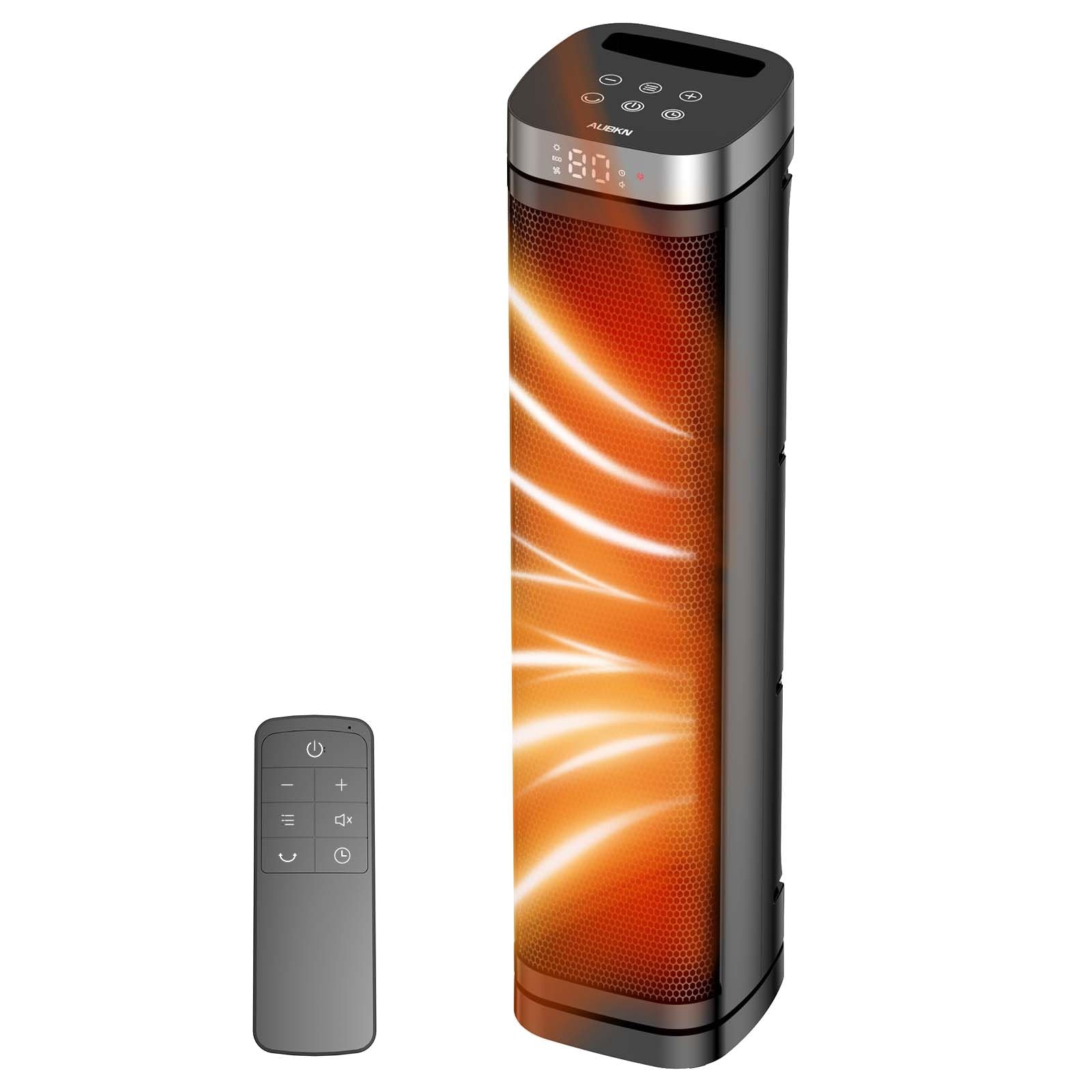
The AUBKN heater focuses on two things: quiet operation and straightforward controls. Users consistently describe it as extremely quiet, with the display lights dimming automatically and only minimal red indicators remaining — ideal for a bedroom where light pollution matters as much as noise. The 1500W PTC ceramic element heats a small space (up to 200 square feet) in seconds, and the 70-degree oscillation distributes warmth without creating a constant direct blast.
The feature set is competitive for an entry-level price: a 1-12 hour timer, three heat modes, a remote control, and multiple safety protections including tip-over and overheat shutoff. The 12-hour timer is especially useful for daytime office use, letting you set it to run through the workday and shut off automatically. The ETL certification and flame-retardant materials add peace of mind for the price.
The main trade-offs are in build and coverage. At 23 inches tall and 5.5 inches square, it’s a slim tower that heats small rooms effectively but struggles in larger or open spaces. The remote requires 2 AAA batteries (not included), and some users noted the heater is smaller than product photos suggest. For a quiet, no-fuss heater for a bedroom or small office, this is a capable entry-level option.
Why it’s great
- Extremely quiet operation with minimal light for undisturbed sleep
- 12-hour timer with remote control for convenient daily use
- Multiple safety protections with ETL certification
Good to know
- Heating coverage limited to about 200 square feet
- Requires AAA batteries for the remote (not included)
7. VOCRS Space Heater
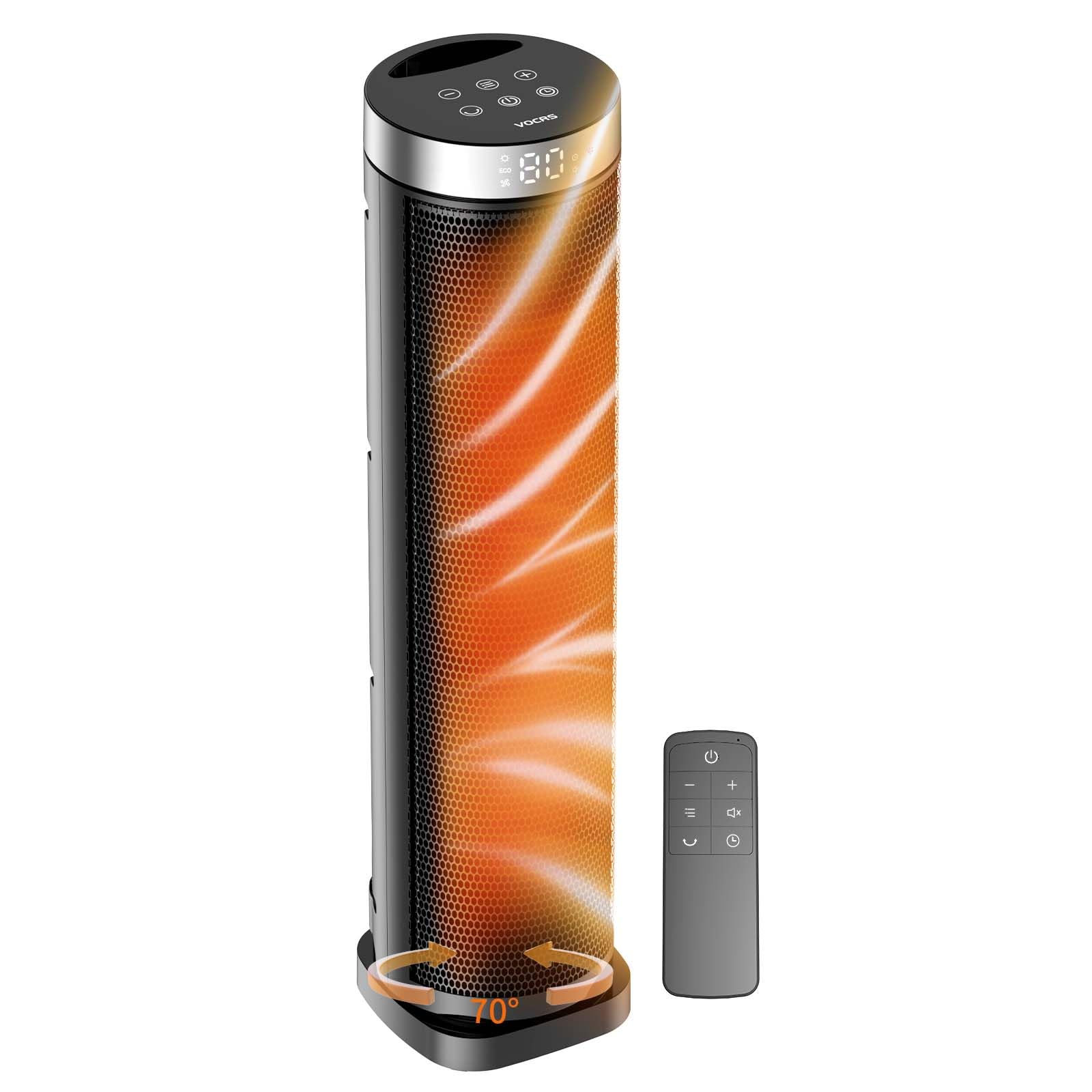
The VOCRS heater stakes its claim on silence, advertising a noise floor of just 32 dB — quieter than a library. This is achieved through Oblique Airflow technology, which reduces wind noise compared to standard fan designs. Combined with a mute mode that silences button tones, this heater is one of the best options for parents who need to adjust settings without waking a sleeping child.
The heating package includes a 1500W PTC ceramic element with 70-degree oscillation and ECO mode that adjusts between H2 and H3 power levels to maintain a target temperature range of 76-84°F. Users report that the heater effectively warms rooms up to 200 square feet, with good heat distribution thanks to the oscillation. The slim 24-inch tower design fits into tight spaces, and the hidden handle makes it easy to move between rooms.
The thermostat range is narrower than competitors — limited to 76-84°F — which may not suit users who prefer cooler nighttime temperatures. Some users also noted that the power button requires cycling through modes to turn the unit off, which is less intuitive than a dedicated on/off button. For quiet operation in a compact footprint, though, the VOCRS delivers well at its price point.
Why it’s great
- Ultra-quiet 32 dB operation with Oblique Airflow technology
- Mute mode silences button tones for child-safe nighttime use
- Compact 24-inch tower with hidden handle for easy portability
Good to know
- Thermostat range limited to 76-84°F, not adjustable lower
- Power button requires mode cycling to shut off instead of a dedicated on/off
FAQ
Can a 110V heater run on a standard household outlet?
How much does it cost to run a 1500W heater for 8 hours?
Should I leave a space heater on overnight?
Final Thoughts: The Verdict
For most users, the best 110v heater winner is the DREO Space Heater because it combines the fastest airflow with precise thermostat control and whisper-quiet operation, making it the most versatile option for bedrooms, offices, and living rooms. If you want deep radiant warmth that heats objects and people in a large space, grab the Dr Infrared Heater DR-968. And for a compact, ultra-quiet heater that fits a tight budget, nothing beats the VOCRS Space Heater.

Mo Maruf
I created WellFizz to bridge the gap between vague wellness advice and actionable solutions. My mission is simple: to decode the research and give you practical tools you can actually use.
Beyond the data, I am a passionate traveler. I believe that stepping away from the screen to explore new environments is essential for mental clarity and physical vitality.