Our readers keep the lights on and my smoothie glass nicely filled. As an Amazon Associate, I earn from qualifying purchases.
The constant ringing, hissing, or buzzing that never fades is exhausting enough without also straining to hear conversations. Bluetooth hearing aids now tackle both problems at once — amplifying the sounds you want while delivering calibrated tones to help quiet the phantom noise. This category has moved far beyond simple amplifiers; today’s models use digital signal processing, adaptive noise reduction, and dedicated masking programs to give you clearer speech and genuine relief from tinnitus.
I’m Mohammad Maruf — the founder and writer behind WellFizz. I focus on audiology technology and analyze every spec from amplifier gain to frequency response, ensuring these recommendations are built on real performance data, not marketing claims.
Whether you need discreet everyday wear, powerful streaming for calls, or audiologist-level customization without the clinic price, this guide covers the best bluetooth hearing aids for tinnitus you can buy right now.
How To Choose The Best Bluetooth Hearing Aids For Tinnitus
Finding the right model means balancing speech amplification, tinnitus relief features, and Bluetooth connectivity. The wrong choice leaves you with whistling feedback or a masking tone that does not match your tinnitus pitch.
Tinnitus Masking vs. Sound Amplification
A quality hearing aid does not just make everything louder — it includes a dedicated tinnitus masking program that plays a customizable sound (white noise, pink noise, or nature sounds) to reduce the contrast between your tinnitus and the environment. Check if the app allows you to adjust the masking tone frequency and volume independently from the hearing aid’s main gain.
Bluetooth Codec and Streaming Stability
Bluetooth 5.0 or higher ensures lower latency and stable connections for phone calls and streaming music, which is essential if you use the hearing aid to deliver masking tones from an app or media player. Models with LE Audio and Auracast support offer even better battery efficiency and multi-device switching.
Gain, Frequency Range, and Noise Attenuation
Look for a maximum gain of at least 40-50 dB for mild to moderate loss, a frequency response extending to 8000 Hz or higher to catch speech consonants, and noise attenuation around 20-24 dB to suppress background chatter. These numbers directly determine how well you will hear in restaurants and crowded rooms.
Battery Life and Charging Case
Tinnitus users often wear hearing aids from morning until bedtime. A minimum of 16-20 hours per charge ensures you get through the day. A charging case that provides at least three full recharges gives you a week of power without hunting for an outlet. Fast-charge capability (15 minutes for several hours) is a lifesaver.
Quick Comparison
On smaller screens, swipe sideways to see the full table.
| Model | Category | Best For | Key Spec | Amazon |
|---|---|---|---|---|
| ELEHEAR-Beyond Pro | Premium | Best all-around with AI translation | VocClear 2.0, 8500Hz, 8ms latency | Amazon |
| iBstone AuraLink | Premium | Physician-recommended tinnitus care | Bluetooth 5.4, IP68, UV case | Amazon |
| Audien Ion Pro 2 | Mid-Range | UV self-cleaning with 6 profiles | 6 custom profiles, 3 hearing modes | Amazon |
| Yeasound RIC800 | Premium | AI auto-mode and wireless charging | 31hr hearing, 5.3ms latency | Amazon |
| Vivtone Xpure | Mid-Range | Budget-friendly with app fine-tuning | 24hr battery, RIC design | Amazon |
| ELEHEAR-Beyond | Mid-Range | Long battery and remote care | 50dB gain, 100hr with case | Amazon |
| Karthus Rechargeable | Mid-Range | Discreet CIC with 2 sound modes | 16-channel DSP, 80+hr battery | Amazon |
| Lexie B2 Plus | Premium | Bose-powered sound with 10 programs | Self-fitting via app, Bose algorithms | Amazon |
| Sennheiser All-Day Clear | Premium | Audiophile sound quality | 24hr battery, auto environment adjust | Amazon |
| Eargo SE | Premium | Virtually invisible CIC design | CIC form, 16hr battery, 5 cycles | Amazon |
| Jabra Enhance Select 500 | Premium | Clinic-grade with audiologist support | LE Audio, Auracast, 3yr warranty | Amazon |
In‑Depth Reviews
1. ELEHEAR-Beyond Pro
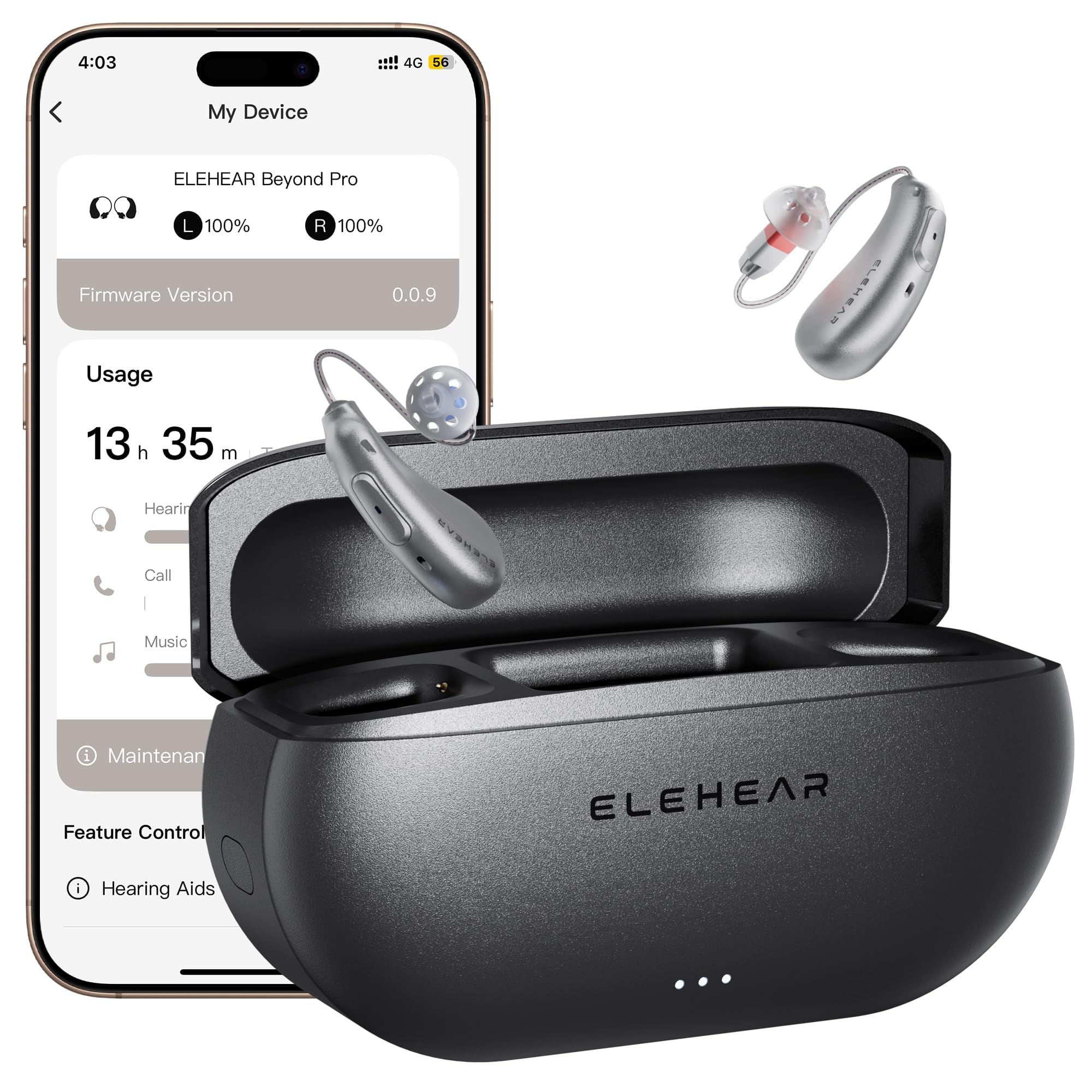
The ELEHEAR-Beyond Pro is the most complete package on this list, combining VocClear 2.0 technology for 30% clearer speech with a wide 8500 Hz frequency response that catches the high-pitched consonants many hearing aids miss. Its 8ms ultra-low latency ensures no lip-sync delay during TV streaming or phone calls, which is critical when your tinnitus makes you sensitive to timing mismatches.
The app offers 20 immersive soundscapes — rain, breeze, ambient tones — that function as customizable tinnitus masking sounds. Users can mix these tones to match the pitch of their tinnitus, a feature typically found only in prescription-grade aids. The 15-minute fast charge delivers 6 hours of use, and the charging case provides four full recharges, giving you up to 100 total hours of run time.
Built-in real-time AI translation supports 11 languages, a rare addition at this level. The RIC design stays comfortable for all-day wear, and multiple dome sizes help achieve a snug seal. Some users reported that the left unit failed after two months, but customer service eventually offered a full refund with free return shipping, demonstrating solid post-purchase support.
Why it’s great
- 8500Hz frequency response for crisp speech
- 20 soundscapes for tinnitus masking
- 15-minute fast charge gives 6 hours
- AI translation in 11 languages
Good to know
- Some units developed feedback after two months
- Battery life slightly below advertised 20 hours
2. iBstone AuraLink
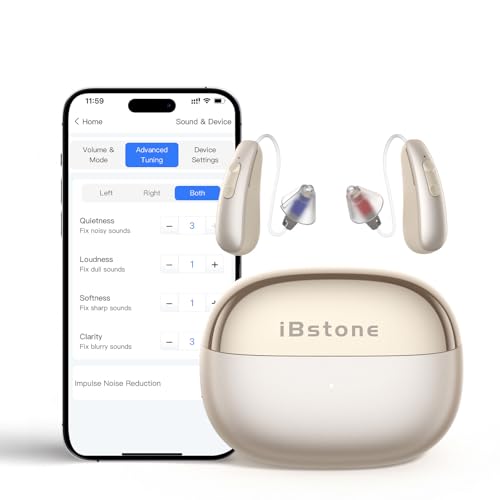
The iBstone AuraLink stands out for its clinical credibility — it was selected for a US physician-led study on cognitive health and voluntarily endorsed by over 1,000 clinicians. The AuraFit app lets you run a hearing check, import audiologist test results, and enable tinnitus masking programs tailored to your hearing profile, all without a clinic visit.
Bluetooth 5.4 delivers lower power consumption and faster data transfer, making phone calls and music streaming more stable than older Bluetooth generations. The IP68 rating means it resists sweat, rain, and dust, so you can wear it during exercise or outdoor activities without worry. The UV-sanitizing charging case adds an extra hygiene layer between ear and device.
The RIC design is lightweight and discreet, with multiple dome shapes for a secure fit. Users with mild to severe loss (25-85 dB HL) have reported hearing sounds they never knew existed after switching. The stiff wire from the unit to the earpiece may require a break-in period, and some users found the earpiece did not stay back when adjusted, but the overall sound clarity and app customization earned consistent praise.
Why it’s great
- Physician-endorsed; used in cognitive health study
- Bluetooth 5.4 for stable streaming
- IP68 sweat and dust resistant
- UV-sanitizing charging case
Good to know
- Earpiece wire can feel stiff at first
- Earpiece may shift out of position during wear
3. Audien Ion Pro 2
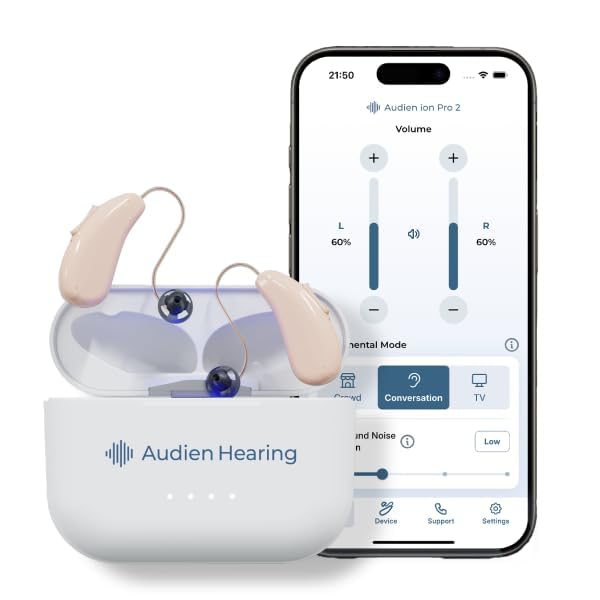
The Audien Ion Pro 2 was developed with Grammy-winning sound engineers, resulting in three hearing modes and six custom hearing profiles that cover everything from quiet conversation to crowded restaurants. The dual-button interface lets you switch modes or adjust volume without digging into an app, a practical touch for seniors who prefer tactile controls over smartphone screens.
The built-in UV sanitizing technology activates while charging, automatically cleaning the earpieces without separate tools or chemicals. This is a genuine hygiene advantage, especially for tinnitus users who wear aids all day and need to minimize ear canal irritation. The battery system delivers extended performance that comfortably lasts a full day, though some users reported the aids occasionally lose Bluetooth connection and require a quick re-seat in the charger.
Users with high-frequency hearing loss — the type most commonly linked to tinnitus — reported hearing birds, creaking doors, and group conversations clearly after switching from prescription aids costing much more. Customer service received consistent praise for prompt replacements when units had defects, building confidence for first-time OTC buyers.
Why it’s great
- UV self-cleaning during charging
- 6 custom hearing profiles for different environments
- Developed with Grammy-winning engineers
- Tactile dual-button controls
Good to know
- Can lose Bluetooth connection; needs re-seating in charger
- Some users found the fit less secure
4. Yeasound RIC800
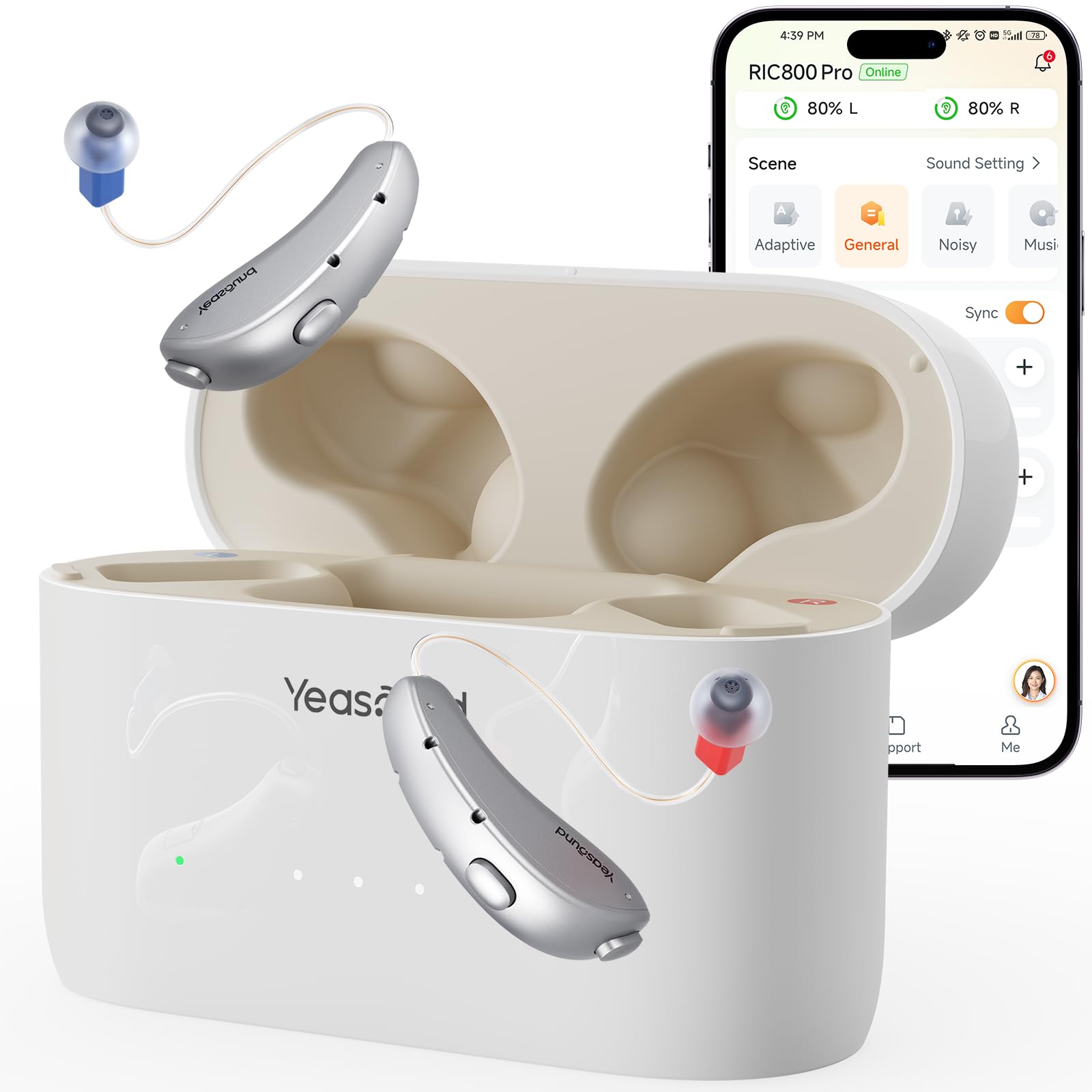
The Yeasound RIC800 packs a 5.3ms processing latency — among the fastest on this list — ensuring real-time conversation without the awkward delay that can worsen tinnitus-related anxiety. Its AI automatically selects the optimal noise-reduction mode from five profiles (Adaptive, General, Noisy, Music, Outdoors), and you can override the selection manually through the app.
In hearing mode, the battery lasts up to 31 hours, dropping to 18 hours during Bluetooth streaming. The portable charging case supports wireless charging and holds three additional full charges, extending total use to 124 hours. At just 0.088 ounces and 1.23 inches long, these are among the lightest and most discreet RIC aids available.
Users who compared them to prescription aids reported equivalent sound quality at a fraction of the cost. However, some Android users experienced difficulty syncing both earpieces to the app, and the manual volume setting can produce high-pitched feedback in very loud environments. Customer support has been responsive to troubleshooting, but the syncing glitch is a known limitation for non-iOS devices.
Why it’s great
- 5.3ms ultra-low latency for real-time audio
- 31-hour battery in hearing mode
- Wireless charging case
- AI auto-selection of noise modes
Good to know
- Android app syncing issues reported
- High volume can trigger feedback in noisy spaces
5. Vivtone Xpure

The Vivtone Xpure uses a Receiver-in-Canal (RIC) design to minimize distortion and feedback, and its companion app includes a full equalizer that rivals the tuning capabilities of premium earbuds. You can adjust volume and frequency per ear, which is essential for tinnitus users who often have asymmetric hearing loss and need different masking levels on each side.
Battery performance is solid — 24 hours of hearing aid use or 3 hours of Bluetooth streaming from a 2.5-hour charge. The charging case provides enough power for a full week of standby, making it a reliable travel companion. Multiple preset sound modes for quiet, restaurant, and outdoor environments let you switch context without diving into the app.
Users with moderate hearing loss reported that 80% volume was sufficient to match their needs, even in challenging acoustic environments. Some found that the equalizer was essential to get the sound profile right, but once dialed in, the clarity matched prescription aids at a far lower investment. The instruction manual is straightforward, and real-human phone support is available if you hit a snag.
Why it’s great
- Full equalizer for per-ear fine-tuning
- 24-hour hearing aid battery life
- RIC design minimizes feedback
- Multi-environment sound modes
Good to know
- Requires app EQ adjustment for optimal sound
- Streaming battery drops to 3 hours
6. ELEHEAR-Beyond

The original ELEHEAR-Beyond still holds its ground thanks to VocClear AI technology with up to 50 dB gain and 24 dB noise attenuation. It delivers impressive speech clarity for mild to moderate hearing loss, and users with severe loss reported being amazed at how much they could hear. The 100-hour total battery life (20 hours per charge plus four additional charges from the case) is the longest on this list.
The app includes serene sound relief and telephone speech enhancement settings, both of which help manage tinnitus by reducing the listening effort required during calls. The ElePro Audiologist Remote Care Service provides personalized sound adjustments without a clinic visit, bridging the gap between OTC convenience and professional guidance.
Multiple dome sizes ensure a comfortable seal, though some users found initial fit issues that resolved with larger cones. A few customers reported that music reproduction sounded underwater, and restaurant noise cancellation was inconsistent. Still, for users prioritizing all-day battery and remote audiologist support, the Beyond remains a compelling mid-range choice.
Why it’s great
- 50dB gain for moderate to severe loss
- 100 hours total battery with case
- Remote audiologist care via app
- 24dB noise attenuation for background suppression
Good to know
- Music reproduction can sound flat
- Noise cancellation is inconsistent in restaurants
7. Karthus Rechargeable
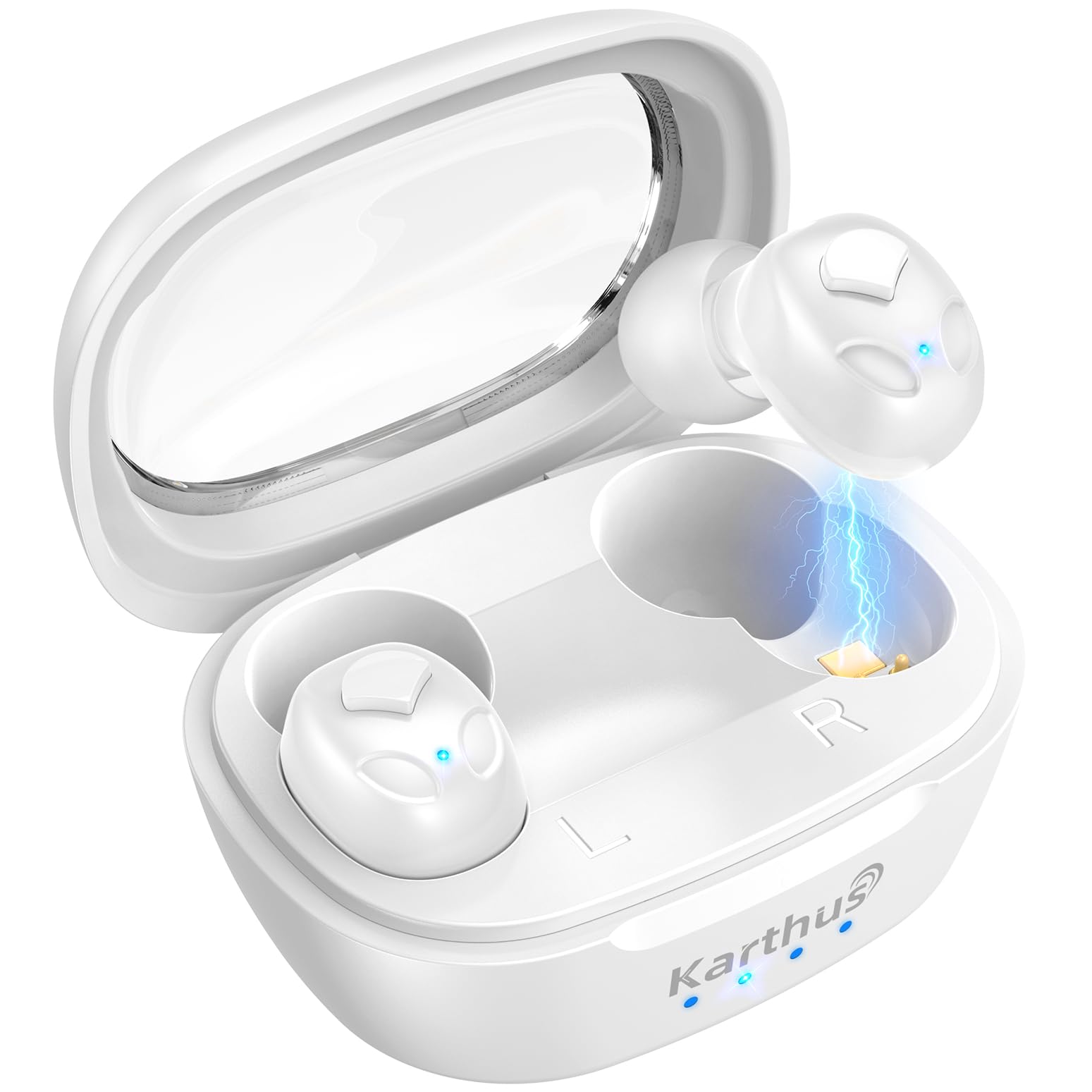
The Karthus hearing aids use a 16-channel digital DSP to suppress feedback before it starts, combined with two environment modes: Quiet Mode for daily life and Noise-Canceling Mode for crowded places. The smart chip automatically kills screechy feedback, a major source of discomfort for tinnitus wearers who are already sensitive to high-pitched sounds.
With a 2-hour charge delivering 24+ hours of use and the portable case adding up to 80+ hours total, you can go for days without worrying about power. The CIC-inspired design sits deep and discreet in the ear canal, making it nearly invisible — a strong selling point for users who want hearing help without a visible behind-the-ear device.
Sound quality earned consistent praise for its clarity in everyday conversations, and the lightweight build (just 5.29 ounces for the whole kit) makes it ideal for all-day wear. Users with family members reported that the aids noticeably improved interpersonal communication. The lack of Bluetooth streaming means you cannot use it for calls or music, but if your priority is discreet amplification with long battery life, this is a solid pick.
Why it’s great
- 16-channel DSP eliminates feedback automatically
- 80+ hours total battery life
- Nearly invisible CIC-style design
- Two environment modes for quiet and noisy spaces
Good to know
- No Bluetooth for calls or music streaming
- Limited to two sound modes, not fully customizable
8. Lexie B2 Plus
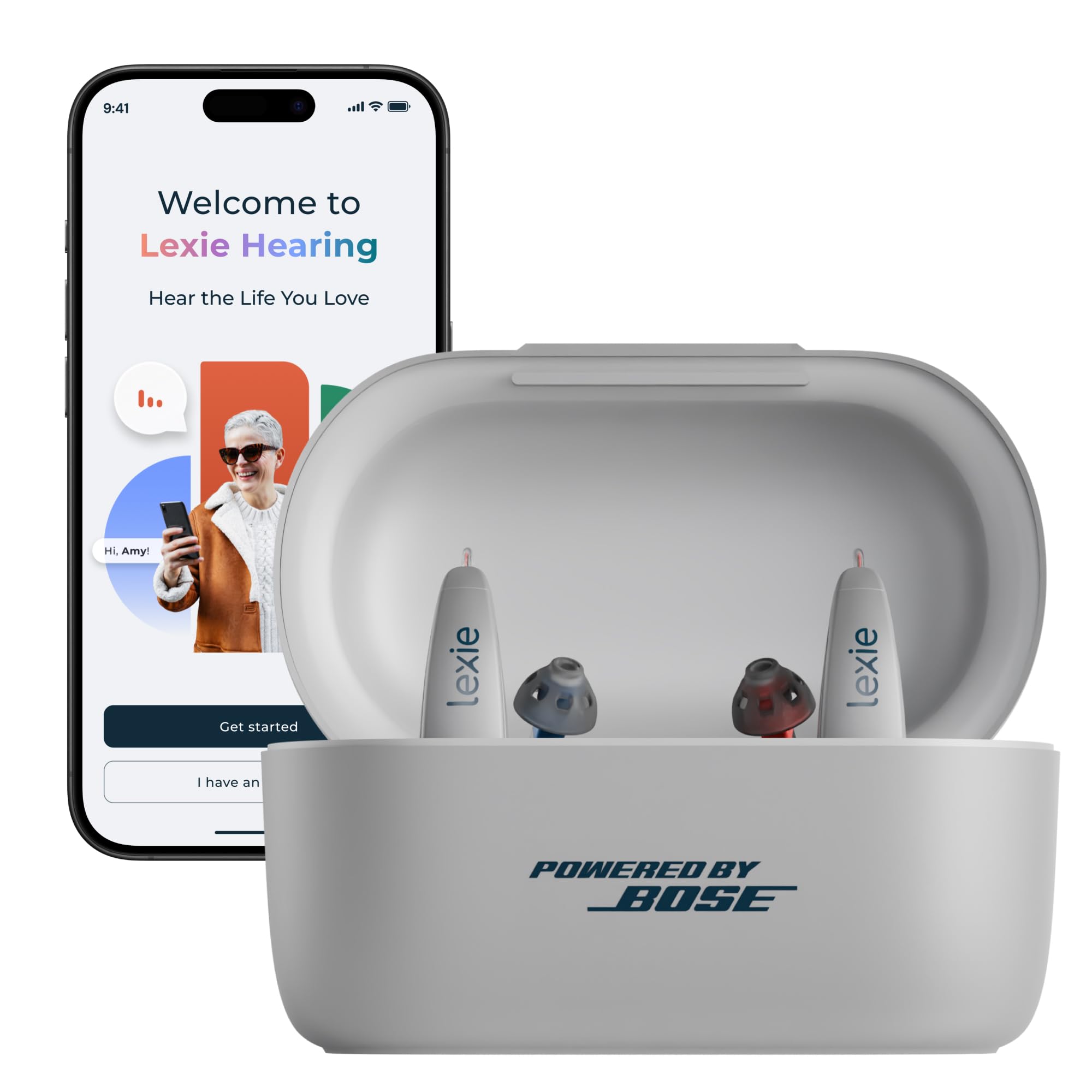
The Lexie B2 Plus is powered by Bose sound technology, giving it access to proprietary algorithms for noise management, wind noise reduction, impulse noise reduction, and feedback management. These algorithms are the same ones found in premium Bose over-ear headphones, adapted here for hearing aid use. The self-fitting app includes a clinically proven hearing test that adjusts treble, bass, world volume, balance, and directionality.
You can choose from four environment programs or create up to 10 of your own, giving you granular control over how the aids respond to different acoustic situations. The wireless charging case adds convenience, and the Lexie ecosystem includes live video coaching, helpful for first-time users adjusting to hearing aids and tinnitus masking programs.
Users praised the clear sound and comfortable open-dome fit, with many saying they heard sounds they had missed for years. However, several long-term users reported that after six months, the aids developed connectivity issues or swishing noises, and the app occasionally deleted custom environments. Customer service received mixed reviews — some found it responsive, others experienced long wait times.
Why it’s great
- Bose noise management and wind reduction algorithms
- Up to 10 custom environment programs
- Clinically proven self-fitting hearing test
- Includes live video coaching support
Good to know
- Some units develop connectivity issues after several months
- App has been known to delete custom settings
9. Sennheiser All-Day Clear

Sennheiser brings its legacy of audiophile-grade sound reproduction to the hearing aid category. The All-Day Clear automatically adjusts to the sound environment around you, making it a set-and-forget device that requires minimal fiddling. The app offers an intuitive interface for personalization, and the RIC design ensures comfort for long wear sessions.
Bluetooth connectivity lets you stream hands-free calls, music, and podcasts directly to the aids. The rechargeable battery delivers up to 24 hours of continuous use, depending on streaming activity. Sennheiser includes eight ear tips in three sizes, wax guards, a cleaning brush, and a USB charging cable, so you have everything needed out of the box.
Users consistently praise the sound quality, calling it exceptional for an OTC device and comparable to premium prescription brands like ReSound and Starkey. The main drawbacks are the charging case — which has no internal battery and must remain plugged in — and the lack of replacement ear tips in stock for extended periods. Some users also reported that after one year, one aid stopped working, and Sennheiser offered only a discount on a new pair rather than a repair or single replacement.
Why it’s great
- True audiophile sound quality from Sennheiser
- 24-hour battery life
- Auto-adjusts to different sound environments
- Easy app-based customization
Good to know
- Charging case has no internal battery
- Replacement ear tips can be hard to find in stock
- No single-unit replacement available after warranty
10. Eargo SE

The Eargo SE is a self-fitting, FDA-cleared device that uses a completely-in-canal (CIC) design — at 0.7 x 0.29 x 0.29 inches, it is one of the smallest hearing aids on the market. This form factor makes it virtually invisible when worn, ideal for users who prioritize discretion above all else. The Sound Match feature in the app lets you tailor settings to each ear individually.
The charging case holds up to five full charge cycles, giving you up to 80 hours of total power. Each charge provides up to 16 hours of use, enough for a full day. Eargo includes three sizes of Trumpet eartips to help you find the best seal, and lifetime customer support is available via phone and online classes.
Users who have tried the Eargo SE report excellent hearing improvement in one-on-one conversations and noisy restaurants. The app setup is straightforward, and the orientation call helps new users acclimate quickly. However, the Eargo SE does not support Bluetooth streaming for music or phone calls, and some users reported that the app drains the phone battery significantly. The charging case LED issues have also been noted, though the devices themselves perform well.
Why it’s great
- Virtually invisible CIC design
- 5 full charge cycles in case
- Sound Match feature for per-ear tuning
- Lifetime customer support included
Good to know
- No Bluetooth for calls or music streaming
- App can drain phone battery quickly
- Charging case LED issues reported
11. Jabra Enhance Select 500
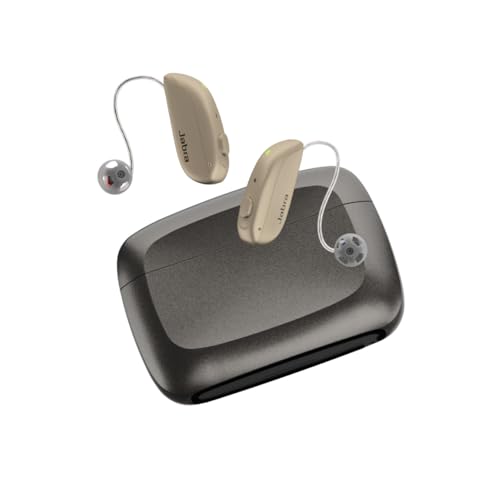
The Jabra Enhance Select 500 is the most clinic-aligned OTC hearing aid on this list. It includes audiology services — an audiologist consults with you remotely to fine-tune the settings — and a 3-year warranty, matching what many in-person clinics offer. The supporting LE Audio and Auracast standards make it future-proof for the next generation of Bluetooth broadcast audio.
The micro RIC design is among the smallest of the premium tier, weighing just 2.12 grams per aid. Hands-free phone calls are handled by double-tapping your ear, and the rechargeable case holds multiple days of charges. Four listening modes cover quiet, noisy, music, and outdoor settings, and the app allows for further customization.
Users with severe hearing loss reported excellent sound clarity in restaurants, concerts, and nature settings. The audiologist support was praised for its responsiveness. However, the setup process can be confusing — requiring multiple apps — and some users experienced connection drops and low phone call volume initially. The incompatibility with high-quality Auracast transmitters (48kHz) is a notable limitation for audiophiles. Despite these quirks, the 100-day return policy and professional support make it a low-risk option for those wanting clinic-grade care at home.
Why it’s great
- Includes audiology services and 3-year warranty
- LE Audio and Auracast support
- Micro RIC design at 2.12 grams
- Hands-free calls with double-tap control
Good to know
- Setup requires multiple apps; can be confusing
- Connection drops reported by some users
- Not compatible with high-quality 48kHz Auracast transmitters
FAQ
Can Bluetooth hearing aids really help with tinnitus?
Do I need Bluetooth 5.3 or higher for good streaming?
What is the difference between RIC and CIC hearing aid designs?
How do I clean a Bluetooth hearing aid with a UV charging case?
Can I use one hearing aid if I only have hearing loss in one ear?
Final Thoughts: The Verdict
For most users, the best bluetooth hearing aids for tinnitus winner is the ELEHEAR-Beyond Pro because it combines 20 soundscapes for masking, 8500Hz frequency response for speech clarity, and 15-minute fast charging into a single package that rivals prescription aids at half the cost. If you want physician-endorsed quality and IP68 durability, grab the iBstone AuraLink. And for clinic-grade audiology support with a 3-year warranty, nothing beats the Jabra Enhance Select 500.

Mo Maruf
I created WellFizz to bridge the gap between vague wellness advice and actionable solutions. My mission is simple: to decode the research and give you practical tools you can actually use.
Beyond the data, I am a passionate traveler. I believe that stepping away from the screen to explore new environments is essential for mental clarity and physical vitality.