Our readers keep the lights on and my smoothie glass nicely filled. As an Amazon Associate, I earn from qualifying purchases.
Water is the ultimate test for consumer electronics, and a camera that can survive a dunking opens up a world of visual storytelling that a standard smartphone simply cannot touch. Whether you are snorkeling a reef, paddling through rapids, or just shooting a rainy-day mountain bike run, the wrong camera turns into an expensive brick the second a wave hits. The challenge is that “waterproof” spans a wild range of tolerances, from a light splash to a 50-foot free dive, and the depth rating alone does not tell you how sharp the video will be or how long the battery will last.
I’m Mohammad Maruf — the founder and writer behind WellFizz. I have spent years analyzing the hardware specifications of ruggedized optics, sorting through the real-world trade-offs between action camera form factors and dedicated underwater compacts, and cross-referencing customer stress tests against manufacturer claims.
After comparing depth ratings, stabilization systems, sensor sizes, and battery endurance across dozens of models, I have narrowed the field to the nine cameras that genuinely deliver on their waterproof promises. This guide to finding the best waterproof camera covers everything from budget-friendly action cameras to premium 360-degree rigs so you can find the right fit for your next adventure.
How To Choose The Best Waterproof Camera
Picking the right underwater shooter means balancing depth tolerance, video quality, and physical durability against your specific use case. The camera that works for a casual pool day will frustrate a diver, and the high-end 360-degree model that excels for a travel vlogger might be overkill for a fisherman documenting catches.
Understanding Depth and Durability Ratings
The single most critical spec is the rated depth without a housing. Some cameras survive 33 feet (10 meters), which covers most snorkeling and pool use, while others handle 130+ feet with a protective case. Also pay attention to shockproof ratings (measured in drop height) and freezeproof ratings — a camera that dies in sub-zero temperatures is useless for winter sports.
Video Quality and Stabilization
Water movement introduces constant camera shake, so electronic or optical image stabilization is non-negotiable for usable footage. Look for at least 4K resolution at 30fps for smooth playback, and check whether the sensor is back-illuminated — a BSI sensor significantly improves low-light performance, which matters when shooting below the surface where light drops off fast.
Battery Life and Cold Resistance
Waterproof cameras drain batteries faster because the display is often at full brightness to overcome glare. A camera rated for two hours of continuous recording is the practical minimum. Cold resistance is a separate spec — if you shoot in ski or snow conditions, look for a model that operates down to -10°C or lower, as standard lithium-ion batteries lose capacity in freezing temperatures.
Quick Comparison
On smaller screens, swipe sideways to see the full table.
| Model | Category | Best For | Key Spec | Amazon |
|---|---|---|---|---|
| Insta360 X5 | 360 Action Cam | Immersive 360° adventures | 49ft waterproof depth | Amazon |
| DJI Osmo Action 6 | Action Camera | All-day 8K vlogging | 4-hour battery life | Amazon |
| OM System TG-7 | Rugged Compact | Macro underwater photography | 50ft waterproof, 2.1m shockproof | Amazon |
| GoPro HERO13 Black | Action Camera | High-frame-rate sports capture | 5.3K video at 60fps | Amazon |
| DJI Osmo 360 | 360 Action Cam | High-res 360° content creation | 1-inch 360° sensor | Amazon |
| PENTAX WG-90 | Rugged Compact | Industrial macro inspection | 6-LED ring macro light | Amazon |
| Ricoh WG-80 | Rugged Compact | Construction job-site photos | 14m waterproof with freezeproof | Amazon |
| Kodak PIXPRO WPZ2 | Rugged Compact | Budget-friendly travel snapshots | 4X optical zoom lens | Amazon |
| AKASO Brave 7 LE | Action Camera | Budget dual-screen vlogging | 40m depth with housing | Amazon |
In‑Depth Reviews
1. Insta360 X5 Essentials Bundle

The Insta360 X5 represents the current apex of consumer waterproof 360-degree capture, combining dual 1/1.28-inch sensors with a triple AI chip that processes noise reduction in real-time. This hardware stack produces genuinely usable 8K30fps 360° video even as ambient light drops, which is rare for a camera this size. The depth rating of 49 feet (15 meters) without a housing makes it truly submarine-ready for most snorkeling and shallow diving — a notable step up from the industry-standard 33-foot limit. The included 114cm invisible selfie stick and AI-assisted reframing in the app mean you can shoot without worrying about composition and pull the perfect frame later.
Battery life of up to 208 minutes with fast charging (80% in 20 minutes) is exceptional for a 360 camera, and the replaceable lens guards address the single biggest long-term durability concern for waterproof action cameras: scratched optics. The four-microphone array with the advanced wind guard captures clear vlog audio even on a windy beach, which is a genuine pain point solved here. The camera uses the Insta360 app for reframing, which has a slight learning curve, but the one-tap export feature helps beginners get shareable clips without diving into the timeline.
The trade-off is that 360-degree footage demands more storage space and processing horsepower than standard 16:9 video, so factor in a fast microSD card and a phone or computer capable of handling high-resolution 360 files. The standalone bundle does not include a carrying case or extra batteries — the Essentials Bundle has the selfie stick, a fast-charge case, and one battery, which is a solid starting kit. For users who want to capture immersive adventures with zero compromise on waterproofing or image quality, the X5 is the benchmark.
Why it’s great
- Waterproof to 49ft without a case — deeper than most action cameras.
- Replaceable lenses eliminate the single-point failure of scratched optics.
- 208-minute battery life with ultra-fast charging keeps shooting all day.
Good to know
- 360-degree footage requires a fast microSD card and a capable editing device.
- The AI editing and reframing workflow has a learning curve for new users.
2. DJI Osmo Action 6 Essential Combo
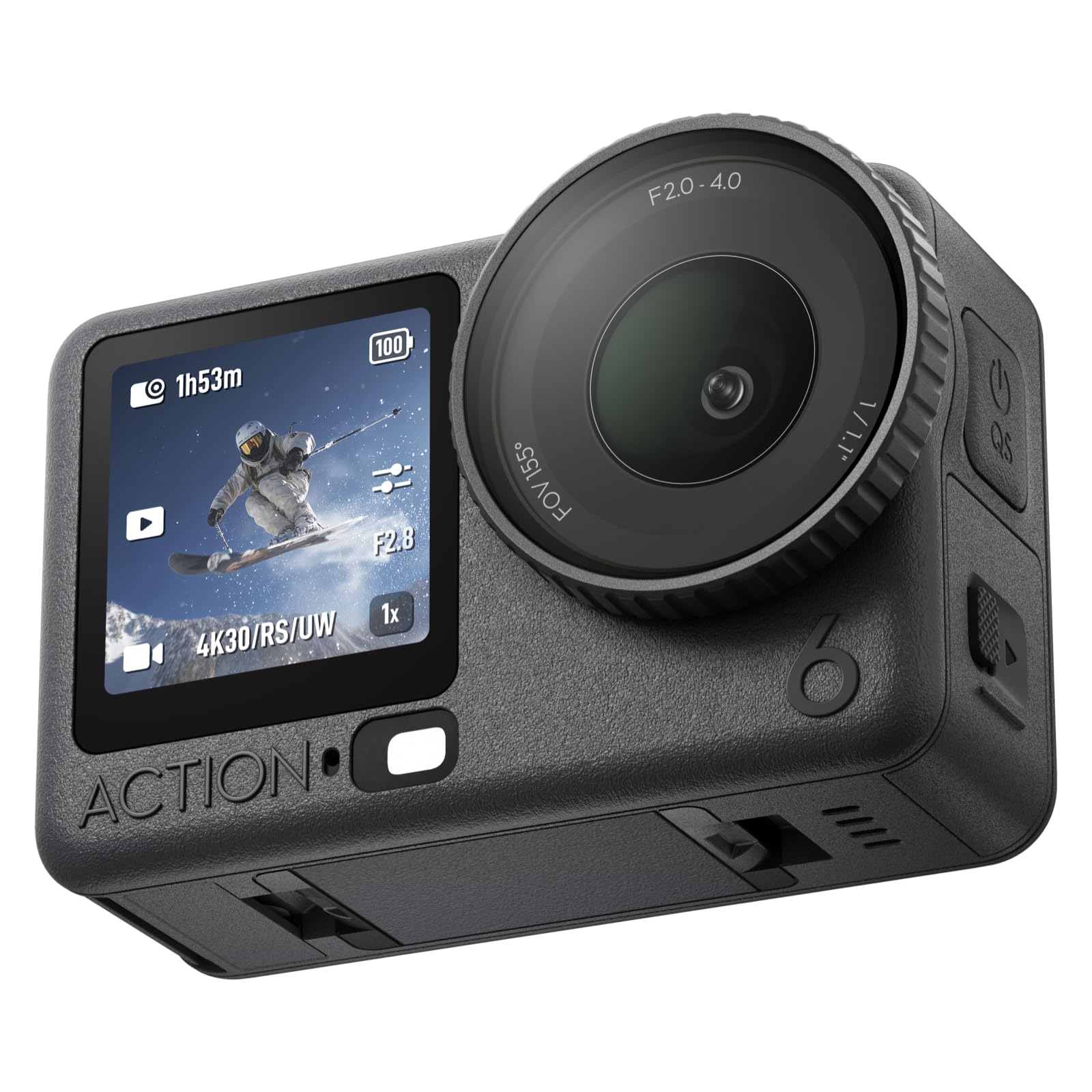
The DJI Osmo Action 6 breaks from the action camera pack with a 1/1.1-inch square sensor and a variable aperture spanning f/2.0 to f/4.0. This combination is not just marketing copy — the variable aperture genuinely adapts to changing light conditions, which means you can shoot from a bright ski slope into a shaded forest without the exposure jumping wildly. The 8K video capture (7680 x 4320) provides enough resolution headroom to crop in post-production while retaining 4K quality, a useful trick for framing shots after the fact. Waterproof to 20 meters (66 feet) without a housing, it beats the standard GoPro depth rating while delivering competitive stabilization via RockSteady 3.0 and HorizonSteady for 360° roll-axis correction.
The battery life claim of up to 4 hours in normal conditions is credible based on field reports — users consistently report shooting through a full day of hiking and water play without needing a recharge. The cold-resistant design keeps the battery functional in sub-zero temperatures, which is a must if you film winter sports. Having 50GB of built-in storage is a thoughtful safety net for when you inevitably forget your microSD card, and the direct connection to two DJI microphone transmitters without a receiver simplifies dual-person interview and vlog audio.
The Essential Combo is the stripped-down version — no curved adhesive base included — but it ships with the core mount, an anti-slip pad, and the Extreme Battery Plus. The display resolution is modest at 400 x 712 pixels, which is fine for framing but not for reviewing fine detail in the field. If you prioritize battery endurance, cold-weather performance, and a sensor that handles variable light, the Action 6 is the most balanced waterproof action camera on the market right now.
Why it’s great
- Variable aperture f/2.0–f/4.0 adapts to changing light without exposure jumps.
- Waterproof to 66ft (20m) without a case, beating the industry standard.
- 4-hour battery with cold-resistant design works in sub-zero conditions.
Good to know
- Essential Combo lacks the curved adhesive mount found in the standard kit.
- Front display resolution (400×712) is adequate but not crisp for reviewing footage.
3. OM System OLYMPUS Tough TG-7 Red

The OM System Tough TG-7 is the direct successor to the legendary TG-6, retaining the same rugged DNA: waterproof to 50 feet (15 meters), shockproof against a 7-foot drop, crushproof to 220 pound-force, and freezeproof down to 14°F (-10°C). What sets it apart from every action camera on this list is the dedicated variable macro system with four macro modes, including an underwater microscope mode that lets you focus as close as 1 centimeter from the subject. For snorkelers and divers who want to document tiny marine life — nudibranchs, coral polyps, shrimp — this is the only camera under that delivers true macro capability underwater without requiring an aftermarket wet lens.
The F2.0 maximum aperture lens with 4x optical zoom (25-100mm equivalent) gives you genuine optical reach underwater, something no fixed-lens action camera can offer. The 5 underwater shooting modes (including underwater HDR) are not marketing gimmicks — they adjust white balance and contrast based on actual underwater image data, producing accurate colors down to moderate depths without manual tweaking. The Tough TG-7 shoots 4K video at 30fps and 120fps high-speed at 1080p, along with vertical video mode for social media. Raw photo capture is supported, giving you latitude for post-processing exposure corrections.
The sensor size is roughly equivalent to a high-end smartphone (1/2.3-inch BSI CMOS, 12MP effective), so low-light performance is not its strong suit — you will see noise above ISO 800, and the autofocus uses contrast detection with only 9 points, which can hunt in dim water. The LCD is 3 inches with 1.04M dots, but the menu system requires pre-adjustment for underwater shooting; you cannot just point and shoot without choosing an underwater mode. For dedicated underwater photographers and macro enthusiasts who need optical zoom and raw files, the TG-7 remains the uncompromising compact choice.
Why it’s great
- Variable macro system with underwater microscope mode for 1cm close-ups.
- 4x optical zoom (25-100mm equivalent) gives real reach underwater.
- Five dedicated underwater shooting modes for accurate color and contrast.
Good to know
- Small sensor struggles in low light; noise visible above ISO 800.
- Autofocus (contrast detection, 9 points) hunts in dim water conditions.
4. GoPro HERO13 Black

GoPro’s HERO13 Black refines the formula that made the brand synonymous with action cameras, centering on a 1/1.9-inch sensor that captures 5.3K video at up to 60fps. The headline feature is the HB-Series Lens compatibility with auto-detection — attach the Ultra Wide Lens Mod, Macro Lens Mod, or Anamorphic Lens Mod, and the camera automatically adjusts its settings. In practice, this means you can swap from a sweeping POV to a macro insect shot to a cinematic 21:9 ratio without diving into the menu. The HyperSmooth stabilization is best-in-class: it rivals gimbal-level smoothness even during high-impact sports, and the Burst Slo-Mo mode records at up to 13x normal speed for catching split-second action.
The waterproof rating of 33 feet (10 meters) without a housing covers snorkeling, surfing, and pool use, but serious divers will need the dive housing for deeper depths. The included Enduro battery performs well in cold weather, though the camera draws significant power when recording in 5.3K at high frame rates — expect closer to 79 minutes of continuous recording at maximum quality. The water-repelling lens cover reduces flare and artifacts, which is a practical improvement for shooting in bright, wet environments. The GoPro Quik app provides straightforward editing tools, and wireless Bluetooth audio via AirPods works reliably for voiceover or vlog narration.
The HERO13 has a battery life ceiling of roughly 79 minutes when shooting in 5.3K, which means serious all-day outings require swapping batteries. The magnetic mounting system is proprietary, so existing GoPro buyers with a collection of old mounts will need adapters for full compatibility. If your priority is the smoothest stabilization possible with the flexibility of interchangeable lens mods, the HERO13 Black remains a top-tier choice.
Why it’s great
- HyperSmooth stabilization delivers gimbal-level smoothness in sports footage.
- HB-Series lenses with auto-detection enable quick creative swaps.
- Burst Slo-Mo at 13x normal speed for catching split-second action.
Good to know
- Battery life drops to ~79 minutes at 5.3K high-quality recording.
- 33ft depth rating limited for serious diving without an additional housing.
5. DJI Osmo 360 Essential Combo
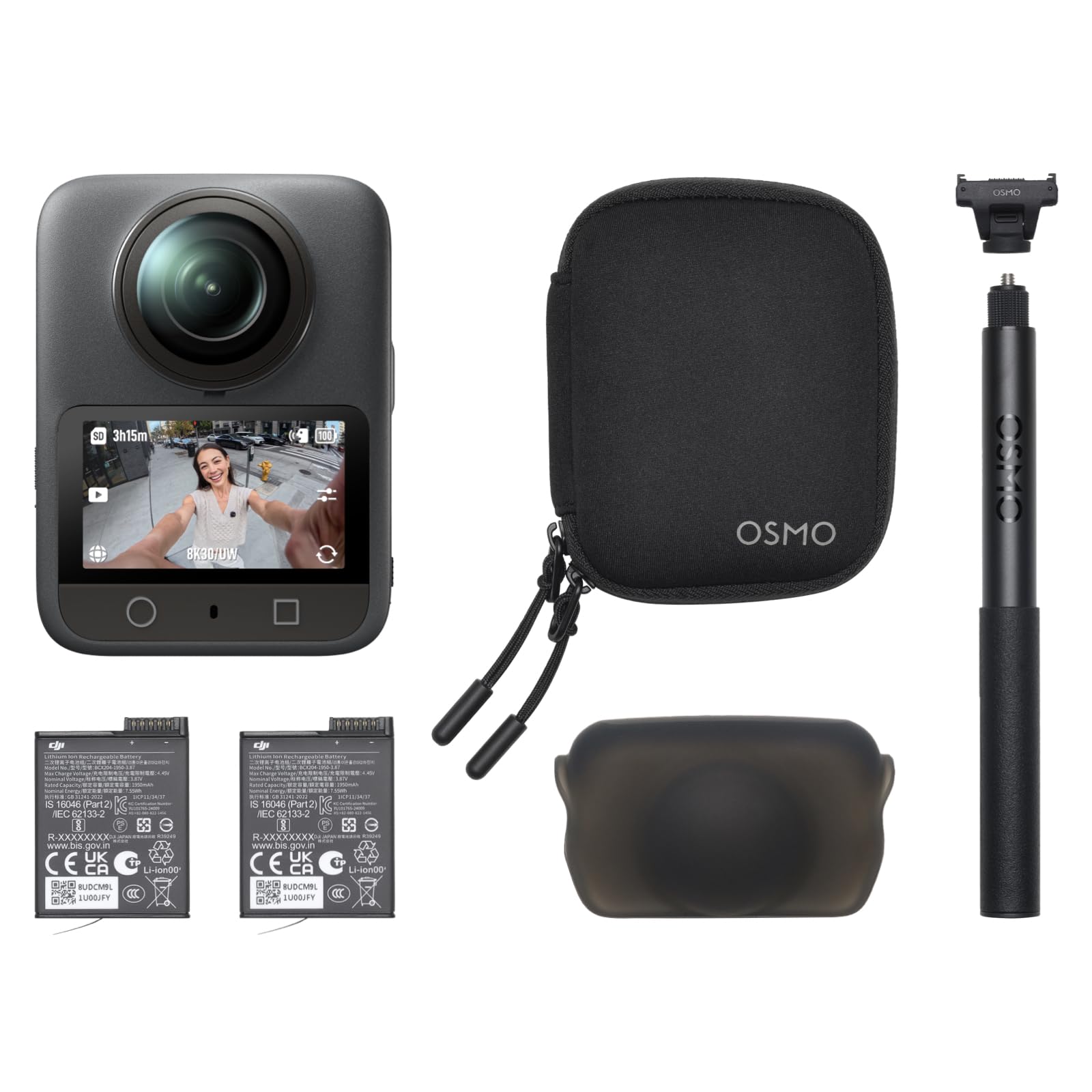
The DJI Osmo 360 distinguishes itself with a 1-inch 360° imaging sensor, which is substantially larger than the 1/1.28-inch or 1/1.9-inch sensors found in standard action cameras. This translates directly to better low-light performance and higher dynamic range in 360-degree video — the 8K/30fps 360° footage has noticeably more latitude for color grading than the compression-heavy output of smaller-sensor 360 cams. The 1.2-meter invisible selfie stick creates the signature third-person effect, and the magnetic quick-release system is compatible with Osmo Action mounts and standard 1/4-inch thread gear, making it easy to swap between 360° capture and single-lens vlog mode.
Battery endurance of up to 190 minutes (with two batteries in the Essential Combo) is generous for a 360 camera, and the 105GB built-in storage eliminates the immediate need for a memory card — though you will still want one for longer shoots at 8K resolution. The four-microphone array supports direct connection to two DJI microphone transmitters without a receiver, a serious advantage for capturing clean dual-person audio during travel interviews or action voiceovers. The DJI Mimo app includes Pano Dewarp and Pano Pro Color Grading tools that streamline the post-processing workflow, though editing 360° footage still requires more time and understanding than standard video.
The Essential Combo includes the 1.2m selfie stick and an extra battery, but does not include a tripod or a carrying case. The learning curve for editing 360° content is real — you must reframe every shot after recording, which takes practice. If you want the highest image quality possible from a 360° waterproof camera and are willing to invest time in the editing workflow, the Osmo 360 delivers professional-grade results that smaller-sensor competitors cannot match.
Why it’s great
- 1-inch 360° sensor provides superior low-light performance and color latitude.
- 105GB built-in storage plus 190-minute battery across two packs.
- Magnetic quick-release system works with both DJI mounts and 1/4-inch gear.
Good to know
- 360° editing workflow requires more post-processing time and skill.
- Essential Combo lacks a tripod and carrying case — plan for extras.
6. PENTAX WG-90 Black
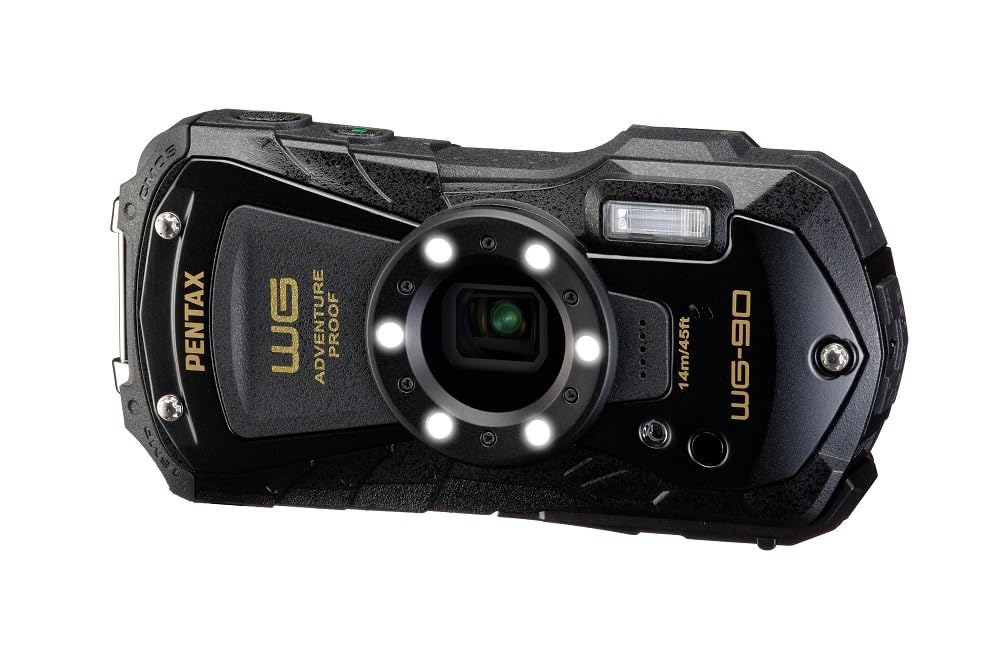
The PENTAX WG-90 is a purpose-built rugged compact with a 16MP back-illuminated CMOS sensor and a 5x optical zoom lens (28-140mm equivalent) that covers wide landscapes to moderate telephoto. Its defining feature is the 6-LED ring light array positioned around the lens barrel, which provides bright, even illumination for subjects as close as 1 centimeter away — a critical spec for inspection work, forensic photography, or documenting tiny mechanical details in wet or dirty environments. The camera is waterproof to 14 meters (46 feet), shockproof against a 1.6-meter drop, and freezeproof to -10°C, making it one of the toughest compact cameras in this price range.
The Digital Microscope Mode goes beyond standard macro by allowing extended observation and capture at minimum focusing distance, which is useful for documenting corrosion, circuit board damage, or biological samples. The AR-coated 2.7-inch LCD includes an Outdoor View Setting mode that boosts brightness for shooting in direct sunlight, a practical feature that is often overlooked in cheap action cameras. The Triple Anti-Shake system uses a combination of sensor-shift and digital correction to reduce blur in low-light handheld shots, though it does not replace a tripod for serious macro work. The Underwater and Underwater Movie shooting modes optimize color temperature and contrast specifically for below-surface photography, which produces more natural-looking results than generic auto white balance.
The auto mode produces soft images compared to manual settings, and the video capabilities top out at Full HD (1080p) rather than 4K, which is a notable gap for a camera at this price point. The battery life is rated at approximately 2 hours of continuous operation, and the instruction manual is notoriously sparse — users report needing to experiment with settings or use third-party guides to unlock the camera’s full potential. For field technicians, surveyors, or macro enthusiasts who need a waterproof, dustproof, and freezeproof camera with built-in macro lighting, the WG-90 is a specialized tool that nothing else in this list can replicate.
Why it’s great
- 6-LED ring light provides even illumination for 1cm macro subjects.
- Digital Microscope Mode enables extended close-up observation and capture.
- Ruggedized to 14m waterproof, 1.6m shockproof, and -10°C freezeproof.
Good to know
- Auto mode produces soft images; manual settings yield much better results.
- Video limited to Full HD 1080p — no 4K recording available.
- Battery life ~2 hours continuous; modest for a full day of field work.
7. Ricoh WG-80 Orange

The Ricoh WG-80 shares the same rugged chassis DNA as the PENTAX WG-90, with waterproofing to 14 meters (46 feet), shockproof construction, and freezeproof operation down to -10°C. The WG-80 is equipped with a back-illuminated 16MP CMOS sensor and a 5x optical zoom lens with a 28-140mm equivalent focal range, but it lacks the WG-90’s 6-LED ring light — instead, it has a standard built-in flash. This positions the WG-80 as a slightly more affordable version of the same rugged concept, best suited for general outdoor documentation where macro illumination is not the primary requirement. The Underwater and Underwater Movie shooting modes are carried over, optimizing color balance for submerged photography and video.
Construction workers, surveyors, and insurance inspectors form the core user base for this camera — the bright orange body is easy to spot on a messy jobsite, and the dustproof and crushproof ratings provide confidence when the camera is tossed into a toolbox or pocket alongside heavy equipment. The Macro Stand accessory maintains a 1cm minimum focusing distance for close-up captures, though without the LED ring, you will need to rely on ambient light or the flash for macro subjects. The autofocus uses contrast detection with a single point, which is slow by modern standards, but adequate for stationary subjects like a pipe joint or a damaged building surface. The battery uses a standard lithium-ion rechargeable pack, and users report acceptable run times for a day of intermittent documentation.
The image quality is exactly what you would expect from a 1/2.3-inch sensor of this generation: decent in bright light, noisy and prone to white blowout in high-contrast or low-light scenes. The 2.7-inch LCD is functional but not particularly sharp, and there is no touchscreen. The video is limited to 1080p at 30fps, without any image stabilization, so handheld walking footage will appear jittery. If your use case is strictly industrial or outdoor field documentation where durability is paramount and image quality is secondary, the WG-80 offers the same body toughness as the WG-90 at a lower cost.
Why it’s great
- Dustproof, shockproof, freezeproof, and waterproof to 14m — real jobsite toughness.
- 5x optical zoom (28-140mm) provides versatile focal range for documentation.
- Bright orange body is easy to spot in cluttered or low-visibility environments.
Good to know
- No 4K video and no image stabilization — handheld footage can be jittery.
- Autofocus is slow (single-point contrast detection); best for stationary subjects.
- No macro ring light; close-up shots require flash or external lighting.
8. Kodak PIXPRO WPZ2 Yellow Bundle

The Kodak PIXPRO WPZ2 is a straightforward, no-nonsense waterproof compact designed for people who want a camera that works in the water without spending action-camera money. It is waterproof to 49 feet (15 meters), shockproof against a 2-meter drop (6.6 feet), and dustproof — a ruggedness rating that exceeds many budget action cameras. The 4X optical zoom lens (27-108mm equivalent) is one of the few in this price tier that provides true optical reach, and the 16MP CMOS sensor captures adequate 1080p Full HD video. The bundled 32GB SD card, floating strap, monopod, card reader, and protective case make it a complete out-of-box solution for a first-time buyer.
Shooters who need an easy-to-use camera for snorkeling, pool parties, or beach trips will find the WPZ2 intuitive — the menu uses simple icons and the shooting modes include underwater white balance presets that removed the blue-green tint in customer tests. The 2.7-inch LCD is not touch-sensitive, but the physical buttons are large and clearly labeled, which is a genuine advantage when your hands are wet or you are wearing dive gloves. The battery life is surprisingly strong, with users reporting over 4 hours of mixed use, partly because the camera does not have power-hungry features like Wi-Fi streaming or 4K processing. The floating strap is a clever inclusion that prevents the camera from sinking if dropped.
The image quality is noticeably behind modern smartphones in dynamic range and low light — expect soft corners, visible noise above ISO 400, and purple fringing on high-contrast edges. The video is capped at 1080p at 30fps with no stabilization, so you need steady hands for usable footage. The camera uses AA batteries (not included in the bundle), which is a double-edged sword — you can buy alkalines anywhere, but you will go through them faster than a rechargeable pack. For casual water adventurers who want a truly drop-in, worry-free waterproof camera with optical zoom, the WPZ2 delivers remarkable value.
Why it’s great
- Waterproof to 49ft (15m) and shockproof to 2m drop — very rugged for the price.
- 4X optical zoom (27-108mm) provides real reach underwater.
- Bundle includes SD card, floating strap, case, monopod — ready to use out of the box.
Good to know
- No 4K video and no image stabilization — best for bright, stationary shots.
- Uses AA batteries (not included), which have shorter life than rechargeable packs.
- Dynamic range and low-light performance lag behind modern smartphones.
9. AKASO Brave 7 LE Bundle

The AKASO Brave 7 LE is an action camera that punches above its weight class by offering features normally reserved for mid-range models: a front-facing color screen for selfie framing, 4K30fps video with electronic image stabilization (EIS 2.0), and a depth rating of 131 feet (40 meters) when used inside the included waterproof housing. The IPX7 water-resistant body handles rain and splashes without the housing, and the bundle includes two rechargeable batteries, a remote control, and a full mounting kit. Customer feedback consistently praises the battery life (around 2 hours of continuous recording) and the remote’s ease of use for hands-free start/stop.
The dual-screen design is a genuine advantage for vloggers who frame themselves — the front screen is vibrant enough to check composition in bright daylight, and the rear 2-inch touchscreen responds well for menu navigation. The 6-axis EIS 2.0 stabilization does a decent job smoothing out walking footage, though it does not match the gimbal-like performance of GoPro’s HyperSmooth or DJI’s RockSteady. The 20MP still photos are adequate for social media sharing in good light, and the digital zoom (4x) is best avoided for serious shots. The included remote control lets you start and stop recording from a wrist-mount, which is a useful feature for helmet or handlebar mounting when you cannot reach the camera.
The housing adds bulk and mutes audio, though the camera does record usable sound when used without it in dry conditions. The camera settings require learning — the default auto modes produce acceptable footage, but tweaking exposure compensation and white balance manually yields noticeably better results, especially in mixed lighting. The 4K30fps footage shows good detail for the price but is soft compared to DJI or GoPro output, particularly in shadows. For budget-conscious adventurers who want a front-facing screen, long depth rating, and starter kit accessories, the Brave 7 LE is a compelling entry-level waterproof camera.
Why it’s great
- Front-facing color screen simplifies selfie and vlog framing.
- Water depth rating of 131ft (40m) with the included housing — best in class for price.
- Bundle includes remote control and two rechargeable batteries for extended shooting.
Good to know
- Housing mutes audio; use without housing for better sound in dry conditions.
- EIS stabilization smooths walking but lags behind premium brand performance.
- 4K footage is softer than DJI/GoPro output, especially in shadow areas.
FAQ
Can I use a waterproof action camera for freediving past 30 meters?
Does image stabilization make a difference in underwater video?
Why is sensor size important for an underwater camera?
What does “freezeproof” mean for a camera?
Final Thoughts: The Verdict
For most users, the best waterproof camera winner is the Insta360 X5 because it marries the deepest off-housing waterproof rating (49ft) with 8K 360° capture, replaceable lenses, and a 208-minute battery that genuinely lasts a full day of heavy use. If you want a dedicated video-first action camera with all-day endurance and cold-weather capability, grab the DJI Osmo Action 6. And for serious underwater macro photography where optical zoom and raw files are non-negotiable, nothing beats the OM System Tough TG-7.

Mo Maruf
I created WellFizz to bridge the gap between vague wellness advice and actionable solutions. My mission is simple: to decode the research and give you practical tools you can actually use.
Beyond the data, I am a passionate traveler. I believe that stepping away from the screen to explore new environments is essential for mental clarity and physical vitality.